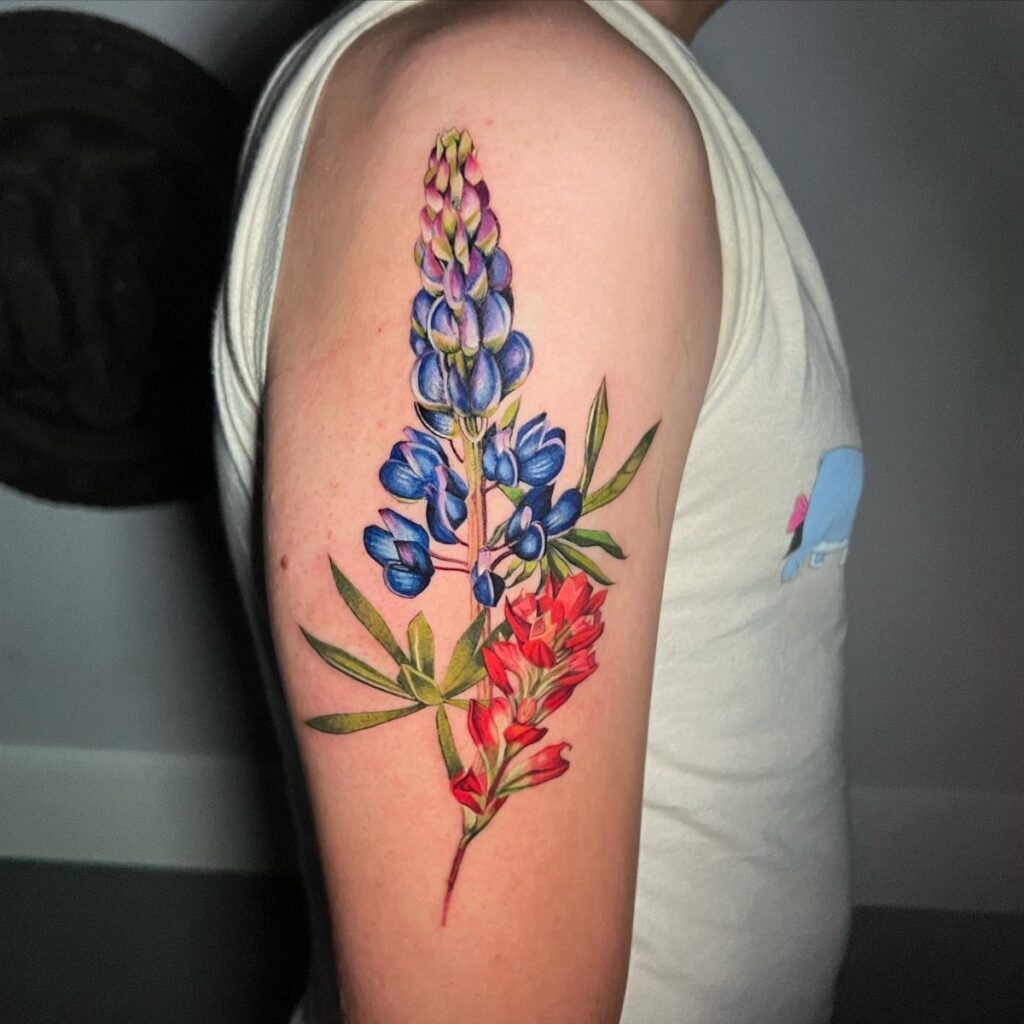
Bluebonnet tattoos range from fine line ankle pieces no larger than a finger’s length to clustered stems alongside Texas map silhouettes, and the right one depends on whether you need it to read across a room or only when someone leans in close.
The watercolor styles demand healed photos before you commit, since cobalt and ultramarine fade on their own timeline, while traditional heavy outlines trade that softness for lines that stay crisp year after year.
Cobalt and ultramarine are the blues most artists reach for.
1. Watercolor Bluebonnet and Texas Wildflowers Tattoo
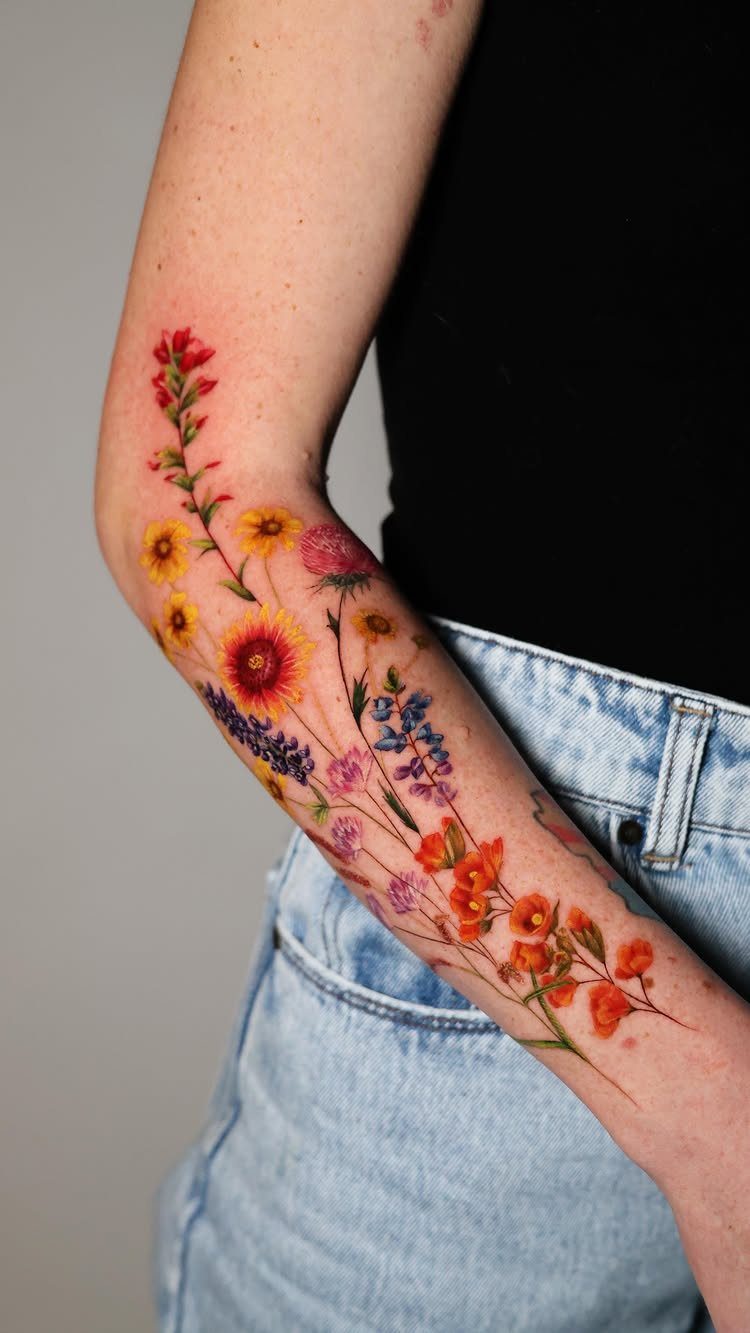
Watercolor blends better on skin than you would expect, at least from an artist who understands how pigment diffuse in the skin versus paint on paper.
Botanical watercolor work takes a specific hand; ask to see healed photos, not fresh work, since the colors settle and fade differently once the skin has fully recovered.
Texas wildflowers give you natural companions to the bluebonnet, Indian paintbrush in red-orange and the yellow bits that appear on early bluebonnet buds.
I would keep the background clean. Let the colors bleed at the edges of each flower rather than boxing them in, and place the cluster where the arm moves, because watercolor tattoos catch light differently as the skin shifts.
2. Clustered Bluebonnet Tattoo
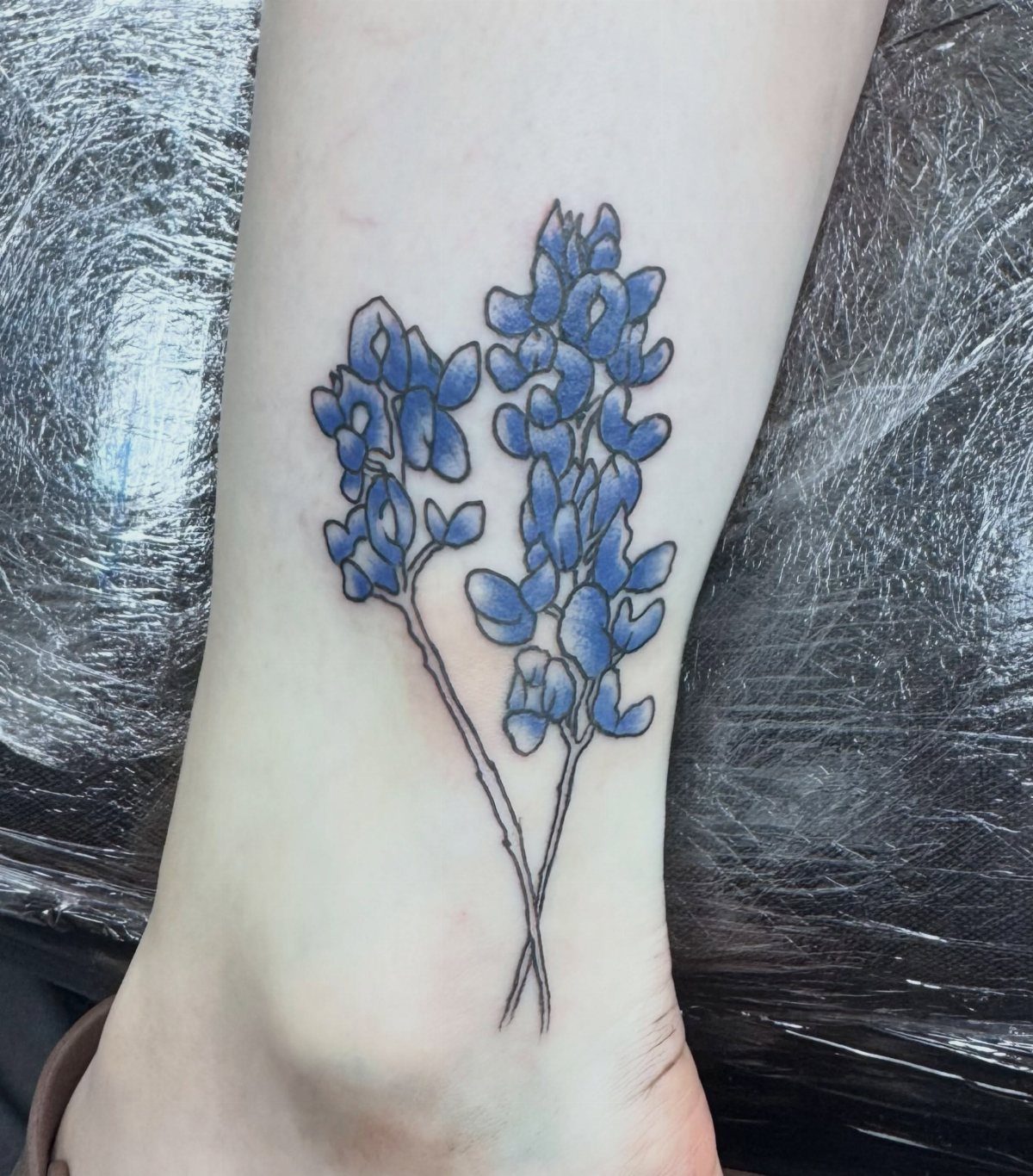
A cluster reads as one shape from a distance and opens into detail only when someone is close enough to ask about it. That is the appeal for a stem you want readable at arm’s length without shouting.
2 crossed stalks with blossoms at each tip anchor well on the lower leg, the ankle bone giving a natural pivot point.
The cluster sits best when the flowers are slightly asymmetrical, one stem heavier with blooms than the other, because real bluebonnets grow that way in fields grazed by deer or beaten by wind.
Green leaves spaced down the lower stem keep the eye moving, preventing the blue from floating untethered.
Anticipate touch-ups. Clustered color settles unevenly on the shin and calf, and the blues used for bluebonnets, mostly cobalts and ultramarines, fade faster than black.
3. Fine Line Bluebonnet Tattoo
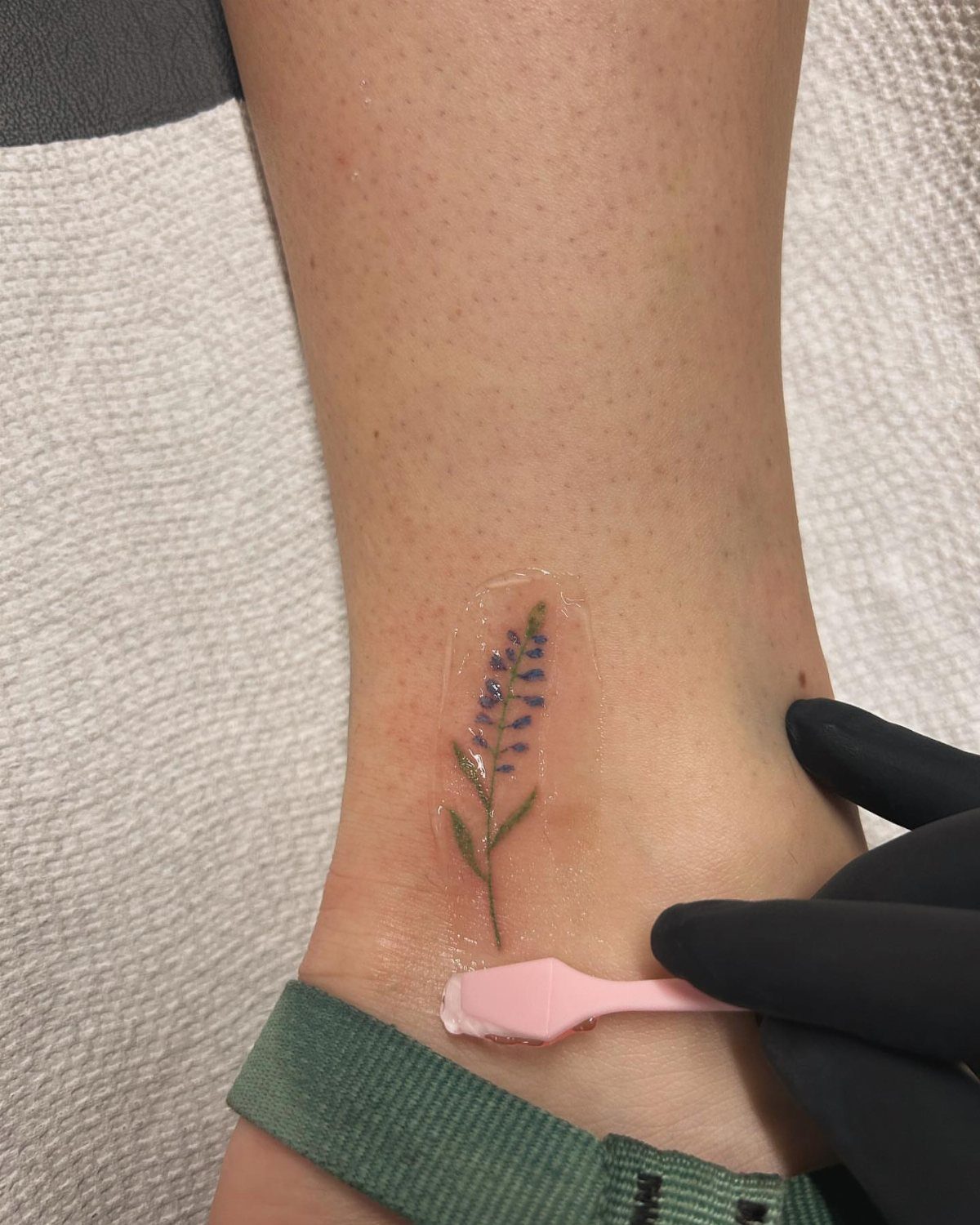
Single-needle work suits the bluebonnet because the flower itself is structurally simple: a vertical stem, a curve of leaf, the small blossoms arrayed like beads. Nothing needs bold weight to read correctly.
The design holds at small sizes, which matters for placement near the ankle bone where skin stretches and shifts.
A black ink drawing with delicate leaves and buds spaced along the stem ages into something that resembles a woodcut or a botanist’s field sketch.
Dotwork accents near the flower bases add texture without bringing in color that would require maintenance.
A fine line tattoo opens small. The image under this entry sits under a healing film, and the aftercare matters more here than with heavier work because the lines are shallow.
Keep the ointment thin, let it dry before clothing touches it, and expect the first pass to soften before it settles.
4. Traditional Bluebonnet Tattoo
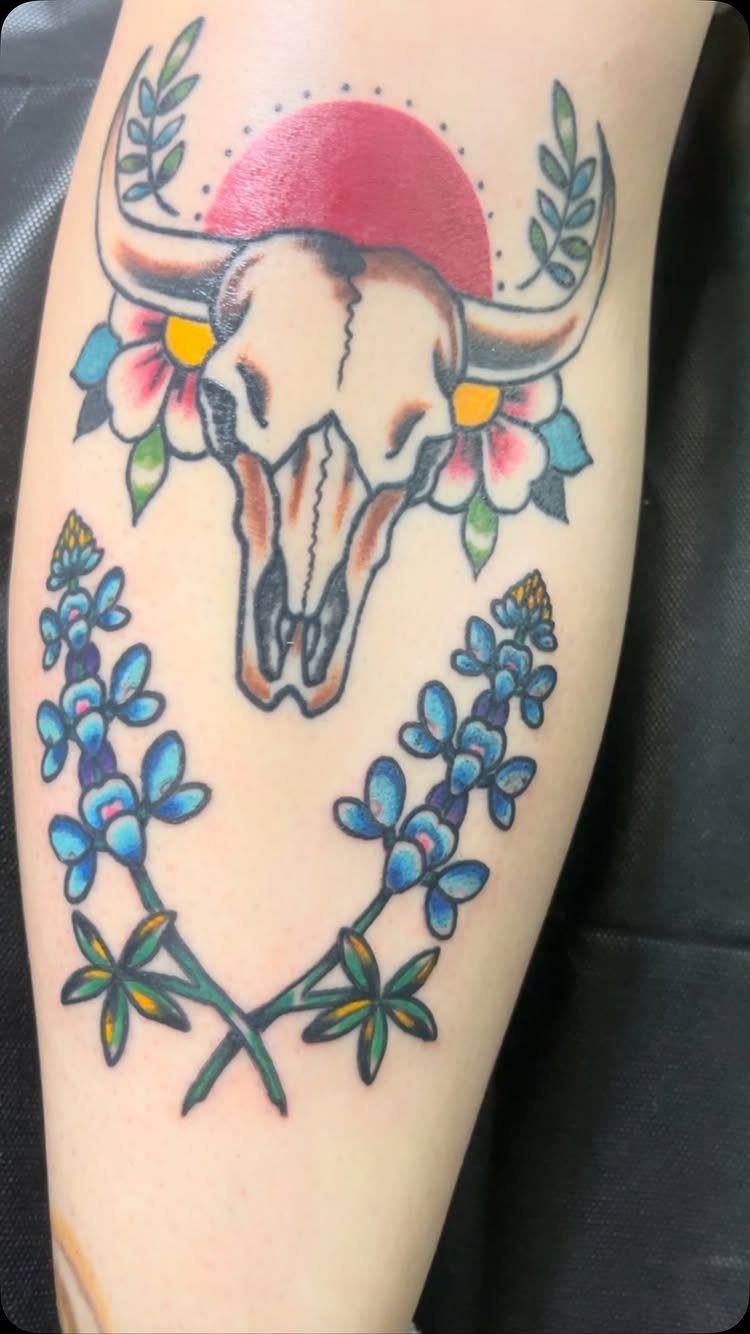
American traditional framing gives the bluebonnet an outsider’s respect, the way Japanese tattooers treated foreign flowers in the 20th century.
Bold outlines and limited color, usually a strong blue for the petals and a flat green for stems and leaves, read immediately against skin.
The style pairs naturally with Texas iconography, a steer skull above, a red sun behind, the flowers crossed below like a botanical signature.
Traditional ink lasts decades with minimal shift because the pigment load is heavy and the design values silhouette over subtlety. You trade the softness of a watercolor cluster for permanence and clarity from across a room.
This suits someone who already wears traditional pieces or who wants one strong Texas reference rather than a flower for its own sake.
5. Bluebonnet and Texas Map Tattoo
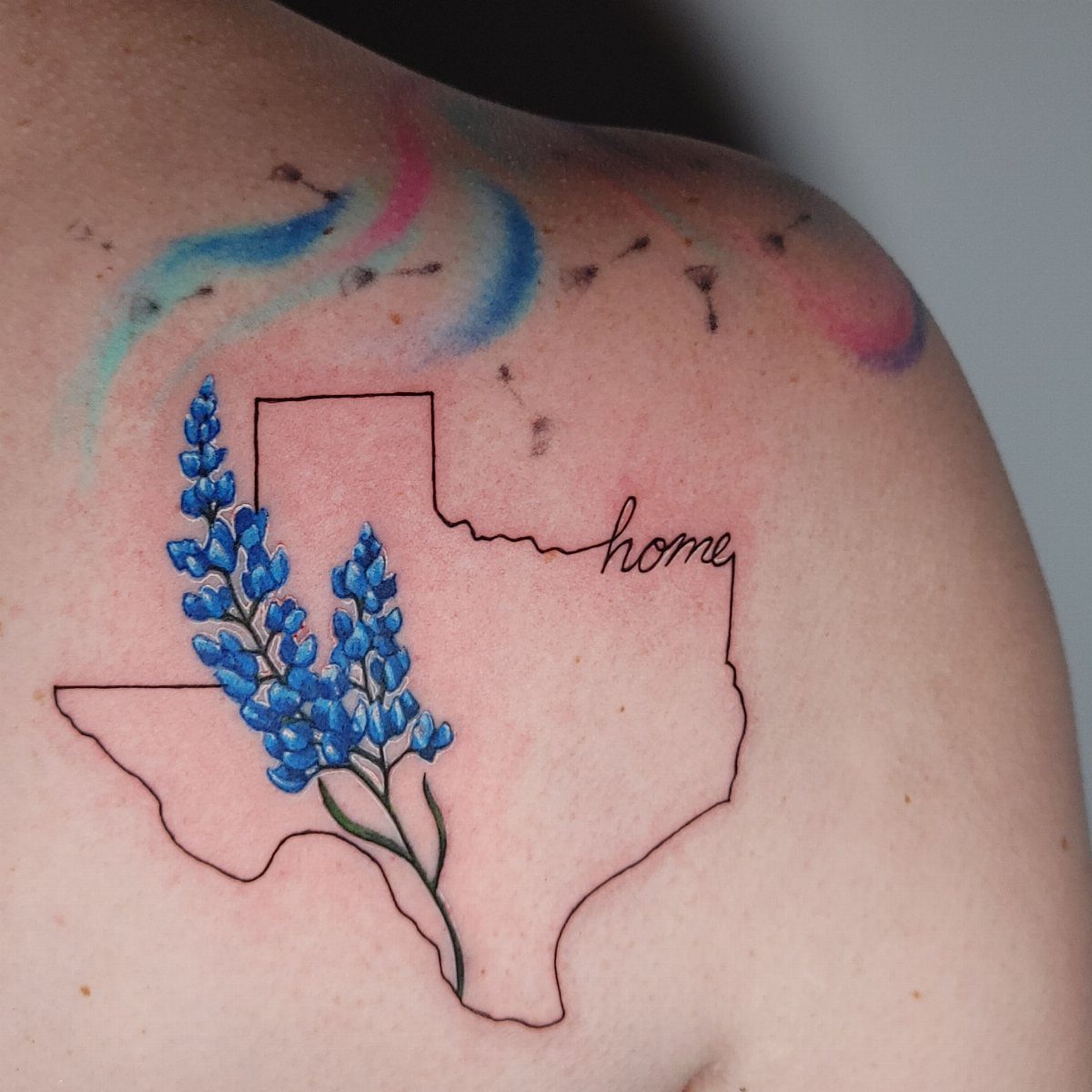
The map silhouette works as negative space, an absence of ink that shapes the flowers around it, or as color field, sunset tones behind the stems.
Either version keeps the state outline recognizable at sizes where individual flower details would blur.
Layering blue wildflower stalks over the map means deciding which element dominates.
In the version visible here, the flowers sit forward, the map acting as ground. The reverse, a strong outline with small flowers tucked inside, reads more like a flag or a brand and less like a garden.
The word "home" anchors meaning if you want that explicit, though the bluebonnet alone already signals Texas to most viewers who would recognize the flower at all.
6. Bluebonnet Tattoo on the Ankle
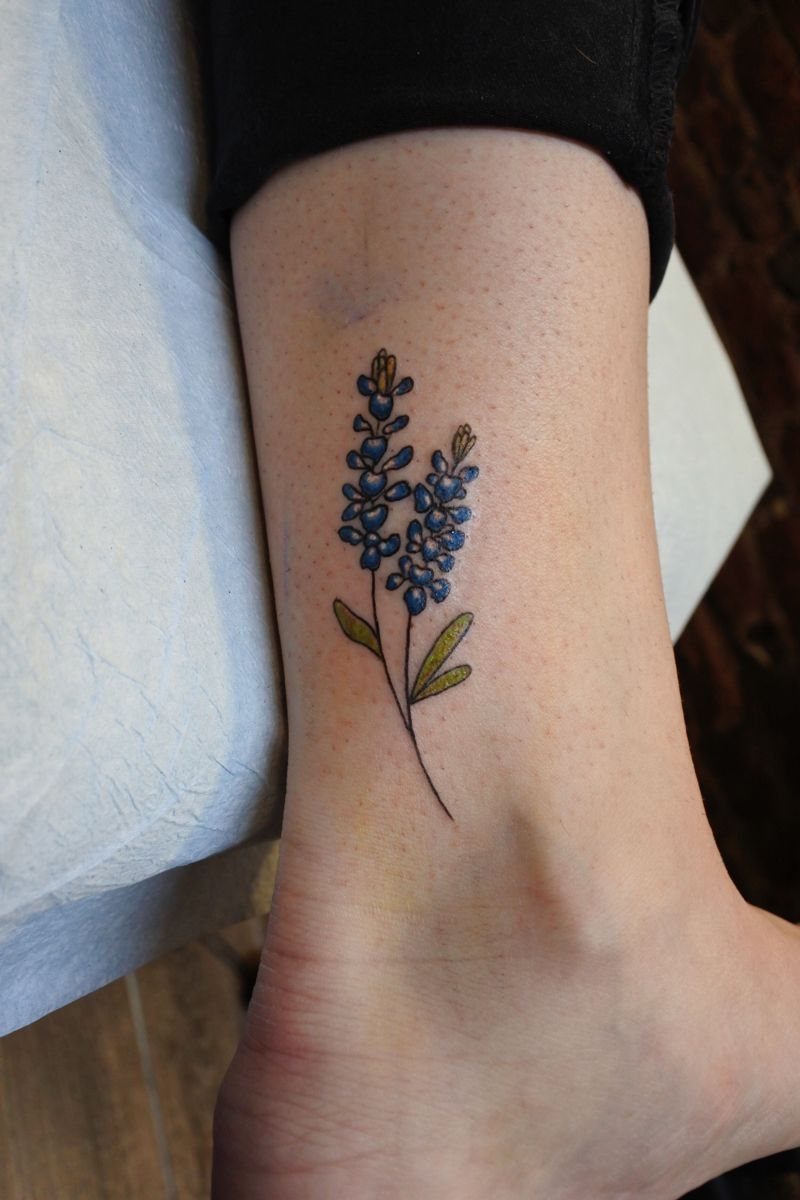
The ankle is narrow bone and thin skin, so a small tattoo with limited color heals cleanly and stays put.
Blue flowers with green leaves fit vertically along the outer ankle, the stem following the line toward the foot, or tucked slightly back where socks or hems naturally cover it.
This placement suits a first tattoo or an addition that needs to stay quiet in professional settings.
The bone means more vibration from the needle and a longer, flatter healing phase; plan for shoes that do not rub at the edge until the skin has closed over.
Size matters more here than detail, because the ankle twists and flexes constantly, and fine linework can blow out where the skin is thinnest.
I would ask the artist to simplify the leaf count and keep the blue saturated rather than shaded.
Symbolism of Bluebonnet Tattoos
The bluebonnet carries meaning beyond state pride, though that remains the common reason people sit for one.
Resilience sits in the flower too: it colonizes fields that burned the season before, roots deep enough to survive drought, blooms briefly and thickly when conditions turn.
A tattoo can hold that thread without naming it, the flower standing for someone who came through a hard season intact.
Beauty operates more quietly. The petals are not symmetrical up close, the color shifts from near-white at the tip to saturated violet lower down, and that irregularity is what field guides illustrate.
A tattoo that keeps those gradients rather than flattening to one blue holds the actual flower more honestly.
The state connection needs no explanation in Texas and reads as regional pride elsewhere; the resilience layer asks only that the wearer know why they chose it.
Placement Ideas for Bluebonnet Tattoos
Arms and thighs offer the width for a cluster that spreads naturally, the flowers arranged as they grow rather than compressed to fit.
Thigh skin is stable, less sun-exposed than forearms, and holds color longer; the trade is visibility, since a bluebonnet there stays under clothing except at beaches or in shorts.
Back placement suits something the wearer wants to feel more than display, positioned where a mirror catches it or where a partner might comment.
The skin is thicker, healing is straightforward, and the canvas allows for a map silhouette or paired elements without crowding.
First-timers often default to wrist or collarbone for visibility; I would steer toward the outer ankle or the upper arm instead.
Both heal predictably, and the bluebonnet’s vertical stem fits the body’s lines without the distortion that comes from wrapping a design around a narrow joint.
Color Variations in Bluebonnet Tattoos
The blue itself is not fixed.
Fresh bluebonnets carry a dusting that reads pale in direct sun; the saturated color in most tattoos is a choice, not a report, and artists move between cobalt, ultramarine, and mixes that lean violet depending on the batch of petals they reference.
Watercolor work brings in the companions: Indian paintbrush in red-orange, early bud yellow, sometimes green-gold stems where the wildflower field is the subject rather than the single flower.
Those additions age differently, the warmer colors holding or fading on their own schedule, so a healed photo matters more than the fresh brightness when you evaluate an artist.
Traditional framing limits the palette on purpose, the strong blue and flat green chosen for contrast and longevity.
The watercolor crowd accepts more variation; the traditional wearer gets a flower that reads as the idea of bluebonnet more than botanical record.
Neither is wrong, but the color story commits you to one camp or the other before the needle starts.
Frequently Asked Questions
What does a bluebonnet flower tattoo symbolize?
The bluebonnet’s value goes beyond state lines: the root system digs down past ten feet, and the plant comes back thicker after a fire scorched the ground months earlier.
What makes the flower hard to tattoo well is the same thing that rewards the effort; the petal shifts from almost white at the tip into a purple so saturated it looks wet, and a design that catches that shift keeps the color alive instead of sinking it to a single flat tone.
What is the 1/3 rule tattoo?
A composition guideline some artists call the 1/3 rule keeps the main subject off-center so the eye moves across the skin; the bluebonnet’s vertical shape suits it, with the bloom cluster sitting high and the stem drawing the gaze downward.
I do not work with that framework when planning bluebonnet placement; instead, I look at where vertical stem lines follow natural body lines and how cluster density reads at the distance that placement typically gets viewed.
What is the prettiest flower to get tattooed?
That depends on whose skin the flower sits on and what they need it to say.
Bluebonnets suit people who want a structurally simple shape with specific regional meaning, since the vertical stem and clustered blossoms fit narrow placements and the color story stays recognizably Texan.
For someone without that connection, the same visual qualities might read as a generic blue flower.