A death star tattoo renders the Empire’s planet-destroying station into permanent ink, but the same spherical simplicity that makes it iconic also makes it unforgiving to place.
A circle warps fast on skin that stretches or flexes, so the shoulder’s deltoid curve, which mirrors the station’s own geometry, often works better than a wrist that twists the trench line out of true.
Colin Cantwell’s original 1977 model was itself a stripped ping-pong ball before ILM added surface clutter; tattoo styles from minimalist linework to American traditional still borrow from that first, clean silhouette.
1. Minimalist Death Star Tattoo
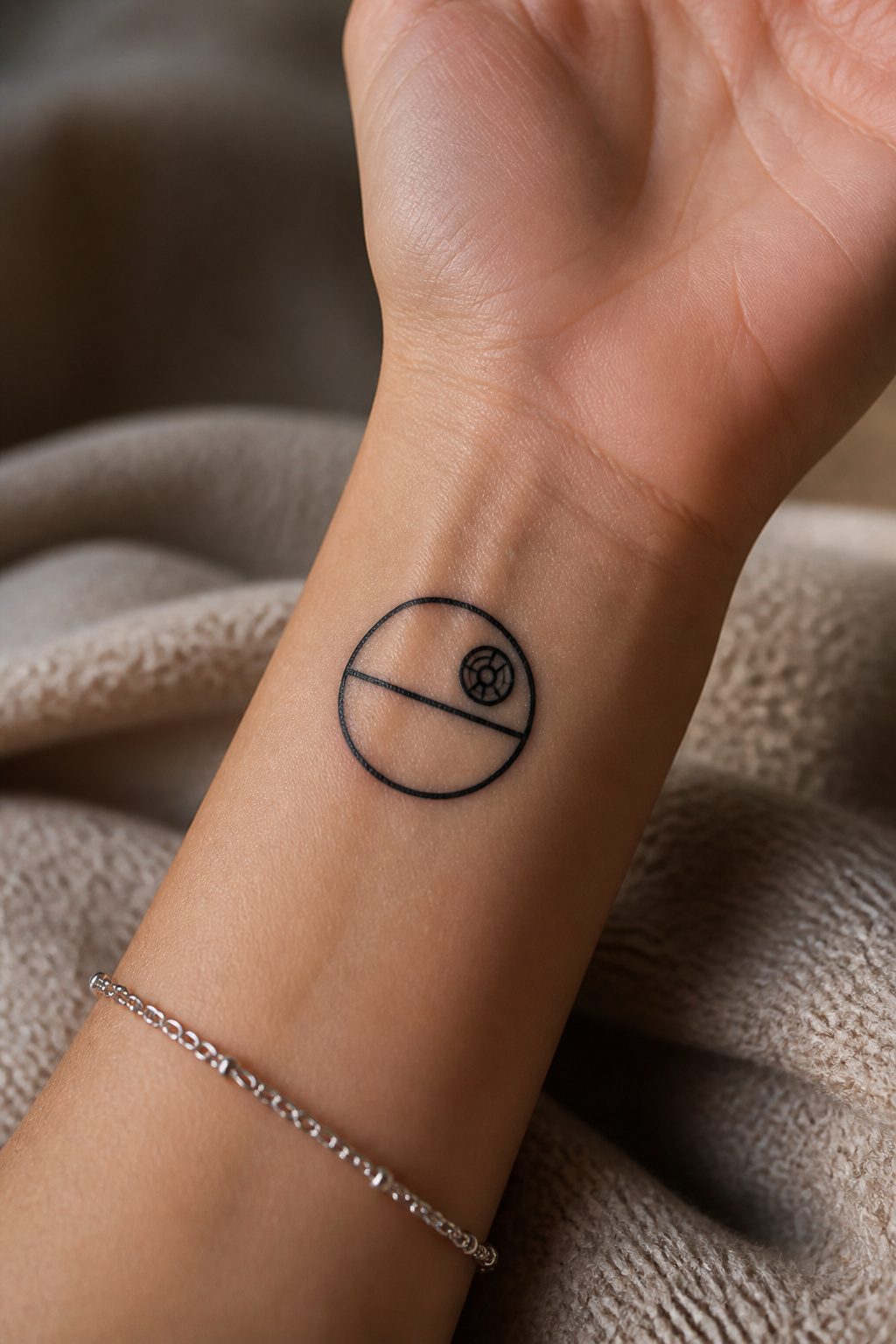
Clean linework strips the Death Star to a sphere, a single trench, and nothing else.
That restraint is exactly why this style works for a first tattoo or a small spot like the inner wrist or behind the ear: the design stays readable at an inch across, and the sitting time runs short enough that anxiety about the needle rarely builds into real discomfort.
Colin Cantwell’s original model for the station was itself a pared-down geometric form, a half-painted ping-pong ball clamped in place before ILM layered on greebles and surface noise for the screen.
A minimalist tattoo returns to that first idea, the recognizable silhouette before the clutter.
The risk with any simple design is placement on a body area that stretches or twists, which can warp that perfect circle over time.
An experienced artist will map the stencil with the arm relaxed and then again with the muscle flexed, checking that the trench line stays level from both angles.

Clean, Flawless Transfers: Your artwork will look so clean once transferred to the skin with the Stencil Stuff gel! Gentle on the skin, Stencil Stuff transfer solution helps you achieve clear and sharp tattoo stencil transfers every time!

Safe and Healthy: Our tattoo transfer gel meets strict safety and non-toxic material standards, non-irritating to the skin and vegan-friendly. Maintains client comfort while achieving clear tattoo stencil transfers.

Precise Transfer: Using our tattoo stencil gel transfers both the pattern and lines to the skin clear and sharp, preserving every detail of your artwork. No smudging or fading for a clean, flawless transfer.
2. Darth Vader Death Star Tattoo
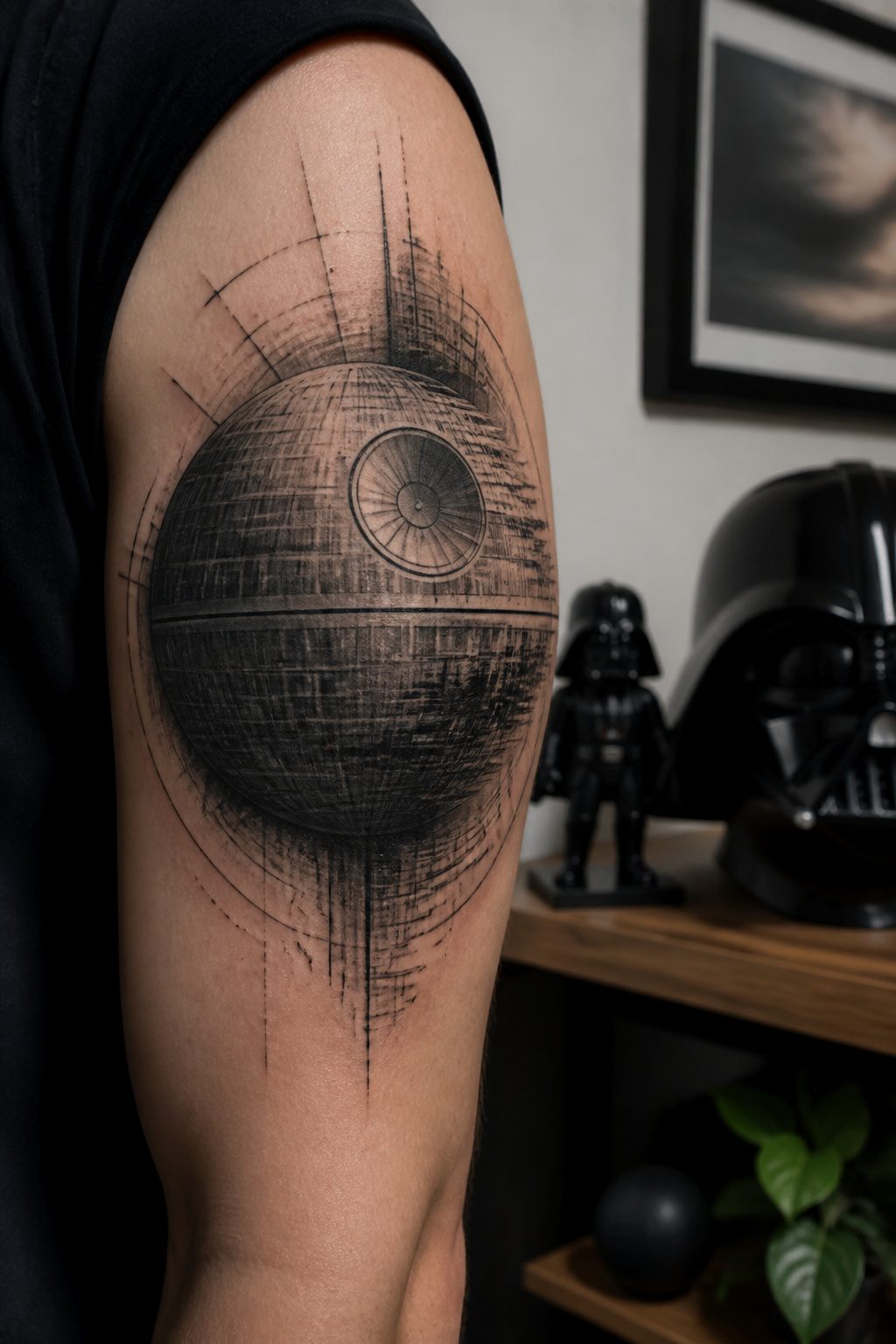
Pairing the Death Star with Darth Vader’s helmet turns a single symbol into something closer to a scene.
The helmet’s black geometry against the station’s pale curve gives the artist two textures to work with, and the contrast carries the eye across the whole piece.
A silhouette of Vader standing in the foreground, with the station as his backdrop, reads immediately as Imperial power without needing much else.
The line everyone remembers from that first film, "That’s no moon," works as text here if you want it. Small lettering along the inner bicep or tucked beneath the station’s lower curve keeps the quote from taking over the image.
In my own planning, I have found that text works best when it sits where only the wearer sees it easily; the surprise of recognition matters more than shouting the reference.
A narrative piece needs breathing room, so this pairing suits the back, chest, or outer thigh better than the wrist or ankle.
The helmet demands detail, and the station’s surface needs space to read as spherical rather than flat. Skimp on either element and the story collapses into a busy blob.

CELESTIAL STARBURST ART: Features an enchanting variety of mystical cosmic icons, including bold multi-pointed stars, north stars, twinkling stardust, and delicate geometric sparkles. This dreamlike motif is crafted using a digital hand-drawn fine line tattoo ensures crisp lines to maintain the ultra-thin points, tiny dot accents, and intricate radiating lines with perfect elegance.

⚡Awesome Realistic Long-Lasting Tattoos -- Semi-permanent tech, tattoo sits in your skin, not on top of it.THE TATTOOS WILL TAKE 12-24 HOURS TO DARKEN OVER THE COURSE ON YOUR SKIN and LASTS UP TO 1-2 WEEKS,waterproof, friction-resistant. It is so real and comparable to the real tattoo.

Join Johnny Rico's elite squad of bug-stompin' soldiers with this Starship Troopers temporary tattoo!
3. Traditional Death Star Tattoo
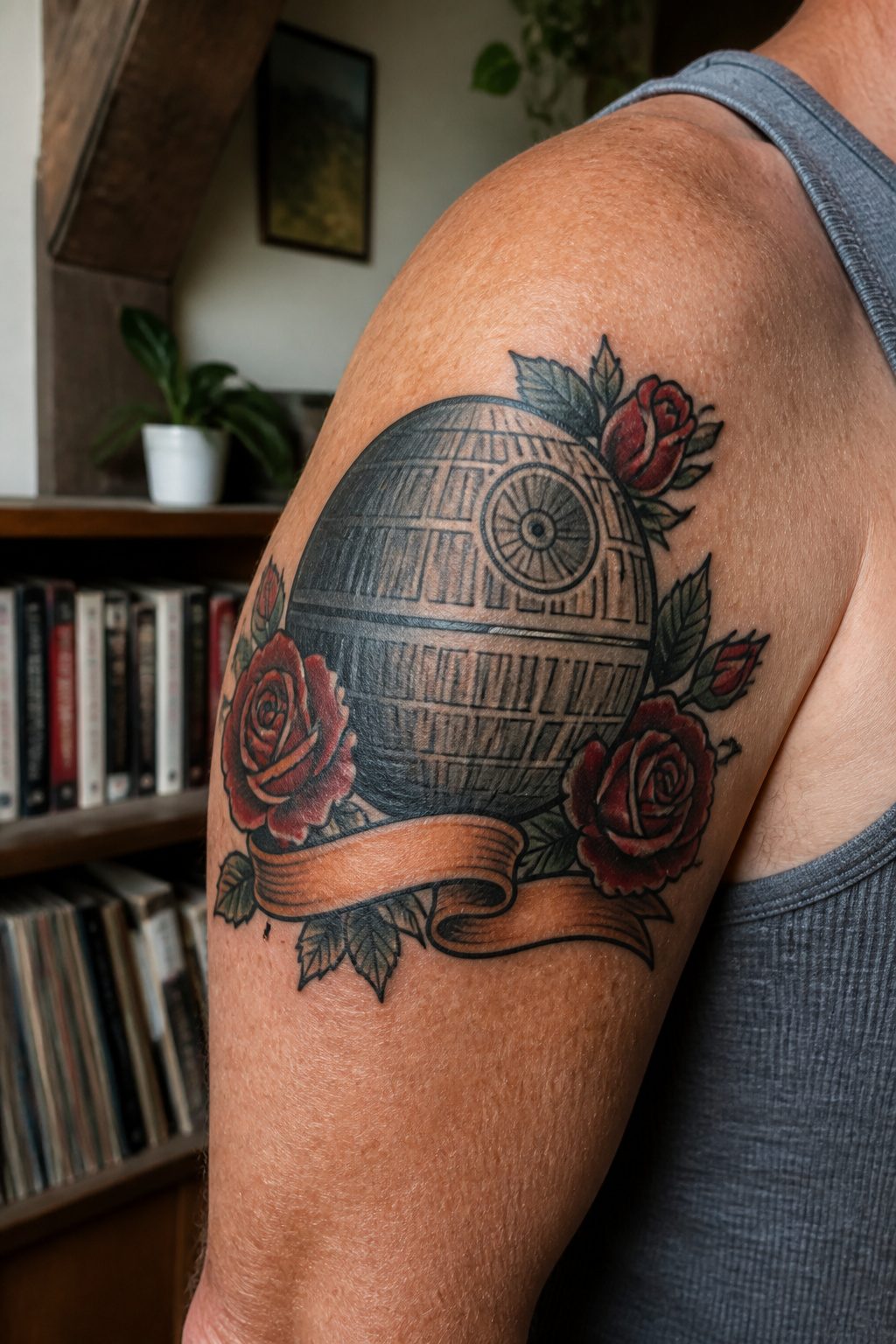
Bold outlines and a tight color palette turn the Death Star into something that reads immediately from across a room.
American traditional work limits itself to black, red, green, and yellow, so the station’s surface becomes a pattern of solid ink rather than gray wash.
The round shape sits naturally in the middle of a chest piece or the cap of a shoulder, where the style’s heavy lines already want to flow with the body.
Roses or banners frame the station more often than not, and that pairing matters for how the tattoo ages.
The filler gives the eye somewhere to rest besides a floating metal ball, and the thick borders around each element hold up as skin shifts over the years.
A Death Star built this way will still scan as a Death Star in twenty years because nothing in it depends on fine detail that blurs.
The limited palette actually helps the subject: without trying to render every trench and panel, the artist picks three or four iconic features and lets the viewer’s memory fill in the rest.
That restraint is what makes traditional work last, and the Death Star’s simple geometry rewards it.

Crenstone exclusive Star Wars temporary tattoos featuring iconic Star Wars characters: Yoda, Darth Vader, Chewbacca, and more! Package of over 70 individual Star Wars...
4. Death Star Shoulder Tattoo
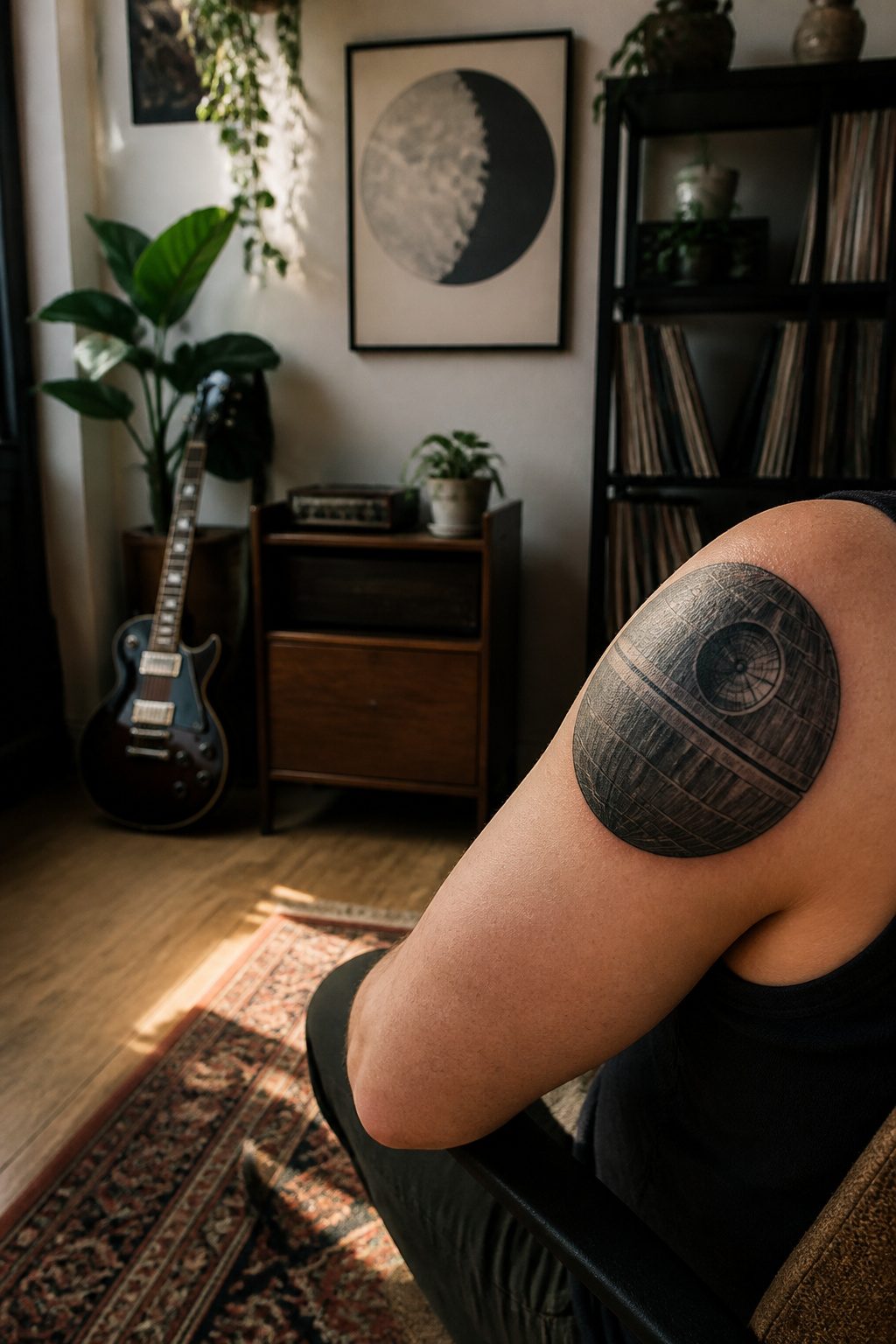
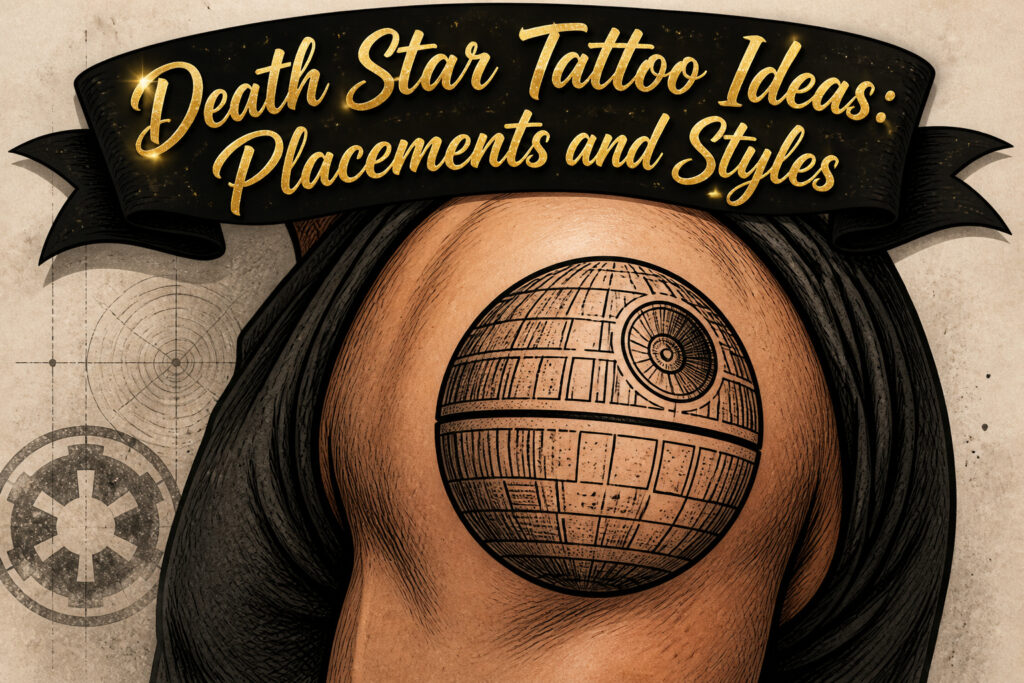
The shoulder’s rounded muscle gives a death star tattoo its most natural home outside of a movie screen.
The curve of the deltoid mirrors the station’s spherical body so closely that the design reads as three-dimensional without forcing any perspective tricks.
A piece here can run larger than a hand-sized limit without eating into visible neck or chest territory, and the flat plane at the top of the arm holds detail that would blur on a more moveable spot.
The superlaser dish lands exactly where the shoulder starts its forward sweep toward the collarbone. That placement lets the dish sit slightly raised, almost functional, as if it could actually pivot and track a target.
In a tank top the whole piece shows cleanly; in a short sleeve it vanishes except for a crescent peek, which honestly looks more menacing than full exposure.
I have seen this alignment done badly once, with the dish rotated toward the back to face outward.
The geometry felt broken, like a satellite dish pointing at sky. Forward orientation, dish toward the chest, keeps the logic of the machine intact.

Great gift: Birthday party gifts for women, children, daughters and sons.

Rose Temporary Tattoos : You'll receive 8 sheets rose flower temporary tattoos, each measuring 12x17cm (4.7x6.7 inches). No designs repeat, so you can switch them up and share them anytime

GOTHIC ROSE TEMPORARY TATTOOS THAT LOOK REAL: Bold red rose with intricate black baroque scrollwork creates a striking gothic and edgy look perfect for alternative style lovers, Halloween parties, vampire costumes, and dark aesthetic festivals. The detailed linework and rich shading mimic real ink without the permanent commitment.
5. Death Star Hand Tattoo
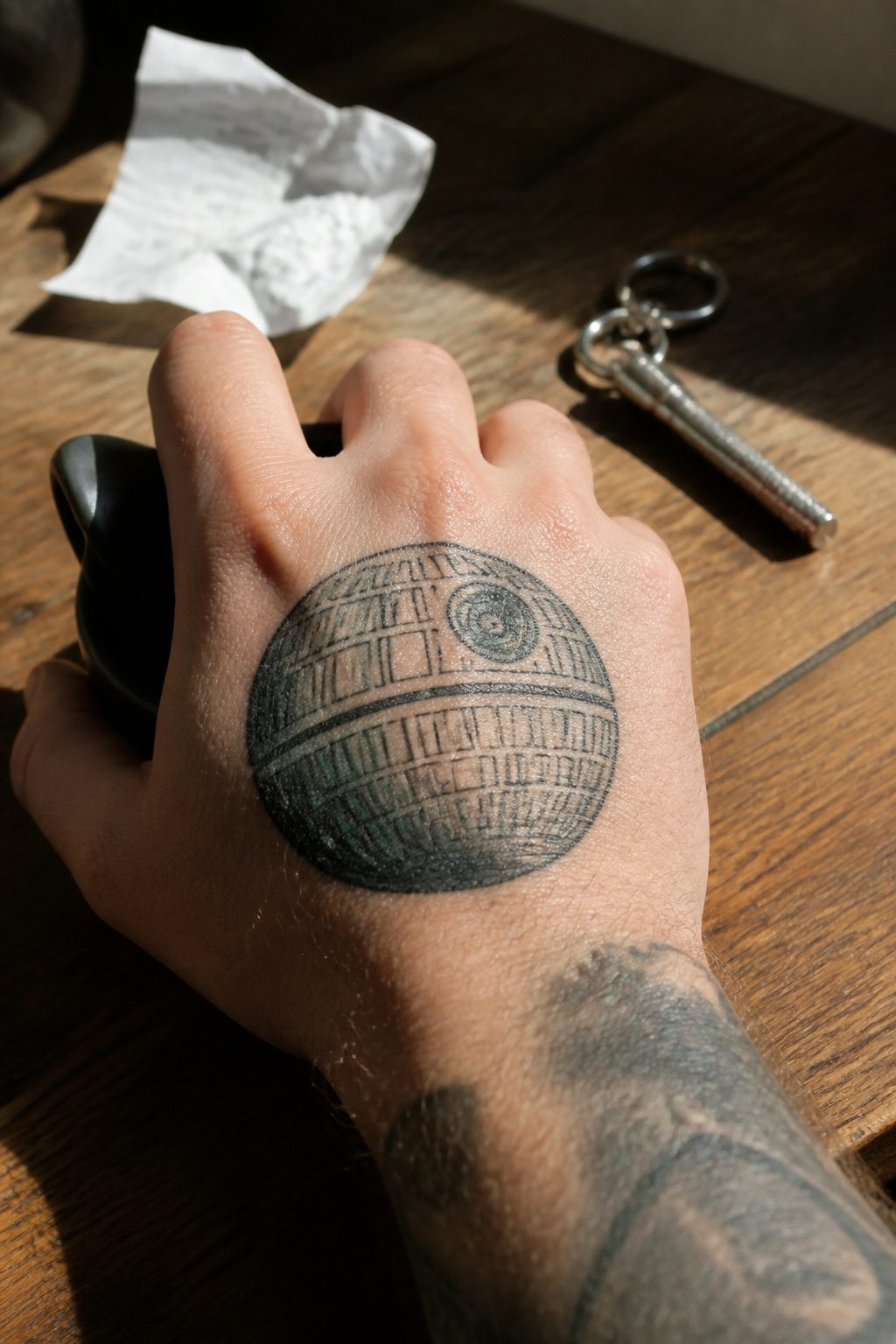
A death star tattoo on the hand forces you into a design you can read from across a room.
The sphere’s geometry simplifies well: that equatorial trench and partial dish read as Star Wars even at finger scale, where a more detailed ship would collapse into noise.
I have watched artists drop the surface paneling entirely and still get immediate recognition from the silhouette alone.
The visibility is the real cost. Palms, fingers, and knuckles sit outside most office cover-up strategies; long sleeves do not reach them.
What convinced me, reading through the conventions and aftercare discussions, is how many people treat this as a deliberate boundary rather than an accident. They want the piece seen.
Fading runs faster here than anywhere else on the body. Hands take sun without obstruction, and daily washing, gripping, and friction strip ink steadily.
Plan on touch-ups every few years if you want the trench line to stay sharp, or let it soften into a worn-in look that some collectors actually prefer.
The Death Star’s bold shapes survive that aging better than fine-line work would.

77 sheets american traditional temporary tattoos,17pieces 7.48*3.74 and 60pieces 3.85*2.28,including sailor,anchor,snake,eagle,sailboat,sailor, pentagram,lighthouse,heart,swallow,flower,vintage roses,swallows,demon,butterflies,sword,skull,eagle,scorpion

⚡Awesome Realistic American Traditional Style Fake Tattoos for Adult -- Super stylish design temporary tattoos, set includes variety of classic elements(rose money, neotraditional, crows, eagle, tigers, and many more popular designs!) that you can use for different locations on your shoulder, arms, chest, etc. Easy to share it with your family and friends.

6. Death Star Line Tattoo
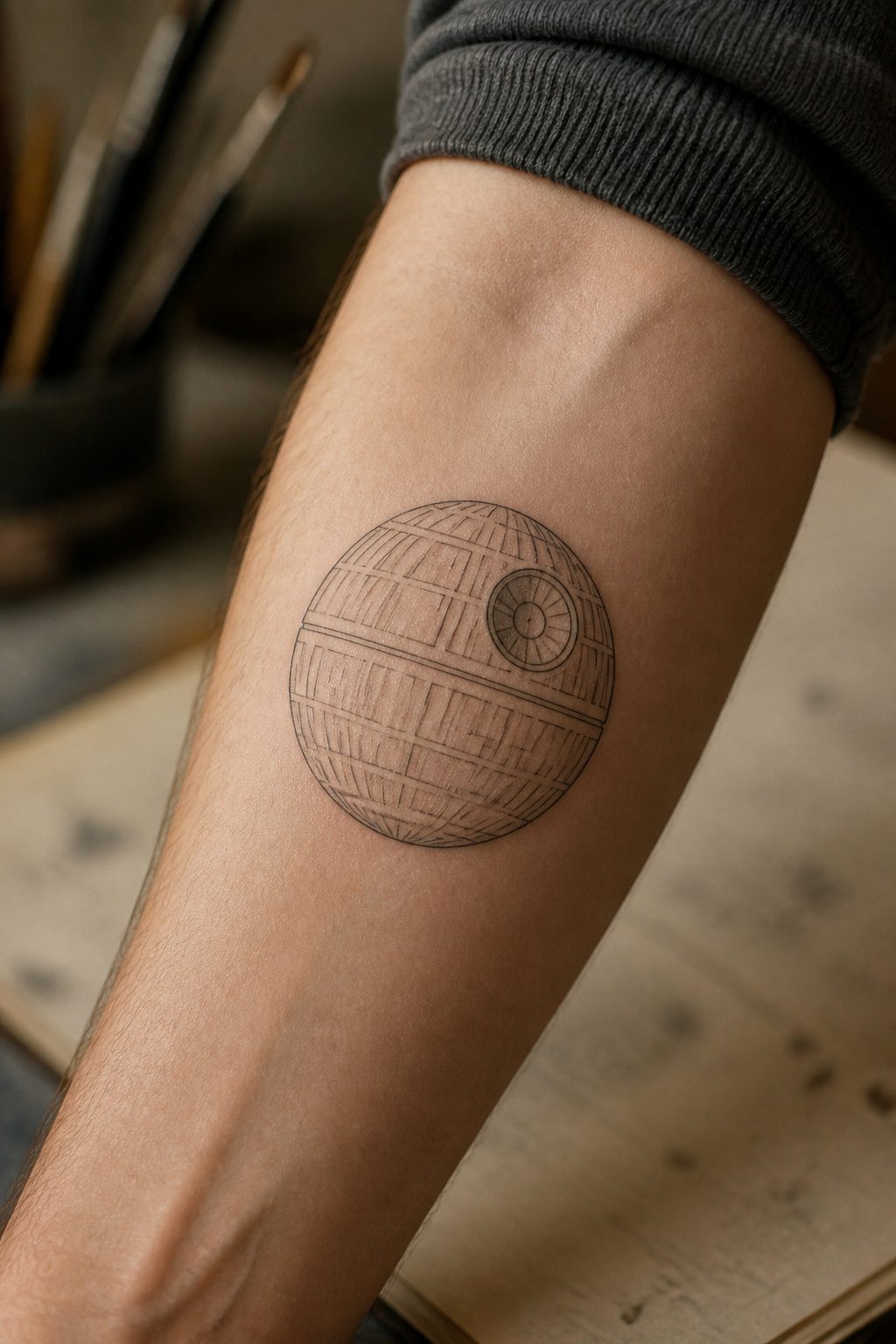
A death star line tattoo done with single-needle or fine-line technique is not the same thing as a minimalist Death Star tattoo, though the two often get lumped together.
Minimalist work can use blocks of solid black, negative space, or even subtle dotwork to suggest the station’s surface; line work strips all of that away and renders the sphere as one continuous unbroken contour, sometimes with the equatorial trench drawn as a single interrupted curve and nothing else.
The technical demands on the artist are different too. A contour-only piece has no shading to hide wavering, no fill to even out inconsistent depth.
The needle must stay at exactly the same angle for the full pass; any flick of the wrist shows up as a visible wobble in the curve.
Single-needle machines run at lower voltage and slower hand speed than standard liners, which means the session takes longer and the skin gets more irritated in the process.
Not every artist who advertises fine-line work has put in the hours on a coil or rotary setup dialed this specifically.
Placement matters for longevity as much as execution. The line weight on a single-needle piece is thin enough that sun exposure and skin turnover will blur it faster than bolder work.
What reads as crisp on day one can look like a soft gray smudge by year five if it sits somewhere that sees daily friction or UV.

Contains THREE - 3.5″ x 7″ laser cut mylar stencil, oval in shape. 🇺🇸MADE IN USA

🌿【Clean & Skin-Friendly Formula】 - Aloe-infused gel works on all skin areas (arms/back/face/legs). No ethanol or common irritants, lightweight for smooth application.

1. Safe and Healthy: Meet rigid safety and non-toxic materials standard, no irritation to the skin. Plus, It also has Clean Dry Protection Skin antiperspirant and deodorant functions.
7. Death Star Tattoo For Girls
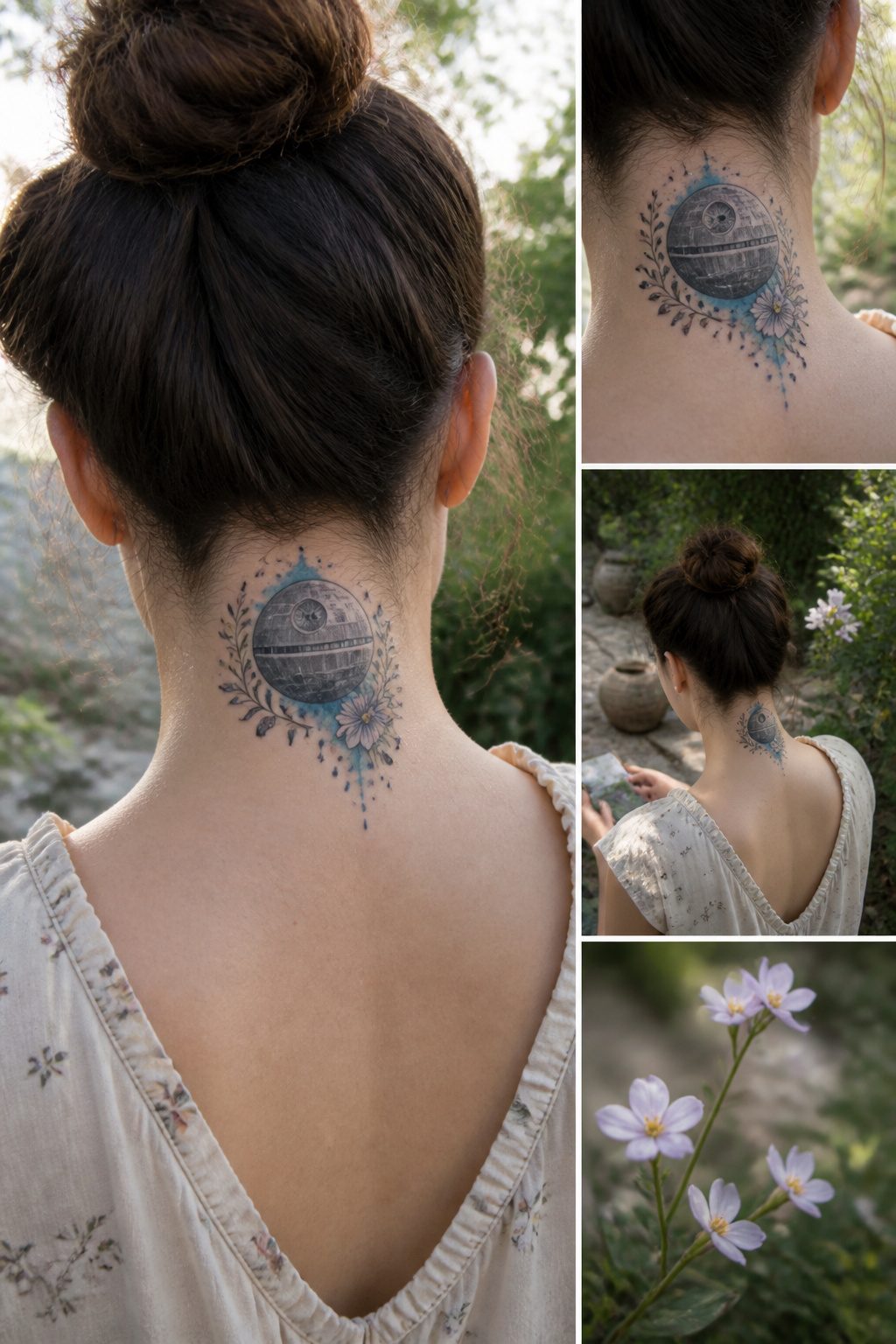
A blue watercolor wash can take the Death Star from military hardware to something that reads more like a night sky on skin.
The borderless color bleeding softens the station’s hard geometry without erasing what it is. Artists often pair this placement on the back of the neck with the curve of the hairline, letting the pigment fade upward like atmosphere.
Smaller scale helps too.
A palm-sized Death Star tucked among florals shifts the context from threat to motif. The same spherical outline that looks ominous at four inches becomes almost planetary at two, something that orbits rather than dominates the composition.
Character incorporation works when the figure interacts with the station rather than simply shares space. Leia or Rey positioned against the Death Star’s surface, scaled to suggest distance, turn the symbol into backdrop for their own narrative.
The choice is stylistic preference, not an inherent quality of the image itself. The Death Star remains the Death Star; what changes is what surrounds it and how heavily the linework presses.
8. Death Star Forearm Tattoo
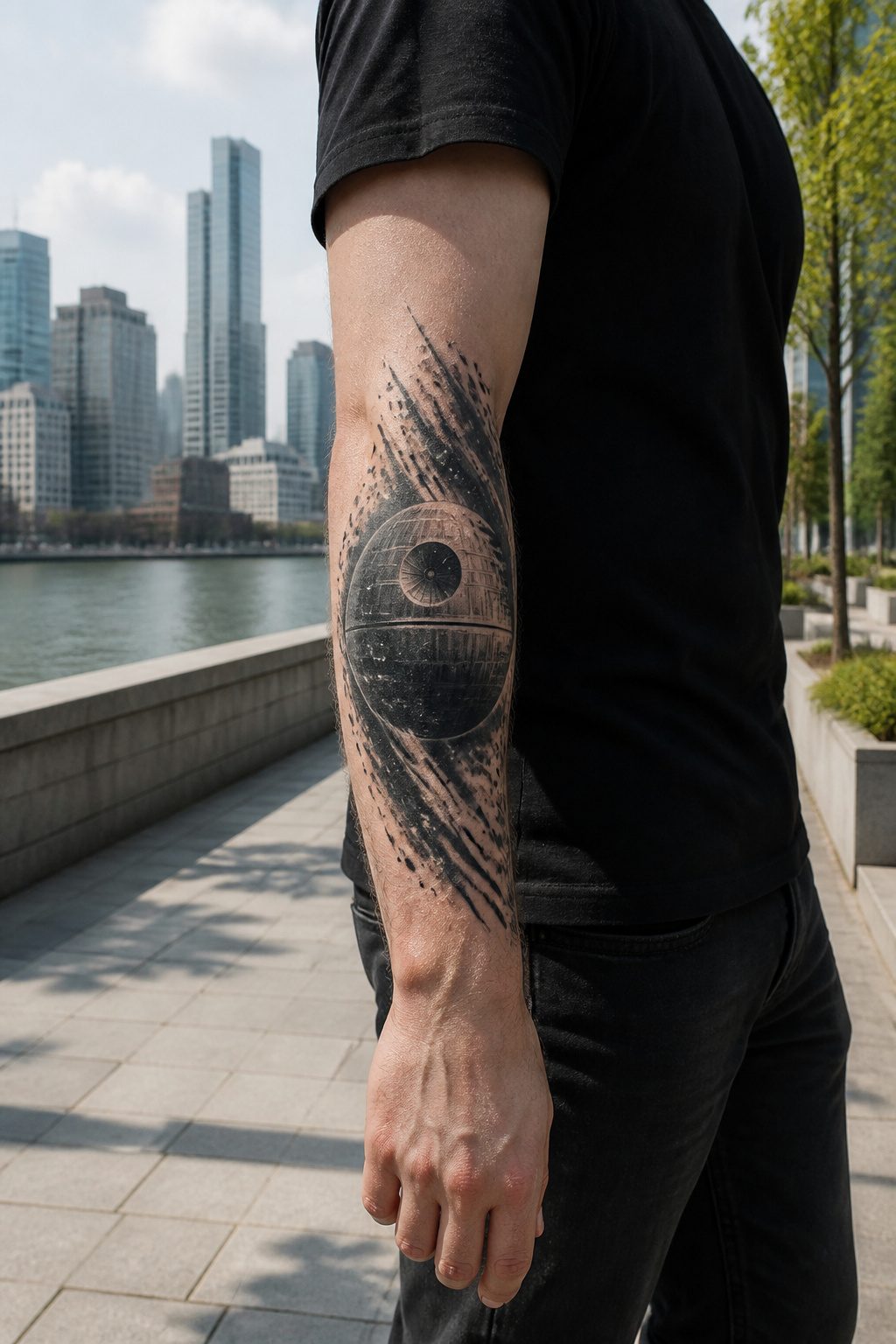
The forearm sits at the top of the list for death star tattoo placement for a few practical reasons.
The surface is flat and broad enough that an artist can render the sphere accurately without the distortion you get on curved or bony areas.
You can check the proportions yourself by holding a circular object against the inner or outer forearm; it stays round.
Showing the piece takes a rolled sleeve.
Covering it takes a long one. That flexibility matters for anyone whose workplace still draws a line at visible ink.
Space is the other draw. A small Death Star reads fine on a wrist, but the forearm gives room for the trench detail, the concave dish, or a companion element like an X-wing in scale.
The "That’s no moon" quote fits underneath without crowding the image.
For anyone already building a Star Wars sleeve, the forearm often becomes the anchor.
The Death Star’s geometry holds the eye, and surrounding pieces like ships or characters can orbit it without competing for attention. A good artist will leave negative space between elements so the Death Star keeps its weight as the centerpiece.
What the Death Star Means
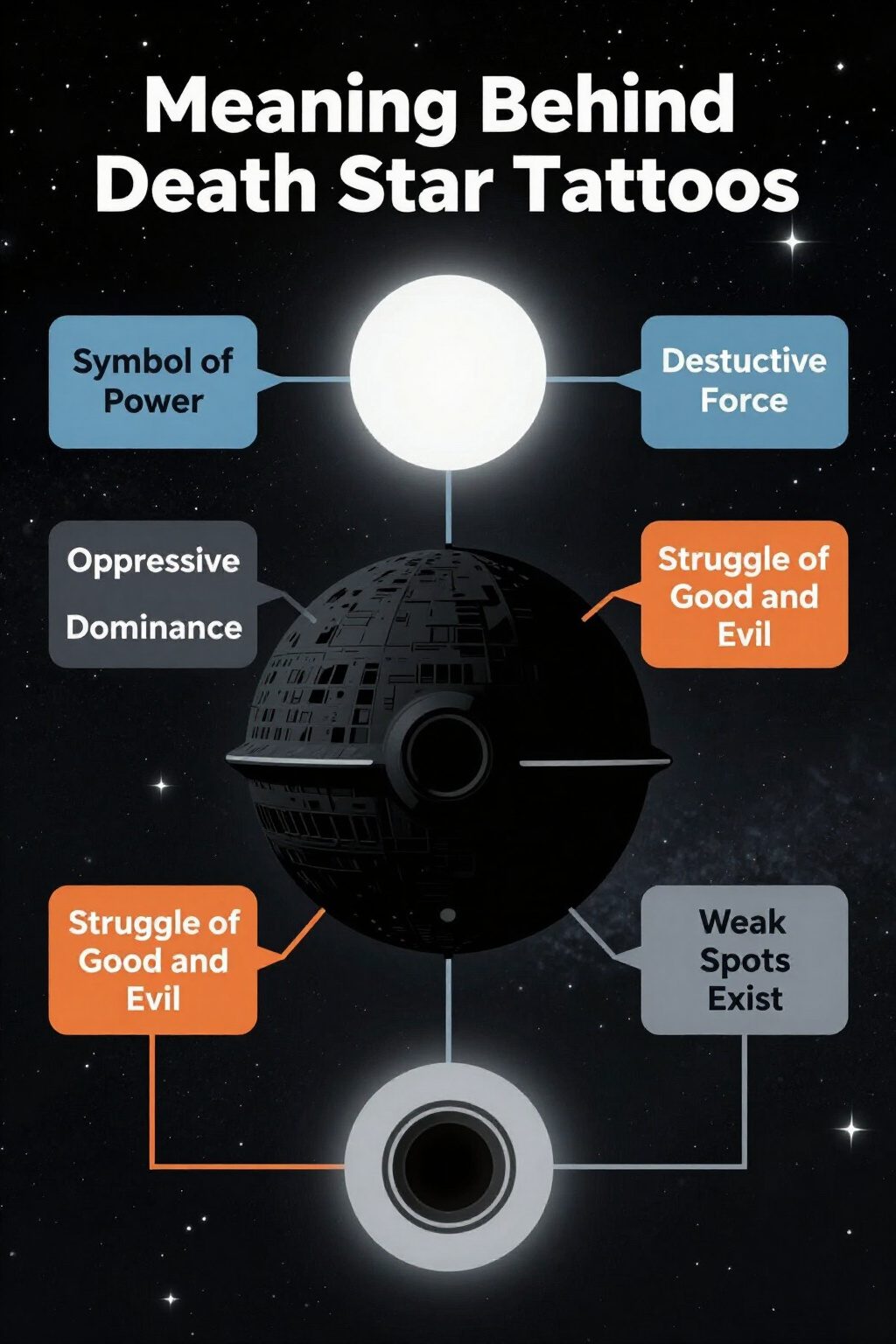
A death star tattoo carries different weight depending on which part of the story you connect with.
The station itself is a symbol of power and ambition, the kind of overwhelming might the Galactic Empire projects across star systems. Its superlaser can destroy entire planets, so the image lands with real force, not just nostalgia.
Some wear it as fans, plain and simple.
Others see the darker reading: oppressive dominance, fear made mechanical and orbital. The struggle between good and evil runs through every frame the station appears in, and that tension lives in the ink too.
What I keep coming back to is the exhaust port.
A thermal exhaust port, two meters wide, is all it took to undo something the size of a small moon. That detail turns the symbol into something else entirely: a reminder that massive systems, personal or political, carry weak spots.
The Empire’s own engineering became its failure point. Whether you want the tattoo to warn or to celebrate, that fracture is built into the design.

【TEMPORARY TATTOO PACK FOR MAN WOMEN ADULTS KIDS】Each Size measuring 150 x 100 mm / 5.9 x 3.9 inch. Contains 4 sheets temporary tattoo paper stickers which are printed with non-toxic ink.


Features the exact phrase "STAY STRANGE" with a skull marked moth, spread patterned wings, crescent moon, blazing flames, red roses, green leaves, stars, ornate scrollwork, and distressed vintage tattoo flash energy for gothic Halloween style.
Where the Design Came From
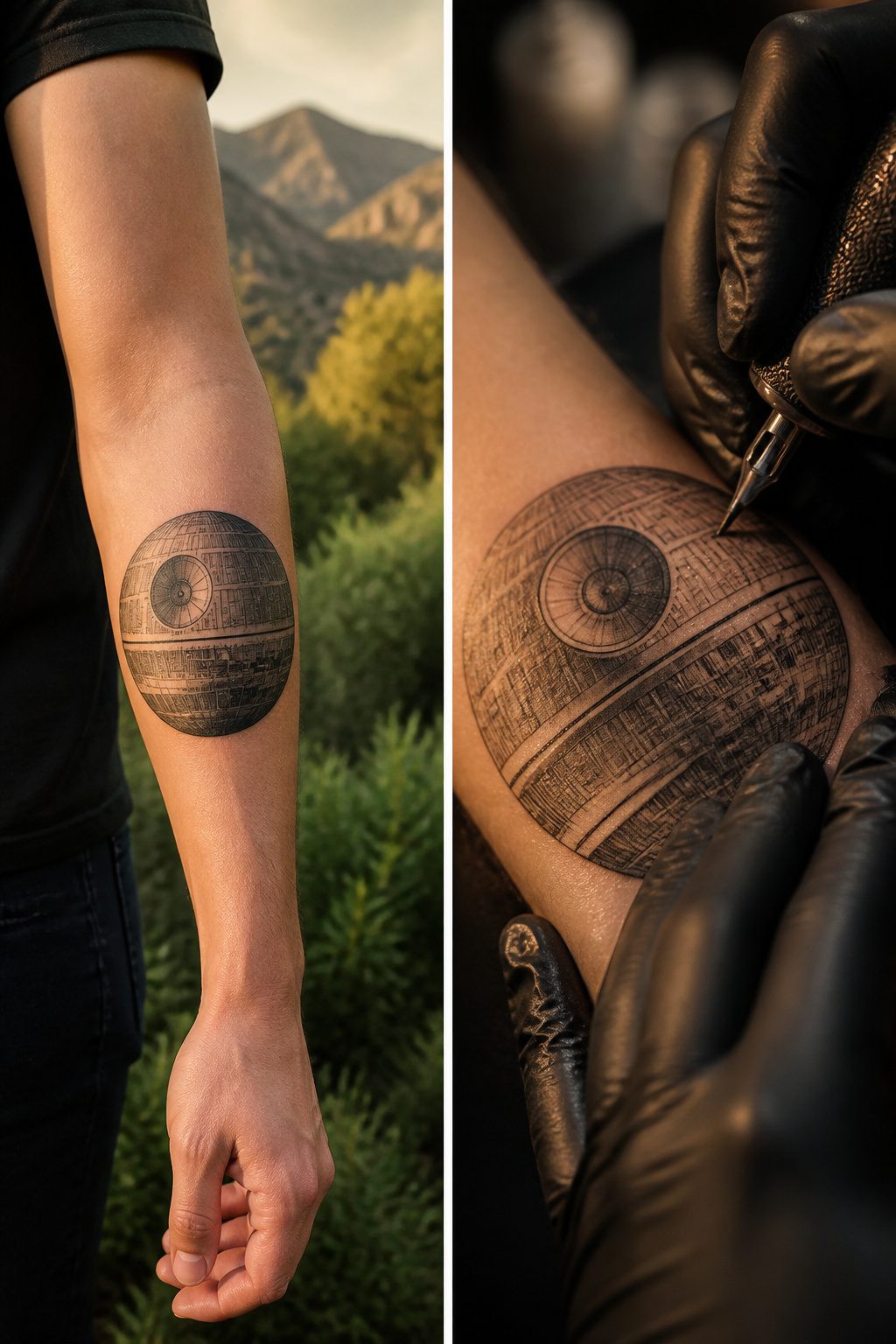
Colin Cantwell built the Death Star’s recognizability into its shape from the first sketch.
The concept artist drafted the original models and artwork for the 1977 film, and Industrial Light & Magic used his designs to construct the three-dimensional model that appeared on screen.
A sphere reads instantly at any scale, which mattered in an era before CGI filled every frame with detail.
I was four when my older brother first pointed out the station rising over Tatooine, and even that small screen on our living room console made the image stick. The summer of 1977 fixed it in American culture fast.
No prior film had deployed a single object that large as pure threat, and by the time the first parade of tie-in toys hit shelves that fall, the silhouette needed no label.
The design choice still governs how the tattoo wears.
A sphere adapts to a shoulder cap or a forearm with equal logic, the curve of the body echoing the curve of the station. That is Cantwell’s doing.

⚡Unique Black Vintage American Tattoo Designs – Featuring a stylish collection of classic style tattoos(skulls, roses, anchors, eagles,heart..). These tattoos are perfect for various body placements, including face, legs, arms, and neck. Share them with family and friends for endless fun!

⚓ AMERICAN TRADITIONAL STYLE FOR TATTOO LOVERS: Inspired by classic old school tattoos art, these retro fake tattoos feature roses, skulls, anchors, hearts and vintage flowers. Perfect for adults who love traditional tattoos.

[LARGE QUANTITY] There are 2 different size temporary tattoos with a large amount. Large size flower tattoo stickers size is 7.48 * 3.74 inch (19 * 9 .5cm) 17 sheets, small lovely tattoos‘ size is 3.9 * 2.3 inch (9.8 * 5.8cm) 60 sheets. Share and enjoy it with your family and friends
Picking Your Design
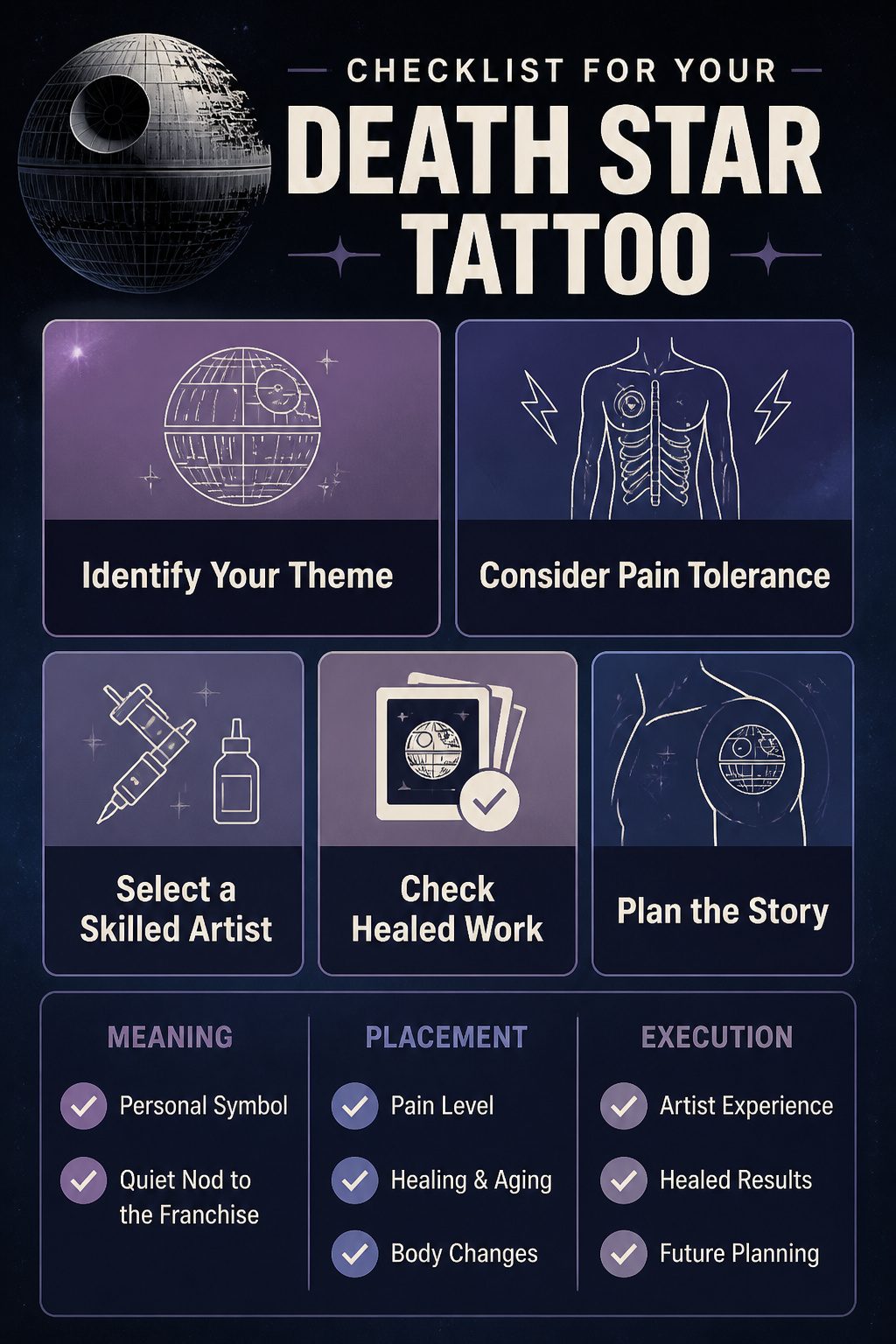
A death star tattoo reads very differently as a quiet nod to the franchise than as a personal symbol of destruction, control, or rebirth.
The same sphere with a trench line can sit on your body as fan art or as something closer to a warning sign you gave yourself. Deciding which layer matters more changes everything about how the artist handles it.
Pain tolerance shapes placement more than most people admit upfront. The ribs, the sternum, the ditch of the arm: these spots hurt, and they also distort more over time.
If you are sensitive or your weight fluctuates, a cleaner panel like the outer forearm or the upper thigh heals more predictably and lets the geometry stay sharp.
Not every artist who does excellent Star Wars work wants to do a Death Star, and not every blackwork specialist has watched the films enough to catch when the superlaser focus lens is pointing the wrong direction.
Ask to see healed pieces in the style you want, not just fresh photos. The detail that looks crisp at day three can fall out of a watercolor wash or a single-needle outline by month six.
Think about whether this piece finishes the story or starts one. A standalone Death Star on a shoulder cap works as a complete image.
If you are building a sleeve, the same design becomes a background element, and you will want the artist to leave negative space and connection points for what comes next.
Frequently Asked Questions
What does a Death Star tattoo symbolize?
A Death Star tattoo carries weight as a symbol of power, ambition, and overwhelming might, the kind the Galactic Empire projects across star systems.
The design also holds tension between good and evil, since the station appears in every frame of that struggle.
Many wearers focus on the exhaust port detail as a reminder that massive systems carry weak spots, a two-meter flaw that undid something moon-sized.
What are some popular Death Star tattoo designs?
Popular styles include minimalist linework that strips the station to a sphere and trench, Darth Vader paired with the Death Star as a narrative scene, and traditional American work with bold outlines and limited color palettes.
Watercolor washes with blue tones soften the military hardware into something more atmospheric, while single-needle line tattoos render the sphere as one continuous contour.
How can I choose a Death Star tattoo design?
Decide whether the piece reads as fan art or as a personal symbol of destruction, control, or rebirth, since that layer changes how the artist handles it.
Factor in pain tolerance and placement; the outer forearm or upper thigh heal more predictably than ribs or sternum.
Ask to see healed pieces in your chosen style, not fresh photos, and consider whether this tattoo finishes a story or starts one that will need connection space later.