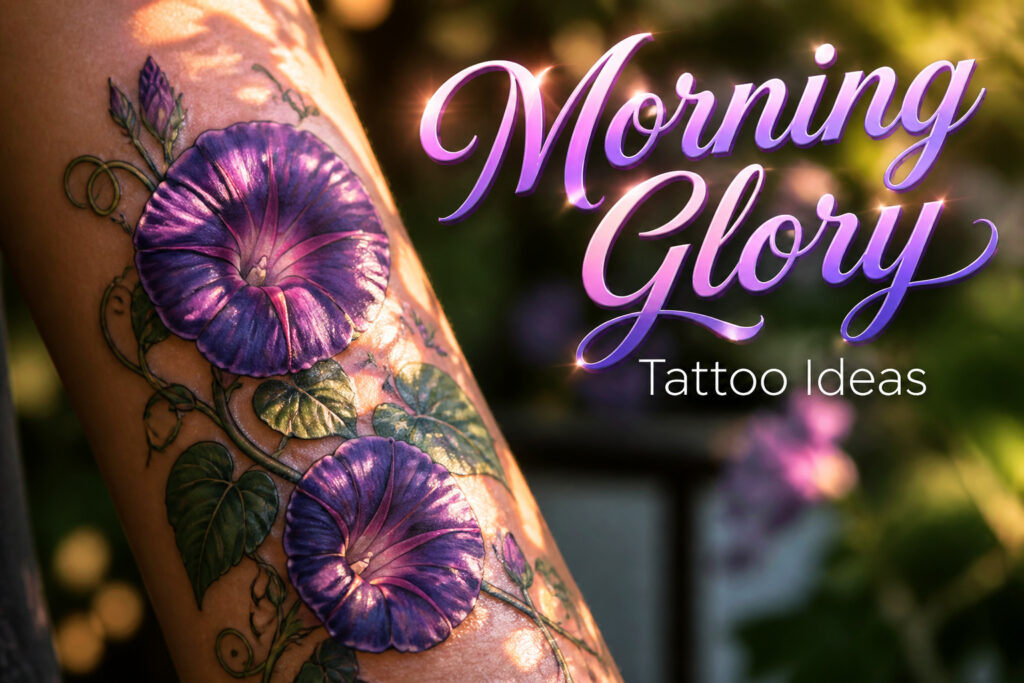
A morning glory tattoo can run from a single-needle silhouette behind the ear to a full sleeve of traditional purple flash, and the deciding factor is how much you want the bloom’s daily cycle to show. The flower opens at dawn and folds by afternoon, so the style you choose determines whether that vanishing act reads as quiet symbolism or full narrative. Watercolor washes mimic the petal’s actual color shift by noon, while American traditional purple blocks borrow straight from Victorian floriography and sailor Jerry’s flash sheets.
1. Simple Morning Glory Tattoo
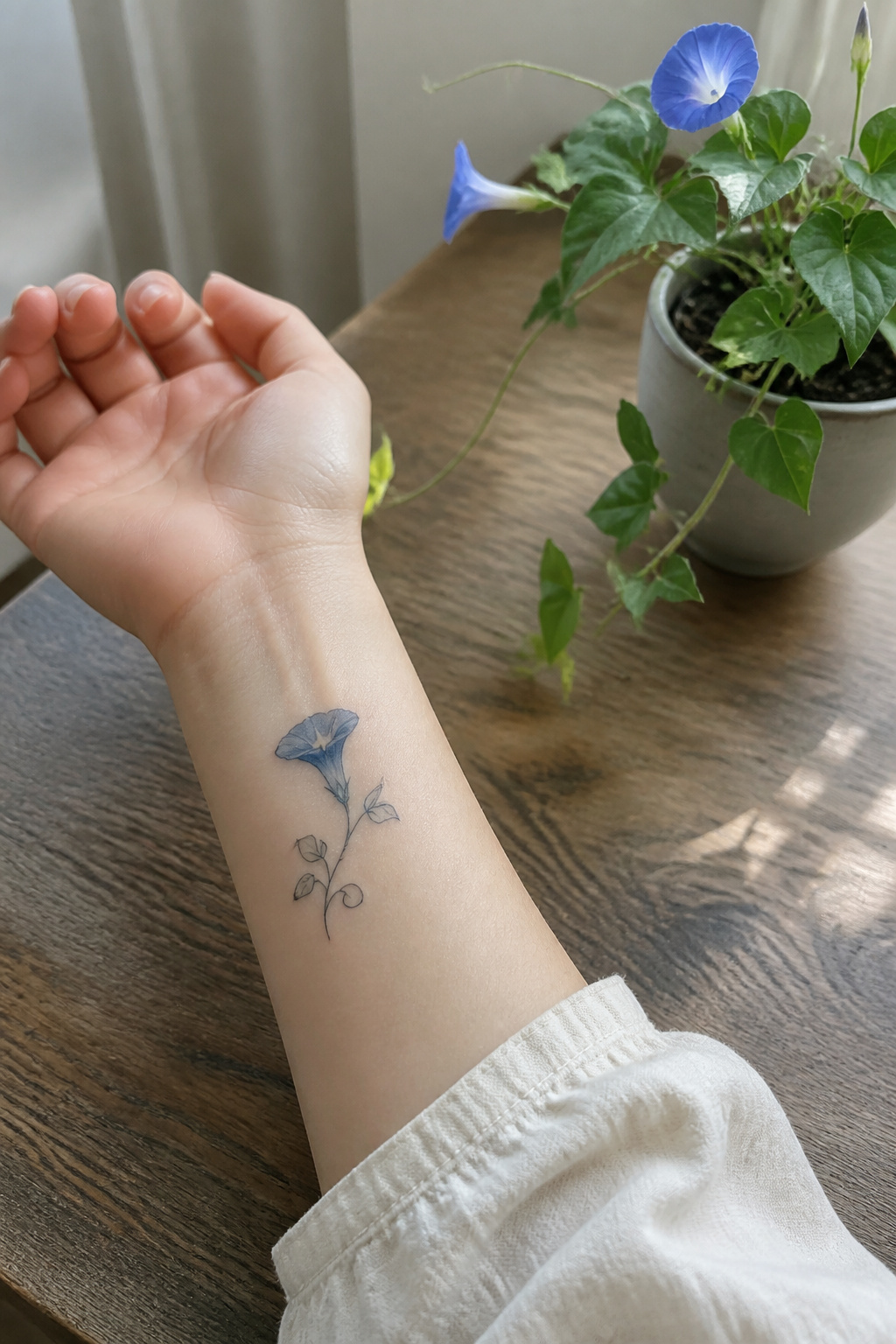
A simple morning glory tattoo strips the flower down to what matters most: the bell of the bloom, the curl of the vine, maybe a single leaf. The quietness is the point. Color stays optional, and when it does appear, a flat wash of blue does the work without shading or highlight. The style sits far from the botanical studies that count every stamen, and it asks less of the skin over decades of fading.
Peace and tranquility come through in that restraint. The flower still opens at dawn and closes by afternoon, still carries the same meaning about seizing the day, but the message arrives softer without the visual noise. Someone drawn to this version usually knows they want the symbol, not the spectacle. They have already looked at more detailed work and felt the clutter.
Fine line approaches can share some of this DNA, though they tend to chase intricacy in the stem work that a truly simple piece avoids. The difference is commitment to silhouette over texture. Where a fine-line artist might spend twenty minutes on veining, the simple style stops at the outer contour and lets negative space handle the rest.
Placement follows the same logic. A wrist, an ankle, the curve behind an ear: small surfaces that keep the scale honest. Scaling this design up to a full shoulder rarely works; the emptiness that reads as calm at two inches turns to unfinished at six.
2. Realistic Morning Glory Tattoo
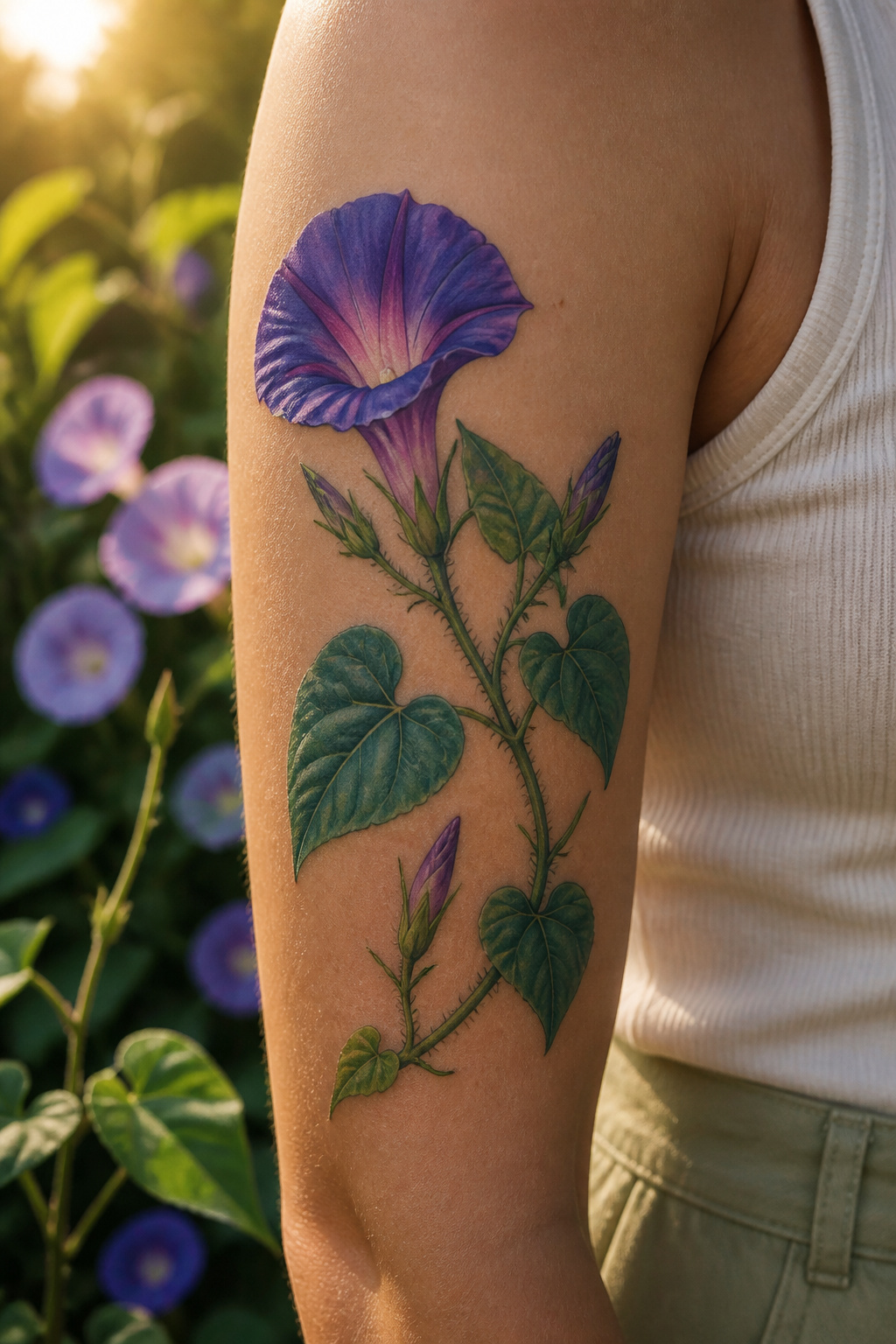
A realistic morning glory tattoo carries the Virgo connection with quiet precision. The flower belongs to those born August 22 through September 22, and the detail work of a realistic style mirrors the sign’s own observant, analytical nature. What convinced me, looking through dozens of these, is how the orange tones emerging from the center do the emotional lifting. That warmth signals happiness, bright days, a small dose of joy made permanent.
The realistic approach also answers something the simpler styles avoid. Morning glory blooms last a single day. A tattoo rendered in true-to-life shading, with the soft gradient of purple or blue petals and the faint fuzz along the stem, catches that brief life at its peak. The Virgo traits of planning ahead and organizing find their match here: the wearer chooses to preserve what vanishes quickly, to study and fix what time would otherwise dissolve. The result is not just a birth flower but a argument for paying close attention while something lasts.
3. Aster and Morning Glory Tattoo
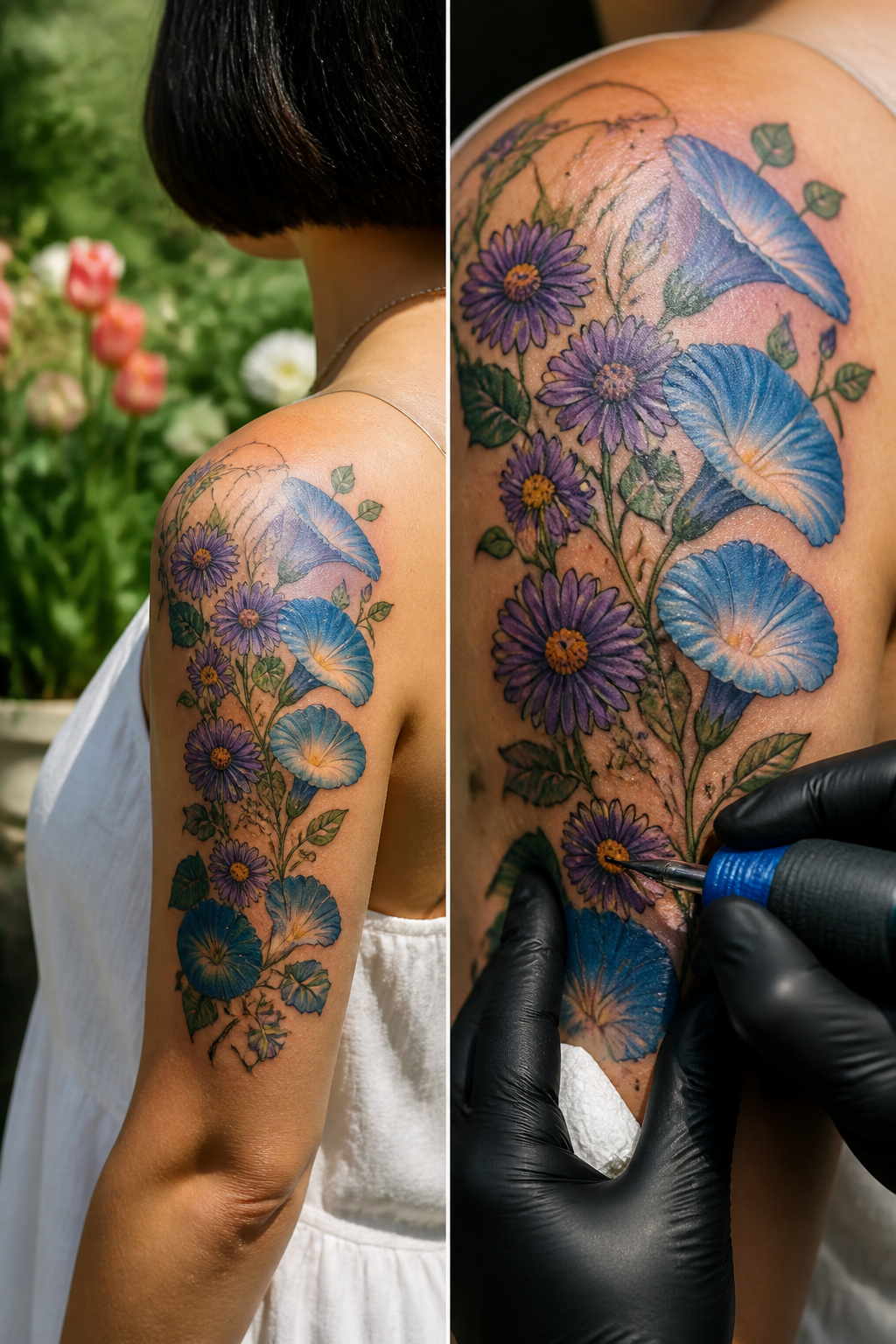
Aster and morning glory together carry the full birth-month story for September. The morning glory stands for pure, unconditional love and the fleeting nature of life, while the aster brings patience, faithfulness, and wisdom into the same design. That pairing of love and patience makes the combination a natural fit for anyone marking a birthday that month or an 11th wedding anniversary, since both flowers share that milestone too.
Color direction tends to settle itself: blue morning glories and purple asters are the most recognizable pairing, with green leaves and buds threading the two blooms together. The aster’s patience against the morning glory’s brief daily bloom creates a tension worth designing around rather than smoothing over. One flower opens at dawn and fades by afternoon; the other keeps its composure through the whole season. A skilled artist can lay that contrast into the composition itself, letting the morning glory twist upward in its typical vine habit while the aster holds a more upright, steady posture below it.
The meaning is specific enough that you will want to place it somewhere you can see it yourself, not tucked away as a private reference no one else catches.
4. Traditional Morning Glory Tattoo
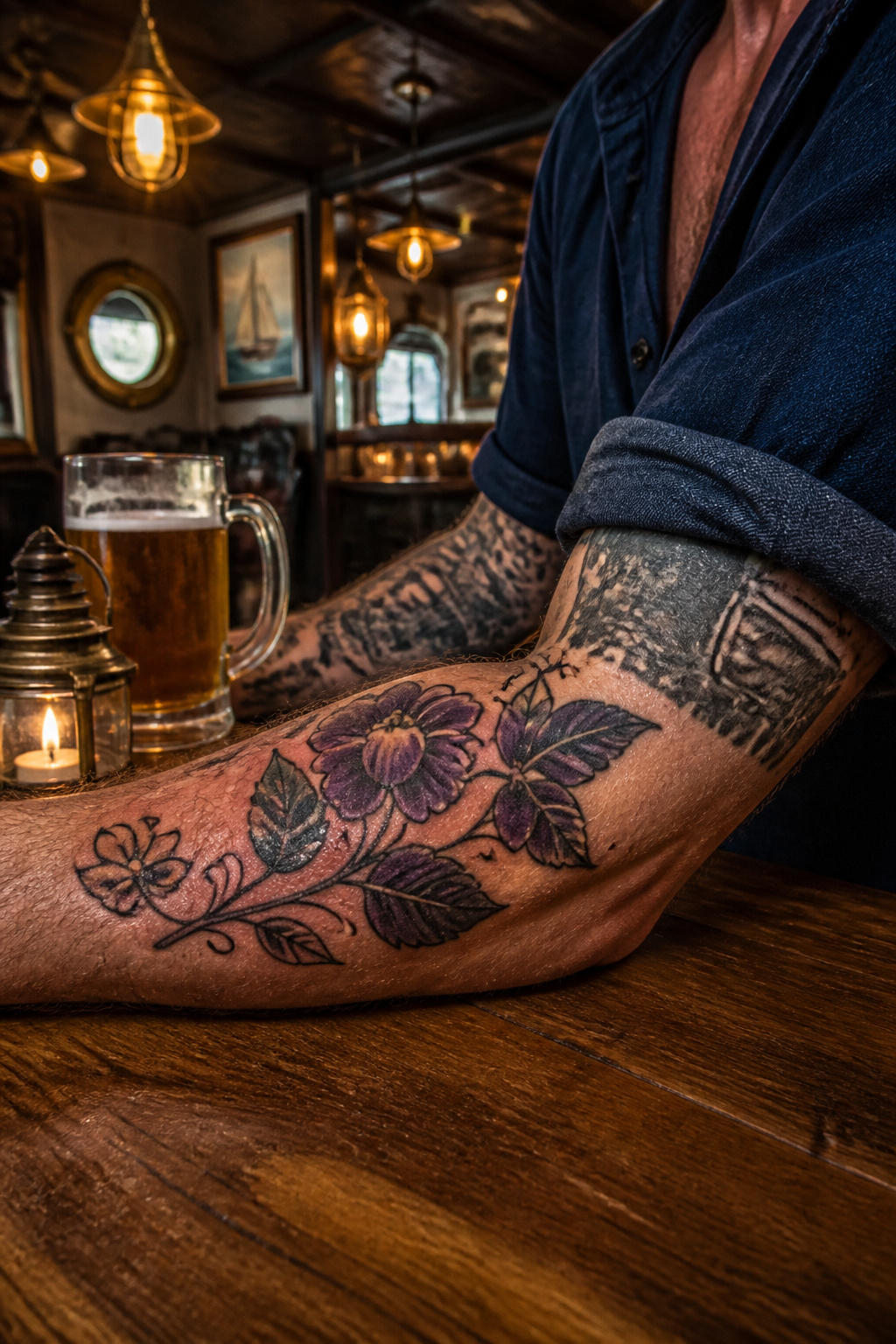
Purple ink has dominated morning glory tattoos since American traditional style took shape in the early 1900s, and that choice carries more weight than simple aesthetics. The color signals royalty and grace, a shorthand borrowed from Victorian flower language that tattooers on the Bowery and along the naval ports kept alive when they stitched these designs into sailors’ arms. A traditional piece leans into that history rather than fighting it: bold outlines, saturated color blocks, and the flower’s trumpet shape simplified enough to read across a room.
The style sits at a specific crossroads in American tattoo history. Sailor Jerry and his contemporaries used morning glories as filler between larger pieces or as standalone good-luck charms for men shipping out, the purple standing in for a connection to home and the women left there. Today’s traditional work keeps those proportions, the leaves rendered in that same blue-green, the composition tight enough to age cleanly on skin that sees sun and time.
A sleeve built in this vocabulary, with morning glory as the governing motif, works because the purple carries the eye across the entire arm without demanding photorealistic detail. The vine structure gives the artist natural flow lines that wrap muscle and bone the way the old masters read body geometry. What separates a successful traditional morning glory from a muddled one is restraint in the color palette: the purple, the green, maybe a touch of yellow at the throat, and nothing else competing for attention.
5. Morning Glory and Daisy Tattoo
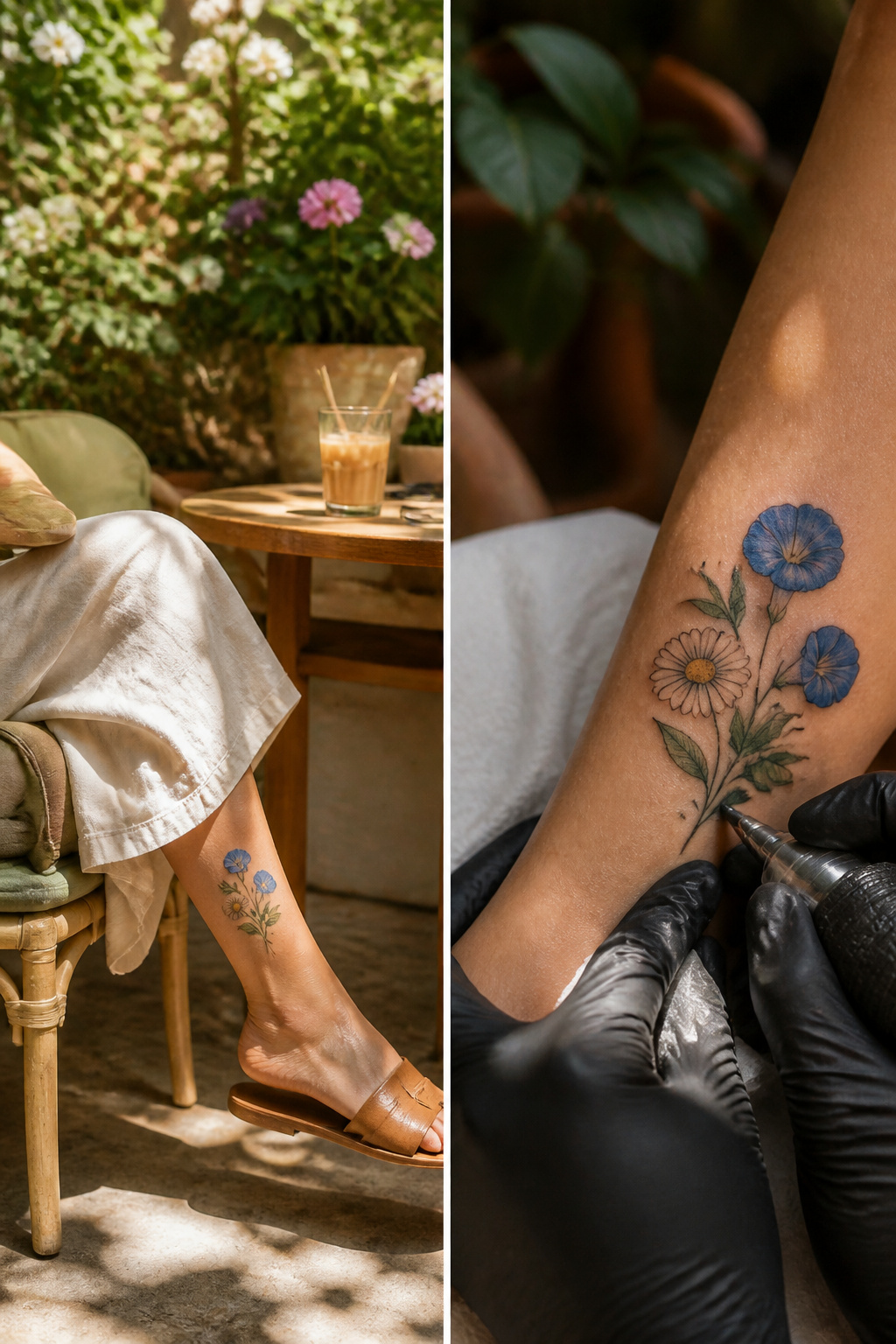
A morning glory paired with a daisy carries two meanings that sit well together. In Chinese tradition, the morning glory stands for marital bliss, affection, and love, while the daisy brings in innocence, simplicity, and loyal love. The combination reads as a relationship built on both passion and purity.
The two flowers also carry weight in Japanese symbolism, though the tone shifts. There the morning glory signals life’s transience, and the daisy carries purity and sincerity. A design that includes a sun behind the pair can push the meaning toward fresh starts and new opportunities.
For placement, the contrast matters. The morning glory’s trumpet shape and the daisy’s flat, radial face give a tattoo artist natural points of visual tension. A black and grey treatment keeps the focus on that geometry rather than letting color do the work. The palette also ages more predictably on skin that sees daily sun.
6. Water Lily and Morning Glory Tattoo
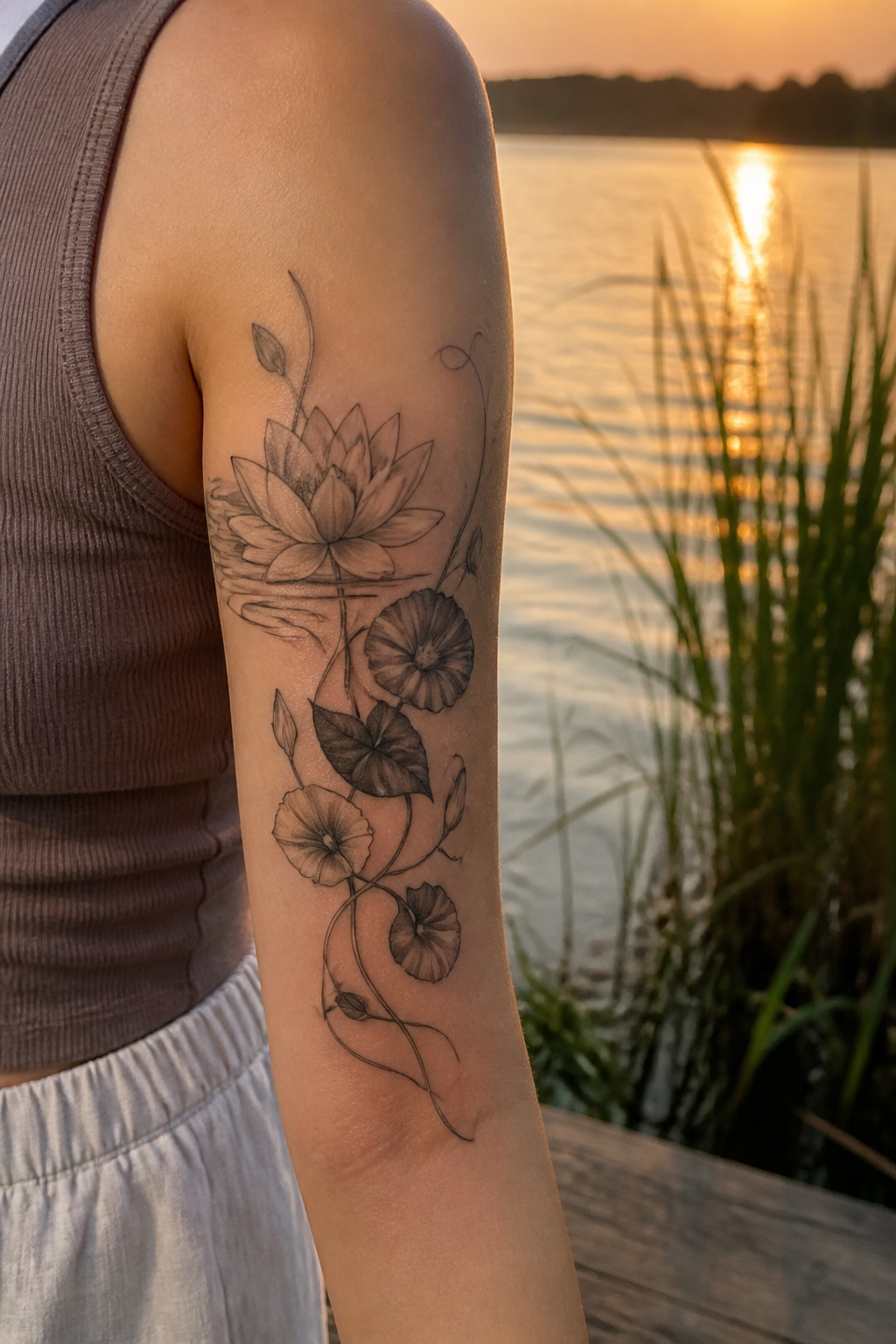
A water lily and morning glory pairing carries weight because both flowers open with morning light and fold by dusk, a rhythm that mirrors Buddhist teachings on impermanence. The morning glory stands for spiritual enlightenment and rebirth, while the water lily signals patience, purity, and the inner self. Together they speak to someone who believes in layers of meaning rather than a single statement.
The shared cycle of opening and closing is what makes this combination coherent. Two flowers doing the same daily dance, yet rooted in different worlds: one climbing toward air, the other floating on still water. That tension between ascent and surrender gives the design its depth.
For placement, the contrast in growth habits offers natural movement. Morning glory vines can frame or lead the eye, while the water lily anchors the composition. The pairing suits a larger piece where each flower has room to read clearly, back or thigh rather than wrist.
7. Carnation and Morning Glory Tattoo
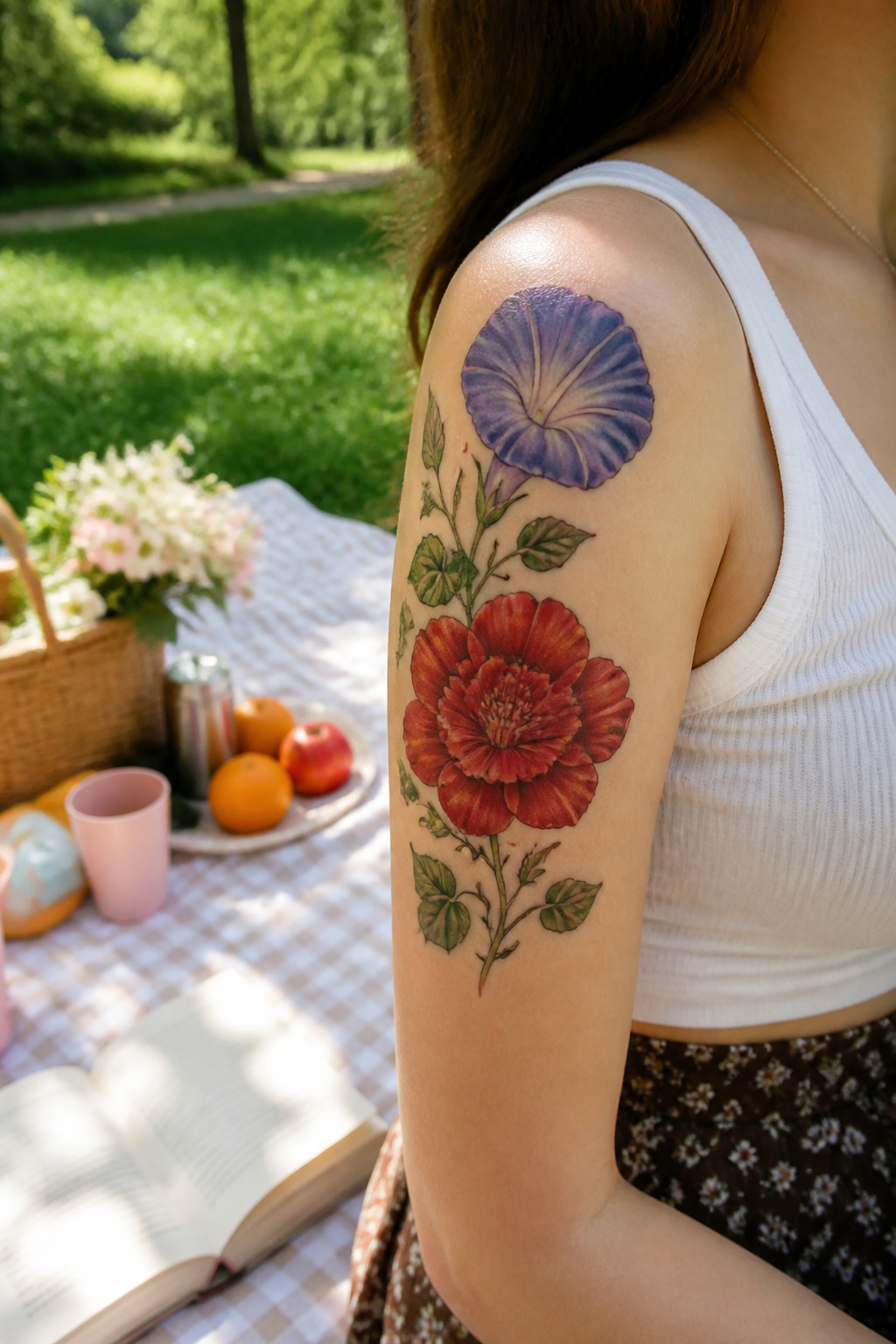
A carnation and morning glory tattoo carries its weight in the friendship it marks rather than romance. The morning glory stands for the quiet beauty of dawn, while the red carnation pins down admiration and deep friendship. Together they shift the whole piece toward the people who stay, not the one you chose.
Color changes the message more than most expect. A bluish-red morning glory against a red carnation sets calm against energy, a balance that reads differently than two softer tones would. The green leaves around them matter too; they give the relationship its living, growing quality rather than freezing it in a single moment.
What convinced me, looking through how these pairings actually get used, is that the color combination does the heavy lifting on meaning. A cooler blue morning glory with a classic red carnation keeps the sentiment grounded and specific. Warmer or paler versions drift toward generic floral territory, and the friendship message gets lost in the prettiness.
This is the design to hand your artist when the person you want to carry with you is a friend who held you through something specific, not a partner or a parent. The layered sentiment builds from two flowers that each mean something on their own, then mean something sharper together.
8. Fine Line Morning Glory Tattoo
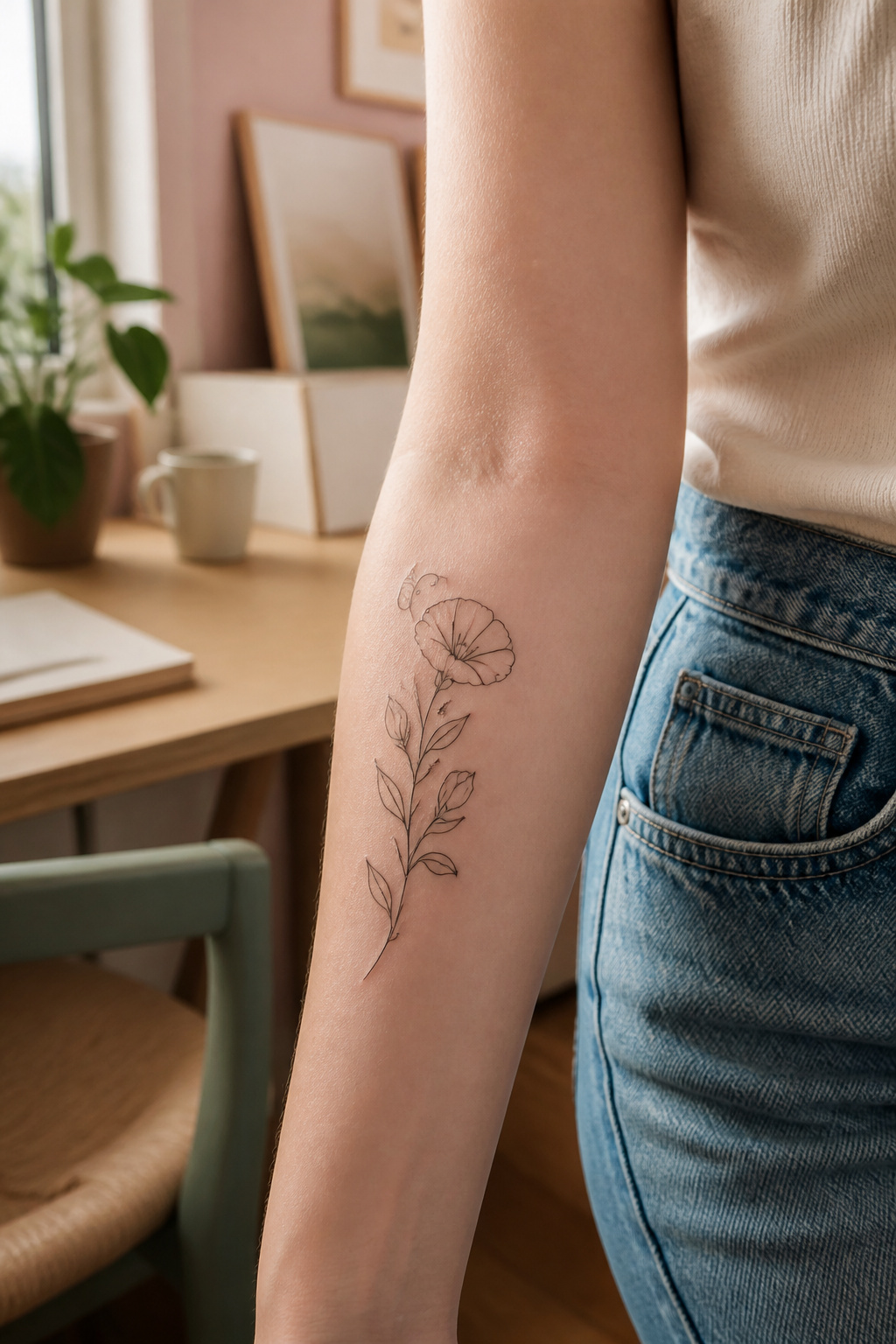
A fine line morning glory tattoo strips the flower down to its silhouette, letting shape and form carry the whole design. The technique demands a steady hand and a single-needle or very tight grouping; every wobble shows, and there is no shading to hide behind. Skin choice matters more here than with bolder work. The upper arm, the outer forearm, and the ribs all hold thin lines fairly well because they see less friction and stretching than spots like the inner wrist or the top of the foot. The meaning stays intact even in this spare version: love, mortality, and renewal, all readable in the curve of a petal. What you give up in color you gain in quietness, and for some placements that trade is the right one.
9. Morning Glory and Sparrow Tattoo
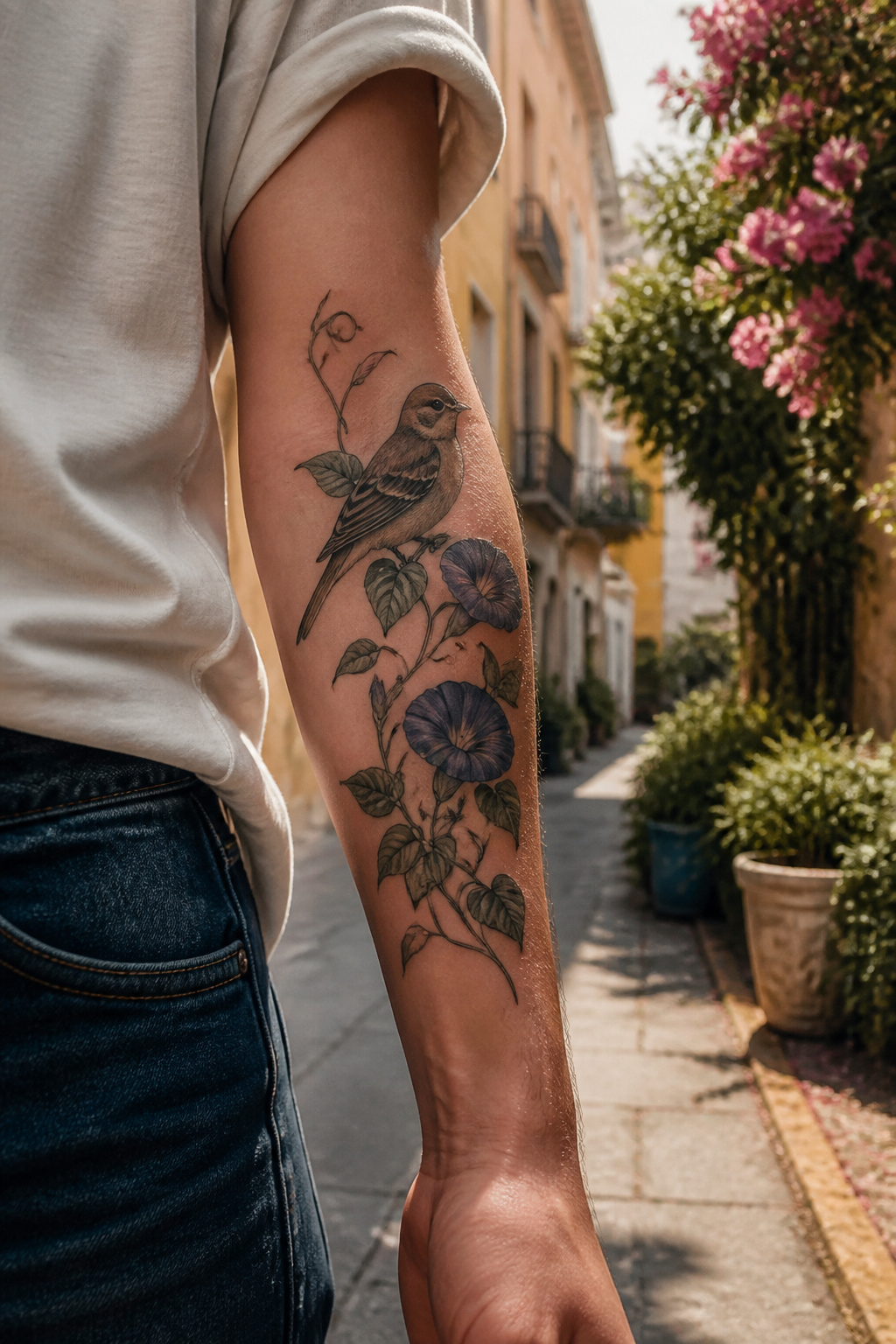
A sparrow perched on a morning glory vine carries two histories that rarely meet in the same design. The bird comes from old-school American tattooing, where sailors wore it for miles logged at sea and for the safe return home. The flower opens at dawn and folds by afternoon, a brief life that has stood for love and the passing of time since Victorian floriography.
Pairing them sets fleeting devotion against enduring freedom, and the tension is what makes the piece work. The morning glory softens the sparrow’s toughness; the sparrow keeps the flower from reading as purely delicate. Most placements run the vine along a collarbone or forearm so the bird has a natural perch, though the upper arm lets both elements breathe at scale.
Color moves the meaning. A blue morning glory with a red-chested sparrow reads nostalgic, almost 1940s flash. Keeping both in black and grey shifts the emphasis to line and silhouette, which suits smaller pieces where detail would crowd. Either way, the design asks for negative space around it; too much background filler and the two symbols stop talking to each other.
10. Morning Glory and Vine Tattoo
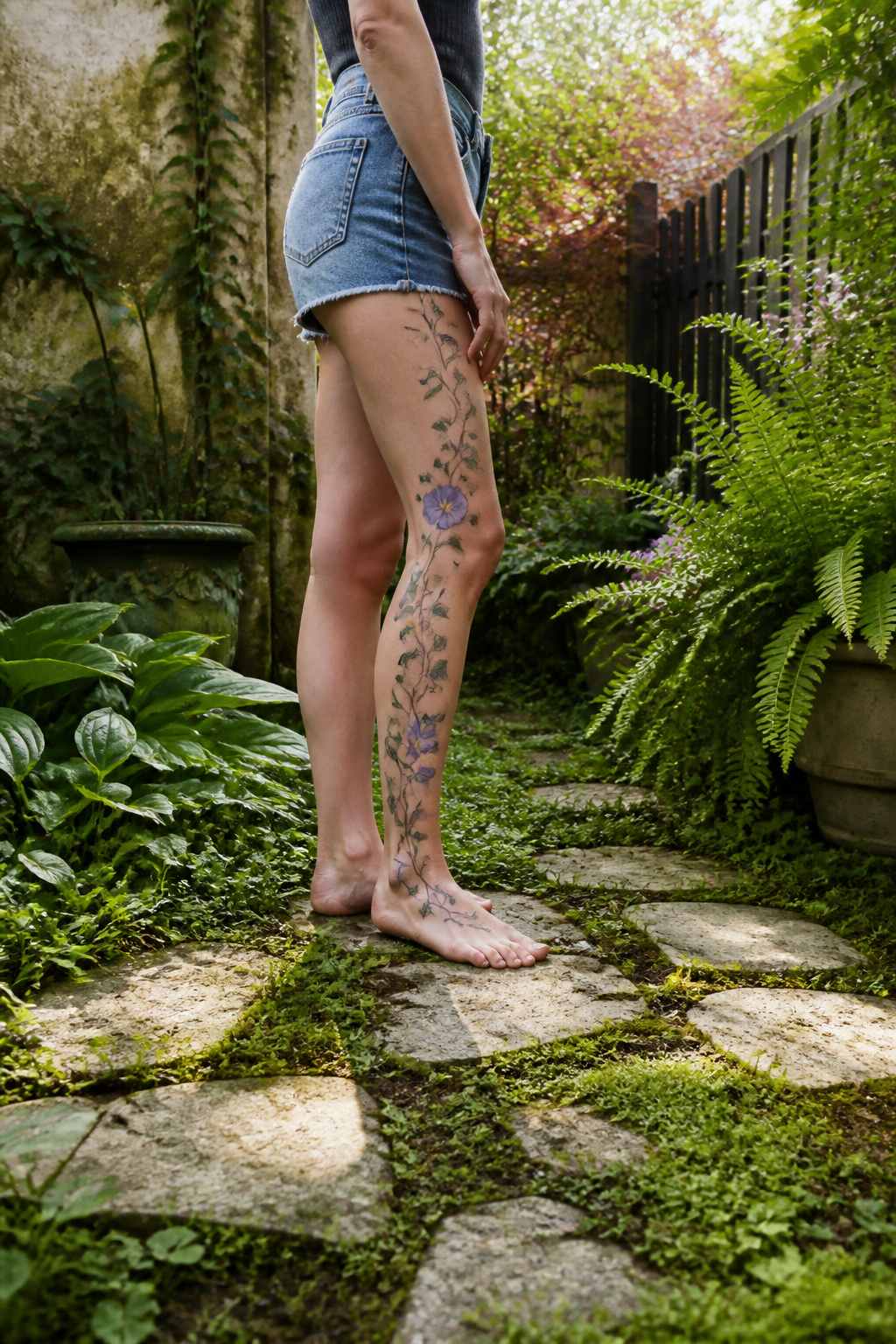
A morning glory vine tattoo carries its meaning in the way the plant actually behaves. The stems twine upward, connecting whatever they touch, which makes the design a natural metaphor for relationships that hold through growth and change. That climbing habit also solves a practical problem: the vine can follow the body’s own lines rather than fight them.
Placement matters more with this design than with a single bloom. A vine that starts at the wrist and wraps toward the elbow reads as one continuous movement, while the same pattern cropped to a flat rectangle loses the point. The shoulder to collarbone path works because the clavicle acts like a trellis, giving the eye a reason to travel.
Color shifts the emphasis. Deep purples and blues keep the botanical accuracy; a single green vine in black ink reads more as pattern than as living plant. Either works, but the choice should match whether you want the flower or the growth itself to dominate.
The risk is overcomplication. A vine loaded with twenty blooms and every leaf detailed becomes wallpaper. Three or four flowers at key points, with the stem doing the connecting work, usually carries the symbol more clearly than the dense version.
11. Morning Glory Clavicle Tattoo

A morning glory clavicle tattoo carries a particular tension that softer placements avoid. The bone sits barely under the skin there, so the surface is not flat canvas; it rises and falls, and the needle must follow that ridge rather than ignore it. What convinced me, looking through dozens of these, is that the design either works with the clavicle’s line or fights it. A vine that traces the bone’s natural curve settles in; one drawn straight across looks like a decal applied at the wrong angle.
The color reads differently here too. The clavicle catches light from above, so the bloom’s blues and purples brighten against the collarbone’s shadow rather than sinking into denser muscle. But that same exposure means healing demands more care than a forearm or shoulder. The skin shifts with every breath and shrug, so scabbing pulls at the line work for two weeks instead of one.
Sitting close to the heart is not just metaphor. The placement keeps the flower visible in a V-neck but hides under a crew neck, which makes the meaning private by default, public by choice. That controlled reveal suits the morning glory’s own habit: open at dawn, closed by noon, never performing on demand.
12. Morning Glory Forearm Tattoo
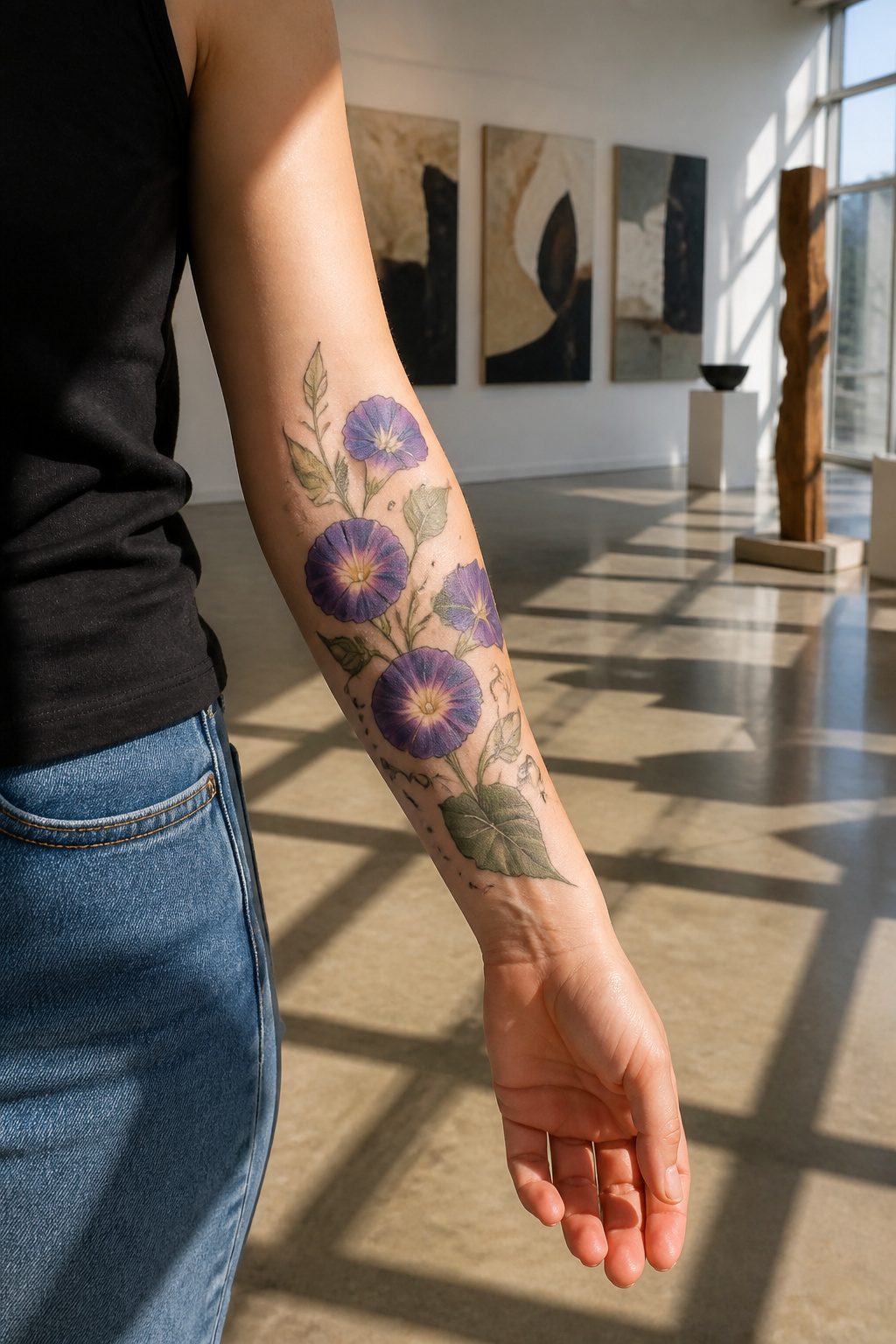
The forearm gives a morning glory tattoo room to breathe. A single bloom can open wide enough to show the vein-like tracery in each petal, or a vine can wrap the full length without the crowding that shrinks detail on a wrist or ankle. That visibility is the trade you make. The spot sits at eye level during every handshake, every coffee order, every reach across a table. What reads as bold at 28 softens at 55 as skin texture changes and ink settles. The color saturation that looked electric fresh will mute; planning for that means choosing slightly deeper blues and purples than the reference photo suggests, not matching them exactly. A forearm piece also frames the flower’s natural geometry against the long axis of the bone, so the vine’s curve can follow the slight bow between wrist and elbow rather than fighting it. The canvas is forgiving for a first larger tattoo, enough flat plane to hold detail, mobile enough that stiffness from a long session becomes noticeable before the work is done.
13. Morning Glory Outline Tattoo
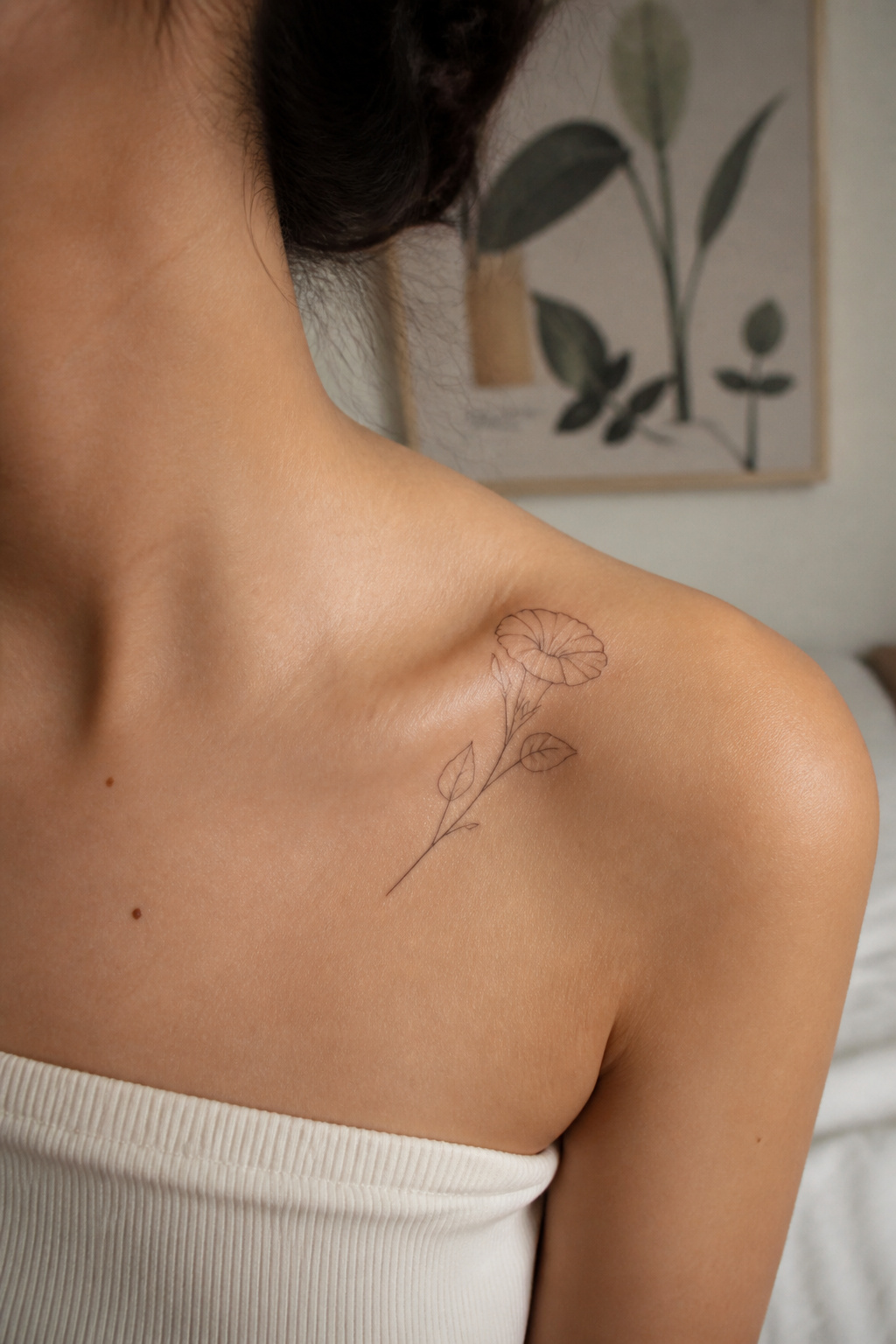
A morning glory outline tattoo strips the bloom down to its silhouette, and that absence of color is where the meaning sharpens. The shape alone still carries love, mortality, and renewal, but without pigment the message stays private, almost coded. Someone who wants the symbolism without broadcasting it finds the logic here.
I have watched this style settle beautifully along a collarbone or the inner forearm, places where a single clean line reads as jewelry rather than declaration. The form needs to be accurate, though. A morning glory’s trumpet flare and twining stem are distinctive, and a generic flower outline loses the specific resonance that makes this choice matter.
The trade is direct: you surrender the drama of blue or purple petals for something that ages cleaner and fits professional constraints without fading into something unrecognizable. For women who already read labels and weigh visible results against daily upkeep, the math is appealing. One session, straightforward healing, no color shifts over time.
Where the outline falls short is in covering older work or standing alone at a distance. It is a close-view tattoo, intimate by design. If your morning routine includes sunscreen application as second nature, the line stays crisp longer; if not, even this minimal investment blurs faster than you might expect.
14. Morning Glory and Rose Tattoo
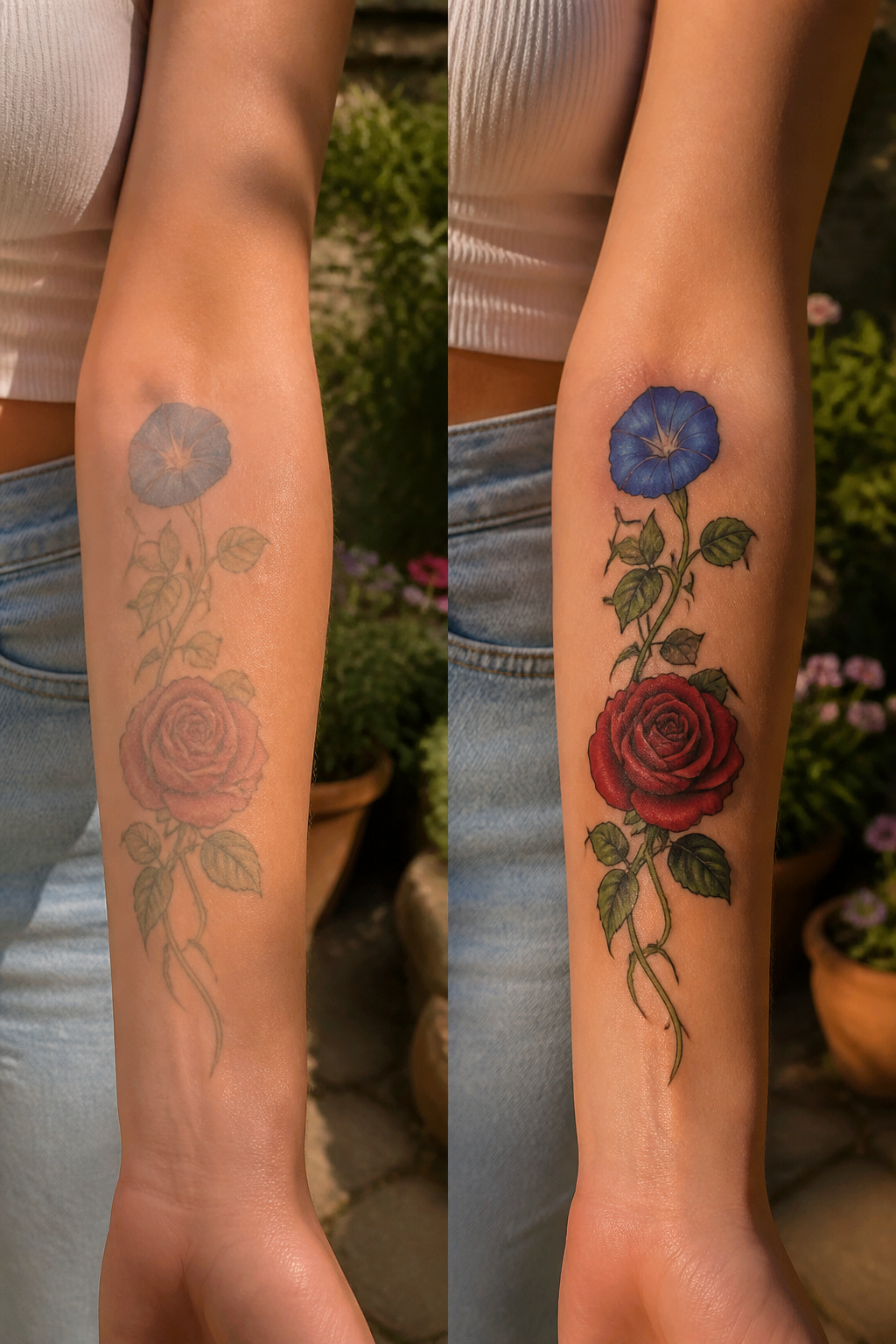
A morning glory paired with a rose speaks directly to the tension between what lasts and what passes in a single day. The morning glory opens at dawn and folds by afternoon, giving it a long association with love that arrives suddenly and leaves just as fast. Against this, the rose carries the weight of endurance, the kind of devotion measured in years rather than hours.
The pairing works because the two flowers refuse to resolve into a single statement. A design that places them together asks the wearer to hold both truths at once, the temporary and the permanent, without collapsing one into the other. Some artists set the morning glory climbing a rose stem, the vine wrapping upward while the larger bloom anchors the composition below. Others let the two sit at equal scale, the eye moving between them without a clear hierarchy.
Color choices shift the balance. A morning glory in its natural blue-purple against a deep red rose keeps the contrast sharp and legible. Muted tones, both blooms rendered in softer saturation, can merge the symbols into something more contemplative, less declarative. The placement matters too. A forearm or shoulder gives enough canvas for the full dialogue between the two flowers to read clearly; smaller scales risk reducing the morning glory to a decorative accent and losing the meaning entirely.
15. Watercolor Morning Glory Tattoo
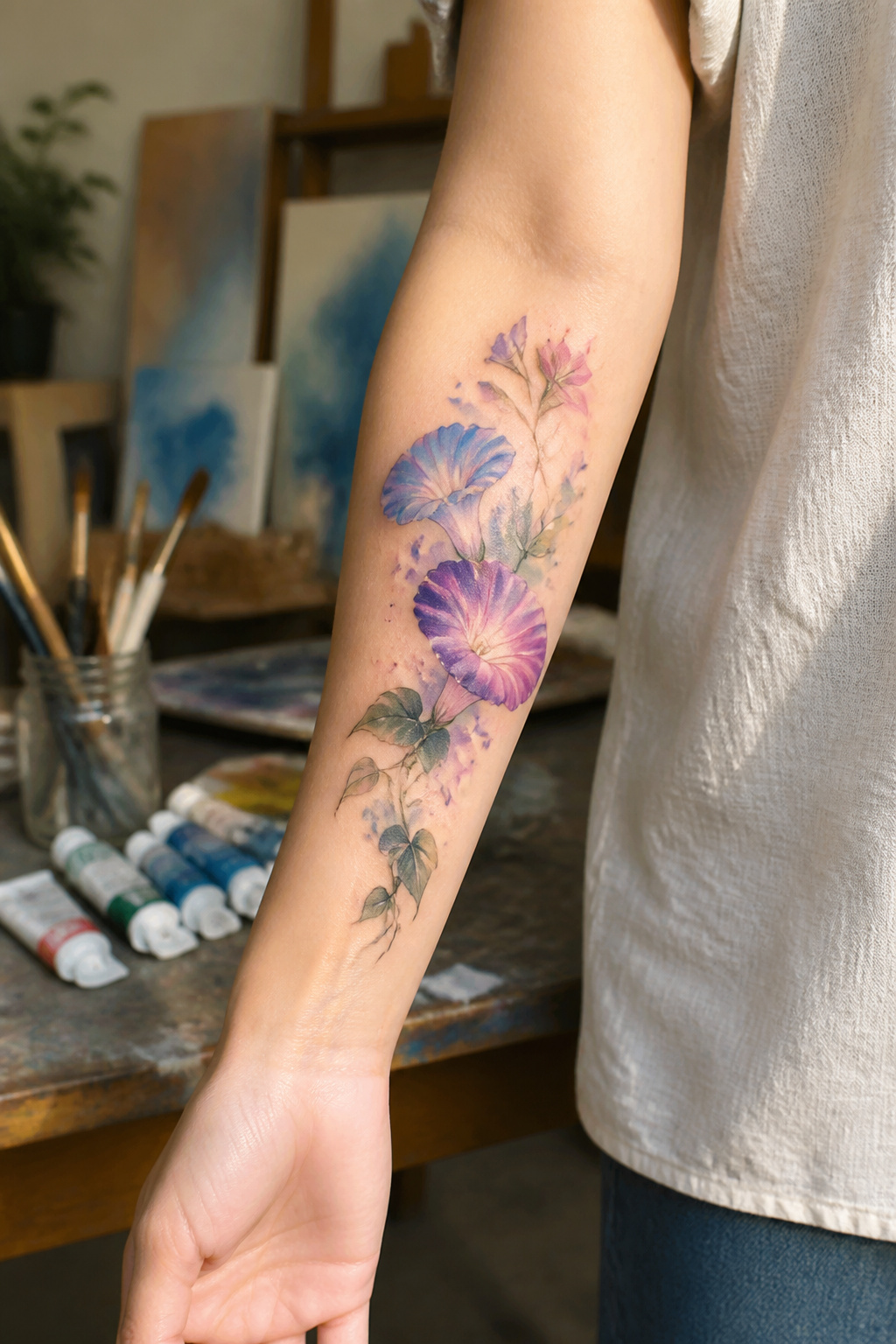
A watercolor morning glory tattoo carries a softness that matches the flower’s own short-lived bloom. The pigment bleeds at the edges the way morning glory petals fade from deep violet to pale blue before noon. That ethereal quality comes from the technique itself: diluted washes with no hard outline, so the color seems to sit inside the skin rather than on top of it.
The watercolor style works because morning glories already behave like watercolor subjects in nature. Their color shifts with light and moisture, and the tattoo mimics that transparency by letting skin tone show through the lighter passages. A skilled artist leaves deliberate negative space where the paper would stay dry in a painting, which keeps the design from turning muddy as it ages.
Placement matters for this effect. Areas with thinner skin, like the inner forearm or shoulder, let the color sit closer to the surface and keep that luminous quality. The watercolor morning glory tattoo is not a design that shouts; it registers as a stain of color first, a flower second, which is exactly the point.
16. Small Morning Glory Tattoo
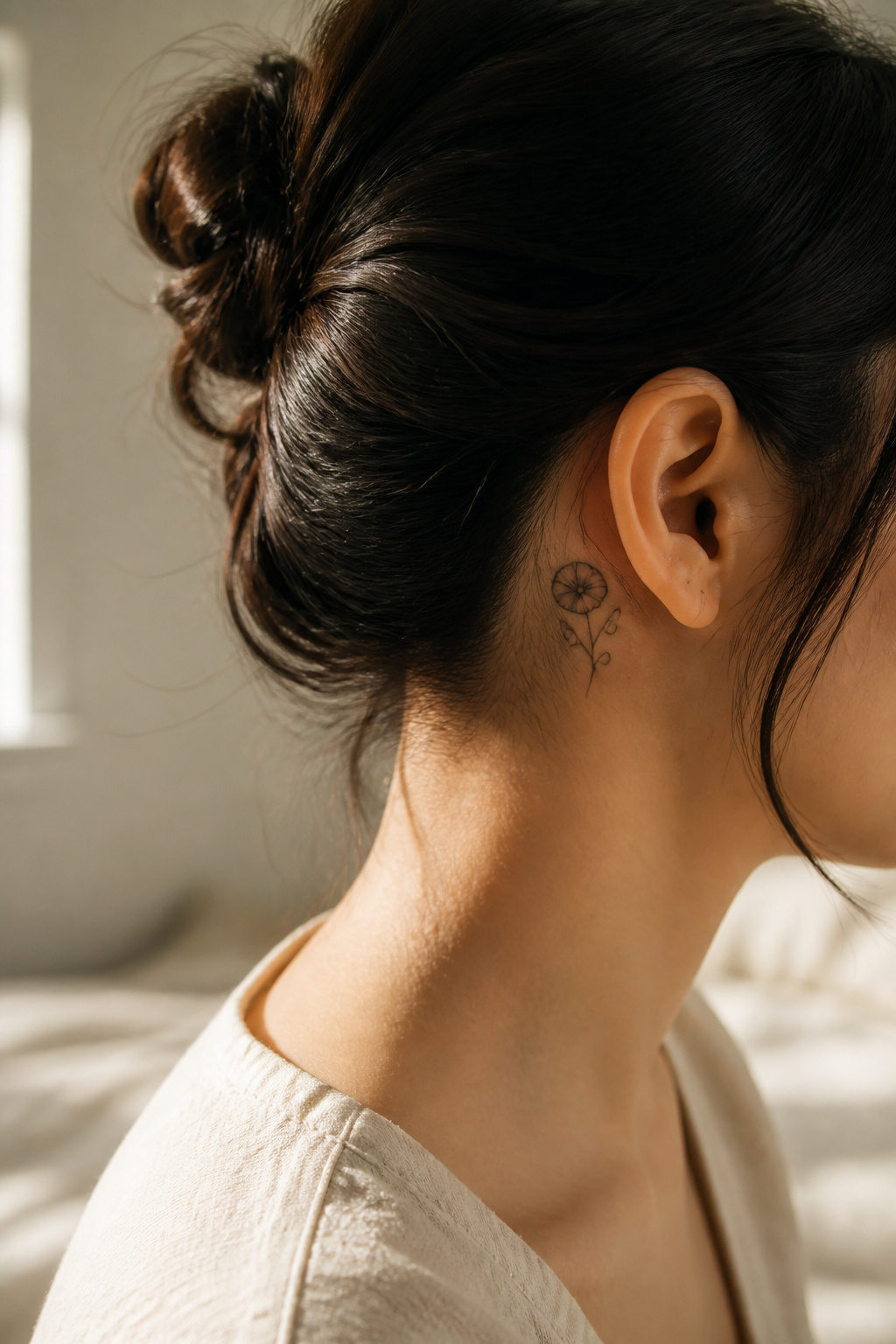
A small morning glory tattoo lives or dies by the vine. The flower itself is thin, bell-shaped, no more than a few centimeters across in nature, so shrinking it further risks mud: petals collapse into blobs, the throat of the bloom disappears, and the whole thing reads as generic flower rather than recognizable species. Single-needle work helps, but only if the artist has steady hands and the client has patience for the longer session that precision demands.
Placement matters more at this scale. The clavicle works because the bone gives the vine a natural line to follow; the wrist fails because a curling stem wraps awkwardly around such a small cylinder. Behind the ear is possible but tricky: the morning glory’s daily opening, that full-face reveal, gets lost when the viewer never sees the whole bloom at once. Color is another negotiation. The purples and blues are the point for many people, yet a piece under two inches wide cannot carry both a saturated petal and the white throat that makes the flower identifiable. One has to win, and the throat usually loses, which is fine if you know it going in.
The meaning stays intact at small scale, or so the logic goes: the same cycle of closing and opening, the same reminder that low periods precede highs. What shrinks is the visual impact of that symbolism. A tiny morning glory whispers where a sleeve would speak. That is the trade.
17. Black and Grey Morning Glory and Daisy Tattoo
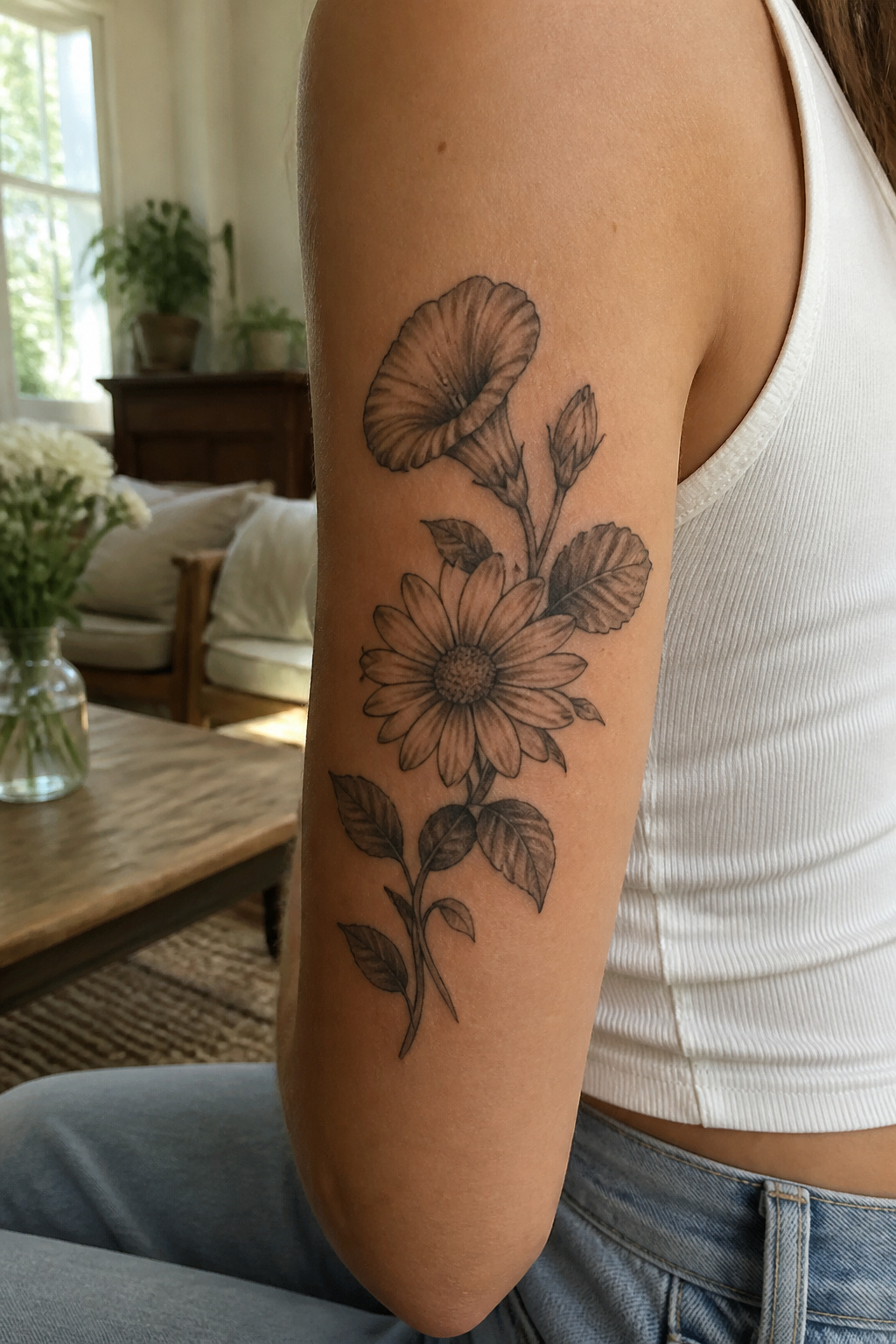
A black and grey morning glory and daisy tattoo forces two color-dependent flowers to communicate through shadow and texture alone. The morning glory’s trumpet shape and the daisy’s flat, radiating petals become the entire vocabulary; without blue or white to read, the eye follows line weight and negative space instead.
Meaning shifts in the absence of hue. In Chinese tradition, the morning glory carries marital bliss and affection, while the daisy holds innocence and loyal love; stripped to greyscale, the pairing reads less like a garden and more like a memory of one. The Japanese view sharpens this: morning glory as life’s transience, daisy as purity and sincerity. A sun worked behind the two, even in grey wash, still signals the fresh opportunities each dawn brings.
The risk is muddled silhouette. Morning glory vines tangle easily around the daisy’s simpler geometry, so placement matters. An experienced artist will separate the forms with deliberate contrast, letting the daisy’s clean disk push forward while the morning glory’s curling stem recedes. Without that discipline, two readable flowers become one grey smear.
18. Black and Grey Morning Glory and Hummingbird Tattoo
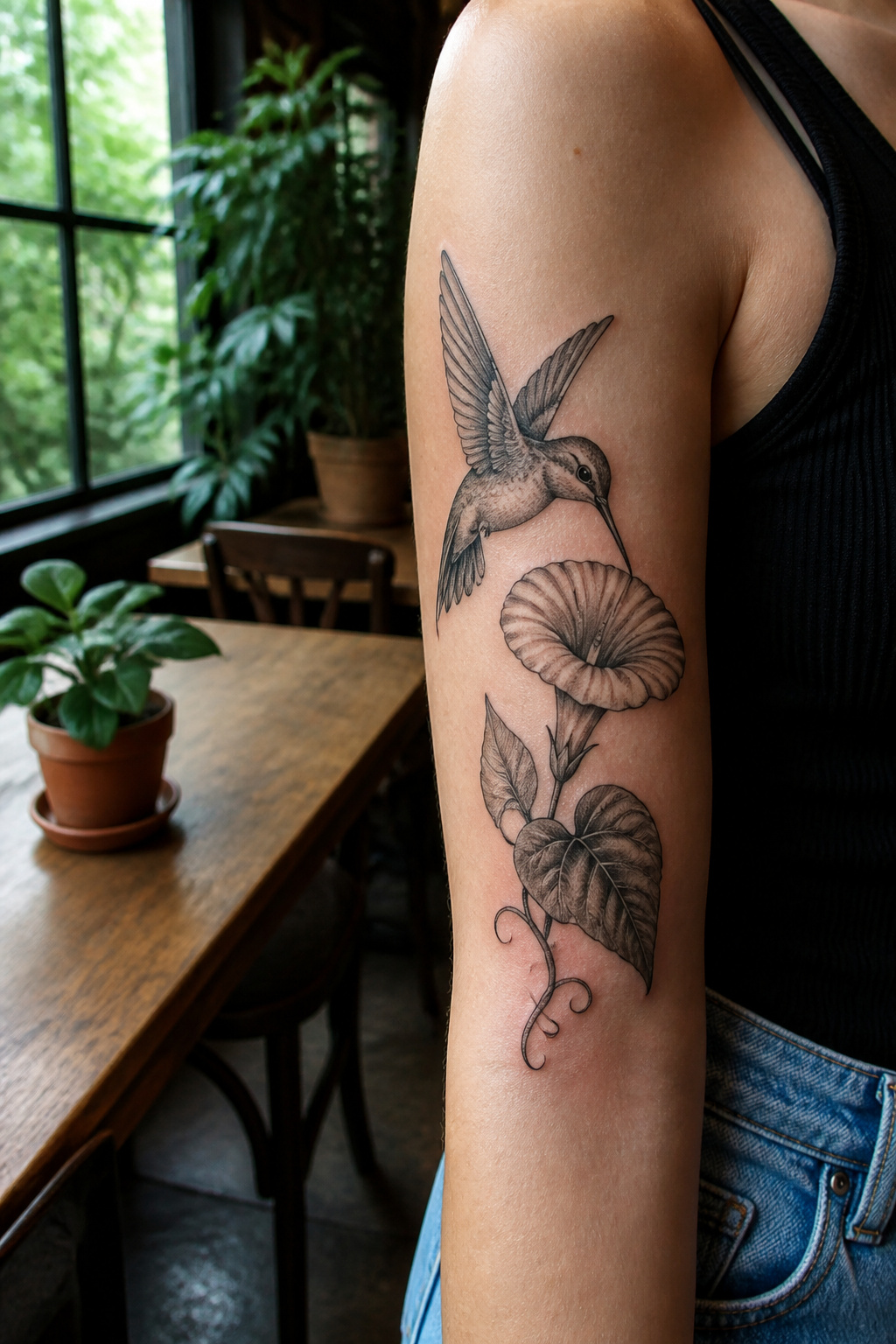
The hummingbird’s hover and sip against the morning glory’s brief opening carries a meaning that stuck with me once I saw it explained: enjoyment of life, captured in motion against something fleeting. The bird does not rush. It suspends itself, drinks, moves on. The flower, meanwhile, opens for a single morning and curls by afternoon.
A black and grey palette keeps this pairing from feeling decorative in the wrong way. The monochromatic treatment adds sophistication and a kind of timelessness that color sometimes dates. What I notice in well-executed pieces is how the grey wash handles the morning glory’s trumpet shape, giving it volume without the crutch of purple or blue ink, while the hummingbird’s iridescence gets translated into needle texture and line weight instead.
Placement matters for the story. The bird’s wings need room to read as blur or freeze-frame. Too small, and the motion collapses into static ornament. The forearm or outer upper arm tends to give the composition the breathing space the subject needs.
The pairing works best when the two elements share a single stem or vine, so the eye travels from bloom to bird in one loop rather than two separate images pasted together.
19. Blue Morning Glory Flower Tattoo
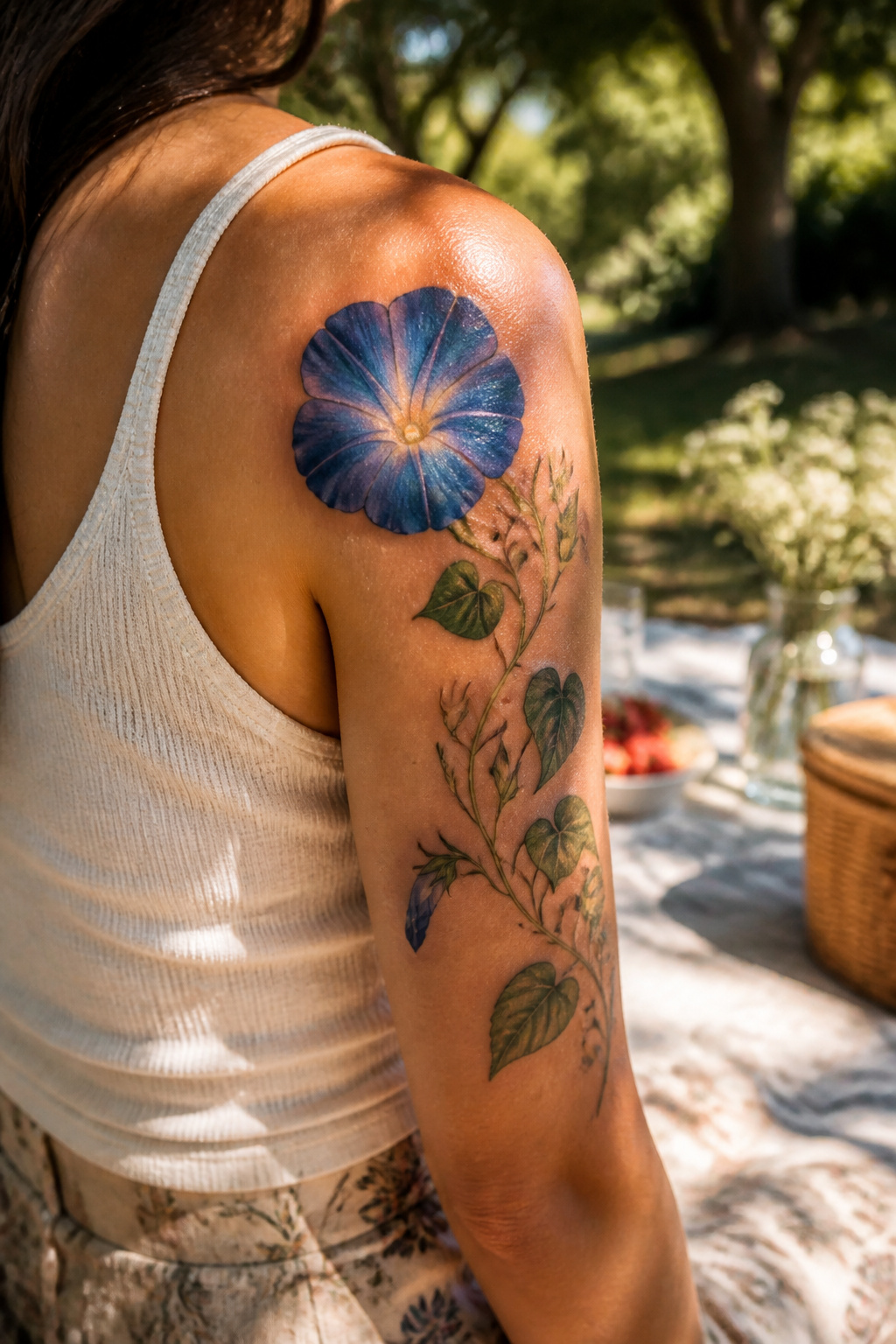
True blue is rare in flowers, and that scarcity gives a blue morning glory tattoo its weight. Most petals lean purple or violet under the name "blue"; the morning glory is one of the few that holds the color without drifting. That intensity carries the design past decoration into statement. The bloom opens at dawn and folds by afternoon, so the color becomes the lasting part, the piece that stays vivid after the flower’s daily cycle ends. A tattoo here works that same tension: the blue promises permanence against the morning glory’s built-in reminder that nothing lasts. Placement shapes how that reads. A shoulder or rib piece lets the vine trail, the blue catching light differently across bone and softer tissue. Smaller designs, maybe behind an ear or on a wrist, compress the meaning into a single saturated bell. The color does the work that detail otherwise would. In September birth-flower pairings, blue morning glories often sit beside purple asters; the contrast sharpens both. Alone, though, the blue holds its own, a splash of pigment that needs no partner to signal love and the living of it.
20. Green and Yellow Morning Glory Flower Tattoo
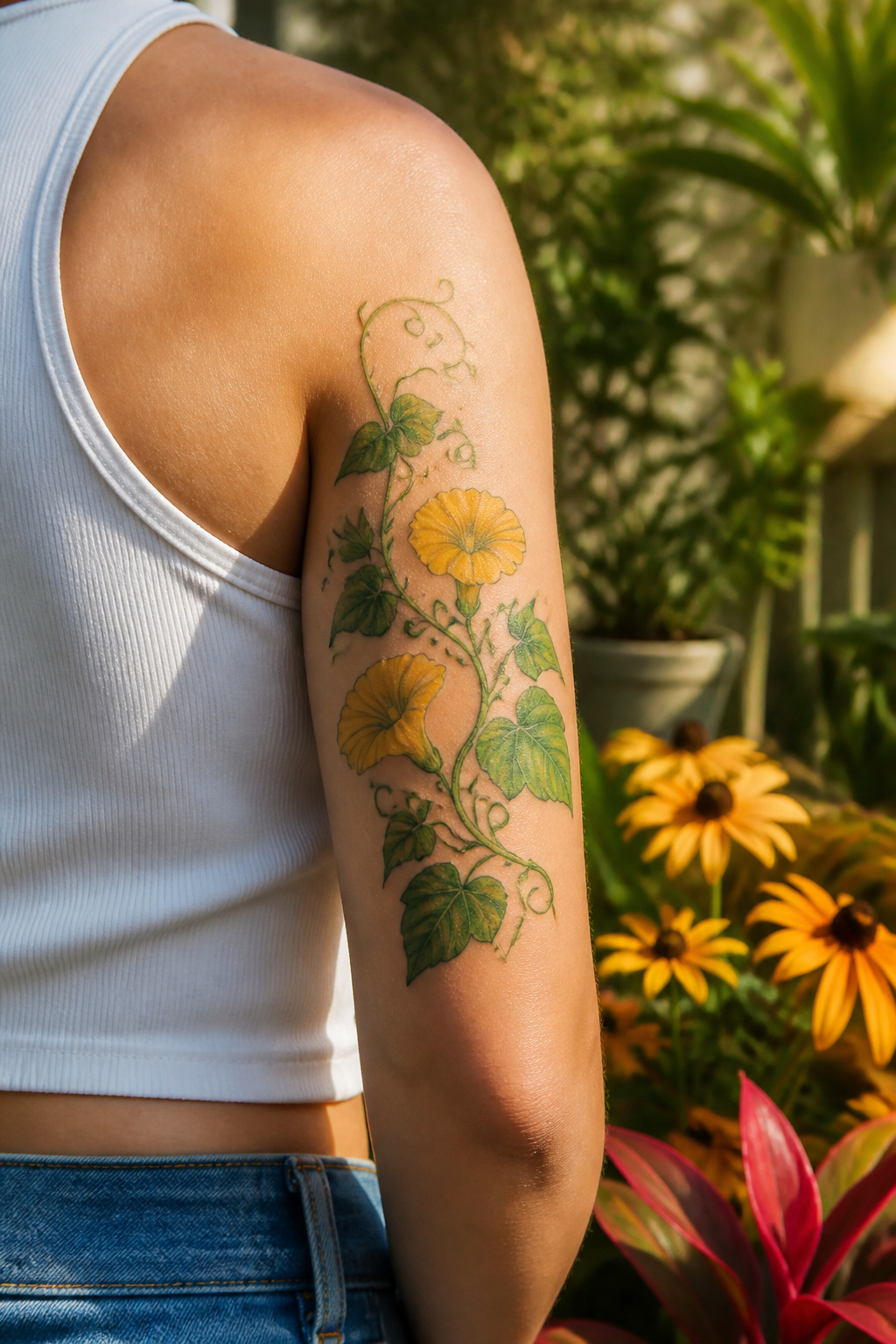
Yellow morning glories carry the lighter end of the flower’s meaning, and friendship and happiness sit right there in the pigment. The green leaves and vines that usually frame them add growth and renewal, so the whole piece ends up reading as optimism rather than the more common mourning or unfulfilled love tied to blue cultivars.
Less common cultivars stretch this palette further. A tattoo that mixes the yellow with chartreuse or lime tones keeps the friendship reading but shifts the mood from cheerful to almost restless, like early morning light still deciding what the day will be. Some artists push the green toward sage or olive to quiet the brightness down, which works better on skin that tans deep and risks swallowing a yellow that sits too close to the surface.
The pairing matters for placement. Yellow fades faster than blue or purple under sun exposure, so the upper arm or shoulder, where a shirt sleeve covers the commute, holds the color longer than a hand or collarbone that sees daily light. That is not a reason to avoid it; it is a reason to plan the touch-up schedule into the first conversation with the artist.
21. Morning Glory and Aster Tattoo
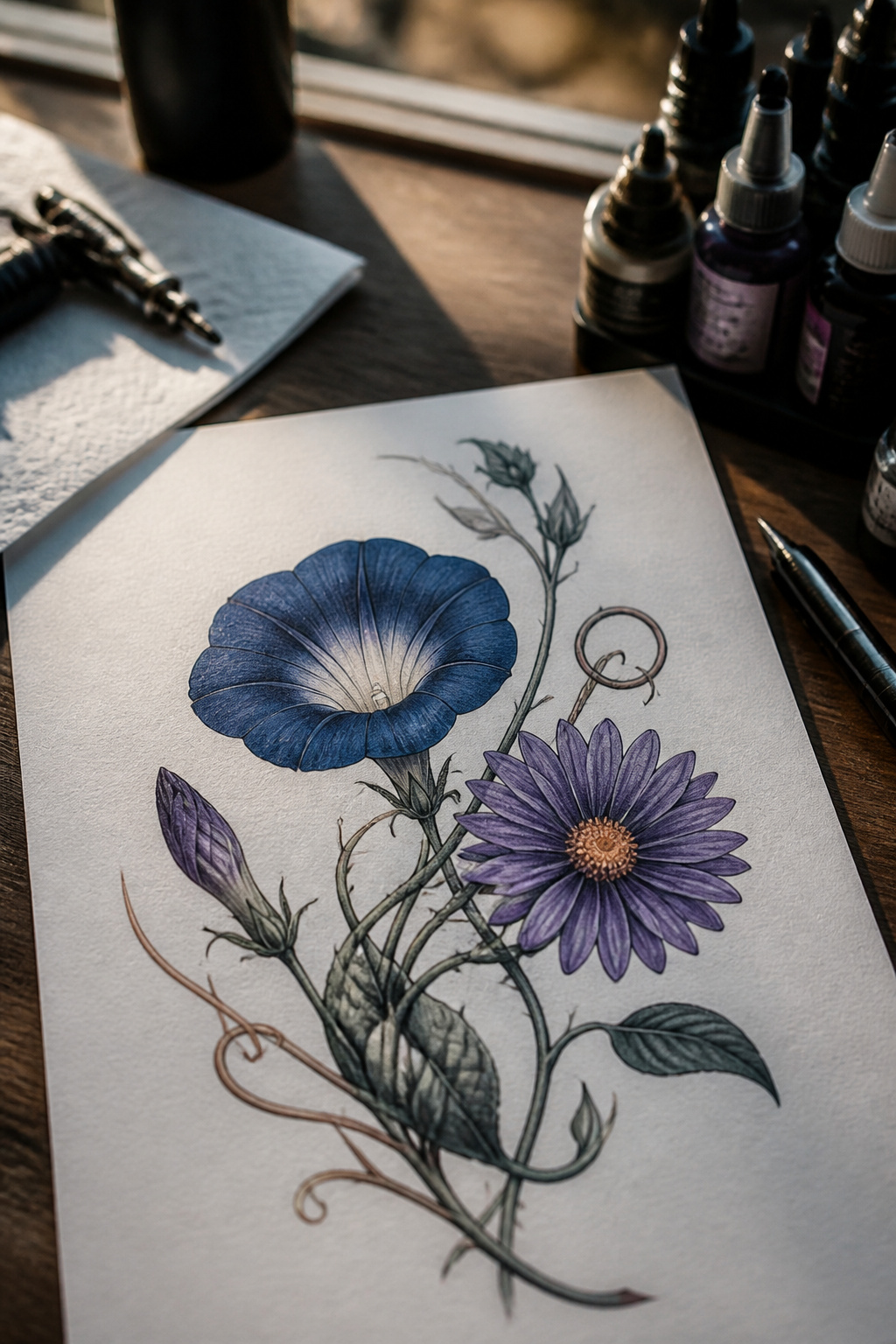
September carries two birth flowers, not one, which gives a morning glory and aster tattoo its particular weight as a birthday tribute. The morning glory opens at dawn and fades by afternoon, while the aster keeps its star-shaped bloom steady through the day. Together they frame a life that keeps beginning rather than one that has already arrived somewhere.
Pair blue morning glories with purple asters and the contrast reads immediately as two temperaments held together: the fleeting and the constant, the burst and the stay. Green leaves between them keep the composition from floating away into pure symbol.
The aster also marks an 11th wedding anniversary, so the same pairing can shift meaning depending on placement and context. On a shoulder blade or ribcage, kept private, it leans toward personal milestone. On a forearm where others see it, the birthday reading usually lands first. The design works either way because the flowers themselves do not insist; they simply carry the month.
22. Morning Glory and Bird Tattoo
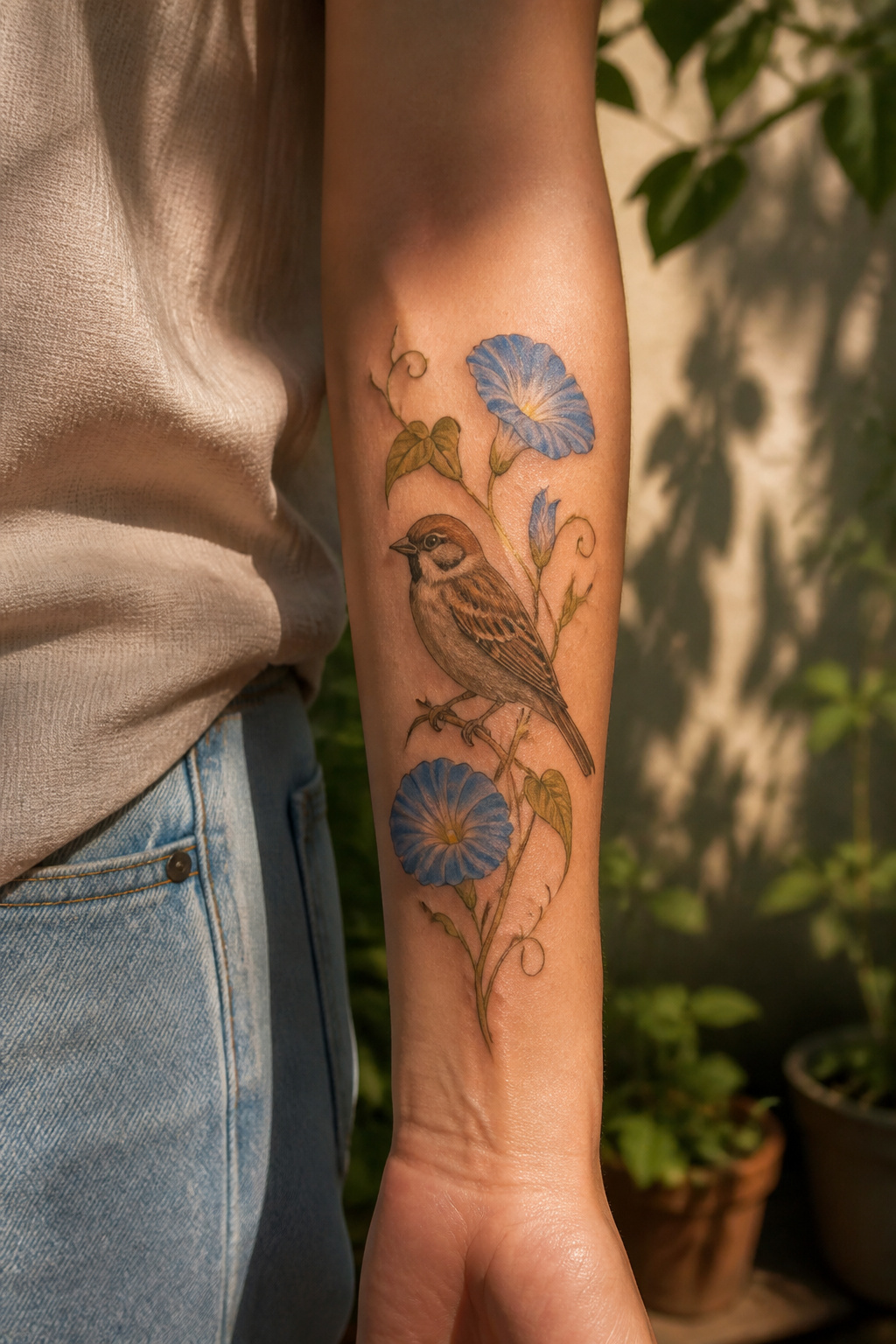
A morning glory wrapped around a bird’s perch gives the design two layers of meaning that work against each other in a useful way. The flower stands for love and life’s briefness; the bird stands for freedom and the wider view. That tension keeps the eye moving.
Sparrows show up often in this pairing, but any small species changes the mood. A finch tilts the meaning toward simple joy. A wren, with its habit of holding territory, shifts the reading toward fierce attachment to a place or person. A swallow adds the old sailor’s meaning of safe return, which layers neatly with the morning glory’s cycle of closing at night and reopening at dawn.
Placement matters for how these two elements read together. A bird in flight above the vine reads as escape or aspiration. A bird settled on the stem reads as contentment within limits. The bird’s direction, the curve of the vine, and whether the flower is open or closed all become part of the same sentence.
Color choices follow the same rule. A blue morning glory with a brown sparrow keeps things earthbound and quiet. Purple or pink against a bird with a flash of yellow on the wing lifts the whole piece toward something more celebratory. The contrast between the soft trumpet of the flower and the bird’s sharper beak and claw gives the artist natural points of detail to build around.
23. Morning Glory and Butterfly Tattoo
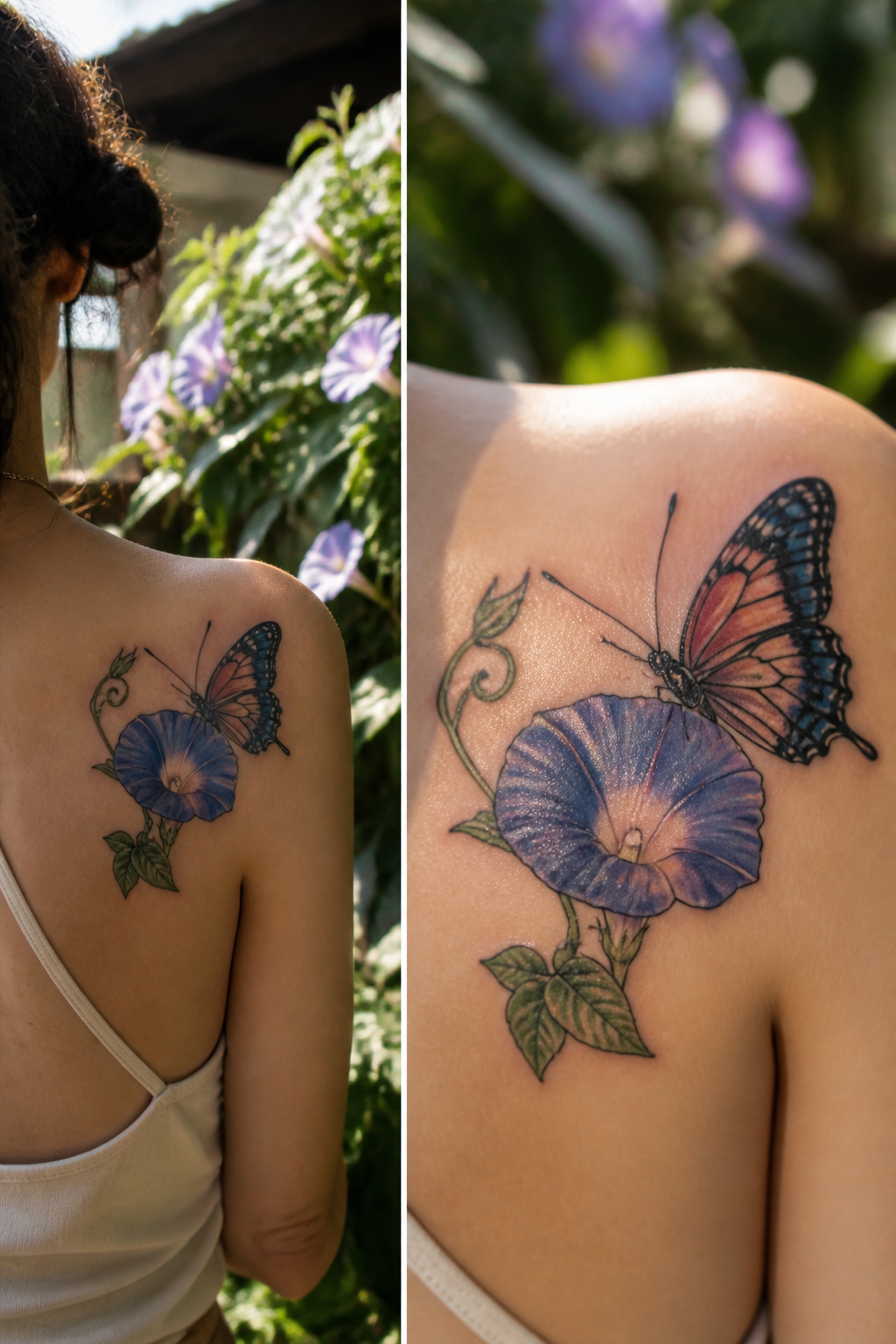
A morning glory and butterfly tattoo pairs two metamorphic symbols that both measure their lives in brief windows. The bloom opens at dawn and folds by afternoon; most adult butterflies live two to six weeks. Together they make the idea of transformation feel less like a single before-and-after and more like something you keep choosing, day after day.
Watercolor technique softens the pairing into something almost translucent, the pigment bleeding like actual morning light. That softness costs something in longevity; fine lines and pale washes fade faster on skin that sees sun and water daily. For someone who wants the image to stay crisp, bolder linework around the butterfly’s wings anchors the design without losing the flower’s delicacy.
Placement matters for how the two elements read together. A butterfly mid-flight above a climbing vine creates motion; one resting on an open bloom feels still, almost devotional. The first says change keeps moving; the second says change is something you arrive at. Either way, the meaning lands because both symbols carry it, not because one explains the other.
24. Morning Glory and Calla Lily Tattoo
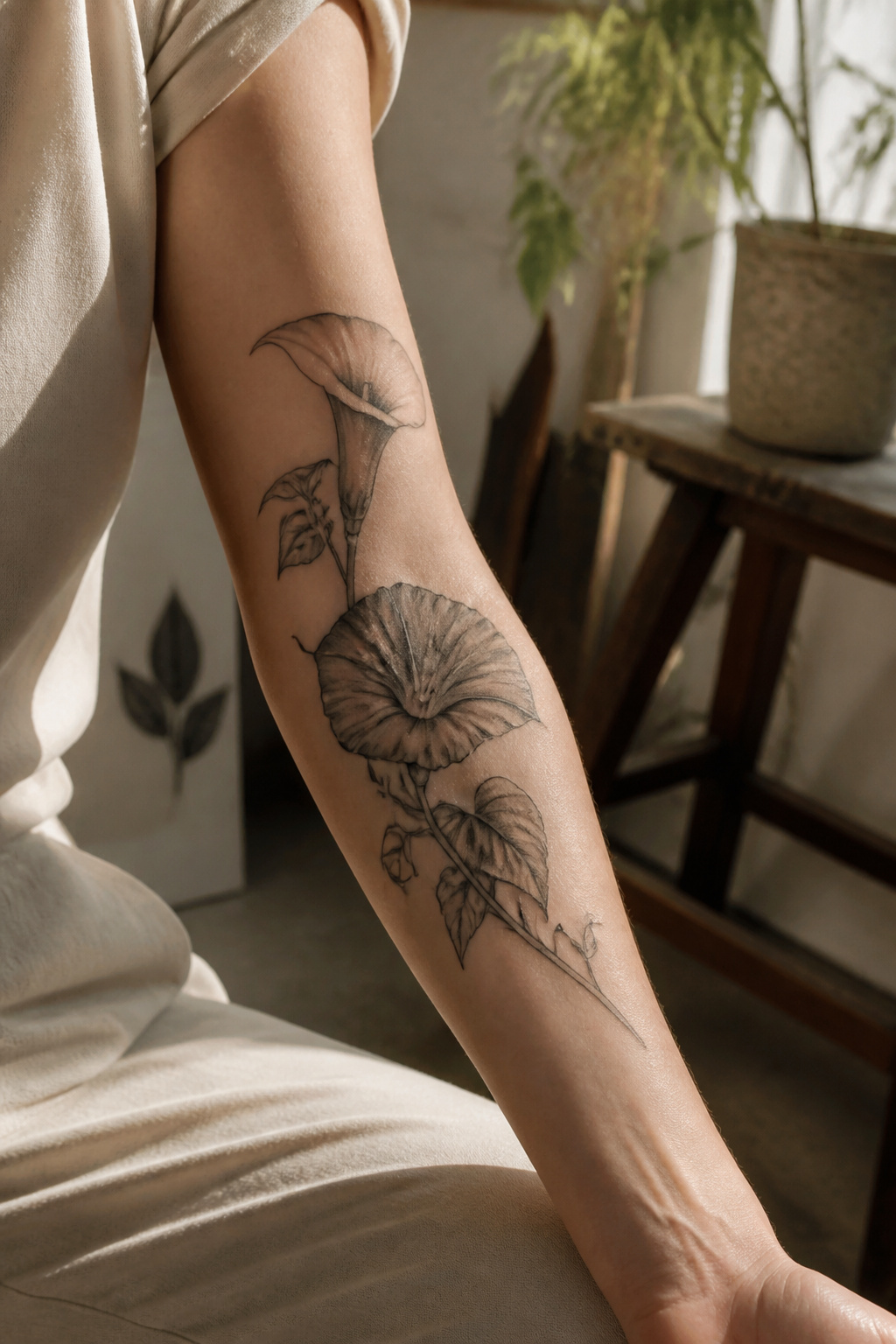
A morning glory paired with a calla lily carries the meaning of majestic beauty and transient love, a combination that works because the two flowers argue with each other in shape. The calla lily’s single, sweeping curve meets the morning glory’s flared trumpet, and that contrast is what keeps the design from looking like a grocery-store bouquet.
The calla lily brings its own weight: purity and rebirth, associations that have stuck to the flower long enough to feel earned rather than tacked on. Layered against the morning glory’s brief bloom, the pairing becomes a conversation between what returns and what does not. The composition tends to run best when the calla’s curve leads the eye upward and the morning glory’s trumpet opens against it, so the shapes support each other rather than compete.
Placement matters for this pairing more than for a single flower. The two blooms need enough room for their silhouettes to read separately; too small and the calla lily’s elegant line collapses into a plain tube. A forearm or shoulder blade gives the design the stretch it needs.
25. Morning Glory and Daffodil Tattoo
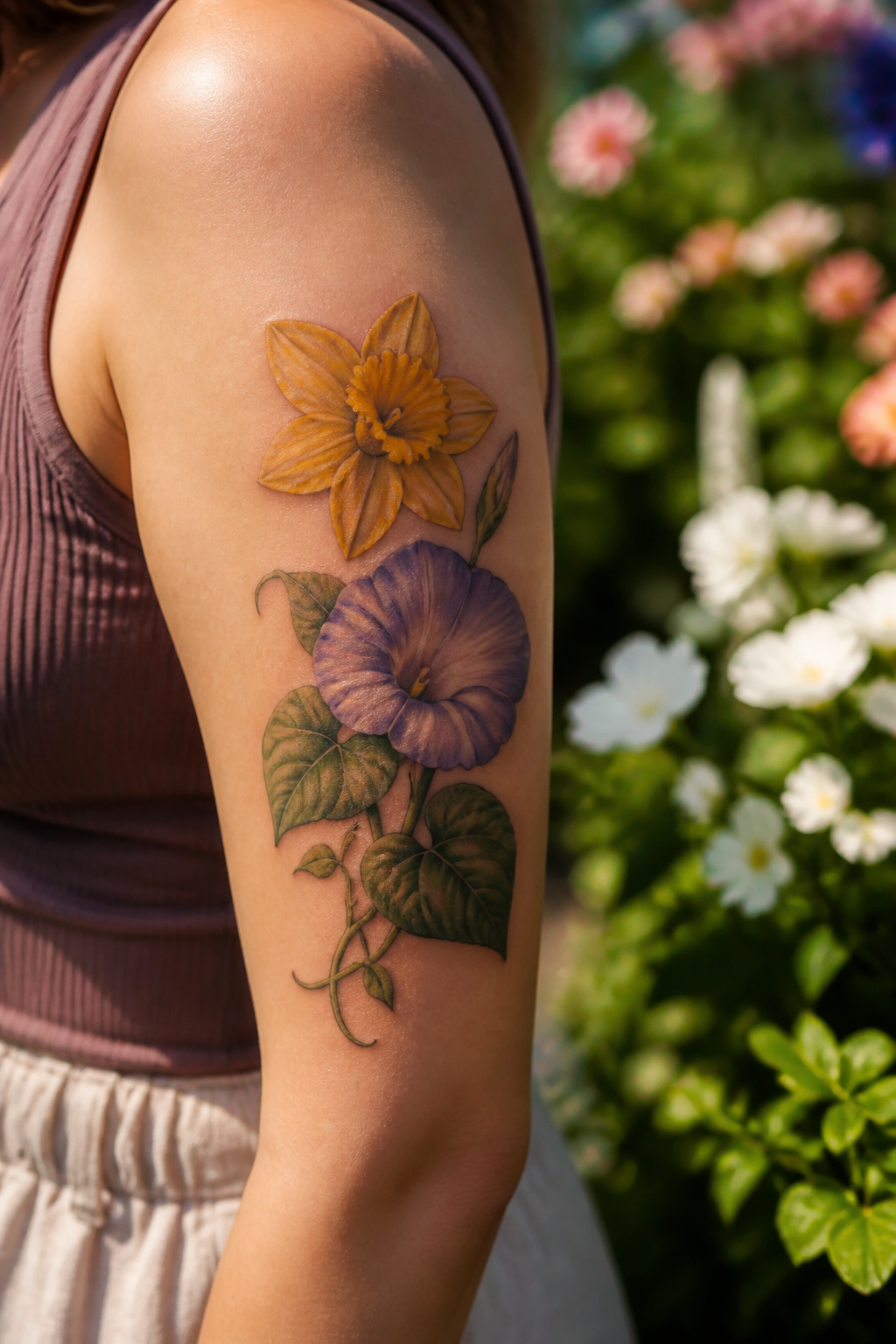
A morning glory and daffodil pairing carries the weight of two flowers that refuse to sleep through the opening act. The morning glory unfurls at sunrise and fades by dusk, while the daffodil pushes through late winter soil to mark the year’s first reliable color. Together they make a tattoo for anyone who trusts the early part of things more than the finish.
Both flowers face the sun throughout their brief performance. That shared habit of turning toward light gives the design its emotional logic: not just new beginnings, but the stubbornness of starting again while conditions are still raw.
The daffodil brings renewal and inner reflection into the pairing; the morning glory contributes its reminder that life is lived in cycles, each high followed by its low, each retreat setting up the next return. Some wearers choose this combination after a season that tested whether they would rise again, wanting the evidence visible that they did.
Style choices tend to keep the daffodil lower in the composition, grounded, with morning glory vines climbing upward around it. The contrast in structure—trumpet against bell, rigid stem against twining tendril—gives a tattoo artist enough tension to build a piece that moves.
What Morning Glory Tattoos Mean
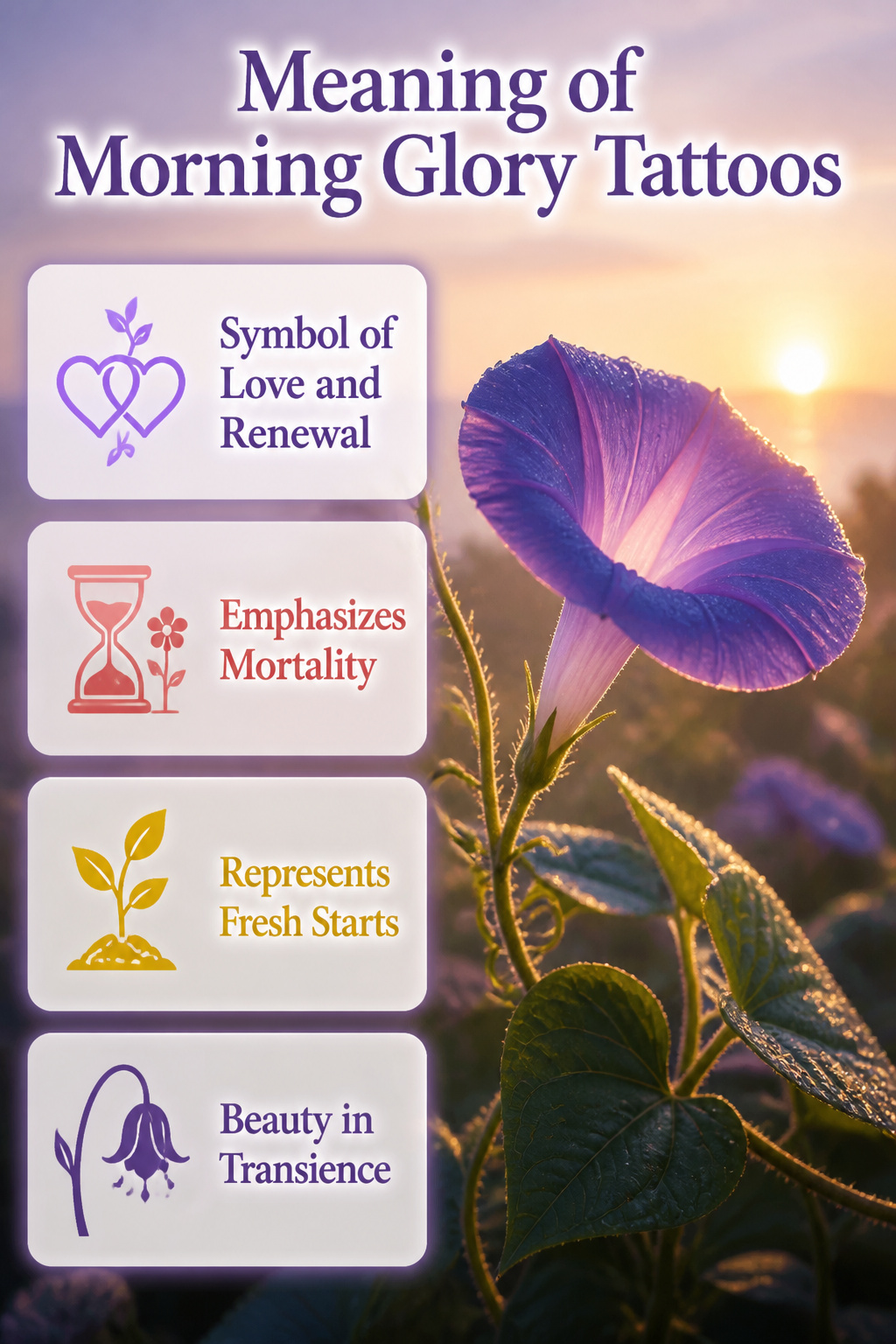
A morning glory opens at dawn and folds by afternoon, and that brief life is exactly why the flower carries weight in ink. Love, mortality, and renewal sit together in the meaning, not as separate ideas but as one continuous thread: the bloom dies, but it returns the next morning. That cycle frames what the tattoo actually says on skin.
Some wear it as a reminder that beauty is borrowed time. The flower does not pretend permanence, and the person choosing it often does not either. Seizing the day stops being abstract when your symbol literally closes shop before nightfall.
Others lean harder into the renewal side. The vine keeps climbing, keeps producing new blooms even as yesterday’s wilt. That reading suits someone marking a fresh start rather than mourning an ending.
The two readings coexist without contradiction. What shifts is where the wearer places the emphasis: on the single bloom that will not last, or on the vine that always sends up another. Either way, the morning glory tattoo refuses to promise forever, which is precisely why the promise it does make feels grounded.
Morning Glory Across Cultures
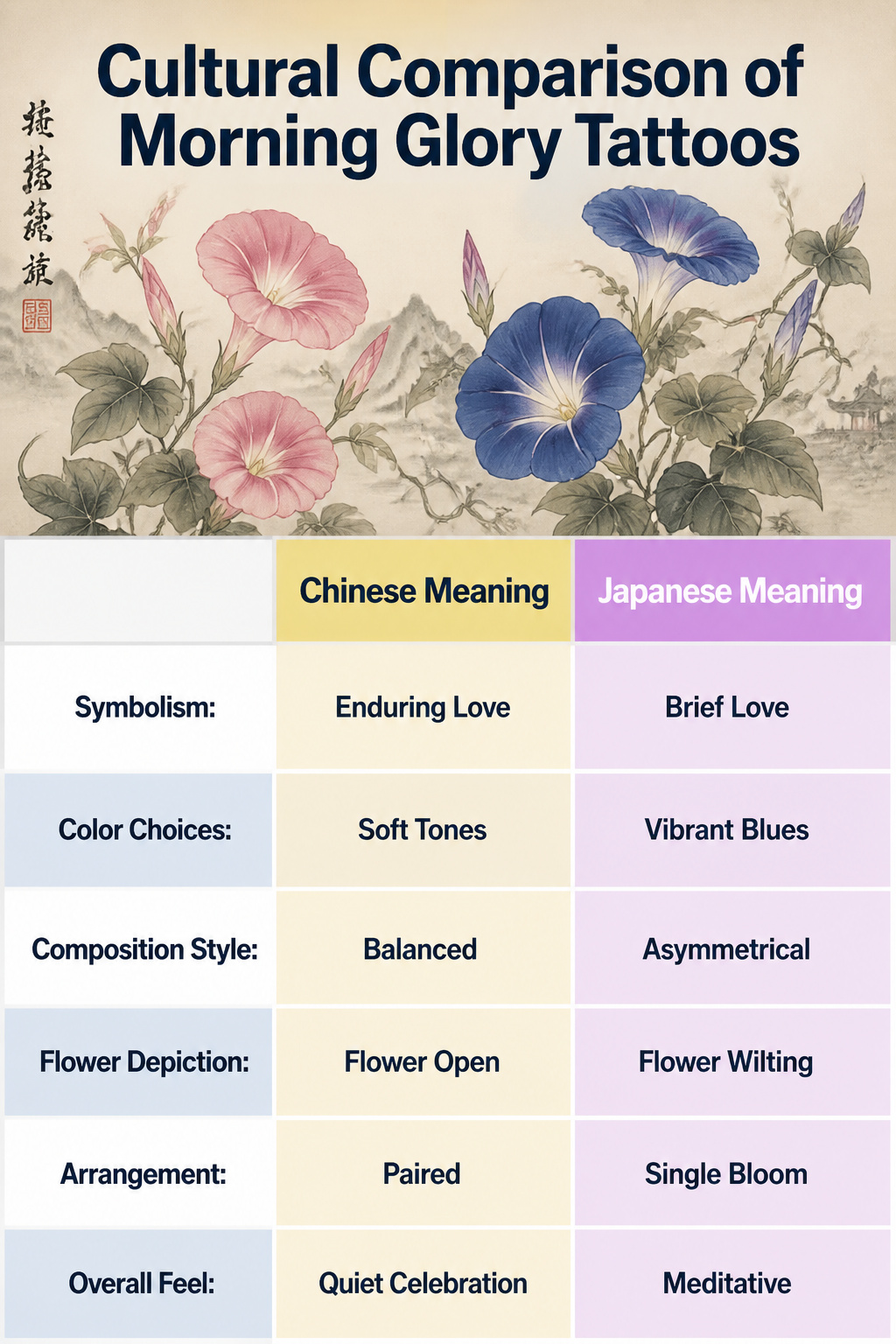
In China, the morning glory carries a weight of marital bliss and enduring love that can steer a design toward something shared. Artists there have long painted the flower alongside pairs of lovers, so a tattoo meant to honor a marriage or a lasting bond gains a clear cultural anchor from that tradition. The color choices tend softer, the composition often balanced, the feeling one of quiet celebration rather than drama.
Japan offers the sharper contrast. The same flower, called asagao, speaks of brief love and life’s transience through the Buddhist concept of mono no aware, the gentle sadness of impermanence. A Japanese-style morning glory tattoo usually sits within a larger, more intricate piece: the flower wilting, the vine curling, the whole scene suggesting a moment caught just before it passes. What reads as romantic in one context becomes meditative in the other.
The historical split matters when choosing a style. Chinese-derived designs favor the flower open, paired, symmetrical. Japanese work leans into asymmetry, the bloom caught at a particular hour, the stem often continuing beyond the frame. Both carry genuine meaning; neither is neutral.
Virgo and the Morning Glory
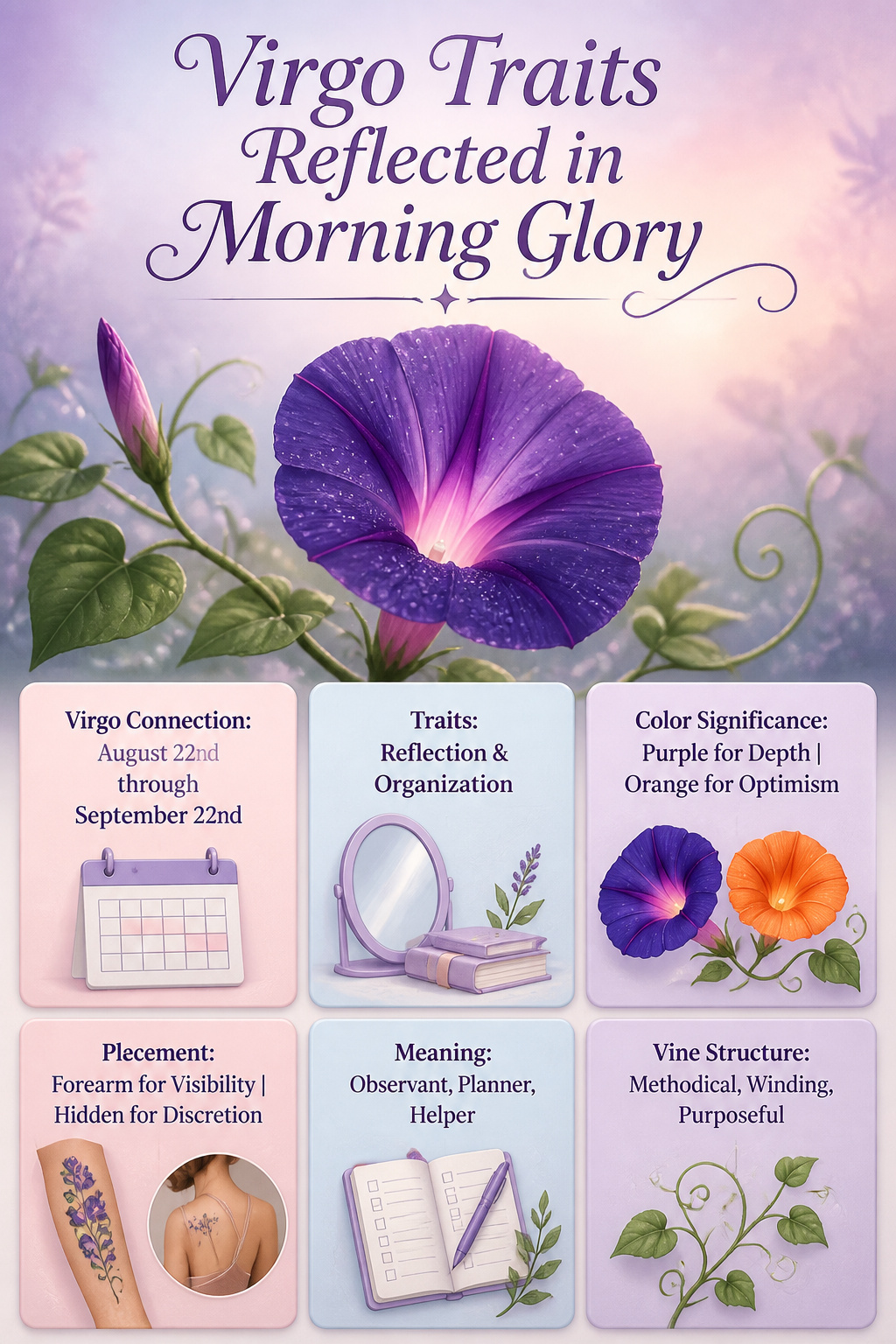
Virgo’s connection to the morning glory runs from August 22nd through September 22nd, and that birth window shapes how the design reads on skin. The flower carries traits the sign is known for: reflection, organization, and that analytical eye for detail. A morning glory tattoo in this context signals someone observant, a planner, the person who helps others get their act together.
The color choice shifts the emphasis. Rich purple or blue shades lean into the thoughtful, inward quality, while the orange tones some artists work into the center can pull toward happiness and brighter days. Purple or blue keeps the Virgo link strongest; orange drifts toward general optimism and starts to compete with the zodiac reading.
Placement matters for the analytical angle. The forearm or shoulder, visible while you’re working through something, keeps the "organized planner" narrative active. Hidden spots mute that trait, which works if you want the flower for its September birth-month meaning without broadcasting the Virgo label. The vine structure itself suits the sign: winding, methodical, reaching in a pattern that looks spontaneous but follows a clear system.
Pairing Flowers for Deeper Meaning
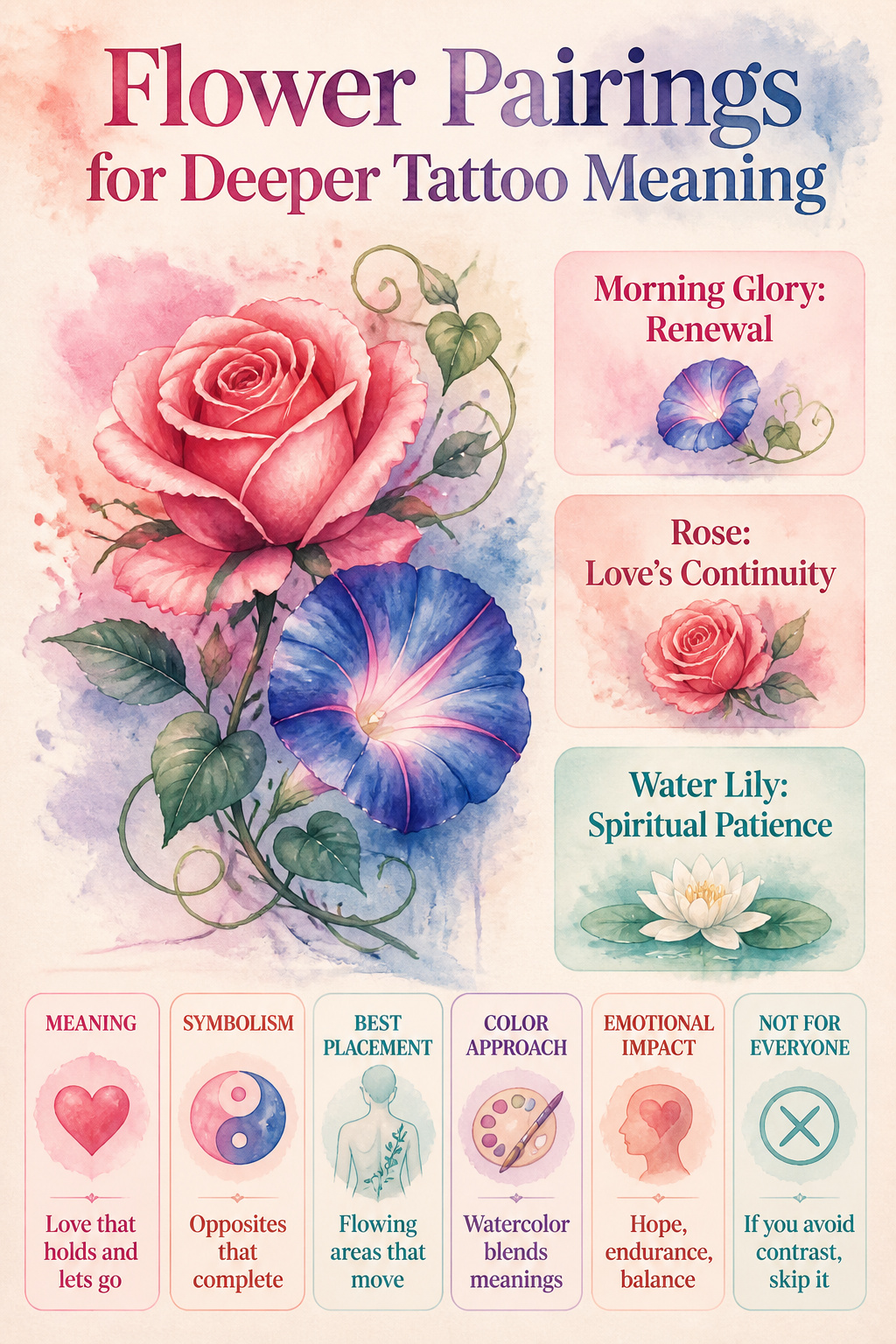
A single morning glory on its own speaks to renewal and the brief span of a single day. Pair it with a second flower, though, and the two start a conversation the skin can read like a sentence. The rose keeps what the morning glory lets go: one marks love that fades with the light, the other love that persists, and together they build a story about holding on and letting go in the same life. Water lily and morning glory share a different grammar, both pointing toward spiritual meaning but from opposite temperaments. Where morning glory suggests resurrection and the flash of enlightenment, water lily leans into patience and the slow work of staying pure. The pairing you choose is the argument your tattoo makes — not which flower you like more, but which tension you want living on your body. Watercolor technique softens the contrast between rose and morning glory into something almost painted on, a blur where the meanings bleed into each other rather than stand in opposition. That matters when you are deciding how loudly the pairing should speak.
Style Guide for Morning Glory Tattoos
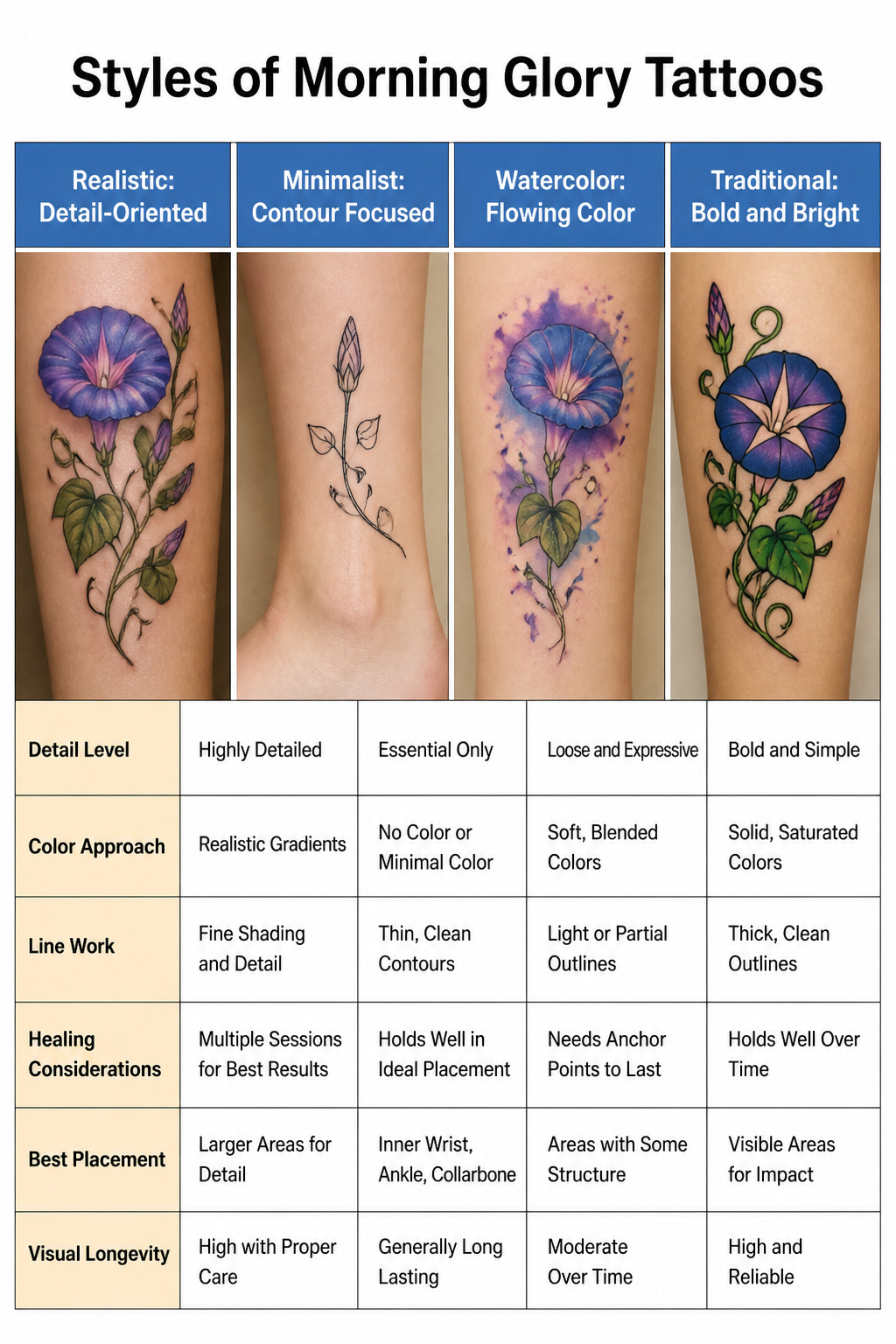
Realistic morning glory work demands patience from the collector and a portfolio deep in botanicals from the artist. The trumpet shape wilts fast; catching it open in ink means nailing the gradient from throat to petal edge, usually over multiple sessions. Skin tone shifts the purples more than people expect, so the reference photo needs matching light, not just matching flower.
Minimalist and fine line styles strip that down to contour and suggestion. What convinced me, looking through dozens of healed pieces, is how much the negative space does the lifting. A single closed bud on an ankle reads as morning glory because the silhouette is that distinct; a generic five-petaled bloom would not. Fine line rewards placement where bone gives the line natural support; the inner wrist or collarbone holds crisper than the back of the arm.
Watercolor trades precision for movement, and that is where collectors get surprised. The splashes need anchor points, stems or partial outlines, or the color pools into something unrecognizable within a year. Traditional American thick-line builds solve this by locking shape first, color second; the morning glory’s twisty vine fits the style’s love of movement, though the flower itself can flatten into a symbol if the artist leans too hard on Sailor Jerry-era flash.
The style you choose should match how much daily visibility you want from the meaning.
Frequently Asked Questions
What does a morning glory tattoo symbolize?
A morning glory tattoo carries love, mortality, and renewal as its core meanings. The flower opens at dawn and folds by afternoon, so the symbolism centers on seizing the day and accepting life’s brief cycles. Different pairings can sharpen the message; a morning glory with a rose, for example, speaks to the tension between what passes in hours and what lasts for years.
What are some popular morning glory tattoo designs?
Popular styles include simple silhouette work, realistic botanical rendering, fine line single-needle pieces, traditional American bold-outline work, and watercolor washes without hard edges. Each approach changes how the meaning reads: simple styles whisper, traditional designs carry historical weight, and watercolor mimics the flower’s own soft fading through the day.
Why is the morning glory associated with the zodiac sign Virgo?
The morning glory is the birth flower for Virgo, covering August 22 through September 22. The flower’s detailed structure mirrors Virgo traits: observant, analytical, and inclined to plan ahead. A realistic style especially suits this connection, since the precision of true-to-life shading matches the sign’s careful nature.