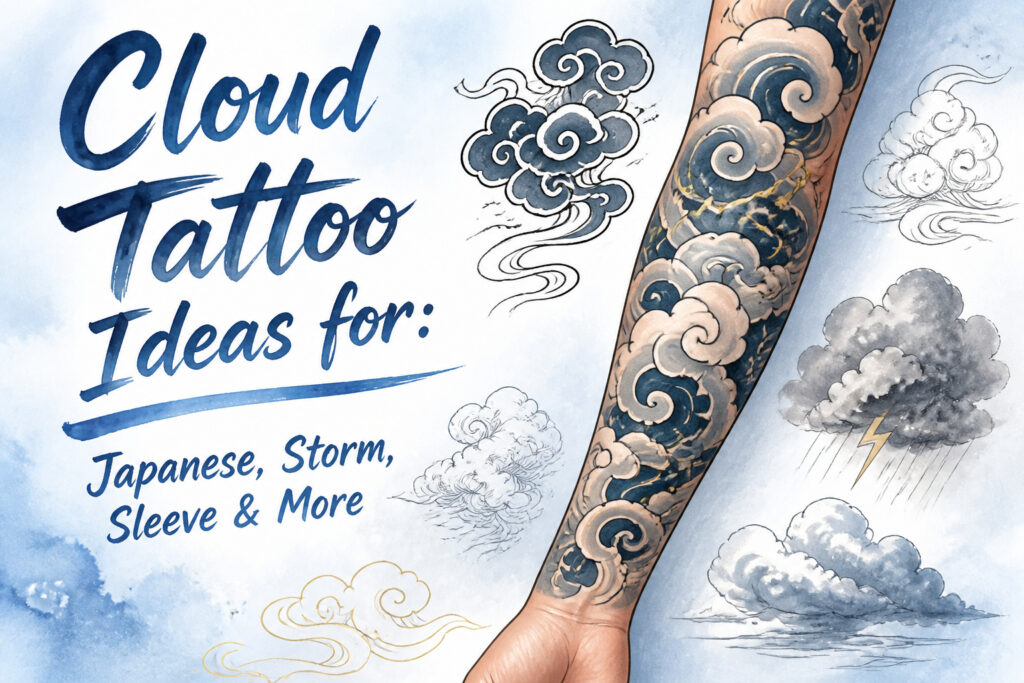
Cloud tattoos range from a single clean line behind the ear to a full sleeve of layered kumo spirals, and the deciding factor is not size but how much of the style’s visual language you are willing to commit to. The catch is that mixing Japanese cloud shapes with Western shading breaks the system that gives them their power. A kumo piece loses its protective, framing function without bold black outlines and flat indigo or gray blocks.
1. Japanese Cloud Tattoo
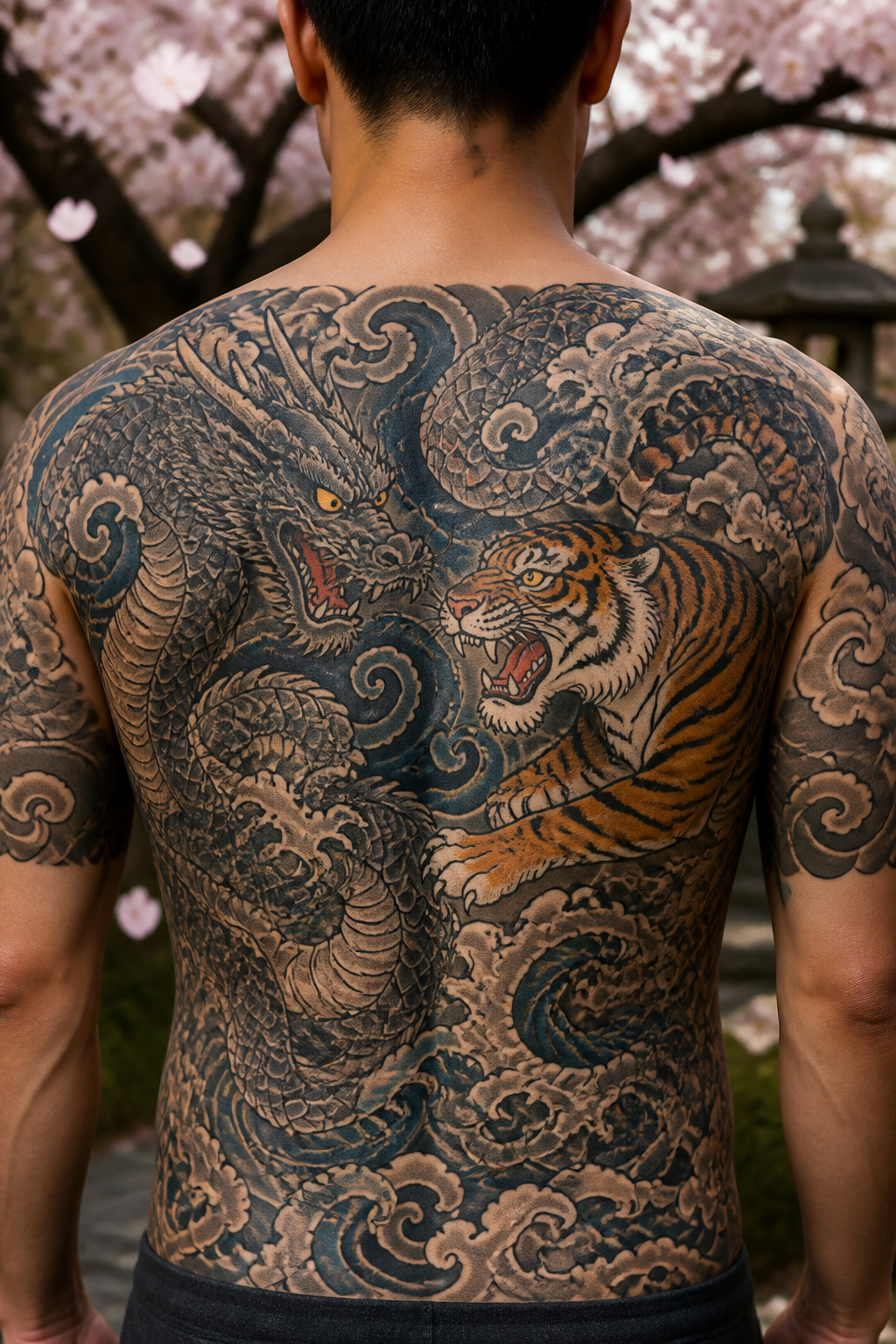
Traditional Japanese irezumi clouds hit different from the puffy cumulus most people picture. The style relies on bold black outlines and flat color blocks, usually inked in deep indigo or muted grays rather than soft gradients. These clouds carry the name kumo, and their shapes are distinct: sharper, more stylized, often curling into spirals or overlapping in layers that read as wind or movement rather than cotton-ball softness.
The meaning runs deeper than the look. In Japanese culture, clouds stand for good fortune and protection, a carryover from their association with the divine and the unreachable. A kumo piece worked into a larger back piece or sleeve acts as a buffer, framing dragons or tigers so the more aggressive imagery does not dominate the wearer’s energy. That symbolic weight is why I think the style works best at scale: a single small cloud loses the layering effect that makes irezumi read as intentional rather than decorative. Placement matters too. The curved forms follow muscle structure well, which means shoulder caps, outer thighs, or the upper back carry the flow better than flat planes like the inner forearm. If you are drawn to Japanese cloud tattoo ideas, commit to the visual language fully. Mixing kumo shapes with Western shading or realistic color breaks the system that gives them their power.
2. Rain Cloud Tattoo
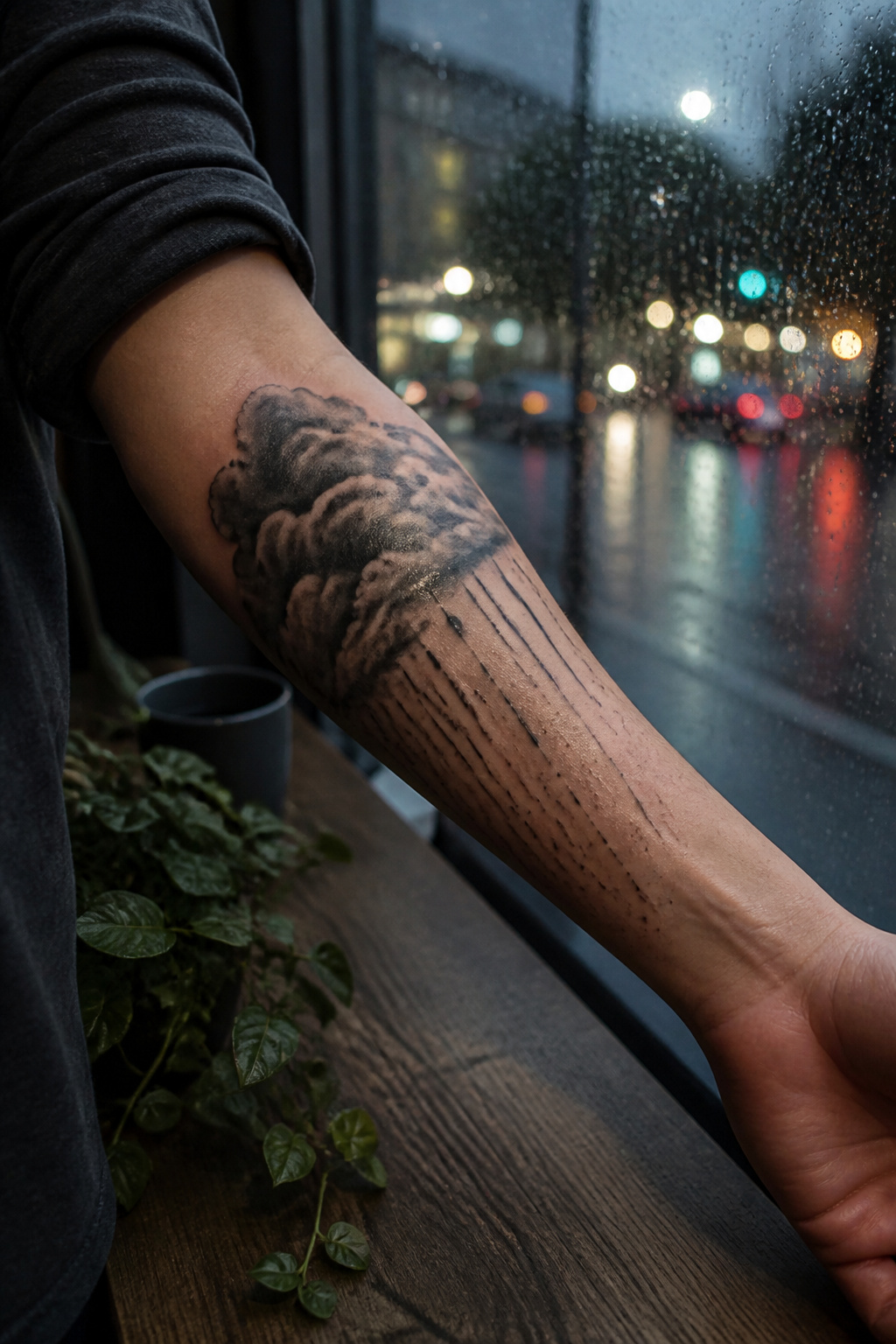
Dark, water-heavy clouds carry a different gravity than their airy counterparts, and the shading tells the story before the drops even appear. Heavy saturation builds the mass of rain-laden formations, while lighter washes leave the cloud open and drifting; the contrast between the two is what makes a rain cloud tattoo feel earned rather than decorative.
Fine line work handles the falling drops best. Single needles or tight three-round liners trace each bead with a weight that matches the cloud above it, connected sometimes by faint dotwork trails that suggest motion without spelling it out. The style tends toward melancholy or cleansing depending on placement and what sits beneath it, a forearm piece reading differently than something tucked behind an ear.
What convinced me, looking through portfolio after portfolio, was the restraint in the rain itself. Artists who render every drop identical lose the sense of weather; those who vary the length and spacing, who let some lines break before they reach the skin, capture something closer to an actual downpour. The 3D effect some pieces achieve comes less from technique alone than from the contrast between that heavy cloud base and the delicate fall beneath it.
3. Storm Cloud Tattoo
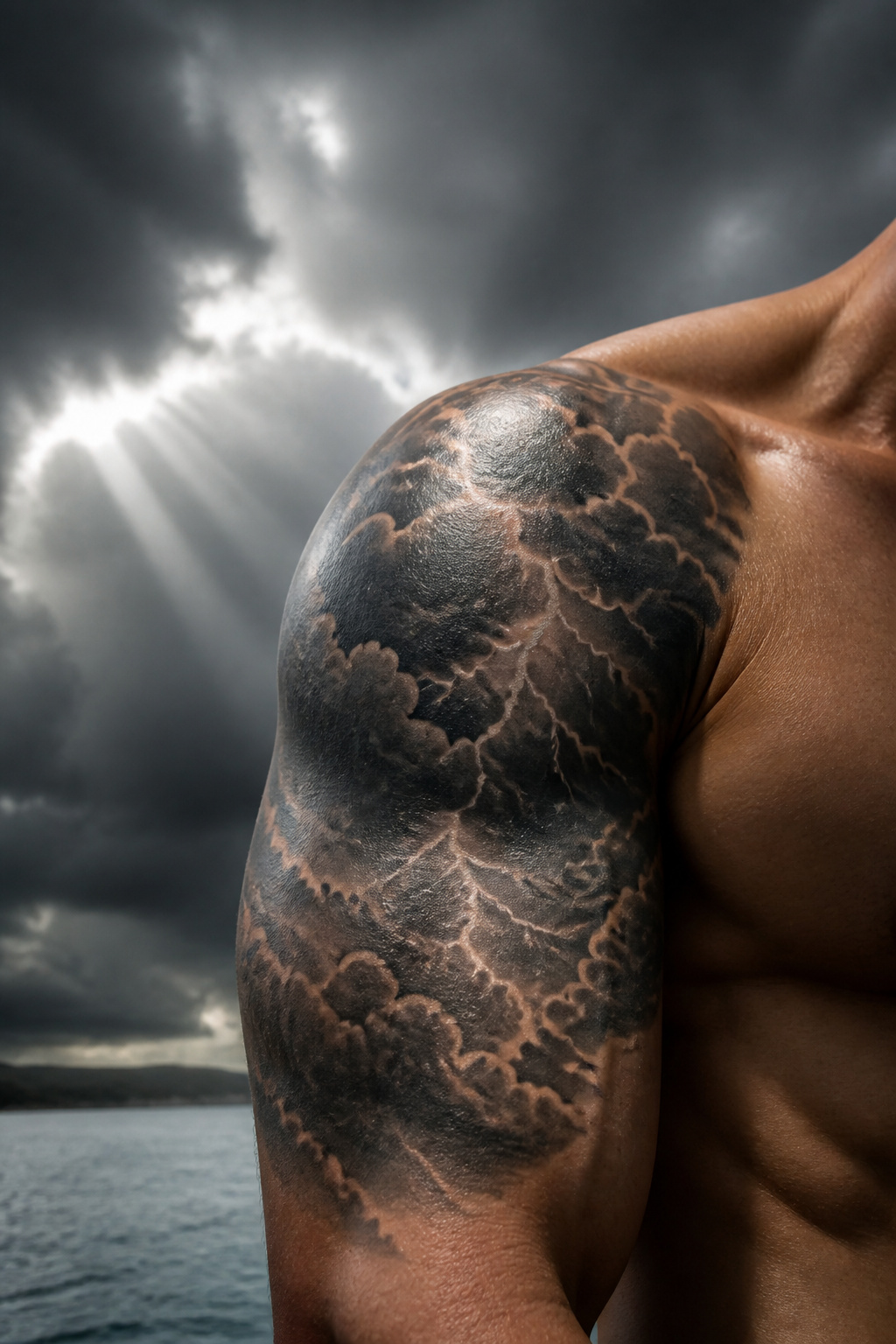
Heavy shading sits at the center of what makes storm cloud tattoos read as turbulent rather than decorative. The artist builds depth through layered grays, leaving negative space only where light would still pierce the thickest formation. A dark core anchors the piece, and when lightning appears, white ink against that density gives it the snap of real voltage.
The contrast does more than look dramatic. It carries the weight of something personal: struggle that has not resolved yet, or power held in reserve. Some wear this as the noise before the calm, the period of growing pains that arrives before any reward. Others see it as the intensity itself, the unpredictability that keeps them alert. Either reading works because the visual language is the same: brooding mass, sudden break, the suggestion that conditions could still worsen or lift.
Placement shapes how the symbolism lands. A storm piece wrapped around a forearm reads as ongoing, something the wearer moves through daily. On a shoulder or chest, it becomes more like armor. The scale needs room for the gradient to develop; too small and the grays muddy into a single dark blob.
4. Simple Cloud Tattoo
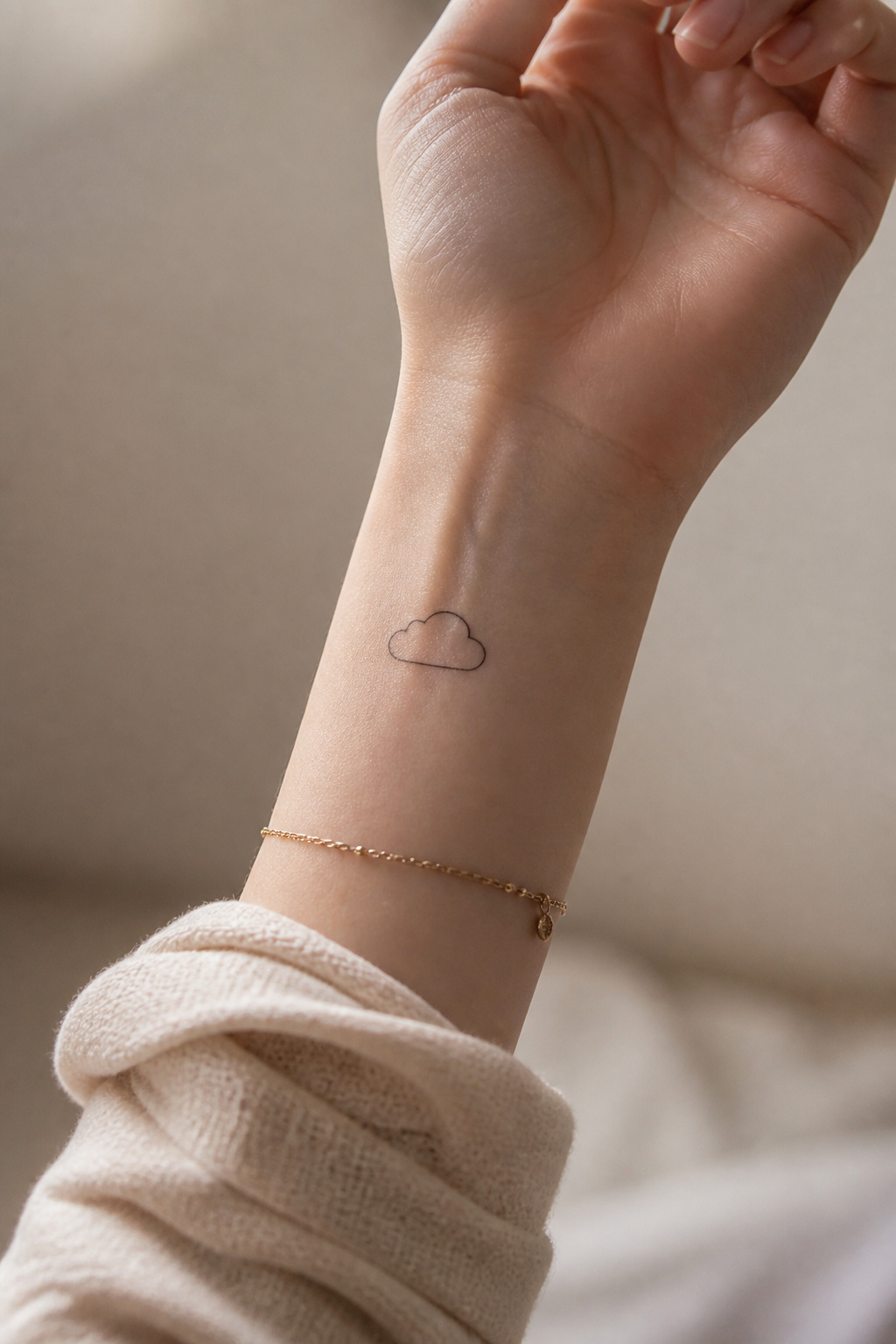
A single clean line tracing the shape of a cloud, with no filler and no second pass, asks more of the outline than most styles do. The artist has one chance to get the curve right. Any wobble sits there in the open, which is exactly why this approach works for a first tattoo: you see immediately whether the drawing holds up without shading to hide behind. Small placements behind the ear, along the collarbone, or on the inner wrist suit the restraint. The form itself becomes the whole statement, not weather or mood or sky. A simple cloud tattoo lives or dies by that one continuous edge, so the reference drawing matters more than with busier pieces. I have watched people bring in photographs of cumulus stacks and leave with something pared back to almost a cartoon, then realize six months later that the simplification was the point. The image does not try to be atmosphere; it stays shape, which ages evenly and reads fast from across a room. That is the trade. You lose drama and gain clarity, and for a first piece the clarity usually wins.
5. Cross with Clouds Tattoo

A cross with clouds tattoo works best when the clouds stay in their lane: soft, atmospheric framing that lifts the eye upward without competing for it. The cross carries the weight, the clouds create the space around it. This design leans heavily into memorial work. Names, dates, or short verses sit naturally beneath or alongside the cross, with clouds gathered at the base or drifting behind the arms to suggest passage rather than finality. In most versions the clouds read as background, not subject. They fill negative space, soften edges, and give the piece air. I’ve seen designs where the cross is rendered in bold black line work while the clouds stay muted, almost washed out, and the contrast keeps the hierarchy clear. Wing impressions sometimes appear at the sides, extending the idea of guardianship. For placement, the back offers the largest canvas, though forearms are common for pieces meant to be seen and revisited. The core risk is overworking the clouds. Too much detail and they become the story; too little and the composition looks empty. The balance that reads right is usually lighter than the client first imagines.
6. Cloud and Lightning Tattoo
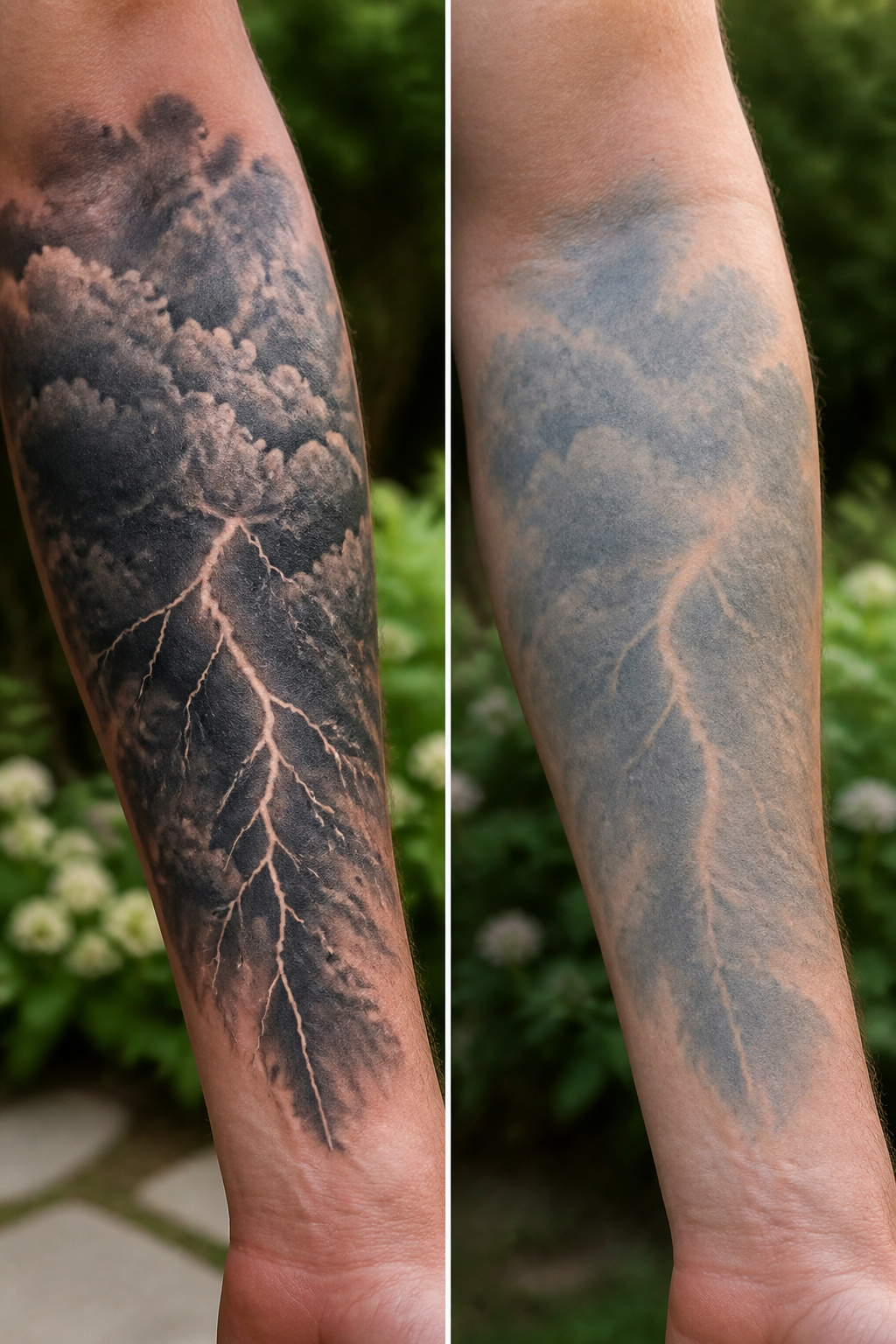
Dark cloud masses gain their depth from gray shading and negative spacing, a technique that leaves the lightning itself to crackle across untouched skin. Jagged bolts cut through softness this way: the clouds billow with blurred edges while the electrical element stays sharp enough to read from across a room. White ink or a pale wash can push the contrast further, making the strike feel like it arrived a split second ago.
That tension between soft and sharp carries meaning as well as visual weight. The design speaks to sudden change, the moment a quiet afternoon turns violent. On skin, it keeps that energy permanently: the storm is always building, the bolt always falling.
7. Moon and Cloud Tattoo

Clouds wrapping a moon give the artist something to work with that a bare lunar disk does not: partial concealment changes the emotional register entirely. A full moon behind thin cirrus reads as quiet observation. The same moon bisected by a heavy cumulus bank suggests something withheld, a cycle not yet complete. The phase matters as much as the cloud shape. A crescent already implies diminishment or return; adding vapor that further erases its edge doubles down on transience. A gibbous moon fighting through reads as resilience, the visible portion insisting on itself.
Placement tends toward the back or chest, where the span lets the moon breathe and the clouds move across it in layers. The lunar phase and the density of cover shift the meaning: a waxing moon barely veiled connects to emergence and feminine cycles in several cultural lineups, while a waning face nearly lost in storm-gray ink tilts toward mourning or the nocturnal. What reads as mystery to one viewer reads as mourning to another, and the tattoo lives in that ambiguity. The cloud-moon pairing also serves well as cover-up work, the vapor’s soft edges forgiving older lines underneath where crisper geometry would fail.
8. Cloud with Stars Tattoo
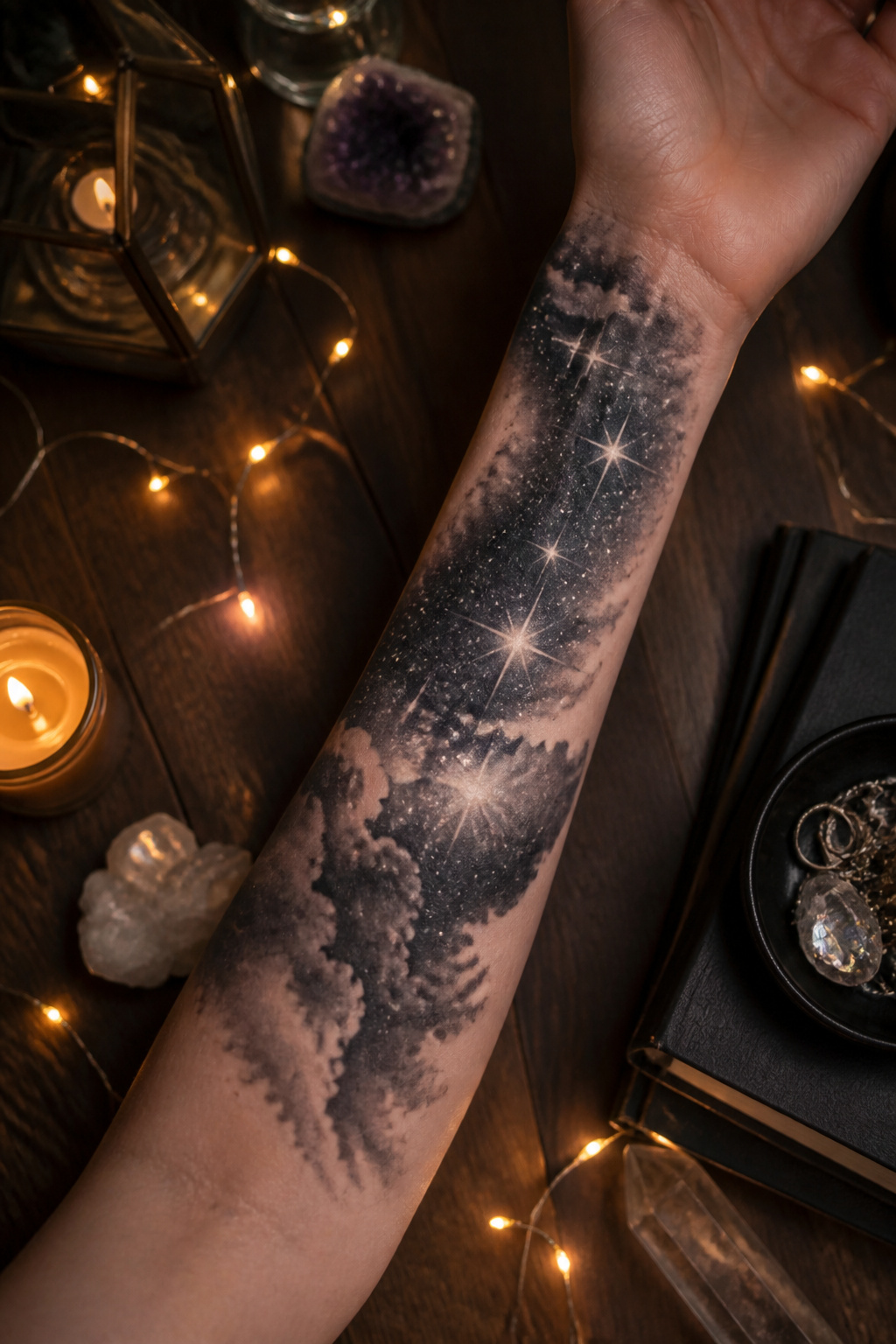
Night sky tattoos where clouds drift across star fields work best when the contrast is deliberate. Soft, billowing cloud edges set against precise celestial points create a tension that keeps the eye moving across the skin. A single bright star caught in cloud break can read as quiet revelation; scattering dozens across the field turns the whole arm into a slice of sky.
Dot work, or stippling, builds star density with pressure rather than line weight. A lighter touch gives distant, faded stars; heavier clustering suggests the Milky Way’s haze. The technique takes time, and an artist who rushes stippling leaves dots that blur together within a year. What convinced me, looking through healed pieces, was the difference between dots placed with consistent spacing and the ones that wandered: the first holds its depth, the second collapses into gray wash.
Clouds in these compositions usually stay grayscale or near-black, which lets the star work carry any color. Some keep the stars white and add a single blue or gold point as an anchor, a planet or a memory. The balance fails when the clouds get too busy, too many layers competing with the stippling. The best pieces let the negative space between clouds do as much work as the ink itself.
9. Black Cloud Tattoo
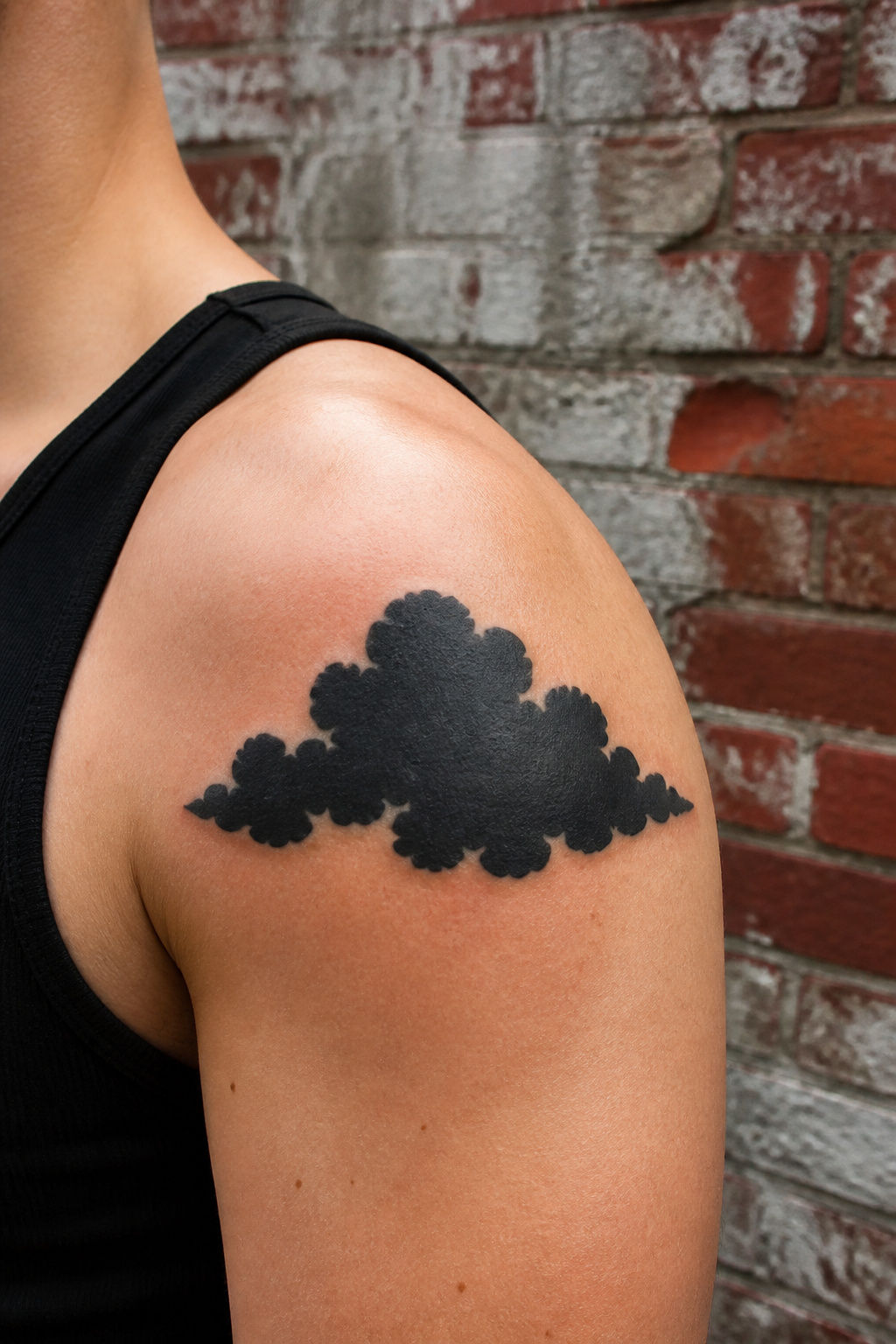
Heavy black fill turns cloud tattoo ideas into something almost opposite to the wispy, gray-wash realism most people picture first. The solid blackwork creates hard silhouette edges and graphic weight that reads from across a room, not just arm’s length. This approach trades atmospheric softness for bold shape, letting negative space do the work of suggesting volume and movement.
Skin tone matters more than most clients expect when choosing between these paths. Delicate gray shading can heal into muddy unevenness on deeper complexions or skin that tends toward keloid formation, while saturated black holds its density and heals with more predictable consistency. The saturation also means touch-ups are simpler decades down the line, since there is no subtle gradation to recreate.
Placement shapes the effect. A black cloud cluster on a shoulder or outer arm catches light differently than the same design over ribs or inner bicep, where the body’s own shadows compete with the tattoo’s intended ones. Bold blackwork needs room to breathe; packing too many solid clouds into a small space turns the design into an unreadable mass rather than a composed shape.
10. Cloud Tattoos with Names
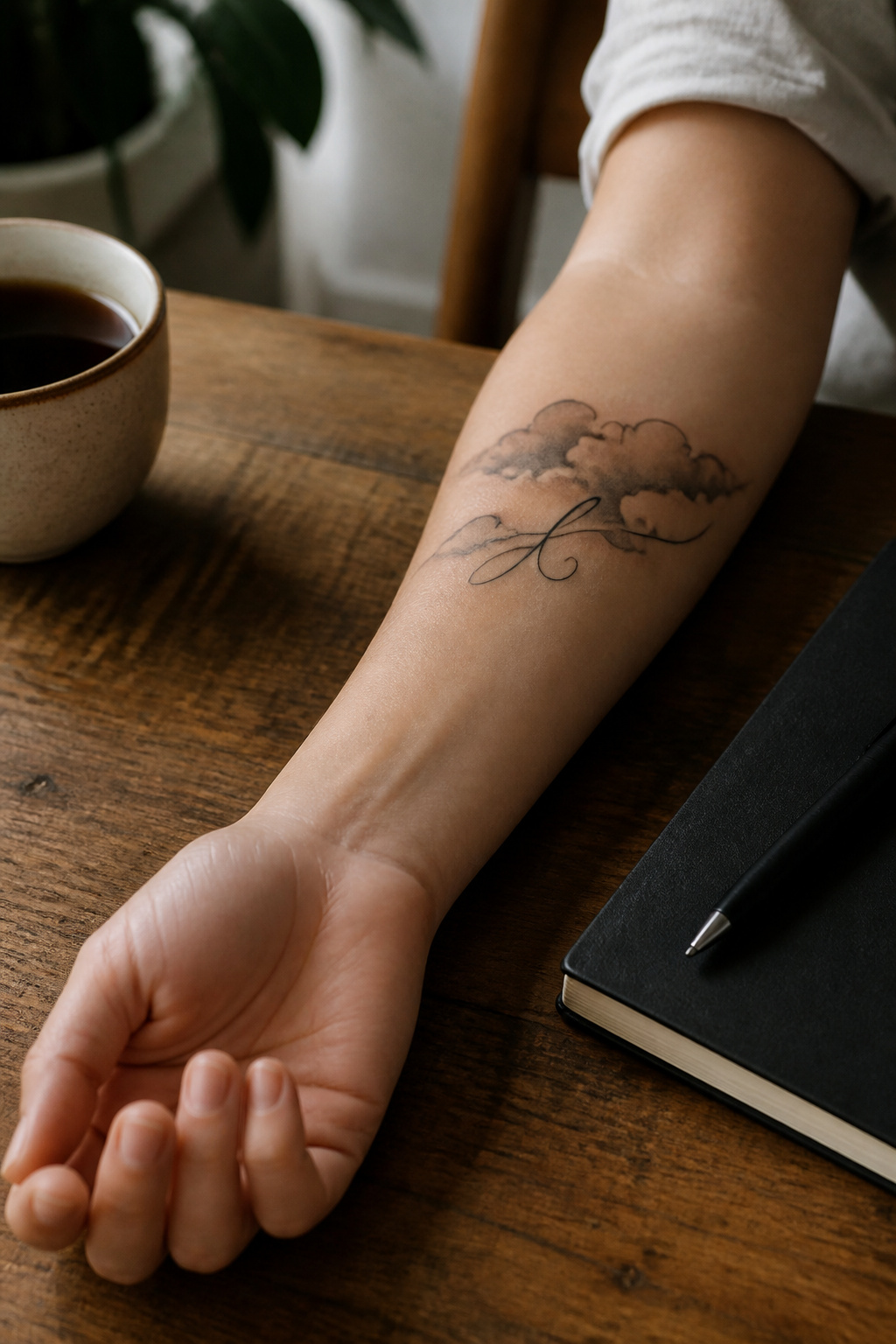
The script has to follow the cloud’s curve, not fight it. Memorial cloud tattoos work best when names, dates, or short phrases nest inside the formation itself rather than sitting on top like a label. A banner pulled across the lower edge of a cumulus cloud gives the lettering a natural frame; the cloud’s soft upper billows contrast with the straight baseline of the text below. For a loved one who has passed, the heavenly association reads instantly without needing additional symbolism. The risk is overloading the design: too many words, and the cloud becomes background instead of subject. Two to four words, or a single date in small numerals, keeps the balance intact. The flow matters more than the font choice. A script that leans into the cloud’s movement, letters slightly italicized to match the sweep, integrates where rigid block lettering would sit awkwardly apart. This is where personalization shifts the tattoo from atmospheric imagery into specific remembrance, the cloud no longer decorative but inhabited.
11. Cloud Tattoos Sleeve

A full sleeve built around clouds lives or dies on how the gradients wrap the arm. The cylindrical surface catches light differently at every angle, so a flat gray wash reads as a smudge from the side. What works is layering from deep charcoal at the cloud’s base to near-skin at the edges, letting the roundness of the muscle create the volume instead of fighting it. On my own arm, the artist spent the first session mapping where the bicep and forearm rotate most, then placed the densest ink there so the lighter edges would always catch the light in motion.
Half-sleeves starting at the shoulder give you the most room to grow. The cloud forms can fade out mid-arm with deliberate softness, leaving the lower arm open for whatever comes next. A dragon, a ship, a second cloud bank: the gradient becomes the bridge instead of a hard line you have to work around. Full sleeves demand more planning upfront. The background clouds need to recede enough that any central figure still reads first, which means the cloud work stays higher on the contrast range than you might expect. Too dark everywhere and the arm becomes mud; too light and the filler looks like unfinished skin.
The real test is standing with arms at your side. Clouds that wrap the inner and outer arm should connect visually without mirroring exactly. Asymmetry keeps the eye moving. Symmetry makes a sleeve look like a sleeve of wallpaper.
12. Sun and Cloud Tattoo
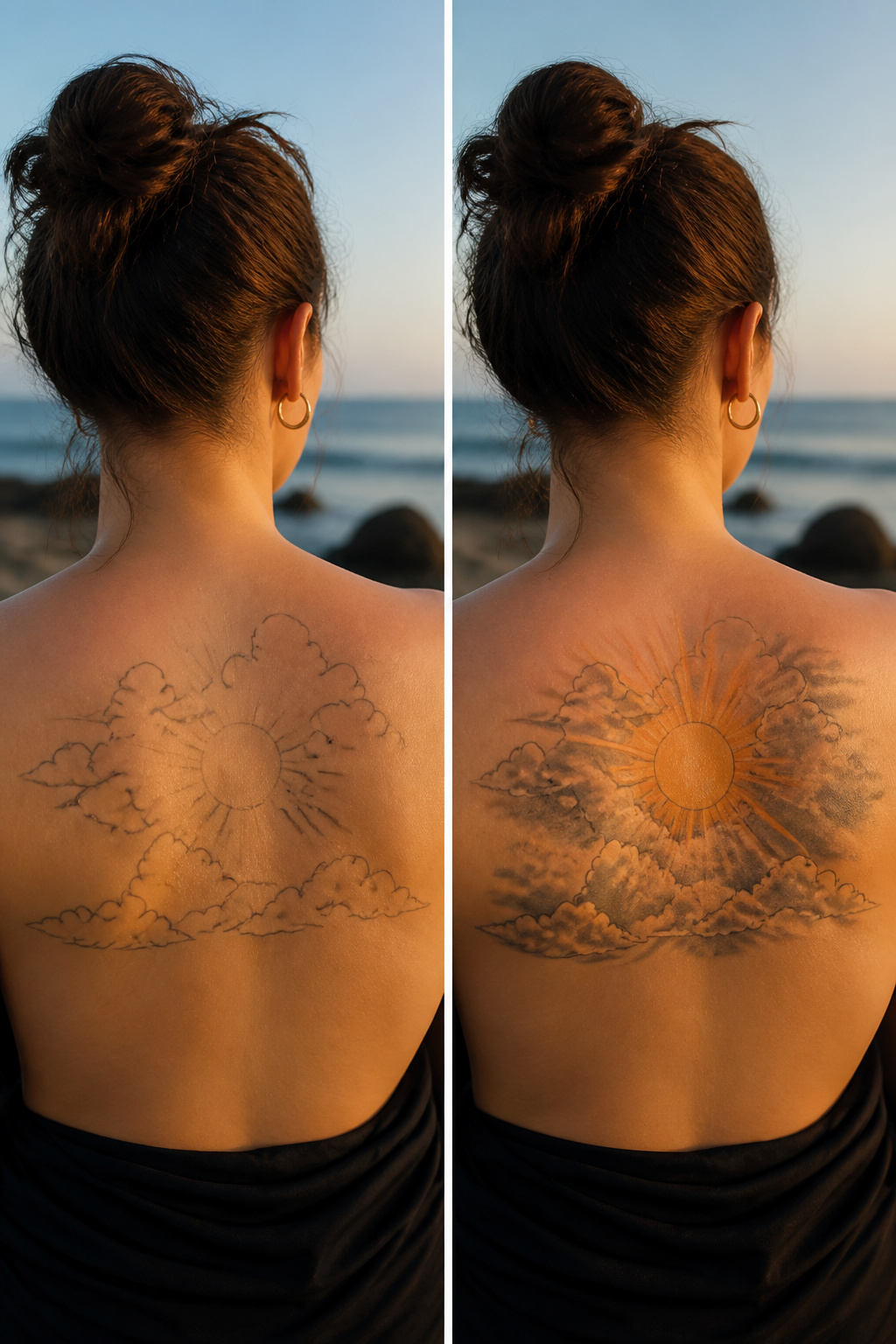
A sun breaking through partial cloud cover carries its own quiet optimism, the warmth still reaching even when the sky is not fully clear. That tension between light and obstruction is what gives the design its staying power; it reads as persistence rather than simple cheerfulness.
The color play here is the real draw. Warm amber and gold tones against cool gray-white clouds create natural contrast without forcing the composition into conflict. The two elements sit together rather than against each other, a harmony that still lets each register distinctly.
Placement shapes how the metaphor lands. A shoulder piece lets the sun emerge from behind cloud as the arm moves, so the light literally breaks through in motion. Smaller versions on the forearm or ribs keep the imagery intimate, though they sacrifice that kinetic reveal.
For someone who wants symbolic weight without heaviness, this pairing offers a way through. The message stays personal: not triumph over darkness, but the ordinary fact of light continuing anyway.
13. Angel with Clouds Tattoo
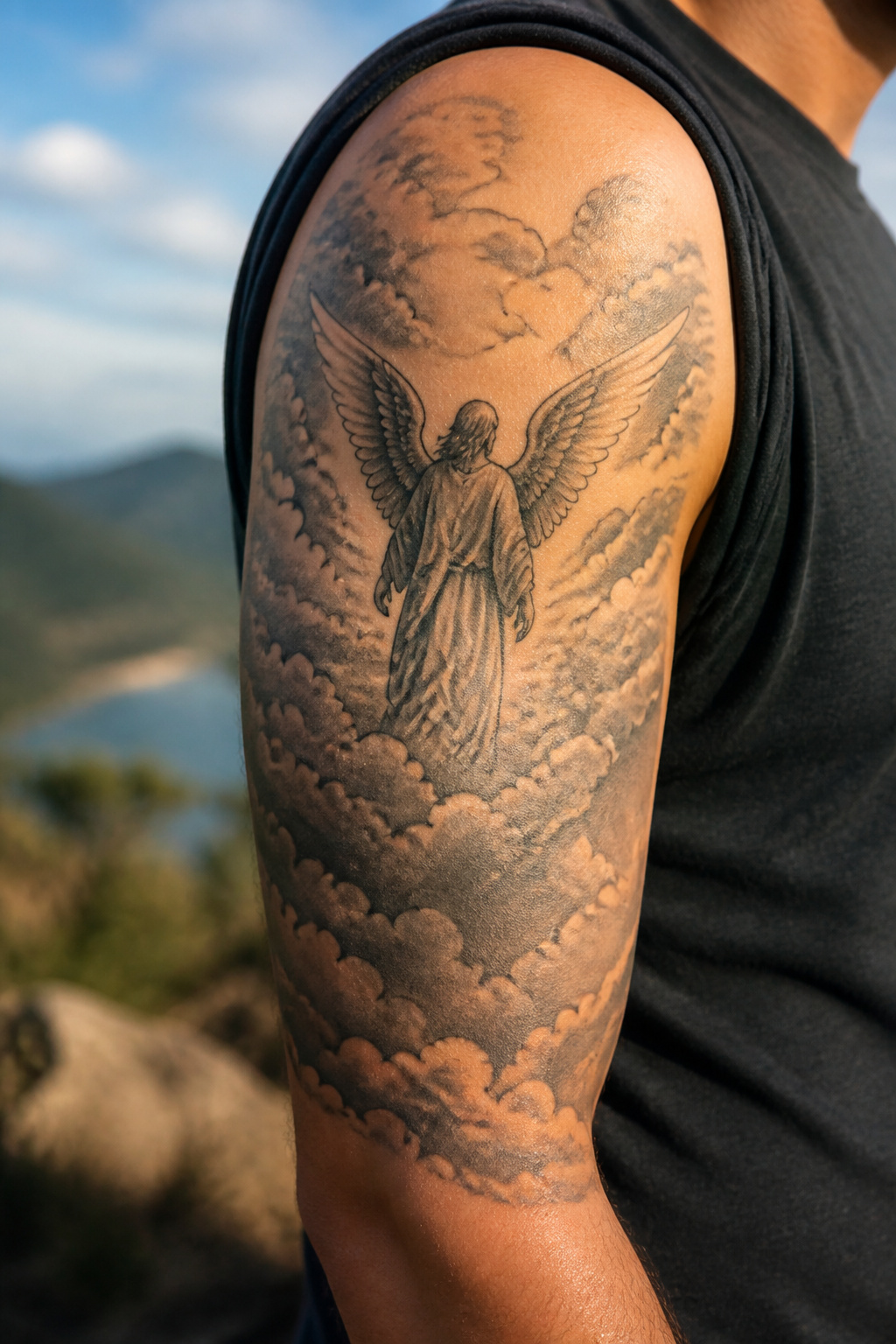
Clouds give an angel something to stand on, and that changes how high the figure feels. Soft, billowing forms rendered low on the composition set the angel at a distance, almost approachable; sharp, windswept edges rising behind the shoulders push the same figure upward, into something more remote. The classic pairing shows up across centuries of religious art, where clouds served as the throne for divine messengers, and tattoo artists still borrow that hierarchy today.
Traditional American styles keep the clouds flat and graphic, more symbolic ground than atmosphere, which lets the angel hold most of the detail. Realistic approaches do the opposite: the figure may stay relatively simple while the clouds carry depth, shadow, and the sense of actual altitude. The cloud treatment decides whether the piece reads as memorial or majesty. Many choose this combination for remembrance, placing it where it stays visible, the angel suspended above loss rather than consumed by it. Either style works; what matters is committing to one logic for both elements so the figure and its platform feel like the same world.
14. Smoke Cloud Tattoo
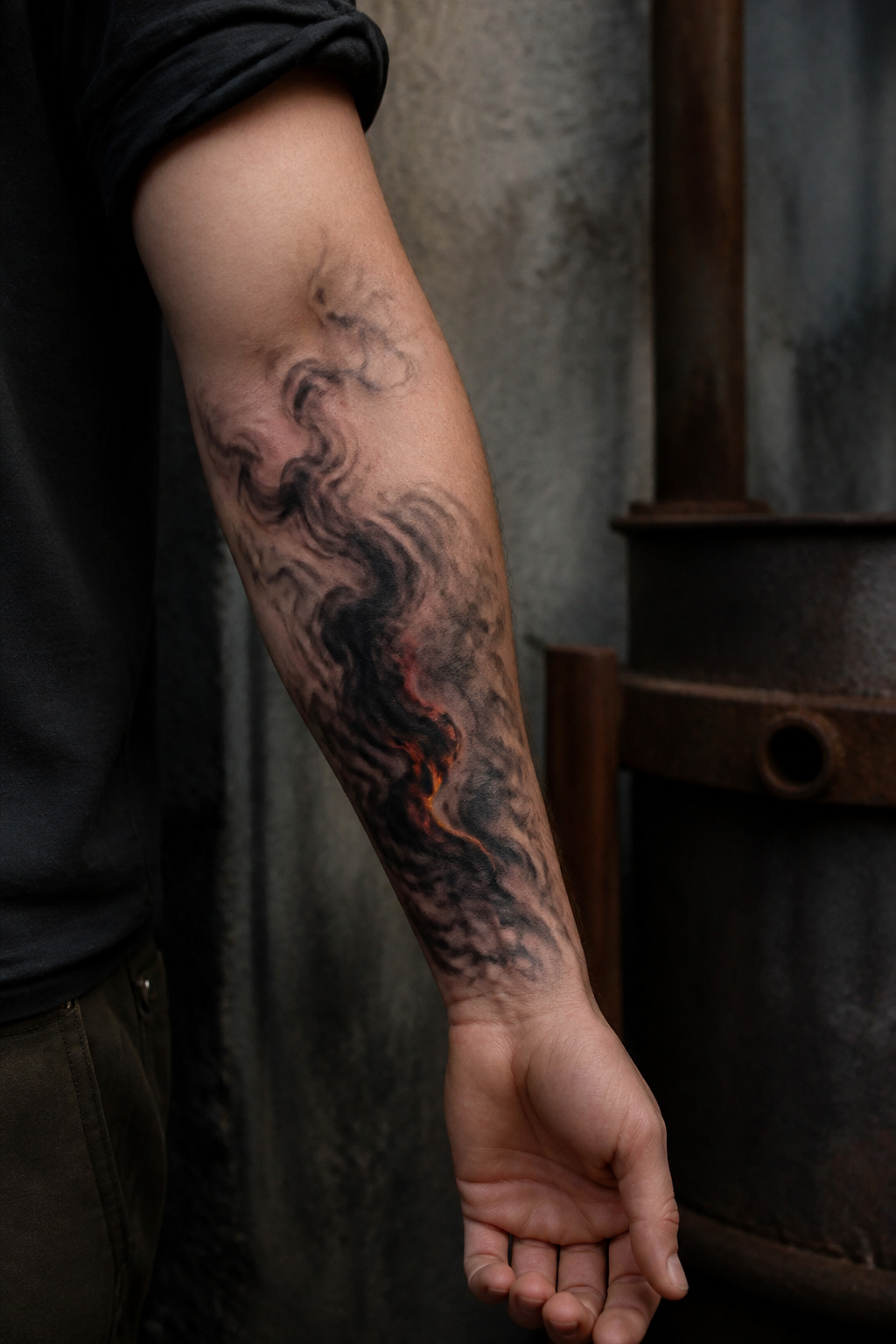
Smoke cloud tattoos sit in that gray area where weather and combustion meet, and the ambiguity is exactly what makes them interesting. Wispier edges and darker tonal gradations replace the fluffy whites of traditional sky clouds, creating something that reads as both atmospheric and consumed. The meaning shifts depending on what you pair it with. Anchored to flame imagery, the smoke reads as aftermath, destruction, loss. Set against gears, pipes, or crumbling brick, it turns into industrial decay, the residue of something that used to run. But shift the context slightly, add a phoenix silhouette or new growth pushing through, and the same dark billows become transformation, the necessary burning before the next phase begins.
Placement matters for this style. The soft, dissipating edges need enough skin real estate to breathe; a too-small smoke cloud collapses into a gray smudge within a few years. A minimum palm-sized area lets the artist build those gradual tonal shifts that sell the illusion of something drifting and unstable. Black and gray ink carries this design better than color, though a single ember point of warm tone deep in the composition can pull the eye exactly where you want it. If you are drawn to the darker end of cloud tattoo ideas, this is the version that carries weight without needing lightning bolts or rain to announce its mood.
15. Cloud Background Tattoo

Clouds settle behind a subject the way fog rolls into a harbor: quietly, and only if the whole scene was planned for it. A ship cutting through storm light, a cross rising above gray vapor, a face half-emerged from shadow; these work because the cloud perspective was mapped before the first line touched skin. Draw the background first, or the depth collapses. The layers need to recede, lighter and softer as they climb, so the eye reads distance rather than sticker collage. I have watched compositions fail when clouds were patched in after the main image sat too low or too centered, leaving no room for the atmospheric haze that makes a portrait feel lit from within. Religious scenes and ships in storms share this demand: the clouds must wrap around the subject, not frame it like a snapshot. The ancient Chinese read clouds as change itself, shape-shifting and impermanent; behind a fixed cross or a steady helm, that tension gives the piece its breath.
16. Cloud and Thunder Tattoo
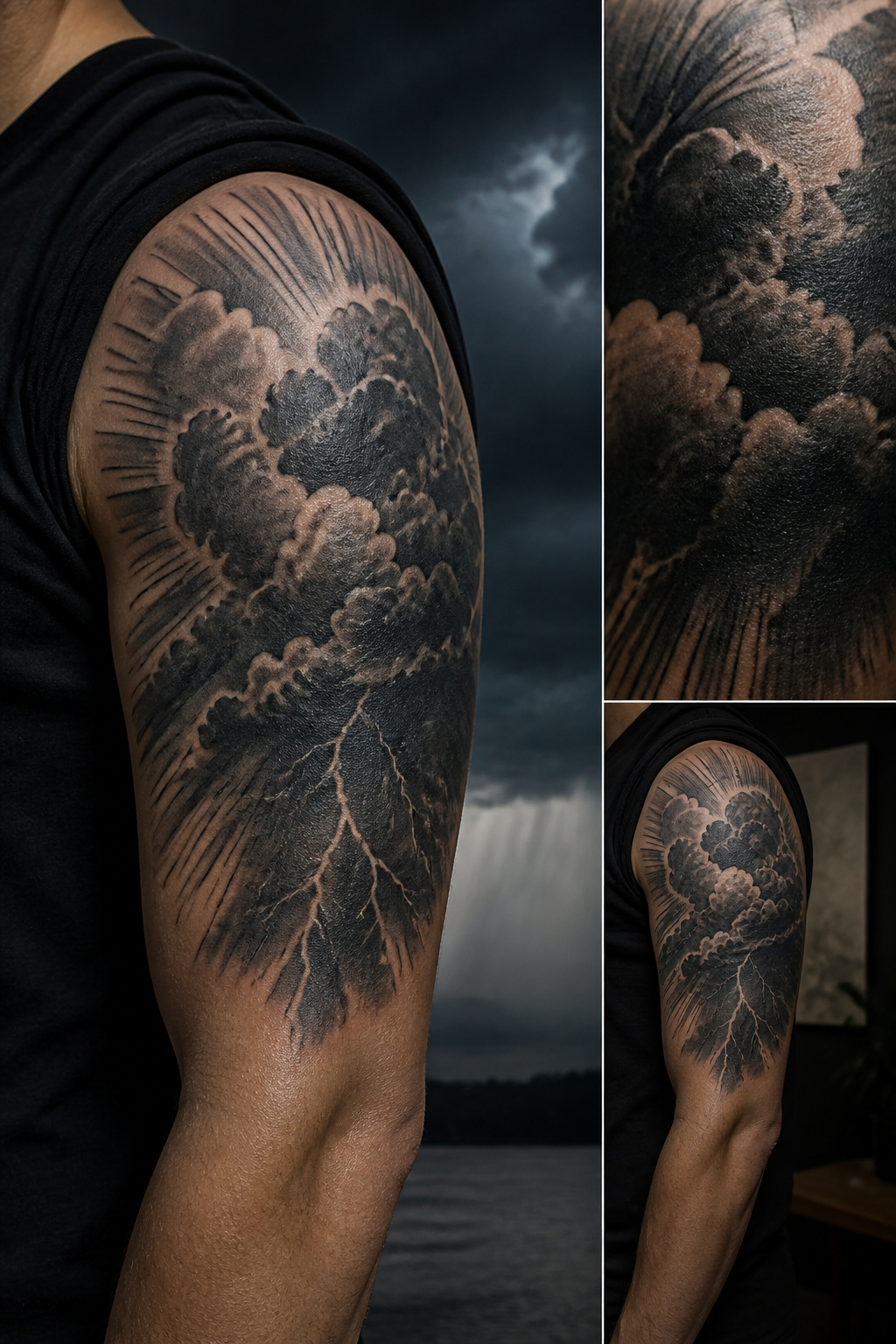
Cloud and thunder tattoos carry weight differently than lightning pieces, and that distinction matters when you are choosing between them. Where lightning freezes a split-second strike, thunder imagery works with vibration lines, turbulent cloud edges, and the sense of something still rolling through you.
Artists suggest sound through visual tricks: concentric arcs that ripple outward from dense cloud masses, or jagged negative space inside cumulus shapes that reads as pressure rather than bolt. The cloud itself gets drawn heavier, darker toward the base, with edges that look shaken rather than soft.
This theme taps something primal. Lightning is spectacle; thunder is the body-feeling of that spectacle, the rumble in your chest before your eyes register flash. A thunder-focused piece sits closer to raw force without needing the literal zigzag. I have seen it work as a full back piece where the clouds seem to press down on the shoulders, and as smaller work where a single dense mass vibrates at one edge. The smaller versions risk looking like unfinished storm pieces unless the vibration lines are deliberate and spaced with purpose, not just scattered.
17. Creeping Cloud Arm Tattoo
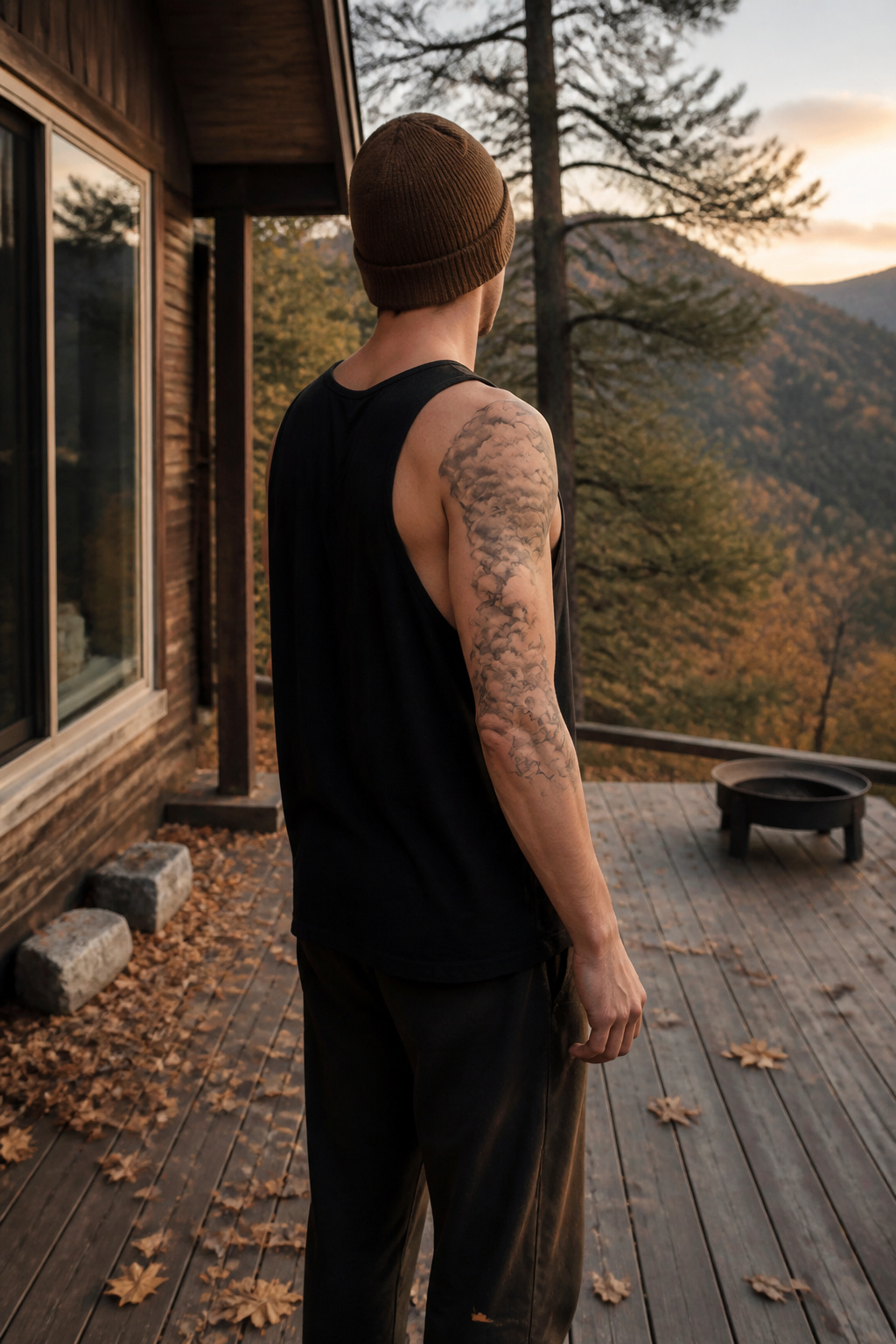
Clouds that creep along the arm need direction built in from the first sketch, not added after. The shoulder makes a natural starting point; from there, shapes can taper and stretch toward either the elbow or the wrist, giving the eye a path to follow. Flow toward the heart reads differently than flow away, and most people settling on this placement do not notice the difference until the tattoo moves with them.
The illusion depends on how the arm itself bends. A design wrapping from outer shoulder to inner elbow will compress and lengthen as the limb folds and straightens, so the tattoo artist has to account for that distortion in the drawing stage. Stretch the cloud shapes too long, and they bunch up awkwardly when the muscle flexes. Keep them too compact, and the creeping effect disappears when the arm hangs loose.
Placement on the back of the arm versus the inner forearm changes what others see. Outer placements catch light and cast small shadows that emphasize the three-dimensional quality of the ink. Inner arm placements stay more private, visible mainly to the person wearing them, which some prefer for a design meant to feel personal rather than displayed.
Skin texture varies along the arm’s length, and the softer tissue near the inner elbow holds ink differently than the tighter surface over the shoulder muscle. An experienced artist maps this out beforehand, adjusting line weight so the creeping motion reads consistently from one joint to the next.
18. Cloud Finger Tattoo
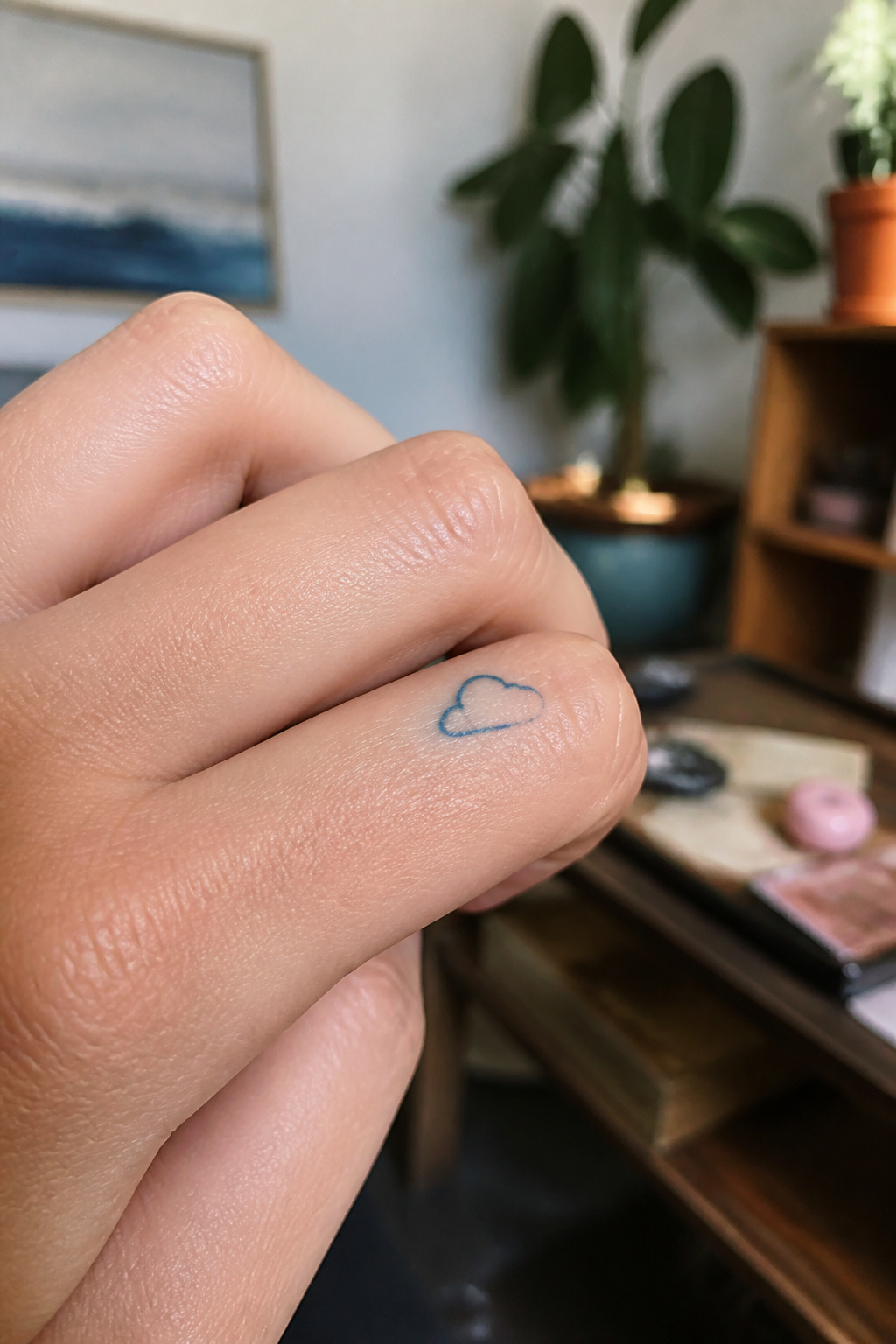
Finger skin turns over fast and takes abuse from hand-washing, typing, and the daily reach into a bag. A cloud design here has to earn its place, and the ones that last are single small clouds or tight little formations that read instantly at a glance. The limited canvas rules out detail; a simple outline carries better than shading that will blur into a gray smudge inside two years.
The fading is real and it is early. Most finger tattoos need touch-up work within twelve to eighteen months, some sooner if the line sits across a knuckle or the side of the finger where friction lives. That cost repeats, and not every artist will agree to the work a second time if the skin has rejected the ink badly. Placement matters: the outer edge of the finger holds pigment better than the pad or the crease, and a cloud drifting toward that edge buys a slower fade.
What convinced me, looking through healed results, is that the cloud finger tattoo works best as a whisper, not a statement. A minimal piece, maybe with a single swirl borrowed from Japanese cloud styling, keeps the shape legible even as the line softens. Anything busier collapses into noise faster than you would want on a spot this visible.
19. Hand Cloud Tattoo
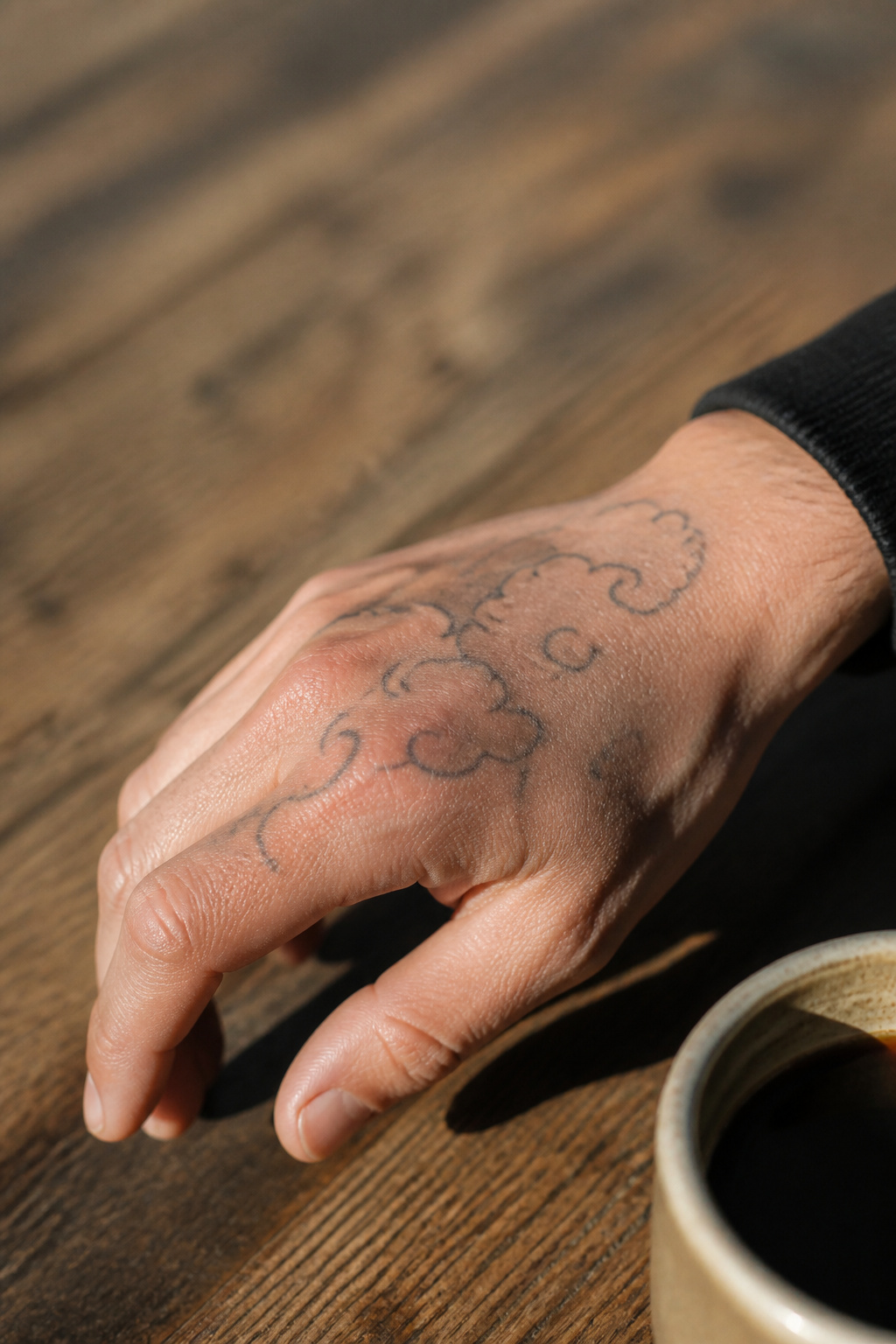
The back of the hand leaves nowhere for a cloud tattoo to hide. Every handshake, every reach for a coffee, every gesture at a stoplight puts it on display. Employers in customer-facing roles still screen for this placement, and the social cost of that visibility has not disappeared the way some online discussions suggest it has.
Skin on the hand turns over faster and moves more than almost anywhere else on the body. Fine linework that would hold crisp for years on a shoulder starts feathering here within months. The knuckles stretch and compress with every grip, so clouds placed between them distort into something the artist never intended. A design that reads as soft and atmospheric on paper tends to thicken and blur here, losing the wispy edges that make cloud work recognizable at all.
Artists who regularly tattoo hands usually compensate with heavier outlines and simplified shapes, sacrificing some of the ethereal quality that draws people to cloud imagery in the first place. That tradeoff is worth understanding before the appointment, not after the healing.
20. Cloud Tattoos on Shoulder
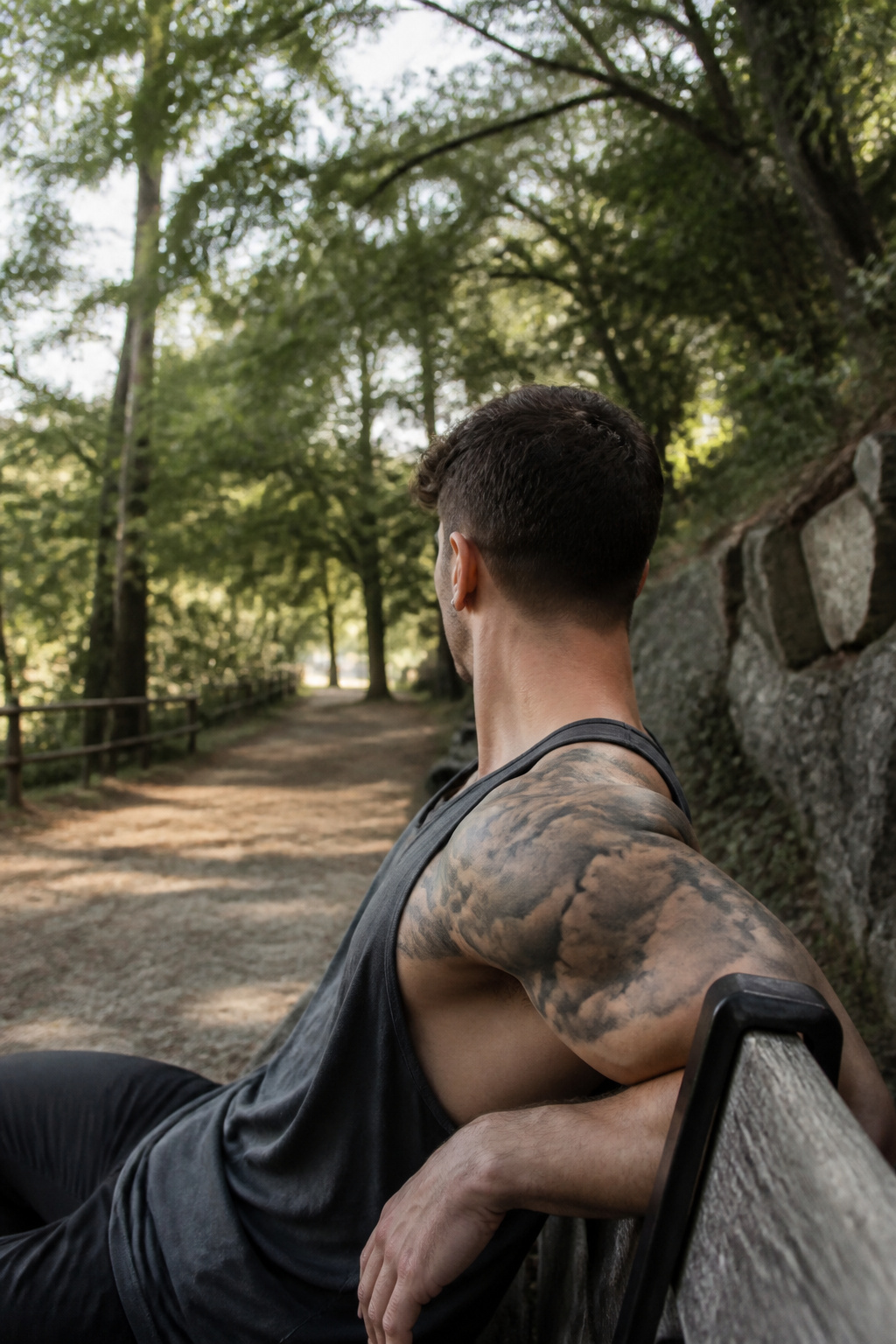
The shoulder’s rounded surface gives cloud formations a natural place to settle, following the curve of muscle rather than fighting against flat bone. A cap placement keeps the design self-contained, a single bank of cirrus or cumulus sitting where a sleeveless shirt ends, visible when you want it and easy to cover for work. Extending the same clouds toward the collarbone or drifting them onto the upper back changes the whole composition; the eye reads movement differently across a larger canvas, and what reads as a passing weather system on the cap becomes a full sky when it travels.
Medium-sized pieces work best here, large enough for layered grays and soft edges but not so big they demand the chest or full arm to balance them. That size range also leaves room to build around later if the mood shifts, adding lightning or a moon without starting over. The visibility control matters more than most spots; a tank top shows it, a T-shirt hides it, and that flexibility suits anyone still deciding how much ink their daily life can absorb.
21. Cloud Tattoos on Chest
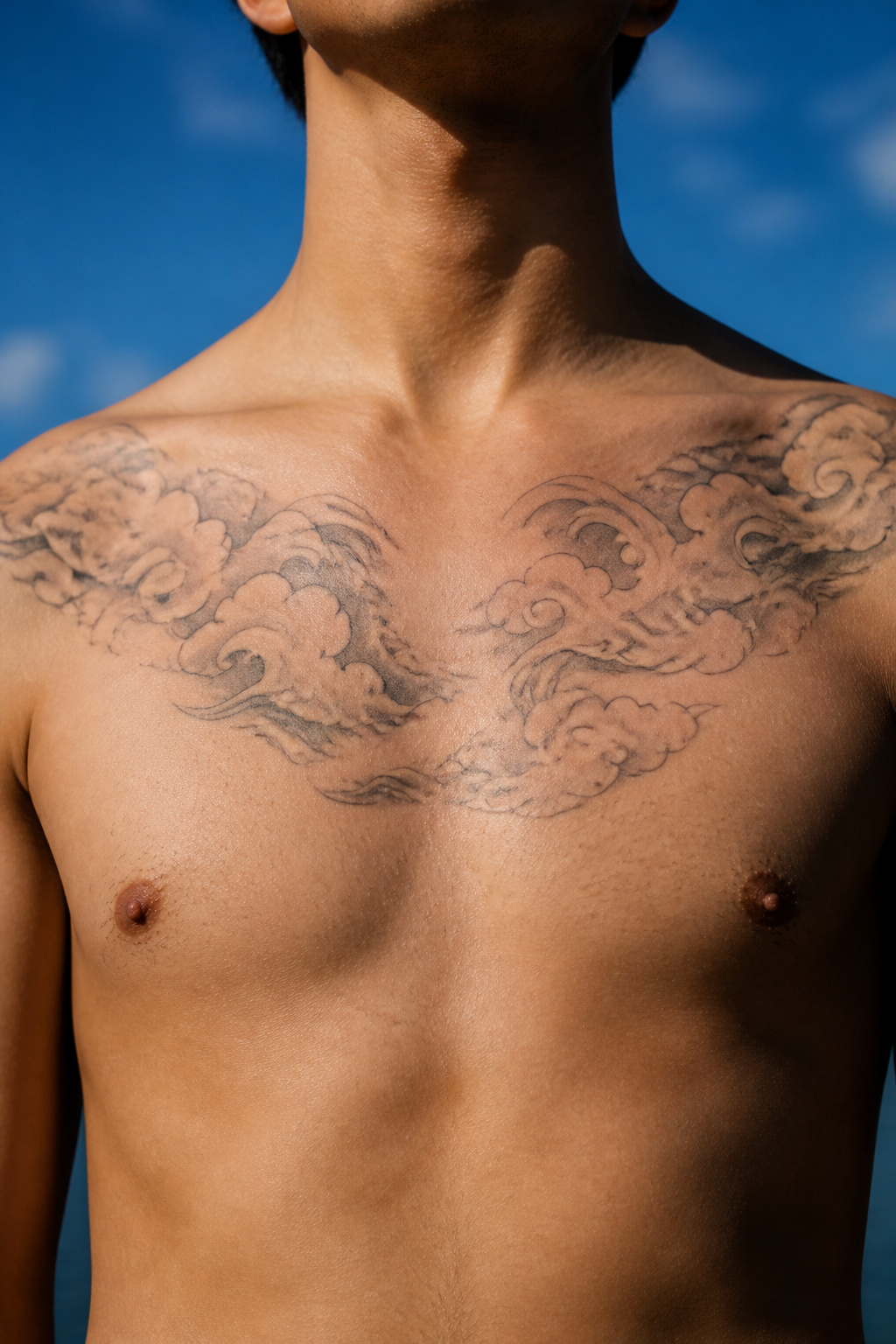
Cloud tattoos on the chest live in one of the most dynamic spots on the body. A small piece settled over the heart rises and falls with every breath, so the cloud softens and tightens in a way no other placement allows. That movement is part of the design, not a flaw, and artists who work the chest regularly build it into how they shade the form. Ask your artist how the lines will stretch when you inhale, because a cloud drawn flat on the table bunches differently when your ribs expand.
The chest also carries weight most other placements do not. The proximity to the heart and lungs gives even a simple cloud a personal significance that reads as protective or memorial, depending on what you pair it with. A full pectoral spread can hold Japanese wind-and-cloud motifs that move with the muscle beneath, or stay minimal, a single cirrus shape floating above the sternum. Either way, the skin there heals thick and can blur detail over time, so bolder linework tends to last cleaner than fine stippling.
22. Forearm Cloud Tattoo

The forearm gives cloud designs room to breathe without committing to a full sleeve. Inner skin sits closer to bone and tends to sting more during the session, while the outer surface carries extra padding and faces outward for easy display. Small clouds clustered near the wrist read as jewelry; a wrist-to-elbow piece flows with the arm’s natural taper. Either way, the location heals predictably because the skin moves less than on a hand or foot, and the flat planes let an artist render soft edges that read as actual atmosphere rather than graphic symbols. A single sitting usually finishes anything below the elbow unless you are building into a larger composition.
23. Cloud and Dove Tattoo
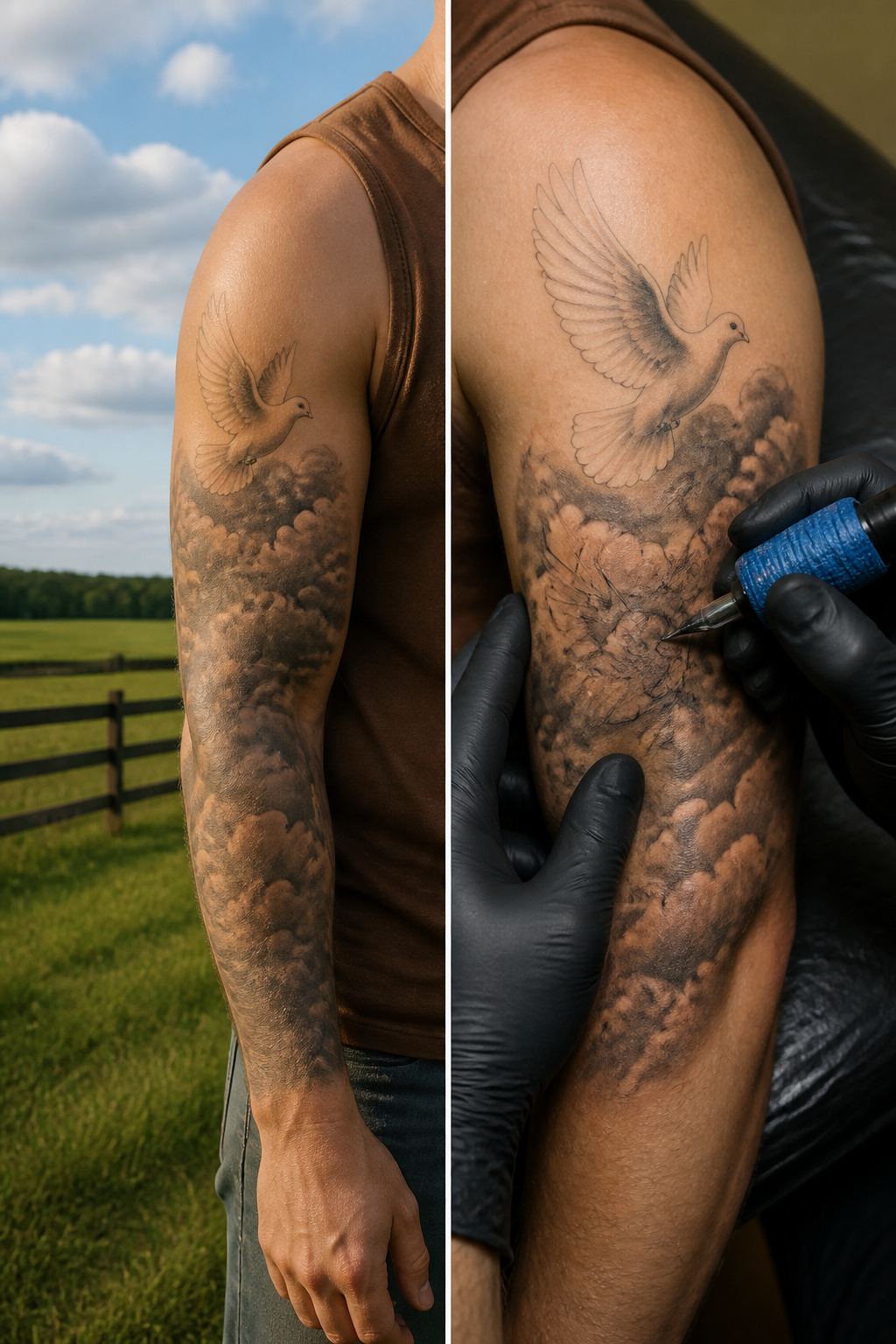
Doves cut through cloud formations in a way that carries weight beyond the image itself. The pairing has served as a memorial marker and a spiritual gesture across multiple tattoo traditions for decades, and that staying power matters when you are choosing something permanent. What separates a strong piece from a generic one is the relationship between the bird’s flight path and the cloud flow beneath it.
A dove ascending against clouds that rise with it creates momentum, a sense of release. The same bird dropping through horizontal cloud layers reads as departure, sometimes grief. Tattooists who handle this combination regularly often angle the dove’s body so it interacts with the darkest ink in the cloud rather than floating above it as a separate element. The cloud’s darkest point should sit where the wing meets the body, grounding the motion instead of letting the bird look pasted on.
Soft shading on the clouds keeps the focus on the dove’s silhouette, though some traditional approaches reverse that balance with heavier bird linework and airy, almost absent background. Either route works; mixing them, with both elements fighting for visual weight, tends to flatten the whole piece. For a memorial specifically, the direction of flight carries more emotional charge than most people expect, so deciding that early, before the stencil stage, prevents a design that says something you did not intend.
24. Mushroom Cloud Tattoo
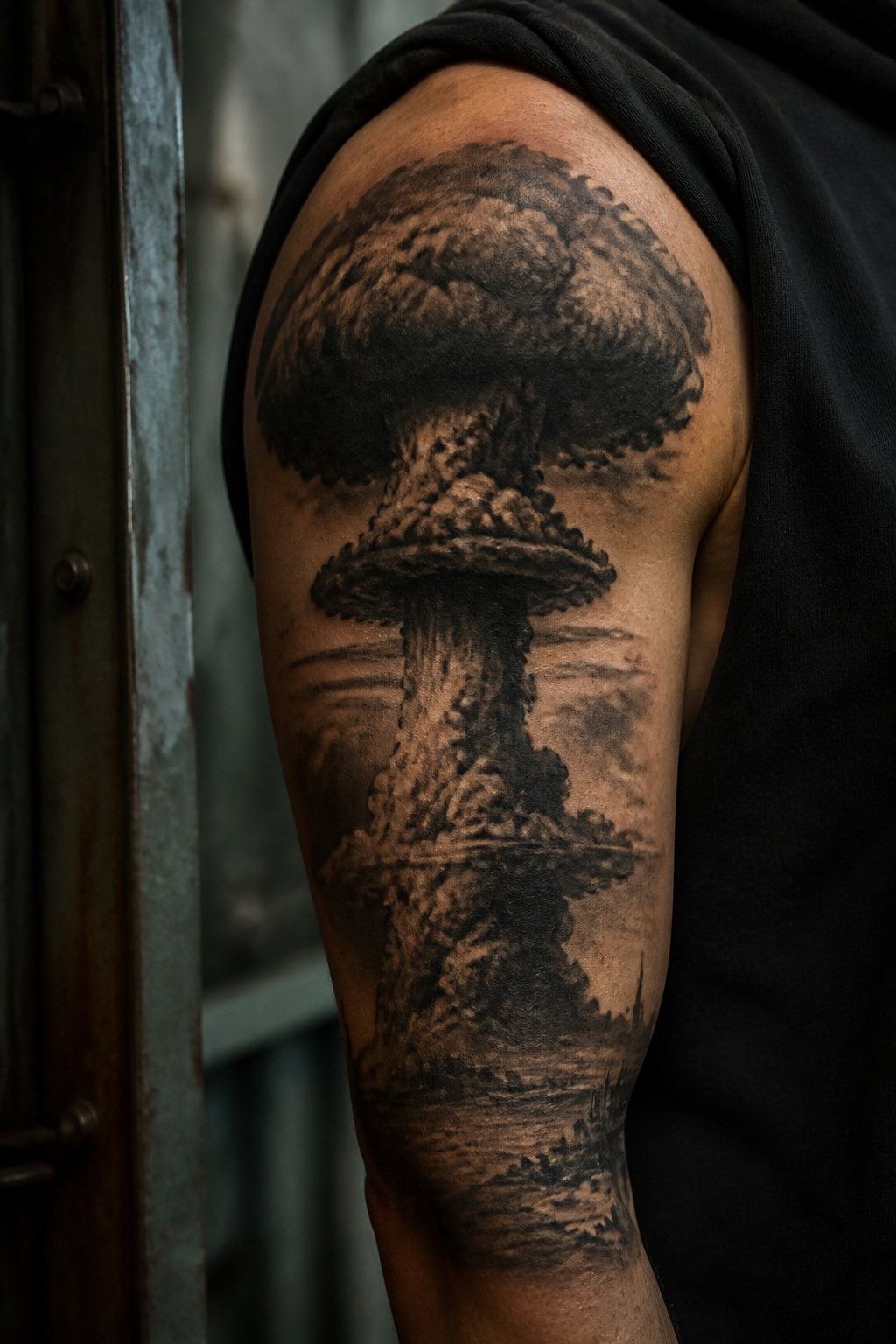
The mushroom cloud rises in a shape no weather ever made: a vertical stem punching upward, then a bulbous cap spreading flat against itself like a second explosion frozen at its widest point. That silhouette carries instant recognition. For some wearers, it channels Cold War unease, the duck-and-cover era, or protest art against nuclear proliferation. For others, the same form reads as punk visual shorthand, stripped of literal politics and worn for its jagged graphic power.
Natural cloud formations billow, feather, or stack in layers; the atomic cloud is deliberate, almost architectural, with its straight column and symmetrical cap. Tattoo artists often push that geometry further, outlining the stem in hard black or adding halftone dots that echo protest posters from the 1980s. Color tends toward sickly yellows, arterial reds, or the pale gray of old newsprint, never the soft whites and blues of sky-born clouds.
Placement matters for tone. A mushroom cloud on a forearm reads more confrontational than the same image tucked behind an ear or floating on a ribcage. The smaller the piece, the more it risks looking like a cartoon bomb from a video game, so artists usually scale it bold enough to keep the form’s weight intact. If you want the political layer present but not screaming, a muted palette and slightly degraded edges, like a Xerox copied too many times, do that work quietly.
25. Heaven Cloud Tattoo
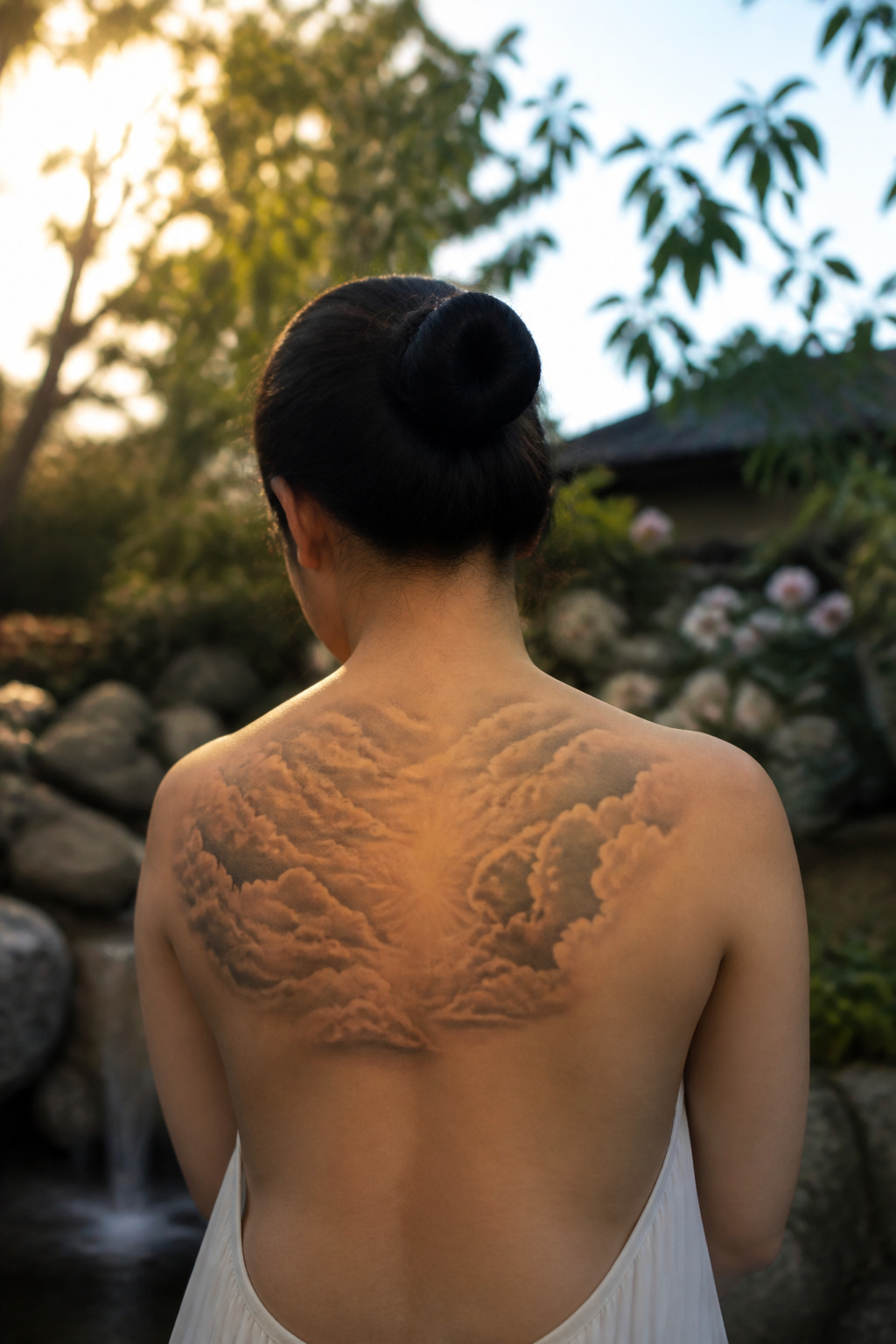
The glow along cloud edges in heaven tattoos comes from negative shading pulled back from the border, letting bare skin read as light source rather than ink. Artists build this in layers, starting with the soft interior form and carving the bright rim last so the contrast stays crisp against darker surrounding tones.
Celestial cloud work draws on imagery that predates tattooing itself. Greek and Roman art placed gods on clouds as vehicles; Renaissance painters used the same billowing forms for heavenly scenes crowded with ascending figures. A tattooed gate or ray of light carries that same reading, the cloud acting as threshold rather than decoration.
Most of the memorial pieces I have traced in portfolios pair the clouds with dates or small portraits, the glow doing the emotional lifting so the figure itself can stay simple. For faith-based work, the ascending form is usually a dove or a human silhouette, placed high on the chest or shoulder where the natural curve of muscle gives the clouds lift. The back offers the only canvas large enough for a full gate composition with flanking light rays, though that scale demands a session count few clients fully budget at the start.
26. Blue Cloud Tattoo
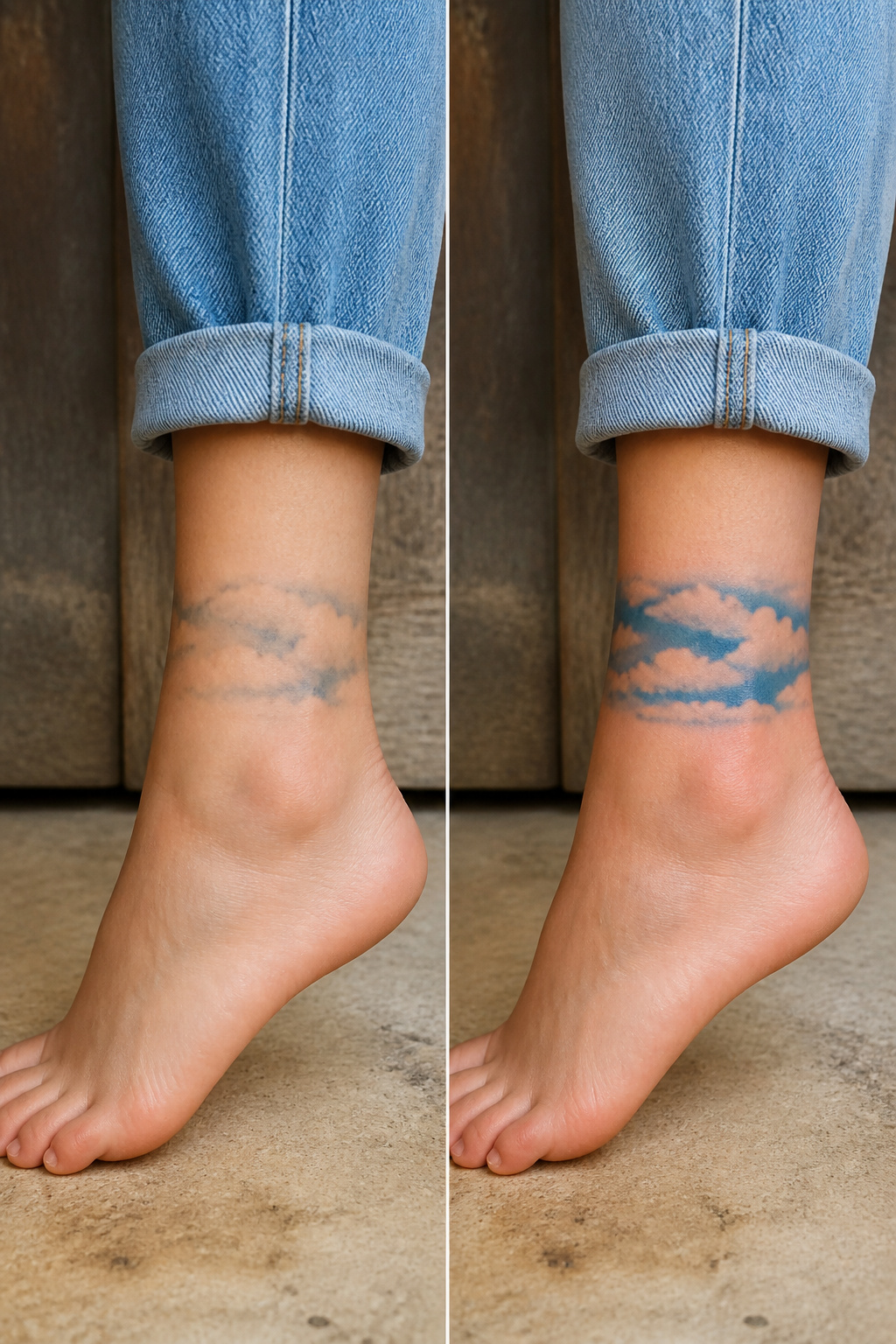
Blue pigment in cloud tattoos reads as sky rather than symbol, and that literal quality is exactly what draws some clients away from traditional black and gray work. Blue ink fades toward a softer, more diffuse edge than black, which ages into a sharper, greener silhouette over time. A sky-realistic piece planned with that fade in mind can actually gain atmosphere; one planned like a black-and-gray design often turns muddy where the blue drifts.
The cheerful effect is hard to get any other way. Black clouds carry storm associations by default, the monochrome palette leaning moody whether the wearer intended it or not. Blue shifts the register toward calm or openness, the Virgin Mary association from religious iconography adding a quiet layer for those who want it. Ankle placements work particularly well here, the small scale letting the color read as sky fragment rather than weather event.
What separates a successful blue cloud piece from one that ages badly is usually the saturation at the start. An artist who builds the form with darker blue values where black would normally sit, then lifts to lighter tints for highlight, gives the tattoo enough structural information to survive the inevitable softening. Without that value range, a medium blue all over turns to haze faster than most clients expect.
27. Cloud Outline Tattoo
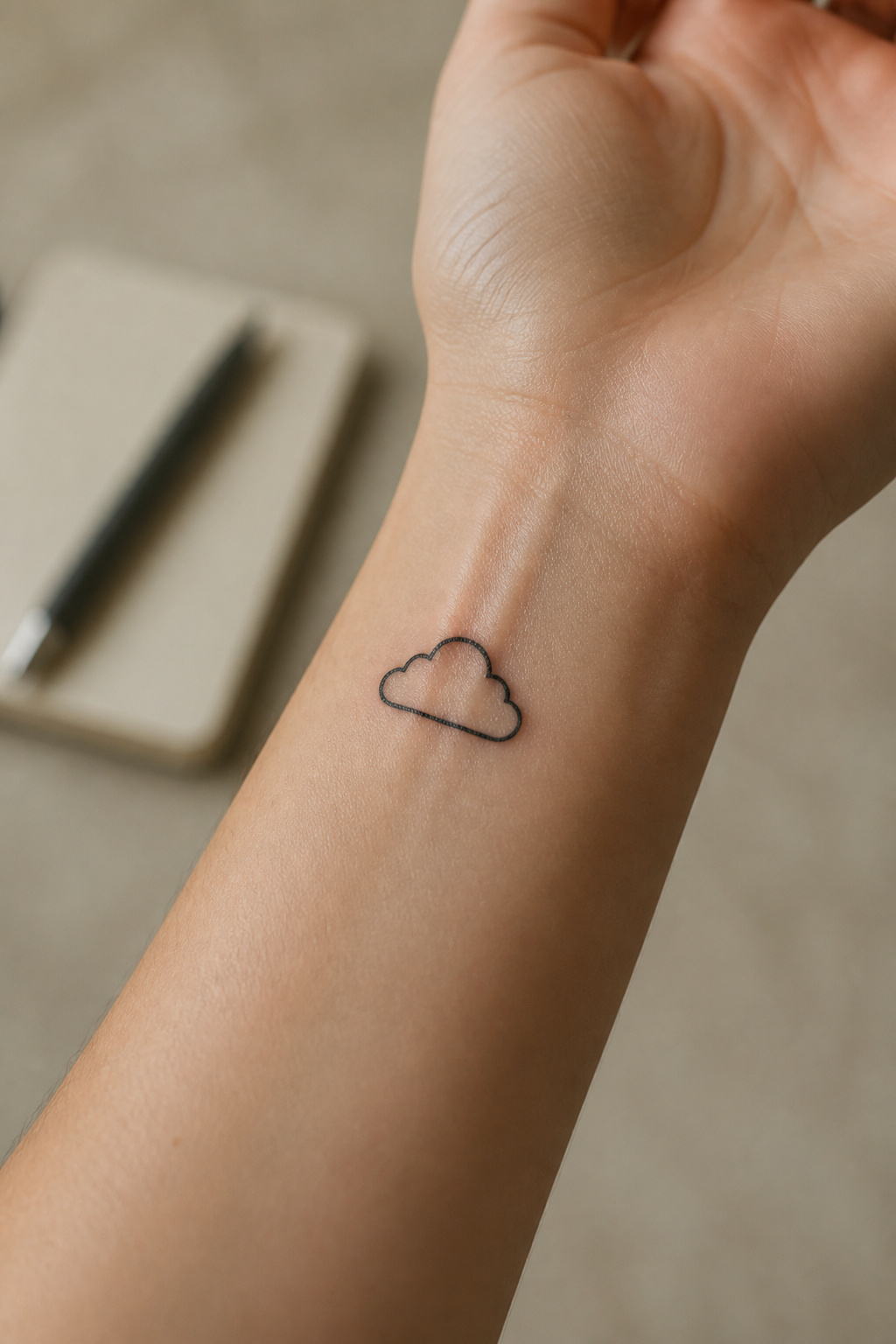
A cloud outline tattoo strips the form down to its edge alone, letting the skin inside the line do the work as negative space. The result reads like a weather icon or a stamp, clean enough to sit on a wrist or behind an ear without demanding room. What convinced me, looking through portfolios of these, is how much the design depends on the single stroke that carries it. There is no shading to distract from a waver, no fill to correct an uneven curve, so the artist needs steady confidence in every millimeter. The payoff comes later. Where heavy black clouds can soften and blur as years pass, a spare contour keeps its shape because there is so little ink to migrate. The risk is upfront, and the choice of artist matters more than with almost any other cloud style.
28. Cloud Rain Ocean Tattoo
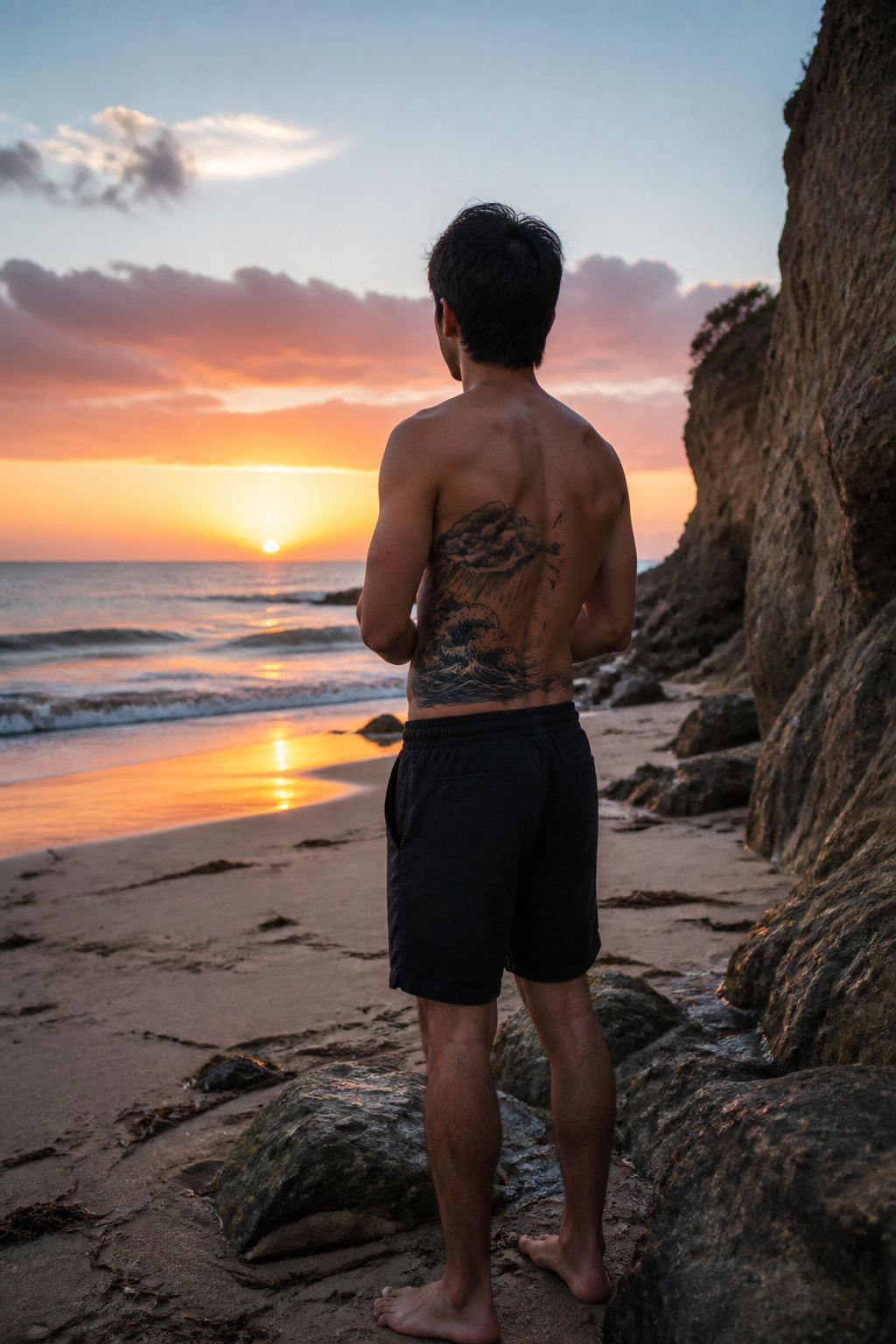
A vertical composition that runs rain from sky to ocean turns the body into a living weather system. The tattoo starts high on the shoulder or upper chest with heavy cumulus, lets the rain fall in gray-wash streaks across the ribs or outer arm, and resolves into dark water at the hip or wrist. Three elements occupy one continuous scene rather than sitting as separate images. The clouds need enough weight to feel like a source; the rain needs enough density to read as connection, not decoration between two unrelated things; the water needs movement, a current or surface chop, so the eye knows the rain has arrived somewhere.
Skin from collarbone to hip gives the story room to breathe, though a forearm can manage a compressed version if the rain falls in shorter, angled lines. What breaks most attempts is treating the sections as equals. The cloud should dominate for maybe forty percent of the vertical space, the rain another thirty-five, the water the remainder. Shift those proportions and the eye stutters, unsure whether it is looking at a sky piece with water added or a seascape with cloud attached. Black and gray handles the tonal range best; color risks splitting the scene into three separate tattoos that happen to sit near each other.
29. Colorful Rain Cloud Tattoo
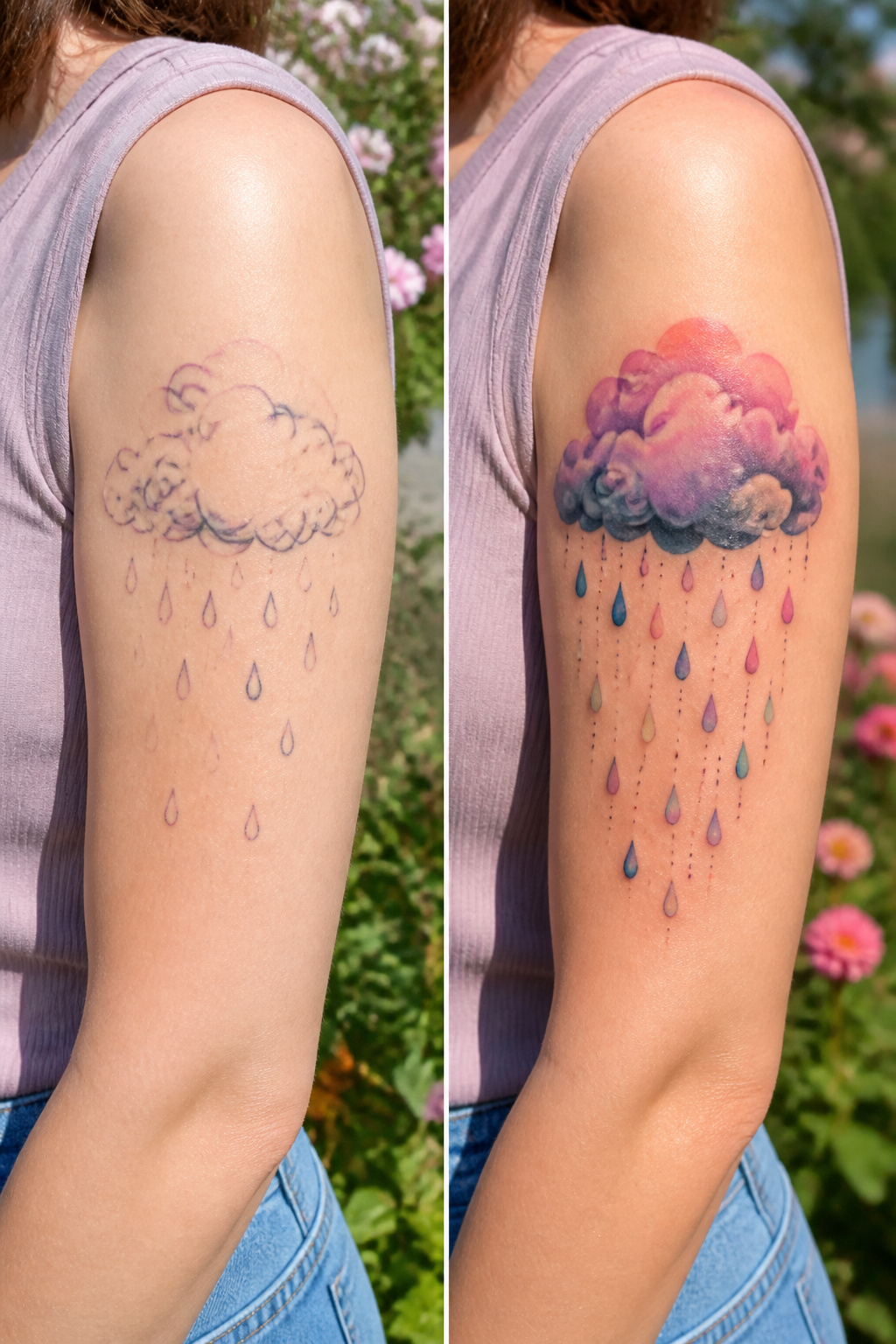
A rain cloud does not have to look like a rain cloud. Purple ink pooling at the base of a cumulus shape, or pink bleeding through gray like a sunset caught inside the storm, shifts the whole premise from weather report to mood board. The color carries the meaning. A client who walks in asking for violet rain usually wants the feeling of a downpour, not a meteorological record, and the tattoo reads that way on the skin: more playlist cover than forecast.
Rainbow gradients in the falling lines themselves are the most direct move toward playfulness. Each drop carries its own hue, or the whole shower shifts from cobalt to coral as it descends. The effect lands somewhere between symbolism and pure decoration, which suits people who want their cloud to mark a state of mind rather than a literal event. The tradeoff is that realism goes out the window entirely, and the design needs confident line weight or the colors muddy. From what I have seen in portfolios, the pieces that hold up best keep the cloud body restrained, one or two tones at most, and let the rain do the chromatic work. Too much competing color and the eye does not know where to settle.
30. Clouds with Cherubs Tattoo
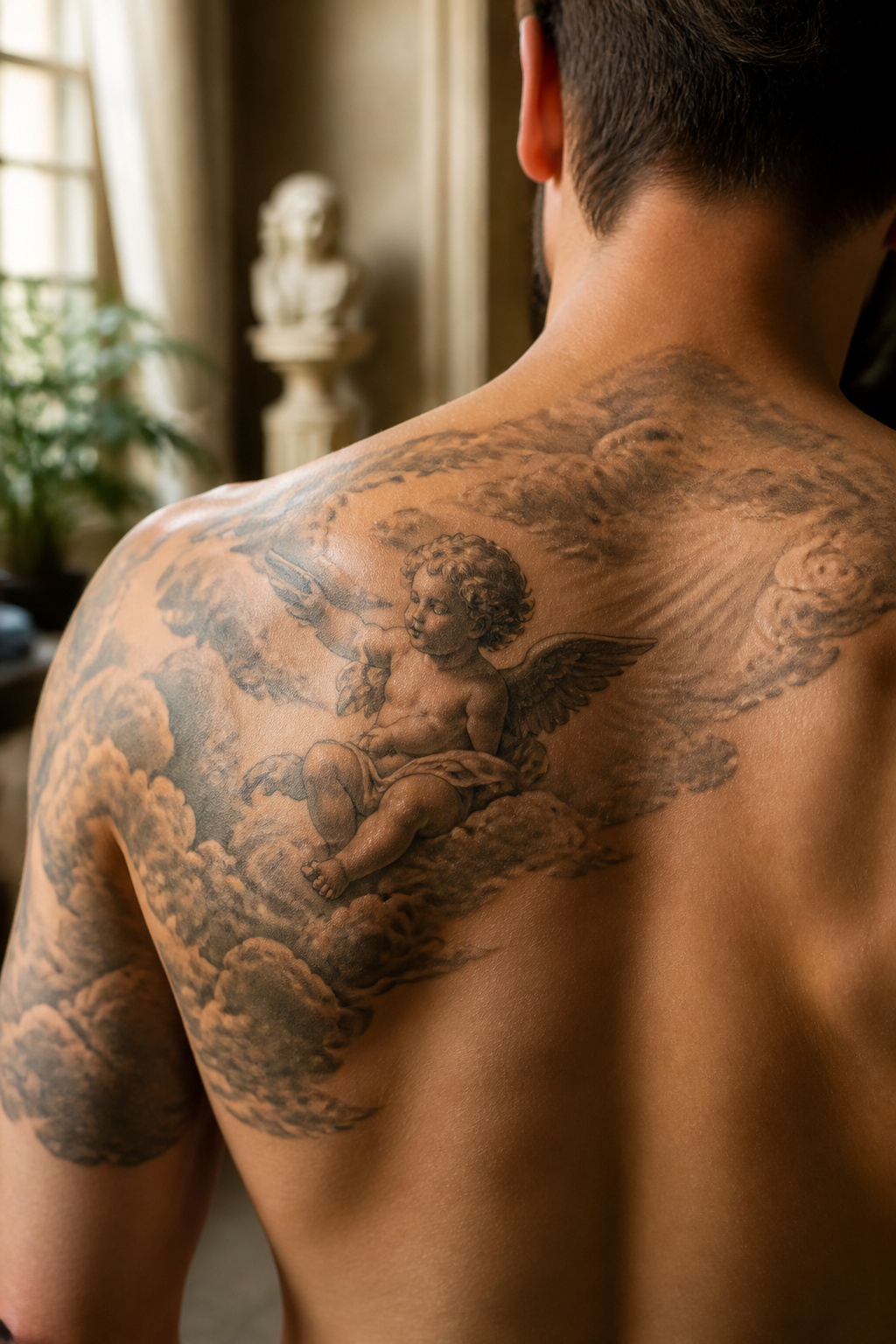
Renaissance painters used putti, those plump winged infants, as atmosphere itself, little bodies tumbling through painted skies to signal divine presence without the solemn weight of full angels. That distinction matters on skin. A cherub paired with clouds carries specific historical weight that generic angel imagery does not; the figure belongs to a particular 15th- and 16th-century visual language of transition, of souls passing or arriving.
Neo-traditional tattooing revived this pairing with deliberate color saturation and bold linework that the original paintings never needed, since oil on panel catches light differently than pigment embedded in dermis. The combination surfaces most often in two contexts: memorial work, where the putto serves as psychopomp guiding a named soul, and birth commemoration, where the figure inverts to arrival rather than departure. Skin tone shifts how those clouds read; the same gray wash that floats on pale complexions can muddy on deeper ones, and experienced artists adjust toward warmer or cooler undertones accordingly. What reads as ethereal in one rendering collapses to sentimental in another, usually when the cherub’s proportions slip toward cartoon rather than the particular infant muscularity Renaissance masters studied from life.
31. Clouds and Trees Tattoo

A single tree with clouds drifting above its canopy turns the arm into a vertical landscape. The sky sits high, the earth low, and the eye reads it as depth without any need for perspective tricks. That upward pull also flatters the natural line of the forearm or the side of the calf.
Both elements carry weight on their own. Clouds shift, dissolve, re-form; trees stand, root, outlast seasons. Paired, they map a full life cycle rather than a single moment. The contrast keeps the composition from feeling static. I’ve seen designs where the tree is bare, even split or lightning-struck, with heavy storm clouds above, and others where soft cirrus float over a full summer canopy. The tree’s condition should match the cloud’s mood, or the piece reads as two tattoos that happen to share skin.
Placement matters for the vertical flow. A back piece gives the most room for a forest line receding into mist; a wrist forces you to one condensed tree and a tight cloud bank above it. The gap between them is as important as the marks: too much empty skin and the connection breaks, too little and they crowd into a single blob of gray and black.
32. Clouds with Birds Tattoo
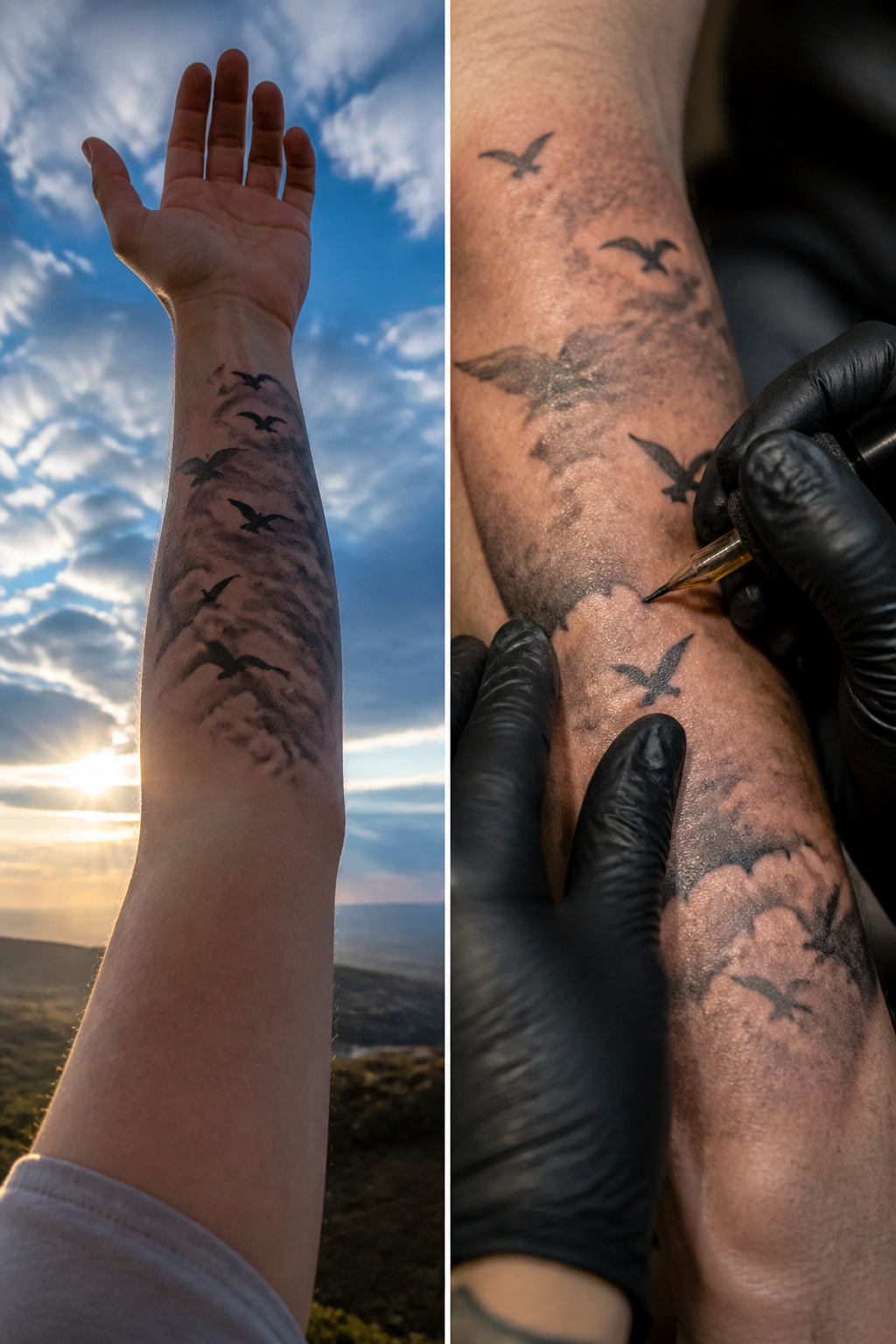
Birds threading through cloud formations add motion that static ink rarely achieves. Sparrows or swallows cut quick, darting paths that read as energy and travel, while herons or cranes stretch the composition vertically and slow the eye down. The species choice loads meaning before the viewer even parses the cloud shape. A raven carries different weight than a dove; an owl reads as watchful where a flock of geese reads as migration and return.
What separates a flat design from one with depth is the size relationship between bird and cloud. A tiny silhouette against towering cumulus pushes the sky back and places the bird far below it. Scale the bird larger and the cloud becomes atmosphere rather than landscape, something the figure moves through instead of beneath. Most successful pieces pick one distance and commit: mixing scales in the same composition collapses the illusion unless the artist is deliberately building multiple planes.
Placement matters for how the movement reads. A bird emerging from the top edge of a cloud suggests ascent and breaking through. One flying into cloud from below reads as shelter or disappearance. The direction of flight, left to right or reverse, carries its own quieter symbolism about coming or going. These choices accumulate into whether the piece feels like freedom or longing, and the best artists make them intentional rather than defaulting to upward motion because it photographs well.
33. Clouds with Aircraft Tattoo
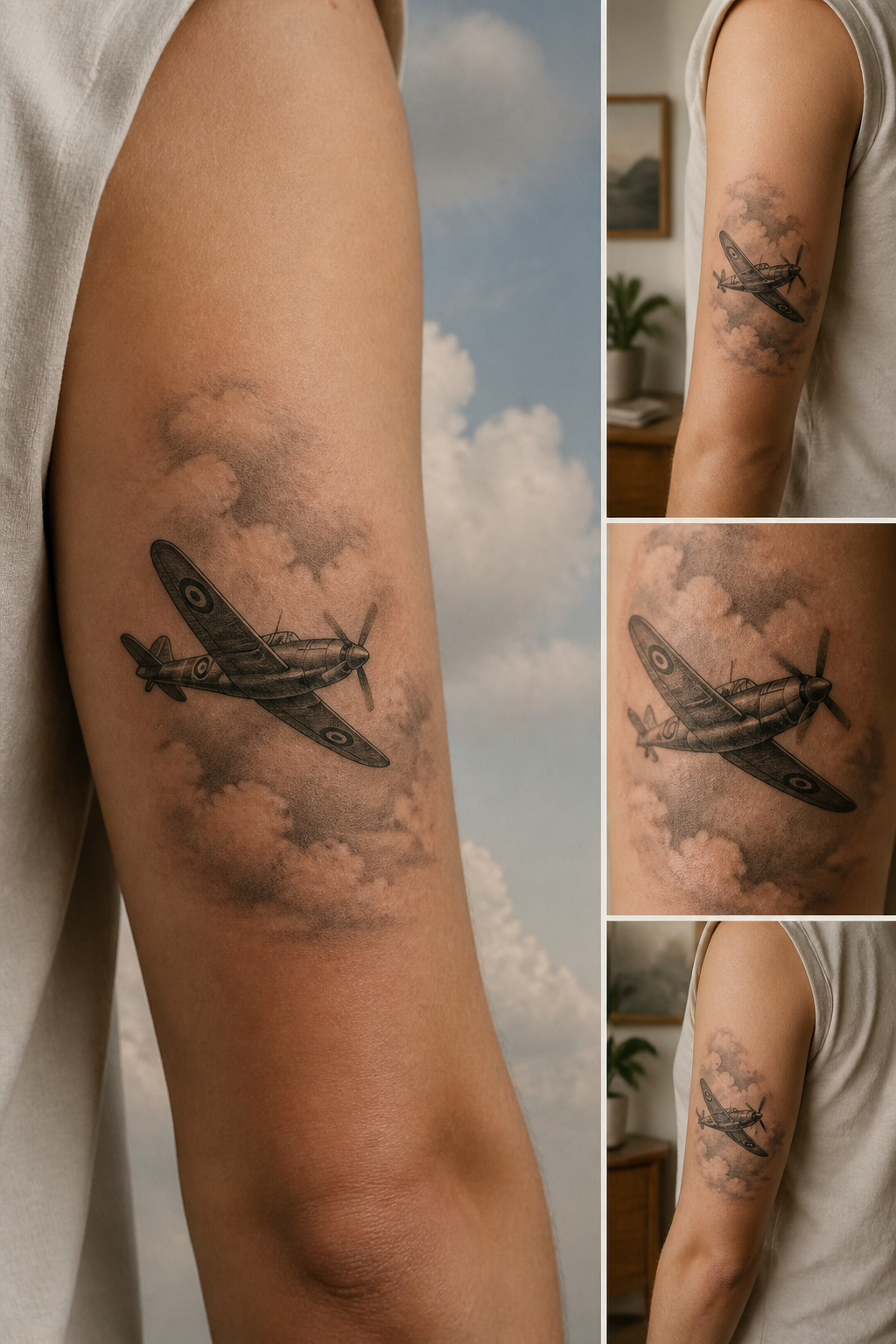
A sparse cirrus field behind a P-51 Mustang reads entirely differently than a solid nimbostratus wall swallowing a C-130 whole. That distinction matters because it changes whether the aircraft looks like it is riding above weather or fighting through it.
Vintage prop planes tend to sit better against softer, broken cloud formations. The negative space around a biplane or DC-3 lets the linework breathe, and the older silhouettes carry an immediate nostalgia that pairs naturally with the romantic idea of early flight. Modern jets need denser backgrounds to feel grounded in the composition; without enough atmospheric weight, a fighter profile can seem to float rather than fly.
These pieces serve three main purposes. Military memorials often pair a specific aircraft type with the cloud conditions someone actually flew in, or with a date rendered small nearby. Active pilots or retired crew frequently choose the plane they worked on, set at altitude where the sky dominates. For aviation enthusiasts without service history, the appeal is simpler: the machine itself as an object of beauty, clouds doing the work of motion and context.
The tattoo ages better when the cloud density is planned around the aircraft scale. A sleeve with a bomber emerging from heavy weather keeps its readability longer than fine detail scattered across too much empty sky.
34. Clouds with Script Tattoo
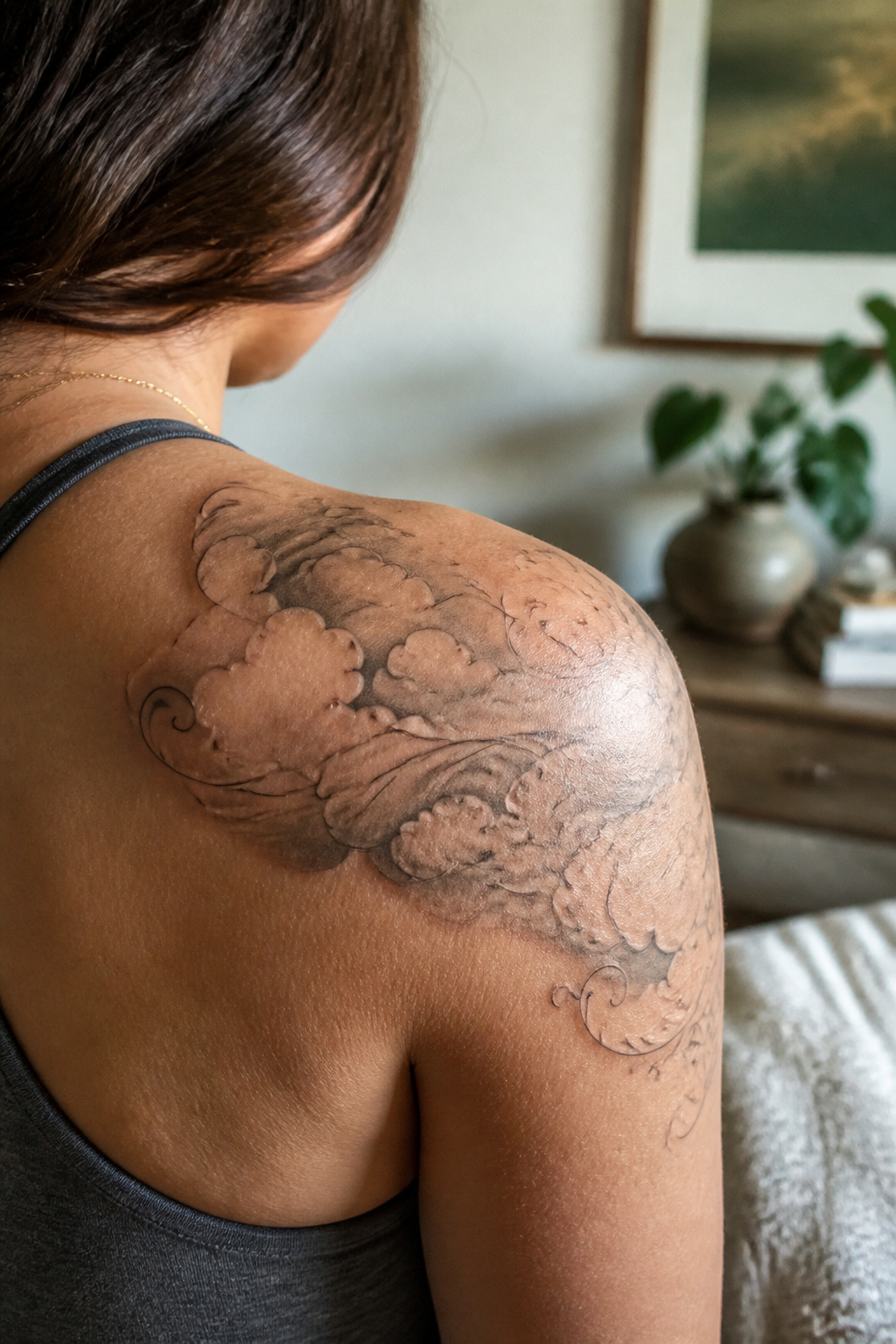
Cloud formations that carry words inside them need the lettering and the vapor to grow together from the first sketch, not bolted on after the clouds are settled. A flowing script tucked into the belly of a cumulus shape reads as breath or wind made visible, but drop the same text across a finished cloud and it sits like a sticker on glass. The weight of the line matters: thick blackletter or heavy serif blocks will fight against soft edges, while hairline scripts or brush-style caps let the cloud keep its volume. Turbulent storm clouds can handle more aggressive lettering, something with speed or tilt, because the motion is already there. Calm cirrus wisps call for open spacing and thin strokes so neither element overpowers the other. Placement within the cloud shape, not across it, is what makes the text feel born from the vapor rather than floating on top. A banner or ribbon woven through the form works only when the ribbon follows the cloud’s own curves instead of cutting across them like a label. Plan the script and the cloud in the same session, with the same pencil, or the two languages never learn to speak to each other.
35. Clouds with Nature Elements Tattoo
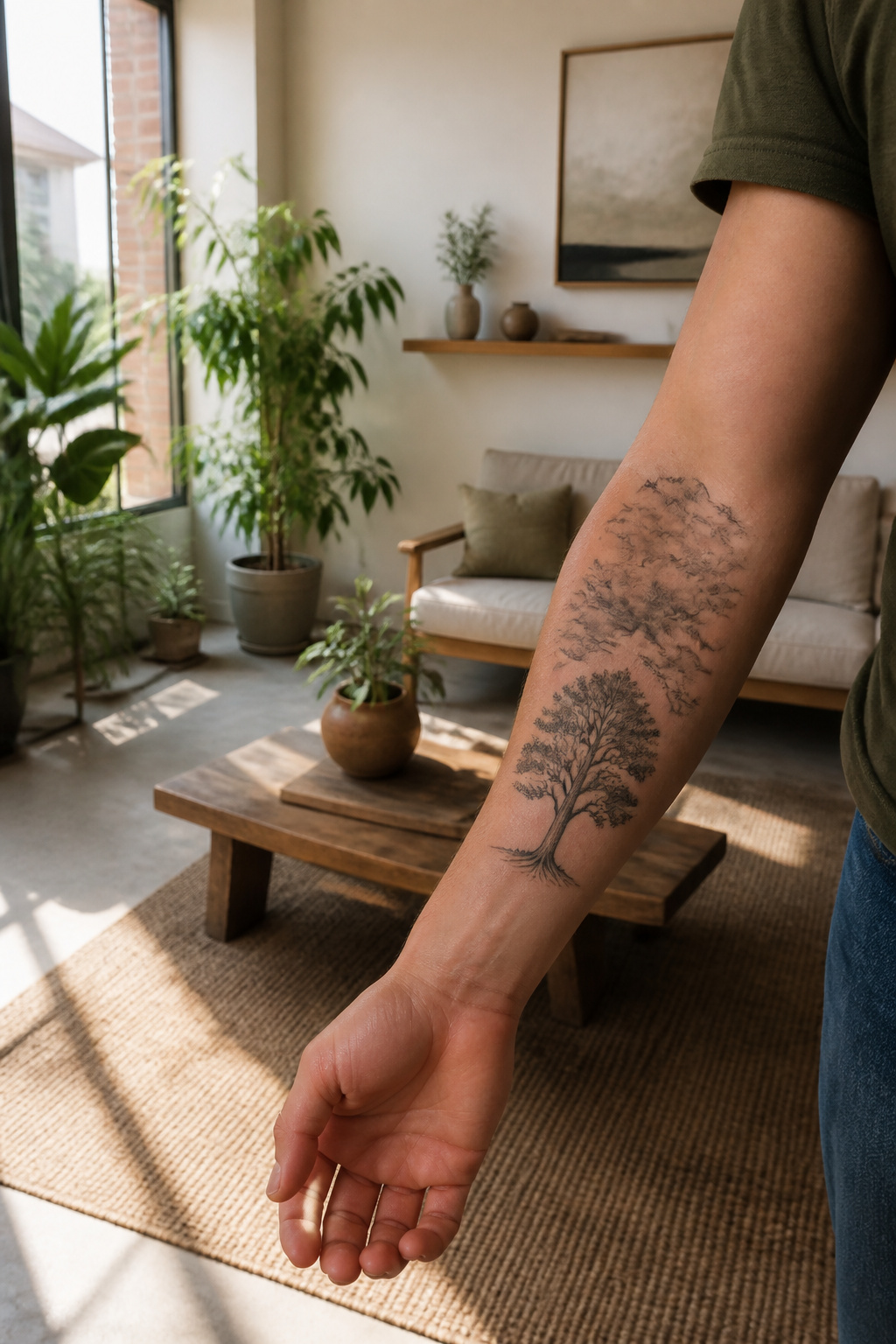
Clouds paired with mountains, rivers, animals, or plants work best when the sky itself carries the emotional weight of the piece. A soft, layered cirrus formation behind jagged peaks reads as quiet endurance; heavy, dark cumulus rolling over a river valley turns the same landscape into something approaching storm. The cloud treatment sets weather and mood for the whole composition, so decide the feeling before the first line is drawn.
This approach demands room. A single cloud and a single tree on a forearm tends to look like two stickers placed near each other rather than one coherent outdoor scene. Full back pieces, full thighs, or full sleeves give the artist space to let elements breathe, overlap, and establish real depth. A wolf emerging from mist needs enough surrounding atmosphere to sell the illusion; cut that space and the animal just floats.
Color choices follow the same logic. A muted, overcast palette unifies disparate elements into one remembered moment. Brighter skies work too, but only when the commitment to that mood runs through every leaf, rock, and fur texture below. Half-measures read as uncertainty, and at this scale, uncertainty is expensive to fix.
36. Clouds with Fire Elements Tattoo
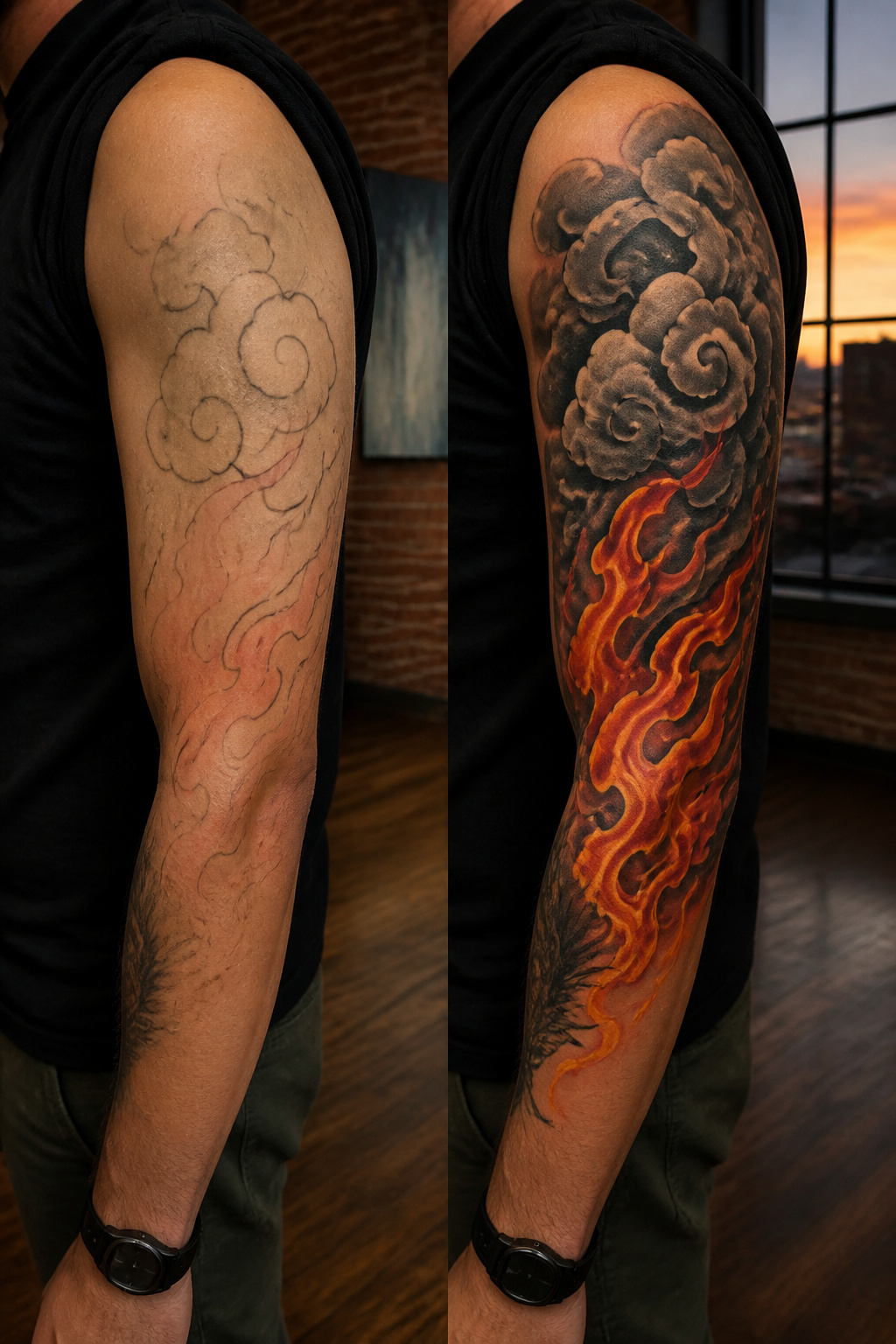
Warm orange and red flames licking the underside of a cloud mass create one of the more striking combinations in tattoo work. The temperature contrast does the heavy lifting here: cool blues and grays against those heated tones pull the eye immediately, no extra linework required. Sunset-lit cloud undersides read as peaceful transformation, the kind of image that works well on a shoulder or upper arm where the curve of muscle can echo the roll of cloud and flame together.
Storm clouds paired with fire push into different territory entirely. Dark, almost black cloud bases with jagged flame elements read as apocalyptic, elemental clash rather than gentle change. That combination carries weight; it suits larger pieces where the artist has room to build real atmospheric depth. The theme shifts from transformation toward destruction and renewal, or the balance of opposing forces held in tension.
Placement matters for the temperature story you want. A smaller flame-warmed cloud on the forearm keeps the sunset reading, intimate and personal. Full back pieces with storm and fire can go almost narrative, battle-scene energy without needing figures at all. Either way, the warmth-against-cool dynamic is what saves the image from muddiness; without that deliberate temperature split, gray and orange risk turning to mud on skin over time.
37. Clouds with Water Elements Tattoo
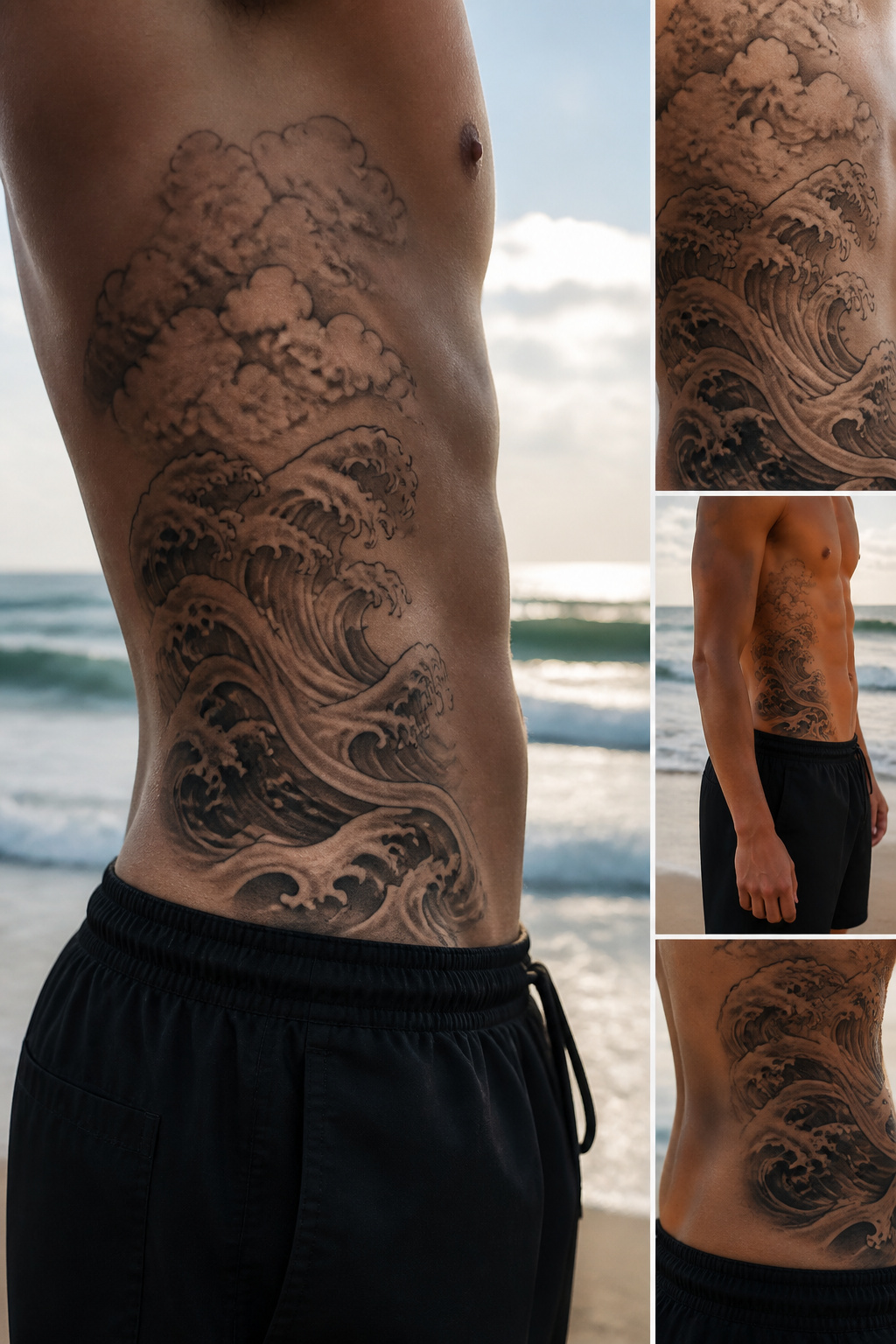
Cloud and water share the same visual language in tattoo work. Both shift shape continuously, catching light at their edges and dissolving into softer gradients where they thin out. An artist rendering waves cresting into mist, or a waterfall dissolving into spray, uses the same needle technique for both: tight linework at the dense core, then softer whip shading as the form breaks apart.
The pairing works because it names a cycle the body can carry. Water rises, gathers, falls. Clouds are water already changed. Seeing both together in one piece, the eye reads continuity rather than contrast. A water spout design, twisting from dark sea to pale column, makes that transition literal. The arm or back gives enough length to show the full arc without crowding either element.
Placement matters for how the motion reads. A vertical composition, ribs to hip or shoulder to elbow, follows gravity and feels like falling or rising. Horizontal placement, across the upper back or wrapping the thigh, reads more like weather moving across a view. The quieter the background, the more the two elements seem to generate each other out of empty skin.
38. Clouds with Geometric Shapes Tattoo
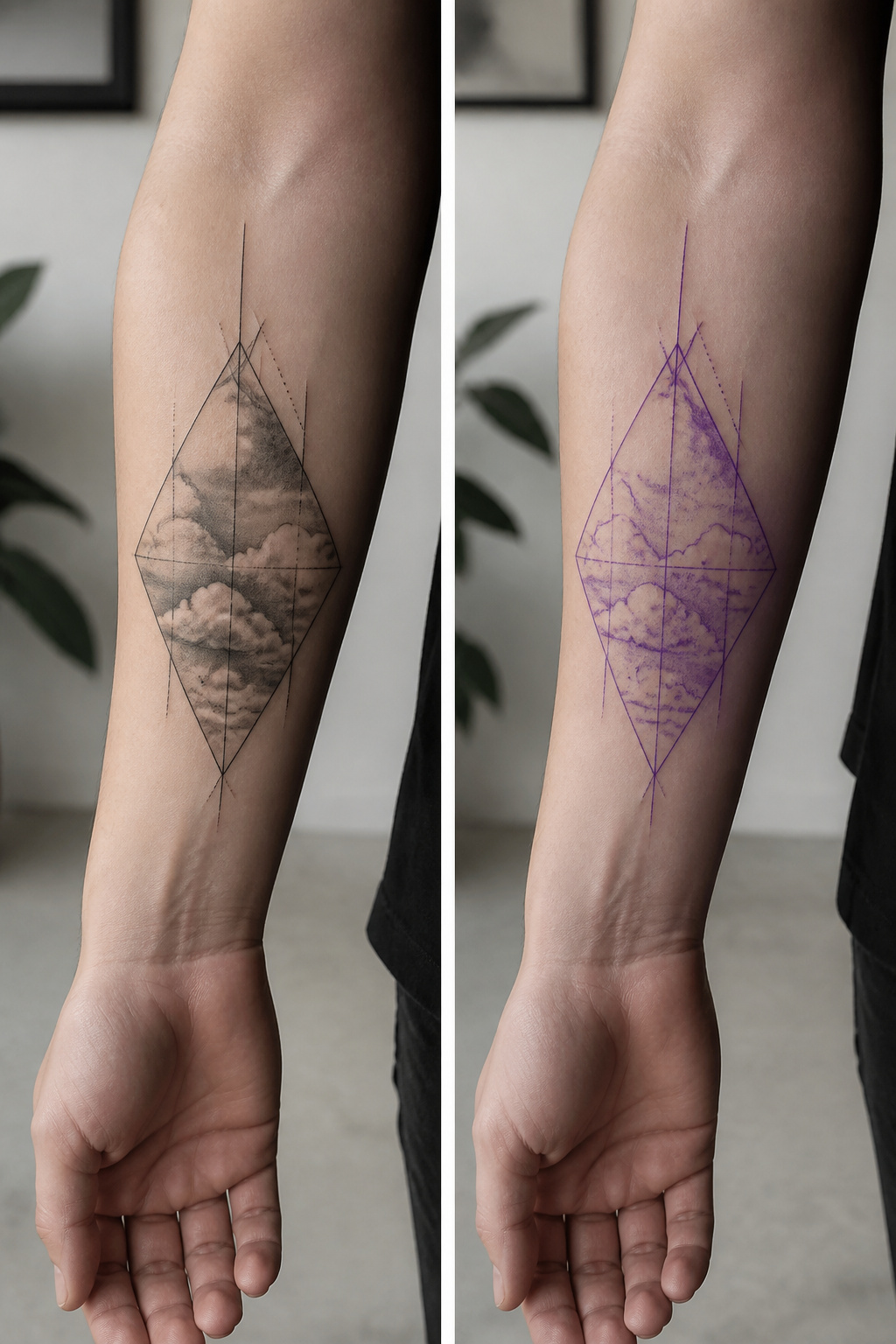
Clouds rendered in soft gray wash locked inside a perfect hexagon or triangle still catch me off guard every time I see one healed. The contrast works because skin does half the job: organic pigment spreads slightly at the edges no matter how steady the hand, so the cloud breathes against lines that refuse to. That tension between drift and fix is the whole point. Artists building these pieces usually map the geometry first, then break it deliberately with vapor that bleeds past the boundary in one or two spots, because total containment looks like a sticker. Placement matters more than with free-floating cloud work. The forearm’s flat plane holds a centered frame well; ribs or shoulders need the geometry tilted to follow the body or the whole thing reads crooked after a month of healing and settling. Ask to see healed photos of geometric frames specifically, not fresh work, since crisp linework blurs fastest on high-traffic skin. Someone wanting a grandfather’s cumulus tradition but living in a loft full of right angles finds their compromise here.
39. Clouds with Abstract Designs Tattoo
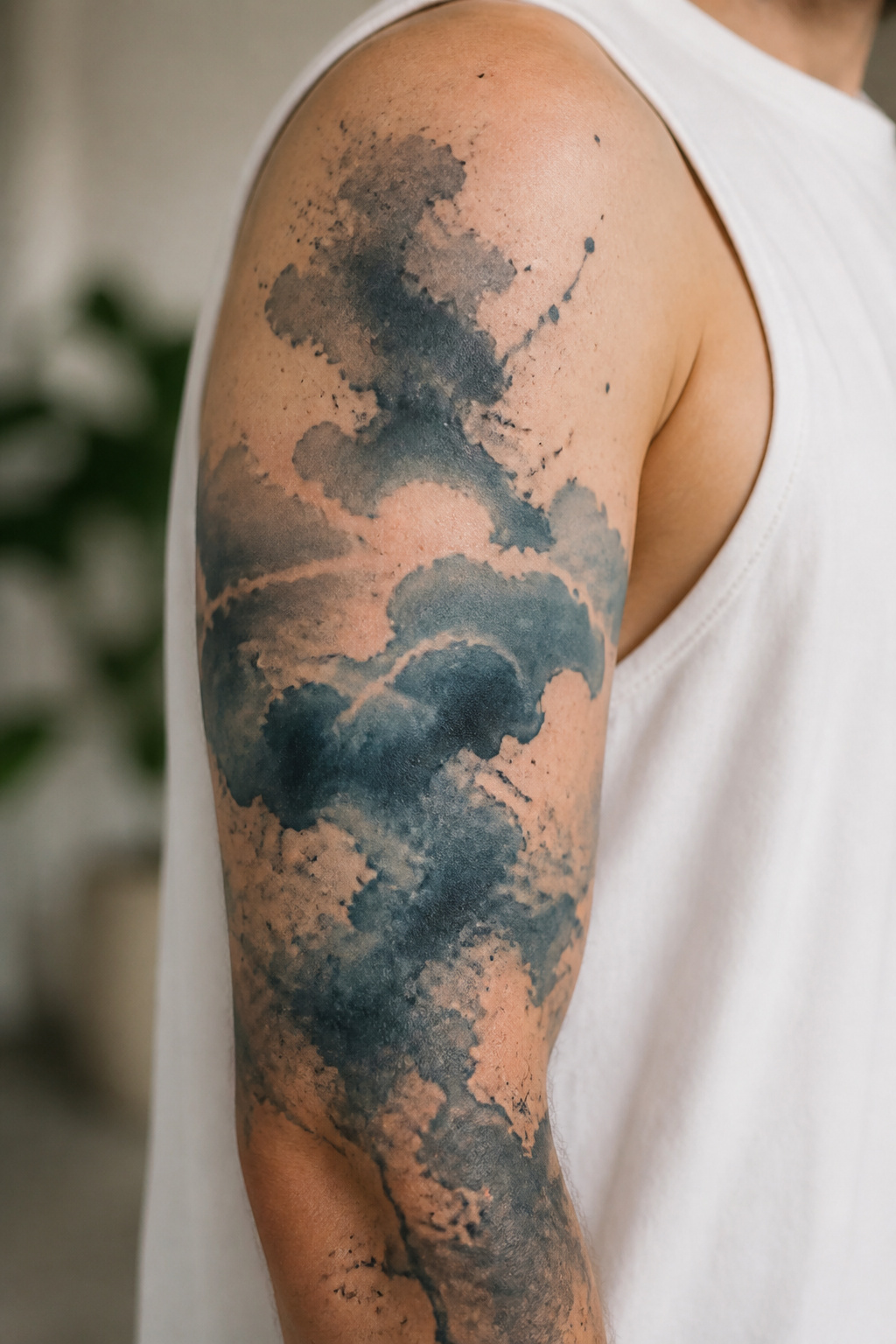
Abstract cloud work trades recognizable cumulus shapes for color fields that still read as weather. A pale wash at the shoulder might fade into nothing, or ink splatter can suggest a front moving through without ever drawing a proper edge. The atmospheric reference stays intact because clouds are already half abstract to begin with; loose pigment and irregular marks capture that better than tight linework.
This approach suits clients who collect prints or follow contemporary painters, people who would rather wear a Rothko mood than a meteorological diagram. Placement matters more here since the image won’t announce itself as "cloud." A rib panel or upper arm gives the color room to breathe and shift in tone as skin moves. The risk is a piece that reads as arbitrary smear if the artist lacks control over saturation and edge quality, so reviewing healed photos of their abstract pieces is non-negotiable.
Healed photos matter more than fresh ones for this style, since soft edges blur further and colors settle unpredictably.
40. Clouds with Personal Symbols Tattoo
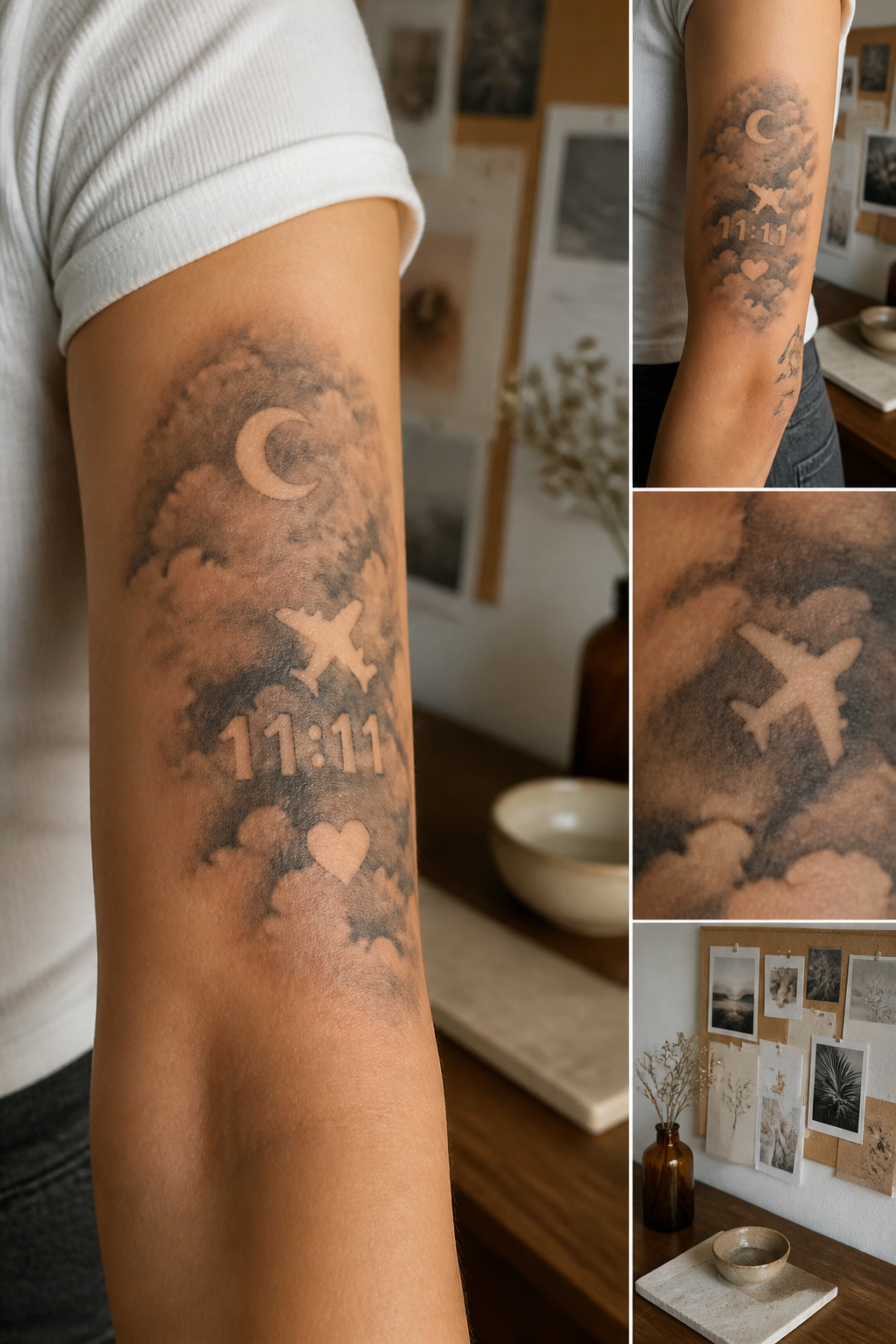
Hiding coordinates inside a cloud’s edge turns a weather symbol into a private map. The shape wraps around numbers so naturally that most viewers read it as atmosphere, not location. A client once asked me to place her grandmother’s birthplace in negative space between two cumulus layers; from three feet away it reads as soft shading, but step closer and the latitude line emerges.
This same trick works for dates, initials, or small icons. Clouds adapt because their edges are supposed to be irregular. A bird silhouette can read as accidental wisps until you name it. The body becomes a selective archive: visible to anyone, legible only to those who already know the code.
The risk is overcrowding. A single cloud with one hidden element carries weight; three symbols in the same formation looks like a puzzle nobody asked to solve. My preference leans toward one secret per piece, placed where the eye rests second, not first. The tattoo stops being generic stock imagery and becomes specific autobiography, but only for the wearer. That restraint is what separates commemoration from collage.
Frequently Asked Questions
What does a cloud tattoo symbolize?
Cloud tattoos carry layered meaning depending on style and culture. Japanese kumo clouds symbolize good fortune and protection, often framing more aggressive imagery to buffer its energy. Storm clouds speak to ongoing struggle or power held in reserve, while sun breaking through partial cover reads as persistence rather than simple optimism. More broadly, clouds represent change and impermanence, a meaning drawn from ancient Chinese philosophy where their constant shifting stood for uncertainty and transition.
How should a cloud tattoo be shaded?
The shading approach depends entirely on the mood you want. Light, airy clouds need minimal tone and soft edges; heavy storm formations build from deep charcoal cores with layered grays, leaving negative space only where light would pierce. Rain clouds use saturation contrast, a dense base above delicate single-needle drops. For blackwork clouds, solid fill replaces gradation entirely, letting silhouette do the work. The arm’s cylindrical surface especially demands that gradients wrap rather than sit flat, or they read as smudge from the side.
What kind of tattoo goes with a cloud background?
Religious iconography and nature scenes both suit cloud backgrounds well: crosses rising above vapor, ships cutting through storm light, angels given something to stand on. The key is planning the background first, before the main image sits too low or centered to leave atmospheric room. Clouds must wrap around the subject to create depth; patched in afterward, they read as sticker collage rather than distance. The ancient Chinese association of clouds with change itself gives tension when placed behind fixed symbols like a steady helm or cross.