These 16 ideas run from a single black-and-grey bull head to the full Wall Street scene with Broadway signs and stock exchange lettering, so the deciding factor is how much narrative you want the tattoo to carry.
The better approach is to start with the trait you want uppermost, strength or devotion or memento mori, then match the style to that meaning rather than picking the picture first.
The smoke-effect version, for instance, needs an artist who can read healed negative-space work, or the ribbons between presence and absence collapse to bad shading inside a year.
1. Realistic Bull Tattoo
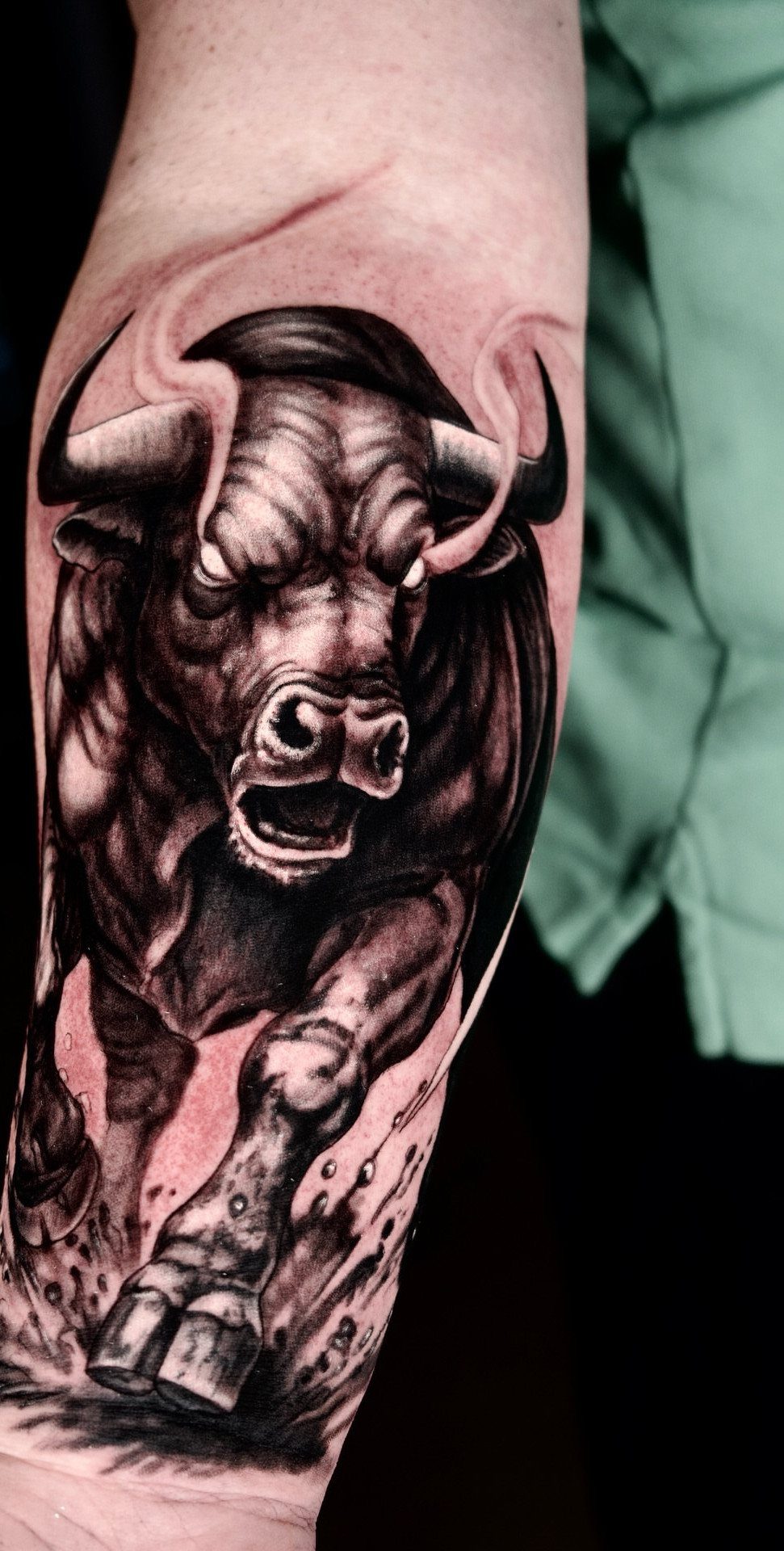
A realistic bull tattoo lives or dies on the shading. Smoke from the eyes and water under the hooves only work when the bull itself reads as flesh first, effect second.
Black and grey build the muscle and the wet shine on the hide; without that base, the smoke looks pasted on.
If you want this version, ask to see healed photos of animals the artist has done.
Fur texture holds up differently than human skin, and the wrong needle grouping turns it to mud fast. Mountains or a sunset behind the bull are an option, though the arm here carries the animal alone.
The pose matters too. This one is mid-charge, head down, which fits a forearm’s length and lets the horns follow the bone.
A turned or standing bull sits better on a chest or thigh. Plan the placement with the direction of the charge in mind, or the movement fights the body instead of using it.
2. Geometric Bull Tattoo
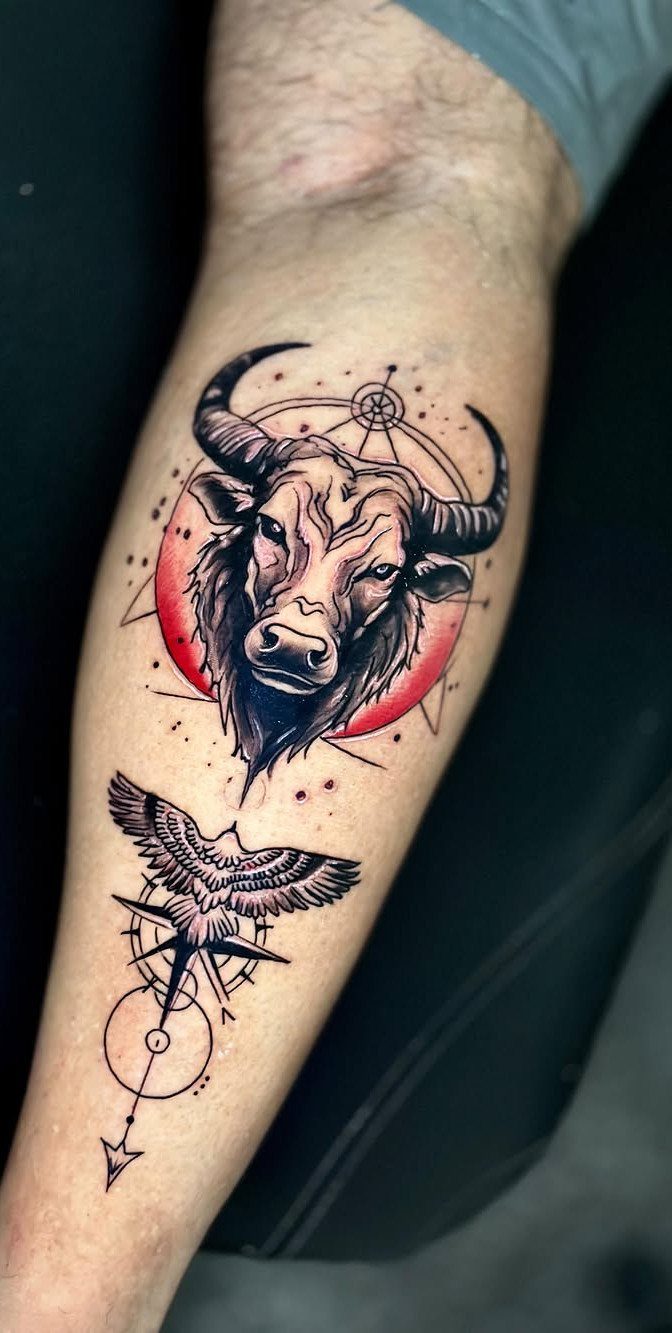
Geometric lines frame the bull, a red circle behind the head and smaller shapes below. The balance is the trick: too many lines and the animal disappears into pattern, too few and the geometry looks like an afterthought.
This artist kept the bull’s face fully readable, then added geometric lines, stars, and a bird symbol as separate layers.
Sacred geometry and astrology work as starting points.
If that is your angle, bring reference: specific shapes, their meanings, and where you want them. A good tattooer will adapt the angles to your body’s curves, but they need to know which symbols are non-negotiable.
Black and grey shading sits between the lines here, which keeps the geometry from looking flat.
Without it, the design reads as outline only, more sticker than tattoo. Ask for depth in the consultation, not as a fix at the end.
3. Realistic Bull Tattoo on the Bicep
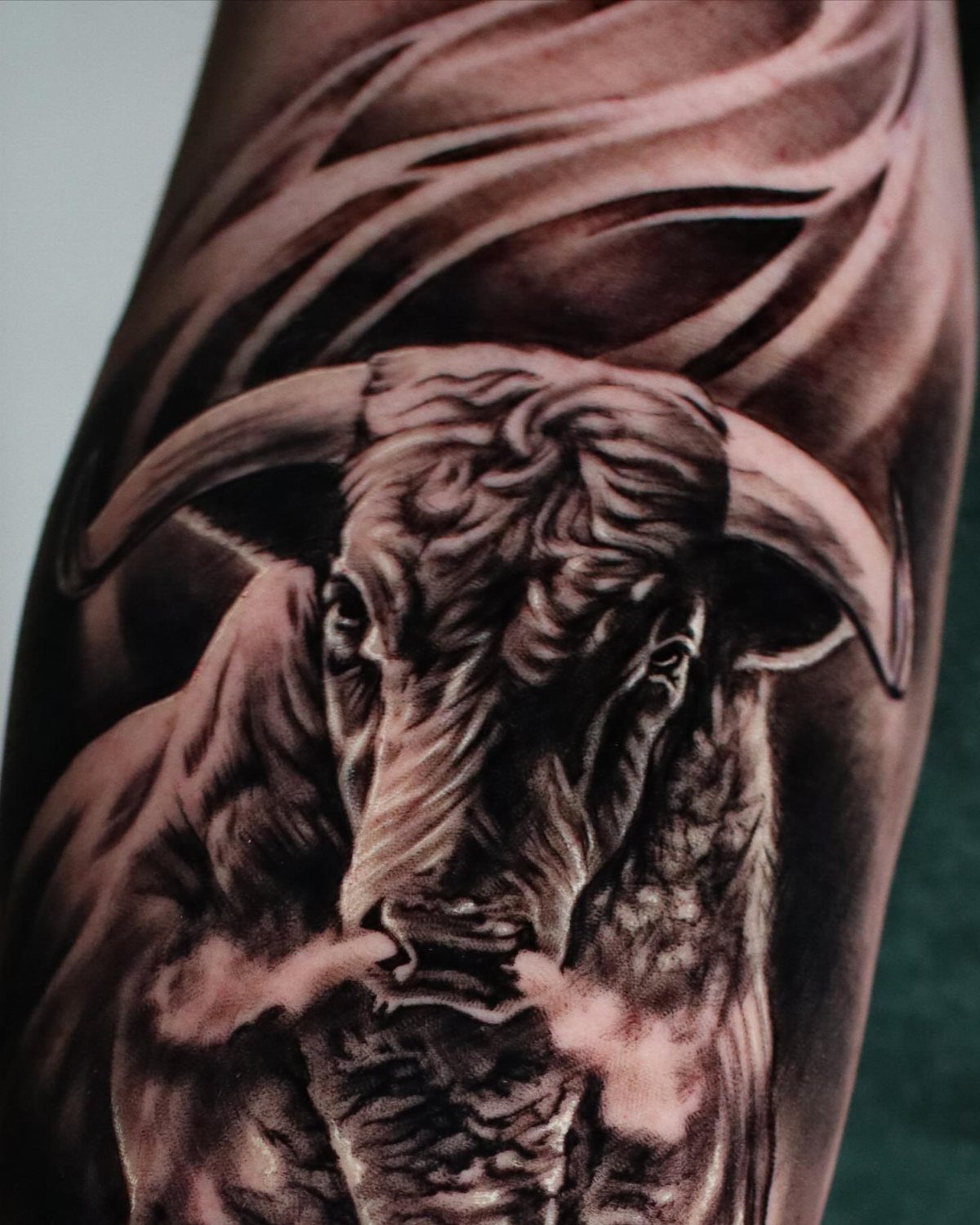
Smoke from the nostrils is the detail that separates this bicep piece from a standard bull head. A smaller arm compresses the effect or loses it above the line of a short sleeve.
The hair detail cascades down the nose, elegance on strength.
That texture comes from single-needle work or a very fine group, and it takes time. Budget for a longer session or accept a simpler fur treatment.
This placement shows best when the arm is relaxed at the side, the bull facing outward.
Flexed, the horns spread and the face distorts slightly, a tradeoff of any bicep design. If you need the image perfect in a posed photo, consider the outer arm instead.
4. Bull Skull Tattoo
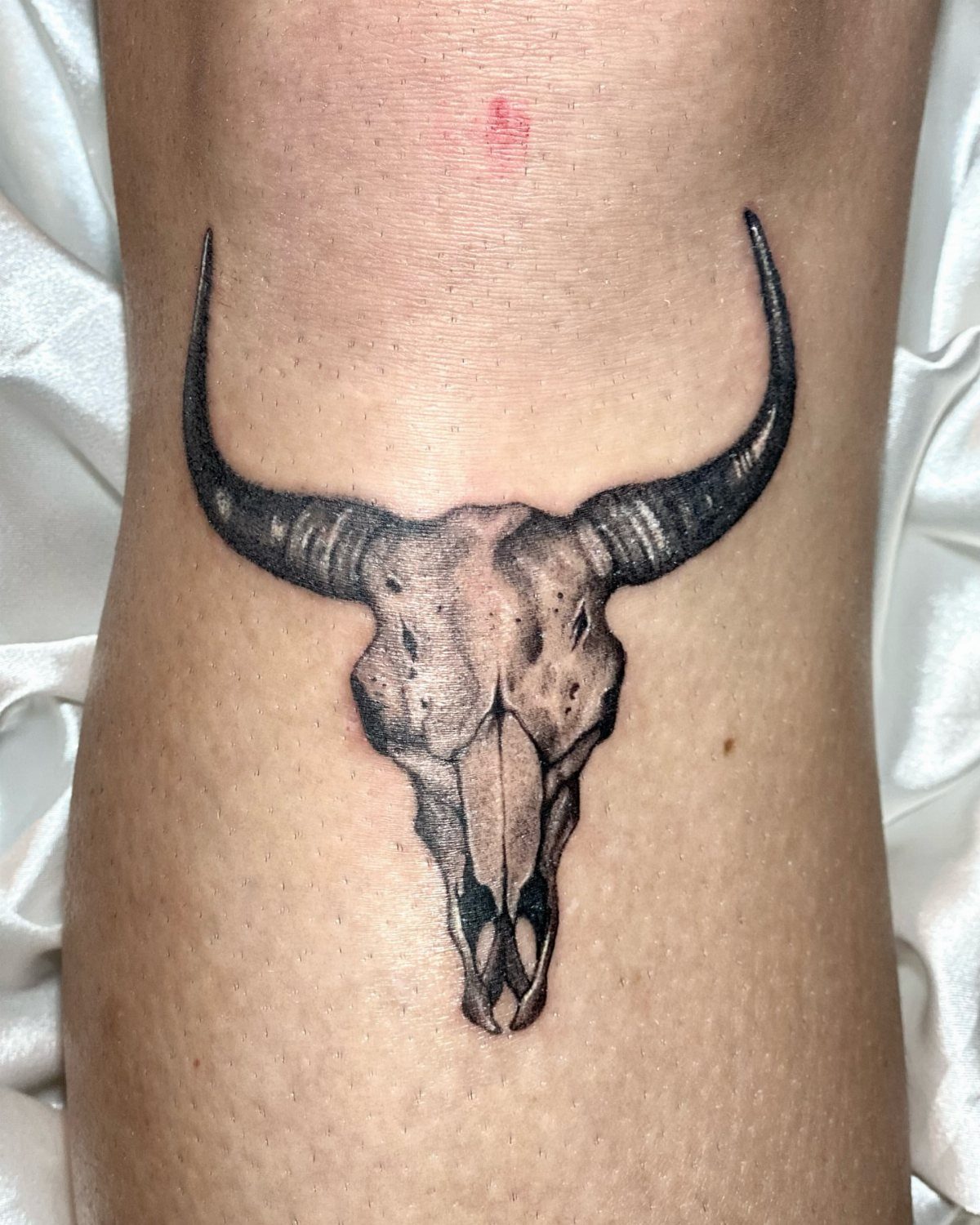
A bull skull tattoo carries weight because the animal itself is gone; what remains is the structure that held the power.
Clean horn curves and the hollows where the eyes were, all in black and grey on the leg below the knee. That placement lets the horns wrap slightly around the calf, using the bone beneath as a kind of armature.
2 readings fit: ancient endurance and personal change through shedding an old self.
The skull suits either, but the tone shifts. Darker shading and sharp edges lean toward the memento mori tradition; softer lines and keep the horn texture weathered, not cracked, and the mood shifts to something more like a landscape.
This design covers less area than a full bull but reads from farther away.
The negative space of the eye sockets does the work. A background would compete, and the photo keeps it single against skin.
5. Realistic Bull Tattoo with Taurus Zodiac Symbol
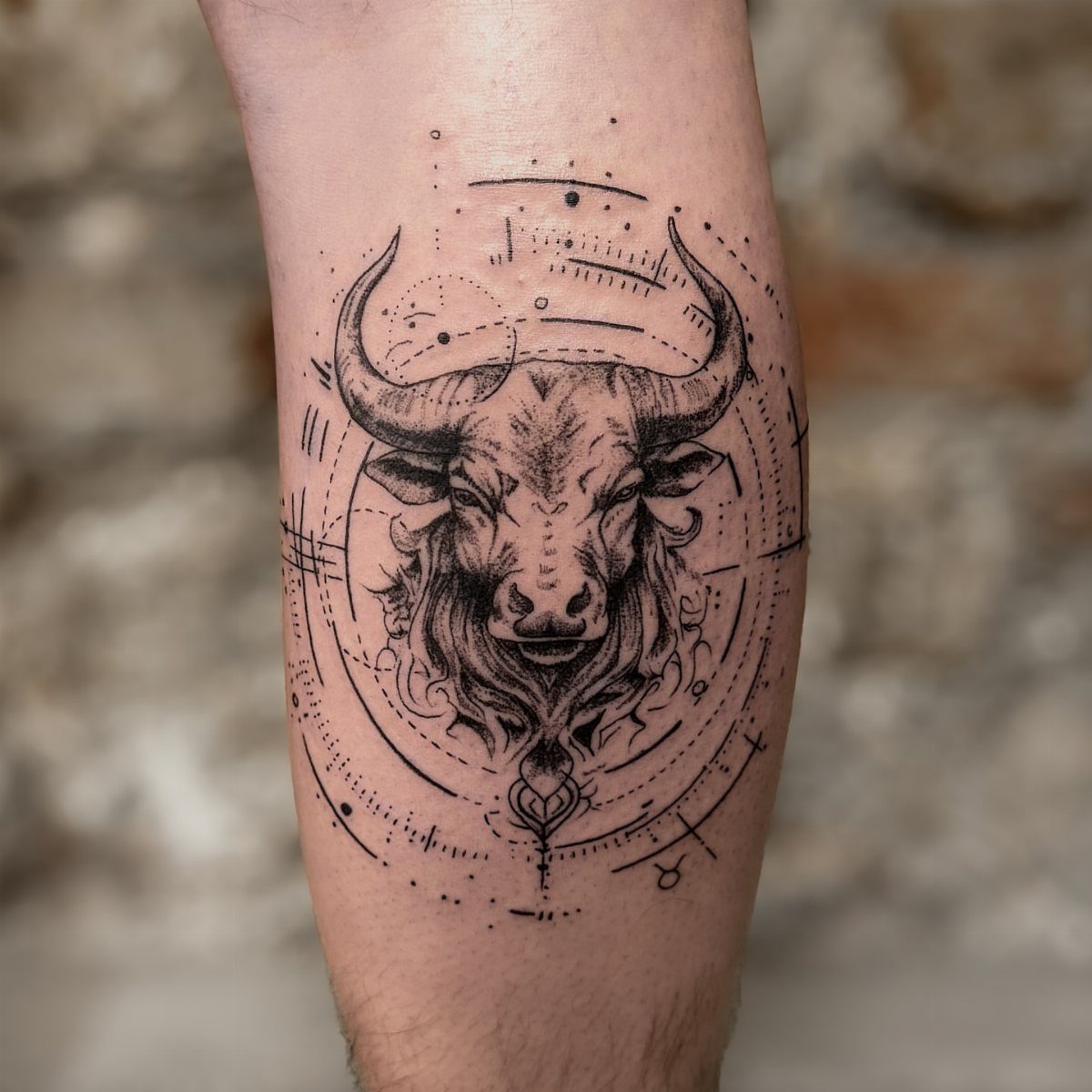
The Taurus symbol sits small in the geometric circles, easy to miss if you are not looking for it.
That is the right scale: the bull dominates, the astrology signs as footnote. Switch the ratio and you have a zodiac tattoo with an animal illustration, a different project entirely.
Born April 20 to May 20, the Taurus reader considering this has options. The simple glyph, 2 connected curves, fits almost anywhere as a pairing.
Celestial elements like stars or a moon are another route, though this one keeps it minimal with line geometry instead. Either works; mixing both risks clutter.
The bull head itself carries the same demands as any realistic version: reference photo, discussion of direction and expression, commitment to the sitting time.
The symbol adds perhaps 20 minutes. Decide in the consult whether you want it integrated or set apart, since the tattooer’s approach changes.
6. Charging Bull Tattoo
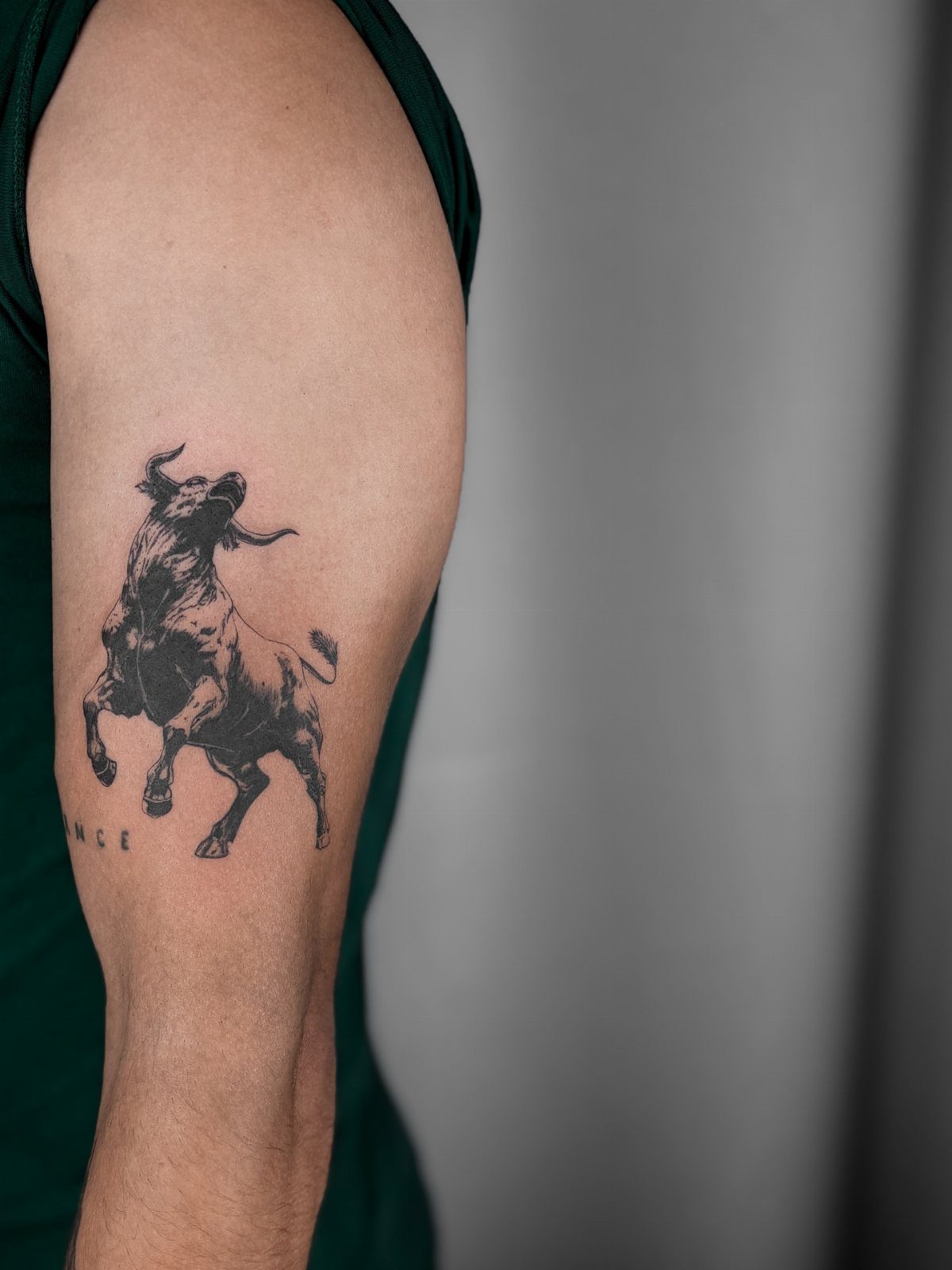
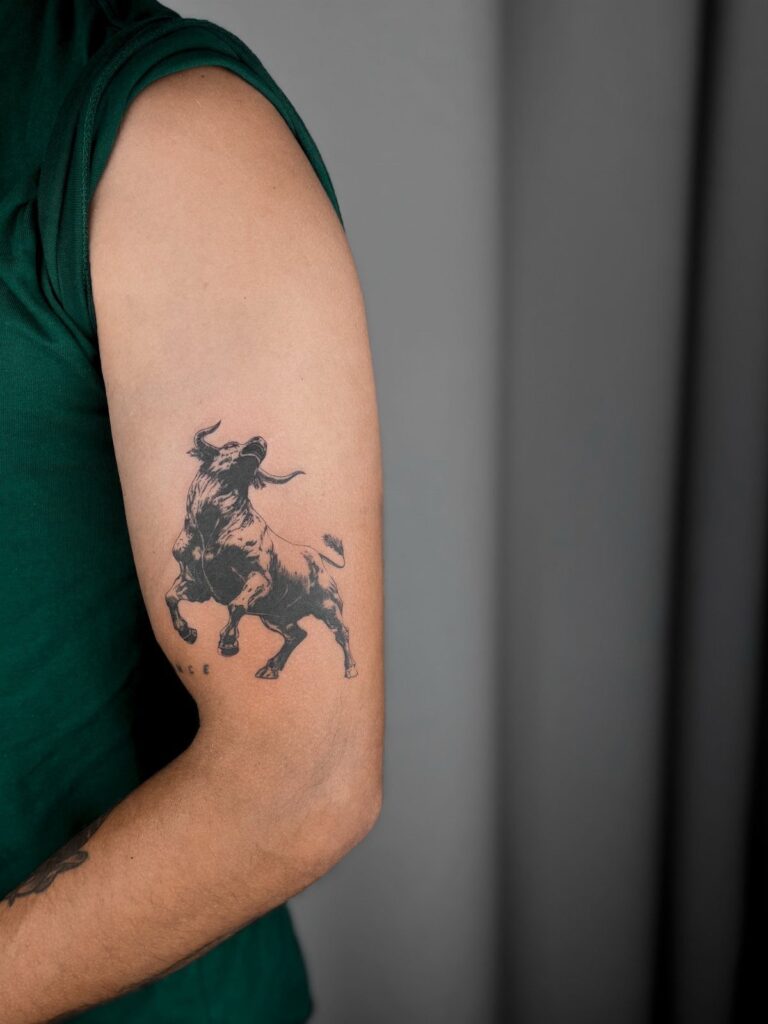
A charging bull needs a diagonal.
The body angles upward, the legs driving, which lets the arm’s length become the direction of the charge. On a flat plane like the chest or back, the same pose would need more foreshortening to keep the energy.
Tattoos on limbs traditionally face inward, toward the heart.
The bull follows this, head aimed at the body’s center when the arm hangs down. Reverse it and the charge escapes outward, which may suit a different meaning but reads as a break with convention, not ignorance.
If you are adding text, settle the composition before the first session. The bull’s placement shifts to accommodate words, not the reverse, or the spacing looks squeezed in afterward.
7. Angry Bull Tattoo
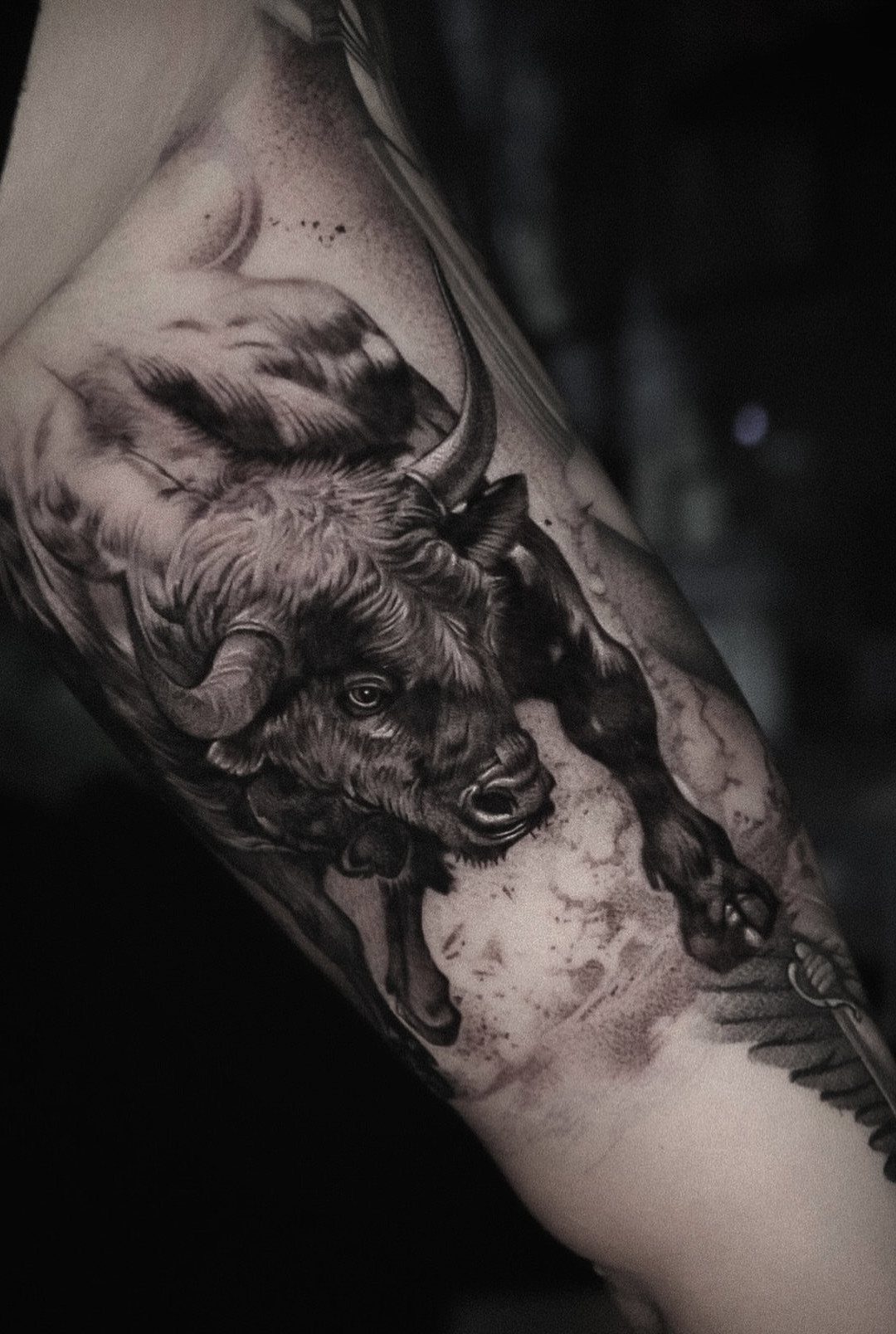
The aggression here sits in the eyes and the set of the jaw, not in added flames or color.
A black-and-grey bull can telegraph rage through shadow placement alone; the brow sinks lower, the nostrils flare wider, and the horns angle forward like weapons. That restraint keeps the tattoo readable longer than orange and blue fire would.
Placement on the inner forearm lets the face confront the viewer directly.
The curve of that surface also softens the image slightly when the arm rotates, so the expression should be dialed up enough to survive the shift. Ask for the rage in the structure, not the embellishment.
8. Bull Portrait with Rope Halter
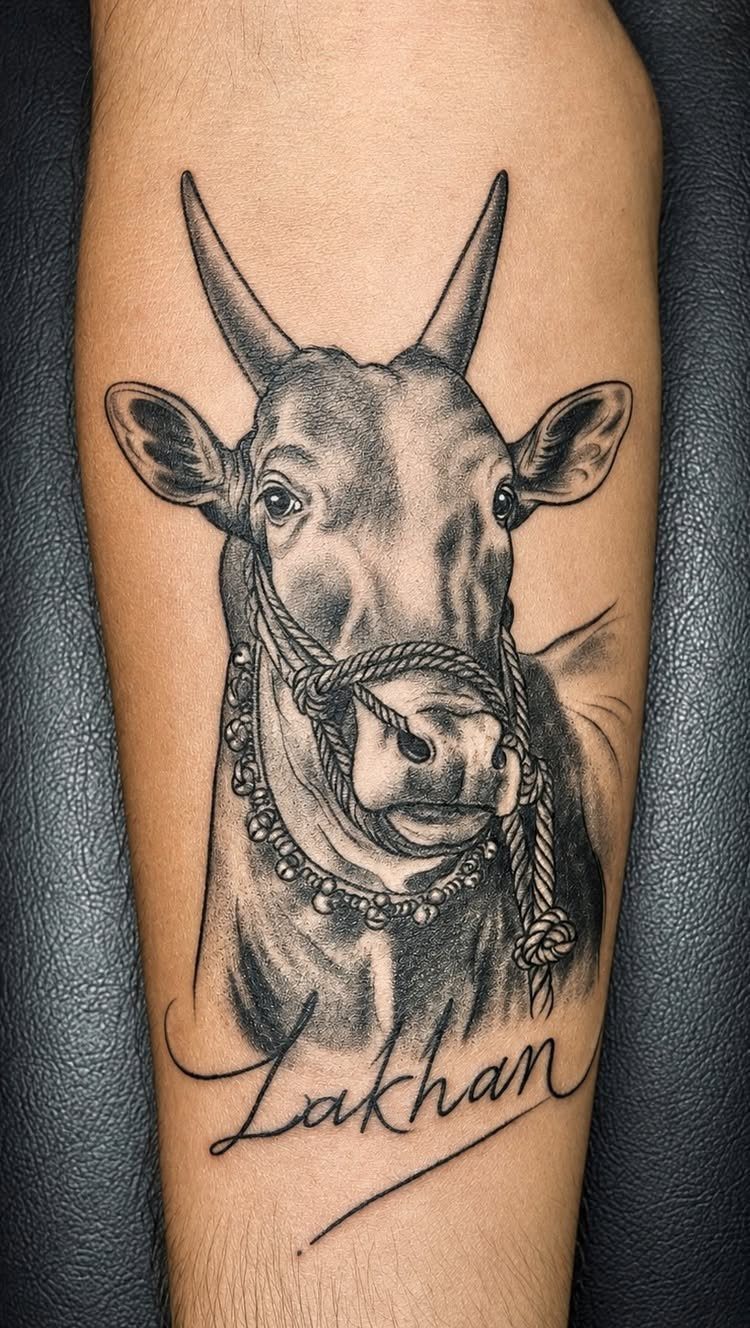
The rope halter and beaded necklace shift this from wildlife study to portrait of a specific animal, maybe one that belongs to someone.
The name "Lakhan" underneath locks that reading in. If you are honoring a particular bull, bring photos of the actual hardware; the way the rope sits on the poll and the knot at the cheek is individual.
Realistic rope texture takes time, and the beads need a separate needle pass.
The halter detail costs extra time, or it flattens into a dark band against the bull’s fur. The rope work builds on an already demanding portrait; the head still has to read as solid muscle and hide first.
9. Bull Tattoo on Forearm
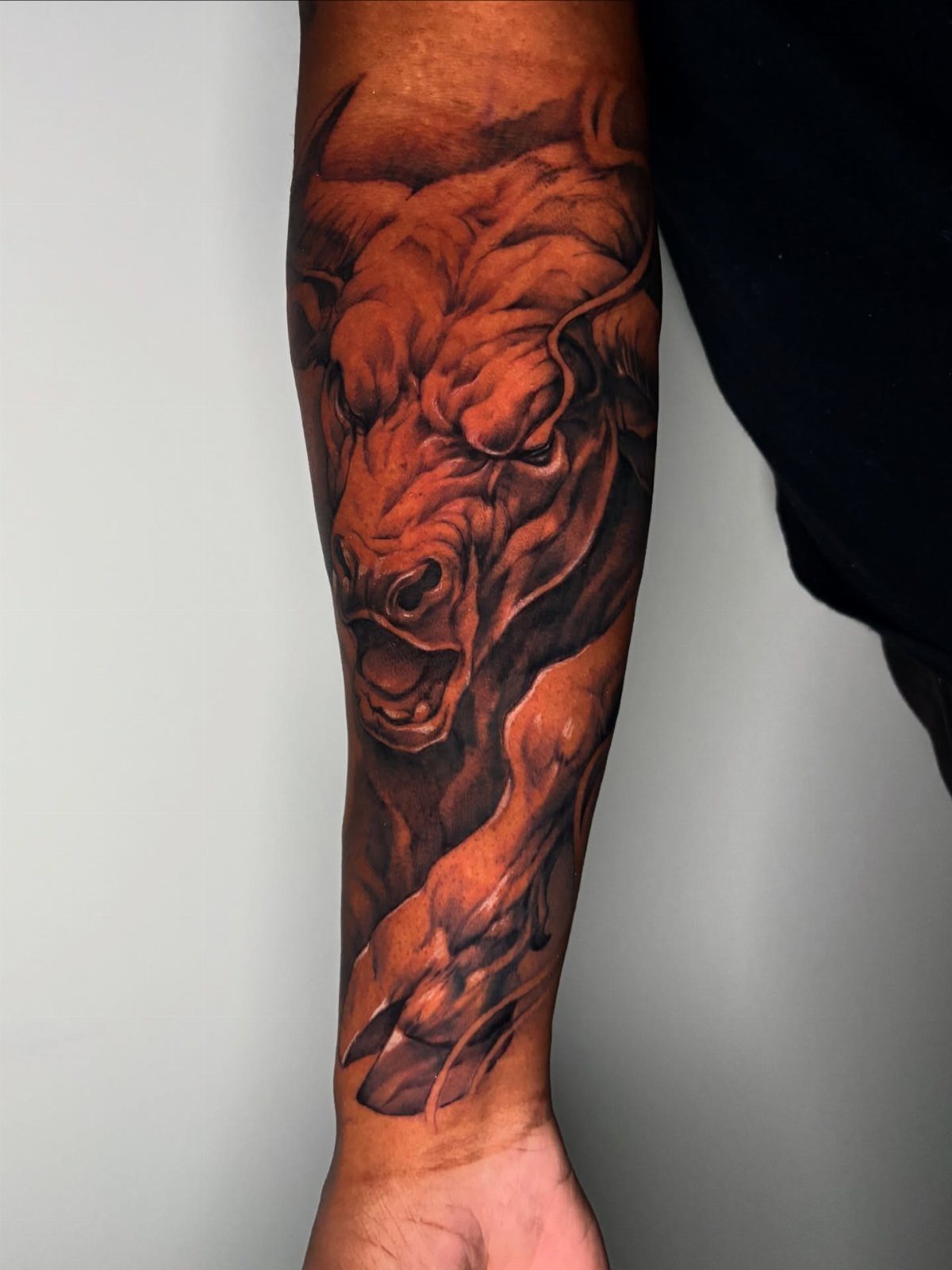
The forearm offers length without the distortion of a bicep. A bull’s full body fits here, or a large head with room to breathe.
The flat plane of the outer forearm shows the image consistently whether the arm hangs or lifts; the inner forearm, where this one sits, curves more and hides part of the design against the torso.
Sleeve length matters for placement. A short sleeve cuts across the mid-horn on many forearm bulls, which can look accidental.
Measure your usual sleeve line against the proposed top of the tattoo, or raise the design to clear it entirely. The lower forearm, nearer the wrist, anchors a charging pose well; the direction of motion follows the arm’s natural point.
10. Bull Tattoo on Leg
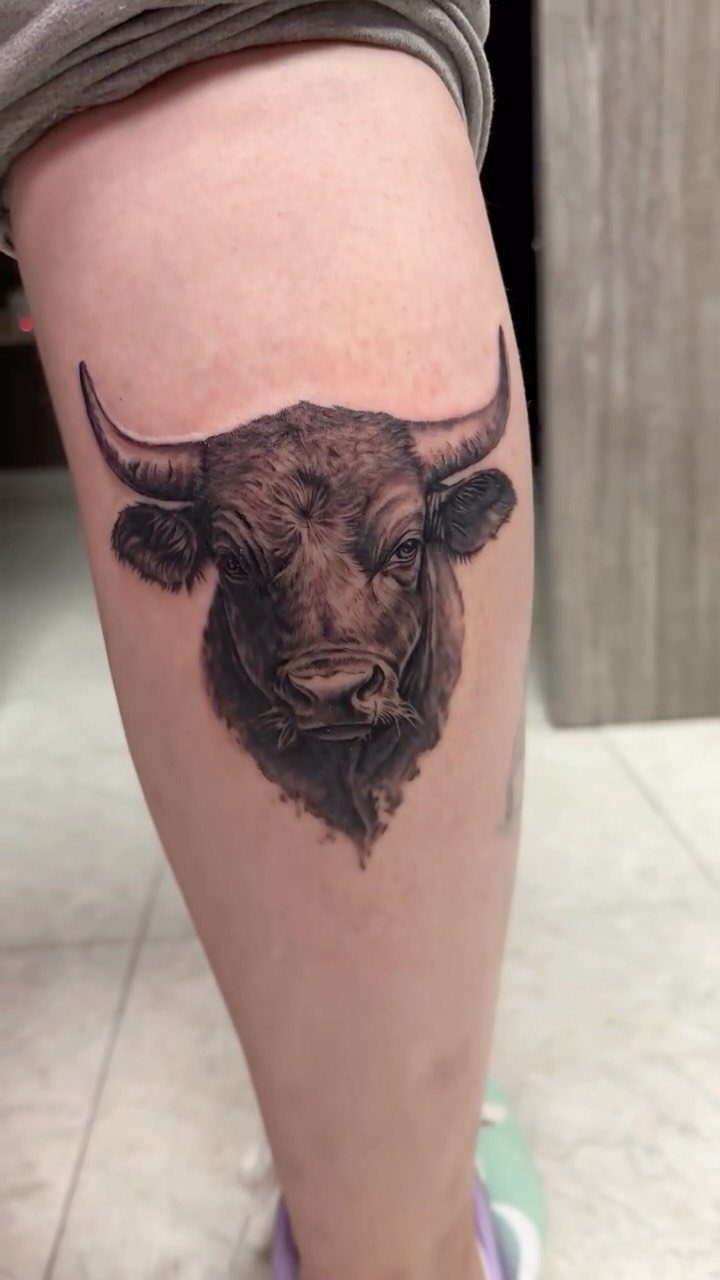
The calf’s cylinder shape wraps a bull head nicely, letting the horns follow the muscle’s curve.
This placement carries more bone than the arm, so sitting through the session hurts more; the tradeoff is a larger canvas that shows fully in shorts.
A standing or front-facing bull works on the leg front, where the shin is flatter. The calf’s outer curve, where this one sits, favors a turned head, the near horn longer as it rounds toward the viewer.
11. Bull Tattoo with Floral Accents
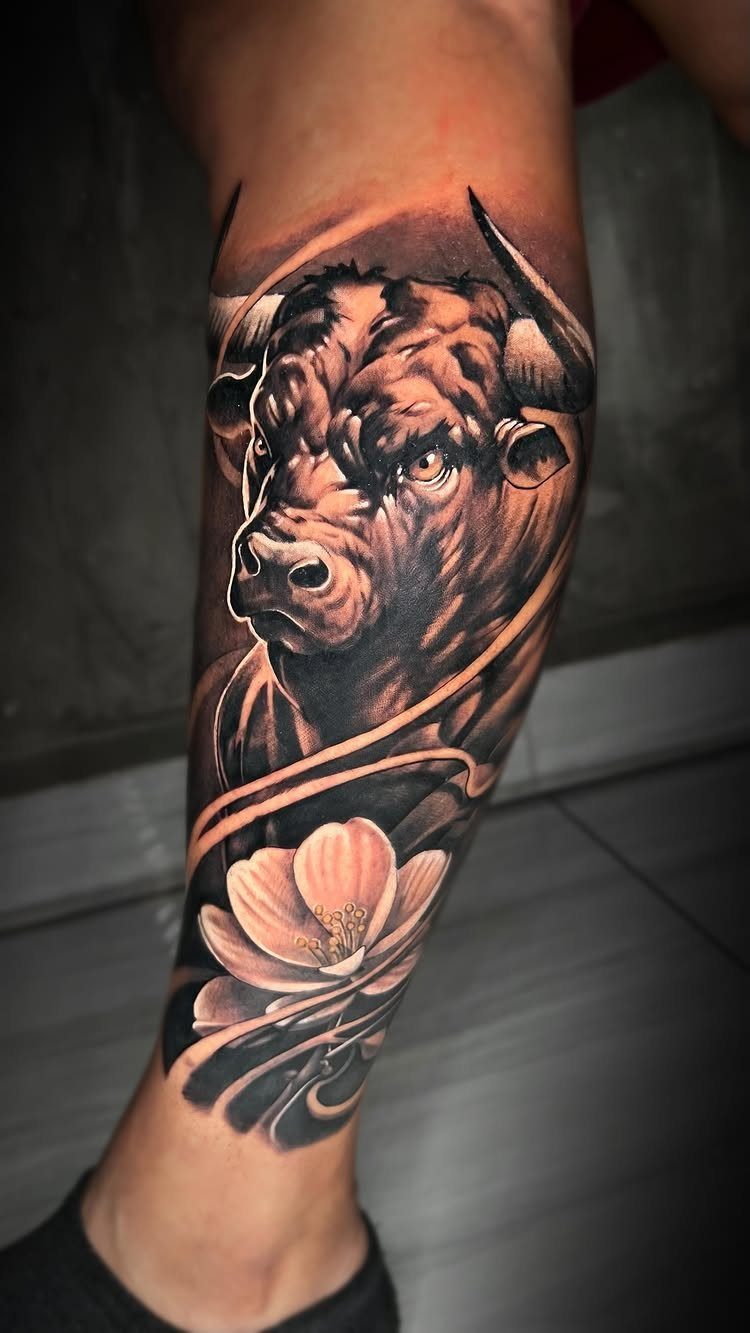
The flower beneath the bull softens what otherwise reads as pure confrontation. In this black-and-grey version, the bloom is shaded like the animal, not colored like a watercolor piece.
That unity keeps the two elements in the same world; a purple and orange flower above a realistic bull would look like two tattoos colliding.
Choose the flower for meaning or for shape. A rose fits almost any narrative; a lotus adds a different lineage.
The stem and leaves need to connect the 2 elements or they float apart. Here the flower sits directly under the jaw, the bull’s shadow falling onto the petals, which ties them together.
12. Bull Tattoo with Red Accents
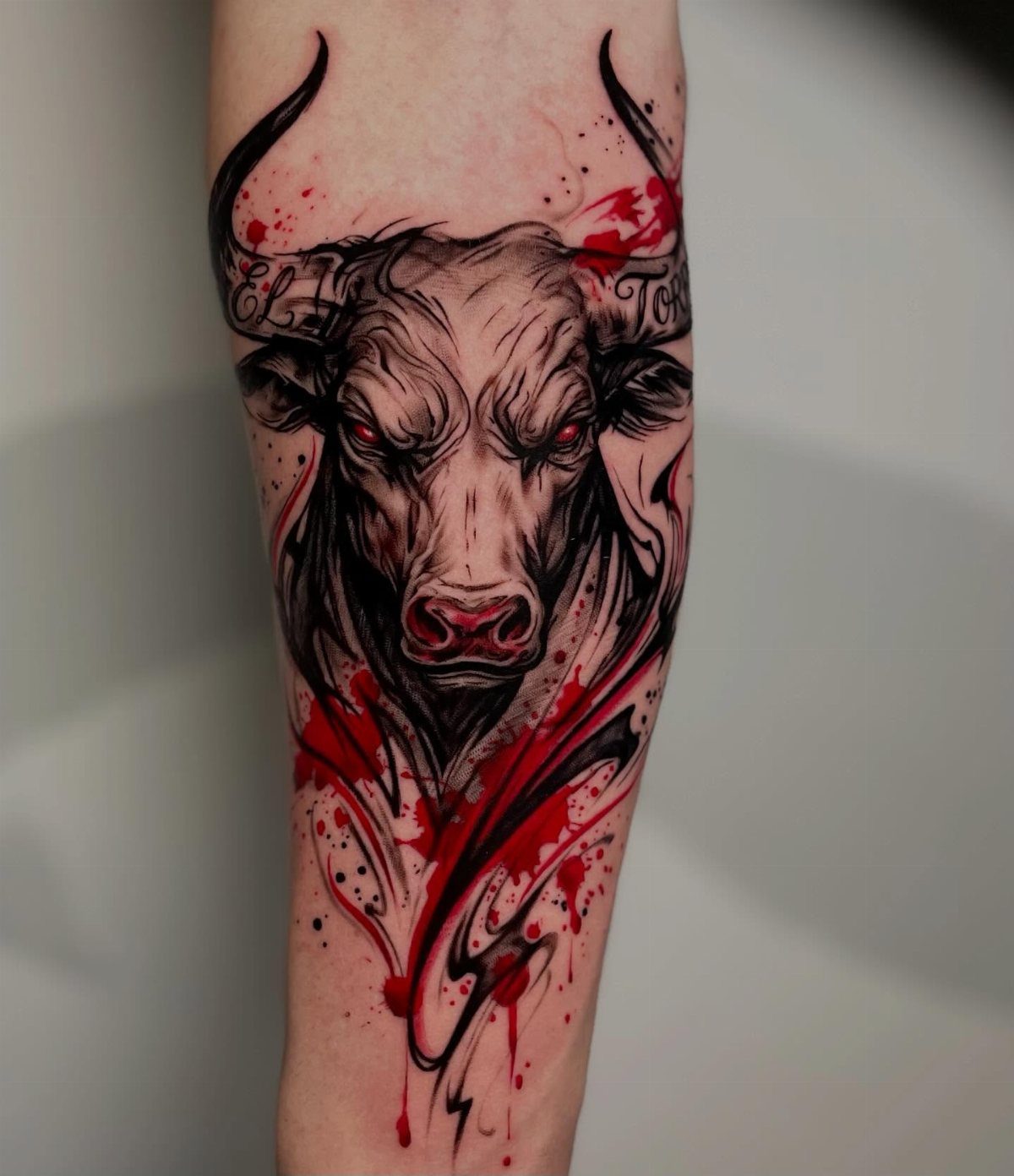
Red ink around the eyes and at the horn base signals danger without rewriting the bull as cartoon.
The "EL TORO" script across the horns names the tradition outright: matador, arena, the charged moment before the cape. That text determines the reading; without it, the red could mean rage alone.
Red fades faster than black, especially in sunlight. The splatter effects will soften first, then the eye accents, leaving you with a grey bull and a memory of color.
Red ink fades faster than black, so plan for a touch-up if the color matters to the meaning, or keep the accents small enough that their fade does not orphan the design.
13. Bull Tattoo with Lightning Effects
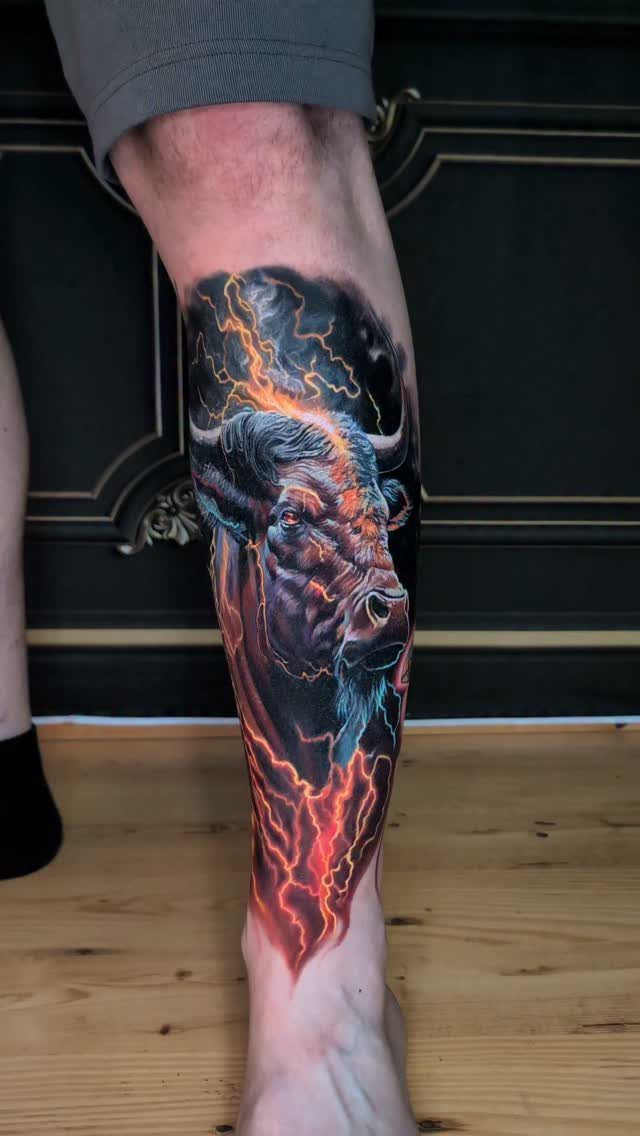
Lightning around a bull head turns the animal into a source of power rather than a victim of it.
The orange and yellow bolts on this lower leg piece read as energy radiating from the horns and eyes, not striking down.
The color choice matters.
Warm lightning against black and grey reads as controlled force; blue or purple shifts toward something colder, more alien. Stick to one temperature or the effect splits in two.
A flat plane like the shin shows the geometry of the bolts clearly.
On a curved surface, the lines would need adjustment or they read as wobbled. The leg bone helps here, giving the bull a vertical anchor that grounded lightning needs.
14. Bull Tattoo on Hand
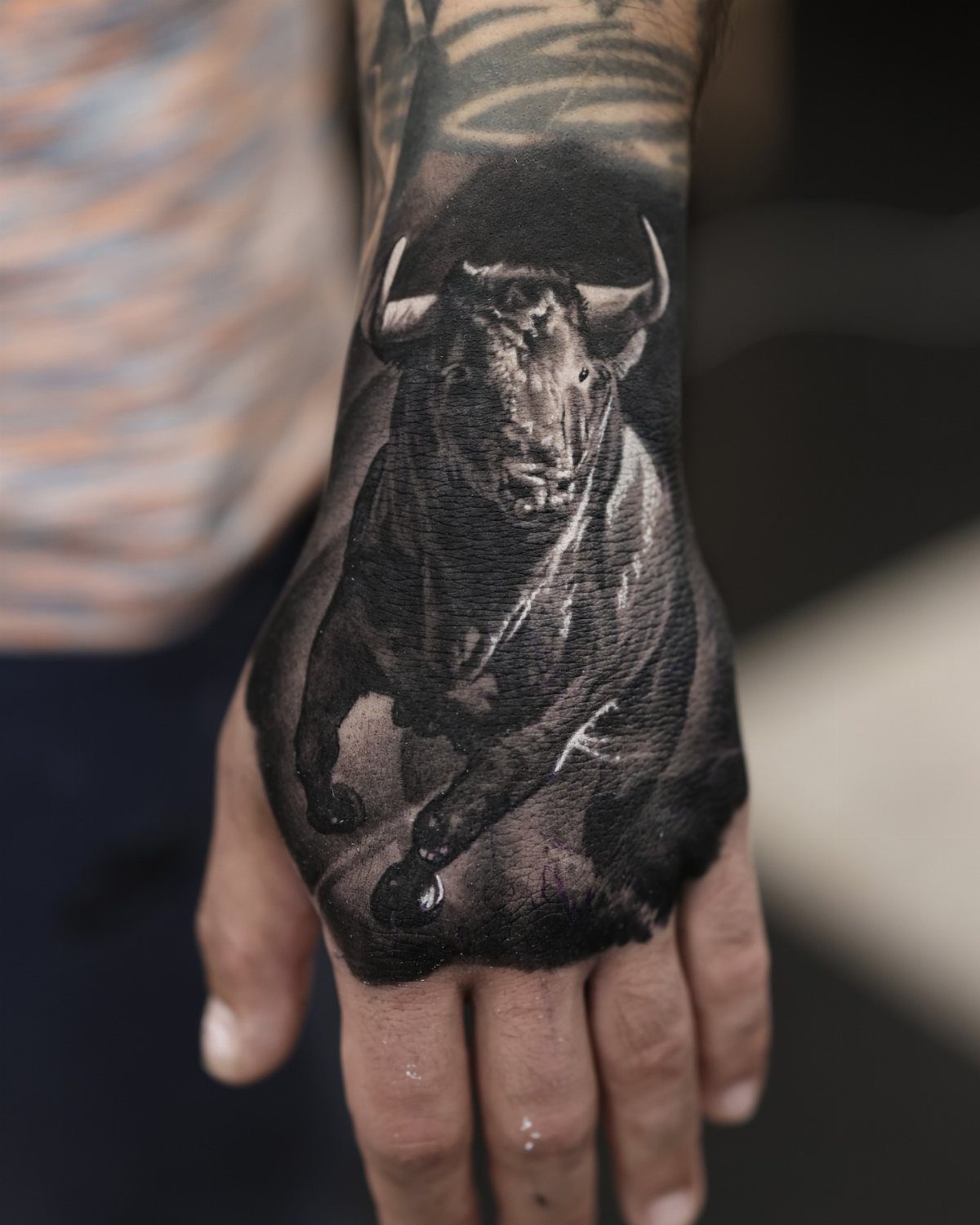
The hand leaves no room for hesitation. A bull covering the entire back of the hand, from knuckle to wrist, commits the wearer to showing it always; sleeves, watches, and hand gestures all display the image.
Black and grey keeps the density readable at this scale.
Healing is harder on the hand than anywhere else.
Expect touch-down during the first week, and plan time off from jobs that use the hands heavily. The tradeoff for visibility is maintenance.
15. Bull Tattoo with Smoke Effects
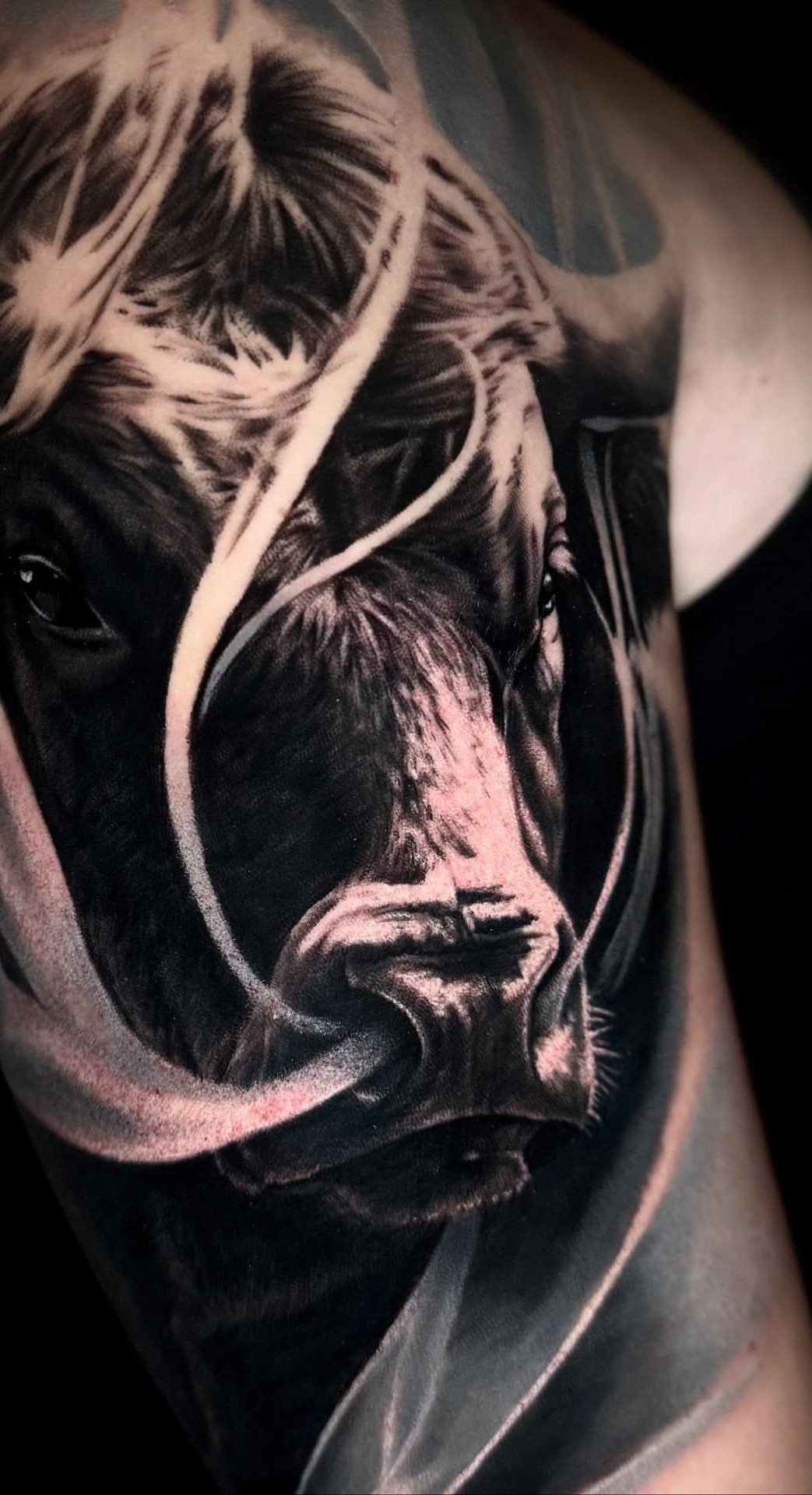
Smoke weaves across the bull’s face here, white and grey ribbons that soften the jaw and curl past the eye.
The effect reads as the animal emerging from or dissolving into something less solid, a middle state between presence and absence.
The technique relies on negative space and gradual grey wash.
Too dark, and the smoke becomes clouds or simply bad shading; too light, and it disappears against paler skin. The artist needs to read healed results on smoke or water work before you commit.
This version suits someone who wants the bull’s meaning without its aggression.
The smoke tempers the charge, turns the image contemplative. Keep the face turned slightly away, as here, or the smoke looks like it is hiding something instead of becoming part of it.
16. Wall Street Charging Bull Tattoo
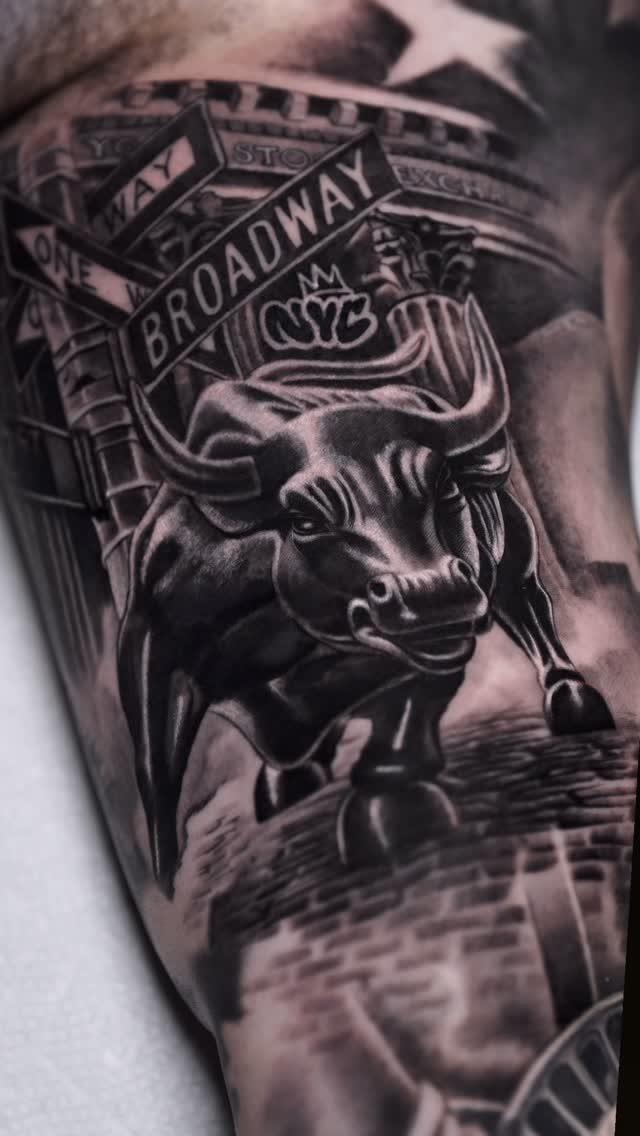
The Wall Street bull carries specific cargo: financial optimism, aggression in markets, New York itself.
The Broadway and One Way signs, the stock exchange building, and the "NYC" lettering lock the reference in; remove them and you have a generic charging bull, a different statement entirely.
The sculpture’s pose is fixed, head down, haunches loaded, which the tattoo reproduces faithfully.
That limits the artist’s room to adapt the body to yours. The background elements do theadjusting instead, filling space the bull’s compact shape leaves open.
Black and grey fits the urban stone reference.
Color would read as tourist merchandise. If you want this meaning without the full scene, the bull alone on a shoulder or calf still signals it to those who recognize the pose, and travels lighter.
Meaning of Bull Tattoos
A bull tattoo picks up meaning from what you bring to it.
Strength and resilience are the common ground, but the specific angle matters. Greek myth puts Zeus in bull form when he wants to throw his weight around, and the Apis bull in Egypt carried fertility and rebirth on its back.
Hindu imagery pairs the bull with Nandi, Shiva’s mount, which shifts the reading toward service and devotion rather than dominance.
Celtic herds counted a bull’s head as sign of prosperity pure and simple, and the animal’s refusal to quit made the same point tenacity does today.
The Taurus connection is practical astrology, not mysticism: April 20 to May 20, reliability, patience.
Guardianship and protection sit alongside the more aggressive readings in most traditions.
Decide which face you want uppermost before the consultation, because the artist’s shading choices, eye placement, and horn angle will lean one way or another. The tattoo does not carry all meanings at once.
Cultural Significance of Bulls
Mesopotamian worship made the bull the emblem of Enlil, a god of storms and growth, which mixed force with fertility in ways later cultures separated.
The Minoans on Crete went further toward spectacle: their bull-leaping frescoes show humans vaulting over charging animals, a ritual image that treats the bull as worthy opponent rather than simple symbol.
Roman Mithraism built its central mystery around a bull-killing scene, the tauroctony, which made the animal’s death generative rather than merely violent. That lineage survives in astrological Taurus, where the bull’s steadfastness is the trait emphasized, not its end.
The Hindu Nandi and the Celtic emphasis on herd wealth both treat the bull as presence rather than event.
Your tattoo draws on whichever thread you foreground. A skull design nudges toward memento mori; a charging animal toward Minoan athleticism or market aggression; a still, standing bull toward the older guardian role.
Choosing a Tattoo Design
Start with the trait, not the image. Strength reads differently as muscle under hide than as geometric line or as bone.
Realistic work shows off muscle and hide texture best if you want the animal’s physical presence to dominate; geometric or skull treatments shift the emphasis toward pattern or symbolism instead.
Placement follows from that choice.
A charging pose needs length and a direction that matches your body’s lines. A portrait with halter or rope asks for space to render detail.
Smoke or floral additions require room to breathe around the central figure. Measure your usual sleeve line before committing to forearm placement; a short sleeve cutting across a horn looks accidental, not edgy.
Color ages unevenly. Red accents around eyes or horns will soften faster than black, especially with sun exposure.
Personal elements, initials, specific landscape, or hardware from an actual animal, all add sitting time. Bring reference photos to the consultation, not after the stencil is set.
Frequently Asked Questions
Why does Dwayne Johnson have a bull tattoo?
Dwayne Johnson’s bull tattoo marks his past as a football player and his resilience through injury and career change.
The animal fits his public image: physical power that does not quit. For anyone choosing the same symbol, the meaning you bring matters more than the celebrity version; Johnson’s reading is personal, not universal.
How big is a $2000 tattoo?
A realistic bull this detailed tends to run palm-sized for the budget, or larger if you simplify the shading.
The single-needle hair detail on a bicep bull, or a full charging body on a forearm, each run multiple hours at standard hourly rates.
Smoke effects, rope halters, and other fine work add time fast; size is not the only factor.
Which tattoo is lucky for Taurus?
A bull tattoo is the direct choice for Taurus, since the sign’s animal is the bull itself.
The glyph, 2 connected curves, pairs with it at small scale. Either honors the April 20 to May 20 birth range without needing extra elements; adding stars and celestial clutter risks making the design busy rather than meaningful.