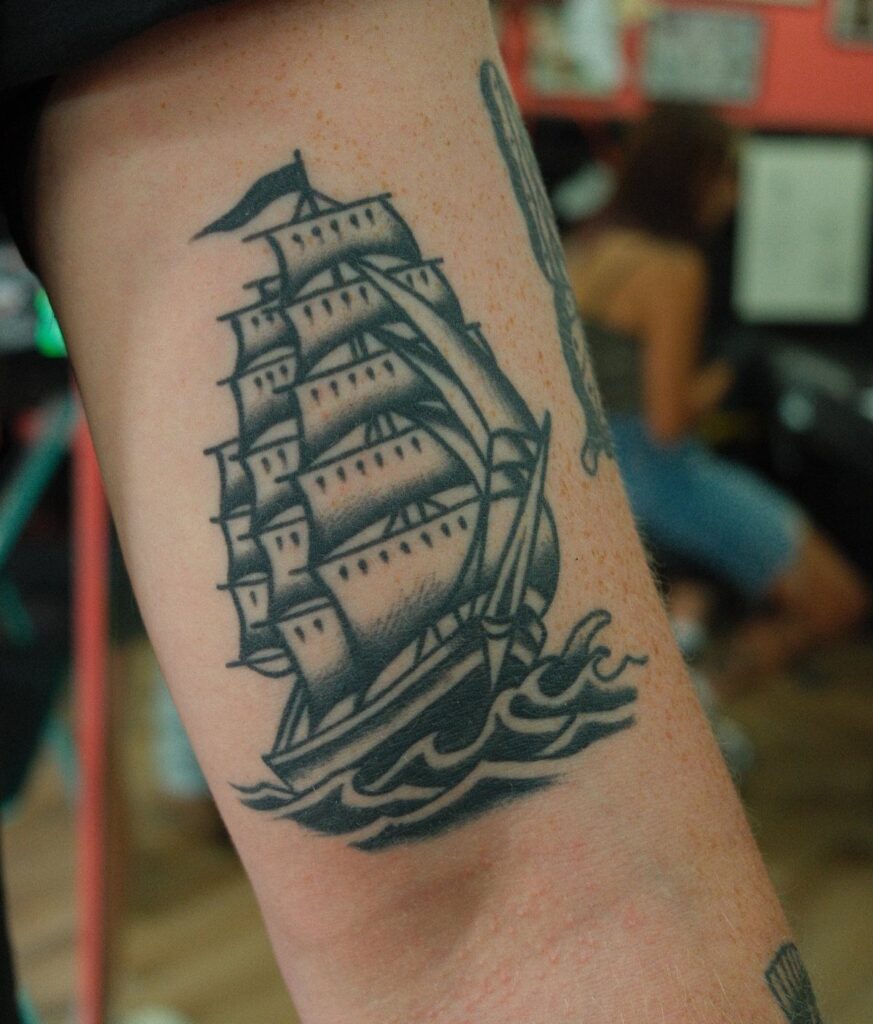
A ship tattoo can run from a wrist-sized anchor to a full back piece with kraken and moon, and the deciding factor is how much skin you will give to the story.
Below a few inches the wheel spokes blur together; a ghost ship silhouette needs at least a forearm to keep the dark hull crisp against pale disc for the decades you want it to last.
1. Ship Anchor Tattoo
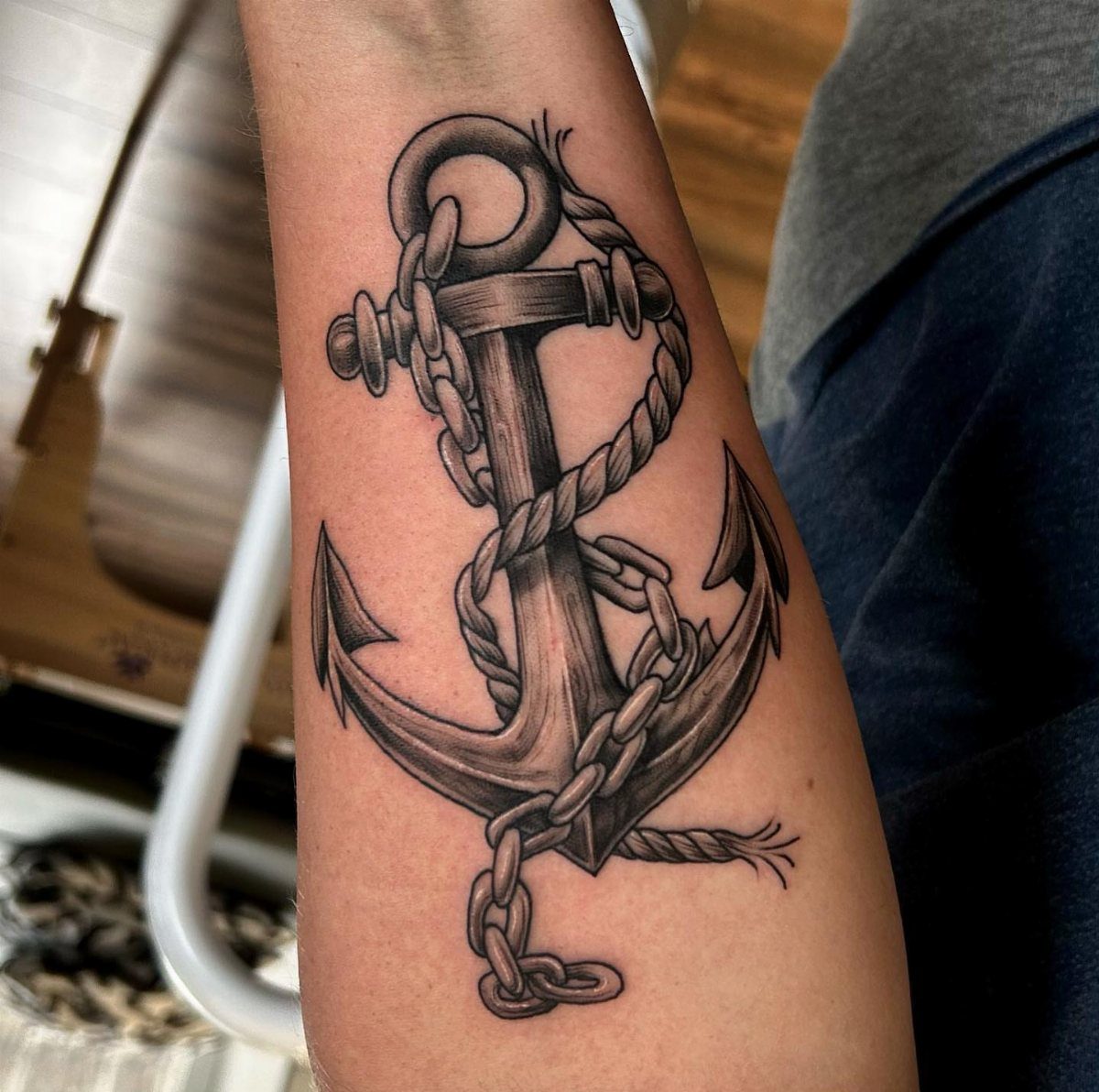
An anchor tattoo lives or dies by its line weight.
Too thin and the chain disappears; too heavy and the rope reads as a solid band from any distance away. Black and gray keeps it readable for decades, which is what you want from something meant to last.
I like this paired with its opposite, the ship itself, on the matching limb.
One arm carries the going out, the other the coming back. That composition needs an artist who understands negative space, since both pieces must stand alone and still talk to each other across the body.
Chest placement sits closer to the heart, literally, but forearm gives you the full rigging detail.
2. Viking Ship Tattoo
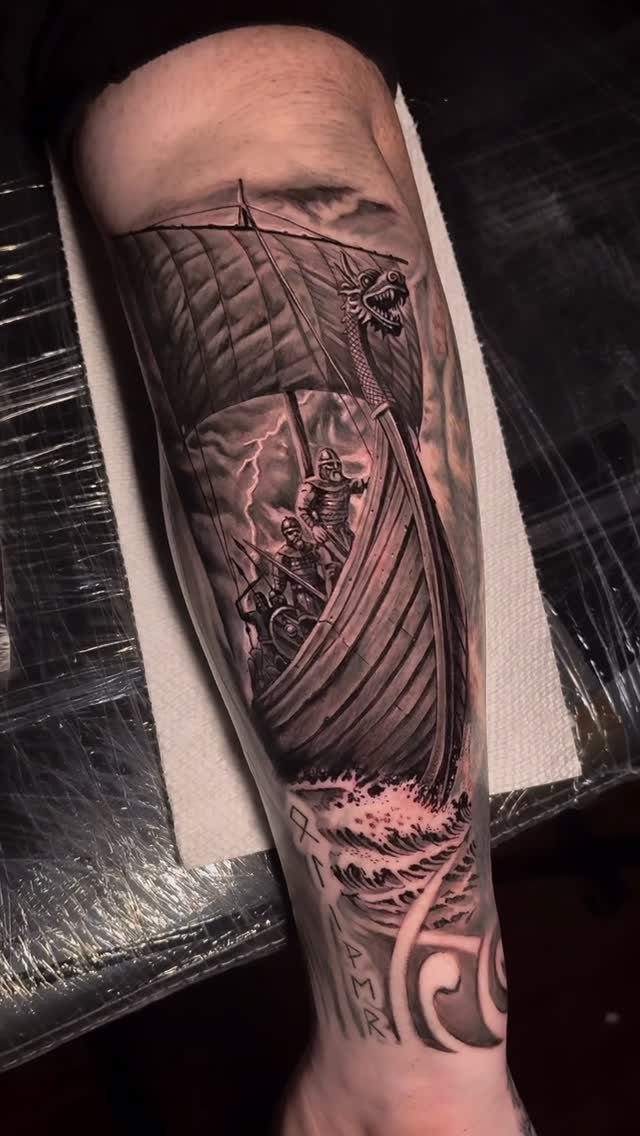
The dragon head prow turns this from generic longship to unmistakably Norse. Scandinavian heritage is one reason to choose it; the other is simply that the knotwork rewards close looking for years.
Storm waves and lightning fill the background, but the ship itself carries the weight.
Heavy blackwork suits the Saga Age gravity without tipping into costume. The sail takes Nordic interlace well; the shields along the hull break up the hull line.
Wrist to mid-calf is the working range. Outer forearm shows the prow in motion, bicep or chest gives the full crew and rigging, calf wraps the sea around the leg.
Each placement reads differently. Small runes added beside the ship ground the piece in personal meaning; they work because they stay small and let the ship breathe.
3. Ship Wheel Tattoo
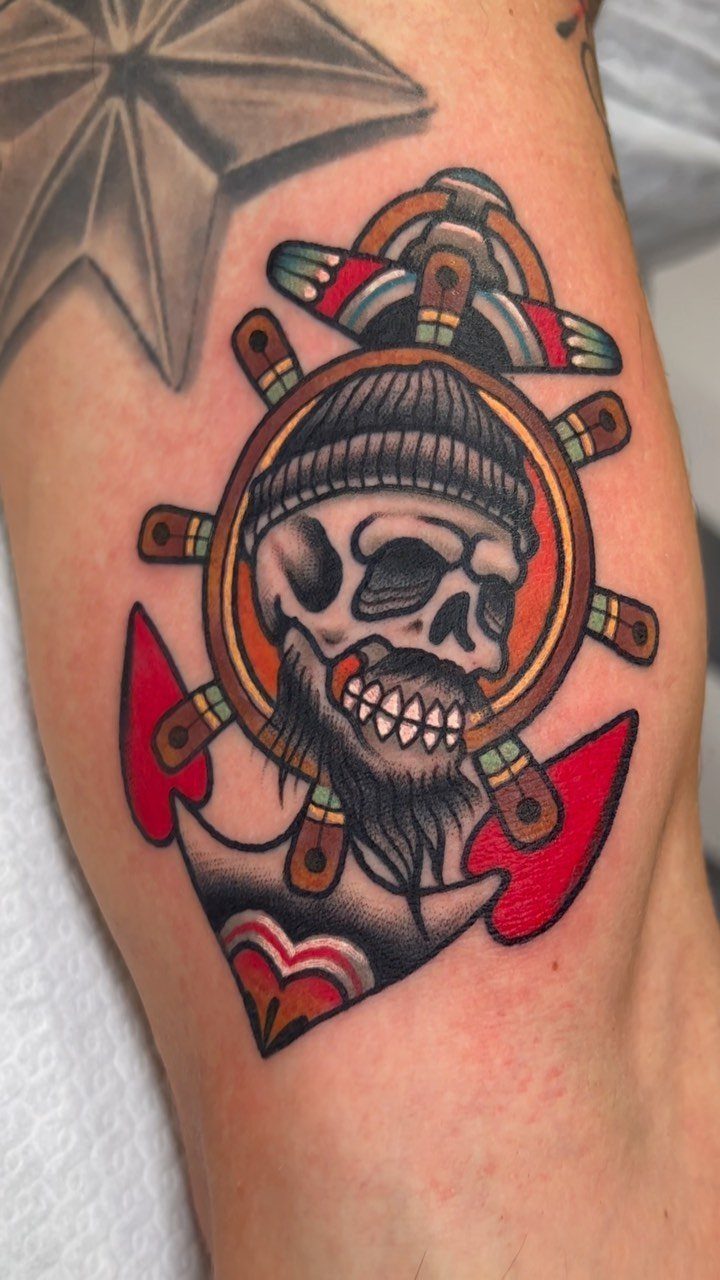
This one asks for a decision before the needle touches skin: wheel alone, or wheel as frame?
A ship wheel tattoo’s composition demands a center subject strong enough to hold the circle.
Without one, the wheel alone still carries meaning, navigation and control, but reads more quietly. Traditional flash pairs wheel with compass almost reflexively; the combination works because it solves the same problem, direction, from 2 angles.
Simpler versions run black and gray with a shadow wash along the spokes.
Color, as in the sailor skull piece, belongs to the traditional vocabulary. Choose based on what else sits nearby on the body.
4. The Bottled Ship
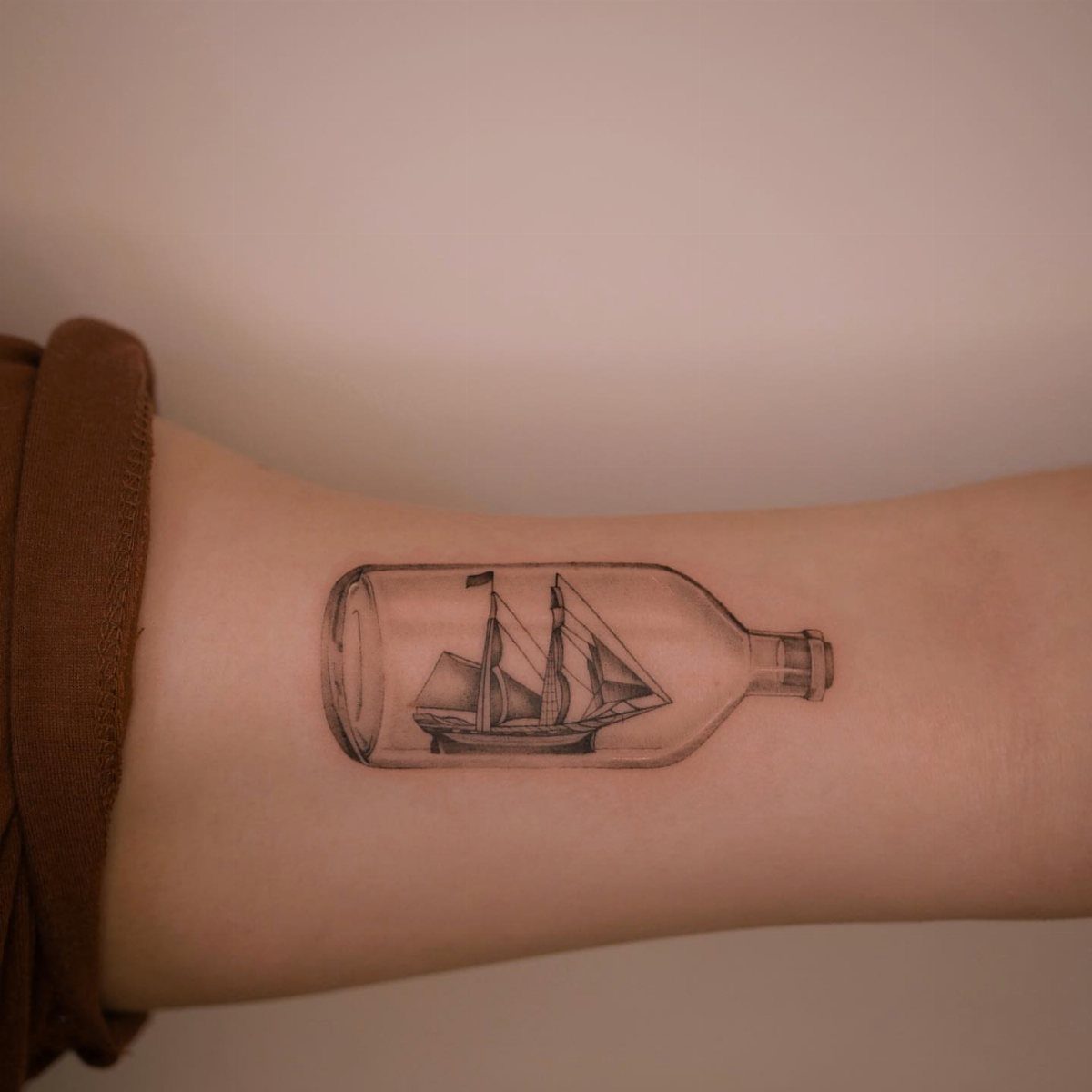
The bottle changes everything a ship tattoo usually does. A vessel on open sea claims space and motion; this one is held, finished, private.
Horizontal corked bottles suit the inner forearm or inner bicep, surfaces a viewer sees only when you choose.
That intimacy matches the meaning: a story kept close, an adventure completed rather than underway. Fine line or illustrative technique handles the glass better than bold traditional; the bottle must read as transparent or the conceit fails.
Add a tiny sea inside, as here, or keep the ship dry and still.
Either way the craftsmanship metaphor holds. Patience made visible.
5. Kraken Ship Tattoo
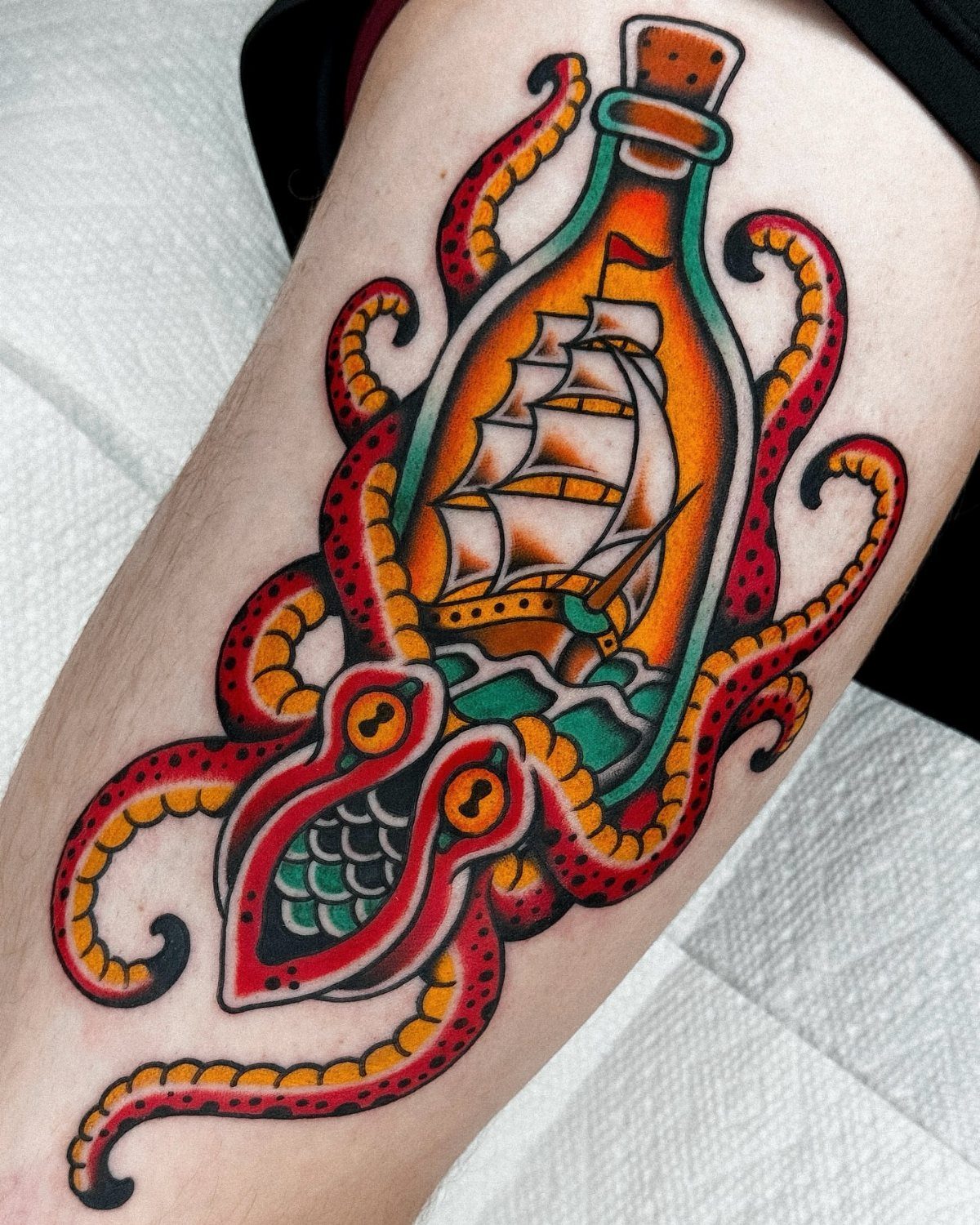
A traditional color palette, red and yellow against blue, keeps the subject readable at a distance even with the complication of bottle and tentacles both. A kraken piece without that clarity becomes busy fast.
The monster represents what ship tattoos usually ignore: the sea as danger, not just highway.
The Scandinavian folklore source matters to some wearers; others simply want the visual drama of scale, the small human vessel against the indifferent giant. Both reasons are sound.
Placement needs room for the wrap.
The tentacles must read as encircling, which means at least one full loop visible. Too small and it becomes an octopus; too large and it overwhelms any body placement except back or thigh.
6. Ship Tattoo on Forearm
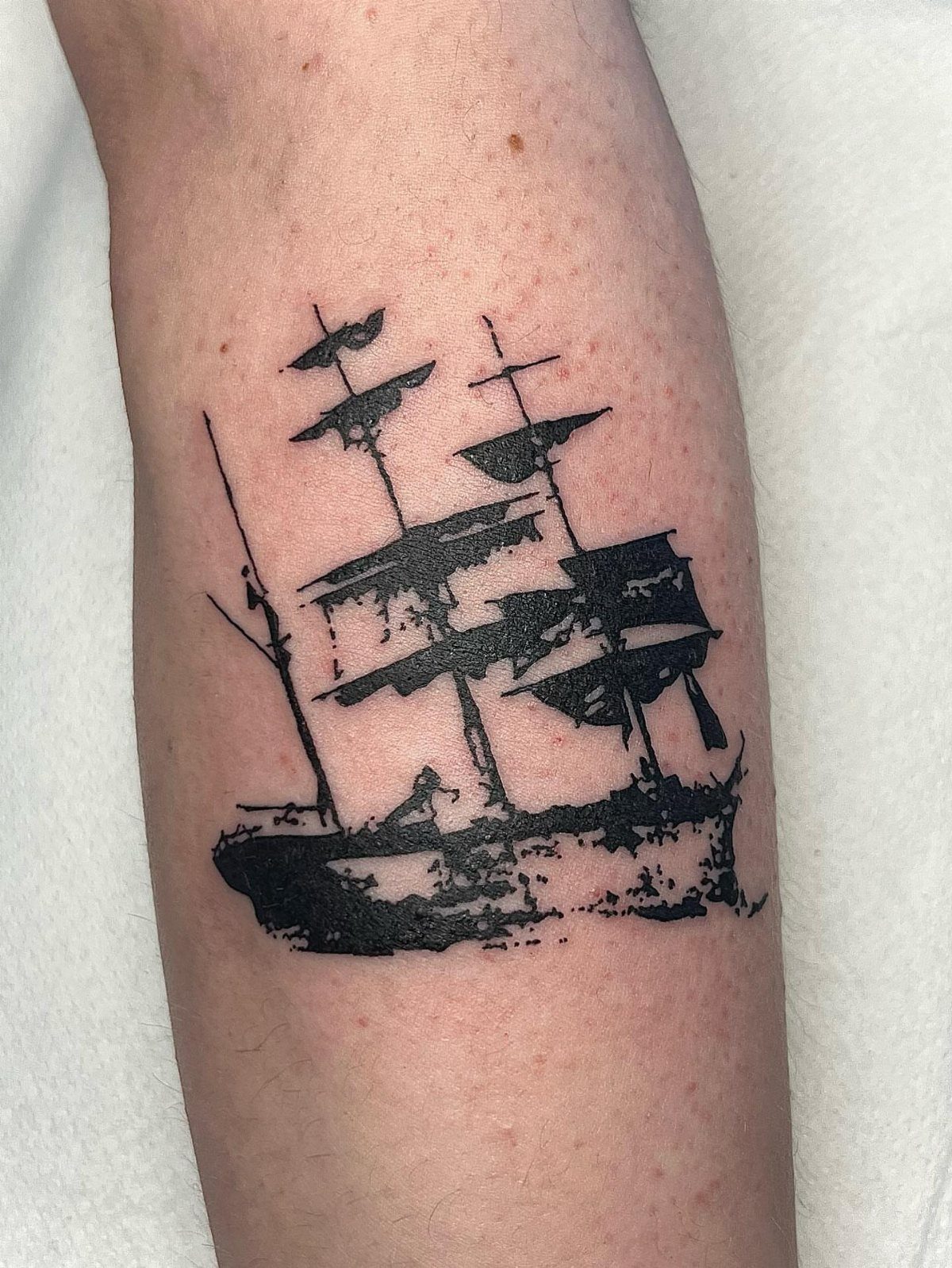
The forearm became the default ship placement because the shape agrees: long, horizontal, flat when the arm rests on a table. This is one of those designs people pick first and understand later.
The distressed stamp texture in the visible piece solves a different problem.
Solid black silhouette with clean edges can read as clip art; the weathered line weight gives it age and specificity. It also ages better, since minor blur and fade belong to the style rather than fighting it.
Minimal here means decisive.
Solid fills, no rigging detail, the sea reduced to a steady wave line below. A ship alone says security and freedom both; the design earns that by knowing exactly what to leave out.
7. Traditional Tattoo Ship
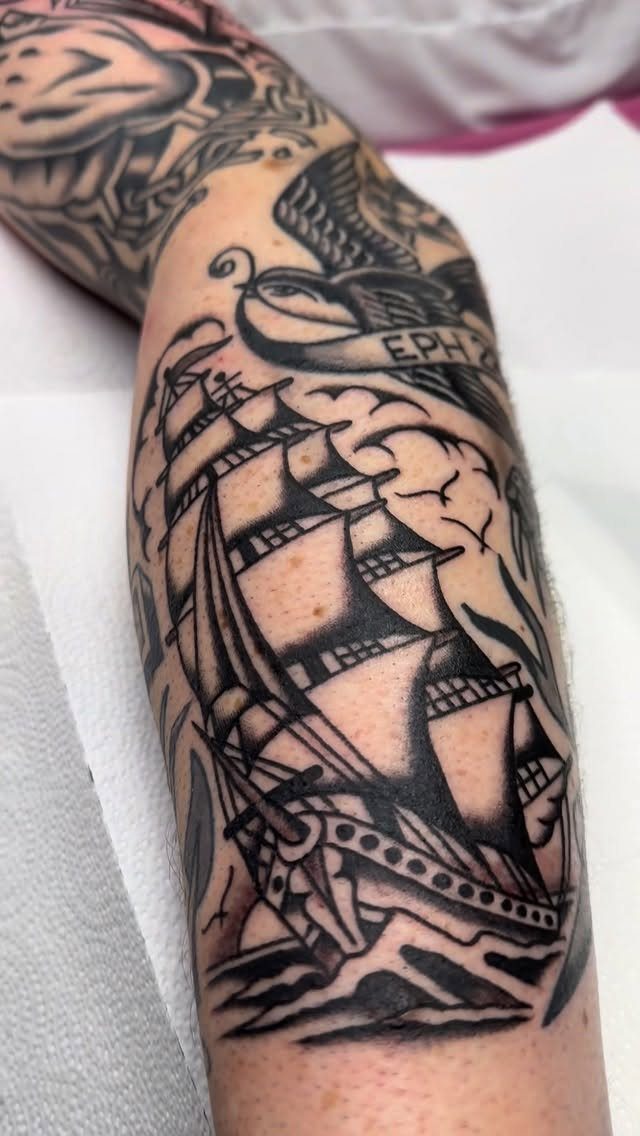
Heavy 3/0 black outlines and careful greywash shading place this in the Sailor Jerry line, the starting point of American ship tattooing.
The rigging has always mattered: the artist balances rope against sail, flag-snap against wave curl, inside a bold silhouette that still reads from across a bar.
A softer neo-traditional update uses burgundy, muted gold, teal, dusty rose, and pairs the hull with a snake, a rose, or a dagger companion. Heavy floral framing, green and red vintage detail, reads decorative rather than purely maritime.
Sleeve adjacent placement anchors the full narrative your other pieces fill in.
8. Realistic Ship Tattoo
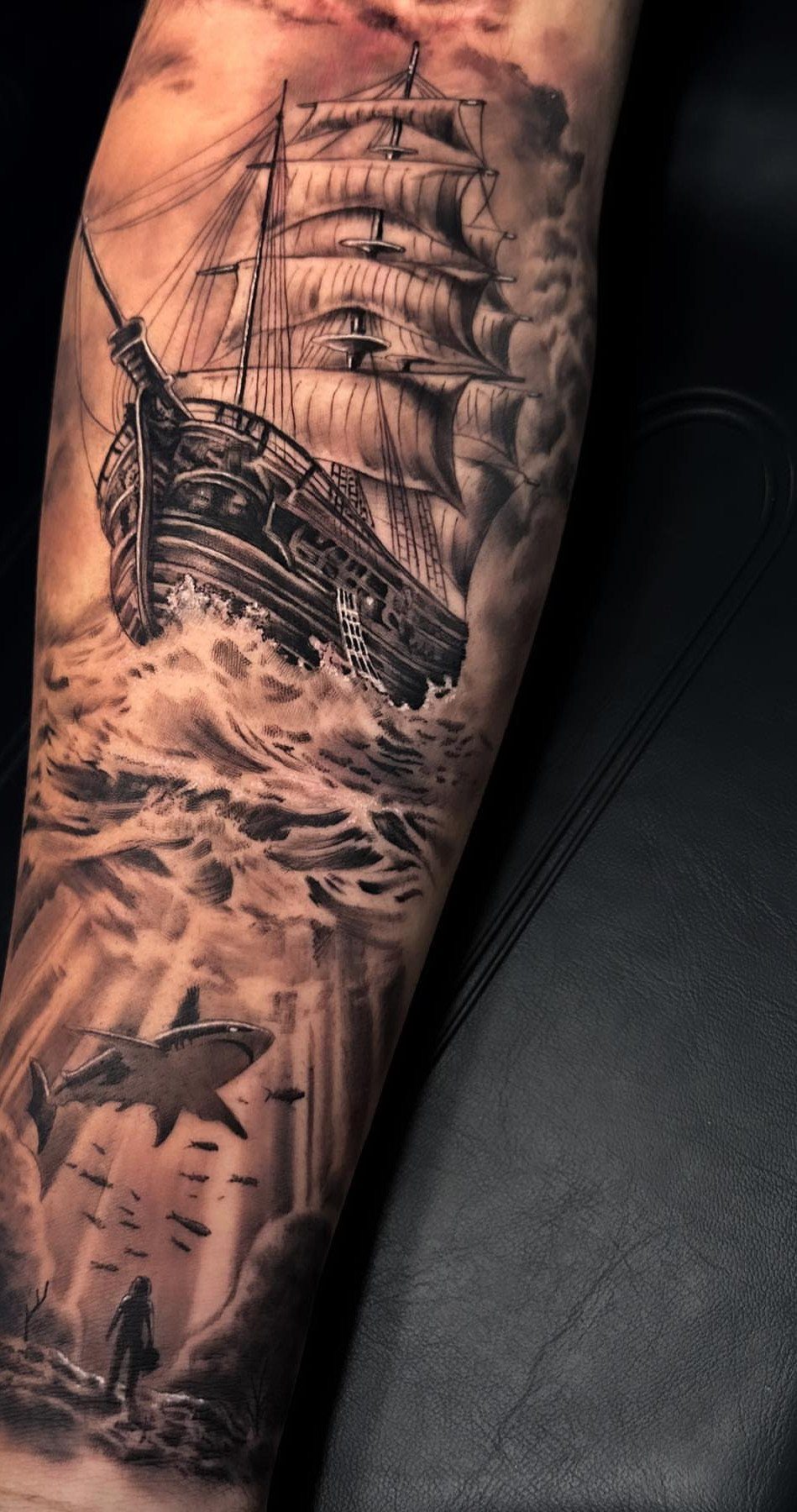
Billowing sails carry meaning only when the shading earns them. Layered black and gray tone on the canvas and the hull gives the ship weight against its sea; flat wash makes it a sticker.
The underwater split scene, shark below and vessel above, doubles the vertical depth but needs a long, flat surface to read cleanly, outer forearm at minimum.
This asks more from the artist’s patience than the wearer’s.
Each stay and spar is drawn, not implied. From arm’s length the detail pays off; from across the room it softens to a shape of hull and water.
Start the consultation with reference photos of actual vessels, not other tattoos.
9. Full Seascape Ship Tattoo
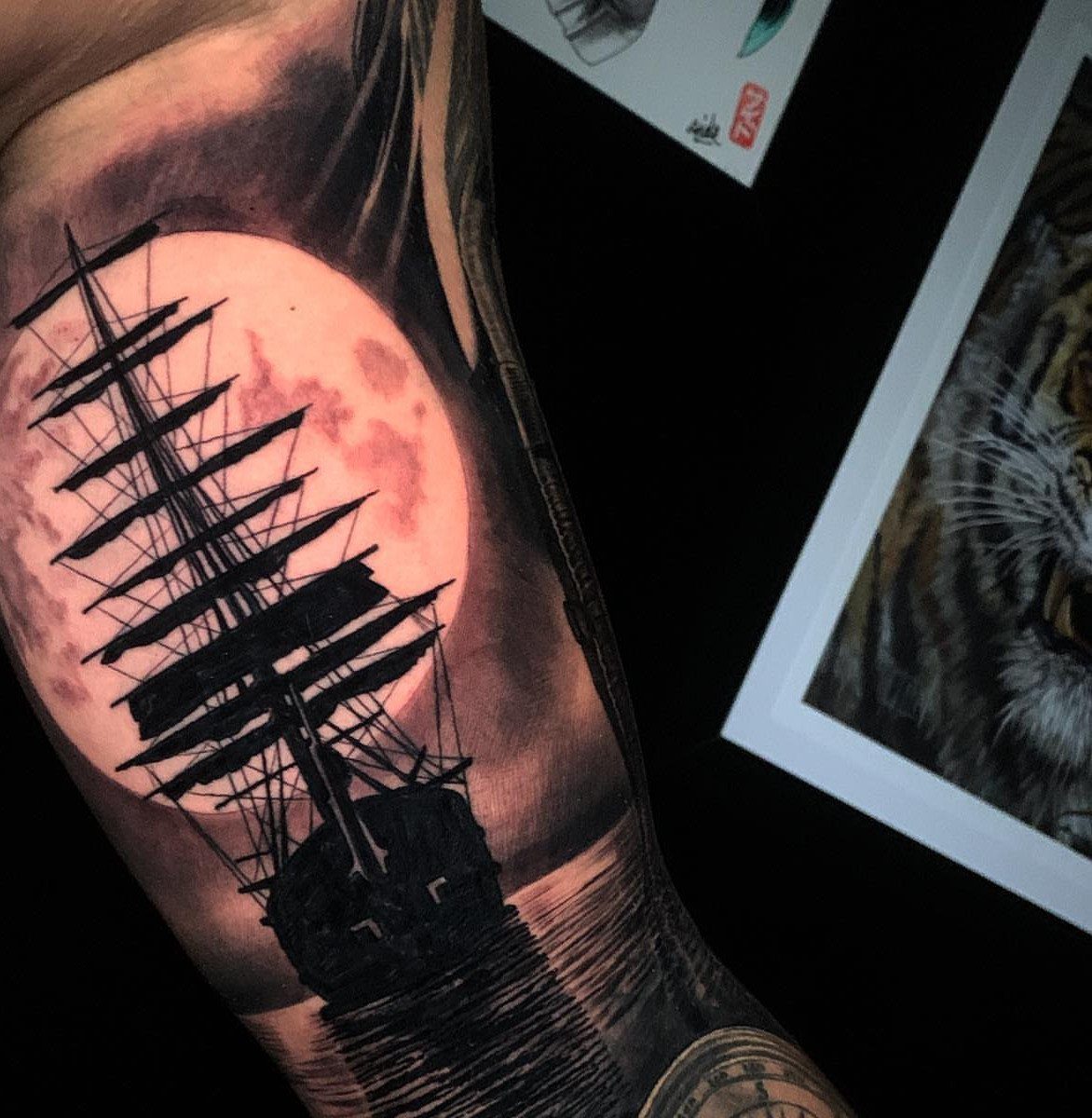
The ship alone on open water with clean negative space fits a 5 to 7 inch forearm. A full seascape, wind bars and moon and Fuji distance, wants half-sleeve commitment or back panel room.
The silhouette against a full moon reads as night voyage, the calm water as passage completed rather than endured.
That tonal shift, dark hull against pale disc, solves the contrast problem decades of fade will otherwise worsen. Gray wash moon loses punch; solid black ship with crisp edge holds.
Placement and scale must stay married here. Shrinking a seascape to fit a spot the ship alone would suit only makes mush.
10. Clipper Ship Tattoo
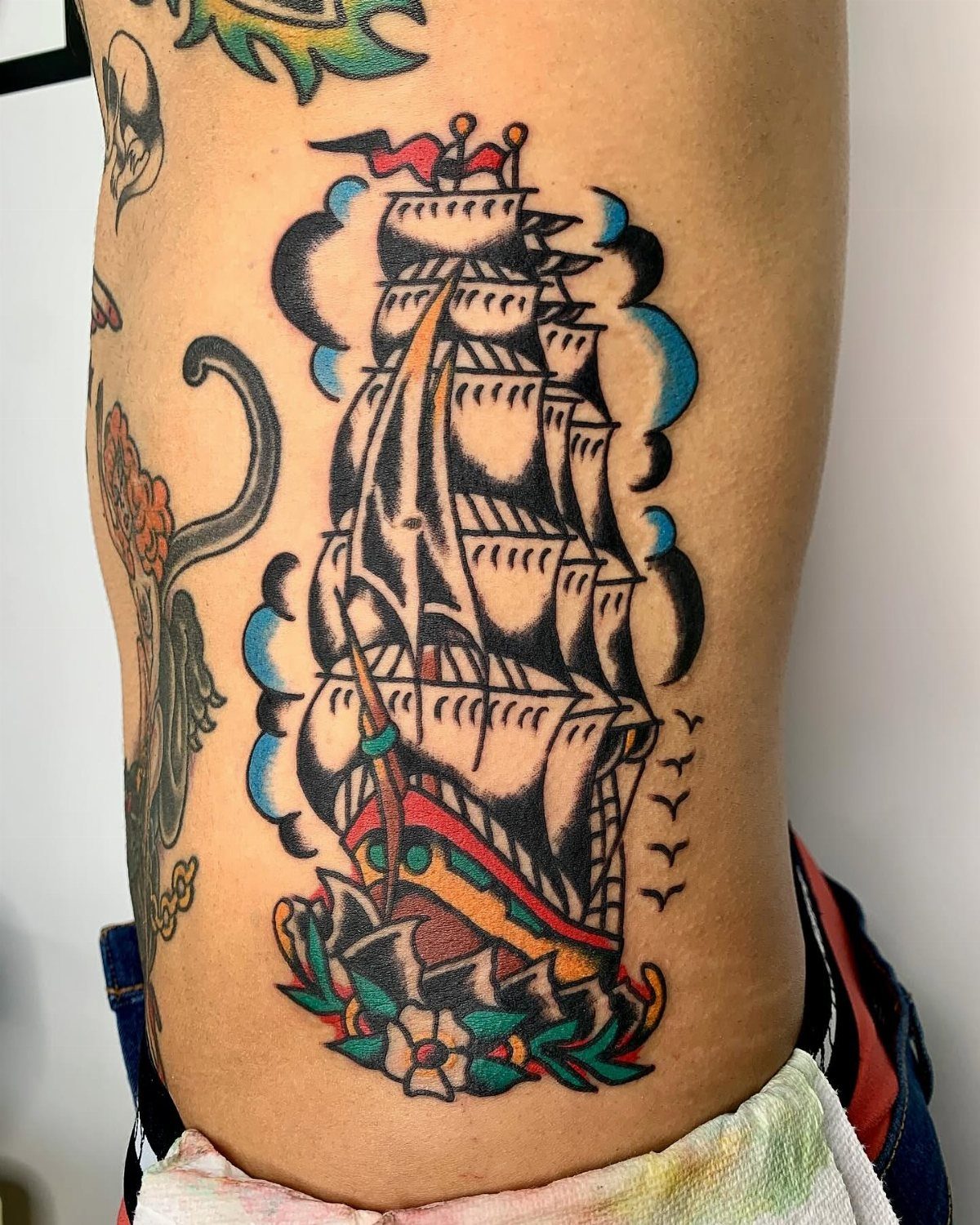
Accuracy matters when the rigging names the hull.
A clipper carries square-rig on multiple masts, royal and skysail yards above; call it that on a schooner hull and anyone who knows sails winces. Choose your vessel before the stencil touches skin, and tell the artist which.
Sailor Jerry’s vocabulary applies: bold outline, limited palette of red and ochre against blue or black sea, rolling waves curling beneath rather than crashing over.
Full sails mean speed, purpose, the chase rather than the storm. White canvas against dark water reads instantly.
11. Ghost Ship Skull Tattoo
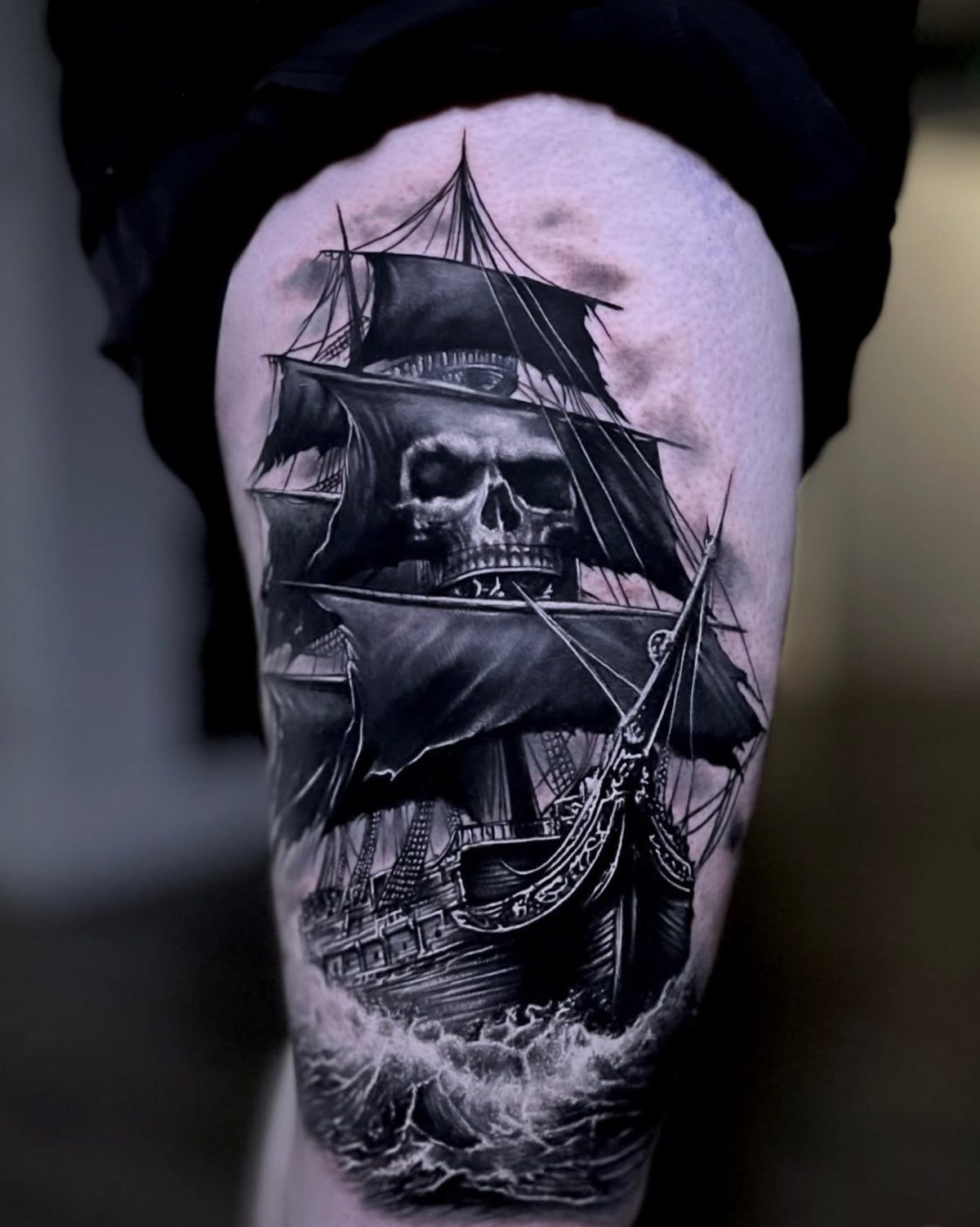
Tattered sails and no crew turn the ship from vehicle to warning. The skull emerging from canvas rather than replacing it keeps the reading ambiguous: death as passenger, or the vessel itself as reaper.
Black and gray washed with brown, soft gradients lifting fog off flat water, takes an artist who can render smoke and still keep the ship’s bones readable.
Too small and the fog reads as smudge, the skull as accident of torn cloth. Negative space carries the atmosphere; overworked gray kills it.
This earns its place through restraint. Every detail you add to a ghost ship subtracts from the dread.
12. Dragon-Framed Ship Tattoo
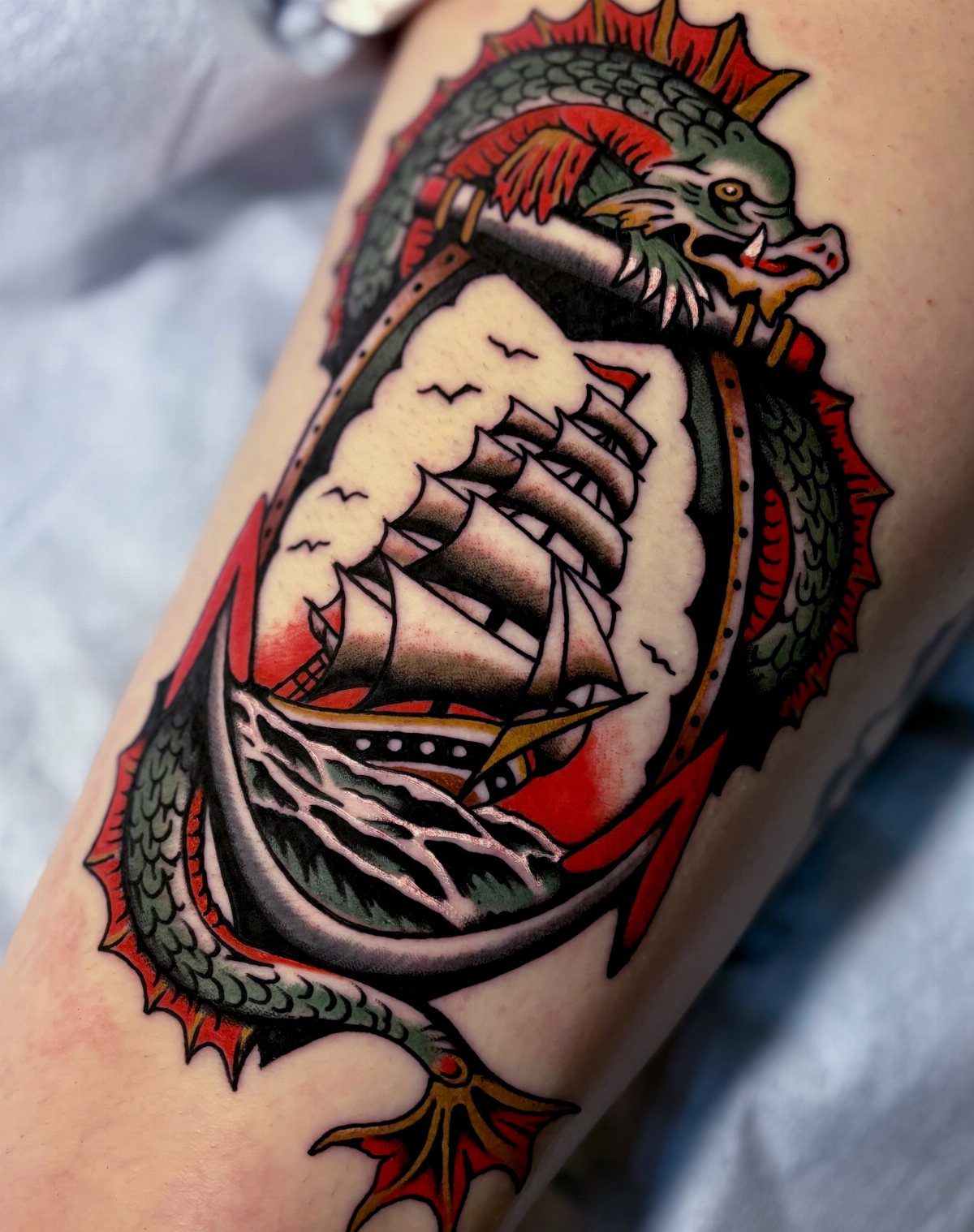
The sea dragon wrapping the anchor and hull solves a framing problem traditional ship tattoos often ignore: what holds the center together against the body’s own curves.
Green serpent against red and yellow clipper keeps the color story controlled, only 2 temperatures even with complexity everywhere.
Traditional bold line carries this; fine line would make the dragon decorative rather than structural. The anchor as bookend, ship as center, dragon as living bracket, gives 3 points of visual rest the eye travels between.
Outer forearm, bicep, or calf wrap suit the horizontal flow. Chest would need the dragon’s head and tail to meet, a harder composition to balance.
13. Skeletal Pirate Ship Tattoo
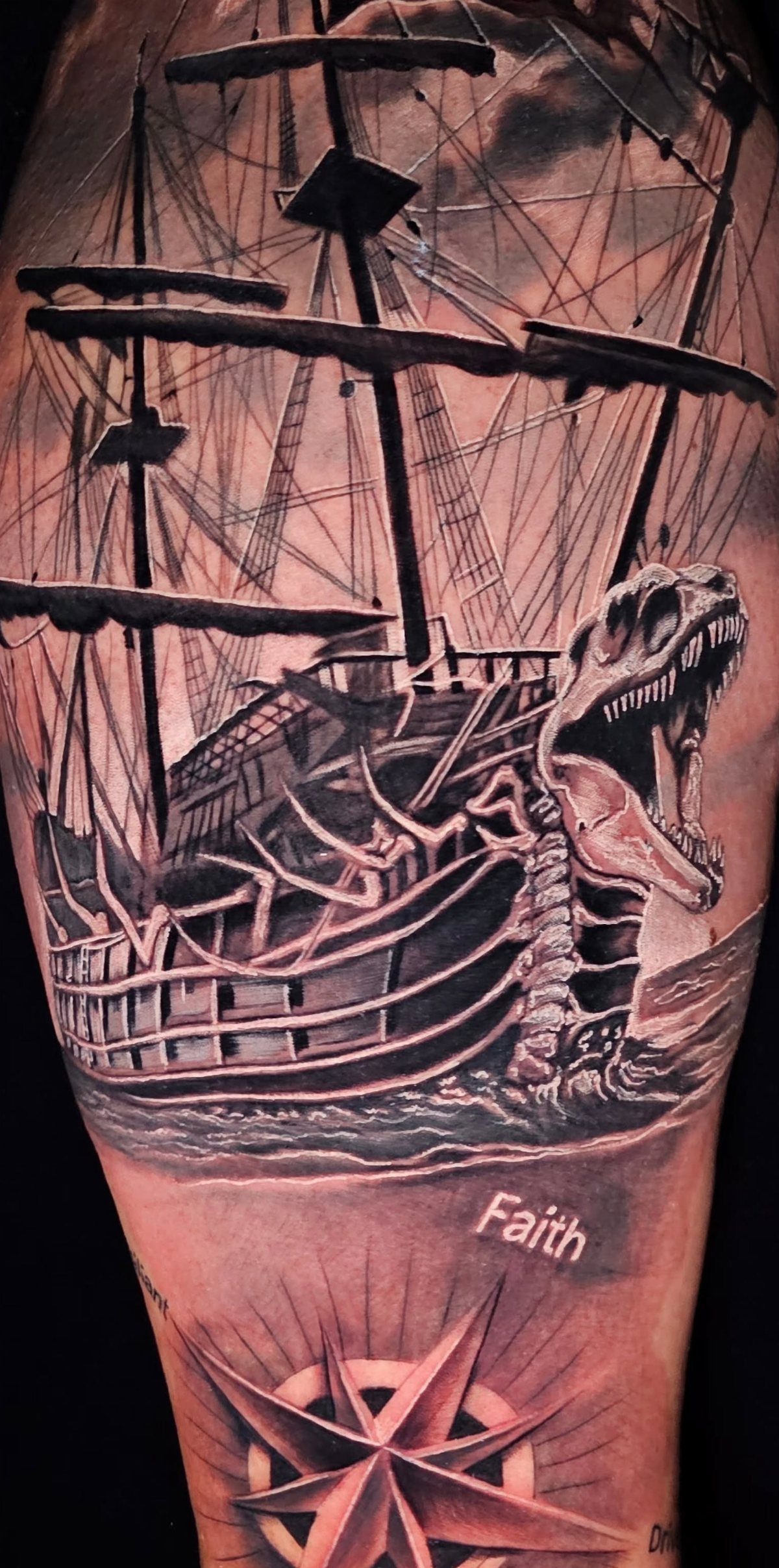
Dinosaur bone for a hull turns the pirate ship from costume to something stranger. The compass rose below it is what makes the composition work; without that anchor of familiar geometry, the bone rigging would read as pure chaos.
Black and gray is the right call here, since any color would fight the skull-as-ship conceit for attention.
Bone texture needs enough surface area to read as intentional rather than accidental smudge, so scale matters on this one. Forearm or thigh gives the horizontal room the prow needs, chest only if you want the compass dead center.
Add script if the word means something specific to you. Generic lettering, "Faith" or "Hope," holds the eye without earning it.
14. Ship and Lighthouse Tattoo
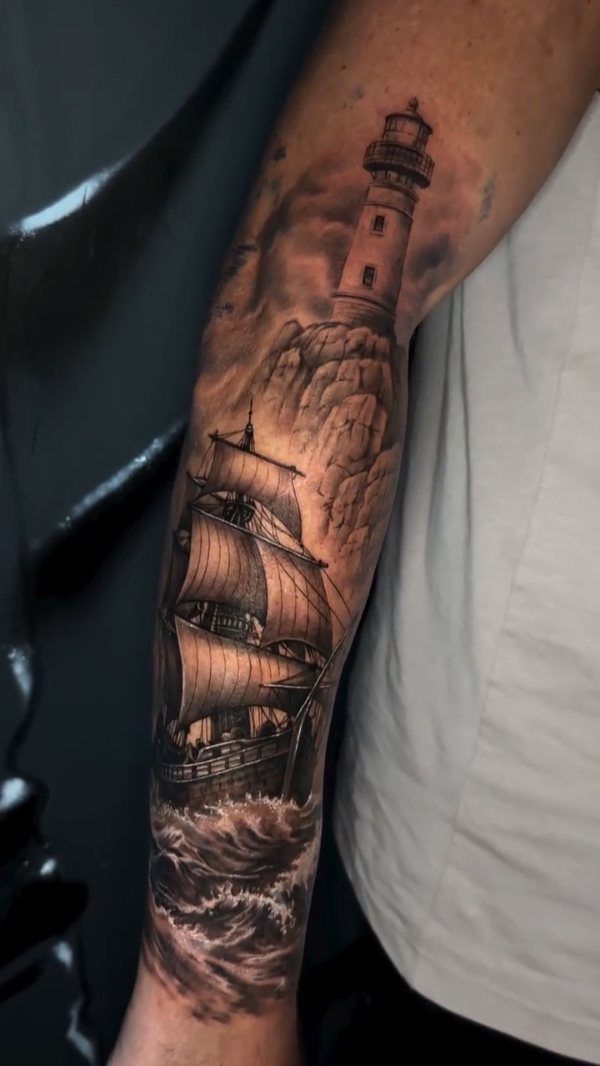
Lighthouse as destination changes the ship from wanderer to almost-arrived. The composition asks which element leads; the photo gives the ship foreground and the tower distance, but reversing that weight works too.
The cliff here solves a problem I have seen go wrong: lighthouse alone on flat water reads as symbol, not scene. Rock breaks the horizon and gives the eye a place to rest between vessel and beacon.
Check that your artist grays the masonry with the same discipline as the hull; uneven stone texture ages worse than almost anything else in black and gray.
Two-session piece at minimum. The waves alone take the first.
15. Ship Wrist Tattoo
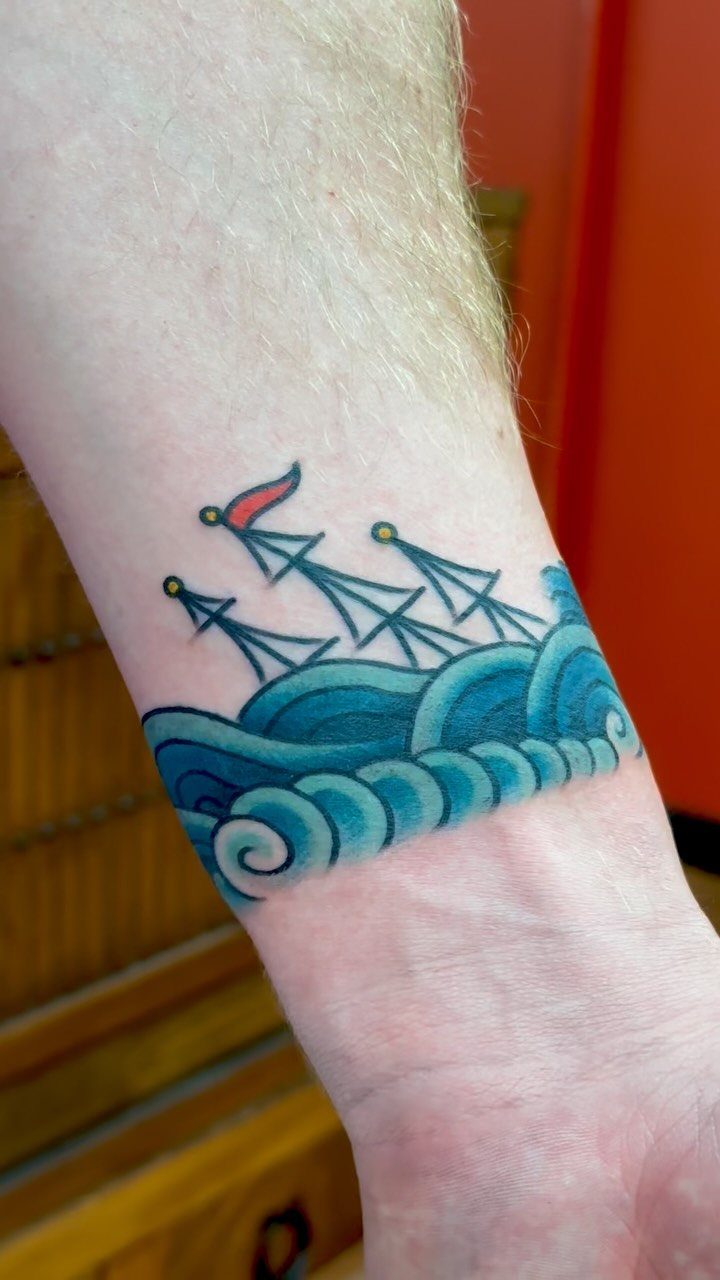
A ship on the wrist wraps rather than sits, which changes how the whole piece gets planned. The masts rising above the waterline exploit that; the rigging reads from the front, the hull travels around to the back.
Color on a wrist fades faster than elsewhere, sun and friction both.
Blue water holds up better than yellow sail or red hull, which is the choice this piece makes. Stylized waves, not realistic wash, suit the small scale; detail that would read as mud on a forearm stays clean here.
Bracelet-adjacent placement means pairing with an actual watch or band becomes part of the composition. Plan for that or it will happen to you anyway.
16. Pirate Flag Ship Tattoo

The skull-and-crossbones on sail rather than separate flag simplifies the composition to one plane. Mountains behind add depth that traditional pirate pieces usually skip; the result reads more landscape than flash sheet.
Black and gray here is a choice against the traditional red and ochre vocabulary.
It pushes the piece toward the realistic side of the spectrum, which suits the detailed hull and rigging. The Jolly Roger still carries the meaning: not-service, self-direction, the romance of opting out.
The flag has to stay legible, so the piece needs room for the lines to hold.
Smaller and it becomes a smudge on a triangle; the skull needs its sockets. Forearm or thigh shows the full narrative, upper back if you want the mountain horizon to spread.
Meanings of Ship Tattoos
A ship at shore reads as homecoming, the same image in open water reads as hunger for what comes next. That difference, arrival versus search, shapes what the tattoo means to whoever wears it.
The Christian reading, safety and belief kept through danger, sits alongside harder meanings.
Some people ink the actual name of a boat they served on, a crossing that changed them, a family trade passed down, the year a hull got rebuilt, or someone who never came back from the water.
The words "hold fast" worked into the hull turn a private promise into something you cannot look away from.
A pirate choice, skull on sail or Jolly Roger flying, says something else entirely: not the settled life refused, but the self-directed one taken instead.
Storm and calm carry their own grammar. A ship breaking through heavy weather marks what was survived, not only the literal sea.
The same hull leaving harbor, sails full, speaks of starts rather than finishes. The body carries the direction you choose.
Choosing a Ship Tattoo
A Sailor Jerry clipper, a Japanese ship-in-waves, a named historical hull, a fine-line schooner, a memorial voyage: these are different kinds of commitment altogether, not just larger or smaller versions of one idea.
Pick the style first, then let it tell you what scale it needs.
Honest measure sets honest style.
Below 5 inches, rigging detail is gone; below 8, a Japanese composition squeezes past the point where you can still read it. The hull you carry in your head must fit the skin you offer.
Dotwork texture, stippled sea and precise edge, suits a calm surface and a shoulder where it earns the space. The ship reads as love of exploration because the ocean reads as passable, not chaos.
Design Considerations
Rigging is the detail that sinks small ships.
A hull with no water under it turns into a museum piece, cut off from both motion and the reason for the tattoo. Size the detail to the placement, never to the reference photograph.
The rig type you settle on locks in every choice that comes after it.
Square-rigged clipper, fore-and-aft schooner, high-stacked barque: each demands different line, different room, different patience from the artist. Read the rig before you ask for it.
The body sets the limits. The design obeys them or fails.
Frequently Asked Questions
What is a zipper tattoo?
A zipper tattoo shows a zipper parting the skin, sometimes with machinery, gears, or another scene visible beneath.
It relies on shadow and highlight to sell the illusion of depth, which means the artist needs to understand how light falls on metal and skin both.
The effect works best where the body has natural planes, forearm or calf, that the zipper can appear to open across.
How big is a $500 tattoo?
A tattoo at that price usually lands in the medium-size range, though price varies more by artist and city than by ruler.
Detail density matters more than measurement alone. A ship at 5 inches with clean silhouette and minimal rigging reads clearly; the same price buys less complexity if you want every stay and spar drawn in.
Do they do tattoos on cruise ships?
Most cruise ships do not employ tattoo artists, and the ones that do run pop-up shops on select voyages rather than permanent parlors.
The hygiene standards and equipment sterilization a professional shop maintains are hard to guarantee at sea. If you want a tattoo to commemorate a crossing, book an artist at the port before you sail or after you dock.
What is the 1/3 rule tattoo?
The 1/3 rule in tattoo composition says a design should divide its space so that no single element fills more than one third of the total area.
For a ship tattoo, that means giving the hull, the water, and the sky or negative space each their own measure. When one element swells past that ratio, the balance tips and the eye has nowhere to rest.