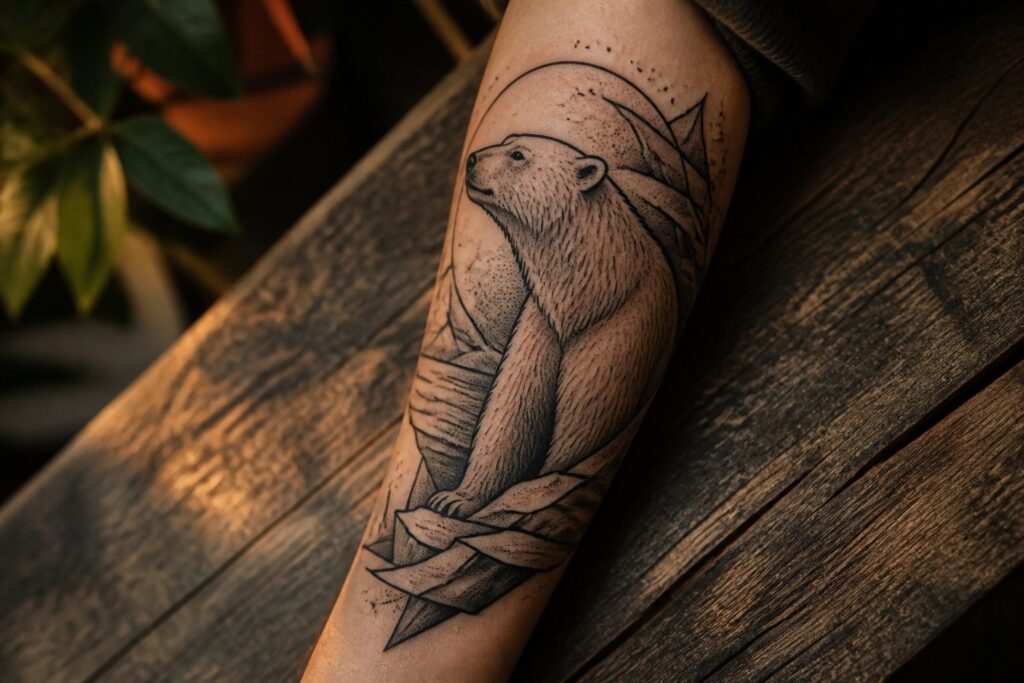
A polar bear tattoo works across every major style, but the deciding factor is how much of the animal’s actual biology your artist is willing to use.
The bear’s guard hairs are transparent and hollow, not white, so the best designs build the fur out of your own skin tone plus black linework rather than fighting with white ink most artists refuse to apply heavily.
That constraint shapes everything from a single minimal line to a full neo-traditional sleeve, and the pieces that last are the ones that treat it as a feature instead of a problem.
1. Realistic Polar Bear Tattoo
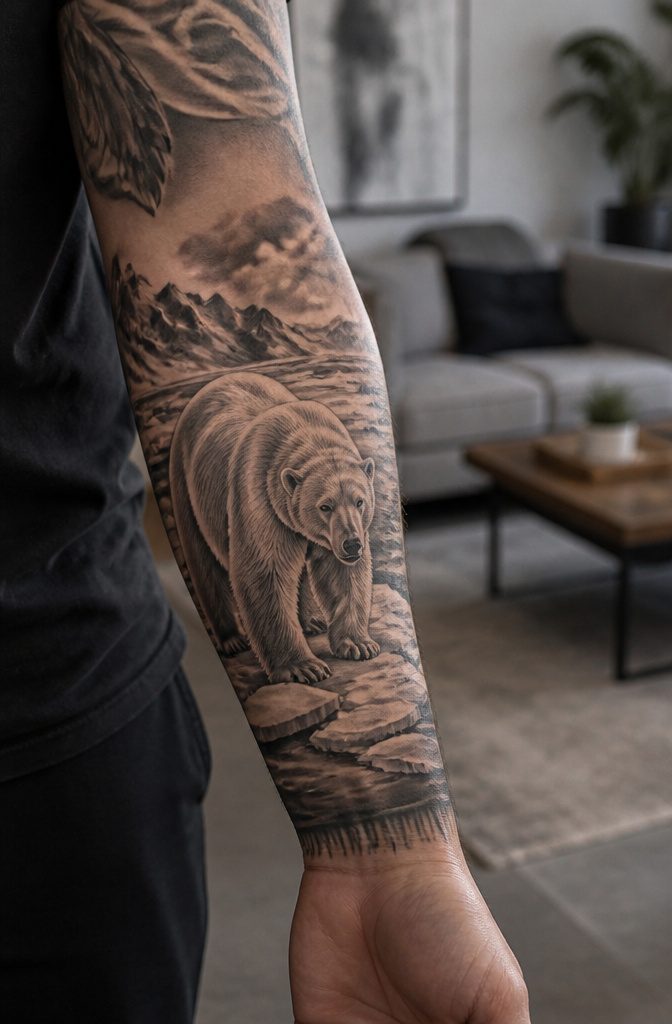
Realistic polar bear tattoos carry weight because the animal itself is carrying more of it these days.
A well-done piece shows the bear in its actual habitat, the Arctic regions of Canada, the US, Norway, Russia, and Greenland, and the image tends to land harder now that the ice those regions depend on is visibly shrinking.
The solitary stance, the bulk of muscle, the guarded posture over unseen cubs, all of it reads as protection and stubbornness made physical.
The technical surprise is how the artist builds white without white.
Polar bears never developed white fur at all. A gene mutation left their guard hairs transparent and hollow, so the bare skin beneath does the actual color work.
Tattooers borrow the trick: the client’s natural tone becomes the base, black linework defines the form, and grey shading supplies the depth and the suggestion of fur layers. The result fools the eye the same way the living animal does.
2. Minimalistic Polar Bear Tattoo
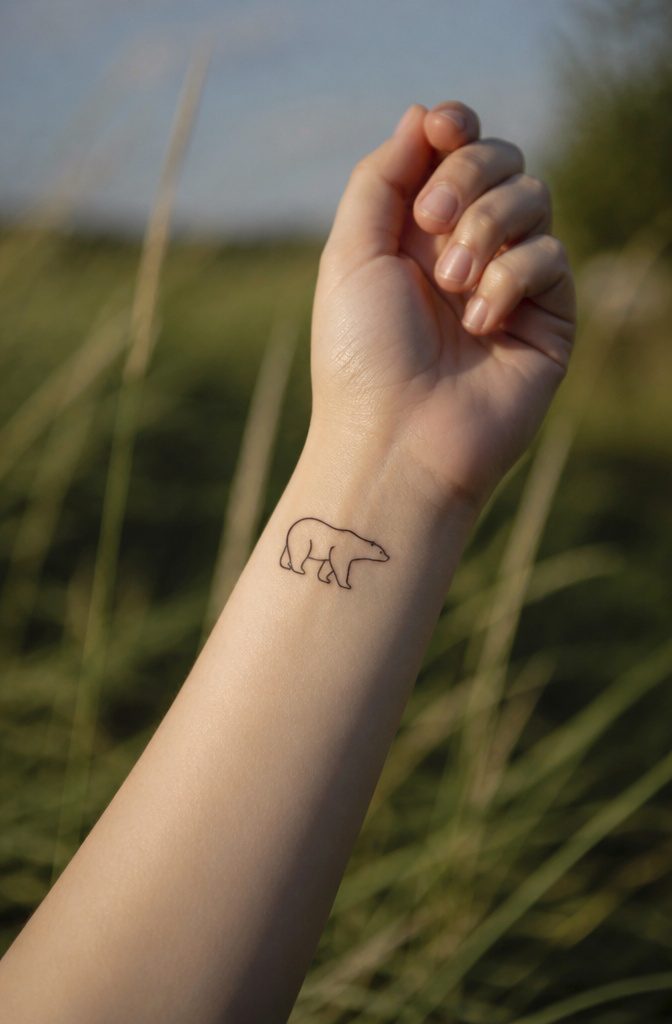
Polar bears carry a useful secret for anyone drawn to spare, clean ink: their fur is not white at all.
Each hair is transparent and hollow, which means a minimalistic polar bear tattoo can lean on the wearer’s own skin tone as the base color rather than fighting with white ink that artists often refuse to use heavily.
The bear’s natural transparency becomes the design’s transparency, and a single flowing line or a few tapered strokes can suggest the entire animal without shading or dense fill.
That spare approach reads especially well at smaller sizes. A wrist, ankle, or behind-the-ear placement keeps the gesture intimate; the eye fills in what the needle left out.
For matching pieces between friends or family, the simplicity also means two artists in different cities can arrive at roughly the same result without the variance that sinks more detailed work.
The climate message survives too, stripped to its essence: a ghost of an animal made of empty space and quiet line, harder to miss precisely because it asks for so little room.
3. Traditional Polar Bear Tattoo
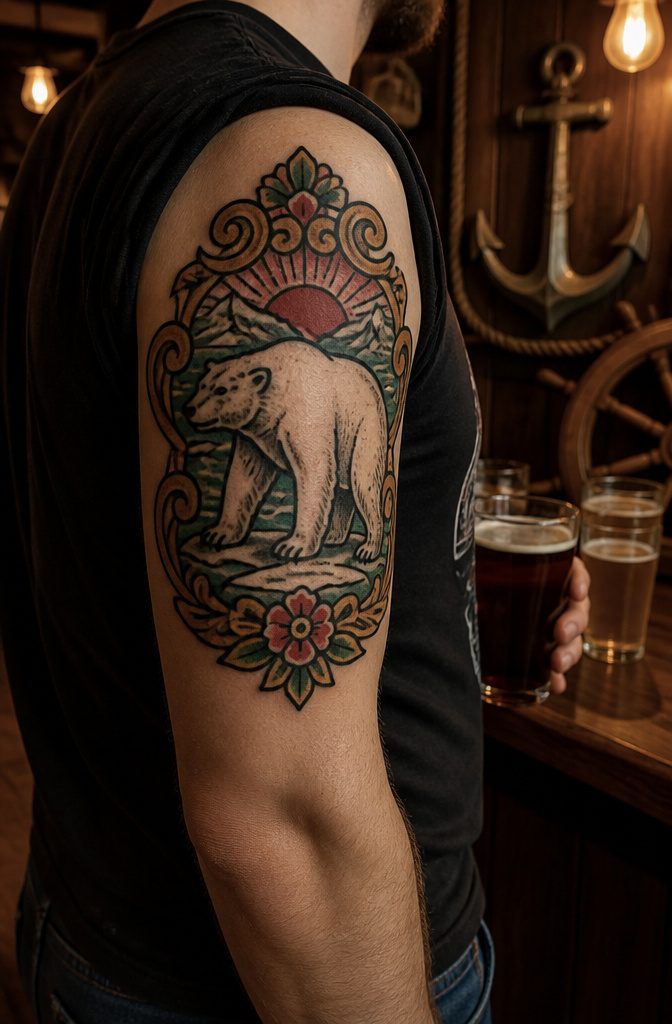
Bold black outlines and a restricted palette of red, green, yellow, and black give traditional polar bear tattoos their immediate visual punch.
The style keeps the animal readable from across a room, which matters when you are choosing something meant to last decades.
I have watched artists struggle to keep polar bear fur from blurring into a white blob on light skin; the traditional approach sidesteps this by trading realistic texture for decisive shape and high contrast.
The bear reads as a bear, period.
The classic imagery borrows from naval and Americana traditions: the bear might stand on an ice floe framed by scrollwork, or wear a banner with a name or date.
These frames do more than decorate. They anchor the design to the body so it does not shift or stretch awkwardly as skin ages.
The symbolism carries straight through from the broader meaning of any polar bear tattoo, strength and resilience, but the traditional format states it plainly rather than whispering it.
You get the virtue without the soft focus. That directness suits someone who wants the idea of endurance in a package that still looks authoritative in 2045.
4. Geometric Polar Bear Tattoo
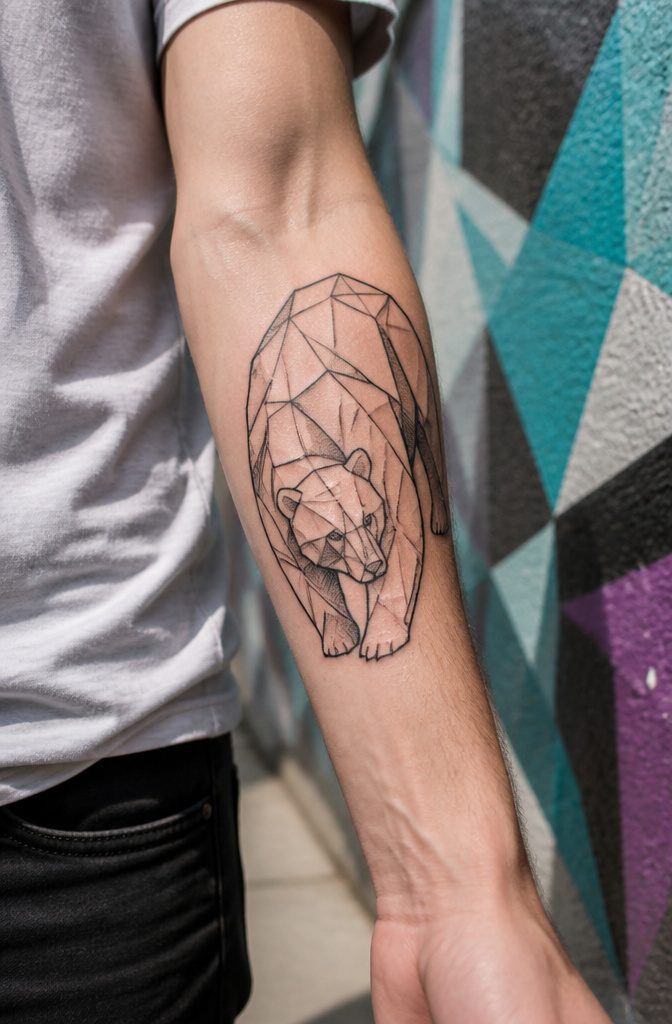
A geometric polar bear tattoo breaks the animal into triangles, polygons, and clean angular lines rather than rendering fur or soft curves.
That abstraction pulls attention toward the bear’s underlying structure, the width of its shoulders, the block of its head, the weight in its stance. What reads as softness in nature becomes architecture on skin.
This style lands in a deliberate middle space: recognizable enough to read as polar bear, modern enough to feel closer to graphic design than wildlife illustration.
Tattoo placements on the wrist or forearm keep the design compact and let the geometry read as deliberate pattern rather than empty space. Other placements on the upper back give larger versions room to build complexity across multiple overlapping shapes.
The look balances two qualities that rarely coexist.
Solidity comes from the bear’s mass and bone structure; contemporary edge comes from the mathematical breakdown of form. For someone who wants the animal’s presence without literalism, the geometric approach stacks both in the same image.
5. Tribal Polar Bear Tattoo
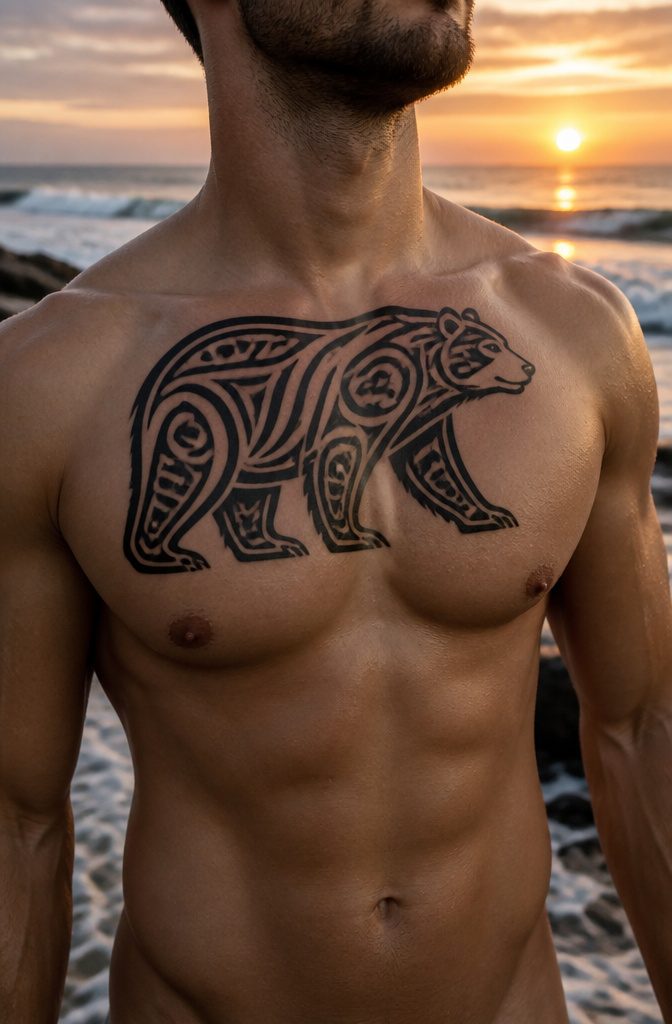
Tribal polar bear tattoos run on heavy, unbroken black lines and patterned fills that read as armor rather than fur. The style pushes power first, detail second: a solid silhouette at distance, a nest of symbols up close.
Most pieces sit across the upper chest or throat like a pendant, which lets the bear’s head drop dead center and the line weight thin toward the shoulders.
Native tradition holds that the polar bear teaches balance alongside raw strength, the two held together rather than traded off.
A tribal treatment can carry that duality literally, pairing thicker bands where the bear stands and finer marks where it waits, so the tattoo’s own geometry mirrors the lesson.
The risk is cliché: too many copies of the same Maori-adjacent spiral laid over any animal that shows up in a search.
Better work draws from a single coherent tradition, or invents its own vocabulary of marks that stay consistent across the whole piece.
The strongest ones avoid the flat look tribal can get by letting the negative space breathe. A bear carved out of black ink needs room to be a bear, not just a shape.
6. Polar Bear Paw Tattoo
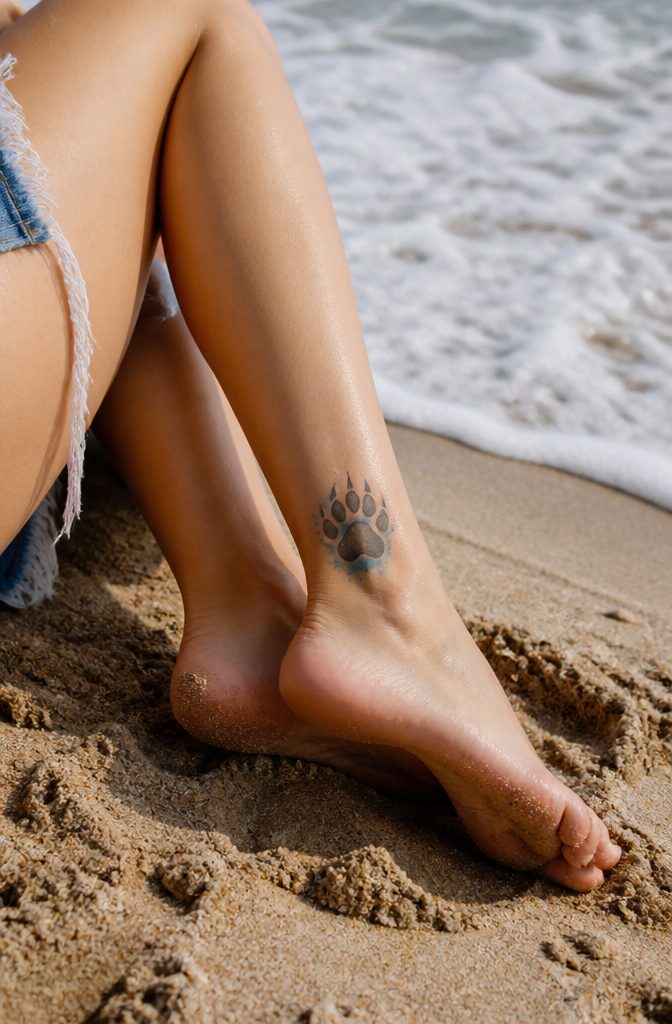
A polar bear paw tattoo carries the same weight of symbolism as a full portrait in a fraction of the space.
The paw stands for physical strength and a protective nature, but its smaller scale opens up placement options that a full-body bear would never fit.
The ankle works especially well here, letting the design sit where a real paw might press into snow.
A watercolor treatment keeps the look from turning too heavy or masculine.
The soft bleed of color around the paw pad edges gives the image some movement without cluttering the small area. That playfulness matters on a design this compact, where every line has to earn its place.
The wrist is the other natural home for this size. It sits visible enough to notice, easy enough to cover, and the vertical shape of a paw print follows the arm’s own line rather than fighting it.
Either placement keeps the meaning personal and close rather than making a billboard of it.
7. Polar Bear Face Tattoo
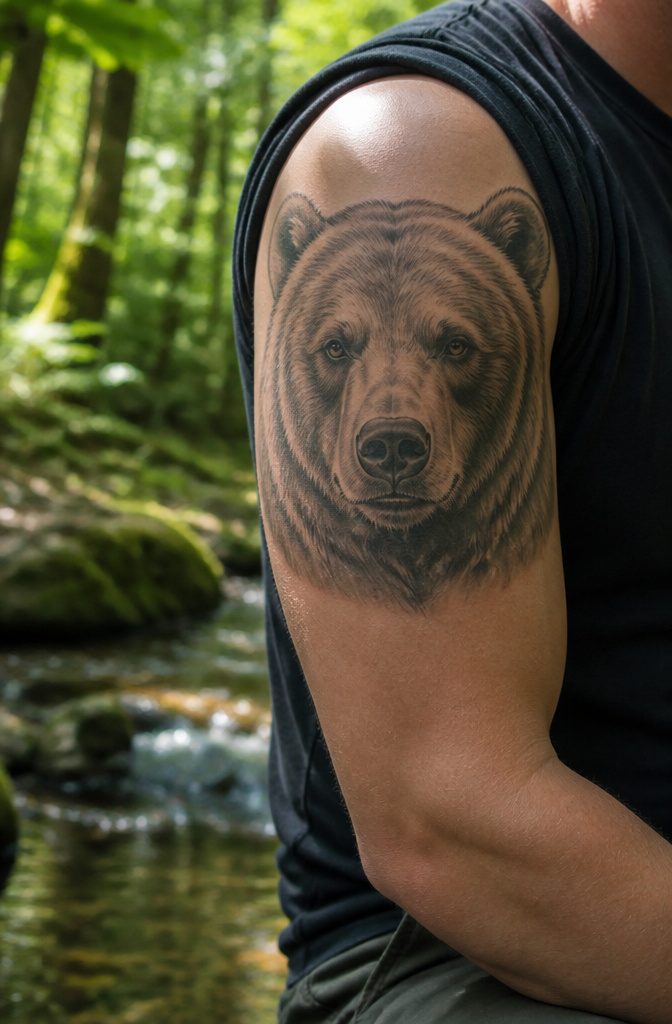
A polar bear face tattoo lives or dies on the expression the artist pulls from the animal.
The eyes carry the weight, whether you want the flat, cold stare of a bear at rest or the slight tension that reads as watchfulness.
The muzzle shape matters too; a polar bear’s face is longer than a brown bear’s, and getting that proportion wrong throws the likeness off immediately.
The fur is where grey shading earns its place. Solid black would flatten the whole thing to a silhouette, but layered greys let the artist build depth against your skin tone.
Where the fur catches light, the shading stays light or open. Where it folds around the jaw or sinks behind the eye socket, the tones drop darker.
The contrast reads as texture without the artist needing to line every hair. On lighter skin, the mid-range greys have room to breathe; on darker skin, the artist may push the highlights brighter so the dimension still registers.
Placement changes what works.
A face large enough to show the eye detail clearly needs flatter ground, chest or upper arm or thigh. Curved spots distort the symmetry and the animal ends up looking warped.
8. Angry Polar Bear Tattoo
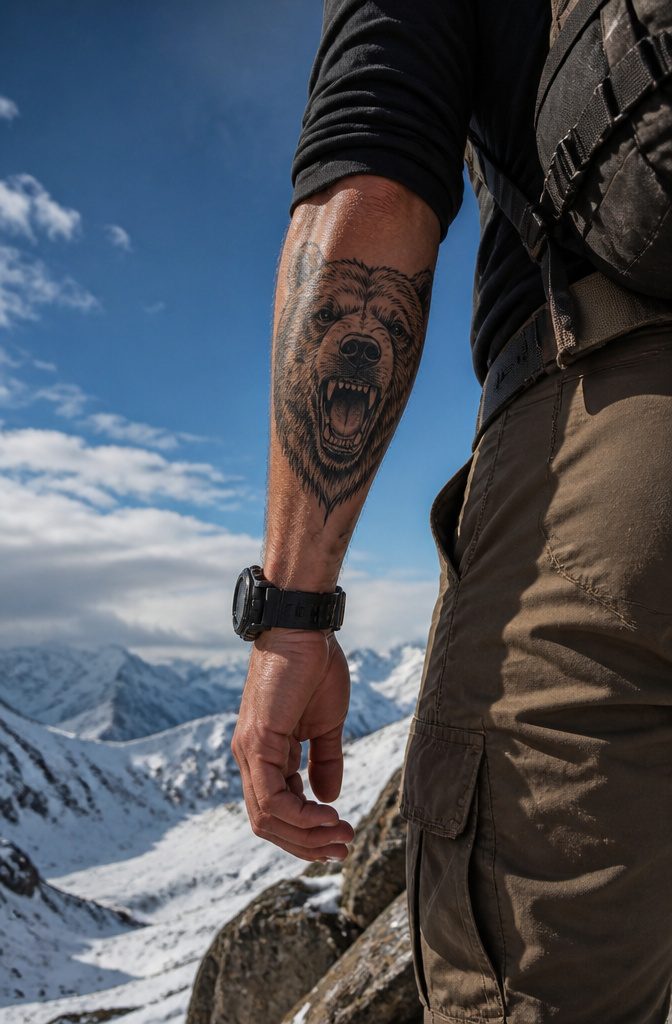
An angry polar bear tattoo drops the calm, approachable image the species usually carries.
The design goes for bared teeth and pulled-back lips, the moment the animal stops being background noise on the ice and becomes something you cannot look away from.
Black-and-white ink does the heavy lifting here, the stark contrast carving that warning out against skin without color to soften it.
The symbolism runs colder than the aesthetic.
A polar bear operates alone across miles of ice, and its aggression is not temper but survival equipment: the raw force required to pull a seal from a breathing hole, to defend kill sites from rivals, to swim through frozen water that would shut down most mammals in minutes.
An angry rendering captures that earned ferocity rather than cartoon violence.
Placement on the forearm keeps the snarl forward, visible, a reminder that quiet endurance and explosive force live in the same body. The black-and-white palette keeps the focus on anatomy and tension, not decoration.
9. Watercolor Polar Bear Tattoo
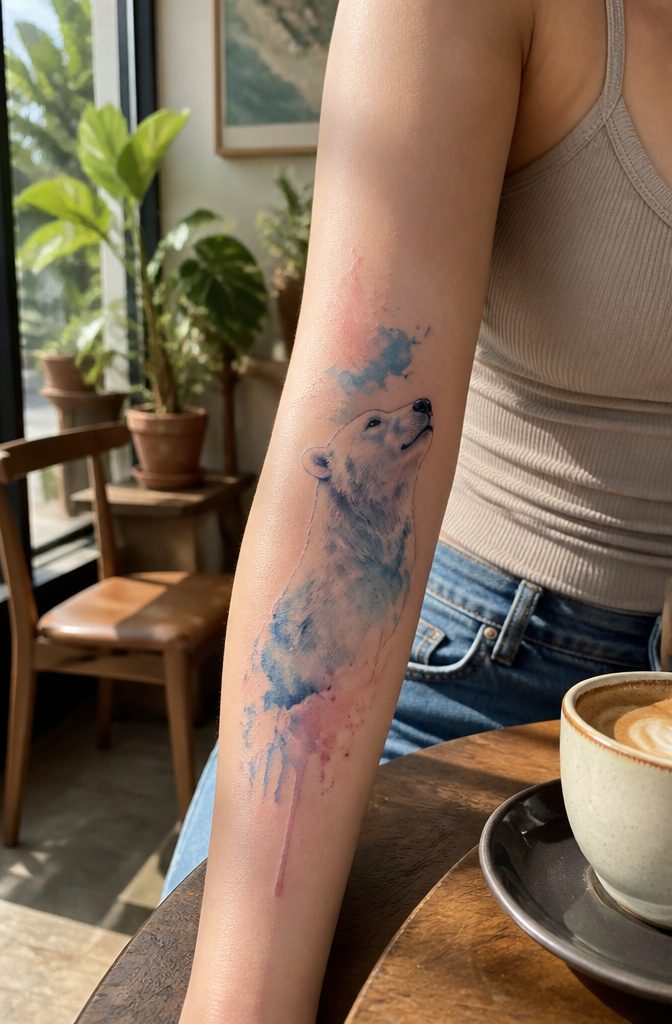
A watercolor polar bear tattoo trades the animal’s native whiteout for splashes of pigment that bleed and bloom across the skin.
Pastel washes of ice blue, pale rose, and soft amber replace the hard edges you’d expect from an Arctic predator.
The style suits the bear’s bulk surprisingly well; broad shoulders and rounded haunches give the color somewhere to pool and fade, the way wet paint settles into heavy watercolor paper.
The contrast is what makes it work. Polar bears evolved to vanish against snow and sea ice, but here the same silhouette becomes a frame for visible brushwork.
Where realism would chase every guard hair, watercolor lets the form breathe through negative space. You lose the camouflage and gain something the bear never had in its habitat: warmth, saturation, a sense that the image might still be drying.
Placement matters more with this style than with most. The colors need room to fade at the edges, so a forearm or thigh panel works better than a wrist band where the design gets truncated.
Fading is real too; those soft pigments don’t hold the punch of blackwork, and sun exposure will blur them faster.
An artist who specializes in watercolor technique should show healed photos from two or three years out, not just fresh work under studio lights.
10. Neo Traditional Polar Bear Tattoo
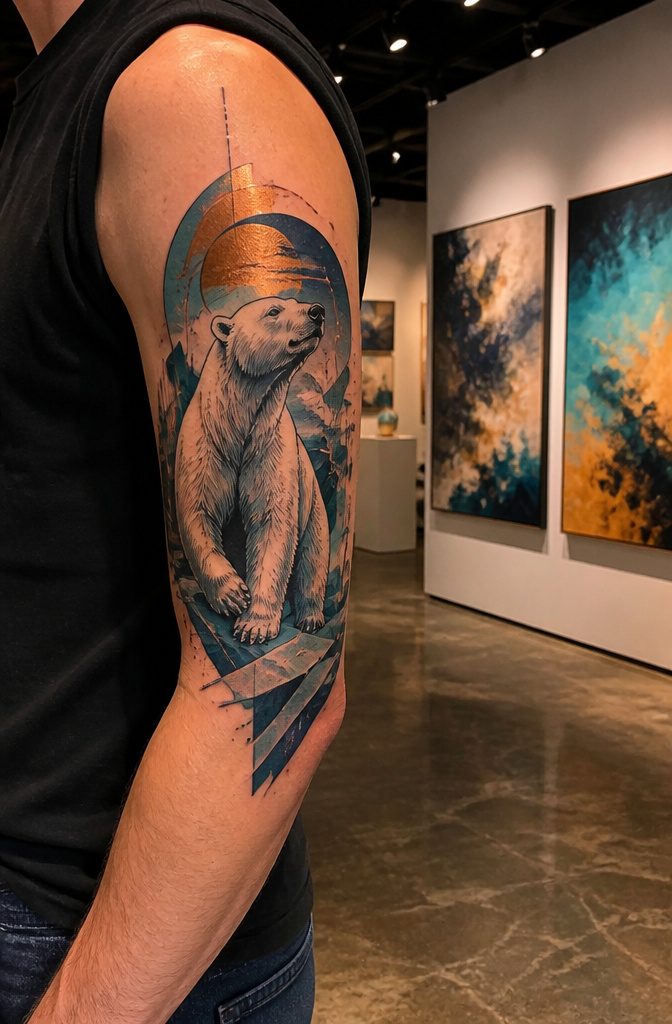
Neo-traditional tattooing pushes the classic bold-outline formula into territory traditionalists once avoided; expanded color palettes and more detailed rendering let polar bears carry purple shadows, copper suns, or teal northern lights without losing the graphic punch that makes a tattoo read from across a room.
Artists like @epicterror and @blackmagicjake treat the polar bear as a creature built for strong shapes and saturated pigment, not the muted realism Arctic photographs might suggest. The style solves an actual problem with Arctic animals on skin.
Most artists refuse white-ink-heavy designs, and polar bears do not actually wear white fur at all; the shafts are transparent from a gene mutation, with light scattering to create the illusion.
Neo-traditional work leans into that deception rather than fighting it, using the wearer’s own skin as the base tone and building volume through bold linework, grey shading, and strategic color rather than attempting to paint every hair.
I have seen the difference between a neo-trad piece that embraces this constraint and one that tries to out-detail a photograph; the first ages cleaner, the second blurs into grey soup inside five years.
Placement matters less than clarity of concept here.
The anthropomorphized French circus bear by @tattoosbyalisha and the half-sleeve by @siemor_ntc both succeed because the artist committed to the style’s rules: readable silhouette first, decorative detail second, color applied in discrete blocks rather than soft gradients.
11. Blackwork Polar Bear Tattoo
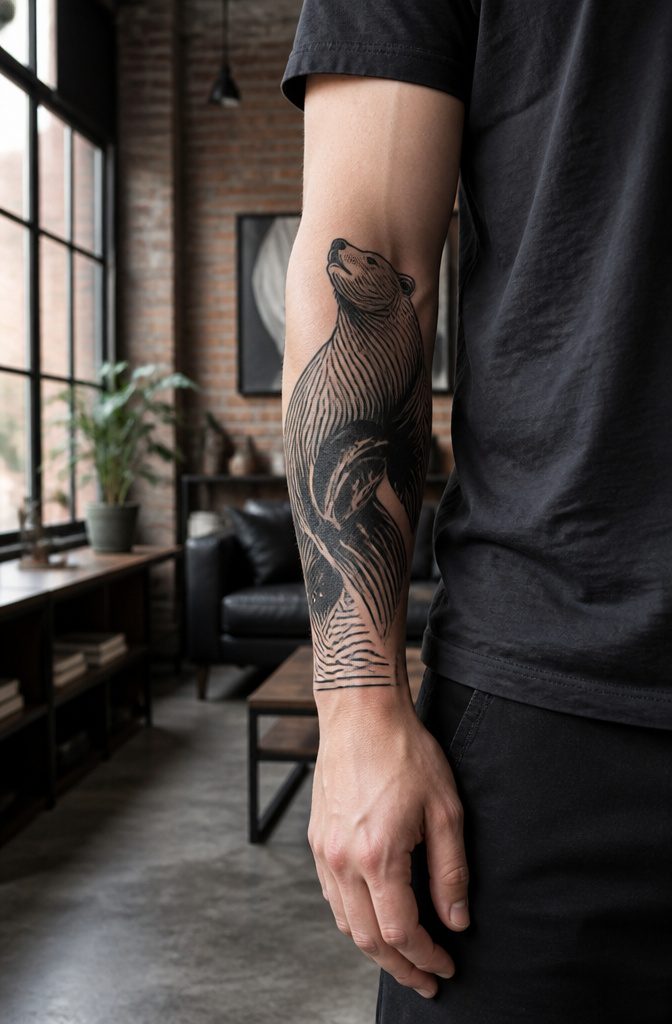
Heavy black ink leaves nowhere to hide, which makes a polar bear one of the harder subjects to pull off in blackwork.
The animal lives in white, and the tattoo lives in solid black, so the contrast has to do all the storytelling.
Artists solve this by carving the figure out of negative space, letting the skin itself carry the color of the fur while the ink defines what surrounds it.
The fur is the real test.
Dense black linework, packed tight in varying directions, creates texture that reads as white underbelly or shoulder hump from across the room. Crosshatching too loose and the bear looks matted; too uniform and it goes flat.
A good artist staggers the weight, laying down solid blacks near the paws and face where real polar bears shadow themselves, then pulling the lines apart toward the back where the light would hit.
The result is a shape that holds its form from five feet away and still rewards someone leaning in close.
Placement matters for healing. The inner arm or calf, where the skin sees less sun and twisting, keeps those fine lines from blowing out over time.
On the ribs or shoulder blade, the stretch can turn careful hatching into a gray blur inside ten years.
12. Cute Polar Bear Tattoo
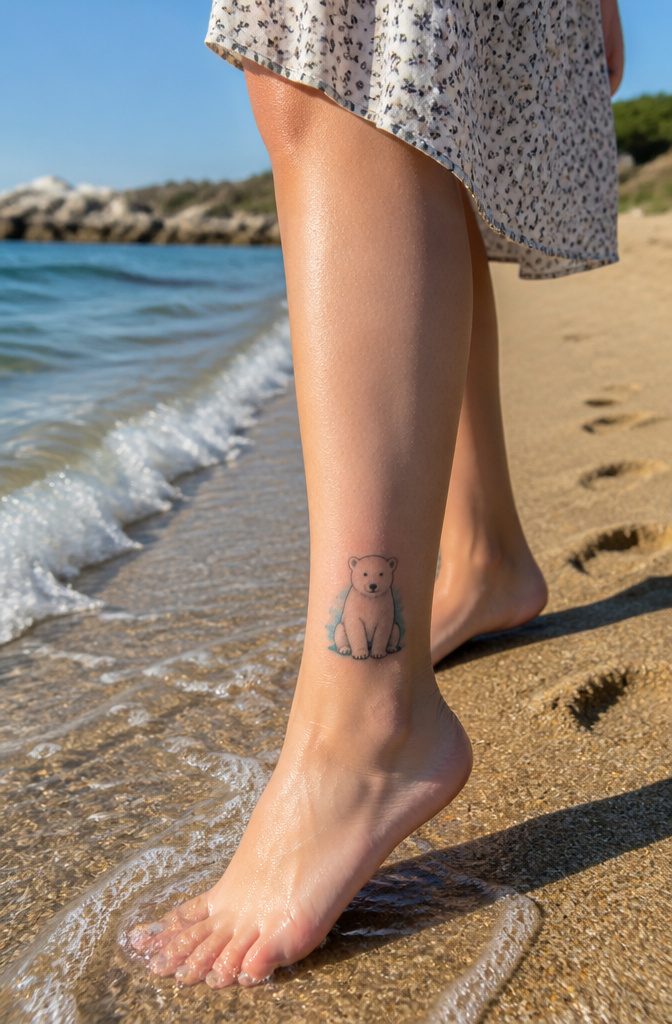
A cute polar bear tattoo trades the animal’s usual size and ferocity for rounded ears, oversized paws, and soft linework that reads more plush toy than apex predator.
The style pulls from cartoon and illustration traditions, and artists like @atelierkaninchenbau have shown how well it translates to skin.
The appeal crosses ages. Someone in their twenties might want a small cub on an ankle or behind an ear as a first tattoo; the placement stays discreet and the tone stays light.
For women further into parenting years, a mother-and-cub version on the shoulder or upper arm carries the same warmth without the weight of a more realistic piece.
The simpler color palettes, usually limited to black, soft grey, and maybe a touch of blue for ice, keep the booking shorter and the healing cleaner. What limits the style is how fast it can date.
A too-trendy reference or a figure too closely tied to one animation studio can feel off in five years, so the better designs exaggerate the bear’s actual proportions rather than borrowing from a specific screen character.
13. Abstract Sketchy Polar Bear Tattoo
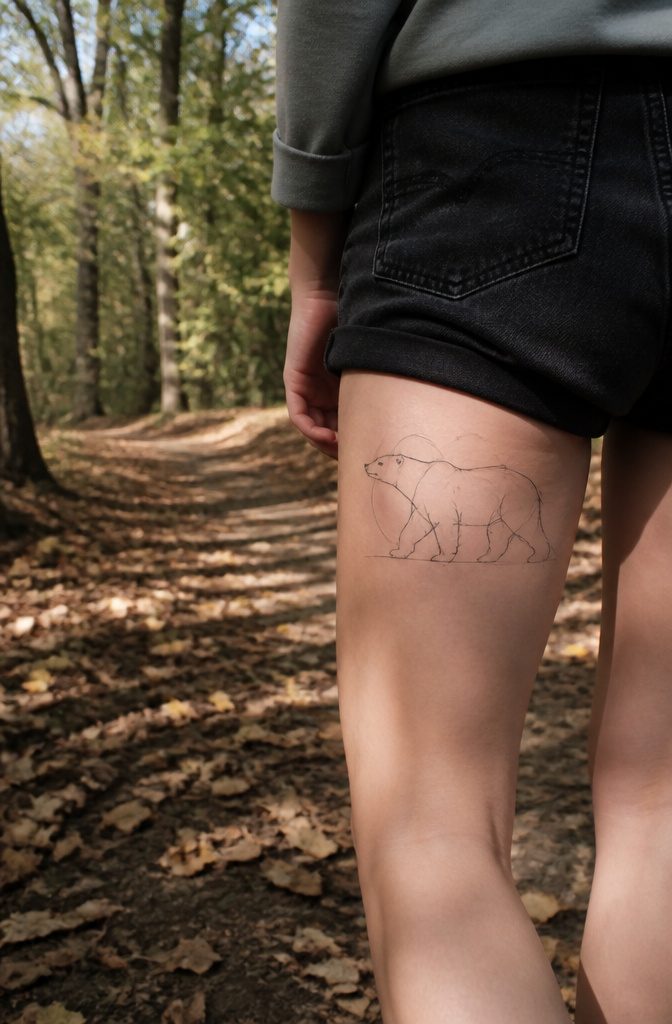
Loose, gestural lines do the work of suggestion instead of description. An abstract sketchy polar bear tattoo might show the animal mid-stride with three quick strokes for a limb, the fourth line trailing into skin rather than closing the shape.
The eye fills in what the needle left open. This unfinished quality captures motion in a way finished outlines rarely manage; the bear stays mid-hunt, mid-swim, never pinned to the wall like a specimen.
The style suits the subject more than most animals. Polar bears already read as remote, half-imagined creatures to people who will never step on pack ice.
A sketchy rendering respects that distance instead of pretending to own it. The lines feel caught on the fly, like a field note from someone who saw the shape vanish into fog.
Placement matters more here than with tighter styles. A shoulder blade or outer thigh gives the lines room to breathe; scaling too small turns the gestures into scratches that age poorly.
I have seen this work best at 4–6 inches minimum, where the negative space between strokes carries as much weight as the ink itself.
The untamed quality is the point, but the composition still needs enough structure to hold together as the ink settles over years.
14. Double Exposure Polar Bear Tattoo
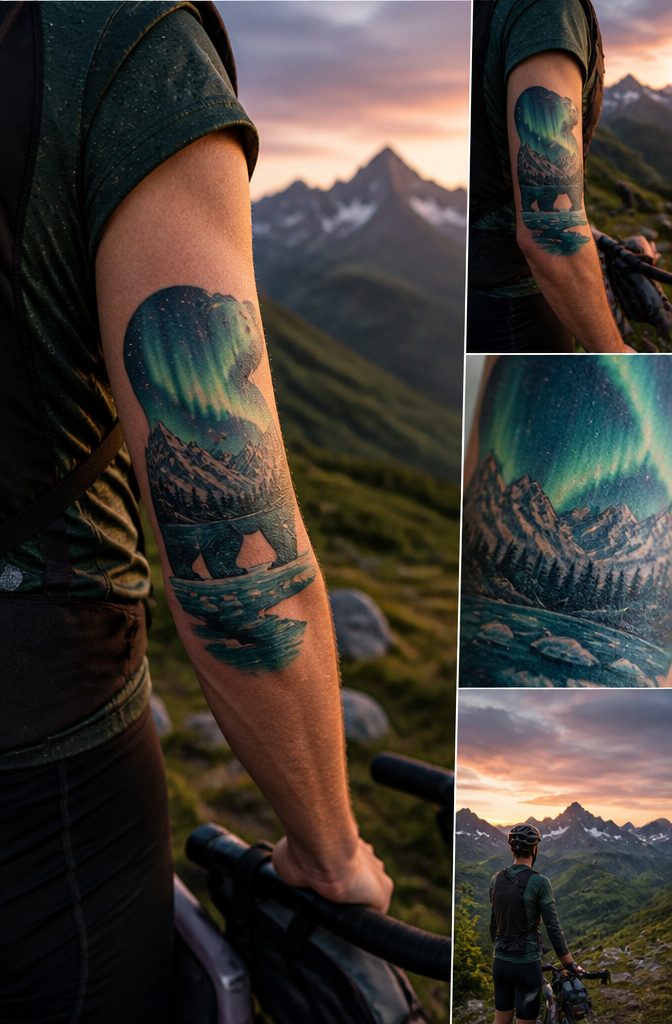
A double exposure polar bear tattoo layers the animal’s silhouette with Arctic imagery so the two share the same ink, the same edges.
The bear’s outline might hold the northern lights in its chest, or its profile dissolves into ice floes and open water. The effect reads as one image from a distance and reveals its construction only up close.
The style carries its own statement about habitat loss.
Where a realistic polar bear tattoo shows the animal amid melting ice as a scene you read left to right, double exposure makes the threat structural: the landscape is literally inside the bear.
That visual choice turns the body into a reminder of what warming temperatures dismantle, piece by piece.
Color handling matters more here than in most polar bear designs. The aurora needs saturation to glow against the muted whites and blues of the Arctic palette, but overshoot it and the piece becomes a neon poster.
Ask the artist to show healed photos, not fresh work; greens and magentas fade fastest, and the balance you approve on day one will shift within months.
Placement shapes the effect. A forearm or calf gives enough vertical space for the silhouette to read clearly while the interior detail stays legible.
Too small, and the landscape collapses into noise. Too large, and the double exposure trick loses its intimacy, becoming a mural rather than a secret held in the skin.
15. Snowboarder Polar Bear Tattoo
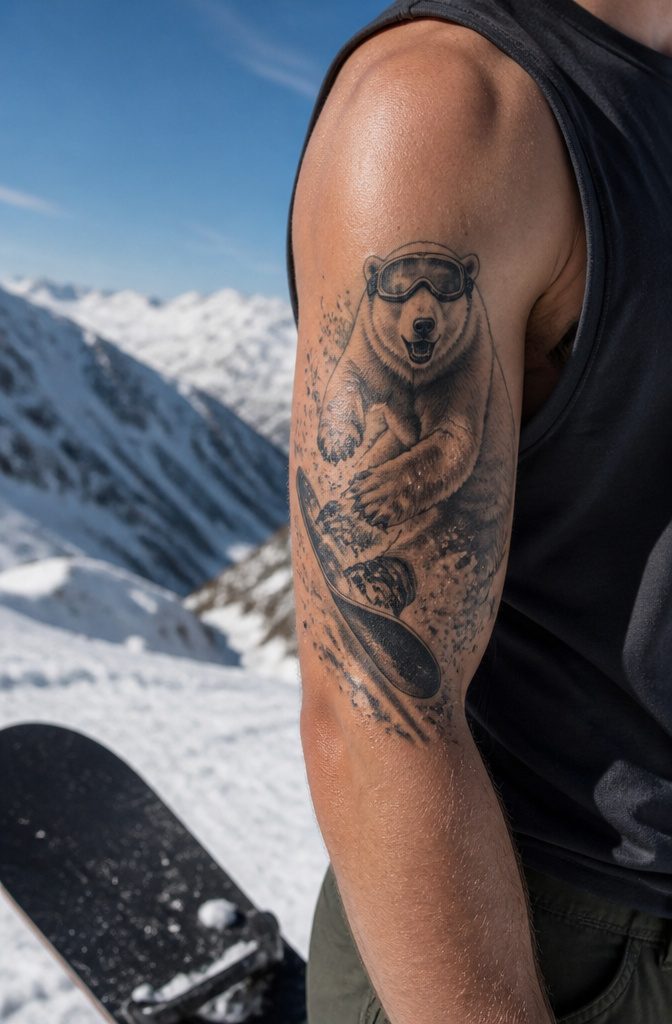
A snowboarder polar bear tattoo takes the animal out of its expected habitat and drops it onto a halfpipe or powder run, goggles and all.
The shift from survival imagery to sport culture makes the design feel current in a way that traditional arctic scenes rarely manage.
A polar bear mid-carve, spray kicking off the board’s edge, reads as playful without tipping into cartoon territory if the artist keeps the musculature believable.
The human gear matters more than you’d expect. A helmet that fits the bear’s skull shape, not a human one scaled up, keeps the anatomy honest.
Board graphics, jacket stripes, even binding stance width become the details that separate a fresh piece from something that looks like clip art from a 1990s energy drink.
One artist I watched work spent longer sketching the bear’s weight distribution over the board than on the face.
Color choices run toward cool tones by habit, but a pop of neon on the board or jacket against muted fur can pull the eye exactly where you want it.
The style pairs naturally with neo-traditional linework or a clean illustrative approach. Placement tends toward larger areas: the thigh, outer calf, or upper arm where the diagonal motion of the carve has room to breathe.
16. Polar Bear and Squirrel Tattoo
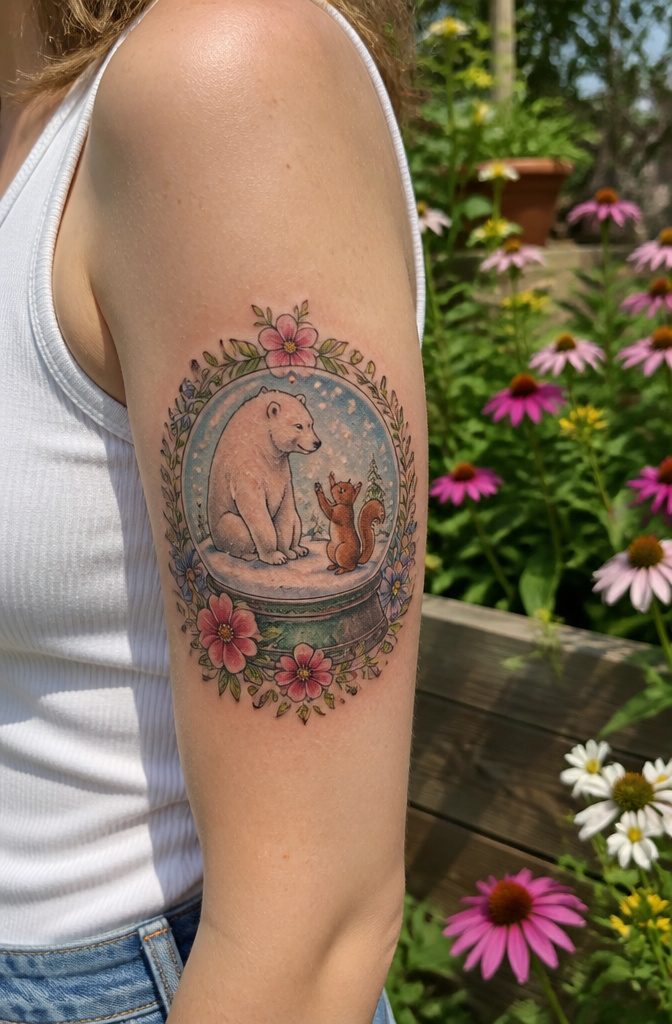
The polar bear and squirrel pairing works because it breaks every rule about how the animal is supposed to look on skin.
Most polar bear tattoos lean solitary and severe: the apex predator, the ice wanderer, the weight of it. Drop a squirrel into the frame and the whole mood inverts.
Jody Dawber’s take puts the two inside a snow globe, which lands the joke without explaining it. The squirrel scrambles; the bear tolerates.
That dynamic, borrowed straight from animated double-acts where the small noisy one pesters the large patient one, gives the design its energy. Watching the specific film is not required to read the relationship.
The contrast in scale matters technically too.
Squirrel proportions let an artist use tighter line work in the same piece, so the bear’s broader shapes, usually built from the client’s skin tone with black and grey shading, sit against fur texture that actually gets drawn.
White ink stays minimal, reserved for highlights on both animals rather than filling whole forms.
Neo-traditional framing handles this well: bold outlines, limited but saturated color, enough structure that the humor does not dissolve into pure cartoon. The snow globe itself, borrowed from Dawber’s version, adds a container that justifies the strangeness.
Without that frame, the squirrel risks looking like a mistake. With it, the mismatch reads as intentional, even classic.
What Polar Bear Tattoos Mean
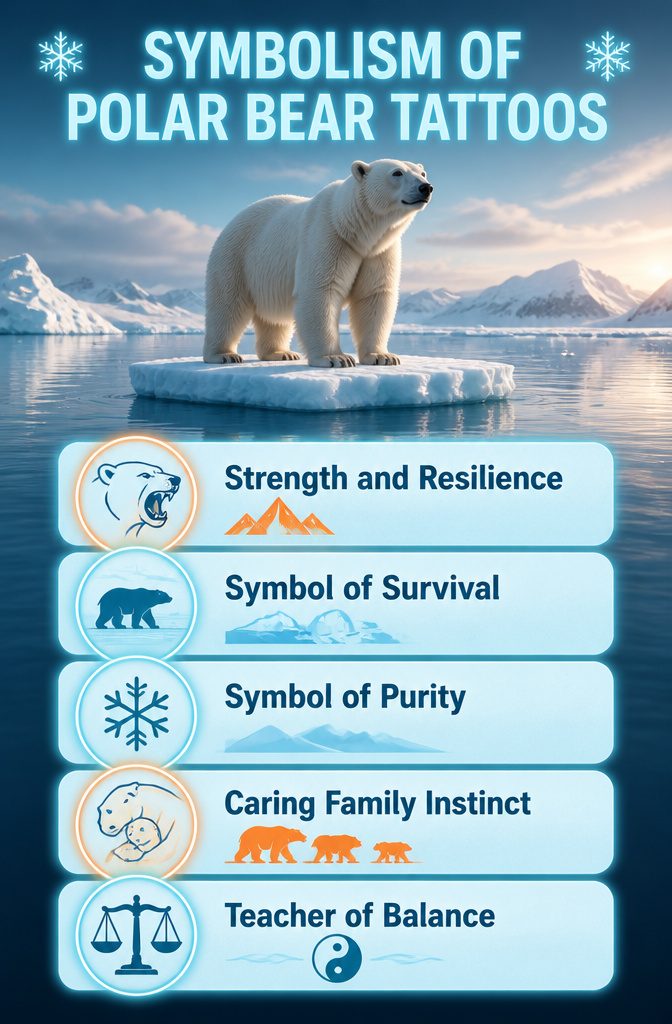
Polar bears carry a heavier load of meaning than most Arctic imagery. Strength and resilience sit at the core, built from the fact that these animals cross the tundra alone, hunting through months of darkness and seasonal starvation.
The symbolism of survival runs almost as deep; polar bears have become the face of climate change precisely because their existence tracks the vanishing ice, making them a quiet but visible statement of environmental awareness.
Purity enters the reading through the bear’s white coat against an empty landscape, and that solitude is complicated by what happens in a den.
A polar bear mother will fast for months to protect newborn cubs, which folds protective family instinct into the same design that reads as lone wanderer.
Native American tradition adds another layer, treating the polar bear as a teacher of balance: how to hold power without letting it consume you.
The advice is to match force with patience and determination, qualities these animals display in a hunt that can last hours across broken ice.
Most designs pick one thread and let the rest sit in the background. A paw print might lean into family protection; a full figure standing on shrinking floe tilts the meaning toward survival and environmental awareness.
Where to Place a Polar Bear Tattoo
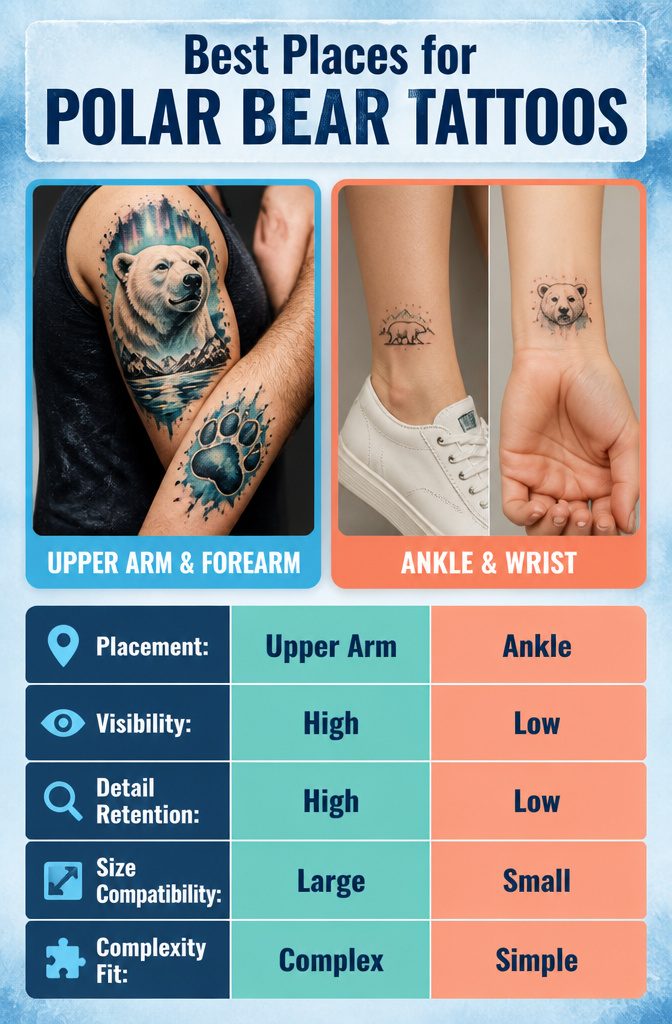
The upper arm and forearm carry most polar bear tattoos that need the space to breathe.
A watercolor polar bear paw, for instance, needs enough flat surface for the color to spread without wrapping around bone in a way that distorts the shape.
The ankle works for a smaller stamp of intention, though the skin there moves differently and the detail softens faster with friction from socks and shoes.
Wrist placement shrinks the design further. A polar bear face there becomes a gesture more than a portrait, something glimpsed rather than studied.
The back opens the opposite direction: room for a full scene, northern lights behind the bear or a cub at her flank, the kind of composition that needs the uninterrupted canvas.
Match the complexity to the real estate.
A single bold silhouette survives compression. A neo traditional piece with line work and layered color wants length, not width, and settles better on a limb than on a ankle where fine points blur together.
How Artists Handle Polar Bear Fur
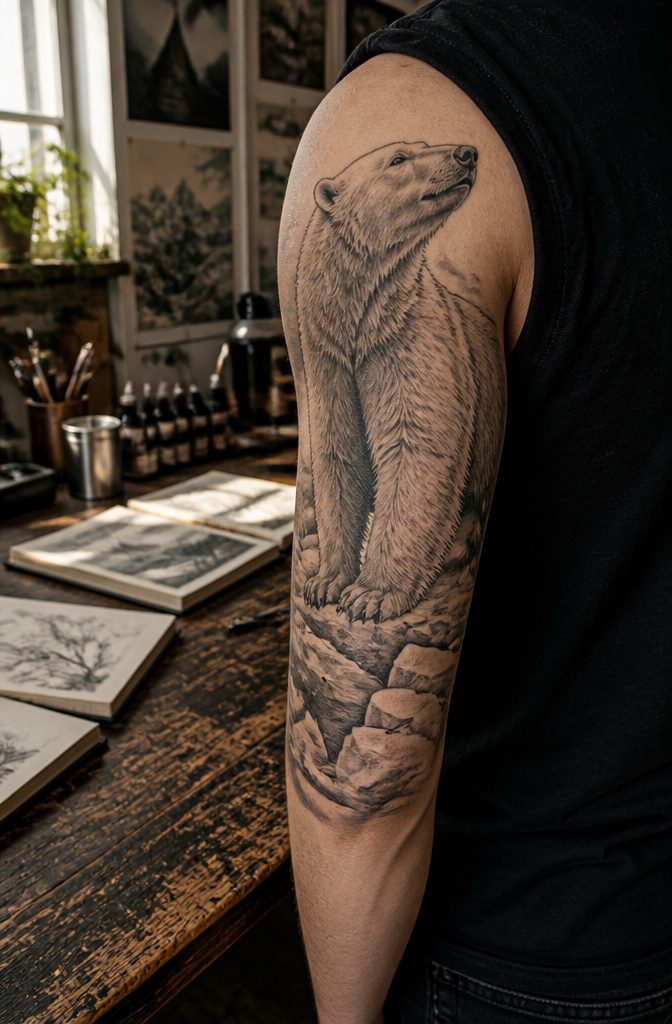
Polar bear fur only looks white. Each strand is actually transparent, the result of a gene mutation common to the species, so light scatters through the hollow shaft the way it does through snow.
Tattoo artists treat this as the central design problem and the solution both.
The skin underneath becomes the color of the bear. Rather than laying down white ink across the entire animal, which most artists avoid anyway because heavy white applications fade unpredictably, the artist leaves the client’s natural tone as the base.
Black linework defines the form, and grey shading builds the dimension that suggests depth in the coat. Highlights in white ink appear only sparingly, catching points where light would hit.
This approach means a polar bear tattoo lives or dies on how well the artist reads the client’s skin tone. On lighter complexions, the contrast with black and grey reads as the soft cream-and-amber of a bear in Arctic sun.
On deeper skin, the same transparency effect can register as luminous, though the artist must calibrate the grey wash to avoid silhouetting the animal against its own fur.
The finished piece mimics the same trick of light that lets a living polar bear disappear against snow. The deception is the design.
Frequently Asked Questions
What does a polar bear tattoo symbolize?
A polar bear tattoo symbolizes strength, resilience, and survival. The animal’s solitary life through Arctic darkness and starvation built that meaning.
In recent years it has also become a quiet statement of environmental awareness, since polar bears now track the vanishing sea ice that keeps them alive. Some designs add purity or solitude through the white coat against empty landscape.
What are some popular styles of polar bear tattoos?
Popular styles include realistic, minimalistic, traditional, geometric, tribal, watercolor, neo-traditional, blackwork, cute cartoon, abstract sketchy, double exposure, and illustrative pieces like snowboarder or paired animal designs.
Each solves a different problem: realism honors the bear’s actual habitat, minimalism uses the animal’s transparent fur as a design feature, and traditional work sidesteps the white-ink problem through bold outlines and limited palettes.
Where should I place a polar bear tattoo?
Common placements are the upper arm, forearm, wrist, ankle, upper back, shoulder blade, thigh, and chest. Smaller designs like paws or minimal lines fit wrists and ankles.
Larger pieces with detail, faces, or double exposure need flatter areas like the upper arm, chest, or thigh to avoid distortion. Watercolor styles need room for edges to fade, so forearms and thighs work better than wrist bands.
What does a bear tattoo symbolize?
Bear tattoos in general carry strength, protection, and solitary endurance. The polar bear specifically adds survival through extreme cold and isolation, plus a newer layer of climate awareness.
Where brown bear or black bear tattoos might emphasize ferocity or forest power, the polar bear leans into quiet persistence against a landscape that is literally disappearing.