The seven tent tattoos below run from a single crossed-woods flame small enough for a first-timer to full illustrative pieces with mountain backdrops, and the one that belongs to you depends on whether you need the tent to read as personal shelter, shared spectacle, or somewhere between.
Fine line on the forearm or calf keeps a camping tent’s geometry cleanest there, where fabric planes and pole angles stay readable without heavy shading crowding them into something you did not ask for.
1. Camping Tent Tattoo
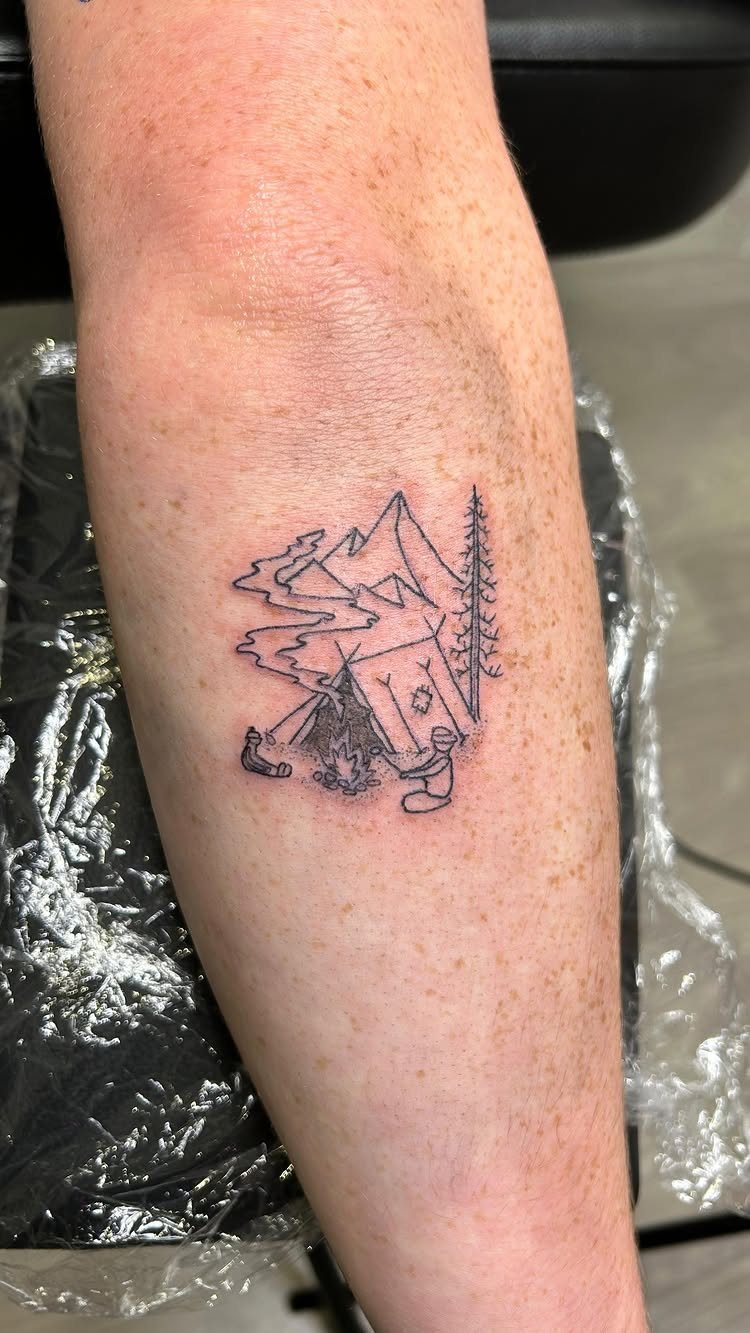
A camping tent tattoo anchors the whole scene around shelter, the reason you packed in the first place.
I think it works best placed where the surrounding elements have room to breathe, the forearm or calf giving that space without crowding the tent into the corner of a smaller canvas.
Fine line keeps the geometry readable as fabric and poles without the weight of heavy shading.
2. Campfire Camping Tattoo
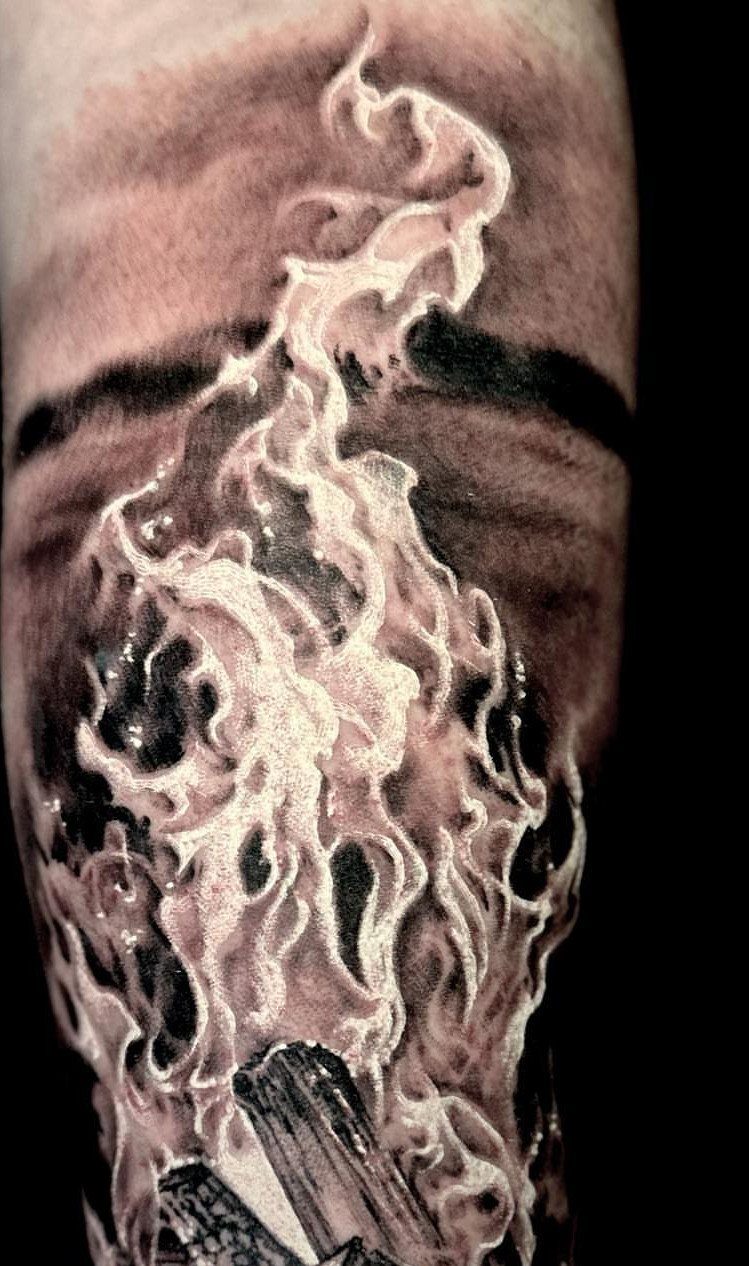
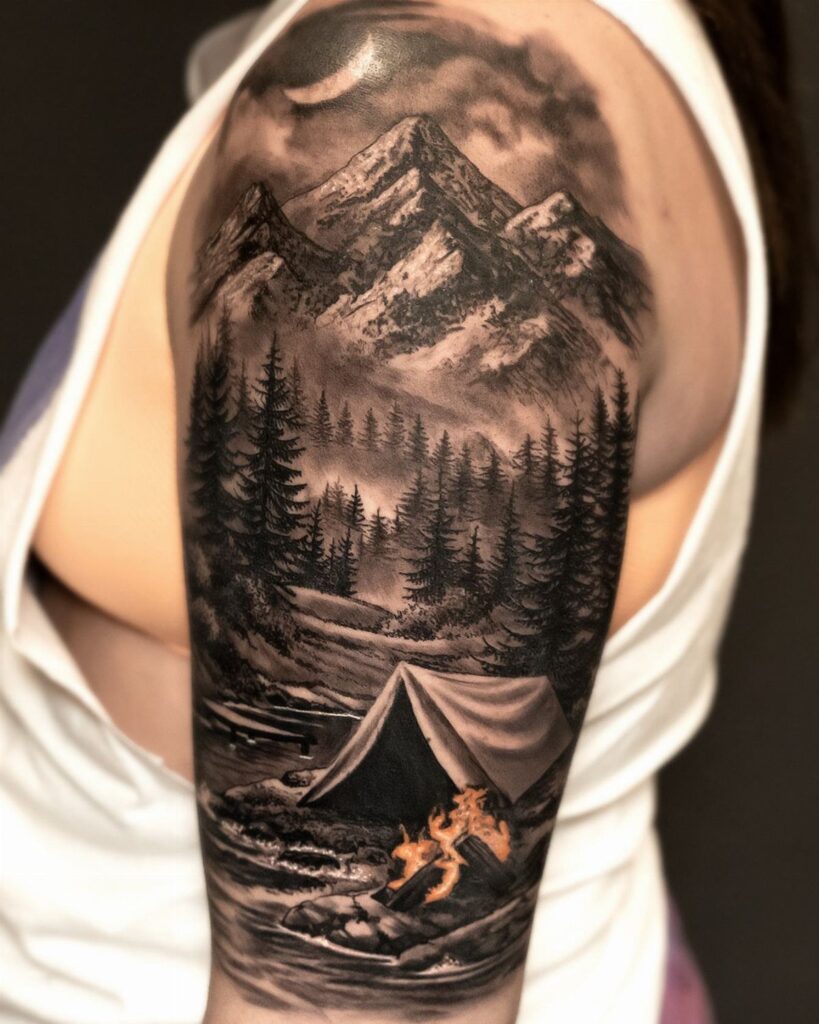
The campfire starts conversations because everyone gathers toward it. Logs stacked in an open cone or teepee shape read instantly, and leaving the flame in white-highlighted negative space against dark background shading gives it that snap of real heat.
The flames rise from stacked logs against a dark shaded background, the way a real campfire looks once the sun goes down.
Black-and-grey realism handles the smoke and ember texture well if your artist works tight detail; without that skill, the flame flattens to a blob. This one suits the reader who wants the feeling of camping, not just its equipment list.
3. Minimalist Camping Tattoo
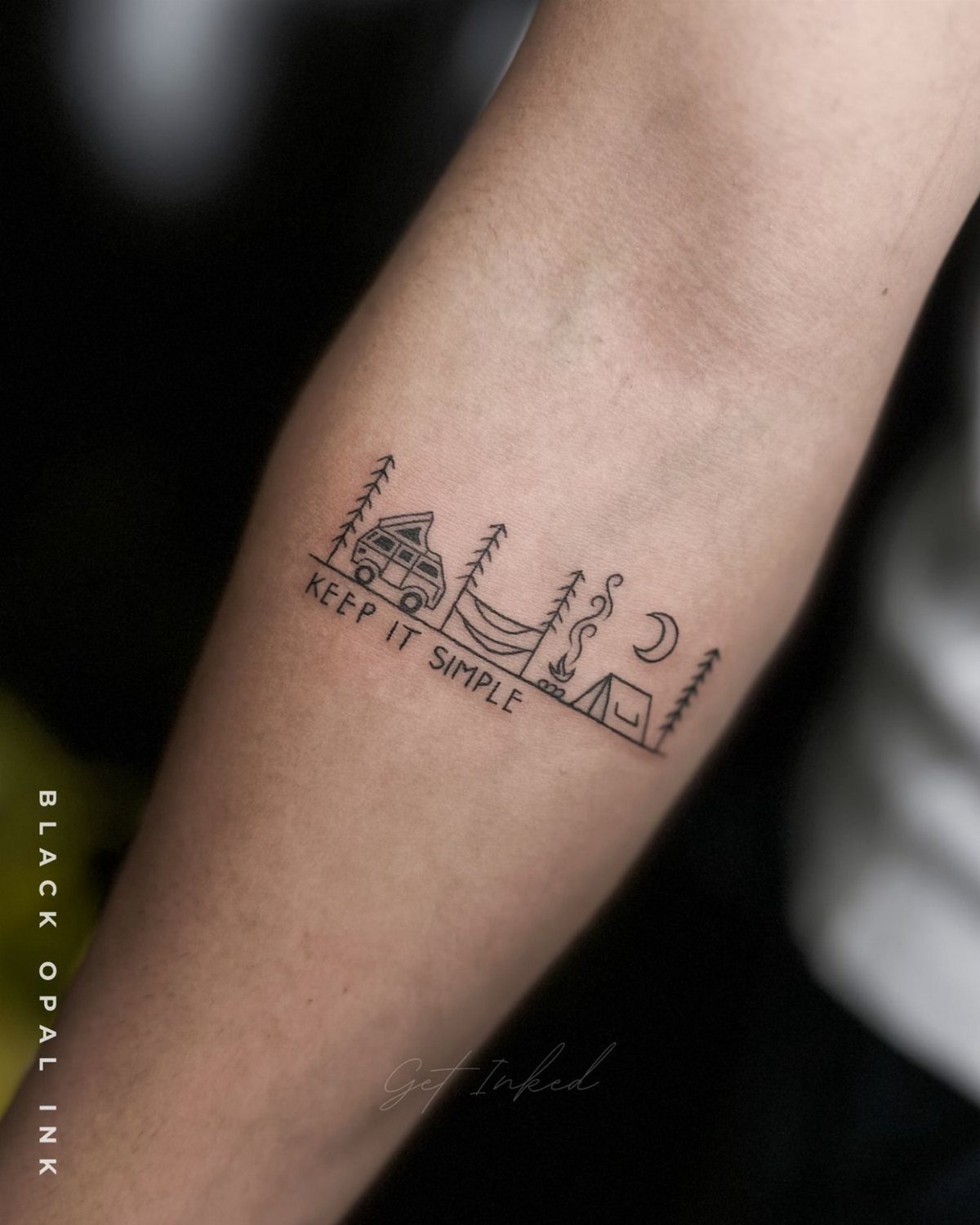
The "KEEP IT SIMPLE" text under the scene makes the point explicitly, but the design would read clean even without it.
I like that the moon, hammock, van, and fire are all given roughly equal weight, no single element shouting the others down.
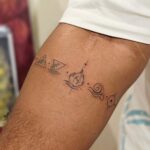
For someone on a budget or a first-timer testing how tattoo wears on them, scattered small icons across the forearm keep each session short and let you pause to see how your skin heals before adding more.
The crossed woods and single flame version runs even smaller if you want to start with just the essentials.
4. Big Top Circus Tent Tattoo
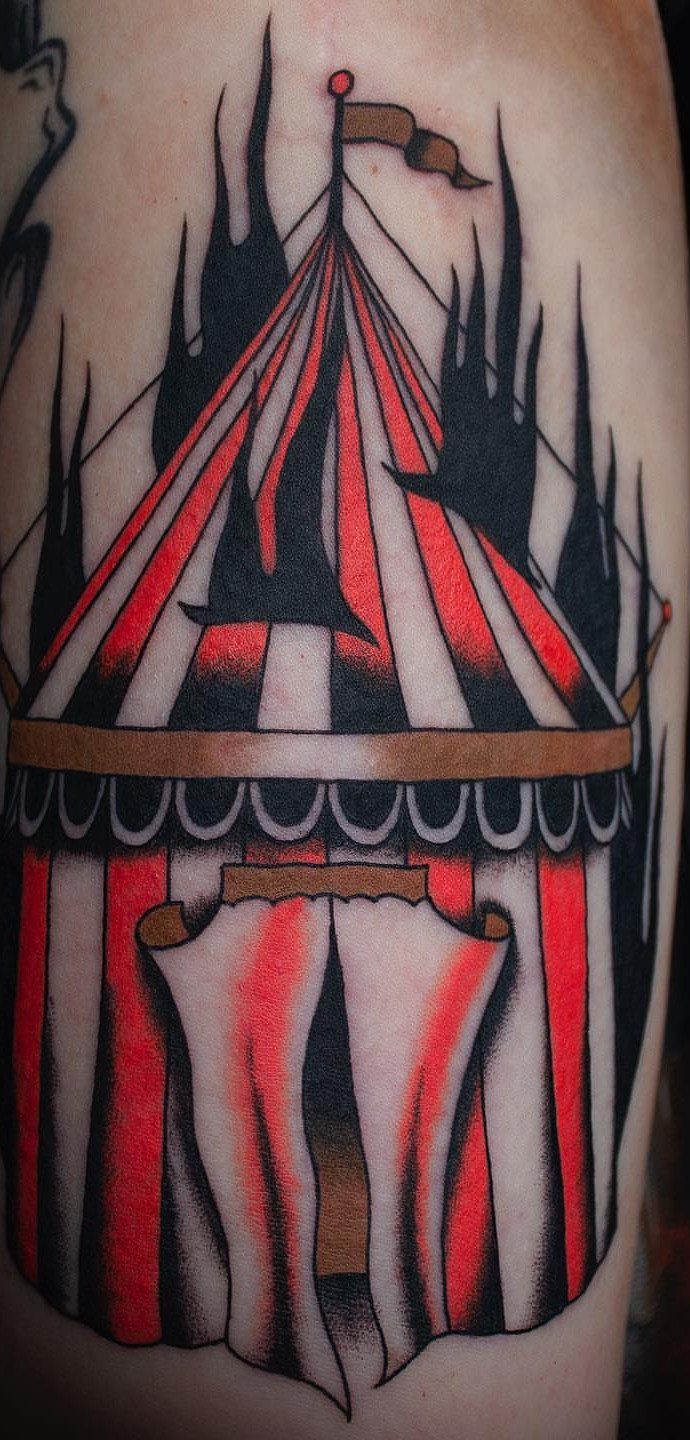
Red-and-white stripes on a circus big top carry instant recognition, the flag on top sealing the read from across a room.
The dark flame or smoke shapes behind the visible example deepen the contrast so the tent doesn’t float; without that backing, bright color on pale skin can look pasted on.
Black shading carries the weight of the design without the cost of packing in more red ink throughout the tent stripes and silhouettes.
I would check that my artist has healed photos of color saturation on skin close to mine, since those stripes need to stay distinct or the whole tent collapses into pink blur.
5. Camping Scene in a Lantern Tattoo
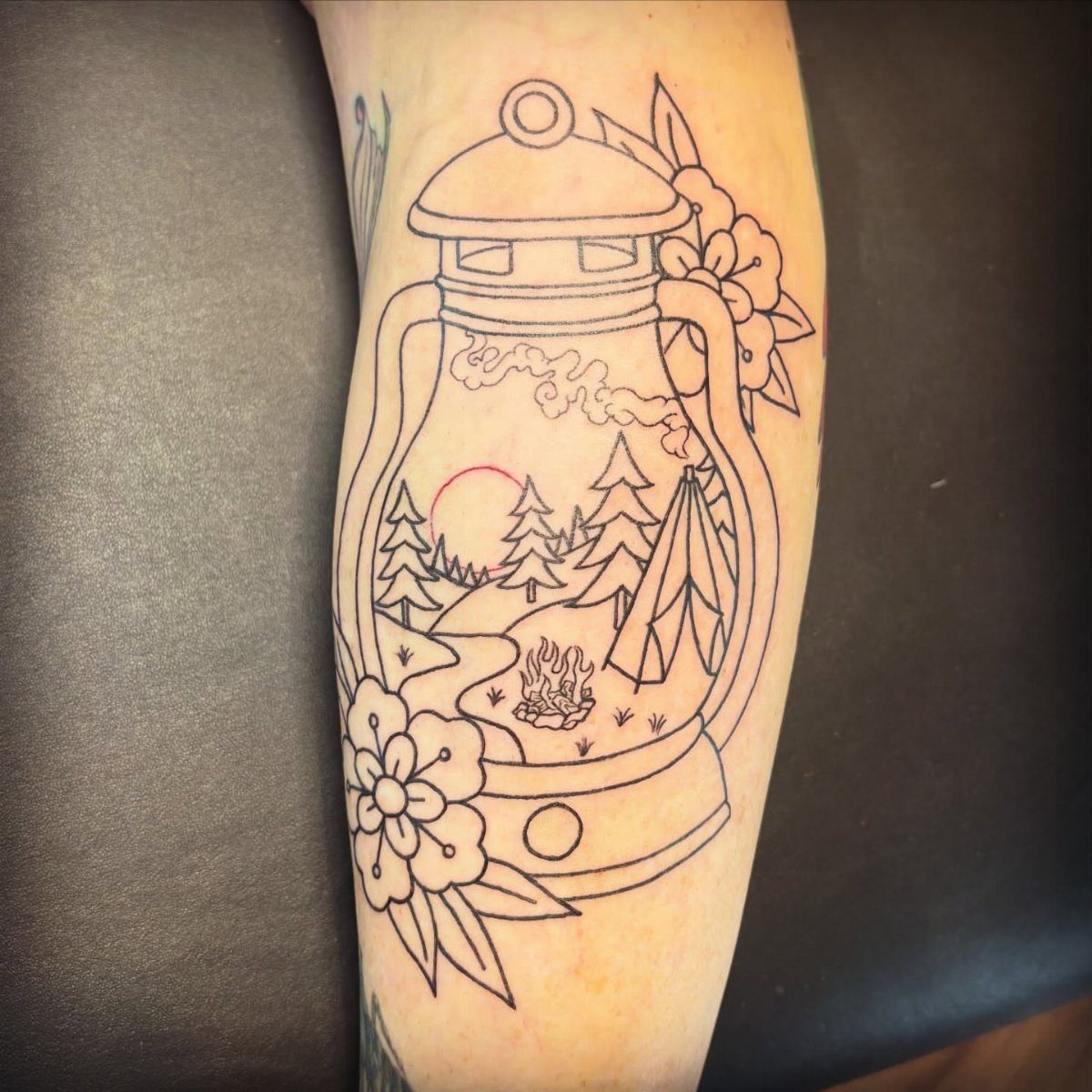
The lantern frame does useful work, containing the scene so your artist isn’t inventing a horizon line that fights your ankle or arm curve.
A simple rectangular chimney-top lantern with glass panels gives hard edges to stack pine, tent, and setting sun against; round or ornate housings compete with the landscape inside.
Line art keeps the walls of the lantern from turning into dead black bands that swallow the detail.
I think this suits the reader who wants camping imagery but needs it office-appropriate, the frame making it look deliberate and composed rather than a raw wilderness shot.
6. Celestial Circus Tent Tattoo
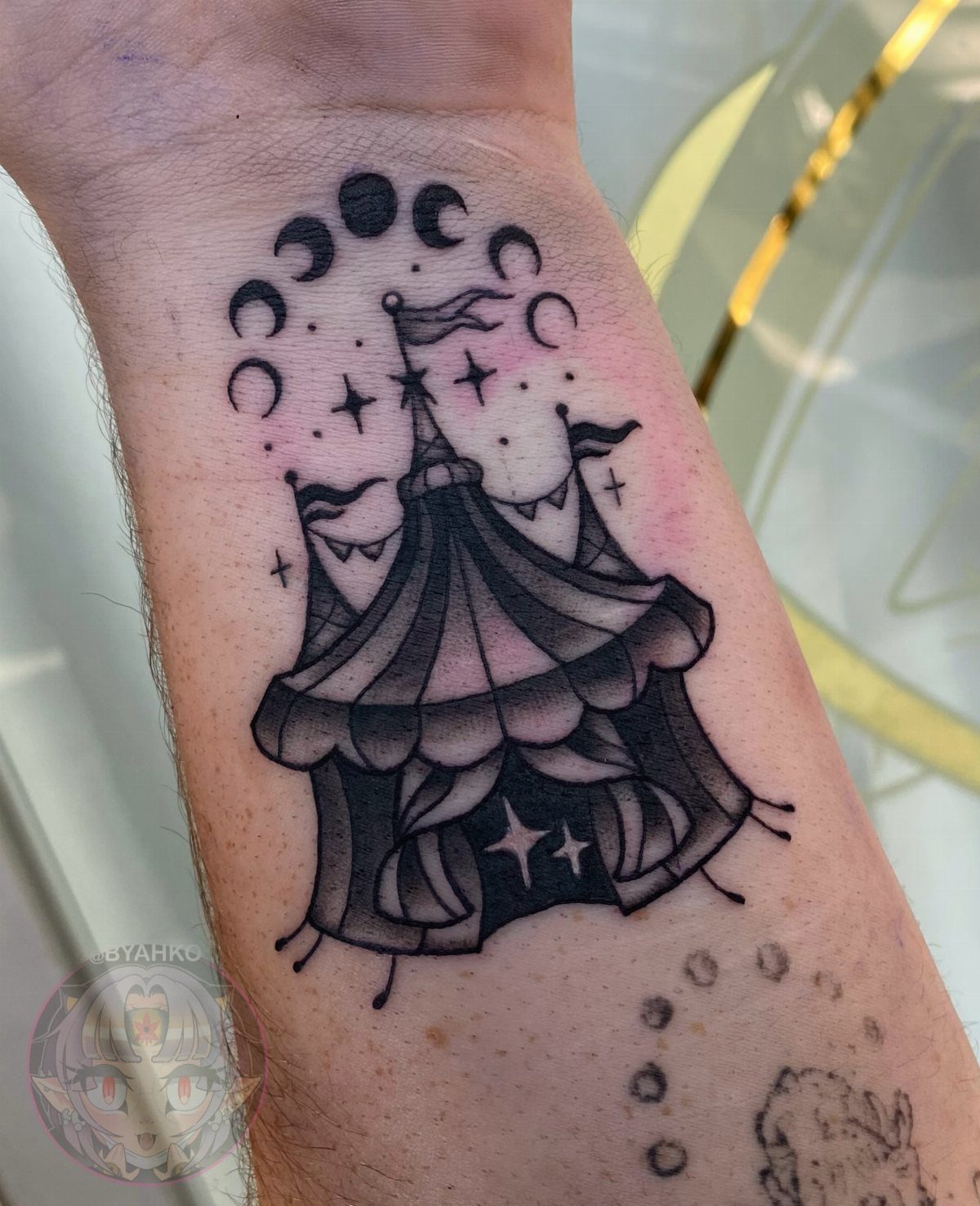
Moon phases arcing over the tent top and star scatter give the circus a night-show, slightly mystical tilt without dumping full occult symbolism on a basically playful subject.
The flags stay small and functional, marking the tent peaks rather than turning patriotic.
Black-and-grey on an inner wrist risks fading fast from wash and friction; the moon phases need to be sized bold enough that a waning crescent doesn’t seal over into a smudge before the line work softens.
I would ask to see one-year-healed wrist work from any artist before committing.
Symbolism of Tent Tattoos
Tent tattoos carry weight beyond the gear itself.
The shape speaks to shelter as a choice rather than a given, a portable roof you pitched yourself. That self-sufficiency reads differently than a house key or a door: the tent goes up, comes down, moves on.
For some wearers, the symbolism sits in memory work. A camping trip mapped onto skin preserves the feeling of a specific night, the way pine smell hung in the air or which friend laughed at the rain.
The tattoo becomes a[] trigger for that calm without needing the full scene spelled out.
The freedom reading runs stronger when the design stays stripped down.
A single triangle outline hints at escape from fixed address without spelling out anti-city sentiment. The circus tent angle shifts this toward spectacle and temporary community, the big top as shared hallucination that packs by dawn.
Placement Suggestions
The forearm offers flat, stable territory for tent geometry. Pole lines stay straight, guy angles read true, and the design ages where you can watch it.
The calf carries a different logic: the natural curve follows a pitched roof’s slope, though the artist must account for how the shape distorts when you flex or sit.
Upper arm placement sits under sleeves for office hours and shows at short-sleeve length.
The camping sleeve concept stretches across this whole canvas, but tent-as-element works better as one anchor in a larger scene than as the single focus at that scale.
The illustrative style noted for mountain-backdrop pieces demands room; compression turns pine silhouettes into hash marks.
Inner wrist, as with the celestial circus design, courts faster fade from daily washing and phone-hand friction. If the tent carries fine phase detail or thin line work, budget for touch-ins sooner than with outer arm placement.
Design Styles
Line art against skin tone lets the tent stand as structure rather than picture.
The fine-line camping piece keeps poles and fabric planes readable without heavy fill; the moment shading piles on, the tent starts reading as cave or mountain by mistake. Without that control, the flame collapses.
Color carries different risks and payoffs.
The circus tent demands red-and-white stripe separation; washed pink kills the read instantly. I would ask healed photos before committing, especially on paler skin where saturation drops fastest.
The illustrative outdoors sleeve uses color as atmosphere, river blues and mountain violets, but the tent within it usually anchors in neutral so the landscape moves around it.
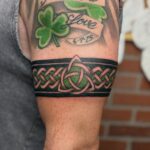
Traditional bold outline with floral framing, as in one noted design, softens the wilderness signal into something more decorative.
That cutesy appeal sits at odds with the rugged reading some campers want; the choice between approaches is really a choice about which camping self you’re tattooing.
Frequently Asked Questions
What are the meanings of camping tattoos?
Camping tattoos speak to shelter as something you choose and build yourself, not a fixed given.
The tent shape especially carries self-sufficiency, going up and coming down, moving on when you decide. For many wearers, the memory work matters most: a specific trip, pine smell in the air, a friend’s laugh in the rain.
A single clean triangle drops the camping read and turns into open-road symbolism, the same shape now meaning you can leave without needing to say goodbye to anything first.
The circus reading flips the mood from solitude to gathering; the tent becomes a place crowds meet under canvas that comes down before morning.
Where should a tent tattoo be placed?
Forearms stay flat enough that pole geometry holds and guy-line angles look right, and the daily wear lets you track how the ink settles over years.
Calves already mirror a roof pitch, though an artist has to map the design around how the skin stretches when you bend the knee or stand.
Upper arms stay hidden under a dress shirt and appear at T-shirt line, though a tent alone tends to get swallowed at that size and works better as part of a wider camp scene.
Inner wrists see soap and phone-scrubbing dozens of times a day, so the color breaks down faster there; plan on paying for refresh work earlier than other spots.
What tattoo styles work best for tent designs?
Open linework keeps the tent reading as architecture against skin, and a fine needle lets poles and fabric planes stay distinct without packing in solid tone.
Color needs precision for circus stripes; red and white have to hold their boundary, because once the red muddies into the pale it reads as weak and sun-faded rather than bright.
Before you book, ask the artist for photos taken a month after healing, especially on fair skin where pigment tends to sink and mute fastest.
Thick traditional outlines with floral corners pull the wilderness feeling toward something more domestic, a decision about whether you’re marking the camping you do or the camper you feel like being.