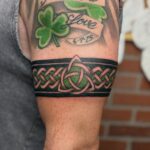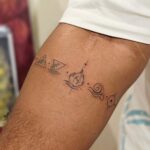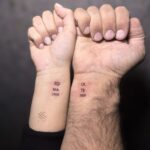
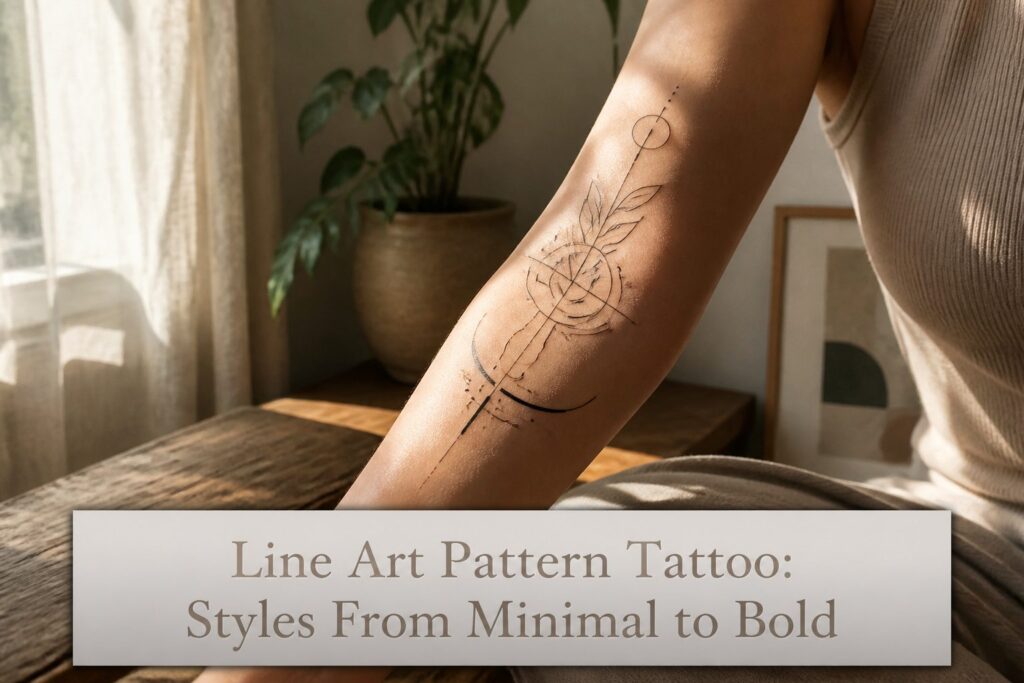
A line art pattern tattoo is any design built entirely from inked lines rather than filled shapes or shading, ranging from hair-thin single-needle work to thick bold strokes that hold their geometry across a room.
Your needle choice determines whether the piece lasts as a crisp drawing or blurs into something unplanned; a 3–4 mm needle lays down barely a millimeter of width, and on skin that moves and tans, that precision is either the effect you want or the flaw you will live with.
1. Minimalist Line Art
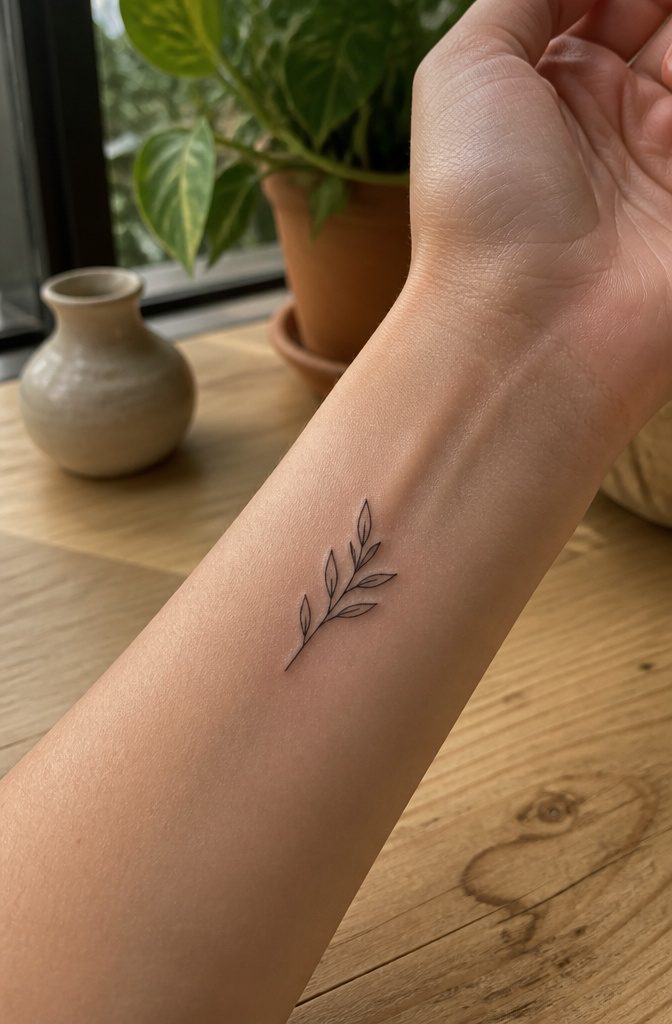
A single face contour or a spare botanical stem often carries more weight than a crowded sleeve when the line quality is clean.
That spareness is exactly what makes minimalist line art work: the line itself becomes the entire point, not a border around something else.
A 3–4 mm needle produces these fine lines, depositing just enough ink to hold without blooming into the surrounding skin. The result ages well.
Thin lines can blur over time, but a deliberately simple shape has less to lose; a leaf stem that reads as a leaf stem at five millimeters still reads as a leaf stem when it softens to seven.
This style suits first tattoos for practical reasons.
The sessions are quick, the cost stays low, and the placement options are wide: wrist, ankle, collarbone, behind an ear. Small areas where clutter would look accidental and a single mark looks intentional.
A first tattoo is often an experiment in how living with one feels; minimalism keeps the stakes correspondingly small while still leaving a mark that feels designed rather than tentative.
2. Single Line Continuous Drawing
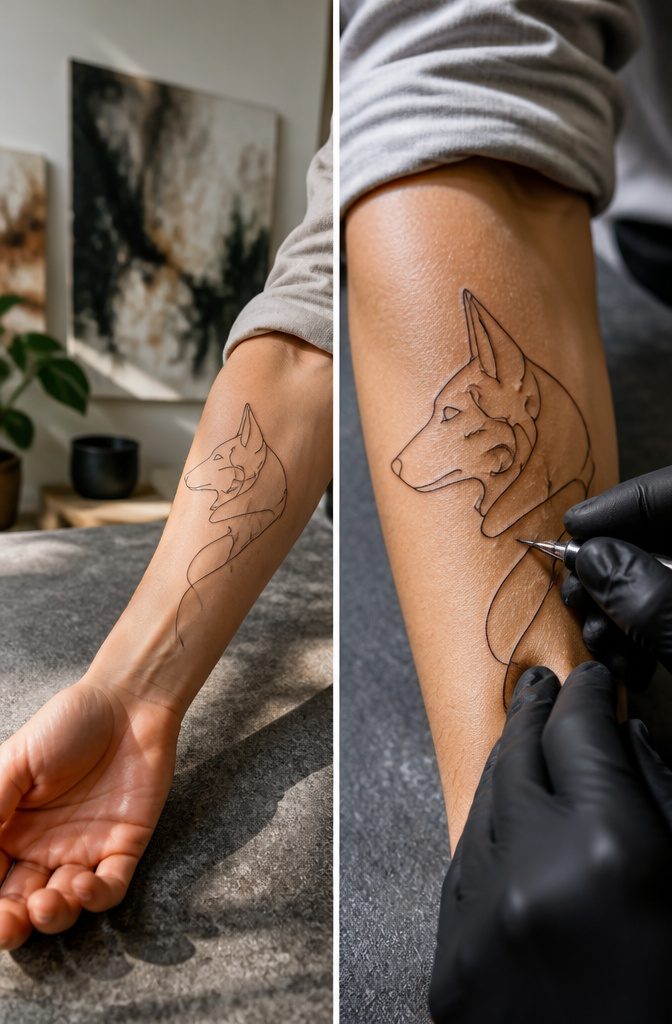
A single line continuous drawing tattoo is exactly what it sounds like: one unbroken line that starts, travels through the entire design, and finishes without ever lifting from the skin.
The effect looks effortless, almost like a quick sketch someone dashed off in one breath, but the precision required makes this one of the harder styles to execute cleanly.
Every curve, every proportion, every relationship between features depends on that single path being exactly right.
The style lends itself especially well to expressive faces, animal profiles, and abstract figures, where the continuous stroke itself carries a kind of narrative weight. A small piece typically takes 1–2 hours to complete, while a more complex composition runs 2–3 hours.
The session tends to run shorter than similarly sized work in other styles because the technique uses less ink and fewer needle passes, which also means the pain level sits lower on average.
Placement tends toward surfaces that suit the delicate quality of the line. The wrist and inner forearm remain the most popular spots for collectors, with the ankle, lower calf, and the small space behind the ear following close behind.
Behind the ear in particular has become one of the more intimate placements in contemporary tattooing for this style. A tiny portrait or minimal form there reads as personal rather than performative.
3. Geometric Line Art
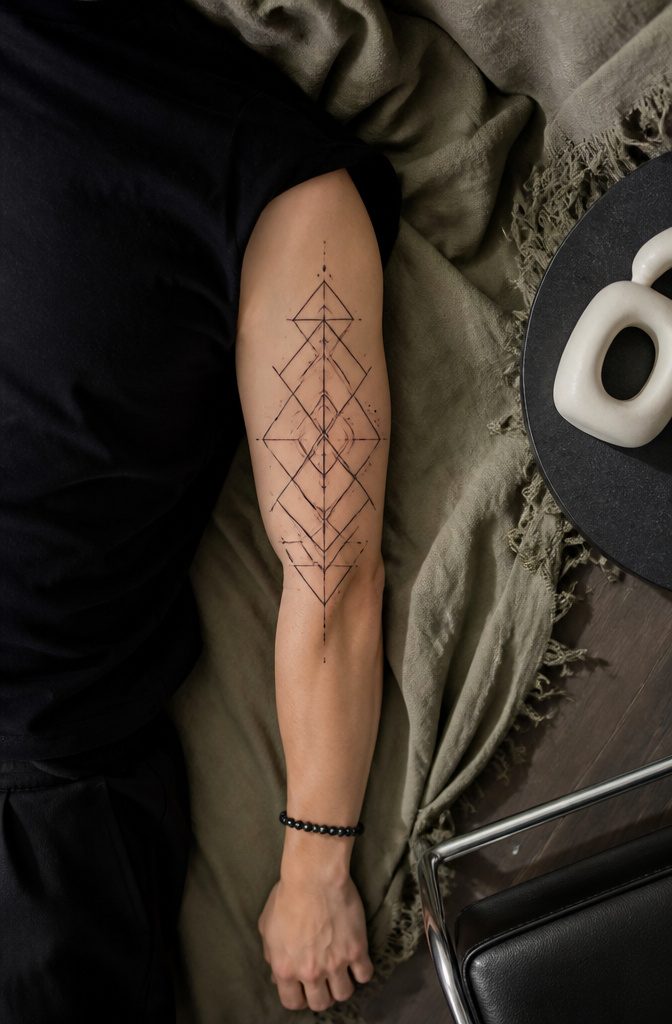
Geometric line art lives or dies on whether the math can survive a curve. Straight lines, mirrored halves, and repeated angles read as calm and controlled when they sit flat against a surface, but skin is never flat.
A mandala drawn for the center of the chest will distort when the shoulders roll forward; a hexagon belted around a forearm straightens into something closer to a band when the elbow extends.
The symmetry has to be planned for the pose where it will be seen most, which usually means standing straight with arms at rest, not the anatomical drawing table.
Sacred geometry and architectural concepts rely on relationships that are easy to check: if one side of a triangle measures 2 inches, the other sides carry that ratio whether the design wraps toward the ribs or stays on the flat plane of the shoulder blade.
Animal faces split down the center need the spine of the design aligned with a body line that does not torque in normal movement.
The repetition itself is what gives the tattoo its sense of order, but each repeated unit has to be scaled to the convexity or concavity it crosses.
An artist who maps the geometry directly from a flat stencil without accounting for how the circumference of a calf or the swell of a hip will stretch those intervals is producing a design that looks precise only in the photograph taken immediately after.
4. Illustrative Line Art
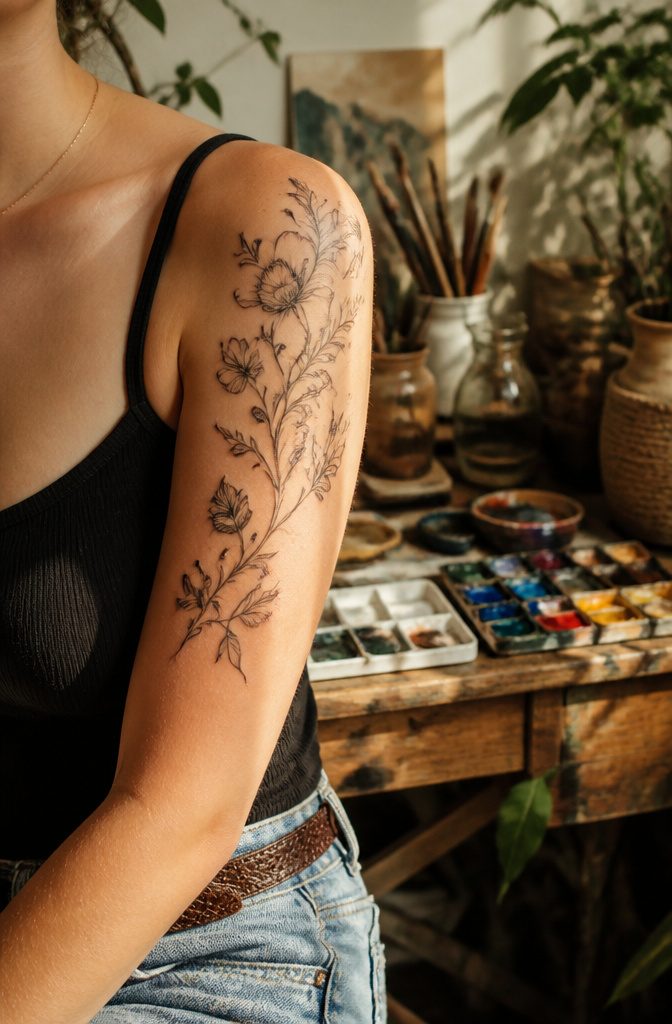
The sketch-to-skin quality of illustrative line art is what separates it from tighter styles. Lines keep the energy of a drawing still warming up, with weight that shifts mid-stroke and details that fade out rather than resolve.
That unfinished texture makes the artist’s hand impossible to ignore, and for some wearers that visibility is exactly what they are after; they want the tattoo to read as a piece carried off the page, not a symbol manufactured for the body.
This looseness also leaves room for interpretation that more rigid line work shuts down.
A botanical in this style might show the plant accurately enough to name, but the stem breaks, the ink lightens, and the viewer fills in the rest.
The balance between recognizable form and open space is deliberately unsettled, so the tattoo keeps shifting the longer you look at it.
It sits between the harder categories that usually get listed: less literal than realism, less fixed than pure geometry.
People who choose it tend to value the evidence of decisions being made mid-process, and the result carries that sense of ongoing interpretation rather than a sealed meaning.
5. Dotwork and Stipple Line Art
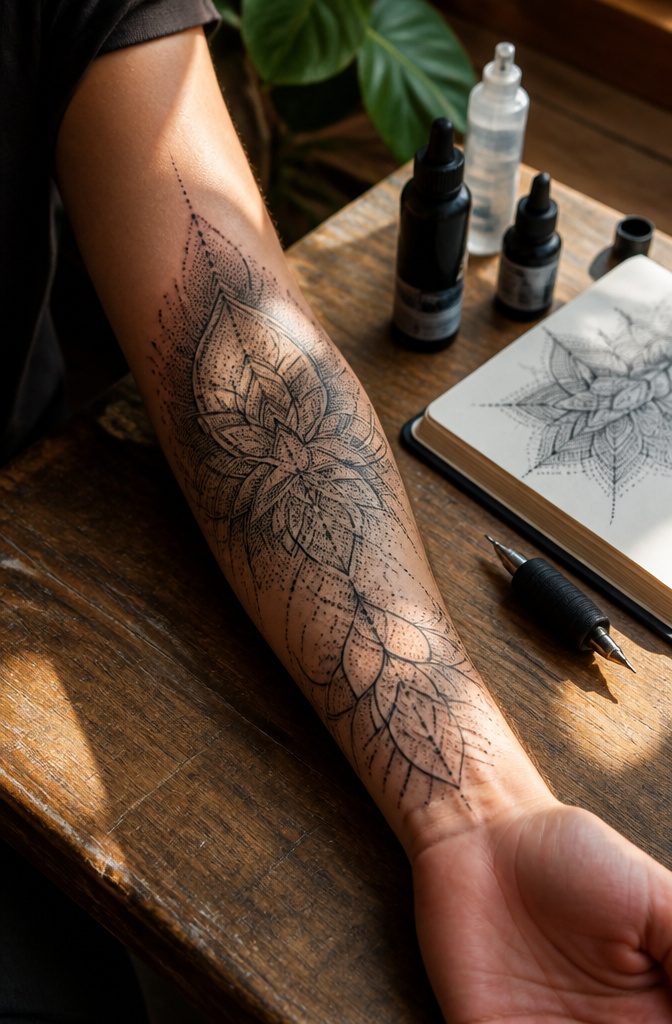
Dotwork builds tone the same way a halftone print does: the closer the dots sit, the darker the surface reads from a few feet back.
Pull them apart and the tone lightens; cluster them and you get shadow. The technique is slow by nature, because each mark is placed by hand, and that patience shows in the finished piece.
A dense stipple pattern on a small area can look sharp on day one and lose definition faster than a broader composition with breathing room, so scale matters more here than with solid linework.
What dotwork does not do well is stand alone in a design that needs crisp structure.
The texture softens edges by default. Pair it with clean, continuous lines and the contrast does the work: the linework holds the shape, the stipple adds depth and atmosphere without muddying the form.
Mandalas and abstract shapes handle this balance especially well, since the geometry gives the eye a reference point while the dots create variation inside it.
Ask your artist where the darkest regions should land and how the dots will read against the surrounding skin. The seating logic matters as much as the image itself.
6. Sketch and Graffiti Line Art
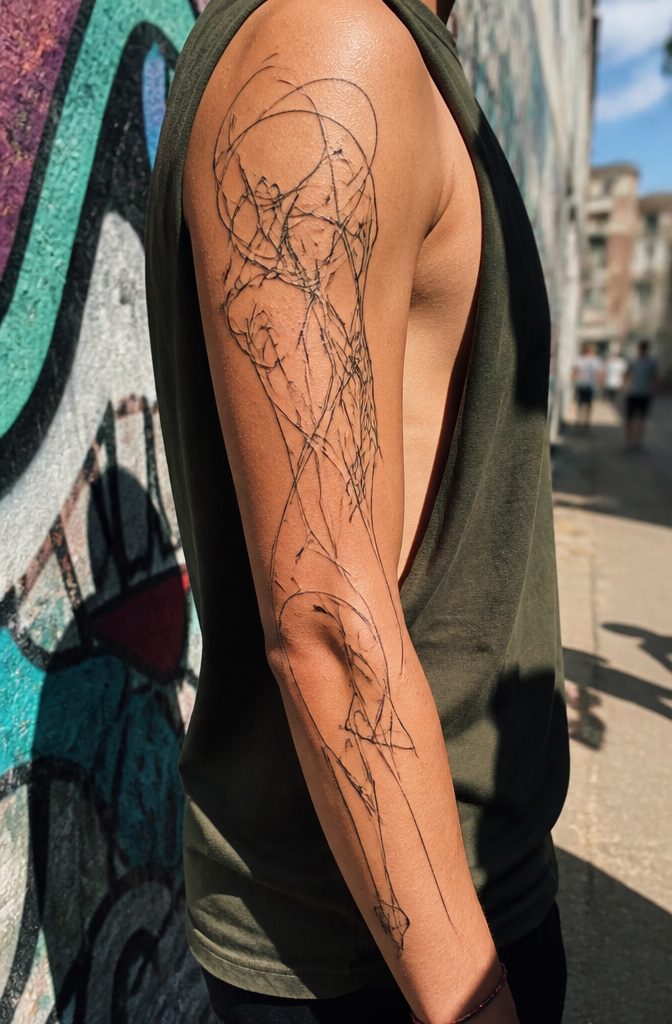
A sketch line art pattern tattoo carries the energy of a drawing that got away from the artist’s hand, the kind of mark that happens when the pen never leaves the page and the wrist keeps moving.
Street art and unfinished marker studies feed into this style deliberately, trading clean edges for motion the eye can follow across the skin.
The lines wobble, overlap, or trail off entirely, and that imperfection is exactly what gives it life: it reads as action caught mid-gesture rather than a illustration frozen in place.
Single-line abstract work pushes this further into pure gesture, letting the mark become the subject instead of framing anything recognizable.
The artist’s hand becomes visible in the weight of the stroke, where pressure thickens the ink and speed thins it back out.
Two paths sit in front of you if this style appeals to you: let the motion suggest something half-recognizable, a figure or face dissolving into its own lines, or keep it fully abstract and let the energy alone carry the piece.
The first risks looking like a mistake if the reference doesn’t break through clearly enough; the second demands placement where the body’s own movement can animate the still marks, since no subject will do that work instead.
Energy matters more than resolution here, and the best pieces look like they were finished in the time it took to exhale.
7. Linework with Negative Space Integration
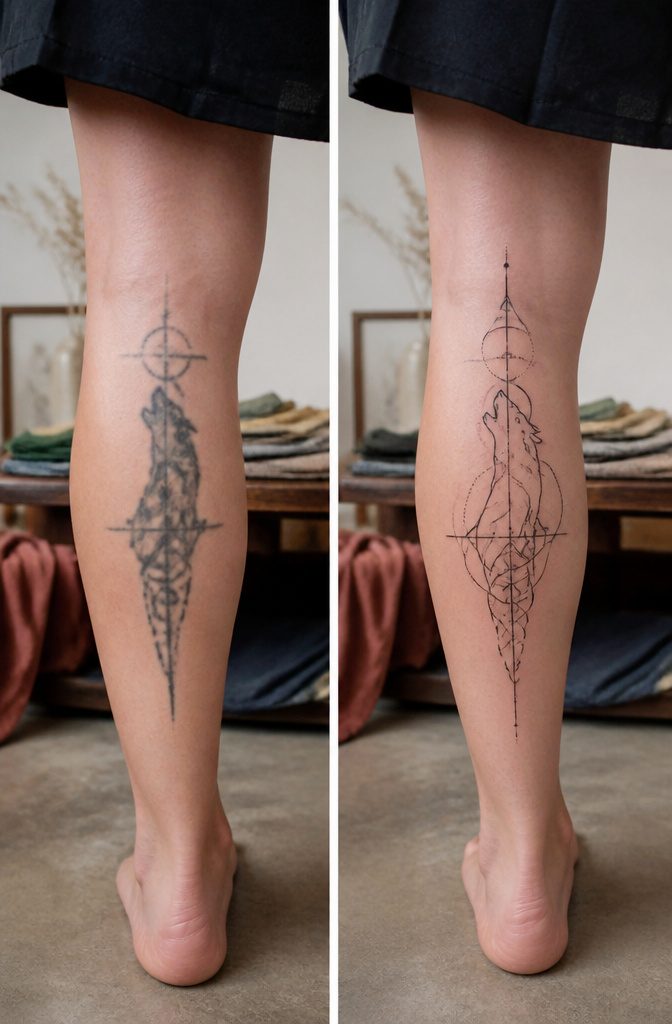
The un-inked skin in these designs stops being empty background and becomes literal shape.
A geometric piece might hold a second form inside the gaps between its inked lines, or an animal silhouette could reveal a face or path in the spaces the needle never touched. That shift changes how the piece ages.
Solid fill tattoos blow out or fade toward a uniform haze, but negative space keeps its contrast almost by default because the skin there was never punctured. The "color" is permanent, in a sense.
Where this goes wrong is spacing. Too narrow a gap and the un-inked channel collapses into the surrounding line as it softens over years; too wide and the hidden form reads as accidental blankness.
The artist has to plan the empty shape with the same precision as the linework itself, usually in a longer consultation than other styles demand.
Geometric pieces with hidden forms, animals carrying secondary silhouettes, and nature designs where the gap itself becomes a symbol tend to work strongest here, giving a layered look without the visual weight of heavy fill.
8. Bold Line Work Tattoos
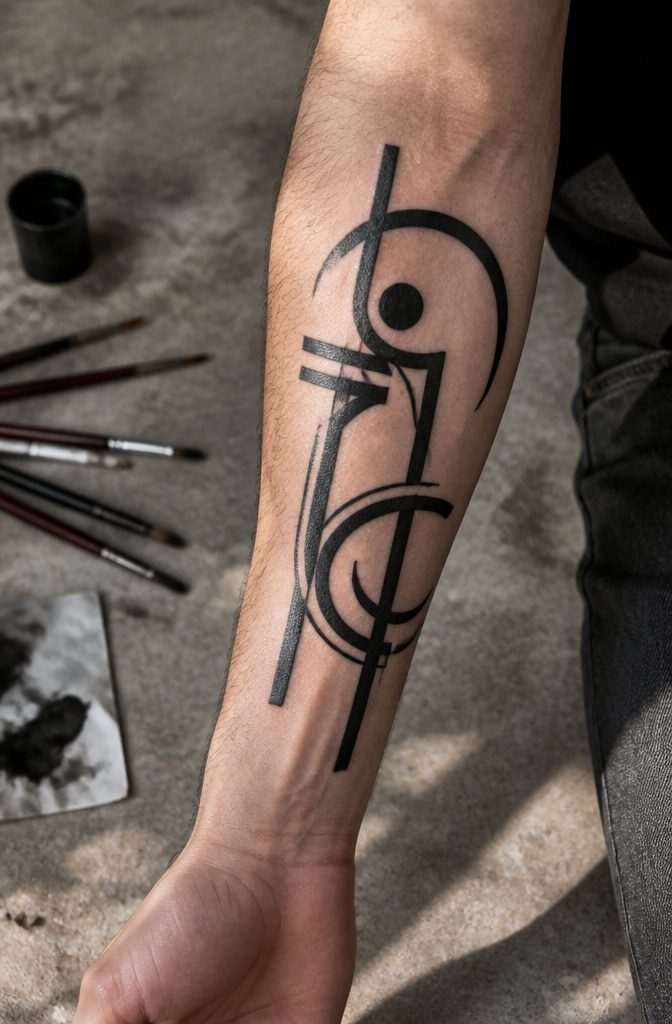
Thick lines carry across a room the way fine lines never will.
A bold line art pattern tattoo holds its geometry from across a street or through a sleeve gap, and that visibility is exactly the effect the wearer wants: the design announces itself before anyone is close enough to parse its details.
The weight matters because skin is not paper. A hairline stroke that looks crisp on a screen or fresh out of the chair has a different future.
Owners on Reddit mention watching fine lines thicken and lose definition as the ink settles and spreads beneath the surface; one described the slow blur that turned a delicate forearm piece into something fuzzier than planned.
Bold work spreads too, but it spreads inside its own borders, so the shape survives. The line gets slightly softer at its edge rather than doubling in apparent width and collapsing into itself.
That stability makes bold line work the practical choice for anyone who wants a pattern tattoo to read clearly at five years or fifteen, not just on the day it was done.
Needle Choice and Technique
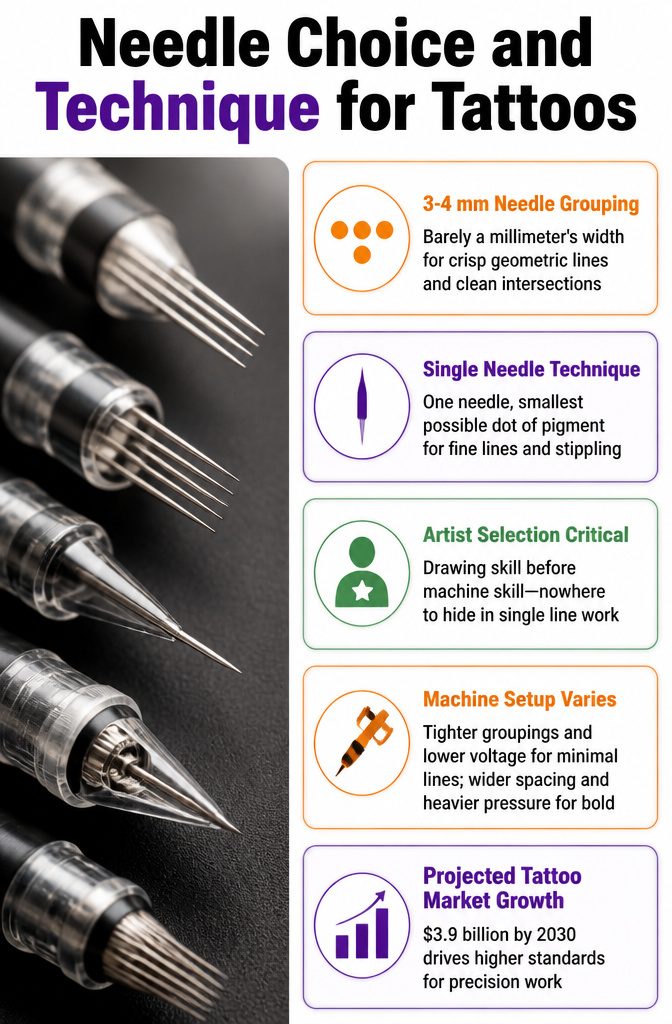
The 3–4 mm needle grouping is what separates a fine line art pattern tattoo from a bolder piece.
At that diameter, the artist can lay down ink at barely a millimeter’s width, which is the only way to keep geometric intersections crisp or to let a single continuous line read as deliberate rather than shaky.
Single needle technique pushes this further: one needle, not a grouped cluster, deposits the smallest possible dot of pigment.
Choose a needle that matches the detail level the design demands; hair-thin lines and stippled texture fading into skin need a fine point, while anything thicker betrays that kind of concept.
Artist selection matters more here than for traditional work because there is nowhere to hide.
A 9 mm mag shader can forgive a wobble inside a solid black field. A 3 mm liner in unshaded skin cannot.
The drawing skill has to precede the machine skill; sources describe single line work as the clearest divider between those who can draw and those who cannot, and that judgment survives permanently on your arm.
Machine setup shifts with the style.
Tighter groupings and lower voltage suit the minimalist end. Wider spacing and heavier hand pressure move the same vocabulary toward bold line work, though that territory belongs to another section entirely.
The projected U.S. tattoo market of $3.9 billion by 2030 signals rising collector expectations and, in theory, wider access to artists who specialize in this precision.
The needle is small. The margin for error is not.
What These Designs Mean
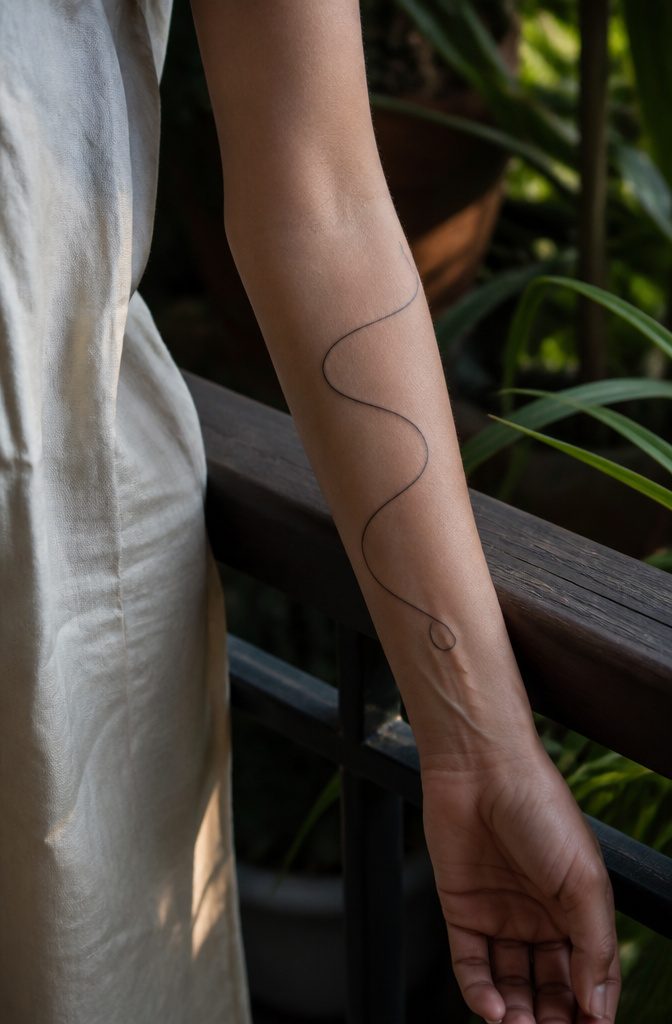
The unbroken line of a single line tattoo carries meaning in its very technique: one continuous path with no breaks, no retracing. That physical unity tends to read as emotional unity.
Simplicity, connection, the idea that everything holds together even when it looks fragile. The same design in a pictorial style might bury that under shading and color; in line art, the meaning sits right on the surface.
Abstract single line work pushes this even further. These marks are gestural drawings made permanent, carrying the energy of the artist’s hand without depicting anything specific.
What they symbolize depends entirely on what the wearer brings: a curve might mean a journey, a tight loop might mean a return. The openness is the point.
A single black line can stand for simplicity or unity.
A single red line can signal passion, love, or courage. The color choice itself becomes part of the statement, not decoration.
Animals rendered in one continuous line often represent freedom or identity. The wearer’s own relationship to that animal matters more than any fixed dictionary.
A wolf drawn in unbroken line reads differently than a wolf in full realism because the technique itself insists on flow and interconnection rather than dominance or isolation.
The risk is choosing a symbol so personal that explanation becomes necessary. Line art generally does the opposite: its directness lets meaning land without a footnote.
Where to Place Line Work
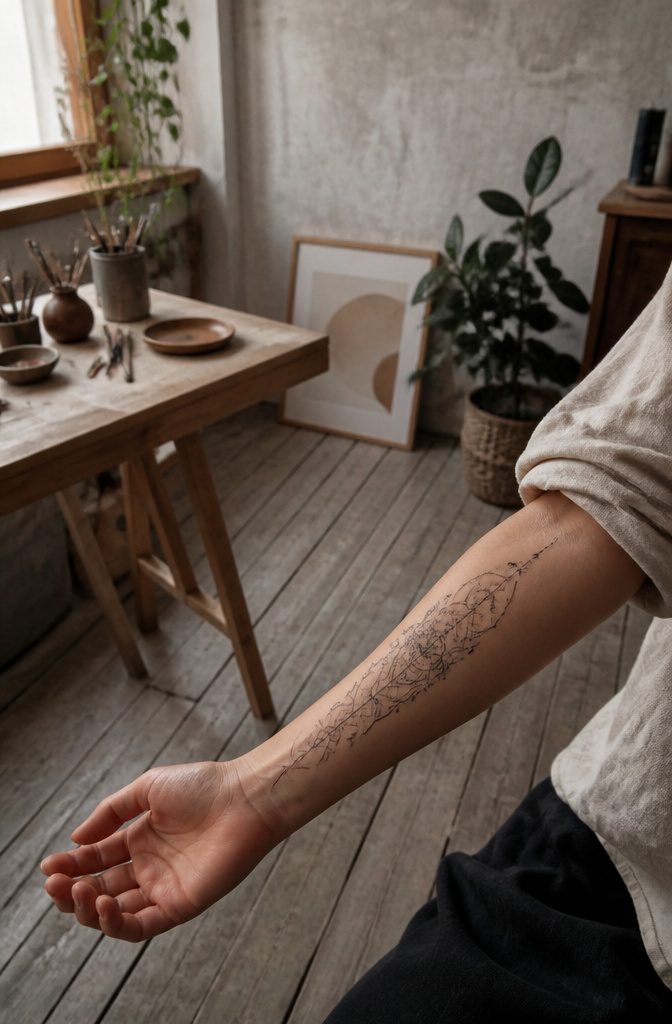
The wrist and inner forearm draw most single line work, since their visible, flat surfaces match the delicate precision those tattoos need.
A tiny portrait or abstract form behind the ear hits that same intimate note, while the ankle and lower calf hide easily under a sock or pant leg when coverage matters.
Placement shapes how a line art pattern tattoo ages more than people expect. Sun exposure on the collarbone blurs fine lines faster than on a wrist that sees sleeves nine months a year.
Skin stretching matters too: the forearm’s relative stability beats the ankle, where walking and shoes shift the skin daily. Owners on Reddit mention learning this late, watching fine lines they’d hoped would stay sharp thicken within a couple of years.
All tattoos spread as they age, but the gap between a single needle’s whisper and a blown-out blur widens fastest where skin moves and tans most.
Frequently Asked Questions
What is a single line tattoo?
A single line tattoo is a design created with one continuous, unbroken stroke that starts, travels through the entire image, and finishes without the needle ever lifting from the skin.
The constraint looks effortless when done well, but the precision required makes it one of the harder styles to execute cleanly. Every curve and proportion depends on that single path being exactly right.
How long does a single line tattoo take?
A small single line piece runs 1–2 hours, while a more complex composition typically needs 2–3 hours. The session stays shorter than similarly sized work in other styles because the technique uses less ink and fewer needle passes.
Are single line tattoos painful?
Single line tattoos tend to hurt less than larger, shaded work because the technique uses fewer needle passes and less ink overall.
The pain level sits lower on average compared to styles that require heavy filling or repeated passes over the same area.
What is line art in tattoos?
Line art tattoos are designs built from clear, precise lines in a single ink color, with no shading or fill required to read the image.
The style ranges from minimalist single strokes to complex geometric or illustrative compositions, all held together by the line itself rather than surrounding tone.
How long do line art tattoos last?
Fine lines blur over time as ink settles and spreads beneath the skin, but deliberately simple shapes age better than crowded ones because they have less detail to lose.
Bold line work survives longer since it spreads inside its own borders rather than doubling in apparent width. Sun exposure and skin movement speed the process, so placement on stable, covered areas like the inner forearm helps longevity.
What are the tattoos with lines called?
Tattoos built from lines go by several names depending on their structure: single line or continuous line tattoos use one unbroken stroke; fine line tattoos rely on needles as narrow as 3–4 mm; geometric line art uses repeated angles and mirrored shapes; and illustrative line art keeps the loose energy of a hand drawing.
All fall under the broader term line art tattoos.
What is the 1/3 rule tattoo?
The design and placement principles discussed here focus on how symmetry, spacing, and line weight interact with the body’s natural curves rather than on fixed proportional ratios.