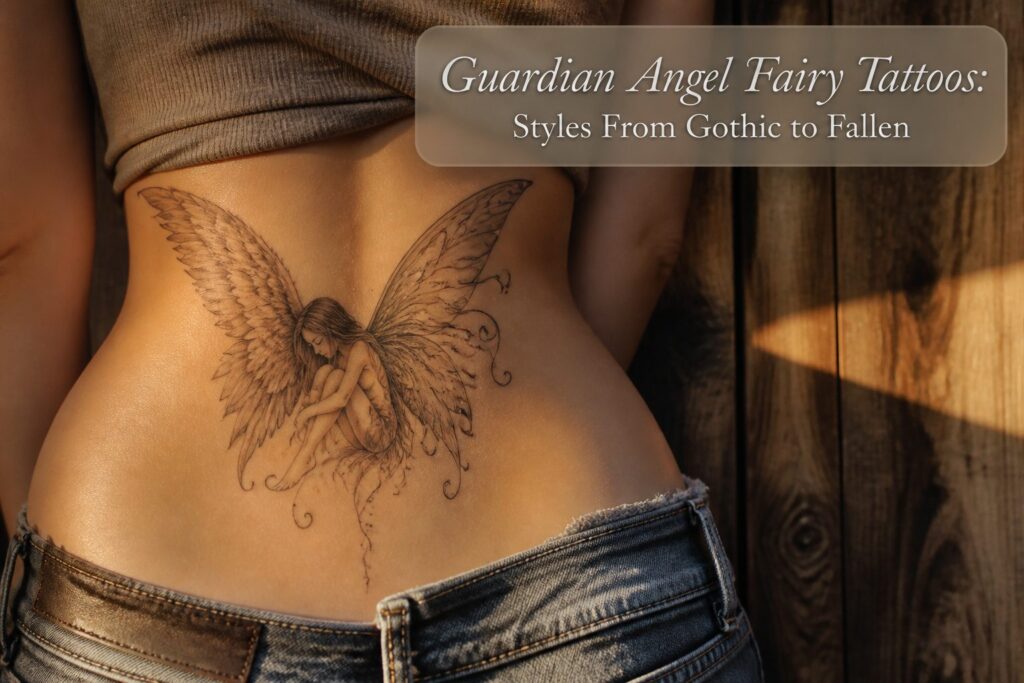
A guardian angel fairy tattoo merges two protective figures into one design: the spiritual watch of an angel with the earthy, mischievous spirit of a fairy.
The combination only works when the artist balances both identities; lean too far toward either and the guardian becomes generic or the fairy loses her weight.
One woman spent months sketching wings before she realized she wanted not beauty alone, but the sense of being watched over.
1. Gothic Fairy Tattoos
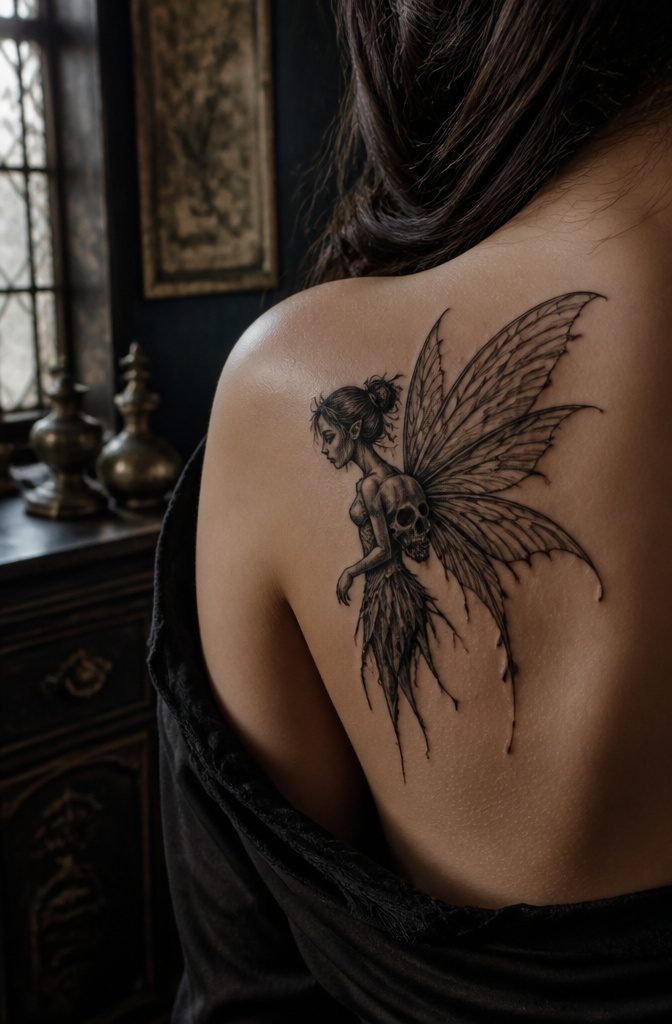
Gothic fairy tattoos take the delicate silhouette you already picture, wings thin as tissue, and dress it in black. The skulls show up occasionally, not as decoration but as weight, something for the fairy to carry or stand against.
That contrast isn’t gloom for its own sake.
Sources describe it as strength and power in adversity, the innocence still visible in the face and the wings, but the eye drawn to the darkness it wears. The balance matters.
Too much edge and you lose the fairy entirely; too little and it’s just a costume. The best pieces keep the bone structure delicate, the features small, the black clothing doing the heavy lifting of the mood.
This style works when you are in a season that needs the reminder. Something sweet surviving something hard.
The skull does not announce itself. It sits in the composition like evidence.
2. Celtic Fairy Tattoos
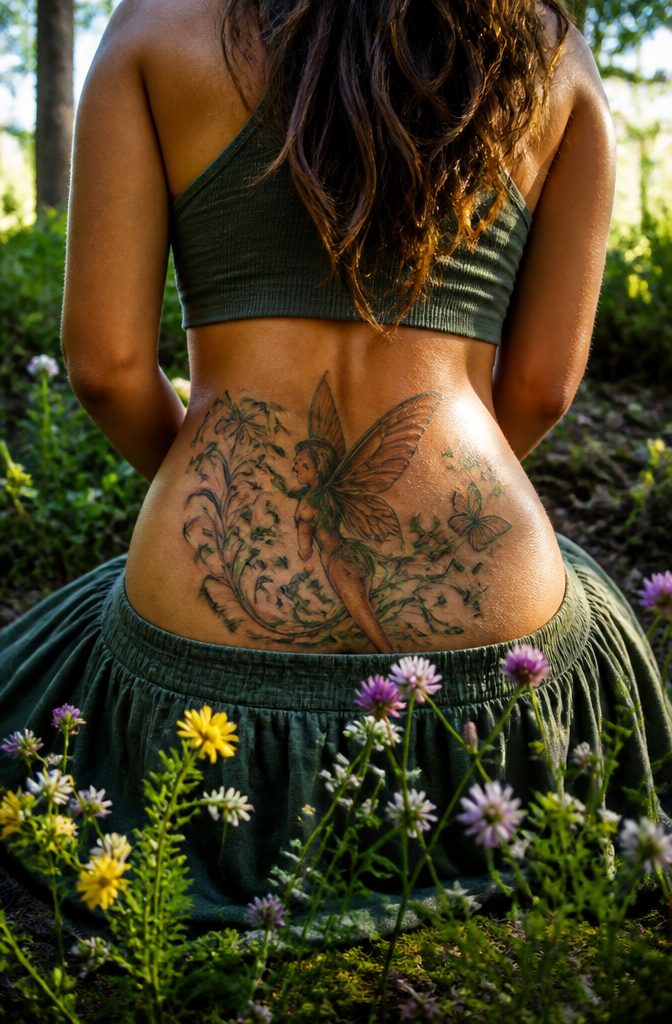
Celtic fairy tattoos carry a rooted, earthy spirituality that sets them apart from more whimsical styles. The designs draw heavily on pagan symbolism, often placing the fairy figure amid butterflies, flowers, and dense forest growth.
This is not accidental ornament; each element serves the same purpose of tying the figure to living nature rather than isolating her as a decorative sprite.
The connection to Mother Earth reads clearly in the detail work. Where other fairy styles might emphasize flight or fantasy, Celtic work keeps the feet on the ground, sometimes literally winding roots or vines through the composition.
Someone drawn to this style usually wants that grounded quality, a sense that the guardian figure belongs to the natural world rather than floating above it.
Butterflies and flowers are not mere accents here; they function as visual proof of the fairy’s closeness to living things.
The overall effect is less ethereal and more territorial, a spirit who protects by belonging to a place rather than passing through it. For a tattoo meant to last decades, that rootedness can feel like the point.
3. Sensual Fairy Tattoos
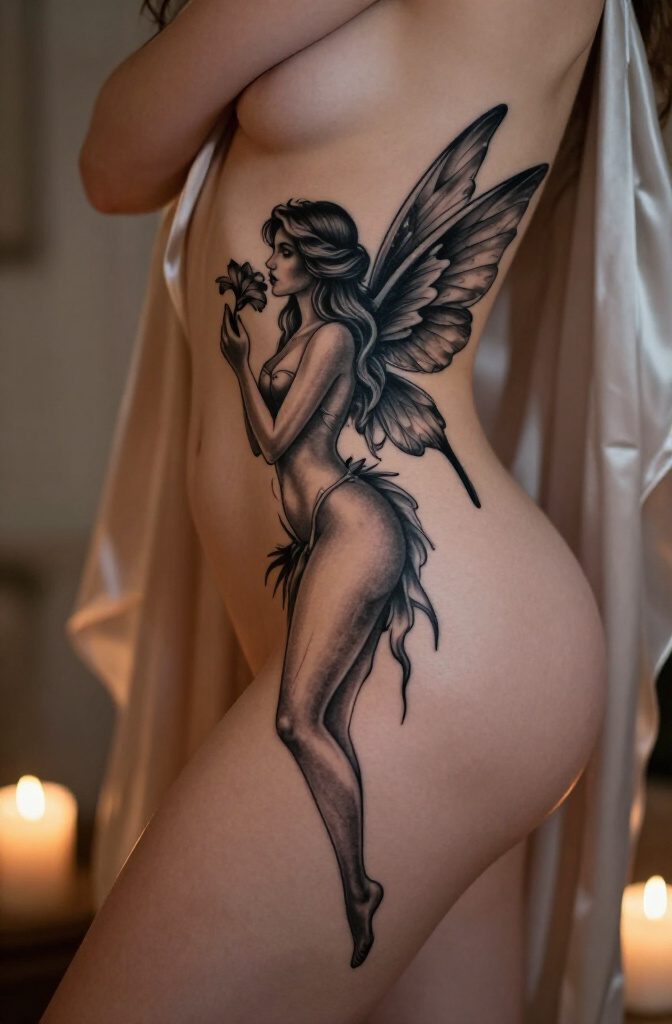
A woman with wings carries a different charge than a fairy rendered as a sprite or a child. In sensual fairy tattoo designs, the body is fully present: curves, posture, the weight of the figure on the skin.
Artists handle this by letting the wings do symbolic work. Large, dark wings cast the figure as fallen or untouchable; lighter, translucent ones read as ethereal but still distinctly adult.
The femininity in these pieces is not delicate. It is power held in reserve, the threat of it visible in a turned shoulder or a direct gaze.
Some designs weave in temptation imagery: a bitten apple, a flower held too close to the face.
Others keep the symbol quieter, letting the body’s stance suggest what the fairy might offer or refuse. The line between sensual and overt sits in the eyes, usually.
An artist I watched work once spent 40 minutes on the mouth, five on the wings. That ratio says everything about what the owner wants caught first.
The pull for the wearer is control.
These are not passive figures waiting to be looked at. They return the look, or they withhold it entirely, and that choice is what makes the tattoo functional as ink rather than just decorative.
Black and grey handles the ambiguity better than bright color, which tends to flatten the mood into something more pin-up than powerful, though both approaches have their audience.
4. Crying Fairy Tattoos
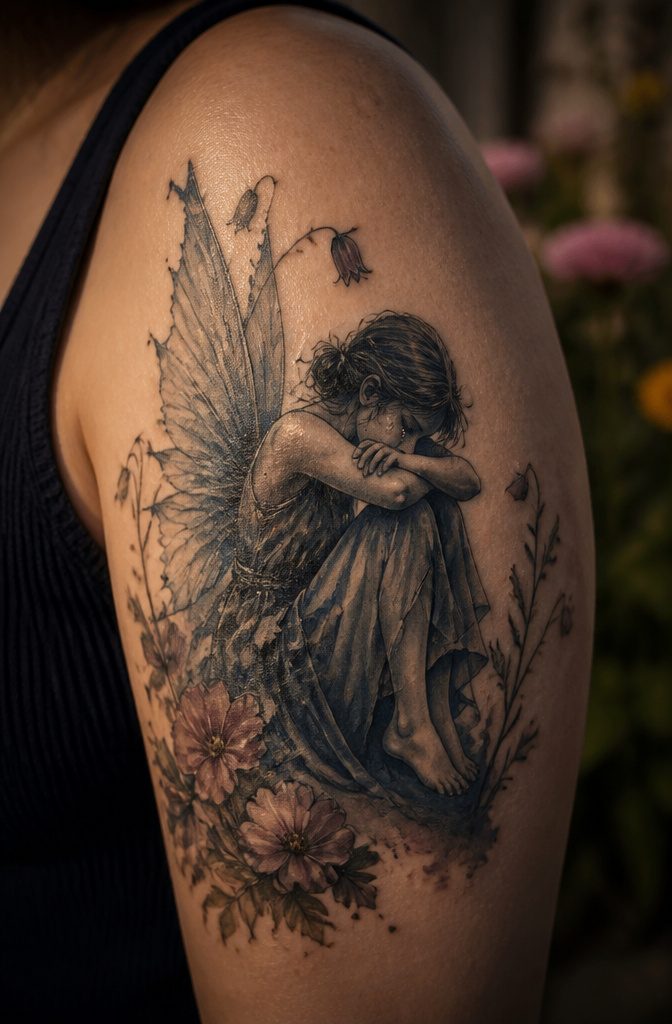
Sadness in a fairy tattoo carries weight that brighter designs skip past.
The crying fairy sits with her wings dropped, sometimes on a flower or at the edge of a forest, and the image reads as loss of innocence rather than simple sorrow.
Someone choosing this has usually hit a moment that changed them: grief, a divorce, recovery from addiction, surviving something that broke the old self.
The appeal is not aesthetic. A crying fairy does not flatter the skin the way a soaring guardian angel might.
What it offers is permission to stop performing strength. The tear itself becomes the small honest mark that says the pain was real and was survived, not ignored.
Transformation shows up here too.
Several women I have talked with about ink framed the crying fairy less as mourning and more as the halfway point: the old self weeps, the new self has not arrived yet, and the body carries that liminal state until it resolves.
One described hers as "the last thing I got before I stopped explaining myself to men." The fairy acknowledges the emotion without turning it into a story for other people.
Pain acknowledgment matters most. A tattoo that validates what you went through, without requiring you to narrate it at every pool party, serves a function that prettier designs rarely match.
5. Magical Fairy Tattoos
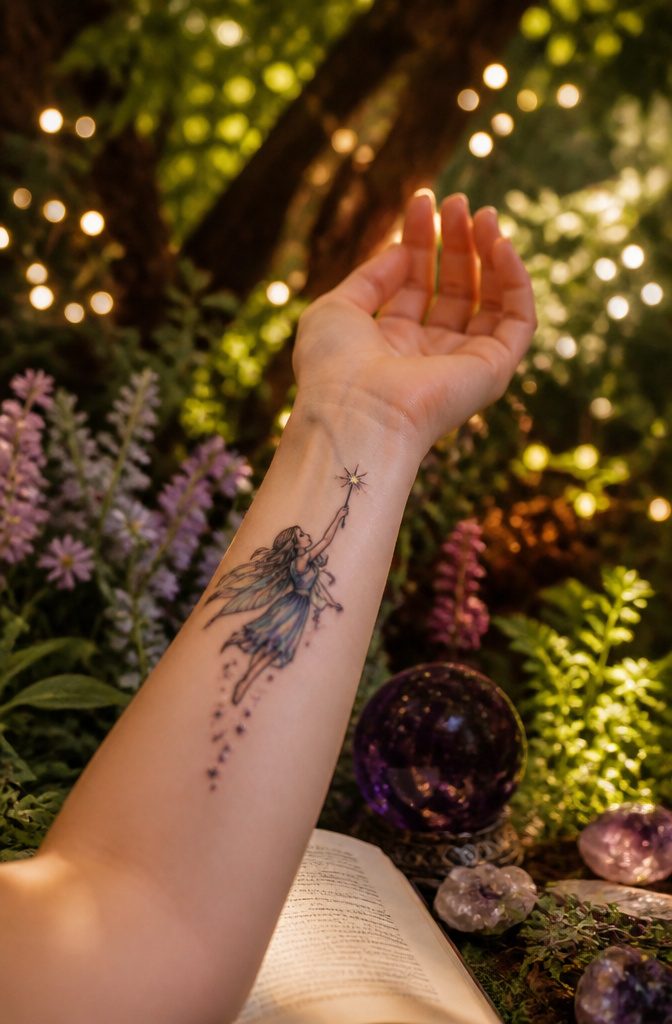
The classic fairy silhouette owes everything to its literalness: a small figure with transparent wings and a wand raised mid-spell, posed like something caught in a photograph the camera almost missed.
This directness is the point. Where more abstract guardian angel fairy tattoos ask the viewer to decode layers, this style states its job without preamble: magic as an active, chosen intervention.
That wand reads as personal agency made visible. The symbolism here sits less in protection received than in protection conjured; the bearer becomes the source of the spell, not its object.
Wish fulfillment follows from the same logic, since the gesture implies reality still open to revision, the wand’s tip pointed toward an outcome not yet fixed.
For women who scan ingredient lists and distrust vague promises, this design offers a candor that resonates. Magic in these designs works through three things: the visible tool, the clear intention, and the moment the spell is cast.
The wings stay delicate, almost insect-thin, so the power registers as earned precision rather than brute force. The message is not that fairies exist, but that the wearer has learned to operate the wand herself.
6. Guardian Angel Tattoos
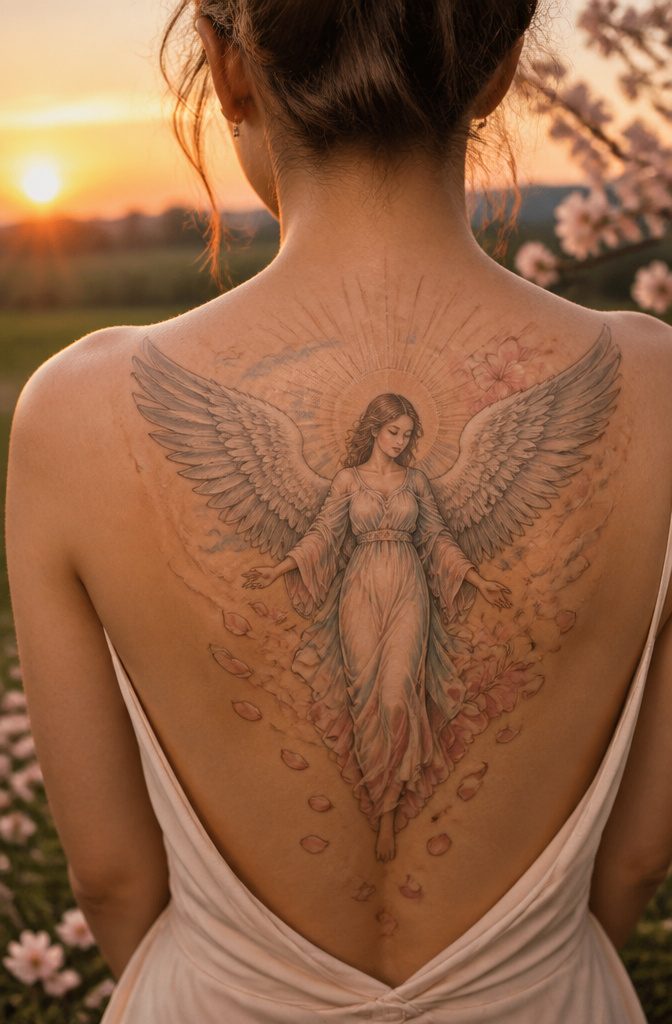
Guardian angel tattoos carry a spiritual weight that sits somewhere between comfort and command.
Where fairy designs lean into mischief and earthly magic, guardian angels keep the tone solemn, focused on protection you can feel against your skin during hard moments.
The intent is different: fairies guard a wilder, more playful kind of femininity, while guardian angels promise guidance through trauma and loss.
People who choose between the two are usually deciding which side of themselves they want the ink to name. Some pair them, letting the fairy’s impish edge soften the angel’s severity, or letting the angel’s steadiness anchor the fairy’s whimsy.
Others know immediately which one fits. A friend of mine, after her divorce, spent months sketching wings before she realized she didn’t want beauty alone; she wanted the sense of being watched over.
The comfort is real and practical.
Guardian angel tattoos are often chosen after difficult experiences, worn as a reminder that protection still exists. The design is less about aesthetics and more about what you need to believe is true.
7. Fallen Angel Tattoos
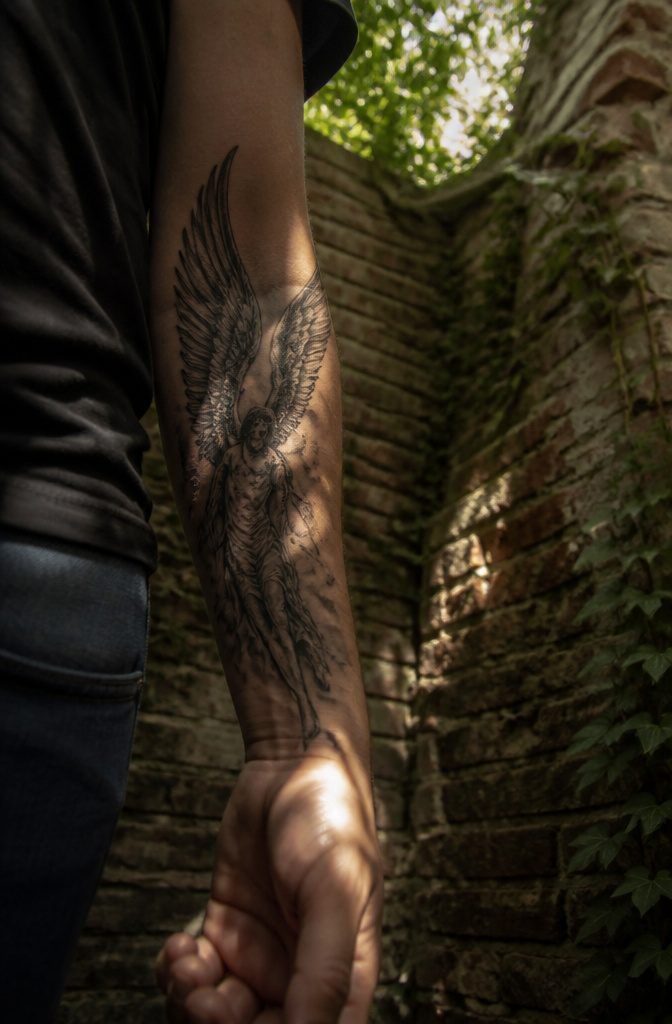
Some of the strongest guardian angel fairy tattoos sit right on the edge of threat.
Fallen angel designs carry that duality deliberately. The wings darken, the posture tilts from watchful to defiant, and the face can shade toward something biblical sources would recognize: Lucifer’s rebellion, the refusal to obey, the expulsion from paradise.
This ambiguity draws people who do not want their ink to read as simple protection. Rebellion and submission live in the same image.
Light and dark share the same body. The wearer gets complexity without surrendering the original guardian frame entirely.
Placement tends toward concealment.
These designs carry weight, and the people who choose them usually know it. That said, the fairy element softens the threat, or complicates it, depending on how the artist blends the two forms.
What Guardian Angels Mean in Ink
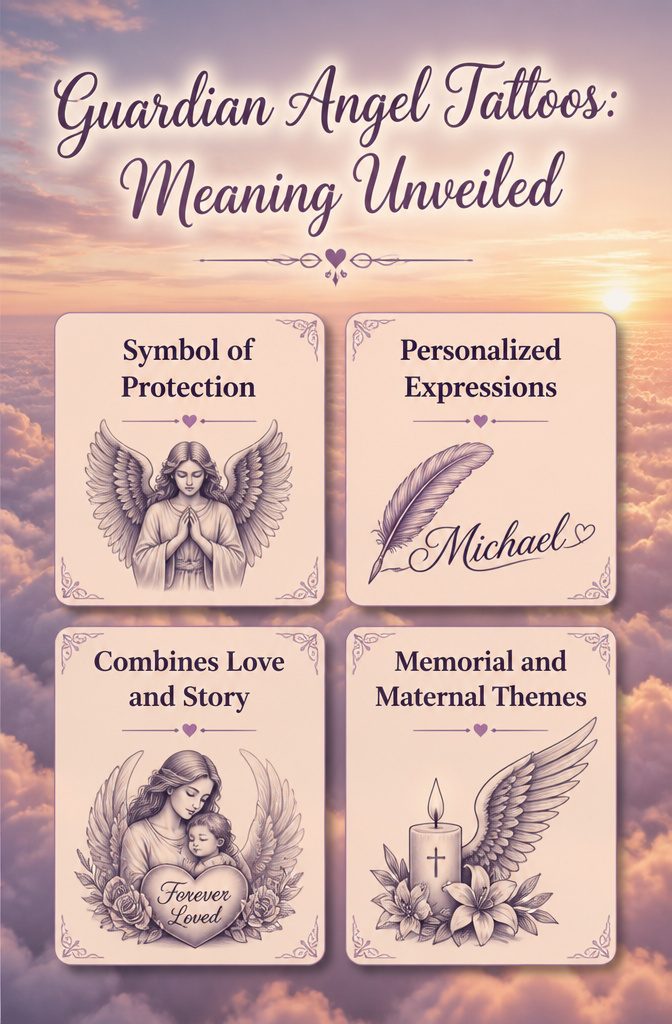
A guardian angel in ink carries the same promise as one in prayer: someone watching, someone who stays. The difference is permanence.
Prayer is spoken and released; skin keeps the job open, visible even when faith wavers. That visibility is what draws people to the image.
A tattooed guardian angel does not ask the wearer to believe every morning. It simply stays.
The meaning shifts in the wearing.
Belief holds an angel as universal, available to anyone who calls. On skin, the guardian becomes specific: my protector, my particular loss, my own need for comfort made public.
The comfort is braver than it looks. Admitting you want guarding is not small.
Love and goodness abide in these designs because they must. A guardian without warmth is just surveillance.
The tattoos that last in popularity pair the wings with something held: a torch, a child, a heart with a name inside. Plain wings fade from fashion; wings plus story endures.
The protective quality people name first is usually maternal or memorial, even when the wearer calls it spiritual. Labels matter less than the weight the image lifts.
What Fairies Mean in Ink
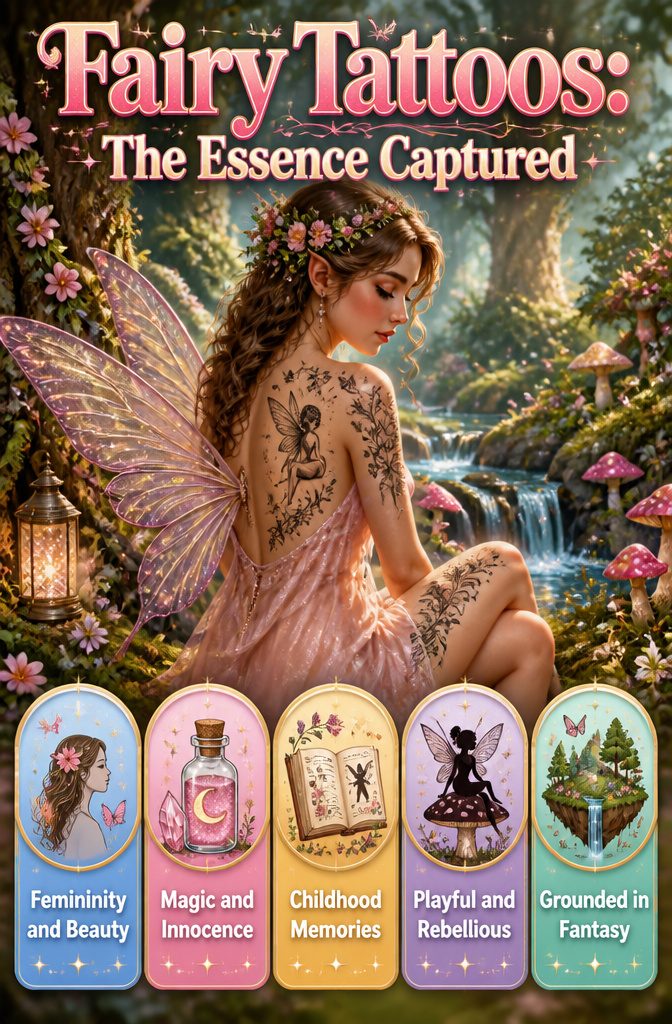
The meanings packed into fairy ink line up neatly with why people sit in the chair at all.
Fairies carry femininity, beauty, magic, innocence, and creativity in one figuresomeone drawn to fantasy and the supernatural can load a single design with every one of them.
There is a reason so many fairy tattoos read as childhood memories made permanent: the source of the sweetness and happiness, the unguarded moment.
Angel meaning overlaps but does not duplicate. Angels stand guard, link the human to the divine, and carry the weight of memorial or grief when someone needs to mark a loss.
Fairies do none of that officially, which is the point of pairing them. Where the angel part of a guardian angel fairy tattoo holds the protective, spiritual watch, the fairy side keeps it personal, playful, even slightly rebellious.
Fairies carry an impish, mischievous edge. Angels do not.
The combination lets a wearer split the difference between heaven and earth without choosing. The fairy grounds the design in bodily beauty and individual fantasy; the angel lifts it toward something larger than the self.
A guardian angel fairy tattoo ends up neither fully sacred nor fully secular, and that middle space is where most of us actually live.
Where to Place These Tattoos
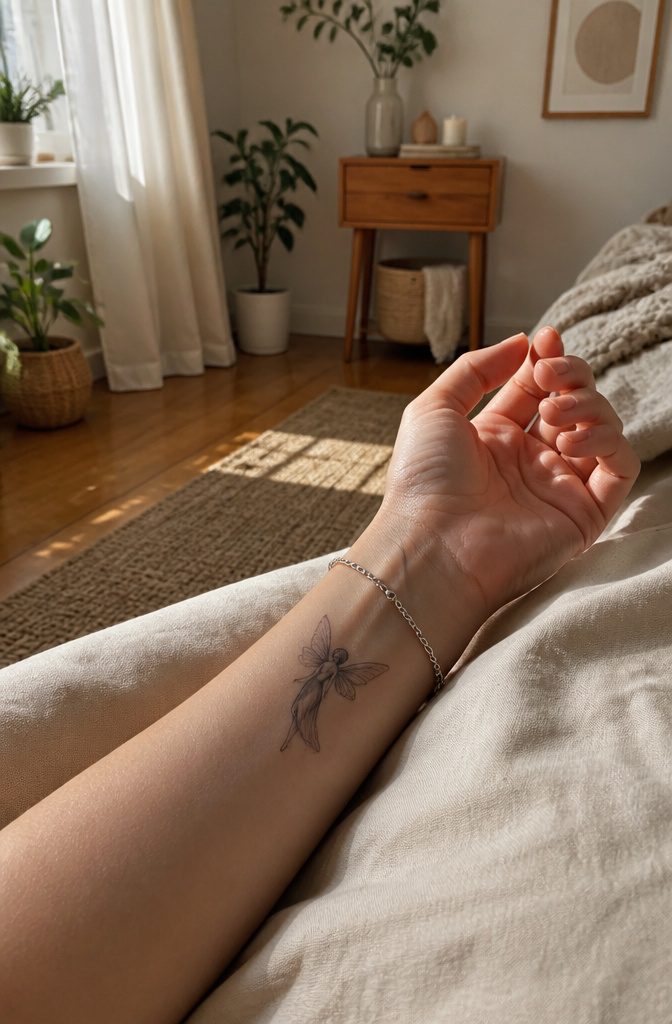
The wrist and the spot behind the ear dominate when someone wants a guardian angel fairy tattoo kept close but not on display.
Both placements carry that private, almost devotional quality; the wrist can be rotated away, the ear hidden by hair, so the wearer chooses when the image sees light.
That concealment matters to people who see the tattoo as a personal escort rather than a conversation piece, a small cherub or folded wing meant for their eyes first.
Visibility pulls in the opposite direction for others, and placement opens up accordingly. A larger guardian angel fairy design on the back or a tiny fairy on the foot lets the figure interact openly with whoever sees it.
What drives the choice is usually whether the tattoo is functioning as memorial, protection, or outward sign of belief. Memorial pieces often hide.
Protective ones sometimes demand visibility. A gothic angel fairy hovering at the hairline, half visible, can thread both needs at once.
The wrist stays the compromise placement: easy to show, easy to cover, and intimate enough that the bearer feels the line with every glance down.
Frequently Asked Questions
What do guardian angel tattoos symbolize?
Guardian angel tattoos symbolize protection, guidance, and spiritual connection you can feel against your skin during hard moments.
They are often chosen after difficult experiences as a reminder that protection still exists. The tattoo makes the guardian specific to your own need for comfort, visible even when faith wavers.
What are the different types of fairy tattoos?
Common types include gothic, Celtic, sensual, crying, and magical fairy tattoos. Gothic fairies wear black and carry skulls as weight against innocence.
Celtic fairies stay rooted in nature with vines and butterflies. Sensual fairies present adult femininity as power held in reserve.
Crying fairies mark loss of innocence and survived pain. Magical fairies show active agency with wands raised mid-spell.
Where should I place my guardian angel or fairy tattoo?
The wrist and the spot behind the ear work best for private, devotional pieces you keep mostly hidden.
The wrist stays the compromise placement: easy to show, easy to cover, intimate enough that you feel the line with every glance down.
Larger designs suit the back; tiny fairies work on the foot. Memorial pieces often hide; protective ones sometimes demand visibility.
What does a fairy tattoo symbolize?
Fairy tattoos carry femininity, beauty, magic, innocence, and creativity in one figure. They often read as childhood memories made permanent, the source of sweetness and happiness.
Fairies also hold an impish, mischievous edge that angels lack, adding rebellion to the mix. In combination with guardian angels, the fairy grounds the design in bodily beauty and individual fantasy while the angel lifts it toward something larger.
What is the luckiest tattoo for females?
Angel and fairy tattoos rank among the most spiritually meaningful choices for women, combining protection with personal symbolism. Guardian angels promise guidance through trauma and loss, while fairies add magic, beauty, and a rebellious edge.
The combination of both in a guardian angel fairy tattoo splits the difference between heaven and earth without choosing, sitting in the middle space where most people actually live.
What is the symbol for a guardian angel?
Wings remain the central symbol, usually paired with something held to give the image story and staying power: a torch, a child, or a heart bearing a name.
Plain wings fade from fashion; wings plus narrative endures. The protective quality people name first tends to read as maternal or memorial, even when the wearer calls it spiritual.
A guardian without warmth is just surveillance, so the symbol must carry love and goodness to function as comfort rather than mere watchfulness.