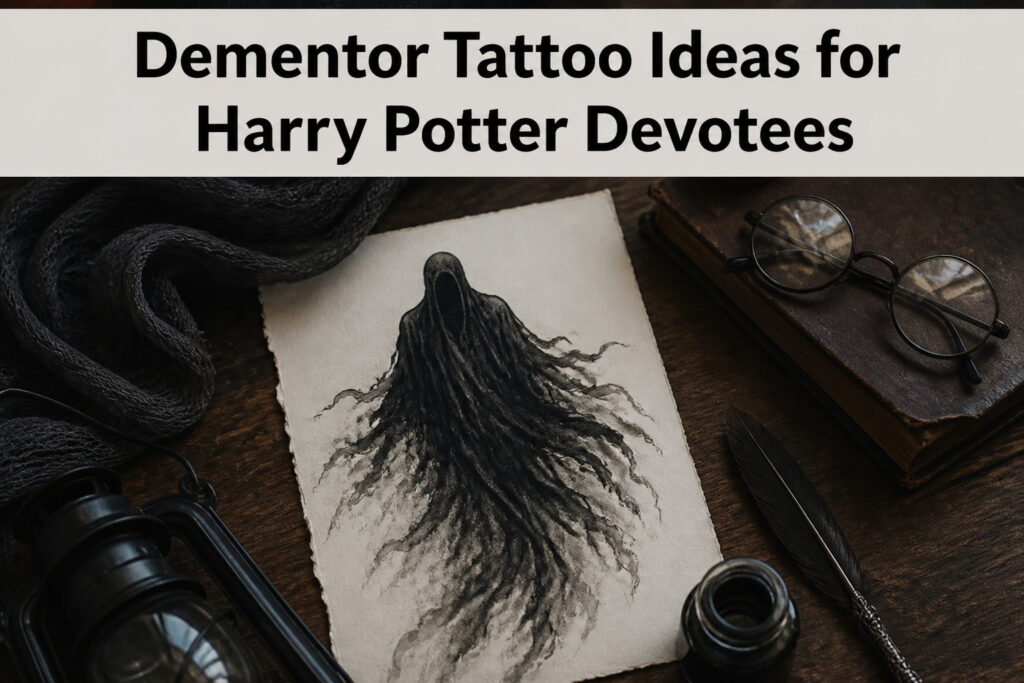
A dementor tattoo works best when it carries more than the creature itself.
The most enduring designs pair the hooded figure with what resists it: a stag Patronus mid-charge, the spell "Expecto Patronum" in silver script, or Sirius Black in his Azkaban rags to give the image prison rather than monster.
The emptiness where a face should be triggers something primal, but the tattoo only earns its place on skin once that void faces something that fights back.
Boggart with Dementor
A Boggart is a shape-shifting creature that transforms into whatever the person facing it fears most.
For Harry Potter, that form was a Dementor, which makes this pairing a natural fit for a tattoo that plays on the idea of fear itself rather than just depicting a monster.
The visual tension here comes from the transformation moment.
A Boggart caught mid-shift lets the artist merge the wispy, hooded silhouette of a Dementor with something more unstable and abstract, like a body that has not quite decided what it is.
The spell "Riddikulus!" pairs naturally with this design, often lettered above or below the image as the punchline that defeats the creature.
What draws me to this concept over a straight Dementor portrait is the layer of meaning.
A Dementor represents depression and despair, but a Boggart-Dementor represents the fear of those things, which is a different weight to carry on your skin.
The design works best when the Boggart’s incompleteness shows, something in the cloak wrong or the hands not fully formed, so the viewer recognizes the illusion before reading the spell.
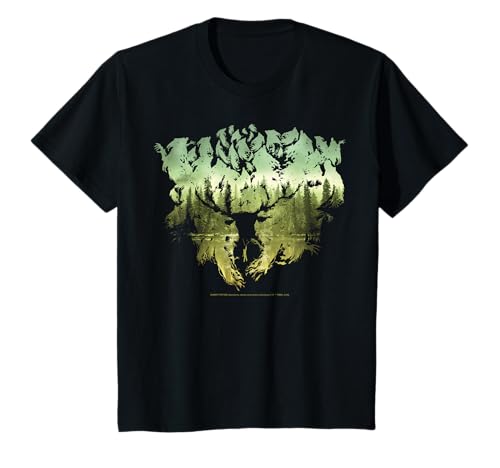
Officially Licensed Harry Potter Apparel

Harry Potter Magic design. Officially Licensed Harry Potter Apparel

Harry Potter Magic design. Officially Licensed Harry Potter Apparel
Sirius Black with Dementor
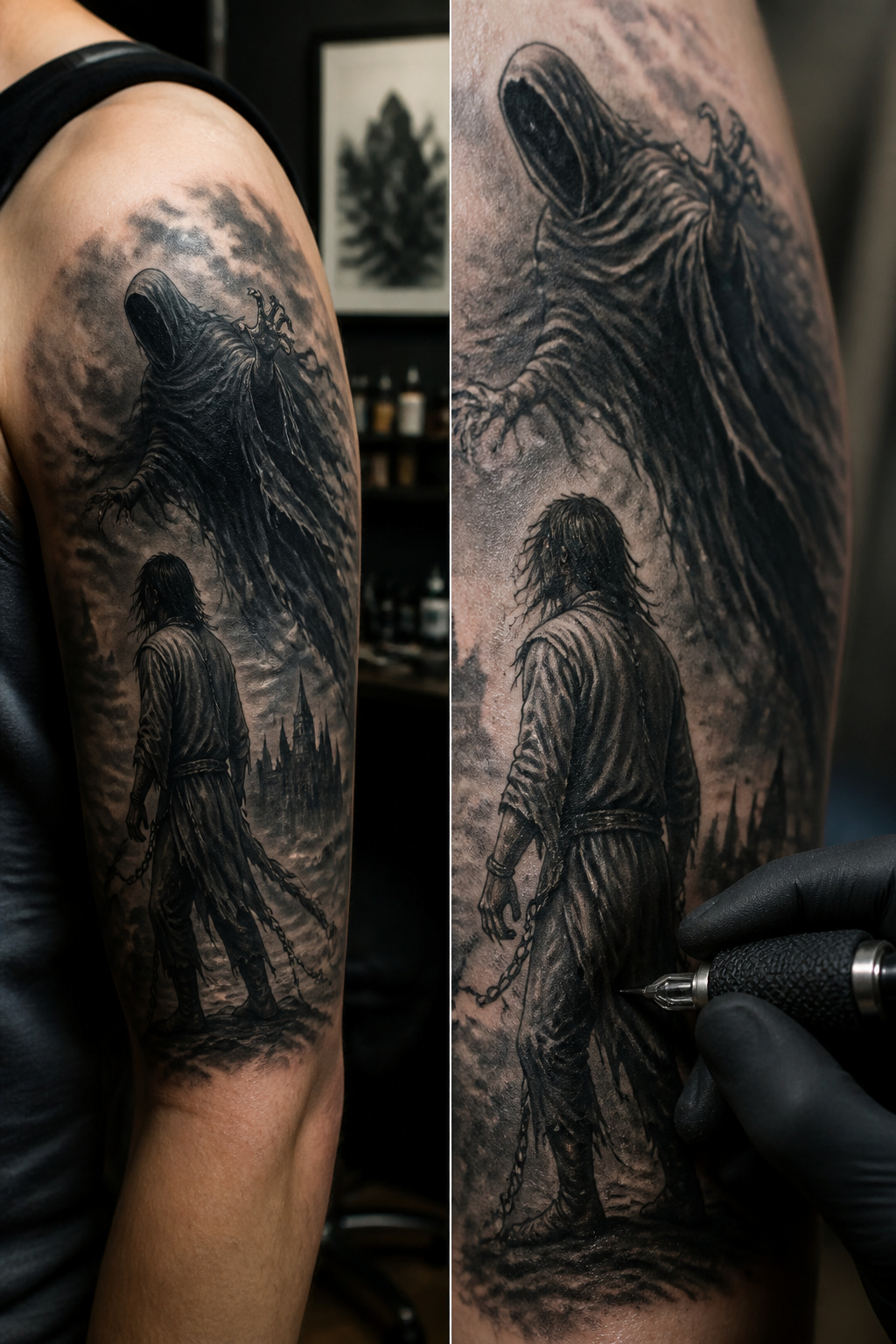
Sirius Black’s twelve years in Azkaban make him one of the few characters whose history is inseparable from the Dementors themselves.
A tattoo pairing the two works because the image carries that specific weight: the gaunt prisoner against the hooded guard, both frozen in the gray light of the prison island.
The design usually places Sirius in his Azkaban rags or his later grizzled form, with a Dementor looming behind or beside him.
Some artists frame it as the escape moment, Sirius slipping past them in his dog form, which the books describe as the shape he used to survive their presence.
Others prefer the confrontation at Hogwarts, where the Dementors nearly caught him and Harry together by the lake.
What separates this from a generic dark-arts tattoo is the emotional transaction in the image. Sirius was innocent, the Dementors were his keepers, and the viewer of the tattoo knows both facts at once.
That tension gives the piece its narrative pull. If you want the Dementor to read as prison rather than monster, the artist needs to keep the figure’s posture upright and institutional, not lunging.
A reaching Dementor becomes horror; a stationed one becomes history.
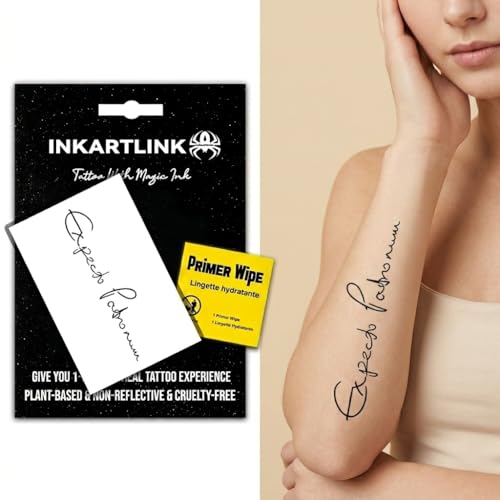
[Semi-Permanent, Realistic Tattoos] INKARTLINK semi-permanent tattoos are lifelike, durable, waterproof, and sweat-resistant, lasting 7–14 days and gradually fading as the skin’s outer layer sheds. They’re perfect for everyday wear, events, or themed occasions. From the beach to the office, they stay vibrant, allowing you to effortlessly showcase your body art in any setting.

You will receive (1) Decal
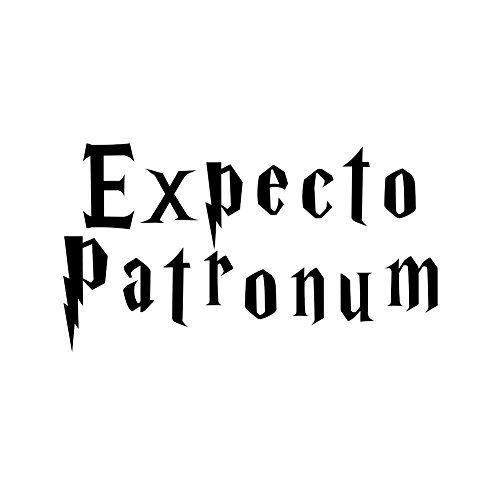
You will receive (1) Decal
Dementor and Stag Patronus
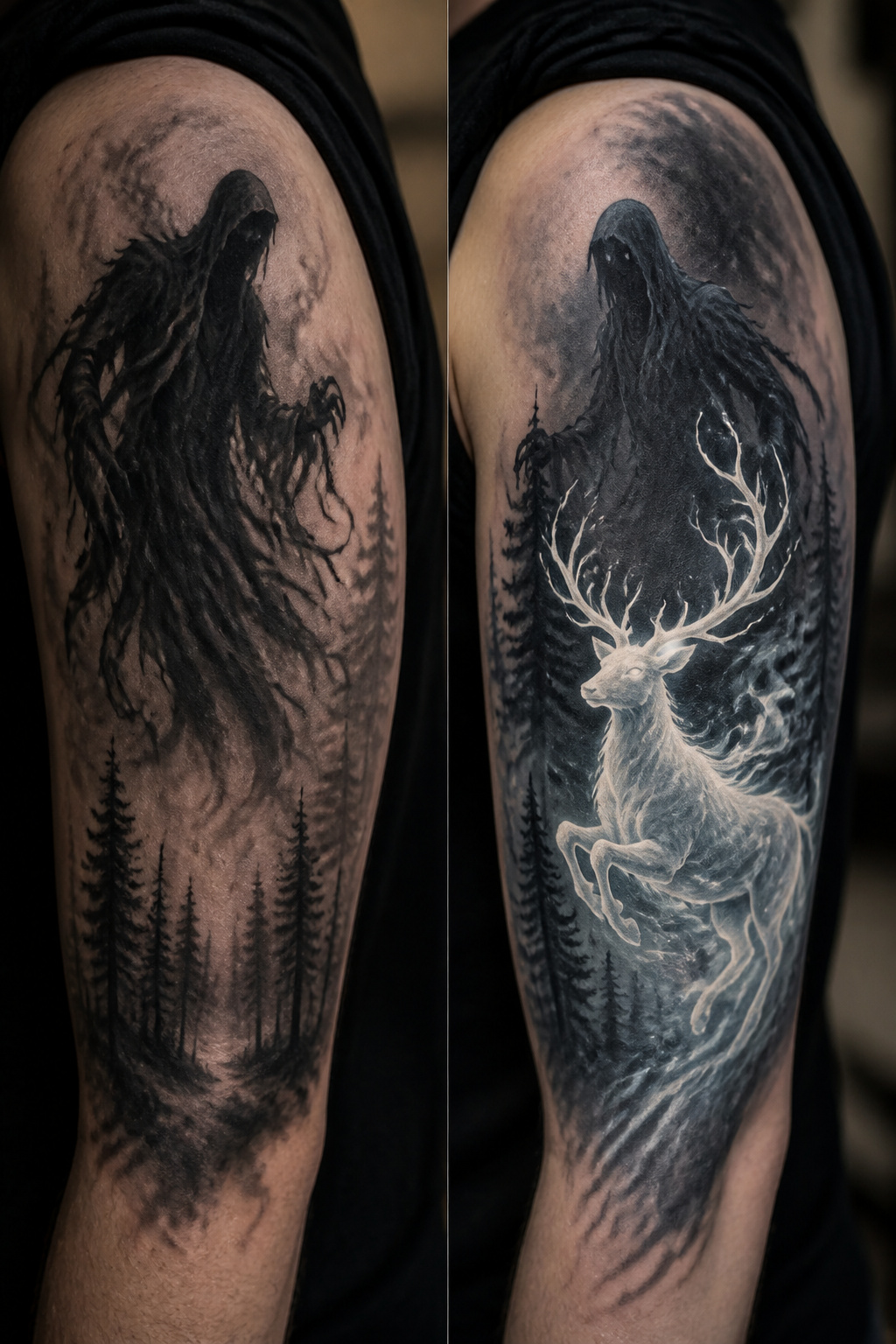
The dementor tattoo design that pits the creature against Harry’s stag Patronus carries the full weight of what "Expecto Patronum" means in the story.
The stag is not random: it matches his father James Potter’s Animagus form, so the spell becomes a kind of inheritance, protection passed down through memory rather than blood.
A tattoo artist rendering this pairing has two textures to solve. The Dementor reads as rot and absence, all hooded void and skeletal grip.
The stag Patronus is light made solid, silver-white, antlers branching like frozen lightning between them. The contrast is despair against hope, but hope tied to grief, since Harry only masters the charm by concentrating on loss.
Placement shapes how the scene reads. Wrap it around a calf or forearm and the two figures can circle each other, the stag always advancing, the Dementor recoiling.
Keep it to a flat plane like a shoulder blade and the composition flattens to a standoff, which some wearers prefer for the clarity.
The spell words themselves work stitched beneath the image or left out entirely. "Expecto Patronum" in script can tip the design toward illustration-with-caption; without text, the visual argument stands alone.
Either choice is defensible, though the best versions I have seen let the stag’s brightness do the talking.

Dopetattoo Waterproof High-Quality Easy-Use Long-Lasting Temporary Tattoos.You can take it to the beach, swimming pool, bath and any other water activities. Without excessive friction. It will last 3-5 days.

Harry and Sirius with Patronus
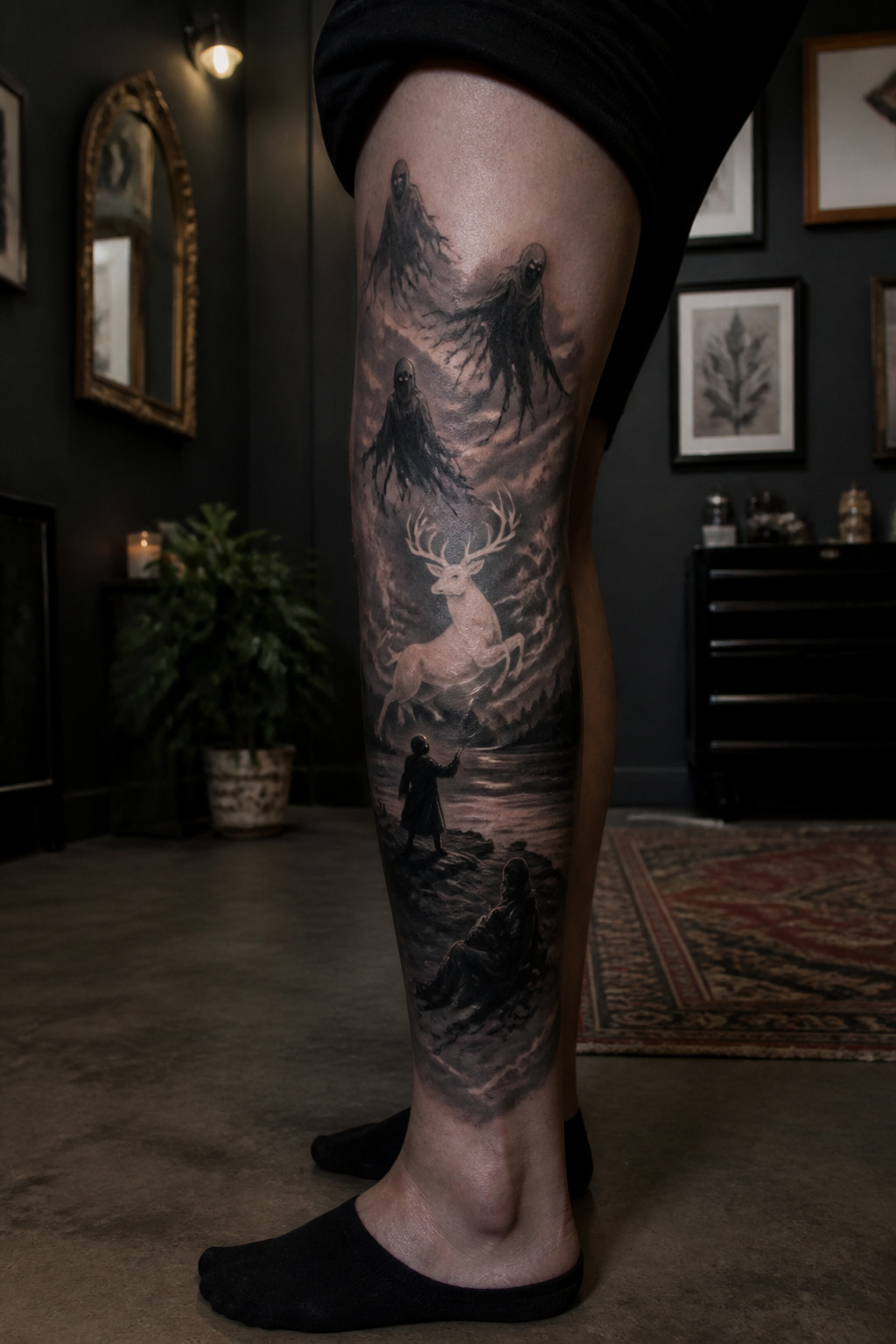
The scene that stays with me from Harry Potter and the Prisoner of Azkaban is the lake shore at dusk, when Harry believes his own father has cast the stag Patronus that saves him and Sirius from the Dementors’ kiss.
A tattoo capturing this moment shows Harry with his wand raised, the silver stag leaping between him and the hooded figures, Sirius collapsed at the water’s edge.
What makes the image work as ink is the confusion Harry feels in that instant, the way the truth dawns on him only when he watches himself across the water, having traveled back through time.
The composition usually layers the three elements with the Patronus as the brightest point, the Dementors as hollow negative space, and the two wizards linked by the realization that Harry has become his own rescuer.
The best versions keep the stag mid-leap, not fully formed, so the charm feels earned rather than finished.
Color choices tend toward monochrome silver for the Patronus against black and gray Dementors, though some artists add the faintest blue to the lake water to ground the figures.
Placement matters for the horizontal flow of the scene; the forearm or outer calf gives the lake shore room to stretch.
Dementors at Hogwarts
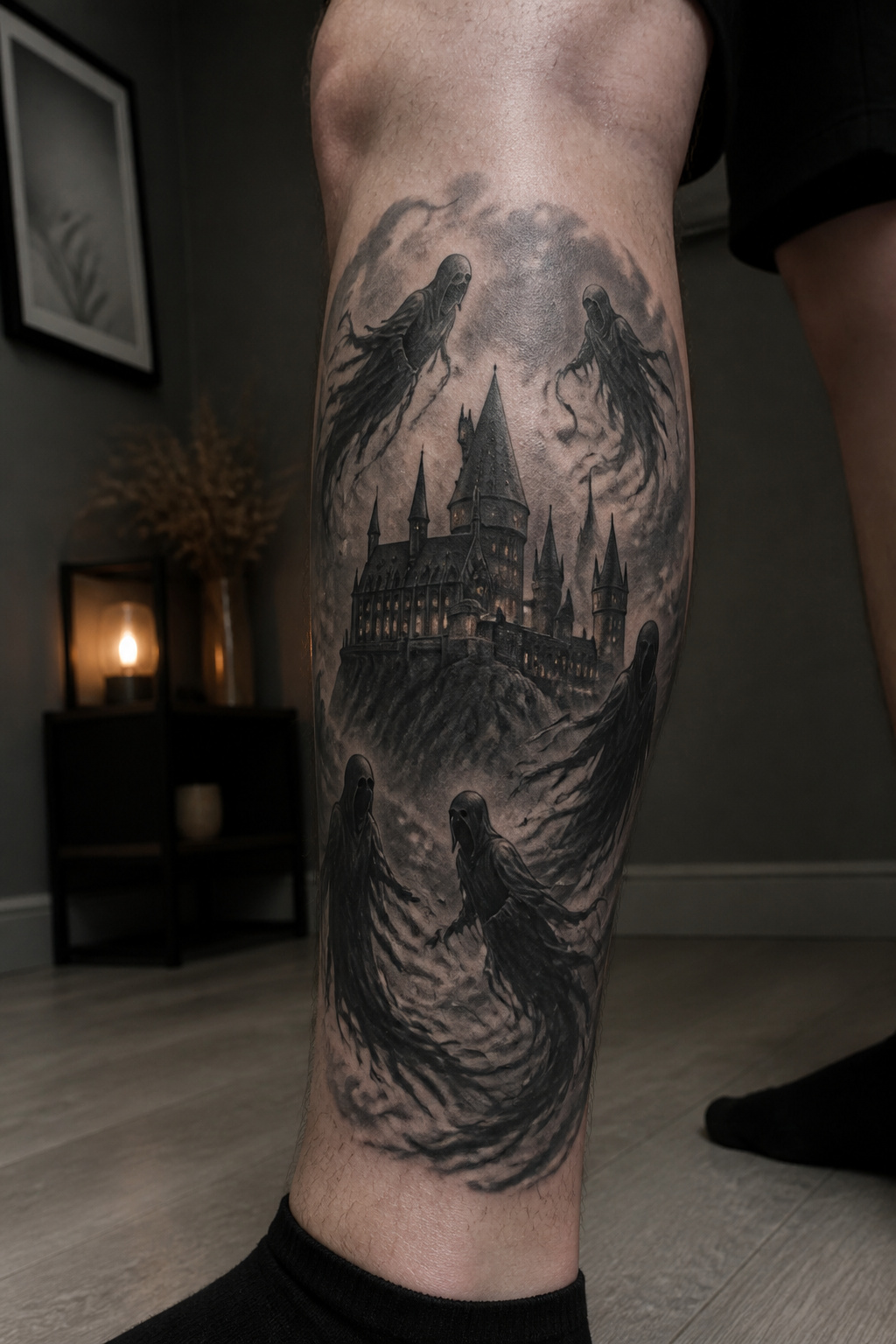
The image of Dementors circling Hogwarts carries a different weight than a single figure standing alone. Tattoo artist Emari OmNaVa built this composition around the castle itself, with the dark shapes pressing in from every side.
The school had lost its protections, and the piece captures that specific breach: the moment when a place meant to be safe became exposed.
Two scenes from the series feed into this design. One reading draws from Harry Potter and the Prisoner of Azkaban, when the creatures were brought inside the grounds to hunt Sirius Black and instead turned on students.
Another traces to the opening of Deathly Hallows – Part 1, where the castle sits surrounded by Dementors in the film’s first shots, the darkness now total and the defense long broken.
The castle gives the eye somewhere steady to land. Without it, the Dementors drift; with it, they have a target and the tension sharpens.
The composition works because the viewer recognizes what is at stake.
Dementor, Patronus, and Deathly Hallows
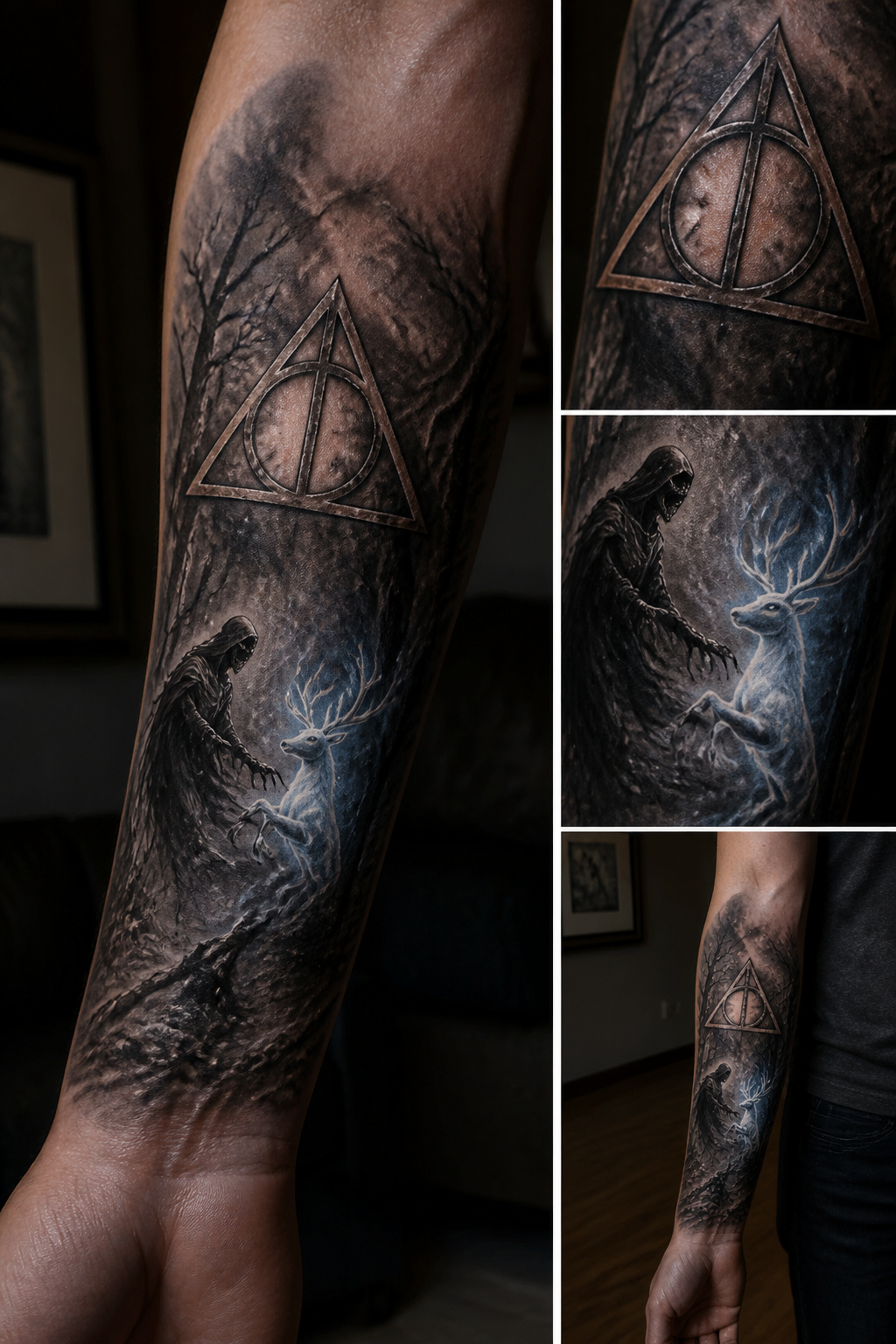
A dementor tattoo that layers the Deathly Hallows symbol, a stag Patronus, and the wraith itself reads as a small narrative about what fear costs and what answers it.
The triangle mark sits behind or above the scene as a kind of frame: the cloak, the stone, the wand, the three objects that let a wizard master death rather than merely delay it.
Against that, the Patronus cuts forward as light and antlers, the exact shape Harry casts in the forest when he drives the dementors from his own past self.
The creature itself occupies the lower or shadowed ground, hooded, mouth open, the cold that Rowling wrote as worse than grief.
Placing all three in one piece asks the skin to hold contradiction. The Hallows promise that death can be beaten; the dementor is what happens when you fail; the Patronus is the work of pushing back.
For someone who came to the books young and kept them into the years when loss becomes real rather than theoretical, that density matters more than a single image could.
The tattoo becomes less about fandom and more about a private argument with mortality, carried where you can see it.
Mischief Managed with Dementor
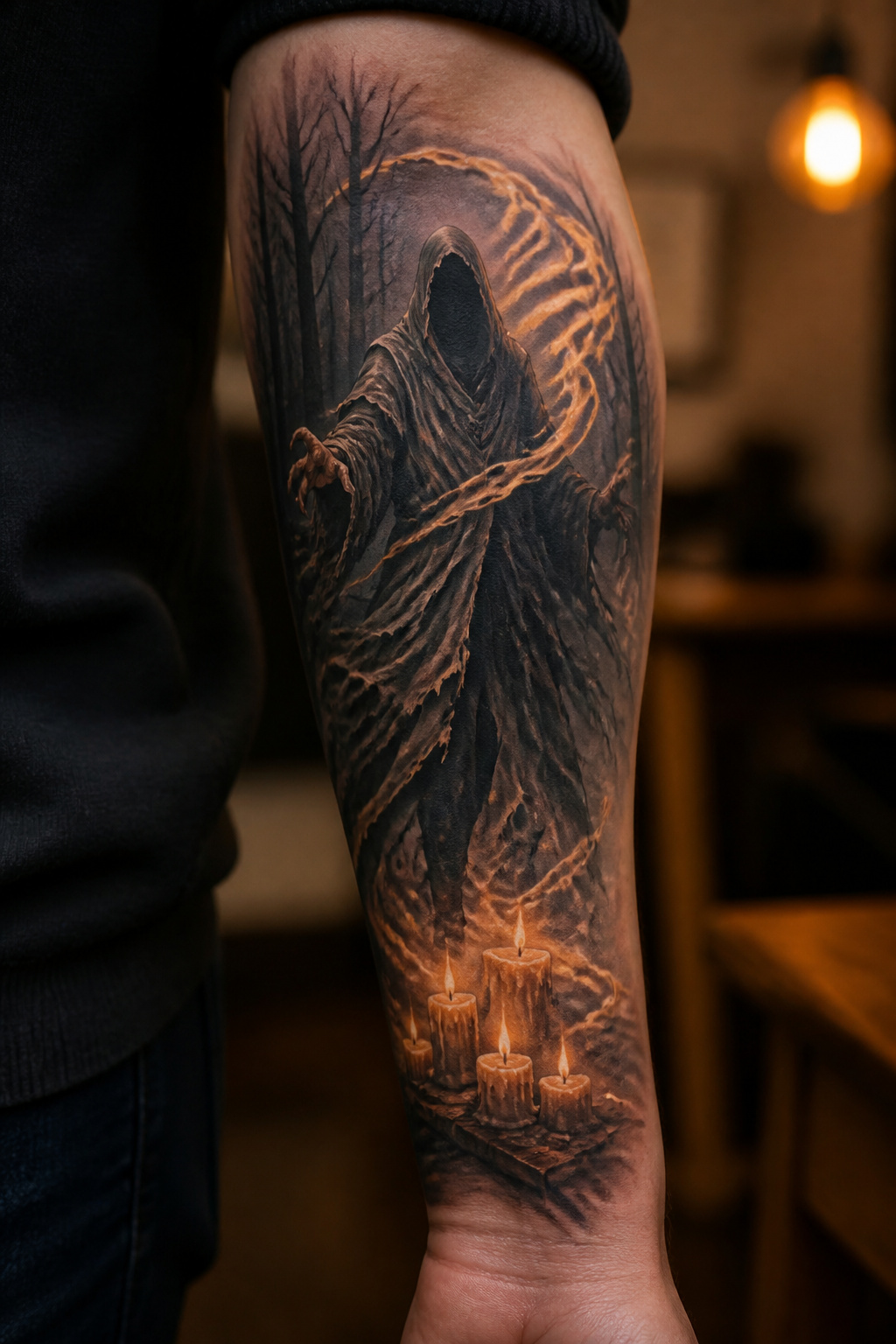
Pairing "Mischief Managed" with a Dementor creates an irony that works better on skin than it sounds on paper.
The Marauders’ cheerful sign-off, something whispered after a midnight kitchen raid or a successful prank, lands against the series’ most joyless creature: a being that literally consumes happy memories. That clash is the point.
The phrase becomes defiance rather than closure, a refusal to let darkness have the last word.
The visual tension matters too. Script lettering in warm tones or a wand’s glow against the Dementor’s hollow, tattered form gives the eye two temperatures to move between.
Placement shapes the meaning. A forearm puts the motto where the wearer sees it, a private reminder; a shoulder blade lets the Dementor loom while the words stay hidden until movement reveals them.
Scale tips the balance. Too large a Dementor swallows the phrase entirely.
Too small and the creature reads as an afterthought. What convinced me, looking at healed pieces, was the Dementor positioned slightly behind or below the text, never competing for the same visual plane.
The words stay legible; the threat stays present.
The Deathly Hallows with Dementors
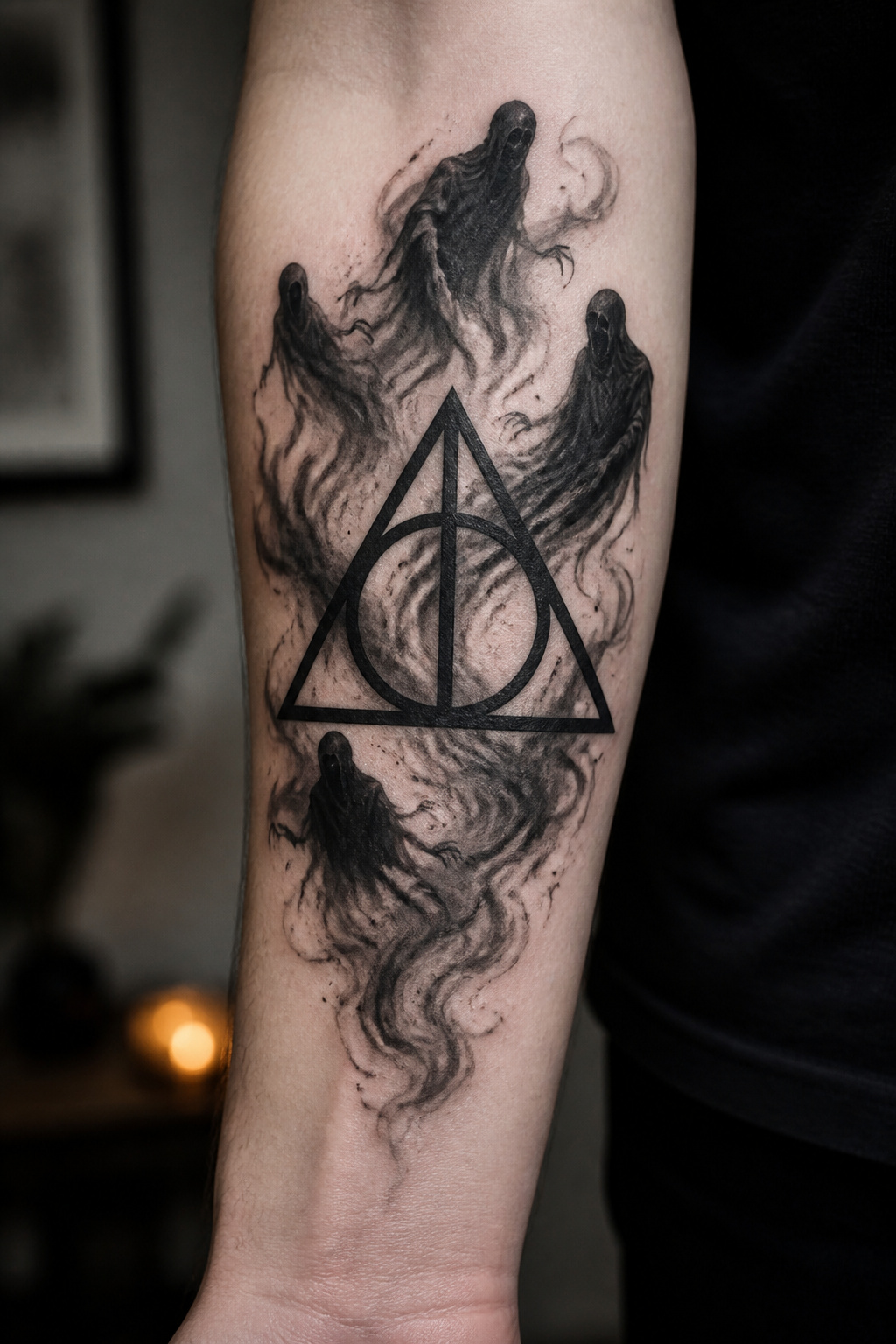
The Deathly Hallows symbol takes center stage in this version, with Dementors wrapping around it like smoke or shadows rather than sharing equal space.
Where the combined Hallows-and-Dementor design gives both elements matching visual weight, this approach makes the triangle, circle, and wand the anchor while the Dementors function as atmosphere.
A skilled artist can render the Dementors as trailing ink off the edges of the Hallows, their cloaks dissolving into negative space so the symbol itself stays crisp and readable.
The contrast matters: the clean geometry of the Deathly Hallows against the Dementors’ formless dread gives each more impact than either would alone.
Placement shapes how well this balance holds. The upper arm or ribs work better than a wrist here, since shrinking the Hallows to fit a small space forces the Dementors into thin, busy lines that lose their looming quality.
Color choices lean toward the restrained: deep blacks and cool grays for the Dementors, with the Hallows in solid black or a single muted tone so the symbol does not compete with its own framing.
What drew me to this variation, paging through portfolios, was how the Hallows become a kind of light source that the darkness actively tries to swallow.
The tension between the two reads differently than a scene of confrontation; it suggests the symbols’ power exists precisely because that darkness is always present, always pressing in.
Dementor Portrait
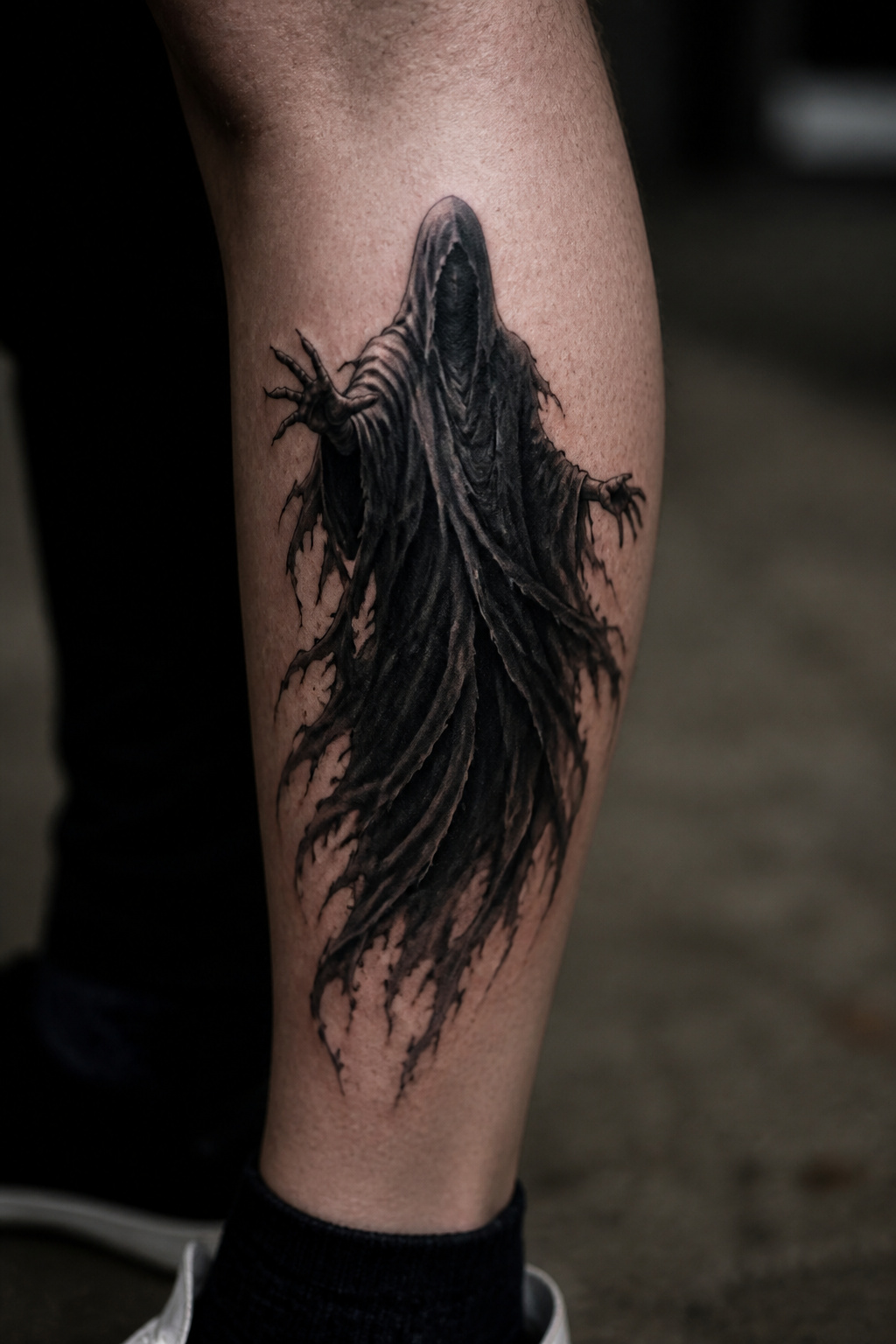
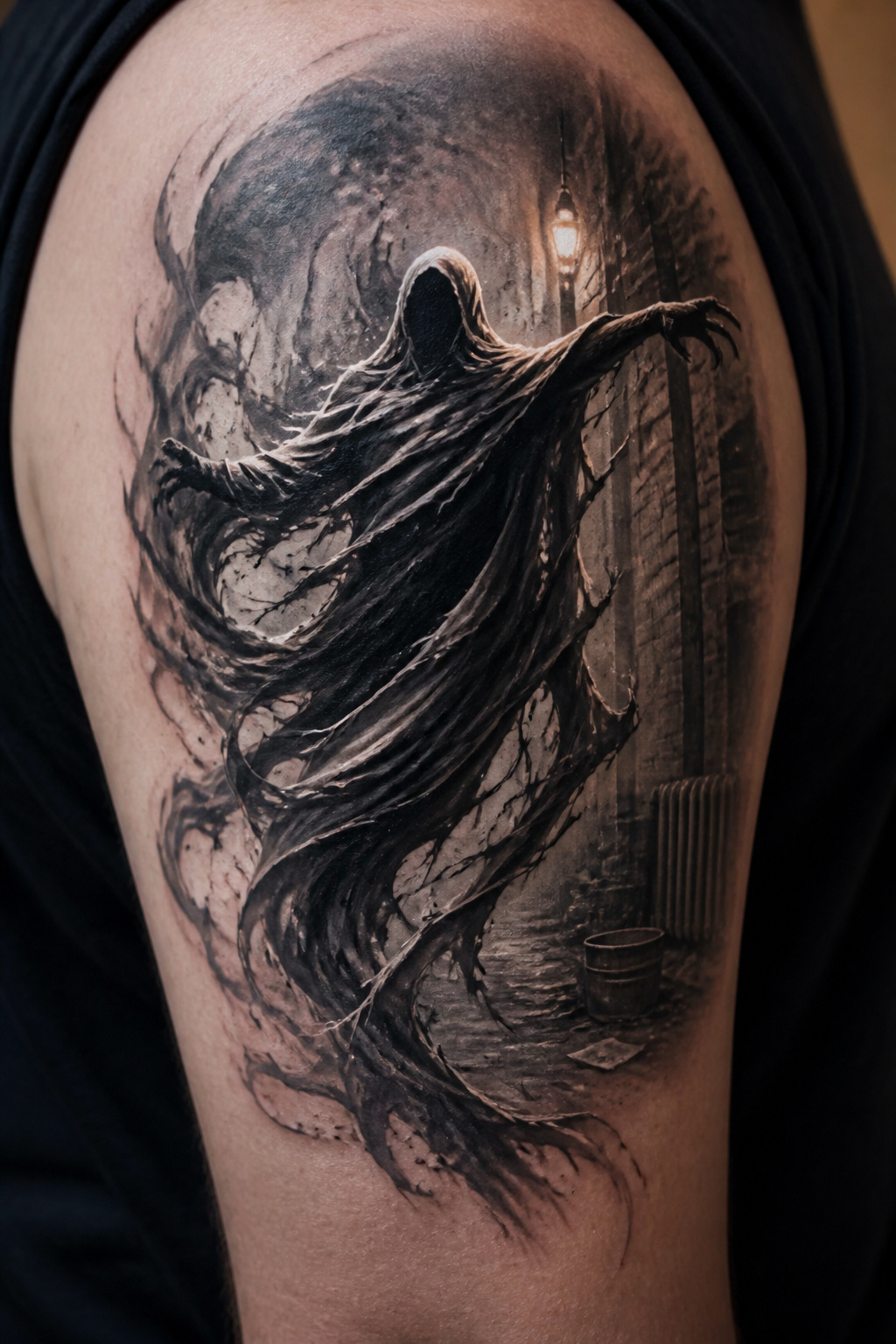
A standalone Dementor portrait strips the creature down to what makes it frightening on its own terms: the hooded cloak that hides everything, the withered gray hands reaching out, and the face that is not a face at all, just a void where features should be.
No wand, no stag, no Harry in the frame. That emptiness is the whole point.
The design works because the Dementor needs no context to read as dread.
The hooded silhouette carries weight from centuries of plague doctors and executioner imagery; the hollow space where eyes and mouth belong triggers something primal about recognizing a human shape that refuses to show humanity.
Someone choosing this wants the feeling first, the fandom second, or maybe not at all.
Placement matters for the emptiness to land. The chest or upper arm gives the hood enough room to loom, the hands enough space to reach.
Too small and the face becomes a smudge, the fingers lose their bone-thin precision. Black and gray ink carries the rot and cold better than color would; the creature drains warmth, so the tattoo should look like it already has.
Harry’s Patronus
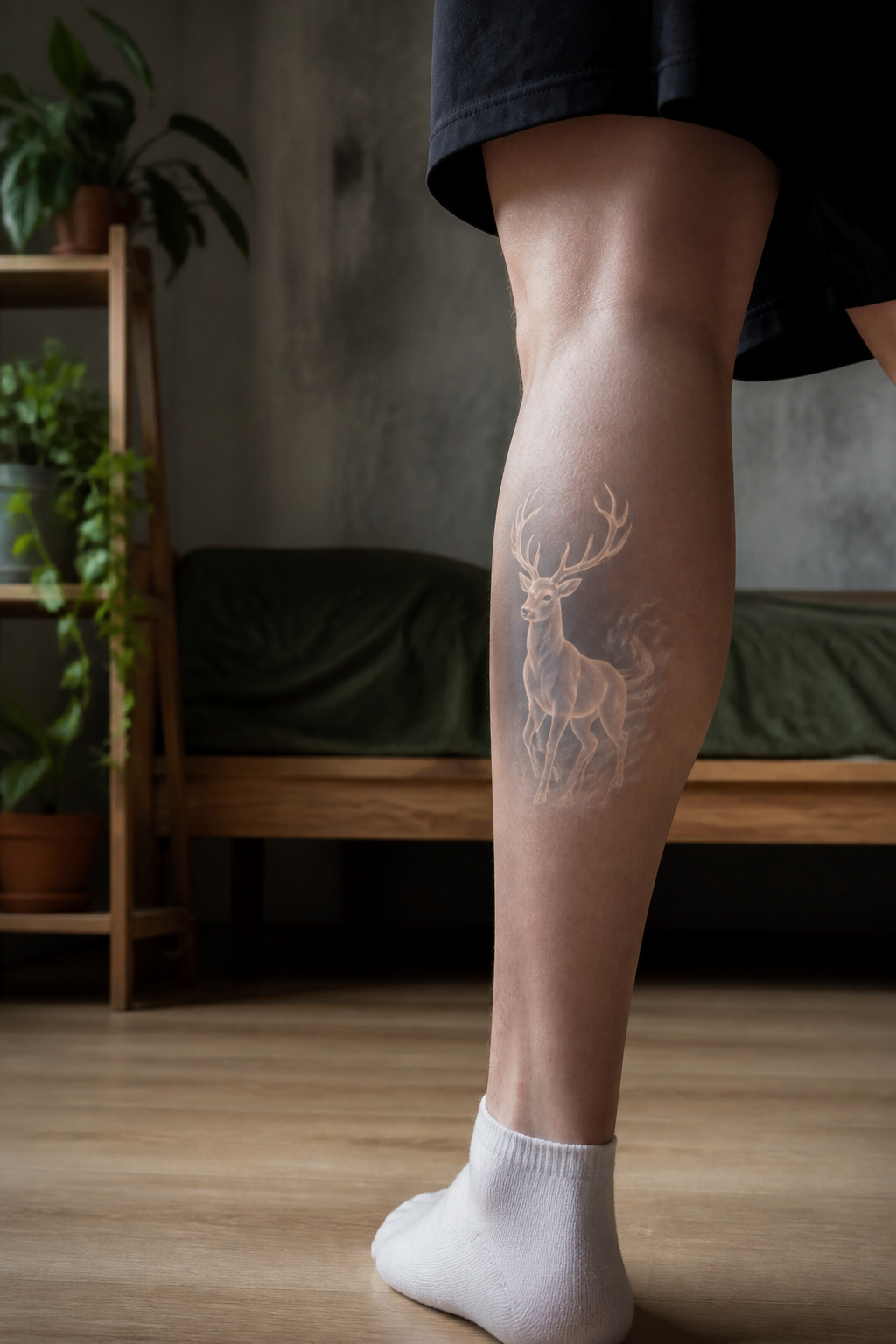
A stag Patronus carries the same weight as the darkness it repels, and some collectors prefer it exactly for that economy.
The design needs no Dementor coiled beside it; the silvery stag mid-charge already tells the story of grief held back, of a memory strong enough to become armor.
Harry’s stag came from his father, from loss, from the moment he learned that joy and sorrow share a root. That backstory lives in the tattoo whether or not a viewer recognizes the species.
The appeal is practical as much as symbolic. A luminous stag stands alone as beautiful line work; a Dementor beside it risks clutter, two competing silhouettes flattening into a dark smear on the skin over time.
Collectors who want the narrative without the visual noise choose the Patronus for its clarity. The stag reads as hope first, Harry Potter second, which suits anyone who would rather explain a tattoo once than every time sleeves come up.
Color choices matter here. The film’s silver-blue glow translates to pale grey or white ink on darker skin, or to a subtle cool wash on lighter tones that avoids the cartoon look of bright color.
Placement on the ribs or along the collarbone lets the antlers follow bone structure, giving the piece movement that feels earned rather than decorative.
What Dementors Mean in the Series
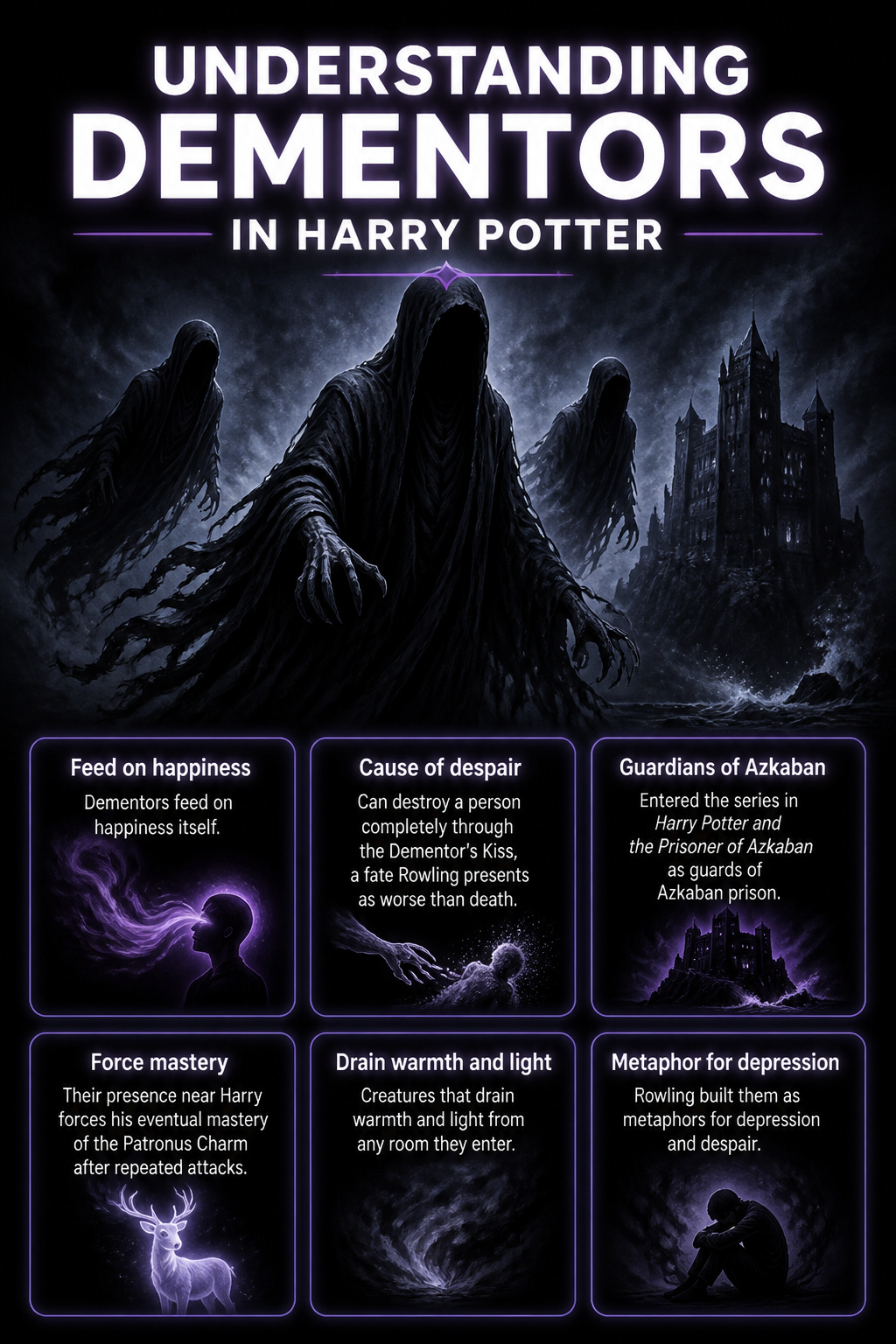
Dark, hooded figures that drift rather than walk, Dementors feed on happiness itself and can destroy a person completely through the Dementor’s Kiss, a fate Rowling presents as worse than death.
They entered the series in Harry Potter and the Prisoner of Azkaban as guards of Azkaban prison, and their presence near Harry forces his eventual mastery of the Patronus Charm after repeated attacks.
"Every fan of the Harry Potter series knows how terrifying Dementors truly are. These creatures feed off of happiness and prey on the souls of people using the Dementor’s Kiss, which is a fate worse than death."
What makes them enduring as tattoo subject matter is how Rowling built them as metaphors for depression and despair, creatures that drain warmth and light from any room they enter.
That symbolic weight gives a Dementor tattoo layers beyond fandom reference, something the reader’s own experience of struggle or witnessed struggle in others can attach to.
The Patronus Charm
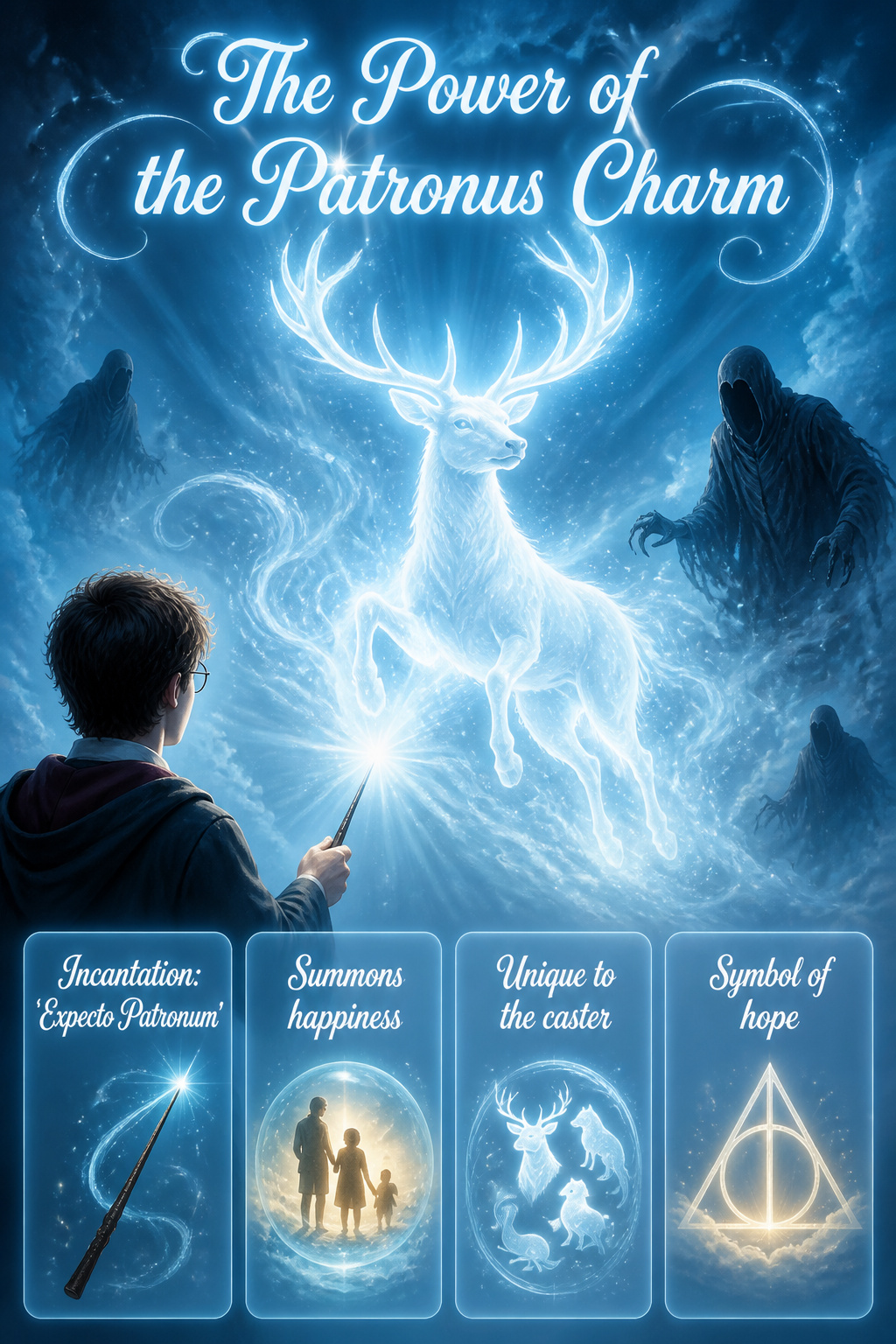
The Patronus charm stands as the only reliable defense against a Dementor’s kiss, triggered by the incantation "Expecto Patronum."
A wizard must summon a memory of pure happiness, concentrate until it fills the chest, and only then release the spell. The result is a silvery animal shape unique to the caster.
Harry’s stag Patronus carries the weight of inheritance. The shape matches his father James’s Animagus form, discovered when Harry watches himself cast it across the lake in Prisoner of Azkaban.
That confusion, seeing what he believes is his dead father, resolves into recognition: the protection was his own, drawn from a memory of his parents that he had buried too deep to name.
The charm’s mechanics make it natural tattoo material for anyone who wants the pairing rather than the threat alone.
A Dementor rendered in black or gray wash, with the stag bursting from the wand tip in white or pale blue, turns the arm or ribcage into the moment of reversal.
The spell’s symbolism is direct enough to read without explanation: hope as something you practice, protection as something you generate rather than receive. For a design that will sit under clothes and emerge in specific company, that specificity matters.
Frequently Asked Questions
What are some Dementor tattoo ideas?
Popular designs include a Boggart caught mid-transformation into a Dementor, Sirius Black paired with his Azkaban keepers, a Dementor facing Harry’s stag Patronus, Dementors circling Hogwarts castle, and the Deathly Hallows symbol wrapped in Dementor shadows.
A standalone Dementor portrait works for fans who want dread without extra context, while pairing "Mischief Managed" with the creature creates ironic defiance. Each design carries different weight: some lean into horror, others into the series’ emotional history.