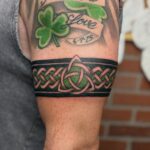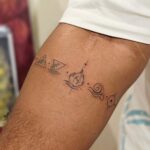
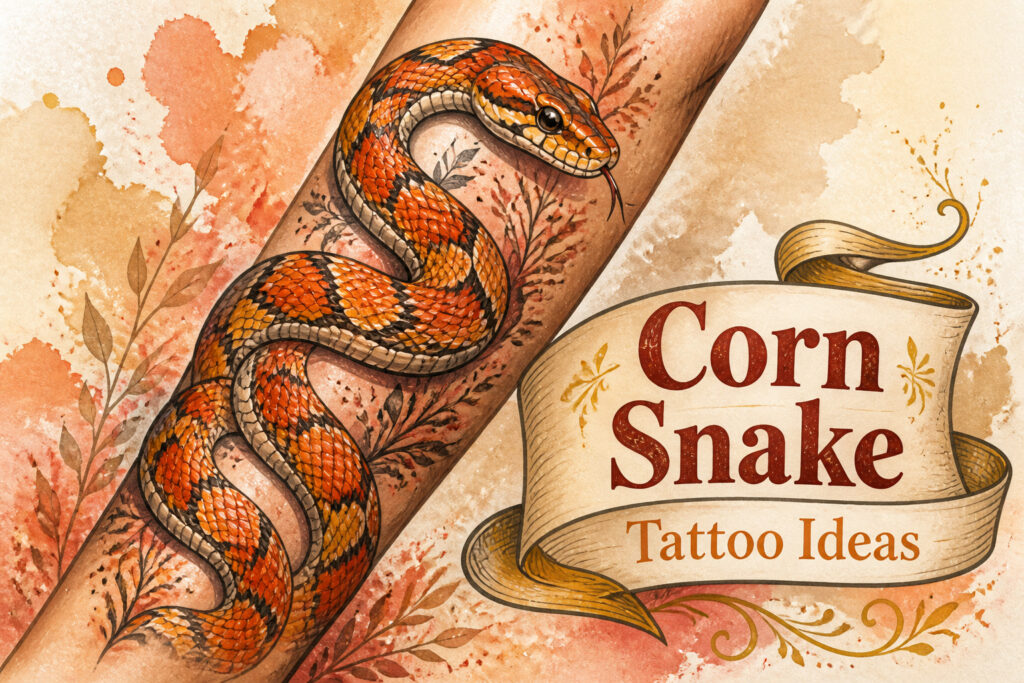
A corn snake tattoo ranges from a small geometric wrist piece to a full back composition, and the deciding factor is usually how much of the animal’s natural patterning you want preserved. The catch is that corn snake colors, especially those bright orange saddles, shift faster in sun-exposed skin, so a forearm placement that looks vivid in January may read as faded ochre by the following summer. The Okeetee morph’s deepened blacks and intensified reds hold up better under that pressure, which is why artists who know the species steer collectors toward it for outer-arm work.
1. Wrapped Around a Branch
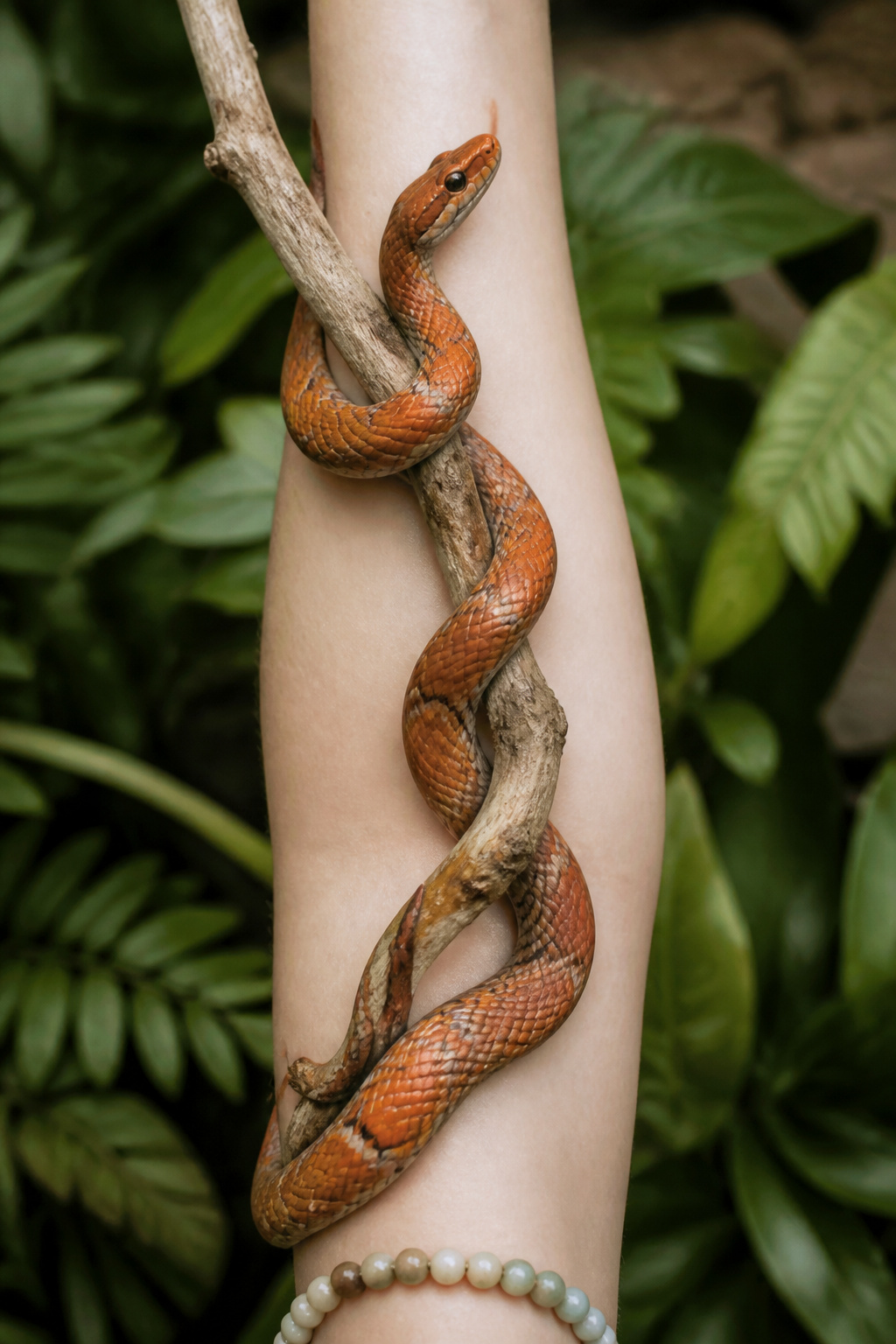
A corn snake wrapped around a branch catches the animal at what it actually does. These snakes climb in the wild, pressing through shrubs and low trees after prey or shelter, and the pose keeps the design from looking like a prop sitting on skin. The branch matters as much as the snake. A thin, slightly curved limb follows the outer line of a forearm or the front of an upper arm naturally, so the tattoo reads as part of the body rather than a sticker slapped on top.
Placement on the forearm works best when the branch starts near the wrist and angles toward the inner elbow, letting the snake’s head face upward or outward for eye contact. On the upper arm, the same curve can follow the deltoid’s front edge. Keep the branch lighter in weight than the snake; too thick and the composition turns into a log with a snake on it, not an animal moving through its habitat. Color on corn snakes runs in repeating saddles of orange, red, or brown against a paler ground, and those bands wrapping around a cylinder shape give the coil real depth. A black outline around each saddle helps the pattern hold up as the tattoo ages, especially on spots where the skin sees sun or friction.
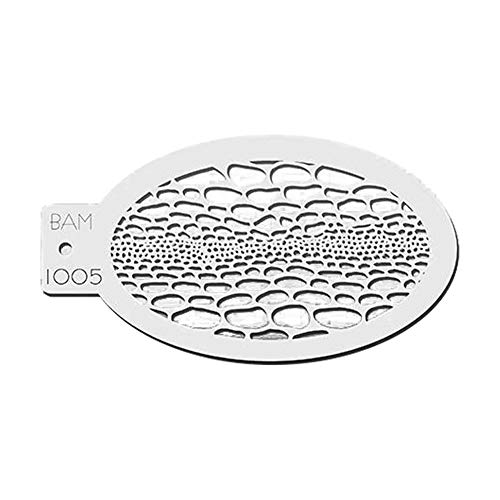
Thin, flexible Mylar stencils perfect for face and body painting

Snake and Botanical Flowers Stencil: You will receive 9 pieces of painting stencils which have beautiful patterns in animal theme. There are snake and botanical flowers, stars, moon, moon phases, human hands patterns on the stencils. Our templates are suitable for you to make handmade projects by yourself.
2. Coiled Around a Skull
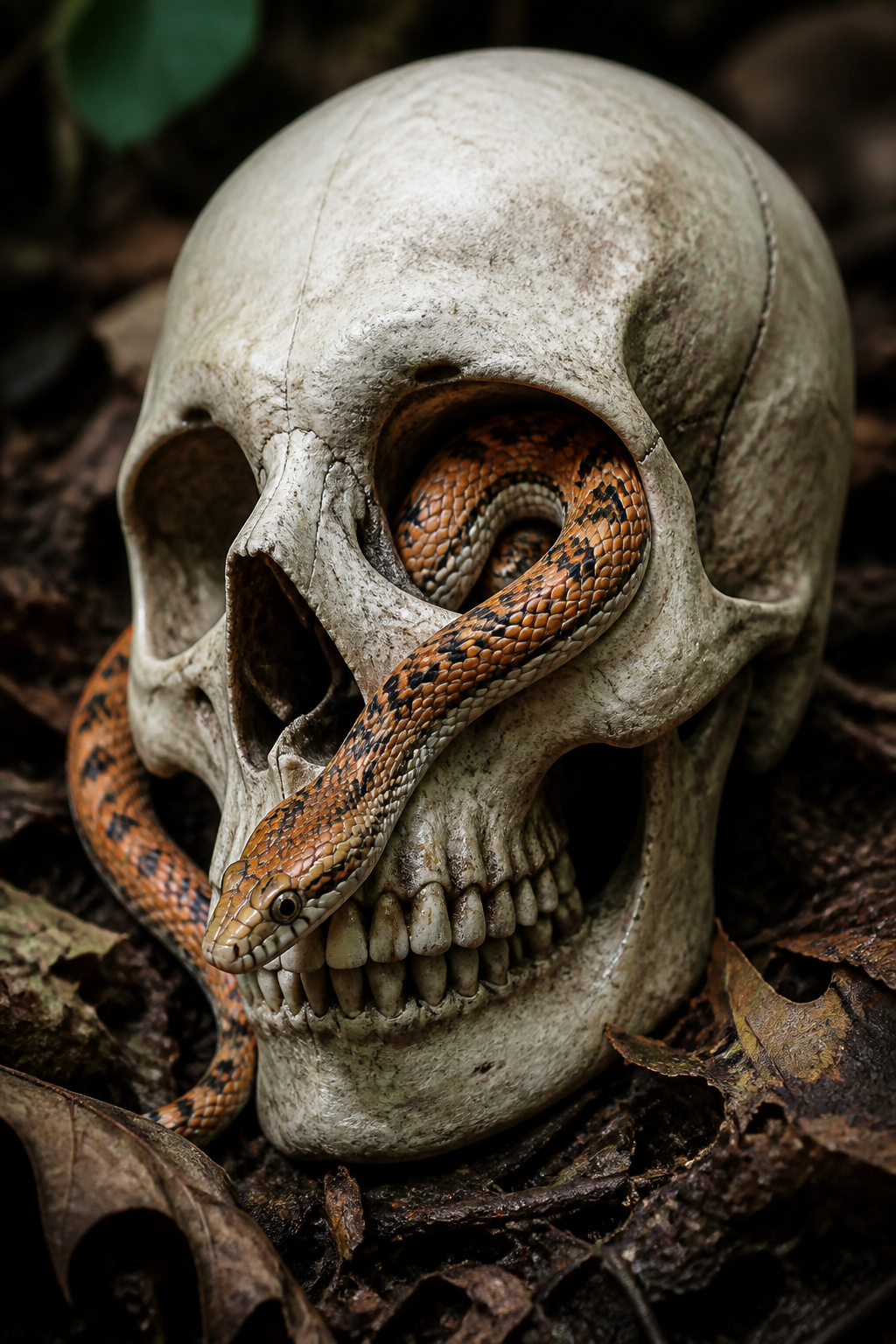
The orange and black checkering of a corn snake reads almost metallic against matte bone, which is why this pairing works so well visually. A corn snake coiled through a skull’s eye socket or jaw carries two layers of meaning that do not compete. The snake stands for shedding and renewal; the skull is the straightforward reminder that time is short. Together they suggest transformation pressed against its limit, which is a more interesting tension than either symbol achieves alone.
The natural patterning of the corn snake does most of the heavy lifting in color. You do not need to push the orange toward red or add invented markings. The real snake’s belly striping, that clean line of black-bordered scales, can trace the curve of the skull’s temple or follow the zygomatic arch in a way that makes the bone look measured rather than randomly decorated. Most designs that fail here do so by wrapping the snake too neatly, like a caduceus, rather than letting the body emerge from behind the cranium in a way that implies depth.
Placement matters for the contrast to hold. On paler skin, the orange will pop; on darker skin, the technician may need to leave more negative space in the black patterning so the snake does not sink into shadow. The skull itself can stay gray-wash or go warm with ivory tones, but avoid pure white. That choice flattens the image into flash art, and the corn snake’s particular texture is what saves it from looking like any generic reptile.

Temporary Tattoo Sticker

Eye-Catching Design: Enhance your Halloween look with our Gold Snake Scales Tattoo Stickers, specifically designed to add an exotic and unique flair to any costume, ensuring you stand out at parties and events

🎃[10 Sheets Long Lasting Temporary Tattoos Snake] There are 10 Sheets Large Snake Temporary Tattoos For Men Women Kids Children Adults,You Can See Different Designs Including Black Rose Flower Sword Cobra Mamba Viper Serpent Skull Snake Tattoos Snakes.
3. With Florals
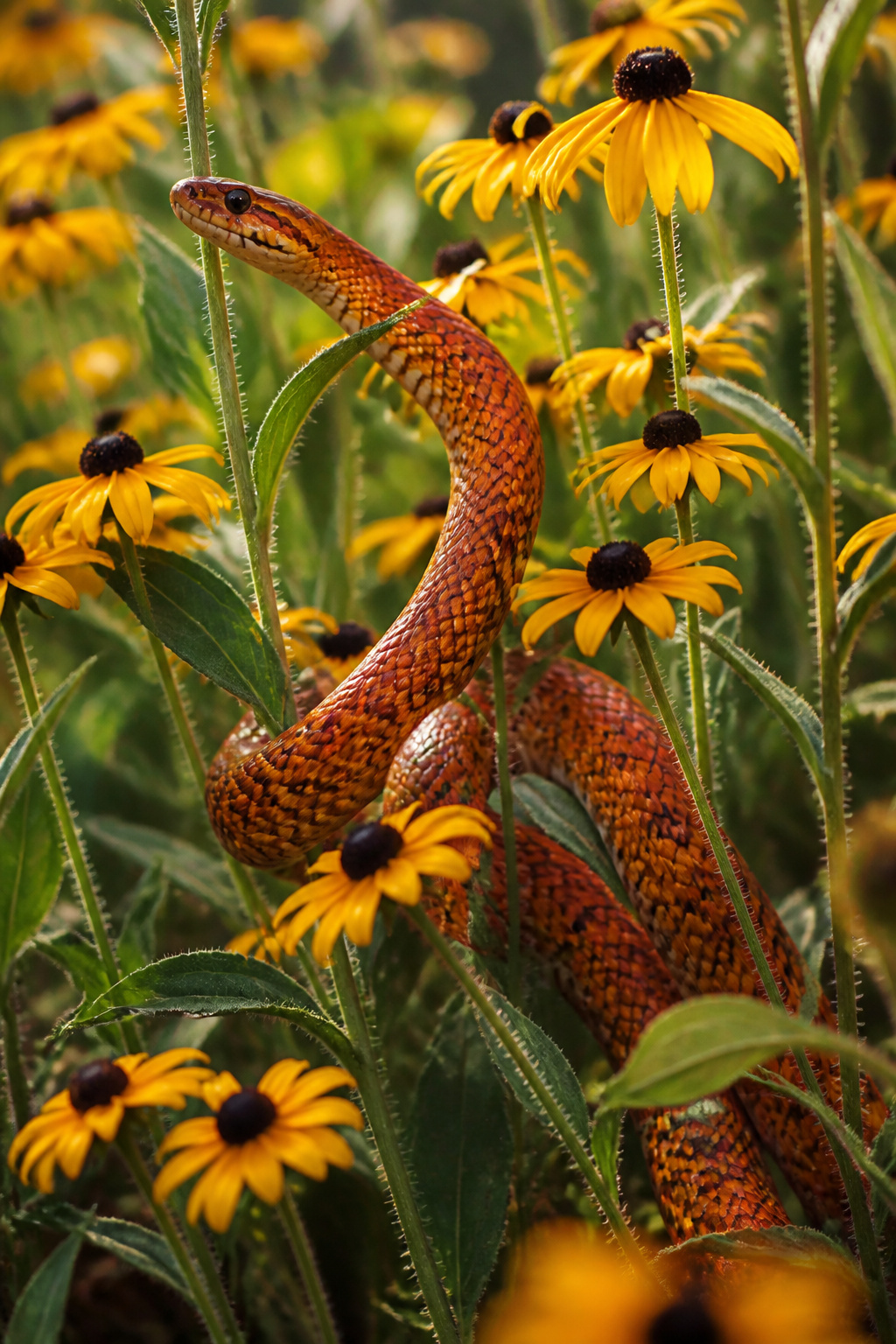
A corn snake wrapped through wildflowers shifts the whole mood of the piece. The reptile’s natural orange and red tones already look like something that grew out of the soil, so the pairing reads as belonging together rather than forced. What convinced me, looking through dozens of these designs, was how much the flower choice changes the story. Black-eyed Susans, which grow throughout the southeastern states where corn snakes live in the wild, root the tattoo in a real place instead of a generic garden. The yellow petals and dark centers echo the snake’s own patterning in a way that feels discovered, not decorated. Botanical accuracy matters more here than in most floral tattoos because the snake itself is so regionally specific; swap in roses or peonies and the design softens into something pretty but placeless. The snake’s slender body weaves well between stems without hiding the flowers or the reptile. Placement on a forearm or calf lets the composition wrap slightly, so the snake moves through the flora rather than sitting on top of it.

· MORE SIZE: 4 sheets large size dark Gothic Halloween temporary tattoos, size 7.5x4.7 inches. Gothic dark creepy wizard crow skull castle spider bat snake tattoos for Halloween accessories.

Skeleton Face Tattoos: You will get 6pcs of Skeleton temporary tattoo stickers features chilling designs including skull face tattoos, skeleton hand tattoos, snake collarbone tattoos, and more. Our Face Stickers are most suitable for Day Of The Dead and Halloween.

DESIGN AND ELEMENTS ---- 2 sheets Cool Snake Temporary Tattoo. (Also get free tattoo.) Almost unlimited creative combinations and options can meet your various needs.
4. Geometric Style
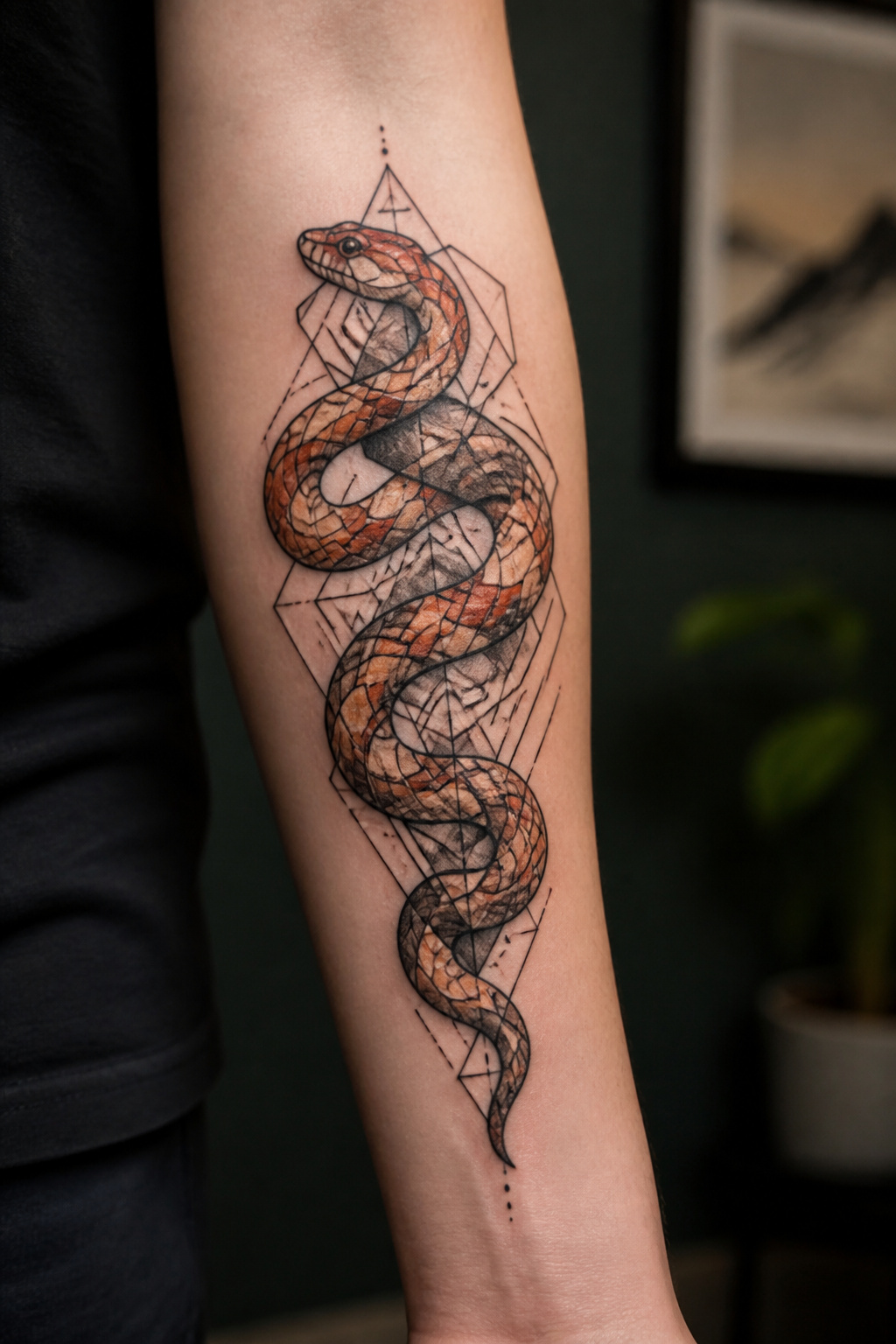
Angular lines give a corn snake tattoo a different kind of energy than the living curve most people expect. The body breaks into triangles, hexagons, or repeating diamond grids, and the negative space between shapes does as much work as the ink itself. I keep coming back to how this style handles the snake’s natural patterning; the corn snake’s saddle markings already read as geometric from a distance, so the translation feels earned rather than forced.
Sacred geometry works best when it frames the animal rather than swallowing it whole. A Fibonacci spiral behind the head, or flower-of-life hexagons trailing the tail, keeps the snake recognizable while building the pattern outward. The upper arm and back are the placements that win here; the repeat needs eight to ten inches minimum before the geometry stops looking like an accident and starts reading as intentional rhythm. A forearm or calf cramps the pattern, and the eye catches the break before it catches the design.
Color choices matter more in geometric work than in illustrative styles. Flat planes of the corn snake’s natural orange and red against black line work read cleaner than soft shading, which fights the hard edges. What costs the composition is half-committing: a snake that is geometric from the neck to mid-body, then dissolves into realism for the tail. The transition rarely lands. Pick one language and stay in it.
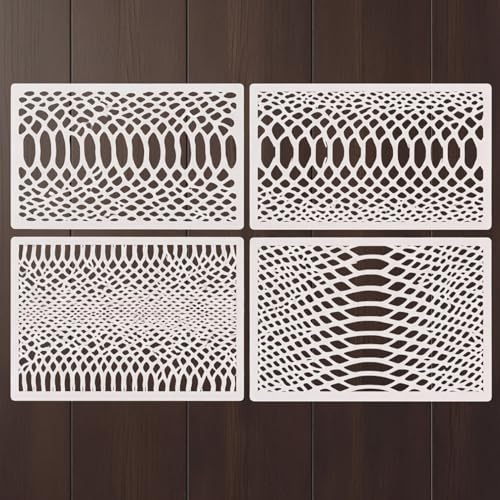
Durable Reusable Stencil Set: Includes multiple snake and alligator skin pattern templates made from high-quality, flexible stencil material for repeated use without tearing or warping.

1 Set = 12 Sheets Henna Tattoo Stencils, 6 Pairs Right and Left hands stencils. Pasting position: Hand, Finger,Forearm, etc. Suitable for Henna tattoo, Airbrush Painting, Glitter tattoo, and so on;

Package:You will get 4 Sheets snake tattoo stickers for Halloween medusa cosplay costume
5. Moon and Stars
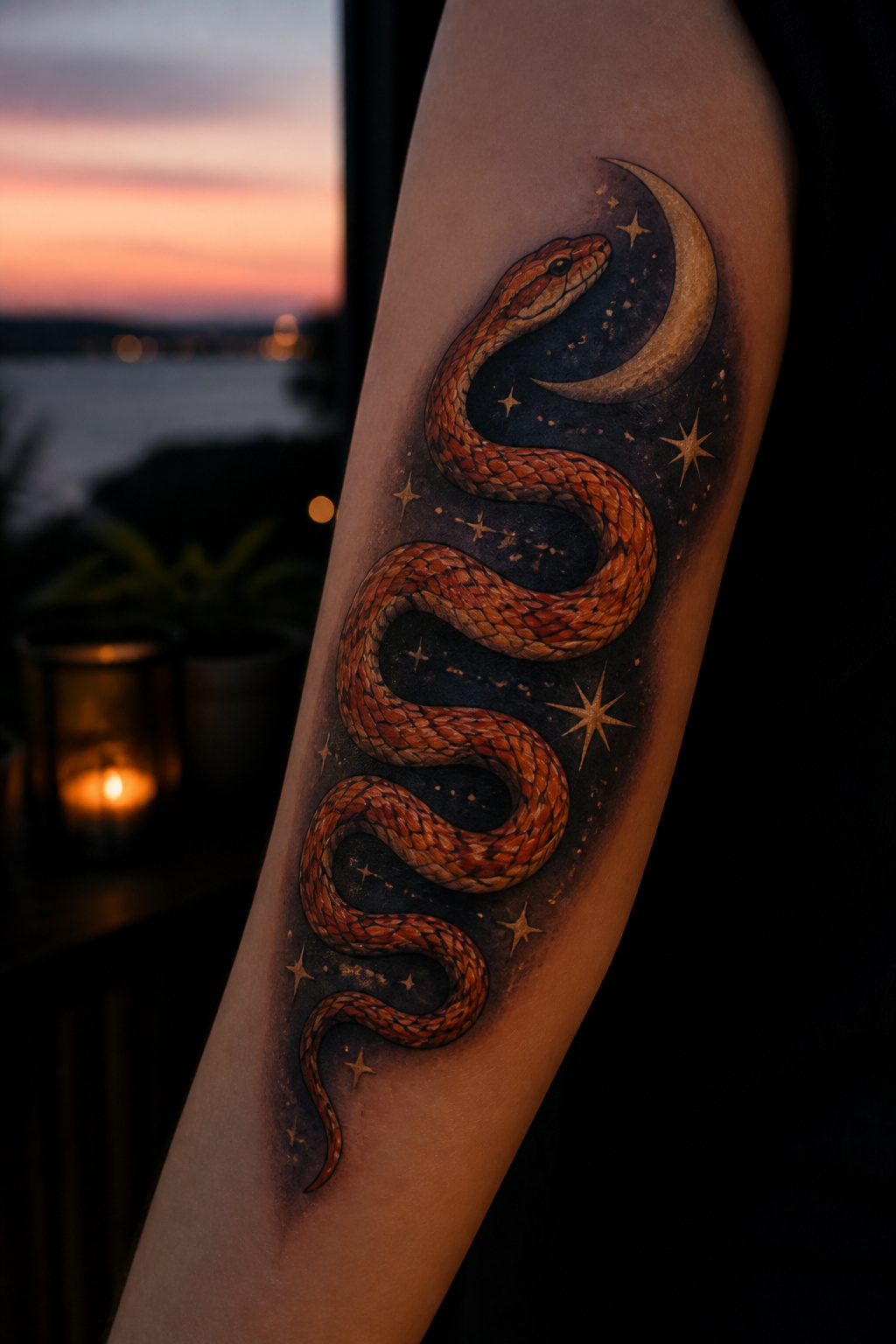
Corn snakes hunt at night, which makes the moon-and-stars pairing one of the few tattoo concepts that looks dramatic and happens to be true to the animal. The snake’s orange and red scales read almost luminous against a dark blue or purple wash, and the contrast does the work of making both elements pop without either fighting for attention.
A full lunar cycle arcing behind the body tracks well with the snake’s natural posture; the curve of a crescent can echo the coil, or a constellation can thread between loops so the snake and sky feel like one continuous form rather than two images stacked together. Dark backgrounds need enough negative space around the scales or the detail collapses into mud from a few feet back. What convinced me, looking through portfolios where this works, is that the artists who nail it keep the snake’s pattern crisp and let the night sky stay atmospheric, loose, almost watery. Too tight on the stars and the whole thing turns into a science illustration; too vague and it reads as a smudge. The balance sits right where the snake looks like it belongs in that particular darkness.

PERSONALIZED STYLE: Sheet size 19 x 12 cm (7.5 x 4.7 inches). Package includes 2 sheets temporary tattoos stickers. Express yourself and show off your unique style with these fun and fashionable temporary tattoo stickers!

🌊【8 Sheets Groovy 3D Realistic Snake Temporary Tattoos For Women Men Adults 】TASROI Unique Design Snake Tattoos For Men Realistic Halloween Black Cobra Serpent Tattos. 【Size】8 Sheets Fake Tattoos For Women Template 7.4"x3.7".

⚡Realistic Black Snake Temporary Tattoos for Adults -- The pack contains 23 unique tattoo sheets filled with varied snake artwork. You’ll find coiled snakes matched with skulls, peonies, thorns and daggers, alongside slim winding small snakes. Timeless black and grey line art brings bold gothic vibes. The collection includes large wrap around snake graphics and tiny minimalist serpent patterns for plenty of styling options.
6. Vibrant Color Study
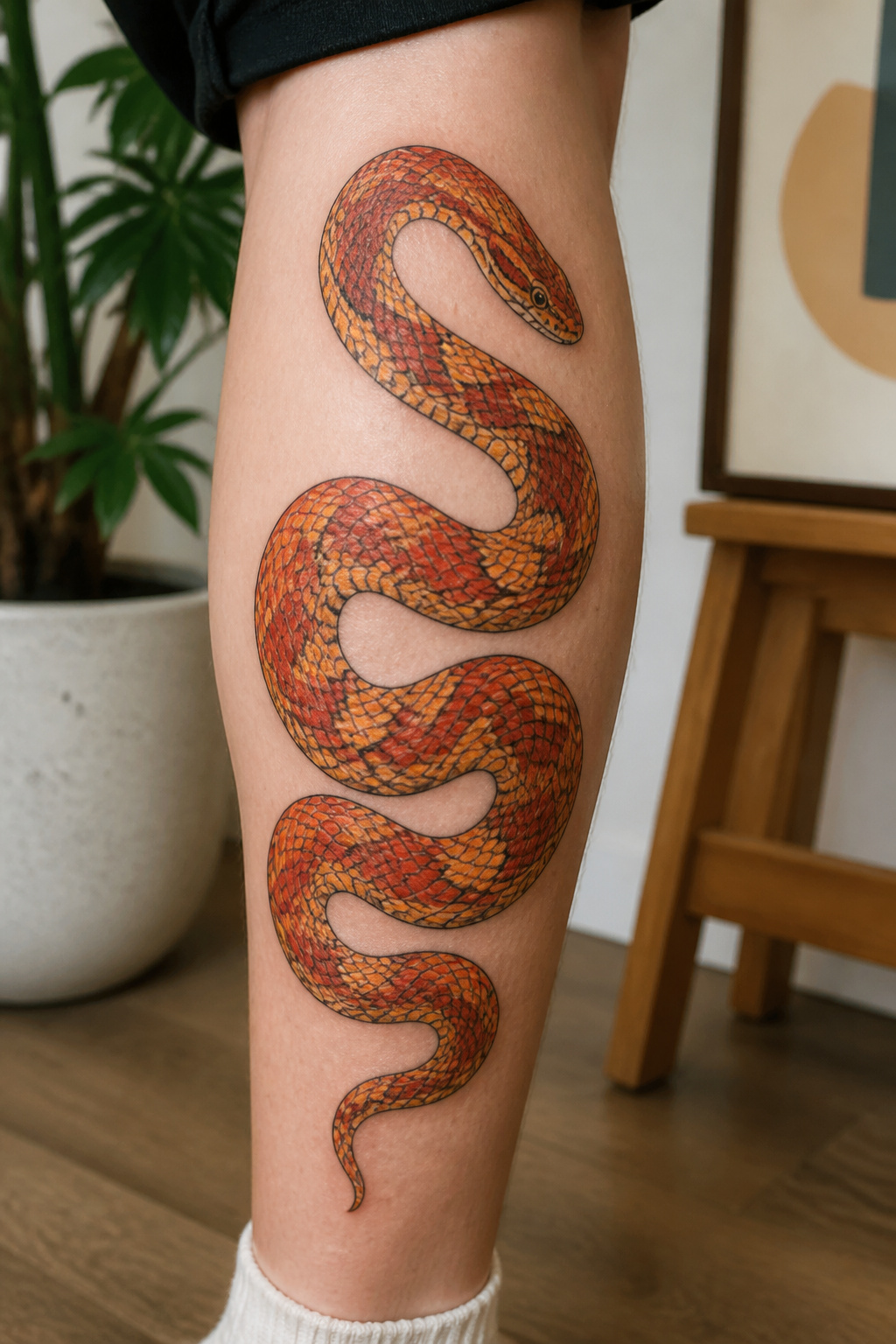
A corn snake’s natural palette does the heavy lifting without any props. The species carries bold orange ground color, yellow belly markings, red saddle blotches, and black-bordered patterning that reads clearly on skin. Working with that native range keeps the design honest to the animal rather than decorative for decoration’s sake.
The Okeetee morph deepens those blacks and intensifies the red, which some artists push further with saturated ink work. The Miami phase cools the orange toward gray-tan with cleaner, narrower saddles, a subtler option if the classic corn snake look feels too bright for your taste. Both give the artist a specific target instead of generic "snake colors."
Placement matters with this much saturation. Areas that see regular sun exposure will shift the yellows and oranges faster than protected skin, so the inner arm or ribcage holds the original balance longer than a shoulder that sees summer daily. My preference runs toward letting the snake’s body curve with yours, the color bands following muscle line rather than fighting it.

Easy to Use : These stencils ensure a flawless finish, making them suitable for both beginners and professionals. Experiment with different paint patterns and unleash your creativity!

UNIQUE DESIGN: You will receive 4 styles of snake and plant pattern wall stencil in same size, each style has different patterns, you can choose different molds according to your own decoration style, and decorate your own room by yourself.

Snake Stencil: You will receive 3 pcs animals theme stencil with various forms of snakes pattern. Reusable DIY plastic stencil that can bring fun to your daily DIY projects, perfect for snakes lover for house decorating! Add a splash of color to your life
7. Tribal Design
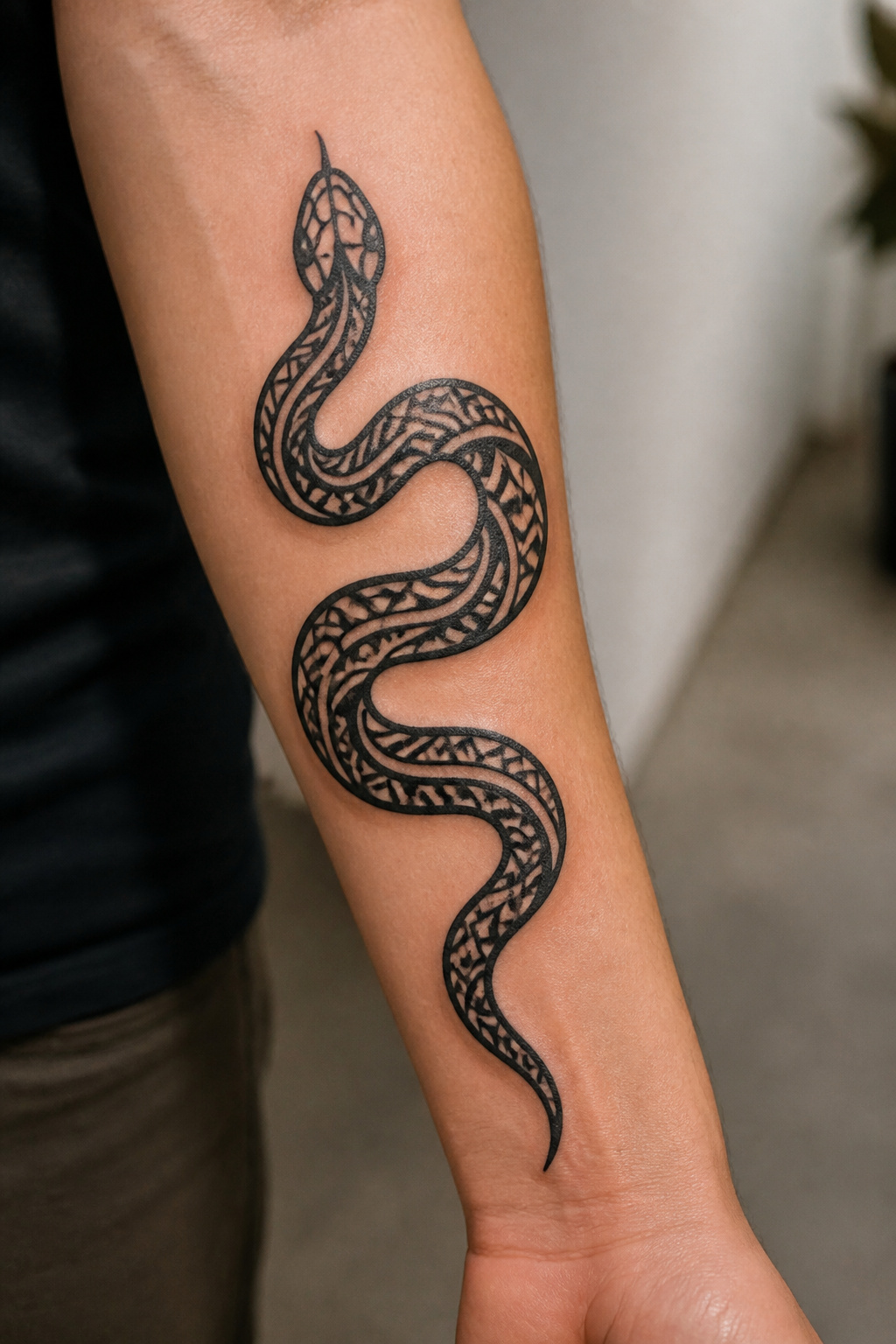
Bold black lines transform a corn snake into something closer to emblem than animal. The heavy weight carries across the body in sweeping curves, with scale patterns reduced to repeating geometric marks that read as texture from a few feet back. Where a realistic portrait asks the viewer to admire the snake itself, tribal work pushes the symbol forward: transformation, earth, the patience of a creature that moves low and waits.
The style demands commitment to solid black. Gray wash or fine detail gets swallowed by the graphic contrast, so the artist builds impact through line variation alone. Thickness changes signal depth; a spine of heavy black tapering to thinner curves at the belly keeps the form readable even when the snake coils back on itself. Negative space becomes the critical tool, carving the pattern out of skin rather than drawing it on top.
Placement matters more here than with softer styles. The bold geometry rewards flat surfaces where the full sweep stays visible: outer forearm, calf, across the shoulder blade. Ribs and joints distort the curves in ways that break the symbolic reading. What reads as ancient and grounded on a stable plane can look merely busy where the body moves too much.

【Style and Elements】 3 sheets of realistic 3D snake temporary tattoos with 9 patterns including Vipera Ursinii, Milk Snake, Kingsnake, Smooth Green Snake, Snake with Star, Snake with Rose, Floral Snake, Snake Wrapped Around Hourglass and more.

🐍 96 PCS SNAKE TEMPORARY TATTOOS: Maximize the fun with 10 premium sheets (6.3x4.7 inches) featuring 86 vibrant, pre-cut snake and reptile designs. Perfect for sharing at boys' and girls' birthday parties, classroom rewards, and safari-themed events."

PERSONALIZED STYLE: Sheet size 19 x 12 cm (7.5 x 4.7 inches). Package includes 2 sheets temporary tattoos stickers. Express yourself and show off your unique style with these fun and fashionable temporary tattoo stickers!
8. With a Heart
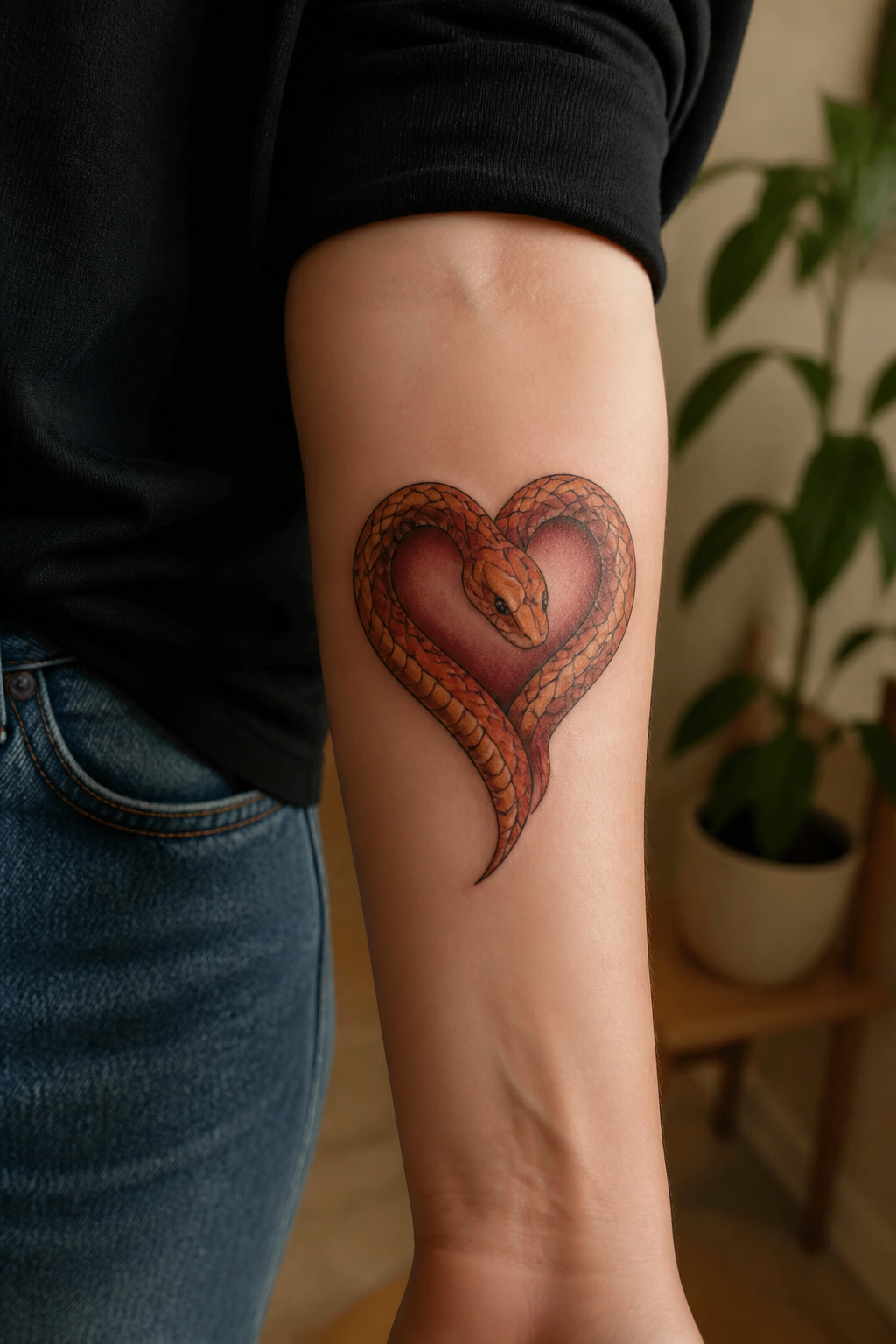
A corn snake tattoo threaded through a heart shape works because the animal’s body does the bending for you. The spine follows the curve naturally, so the artist isn’t fighting the form to make it read as affection rather than threat. Anatomical hearts give more texture, the chambers and vessels offering places for the snake to weave in and out so the two elements feel genuinely intertwined rather than stuck together. Stylized hearts are cleaner, read faster from a distance, and suit the snake’s smoother scales without competing for detail. Placement matters for the curve: the upper chest or inner forearm lets the heart sit at a natural width, while wrapping the design around a shoulder or hip elongates the shape and lets the snake’s tail trail off in a way that feels finished. Color choices shift the mood more than you’d expect. Keeping the heart in muted reds or grayscale while the corn snake carries its natural orange and saddle pattern makes the snake the clear subject and the heart the frame. Reversing that, with a vivid heart and a pale snake, tips the symbolism toward vulnerability rather than the snake’s usual associations with transformation. Either reads clearly as love that adapts, that moves around obstacles rather than breaking against them.

LARGE SIZE AND MORE QUANY -- Total 77 Sheets Temporary Tattoo Stickers for Men and Women Adults Including 17 Sheets Large Size (7.48*3.74 inches) and 60 Sheets Small Size...
9. With a Rose
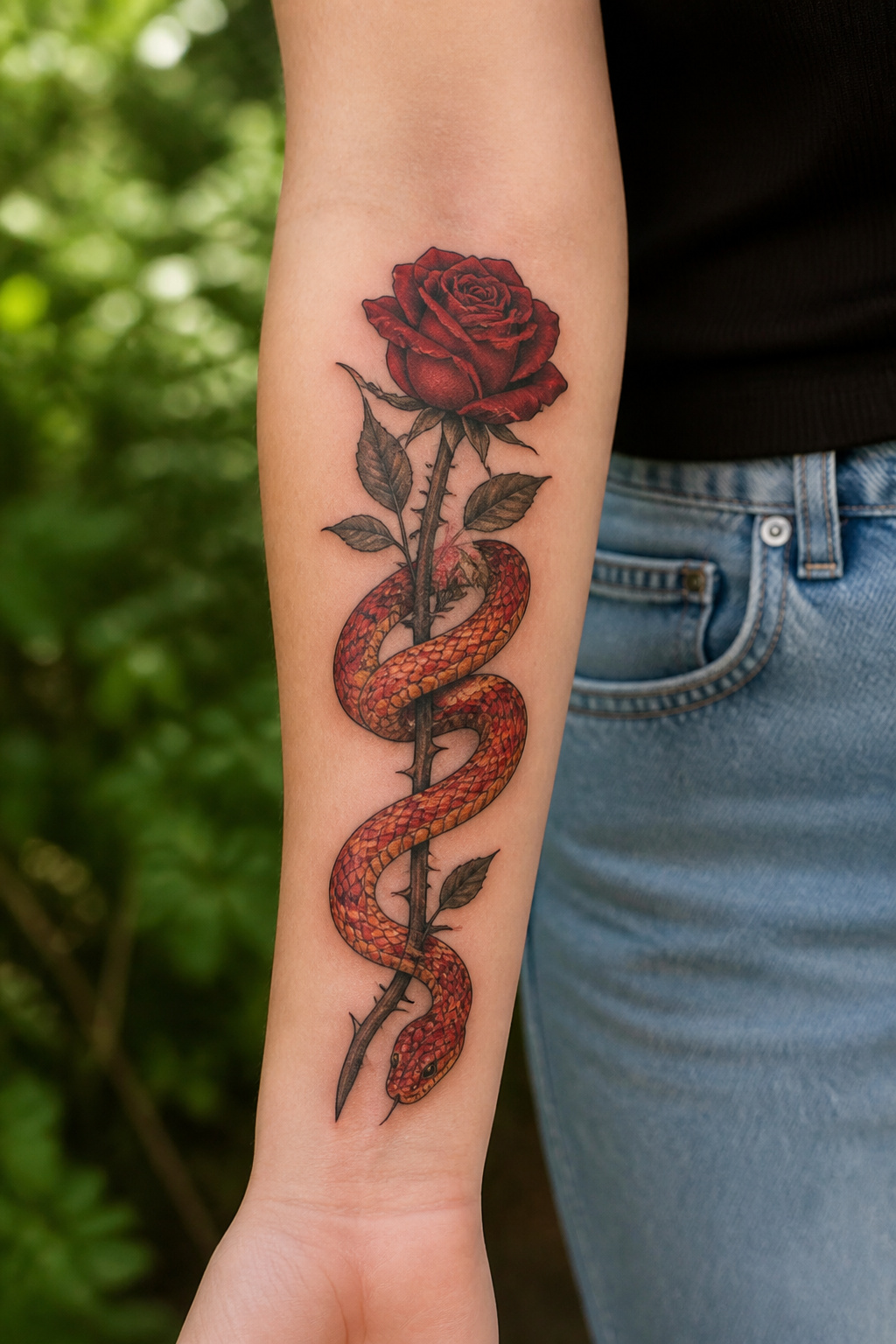
A corn snake’s orange and red saddles against a green stem give the old snake-and-rose pairing something the flash sheets usually miss. The pattern is specific enough that someone who keeps corns will recognize the species at a glance, which matters more than most people think when they’re picking something permanent.
The snake’s head works best near the bloom or threading through the thorns, not dangling off the stem like an afterthought. Placement on the forearm or calf lets the stem run with the muscle line while the snake coils at its own angle, which breaks the composition just enough to keep it from looking like clip art. The thorns should catch light differently than the scales, a detail that separates a decent piece from one that sits flat.
Color saturation is the usual mistake. Corn snake reds are bright but not garish; push them toward true orange and the rose starts to look like it belongs to a different tattoo entirely. A muted crimson for the flower, something that reads as aged rather than fresh-cut, lets the snake’s pattern do the visual work without competing.

Reusable stencils. The best arts and crafts material. Resists inks paints and stains. Stencil sheets are cut from soft materials, to prevent damage to projects.

Different Snake Skin Pattern:These templates show four different snake skin patterns, each boasting a unique color combination and scale structure, vivid and novel, make your creative projects more unique.
10. With a Butterfly
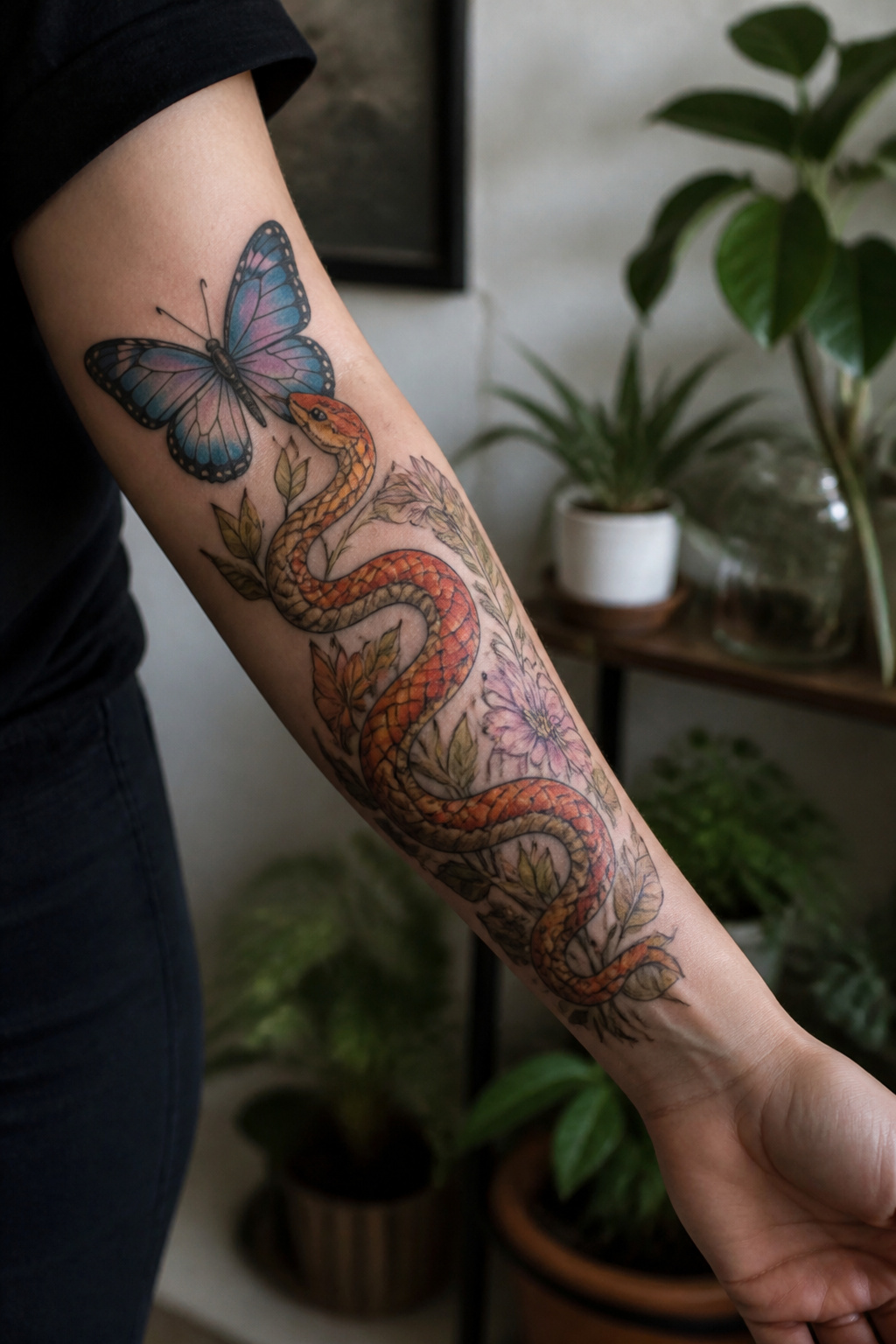
A corn snake paired with a butterfly works because both creatures carry the same story: shedding one form for another. The snake’s long, narrow body stretches across the skin while the butterfly’s wings spread wide, and that difference in shape gives the design natural balance. The snake can curve along a forearm or ribcage with the butterfly perched where the body thins, or the two can face each other so the eye travels back and forth.
Color choices matter more here than with other pairings. Corn snakes already bring orange, red, and yellow to the composition, so the butterfly needs tones that either match for harmony or cool blues and purples for contrast. Too many competing warm shades and the two figures blur together; too much contrast and they look like separate tattoos forced to share space.
The metamorphosis theme runs deeper than matching symbols. A snake leaves its skin behind in one piece, a butterfly dissolves almost entirely before rebuilding. That difference in how transformation happens, what gets kept and what gets lost, gives the design emotional weight without needing text or extra elements to explain it.
11. Watercolor Wash
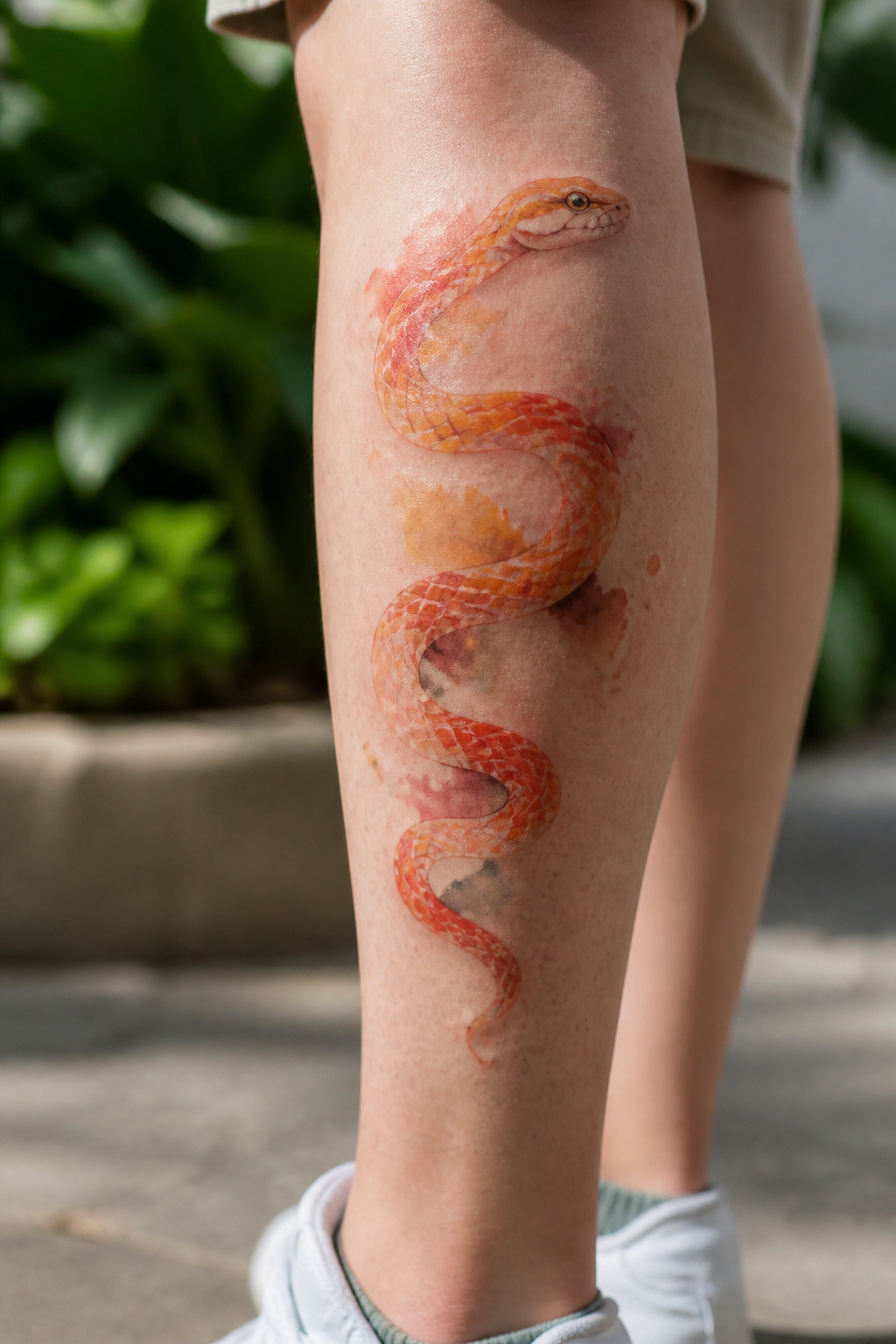
Watercolor technique lets a corn snake’s natural color bands bleed into one another the way they do on the living animal. The style skips black outlines entirely, building the shape from layered washes of orange, red, and pale yellow that feather at the edges. On skin, this means the tattoo reads softer from a distance than a traditional piece, more like a stain than an illustration.
The problem is permanence. Watercolor tattoos rely on pigment sitting in diffuse clouds rather than concentrated lines, and that diffusion makes them prone to blurring over five to ten years. A corn snake’s detailed scale pattern, which gives the species its charm, can dissolve into unrecognizable blotches if the artist miscalculates how much pigment to place. Finding someone who has healed photos from three-plus years back matters more than their Instagram freshness.
Placement helps. Areas with thinner skin and less movement, the outer forearm or the calf, hold these washes cleaner than ribs or fingers where the color breaks down faster. The technique suits someone who views tattoos as evolving pieces rather than fixed images, which matches how I tend to think about them after watching a few age poorly on friends who rushed in for the aesthetic alone.
12. With a Compass
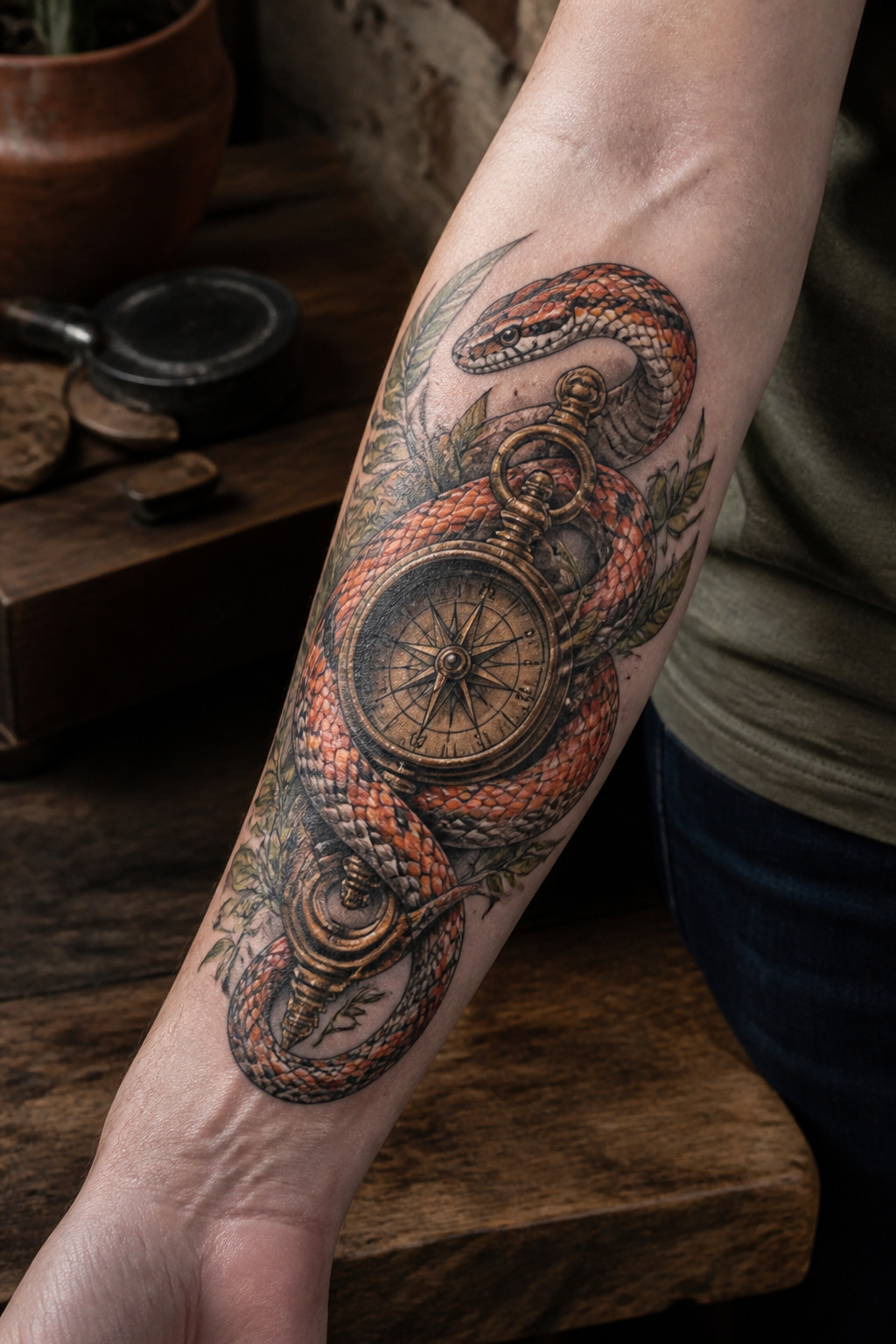
A compass rose wrapped in a corn snake lands somewhere between naval chart and garden shed, and that tension is what makes it work. The snake’s earth-toned bands, those repeating saddles of orange and red, read as something found in leaf litter rather than open ocean, so the pairing keeps the compass from feeling like a generic nautical stamp.
Vintage compasses suit this best: the brass patina, the slightly off-kilter numerals, the wear marks where a thumb would have spun the bezel. Those surfaces give the snake something to contrast against without fighting for attention. A more minimal, modern compass, all clean lines and perfect symmetry, tends to flatten the snake into decoration rather than letting the two elements argue a little.
Placement matters for the geometry. The forearm’s length lets the compass sit true while the snake’s tail can coil past the wrist or shoulder without distorting either shape. On a smaller area like the ankle, the compass usually wins and the snake gets compressed into a thin ribbon.
Meaning here is straightforward without being thin: the snake’s shedding and ground-level patience, the compass’s deliberate direction. Neither symbol overpowers the other, which is rarer in combo tattoos than most people expect.
13. Intertwined With a Dagger
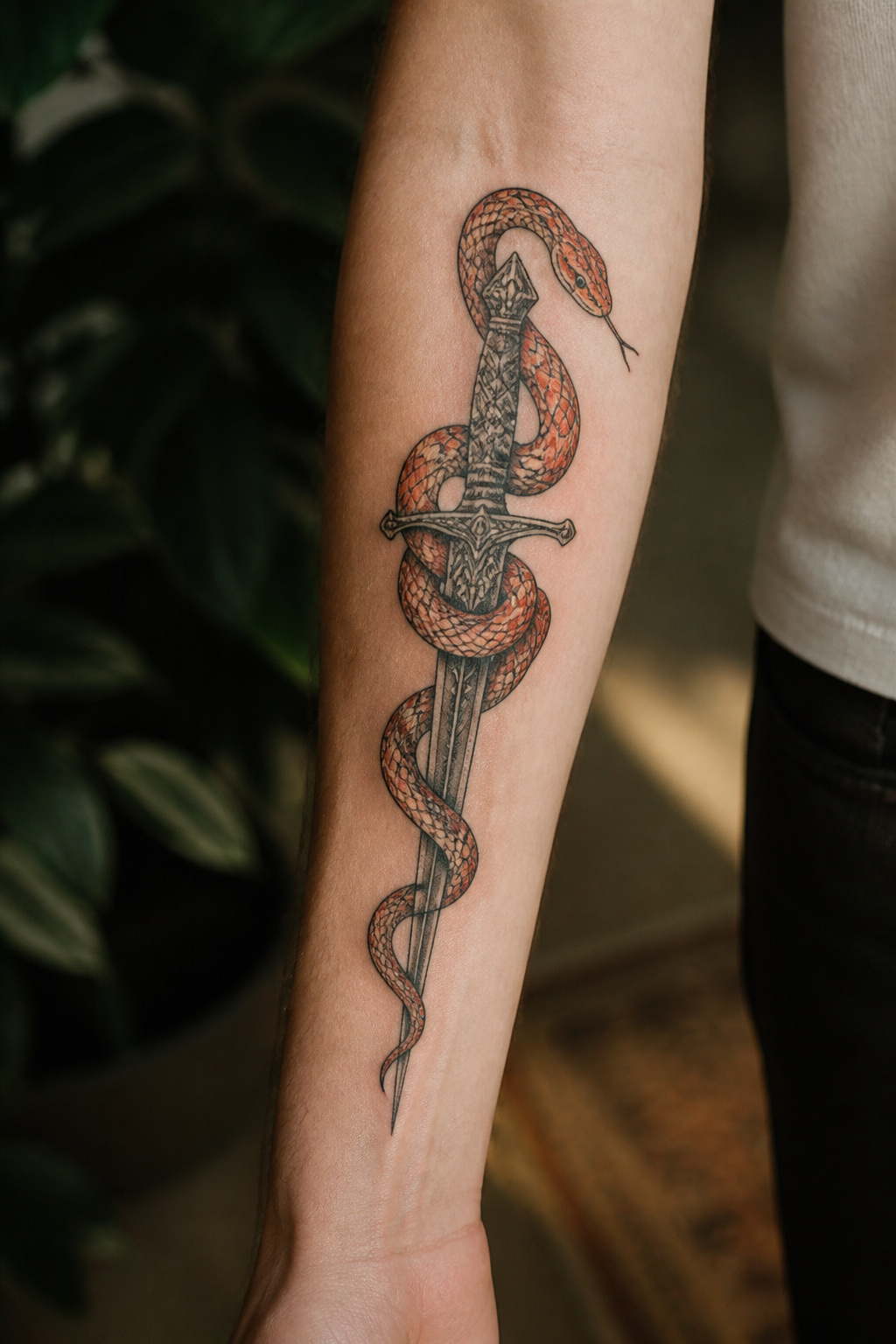
The snake-and-dagger pairing has been around long enough to feel expected, but swapping in a corn snake changes the weight of the whole piece. Where a thick-bodied rattler or python demands a heavy bowie or tactical blade to look proportionate, a corn snake’s narrow frame lets the tattoo breathe with a lighter touch. A slender stiletto, a narrow filigreed dagger, even a broken sword hilt with the blade snapped short, the snake threading through like ribbon through a ring.
Placement matters more here than with most corn snake designs. The dagger wants length, which means the forearm, calf, or ribs. I have seen this flattened onto a shoulder cap where both elements had to shrink and compete, and the snake ended up reading as a squiggle rather than a coil. The blade should run with the muscle line, not across it, or the straight edge fights the body’s curve and the whole thing looks pasted on.
Color choices split cleanly. A natural corn snake, with its orange and red saddles against silver steel, keeps the contrast readable at a distance. An all-black silhouette version trades that clarity for something more graphic, though you lose the species-specific detail that justified choosing a corn snake in the first place.
14. With a Dreamcatcher
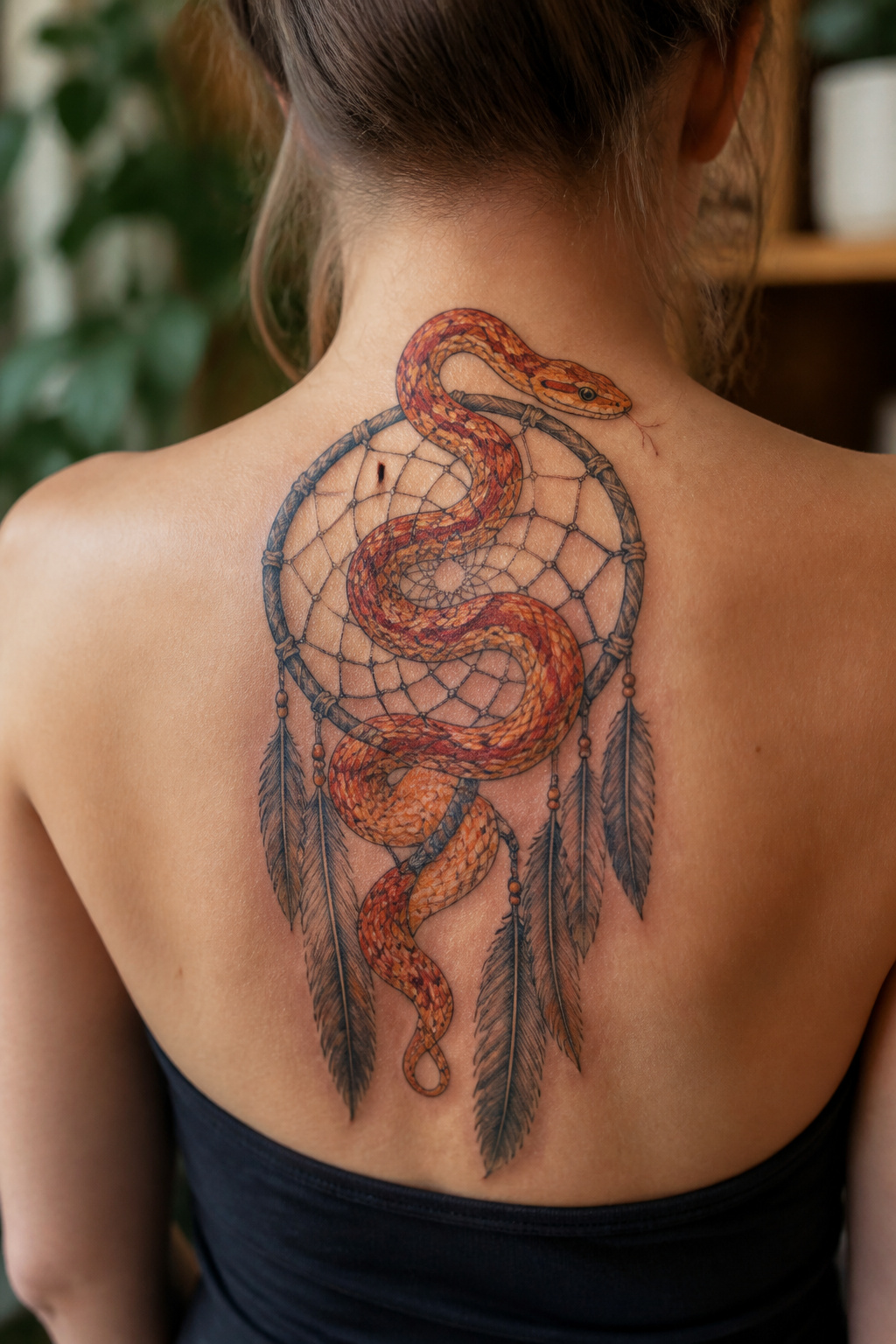
A corn snake threaded through a dreamcatcher web carries two protective symbols that rarely meet. The snake’s repeating saddle pattern can mirror the web’s radiating geometry almost exactly, especially in a upper back piece where both have room to breathe. One artist I watched work placed the snake’s body so its orange blotches sat where the web’s knots would be, letting the two patterns argue and then agree.
The cultural pairing is what makes it stick. Dreamcatchers filter harm in Ojibwe tradition; corn snakes in American folk practice guarded grain stores from rodents, which made them welcome near human spaces rather than feared. That shared guardian role gives the design weight beyond aesthetics, though the visual balance still has to earn its place. A snake dangling as one of the feather lines works better than I expected, the body weighting the drop the way a real feather would. The risk is clutter: both elements compete for detail, and a small forearm placement will flatten the snake’s scales into mud. If the web’s center sits at the shoulder blade with the snake weaving outward toward the ribs, each keeps its own territory and the eye travels with purpose. Color matters less than value contrast here; the snake’s warm tones against cool steel-blue webbing separates them even when the linework crowds close.
15. Yin-Yang Design
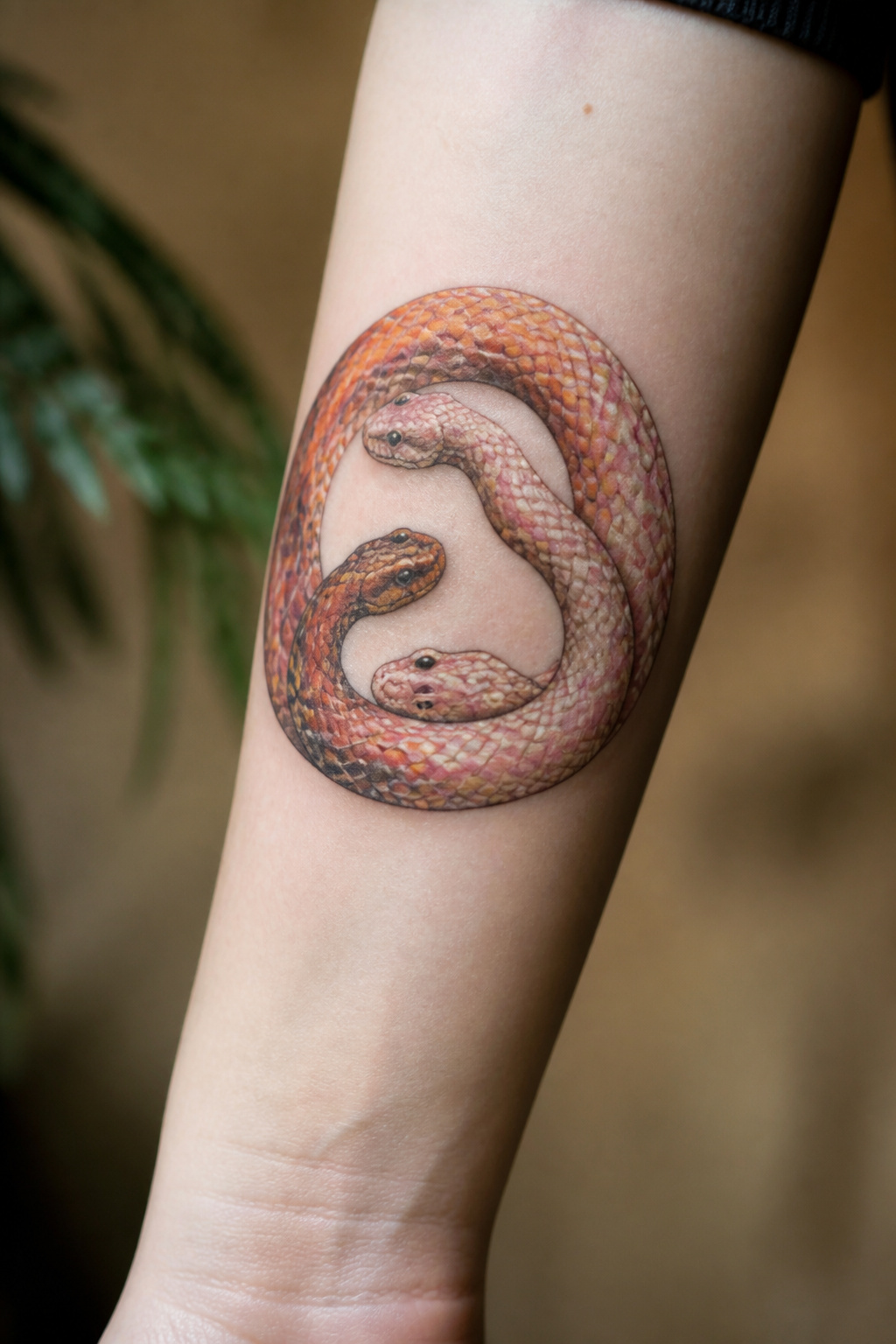
Two corn snakes threaded into the classic yin-yang circle carry more visual logic than most paired-animal designs. The natural color variations do the heavy lifting: an amelanistic morph, pale with soft pinks and creams, reads as the light half without any forced styling, while a normal wild-type corn snake supplies the deep orange-brown contrast. Curving a single snake into the split teardrop shape works, though the head and tail meeting at center never quite resolves cleanly. Two separate snakes, each occupying its half, lets the tattoo breathe and keeps the silhouette readable at smaller sizes.
Placement matters for the color to stay legible. The pale snake risks washing out on lighter skin if the artist under-saturates the pinks. Ask to see healed photos of their previous light snakes. A yin-yang corn snake tattoo lives or dies on whether the contrast still reads after the initial redness fades. The black outline common in traditional yin-yang designs fights against the snakes’ natural patterning; a softer separation, letting the scales themselves create the edge, looks less like a sticker and more like living animals in balance.
16. With Lightning
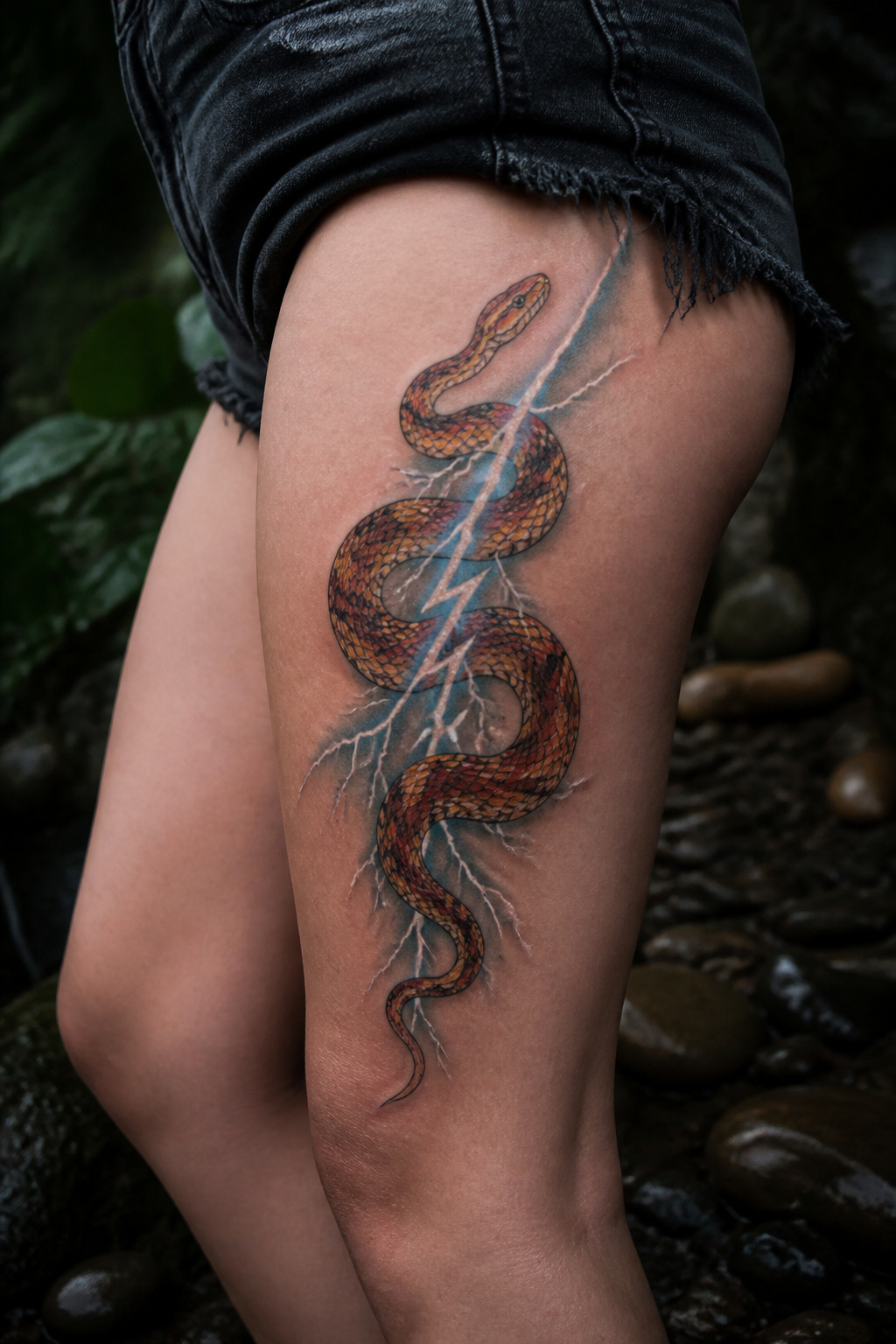
A corn snake tattoo paired with a lightning bolt lives in the tension between two kinds of movement. The snake’s body follows slow, predictable curves, each scale catching light in a way that reads as deliberate earth energy. Set a jagged bolt across that body or running parallel to it, and the whole piece snaps into something else entirely. The angles fight the curves, and that friction is the point.
Placement matters more here than with simpler snake designs. The bolt needs room to read as sudden, which means avoiding spots where the body curves too sharply and breaks the line. The upper arm or outer thigh gives both elements space to breathe without the snake’s coil swallowing the angle. Color tends to work best when the snake keeps its natural oranges and ambers while the lightning goes cool, white, or pale blue, though a single yellow flash against muted scales carries its own stark logic.
The meaning stays close to the surface: groundedness interrupted by change, or patience struck by necessity. What convinces me, looking through the designs that pull this off, is the artists who let the bolt actually interrupt the snake rather than frame it politely. A thin strike crossing behind the head, where the body is narrowest, reads as earned drama. A bolt that merely floats nearby looks like two tattoos sharing skin.
17. With a Sun
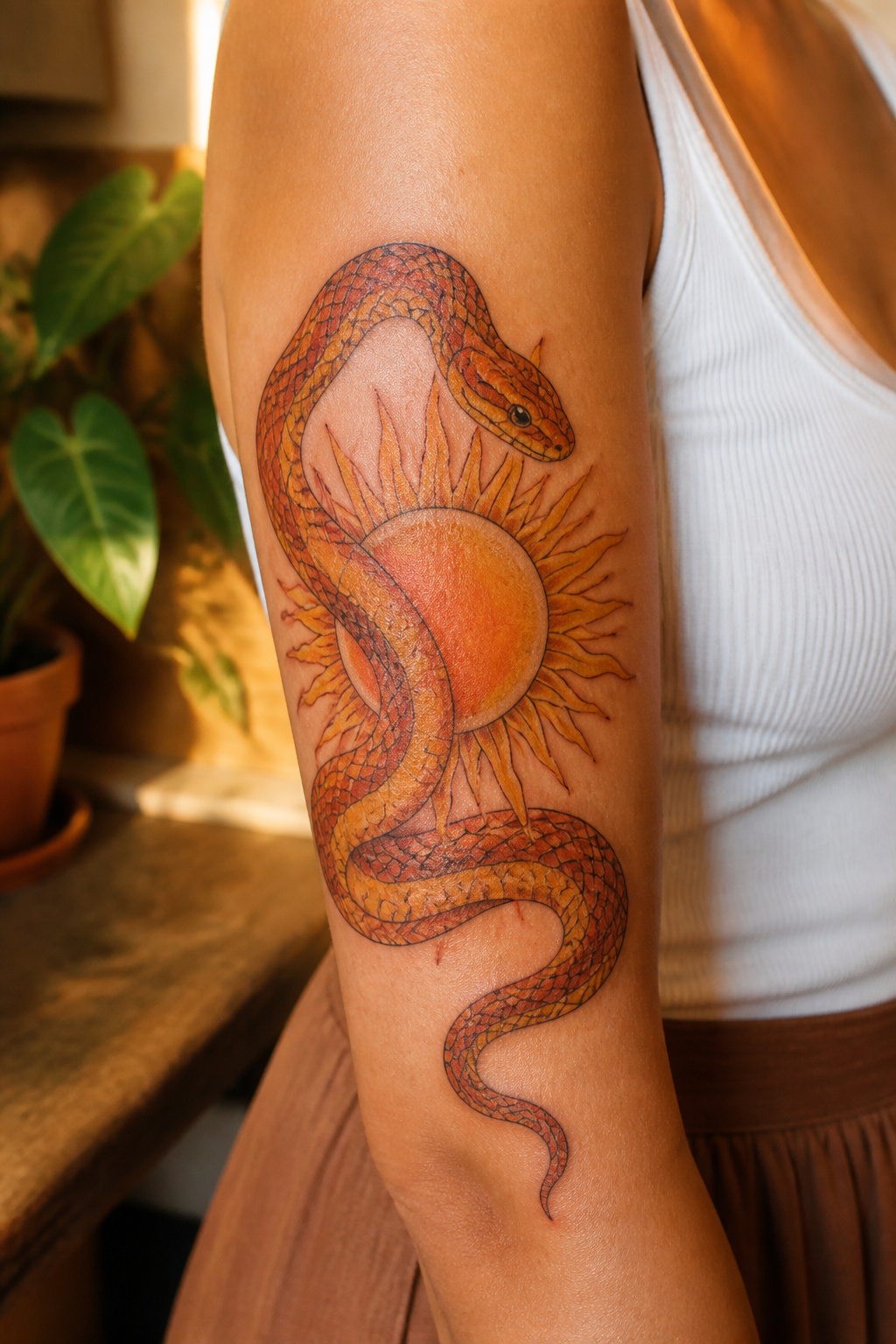
A corn snake curved around a sun disk or radiating sunburst draws on something the species actually does. In captivity and in the wild, these snakes seek out warm surfaces to bask, flattening their bodies to absorb heat. That habit gives the pairing a biological grounding stronger than most symbolic mashups.
The warm palette keeps itself cohesive without much work. The snake’s own oranges, reds, and yellows echo the sun’s tones rather than competing with them. An artist can grade the snake’s scales from deeper amber on the cool side of the coil to near-yellow where the body faces the light source, letting the sun’s rays do the explaining.
Placement matters for the geometry. The sun works best as a central disk the snake can wrap logically, not a background element it crosses arbitrarily. On a shoulder or thigh, the curve of muscle under skin can mirror the snake’s coil so the basking posture reads as relaxed, not pinned. A radiating sunburst behind the head, with the body looping below, risks looking like the snake is being struck; the disk slightly above and to one side, with the snake ascending toward it, reads as choice instead.
18. Traditional Style
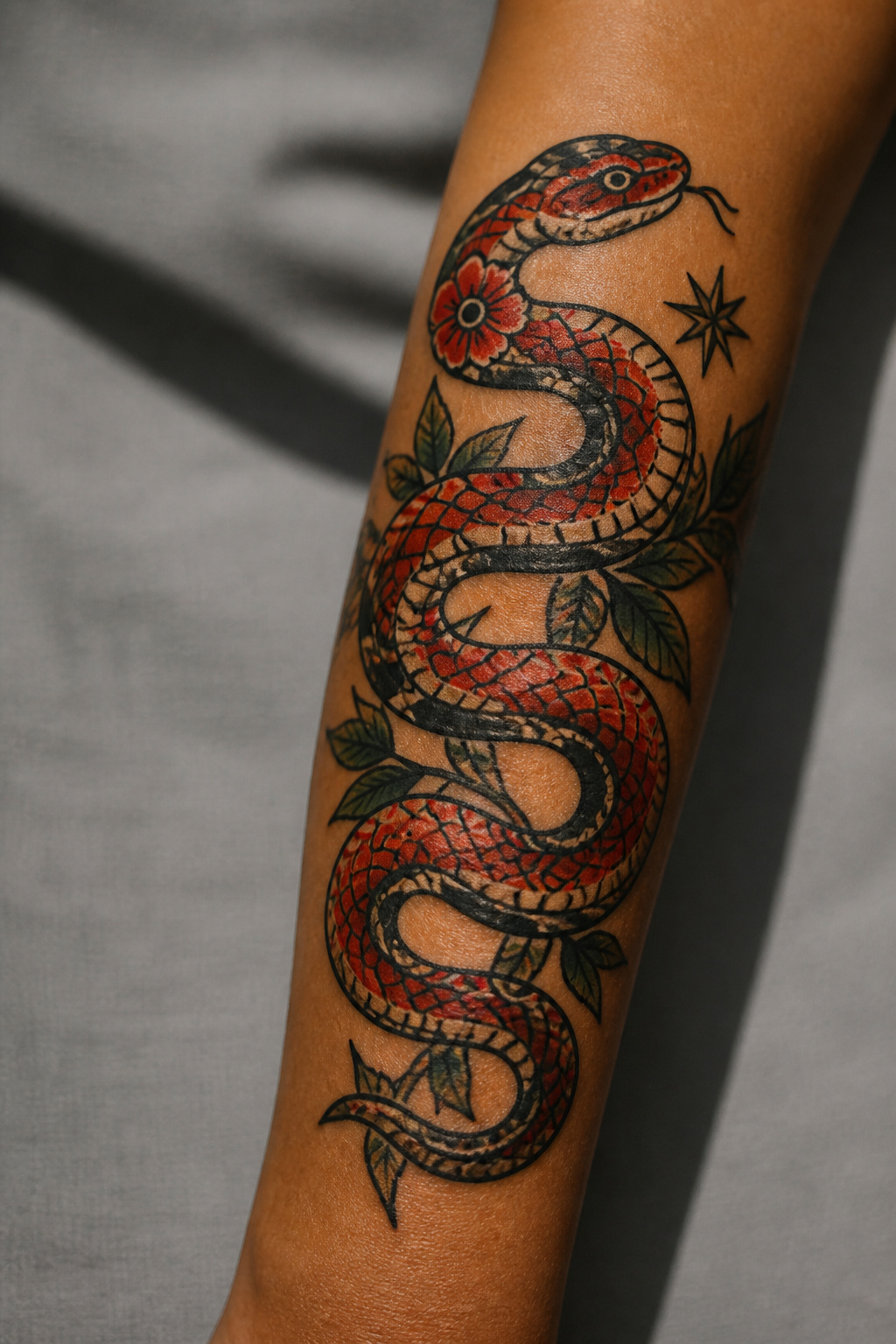
Bold black outlines give a corn snake tattoo the graphic punch American traditional style demands. The breed’s repeating saddle pattern already reads as rows of geometric shapes, so translating it into flat blocks of red, yellow, green, and black feels natural rather than forced. Stylized proportions help here: slightly oversized eyes and a thicker mid-body curve keep the snake readable from across a room, which matters more than anatomical accuracy on skin.
The limited palette actually suits corn snakes better than some subjects. Their natural orange-red ground color maps directly to traditional vermilion ink, while the black-bordered blotches become solid black shapes with thin highlight strips. Yellow works best as small accents: eye rings, belly checkers, or a single split tongue. Green, the least common color in actual corn snakes, earns its place as background filler or a curled leaf motif wrapped around the coil.
Placement shapes the design more than most people expect. A forearm or calf gives the snake length to stretch into a full S-curve without compressing those graphic blotches into muddy overlap. The traditional format’s heavy line weight ages well on high-movement areas where finer detail would blur within a few years.
19. With a Feather
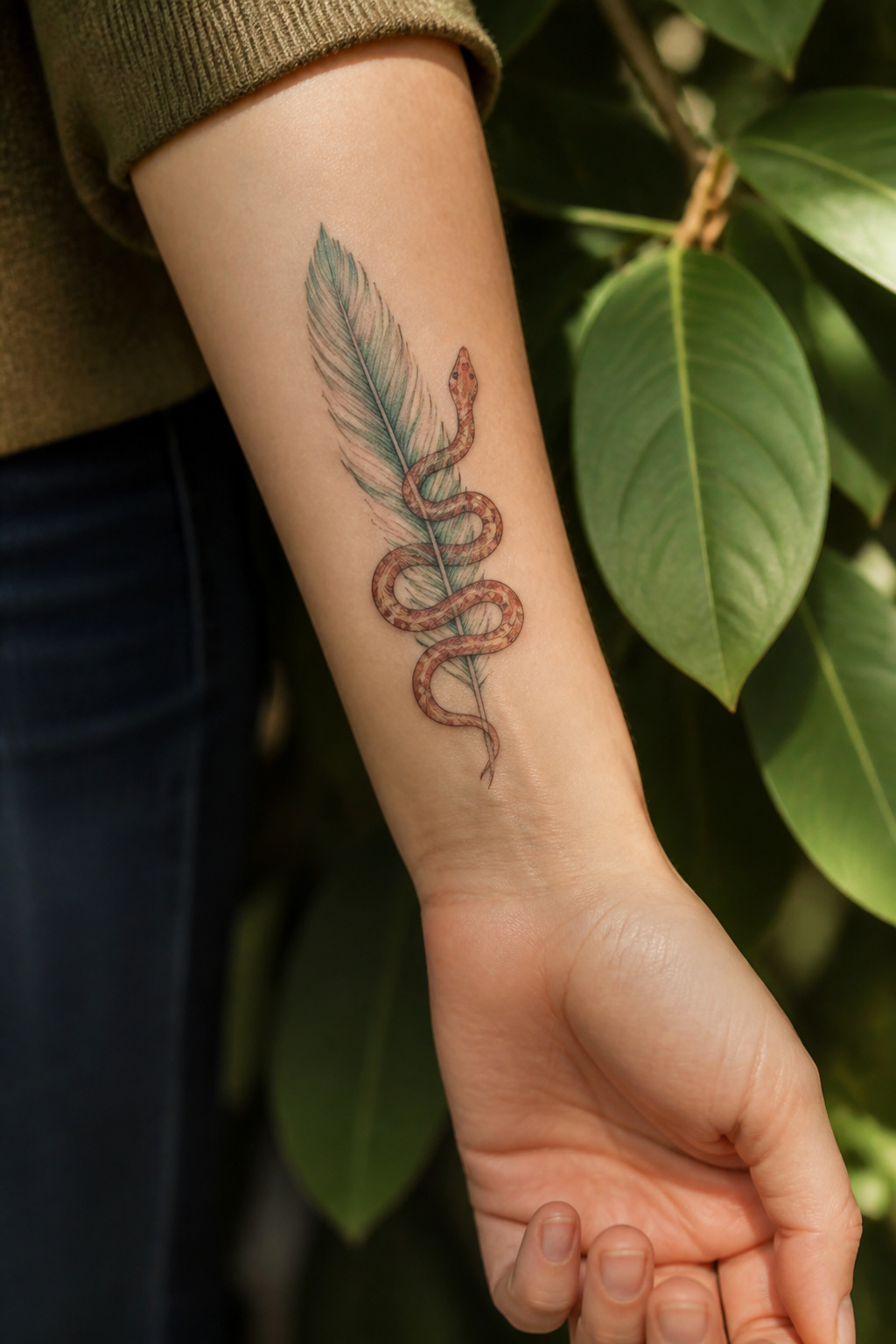
A single feather beside a corn snake works best when the two shapes echo each other. The snake’s slender body and the feather’s shaft and barbs create a natural rhythm, almost like two lines of the same handwriting. I have seen this done with the feather placed just above the snake’s head, as if shed mid-shed, and I have seen it trailing behind the tail like something the snake is leaving behind. Both read differently. The first suggests lightness, the snake almost floating. The second reads more like memory, the feather becoming a token.
Color choices matter here in a way they do not with heavier compositions. Corn snakes carry those warm orange and red tones, so a feather in muted sage or dusty blue creates enough contrast without shouting. The person who wants this pairing usually has a specific feather in mind: a macaw’s for someone from Brazil, a crow’s for a city they left, a simple down feather for a lightness they are trying to claim. The tattoo holds up because the meaning stays private. Someone who does not know the story still sees an elegant pairing of two thin forms.
20. With a Crown
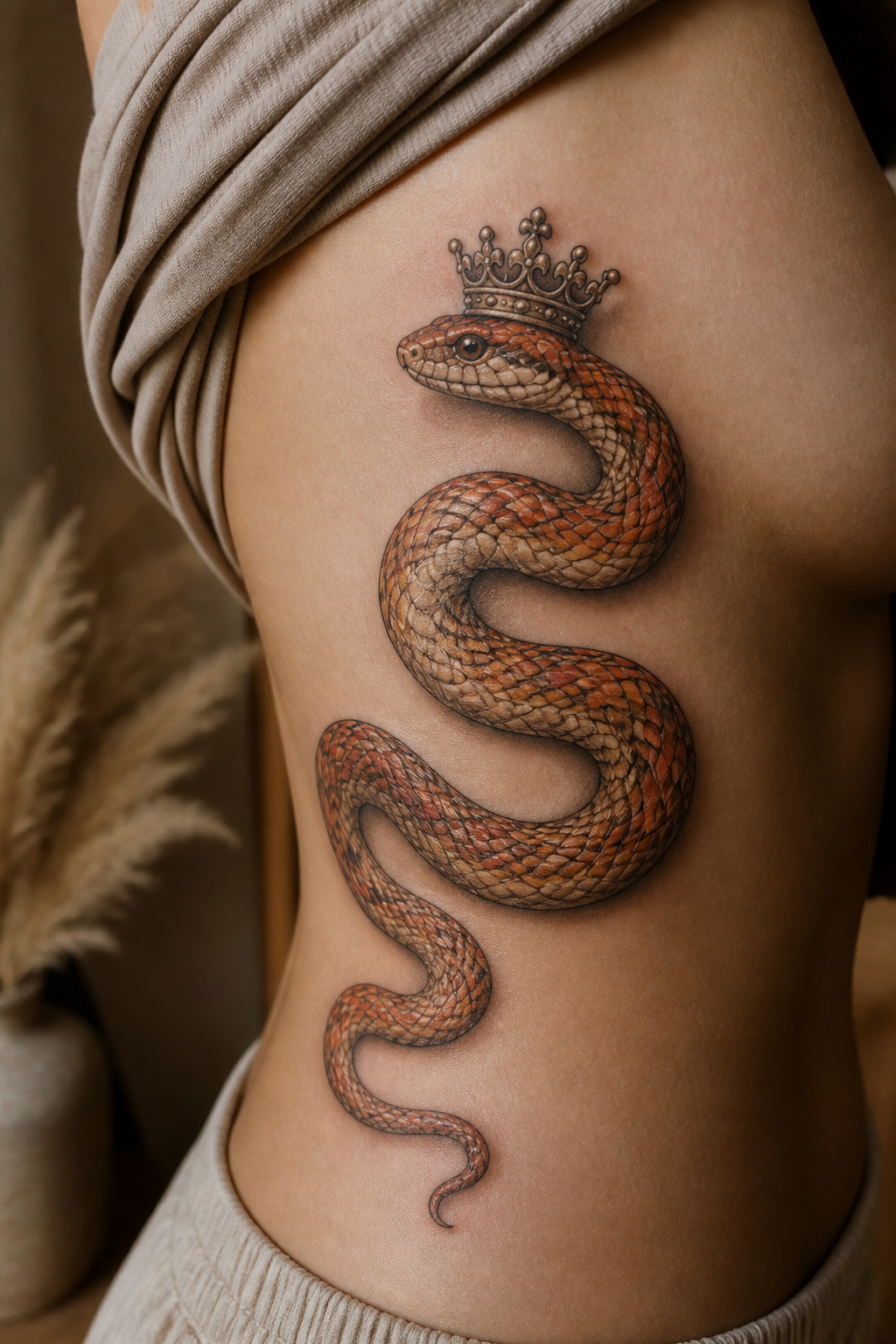
A delicate crown suits the corn snake’s narrow head far better than the heavy, jewel-encrusted pieces you see on lion or eagle tattoos. The snake’s natural build is slim and almost tentative in profile, so a thin circlet or a few small points reads as something it might actually wear rather than something mashed on top.
Placement changes how the piece lands. On a wrist or ankle, the crown draws the eye first and the snake becomes the winding support, which flips the power dynamic in an interesting way. Up along the ribs or shoulder, the snake can curve through the crown and keep moving, and the crown reads as a moment it passed through rather than a static throne.
Color is a judgment call. The corn snake’s own oranges and reds already carry warmth, so gold in the crown can feel like too much of the same note. Silver or oxidized tones give the regal symbol a slightly harder edge and keep the two elements from melting together.
The meaning here is fairly direct: quiet authority, earned rather than announced. What makes it work as a tattoo is the scale mismatch that the corn snake forces. A python or boa with a crown looks like it’s conquering something. A corn snake looks like it found something unexpected and decided to keep it.
21. Minimalist Line
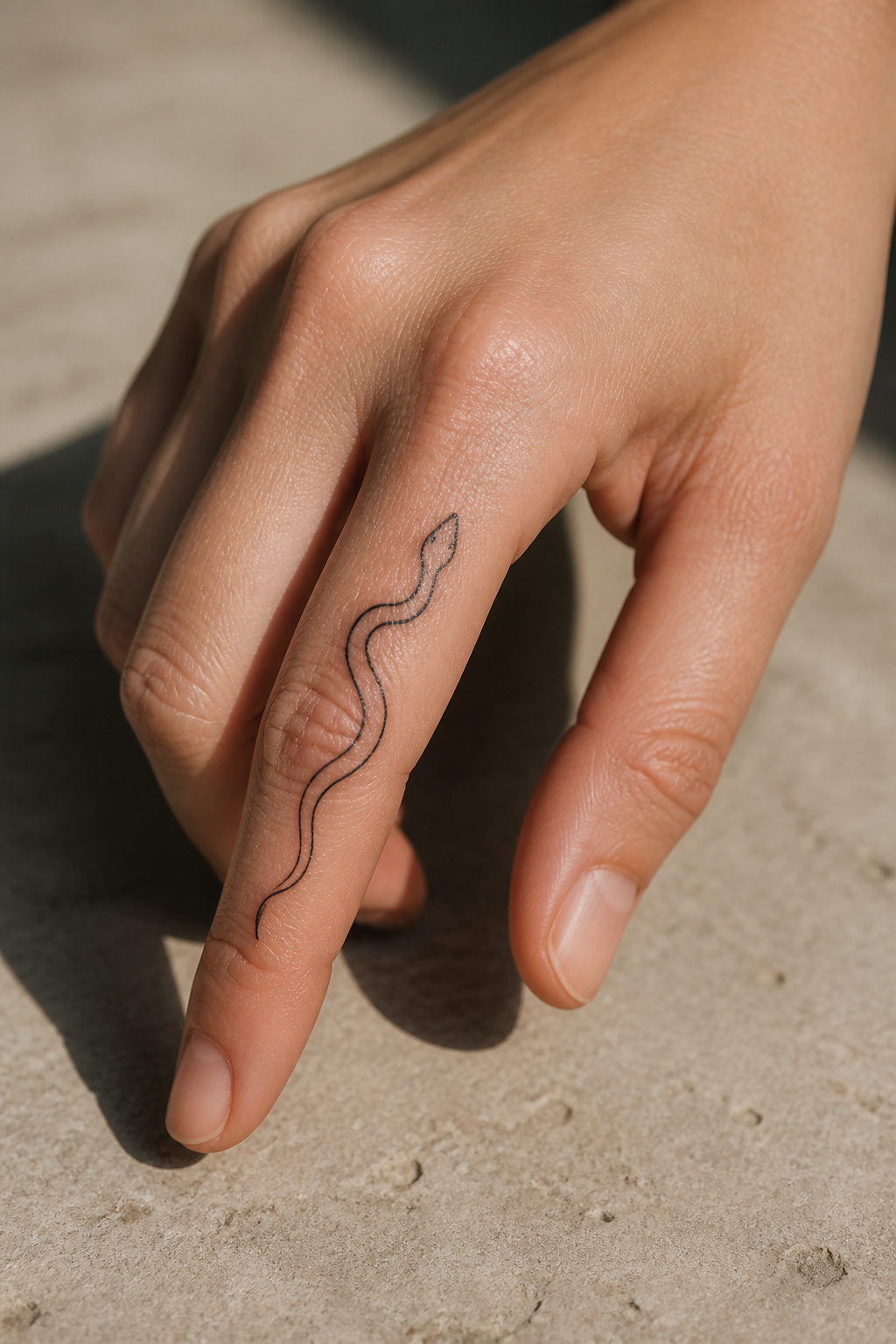
A single unbroken line can carry the full length of a corn snake’s body without ever lifting the needle. The silhouette does the work: the slight widening at the head, the smooth taper through twenty or thirty vertebrae, the gentle curve of a body in motion. Detail would only clutter what the eye reads instantly as snake.
Small placements suit this approach because the line stays legible even at two inches. A wrist wrap reads as a slender band until the angle reveals the head. Behind the ear, the tail can disappear into the hairline while the body follows the natural fold of skin. Finger placement works best along the outer edge, where the line parallels bone rather than crossing the soft center and risking spread.
The artist’s steady hand matters more than the design itself. One waver in a continuous line and the whole form collapses into a squiggle. Ask to see healed examples of their linework; fresh tattoos always look crisper than they settle. Black ink ages cleaner than color here, and a snake drawn in one weight of line holds up better than one that varies thickness for effect.
22. With a Key
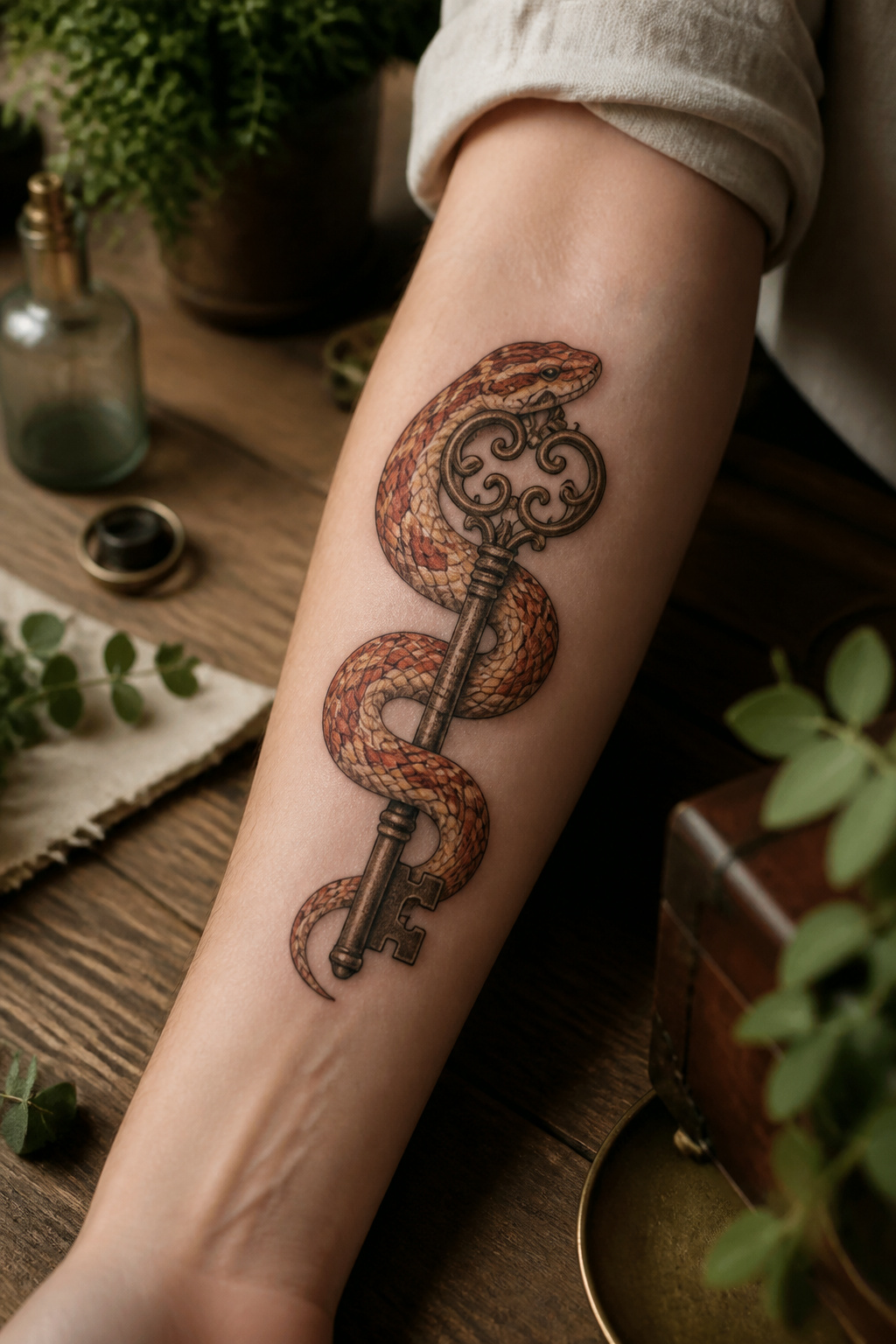
A skeleton key and a corn snake share the same logic: both are about access, about turning something that was closed into something open. The snake’s long, narrow body follows the key’s shaft almost perfectly, winding from the bit end up through the bow so the two forms read as one continuous shape rather than two objects pasted together.
The bow of the key is where the snake’s head should land, since that circular space frames the face and lets the artist give the snake a clear direction of gaze. A corn snake’s pattern of orange and red saddles against the key’s darker metal, whether brass or iron tones, gives the eye two textures to move between without either one winning.
Placement matters for how the key hangs. On a forearm running wrist to elbow, gravity reads correctly: the key points down, the snake’s body drapes naturally. On a ribcage or thigh, the composition often works better rotated so the key lies horizontal, the snake coiled along its length as if the metal were a warm surface it found and claimed.
The meaning stays personal, which is the point of pairing these two symbols at all. Transformation and unlocking rarely happen on separate schedules in a life.
23. With a Lantern
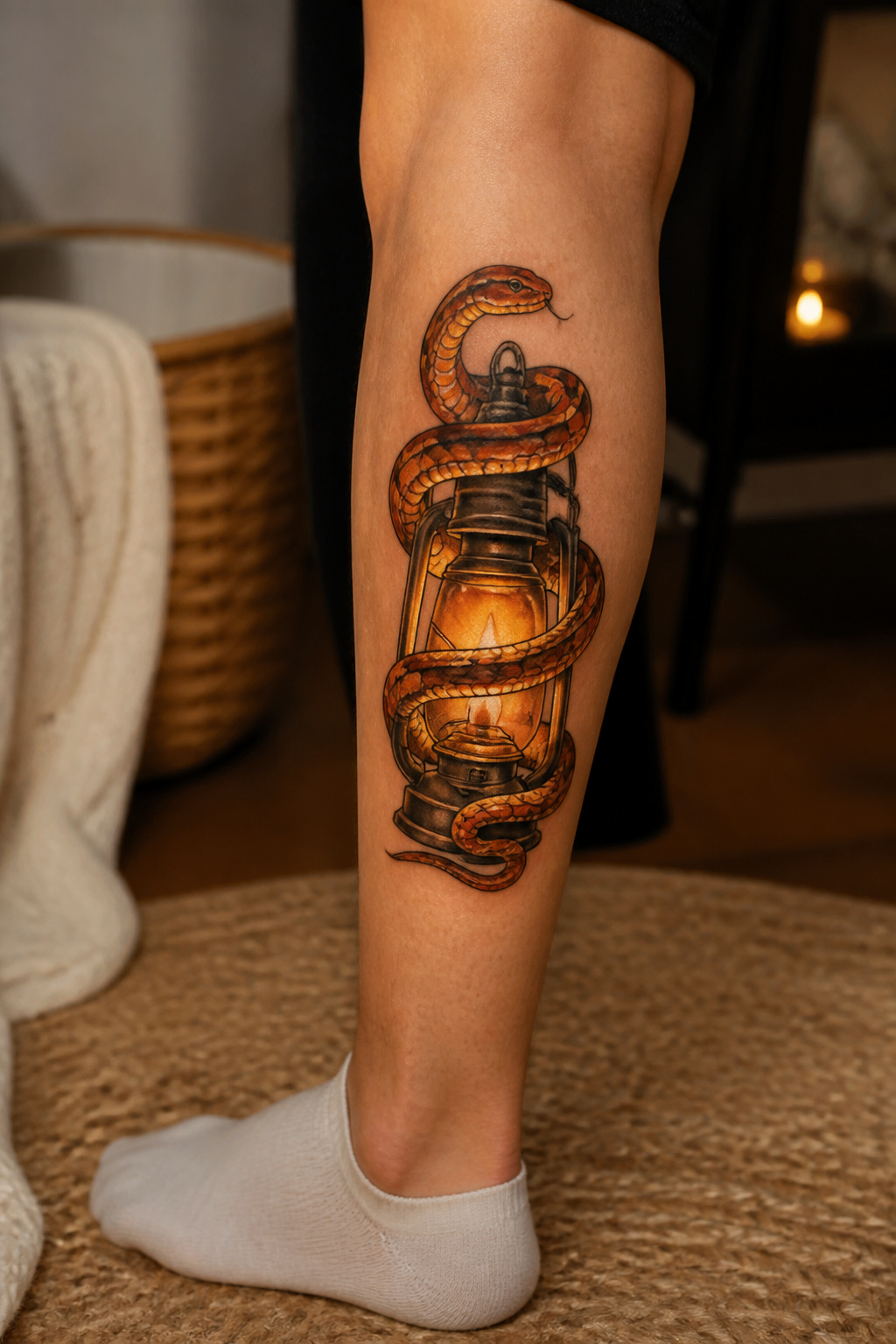
Warm light against a corn snake’s orange and red scales creates something that flat color alone cannot manage. The lantern’s glow pools upward through the coils, turning the belly scales translucent amber and leaving the dorsal pattern in softer shadow. An oil lamp with a visible flame gives the artist more to work with than an electric fixture: the flame itself becomes a small second subject, and the snake’s head can angle toward it with the curiosity real corn snakes show toward any heat source.
Placement matters for the effect. A hanging lantern, suspended by a simple chain or rope, lets the snake spiral downward in a natural weight. The forearm or outer calf carries this well because the slight curve of the muscle lets the lantern settle at the composition’s low point without looking pinned flat. The glow should not reach the full outline of the snake; stopping it two-thirds up the body keeps the light believable.
Color saturation needs restraint. Corn snakes carry their own intensity, and a too-bright flame competes instead of complements. What worked in the references I studied kept the flame in cadmium yellow and palest orange, letting the snake’s saffron and rust remain the richer tones. Black ink for the lantern hardware and shadowed coils anchors the whole piece before any color goes in.
24. With a Fish
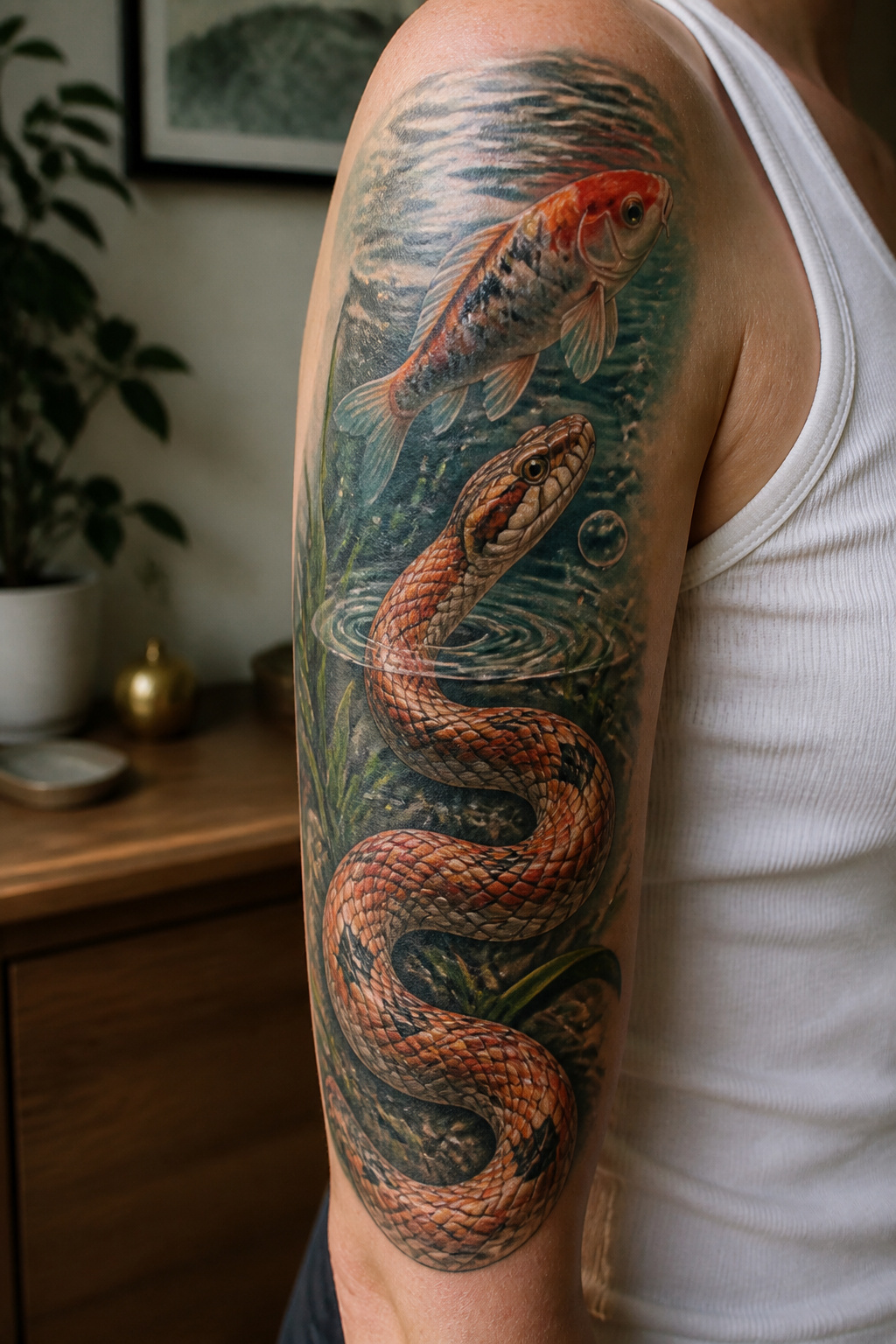
A corn snake paired with a fish works best when the design tells a story about where these two actually meet. Corn snakes are terrestrial hunters through and through, but they will take fish when the opportunity presents itself, especially near southeastern wetlands where the water table sits high enough to blur the line between land and pond. That tension, the snake suspended at the water’s edge or coiled half-submerged, gives the piece its charge.
Koi carry the obvious symbolic weight, prosperity and perseverance rendered in those sweeping orange curves, and they hold their color against the corn snake’s quieter palette of rust and charcoal. The contrast reads cleanly from a distance. But a native species, a warmouth or a longear sunfish with that spatter of blue and copper along the gill flap, roots the tattoo in actual geography. Someone from the Carolina coastal plain or the Florida panhandle would recognize the pairing as local ecology rather than borrowed Japanese iconography.
Placement matters for the composition. The snake’s body needs room to arc, to suggest the strike or the retreat, and a forearm or outer thigh gives that length without forcing either animal into miniature. Water rendered as negative space, the skin showing through as ripple, keeps the design from drowning in blue fill. What fails is treating the fish as mere decoration, a pretty shape dropped beside the snake. The predator-prey relationship has to read in their body language, the koi’s tail flicking one direction, the corn snake’s head tracking another, each alive to the other’s presence.
25. Tribal Pattern Fill
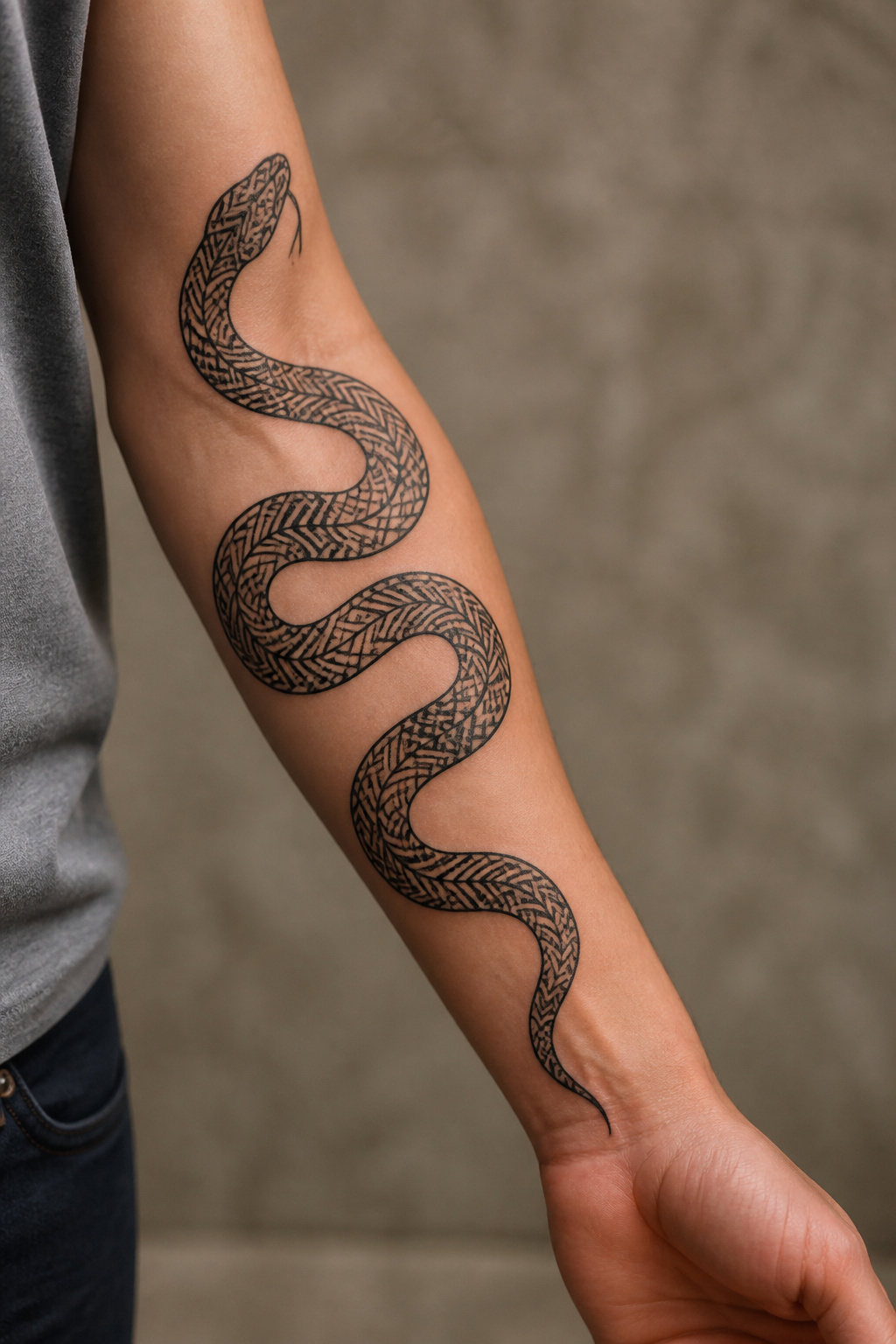
A tribal pattern fill rewrites the corn snake tattoo as pure geometry. The animal’s outline stays readable, but every inch of interior space carries repeating blackwork: spearheads, chevrons, or the rounded petal shapes borrowed from Polynesian marking traditions. The pattern bends with each curve of the body so the snake never looks like a sticker slapped onto skin. Where the spine would be, a narrow negative space often runs the length, giving the eye a path through the density.
The effect reads closer to textile or carved wood than biology. That distance is the point. Someone who wants the snake’s meaning, guard, transformation, without the literalism of scales and eye shine, gets both symbol and graphic punch.
Placement matters more here than with a naturalistic piece. A forearm or calf gives the linear body room to stretch; wrapping around a wrist or ankle, the pattern compresses and can turn to visual noise. The artist needs confidence in flow, not just individual motifs. I have seen versions where the pattern stays identical from head to tail and the whole thing flattens out, missing the chance to swell at the hood or tighten at the tail tip. The best work lets the geometry breathe, thicker bands where the snake widens, finer marks where it tapers, so the body keeps its volume even under all that ink.
26. Skull and Flowers
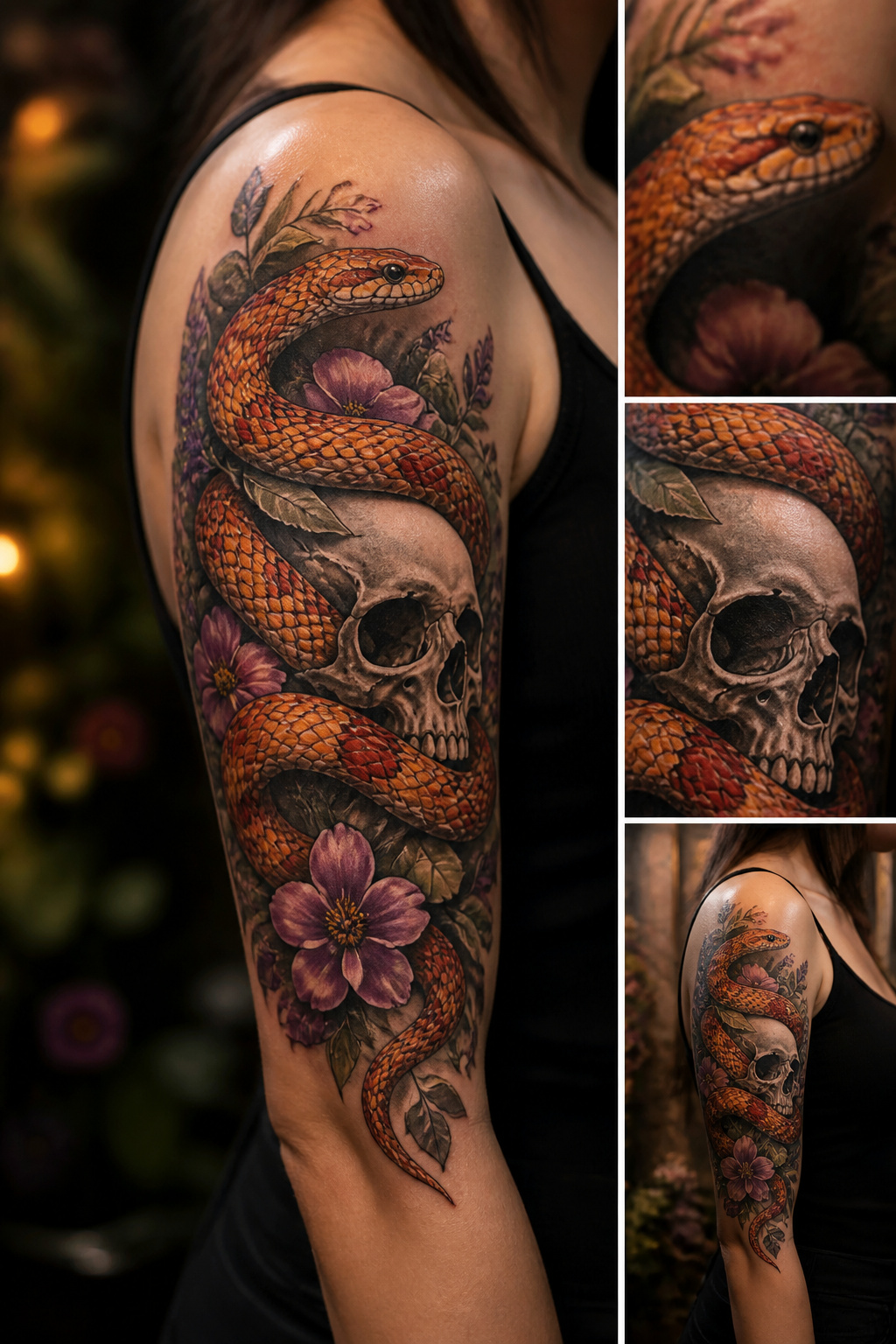
A skull-and-flower pairing with a corn snake threaded through makes the most sense when the snake does the connecting rather than just filling space. The skull sits at one end, blooms gather at the other, and the snake’s body becomes the visual path between them. I have seen this go wrong when the artist treats the three elements as separate stickers on one sheet; the snake looks dropped in afterward. What works is letting the corn snake’s natural orange and red scales pick up warmth against bone white, then cool into greens or muted purples where the petals start. The snake’s slender build helps here. A thicker species would dominate both symbols, but the corn snake’s moderate size lets it weave under a cheekbone and coil through stems without swallowing the composition. Placement matters for the read. On a thigh or upper arm, the eye travels skull to snake to flowers in about the right rhythm. On a forearm, the vertical stack can feel cramped unless the skull tilts and the snake breaks the center line. Ask to see the linework with the snake at two different scale weights before committing; too thin and it disappears between bolder shapes, too heavy and the meaning flips to snake-first with accessories attached.
27. With a Clock
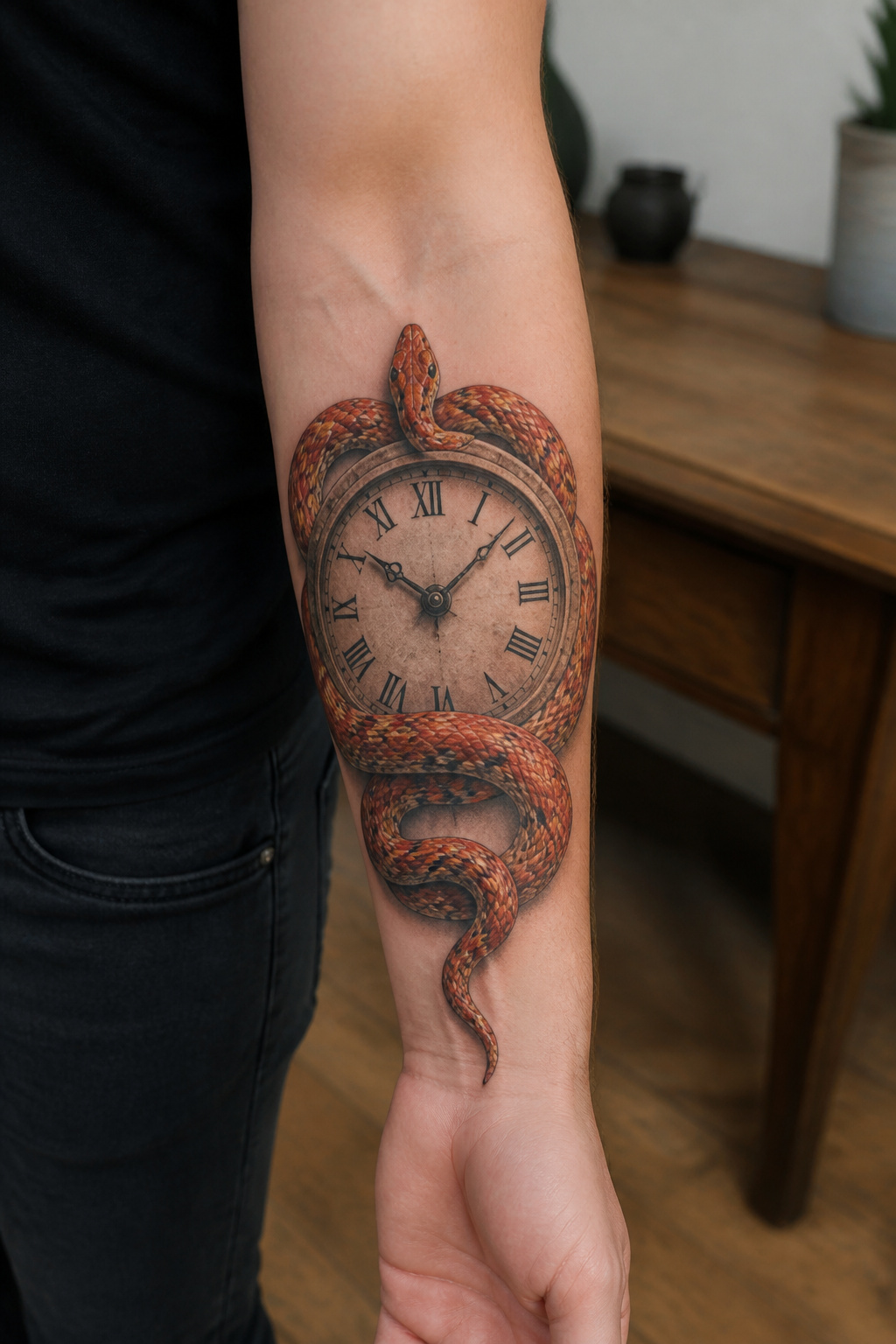
A pocket watch or clock face gives a corn snake tattoo natural geometry to work against. The snake’s body follows the circle, head resting at twelve or six, scales picking up light where the metal rim would catch it. Hourglasses work too, though the snake has to break the symmetry to read as alive; one coil around the glass, another spilling past the frame, keeps it from looking pinned in place.
Time and transformation pair well on skin. The snake sheds, the sand runs, both mark passage without sentiment. What saves this from being too on-the-nose is the corn snake’s actual color: those orange and red tones warm up cold clockwork, make the design feel observed rather than invented. I’ve seen versions where the clock hands are stopped at a specific hour, and that choice reads as private, not decorative. If you go that route, the stopped time should mean something you can explain in one sentence, or it becomes clutter.
Placement matters for the round form. Inner forearm, shoulder cap, or the flat of a thigh hold the circle without distorting it. Ribs or the side of a torso will warp the clock face when you breathe or move, and a snake that looks coiled around a bent surface loses the tension that makes the design work.
28. With a Tree
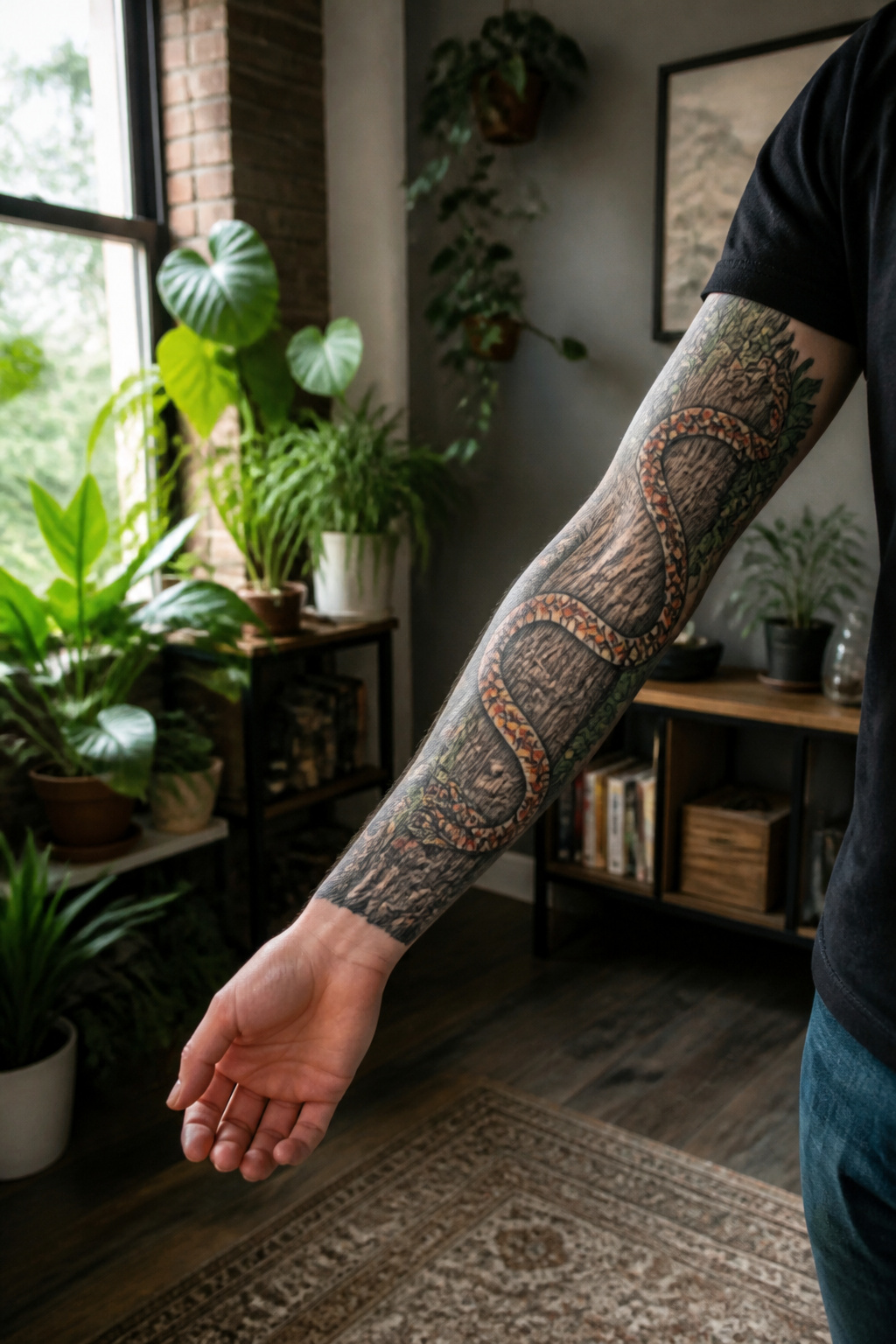
A corn snake wrapped around a tree trunk carries more weight than the same snake on a simple branch. The roots give it ground to defend; the canopy gives it somewhere to climb. That vertical structure lets the artist build a small story in a single frame.
The scale contrast matters most. A corn snake’s pattern is tight and regular, almost mechanical, while bark breaks and splits in unpredictable ways. Setting those two textures against each other draws the eye without either element disappearing. The snake reads as alive partly because the tree looks so still.
Placement on the body shapes what works. A forearm or calf offers enough height for roots at the wrist or ankle and canopy reaching toward the elbow or knee. Ribs or back give more room for spreading branches, though the snake itself usually needs to stay large enough to read clearly from a distance.
Color choices tend toward the natural. Corn snakes bring their own orange, red, and black; trees in these pieces usually stay muted brown and green so the snake remains the focal point. A too-green canopy will swallow the orange unless the artist deliberately pushes the snake forward with stronger saturation or a subtle outline.
The narrative can tilt several ways. Some designs show the snake hunting, head down and tongue out. Others show it resting, coiled in a hollow or sunning on exposed roots. Neither choice is more correct, but the mood shifts enough that picking one early helps the artist keep every detail consistent.
29. Snake Charmer Scene
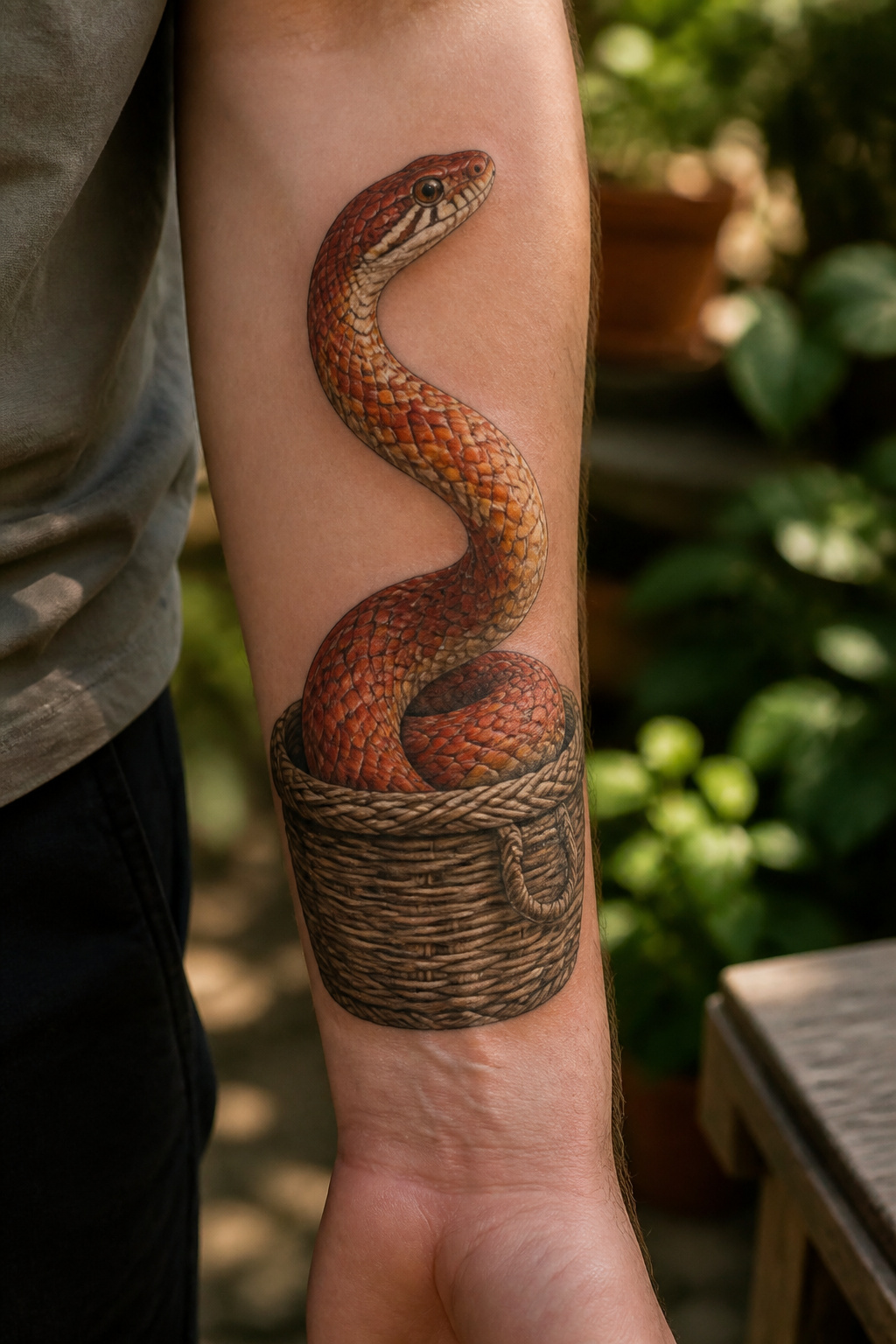
A corn snake rearing up from a woven basket makes for a tattoo that carries instant story without leaning on fantasy. The pose itself is authentic; these snakes stand tall and sway when curious, tracking movement with that slow, hypnotic rhythm people mistake for the charmer’s trick. The flute, or pungi, becomes optional visual flavor rather than a required prop.
Placement changes how the scene reads. On a forearm, the basket can sit near the wrist with the snake ascending toward the elbow, giving the body real length to work with. The ribs or outer thigh offer enough flat ground for the basket’s weave to read as texture rather than a dark blob.
Color choices stay honest to the subject. Wild-type corn snakes carry those orange and red saddles against a gray ground, but the amelanistic morph, cream and peach with ruby eyes, photographs better on skin and ages cleaner. Either way, the basket should stay in muted browns so the snake remains the point of focus.
What kills this design is making the snake too thin. Corn snakes are slender, yes, but a tattoo line below a certain width blurs inside a few years. The body needs enough mass to hold detail; the scales along the spine, the eye stripe, the clean belly pattern. Without that weight, it reads as a generic garden snake and the whole charmer conceit falls apart.
30. With a Lotus
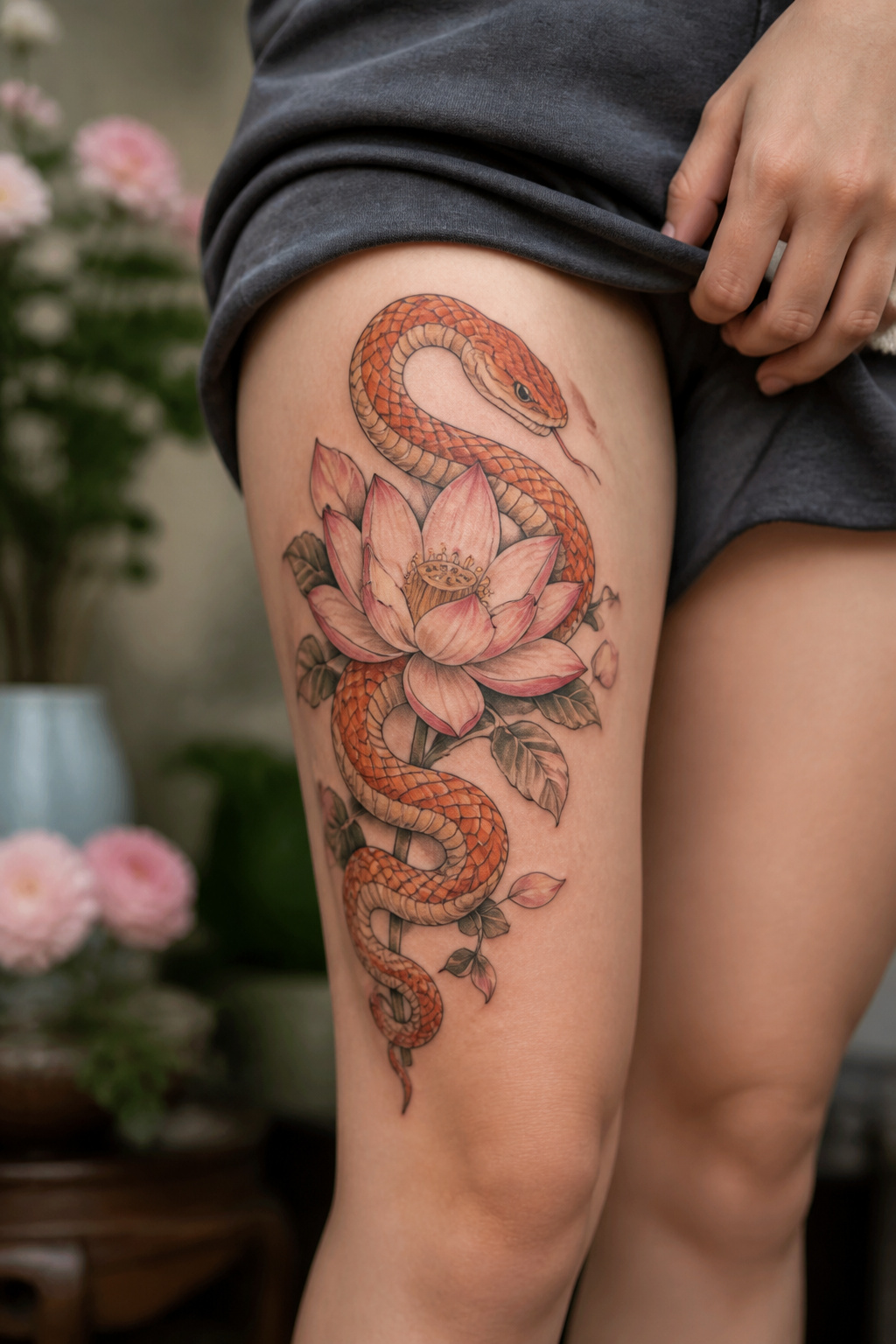
A corn snake coiled around a lotus carries one of the cleaner symbolic pairings in tattoo work. The lotus rises through murky water to open above the surface, and the snake sheds its skin to emerge renewed. Both movements point toward transformation that happens from the inside out, not imposed from somewhere else.
The color of the corn snake matters more here than in some other floral pairings. Its natural oranges and reds read warm against a pink or white lotus, but a muted, almost grey lotus can push the whole piece toward something more contemplative. I have seen designs where the snake’s head rests at the center of an open bloom, tongue testing the air, and others where the body loops through stems and pads below the waterline. The second approach spreads the meaning across the full image rather than concentrating it at one point.
Placement tends toward the ribcage or upper thigh, where the curve of the body can follow a natural line. The lotus gives the eye a place to rest, which keeps the snake’s looping form from feeling restless. Some artists treat the petals with fine line work and build the snake from heavier saturation; reversing that balance usually weakens the read.
31. Formed as a Heart
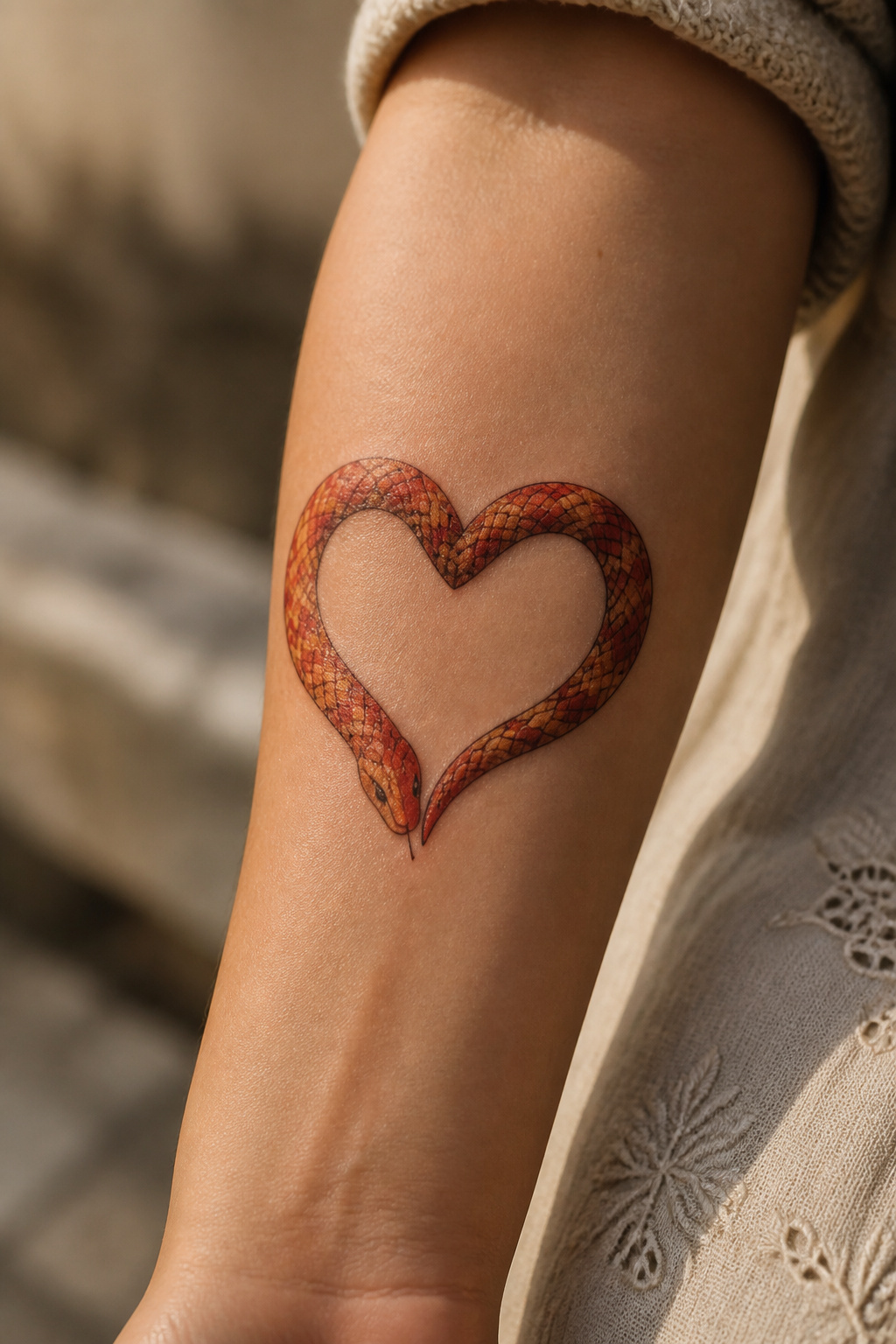
A corn snake’s body curves naturally into a heart shape without any forced posing, the head and tail meeting or nearly meeting at that bottom point where the two loops come together. The spine bends in smooth S-curves as a matter of course, so the tattoo artist is working with the anatomy rather than against it. That flexibility is the whole reason the design reads as elegant instead of strained.
The scale pattern does the visual work here. Each belly scute catches light differently along the inner curve than the outer, which gives the heart dimension without needing extra shading tricks. I have seen versions where the head lifts slightly at the meeting point, tongue flicking upward, and others where the tail simply tapers to finish the shape quietly. The quieter version ages better; the tongue detail tends to blur over time and turn into an indistinct mark.
Placement matters for how the heart sits. On a forearm running top to bottom, the point aims toward the wrist and the loops fill the softer inner surface. On a ribcage, the same curve follows the body’s own line more closely. The snake’s natural orange and red tones against skin create warmth that a black-outline heart never manages.
32. With a Dragonfly
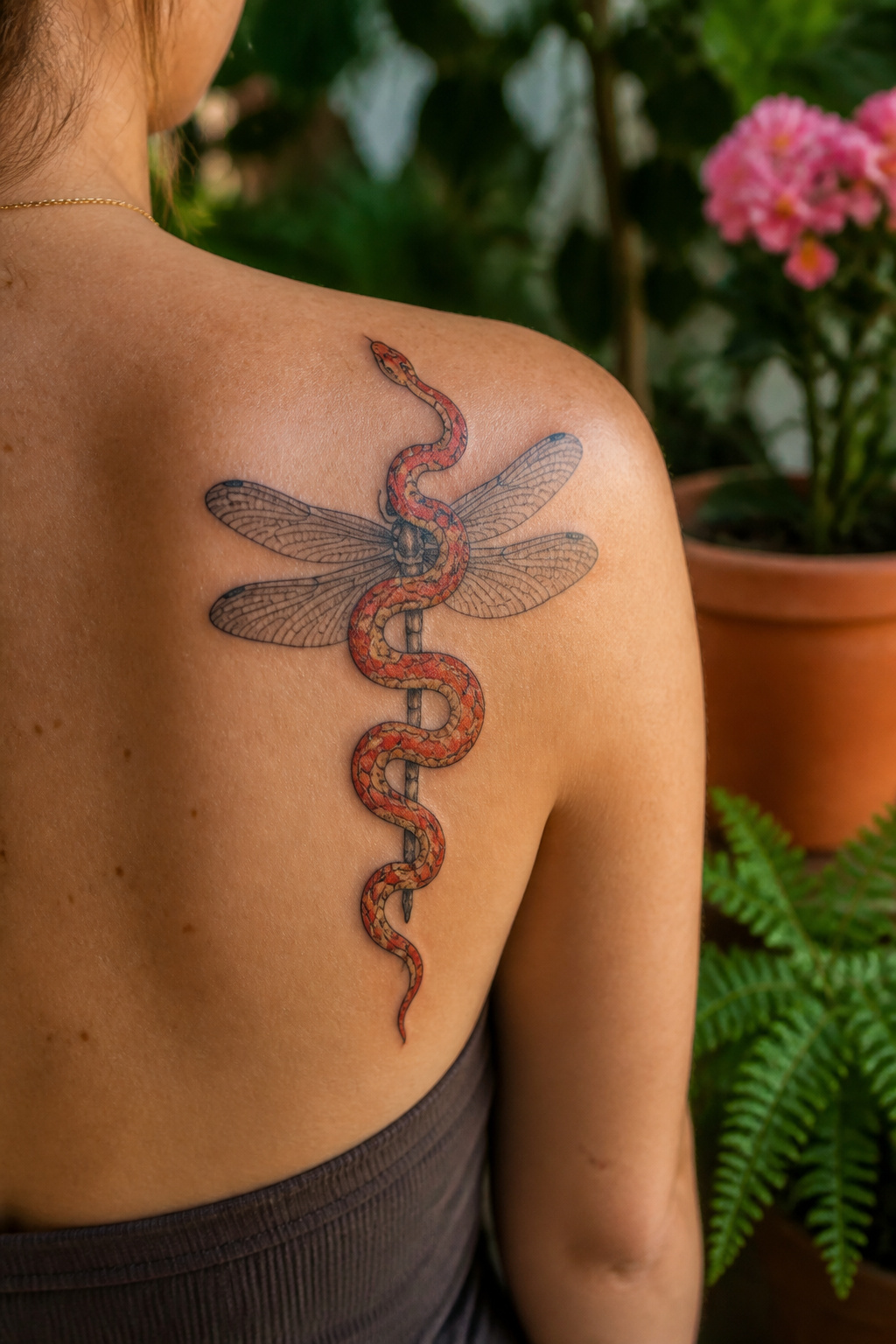
A dragonfly’s wings spread flat against the skin while a corn snake curves through the space beneath them, and that contrast of line against plane is what makes this pairing work. The snake’s body keeps a narrow, ribbon-like path; the dragonfly’s four wings open into clear geometric shapes that anchor the composition at the shoulder blade or upper thigh. Both creatures share the same habitat logic, garden ponds and marsh edges where corn snakes hunt frogs and dragonflies skim the water, so the pairing reads as observed nature rather than forced symbolism.
Color choices here matter more than in some other pairings. The dragonfly’s iridescent wing veining, usually rendered in gray wash or soft blue, sets off the corn snake’s orange and red scaling without competing for attention. In the three designs of this type I traced while researching this piece, the artists kept the dragonfly smaller than the snake, letting the insect serve as a visual pause rather than a second protagonist. That scale relationship keeps the eye moving along the snake’s length instead of splitting the focus.
33. With a Banner
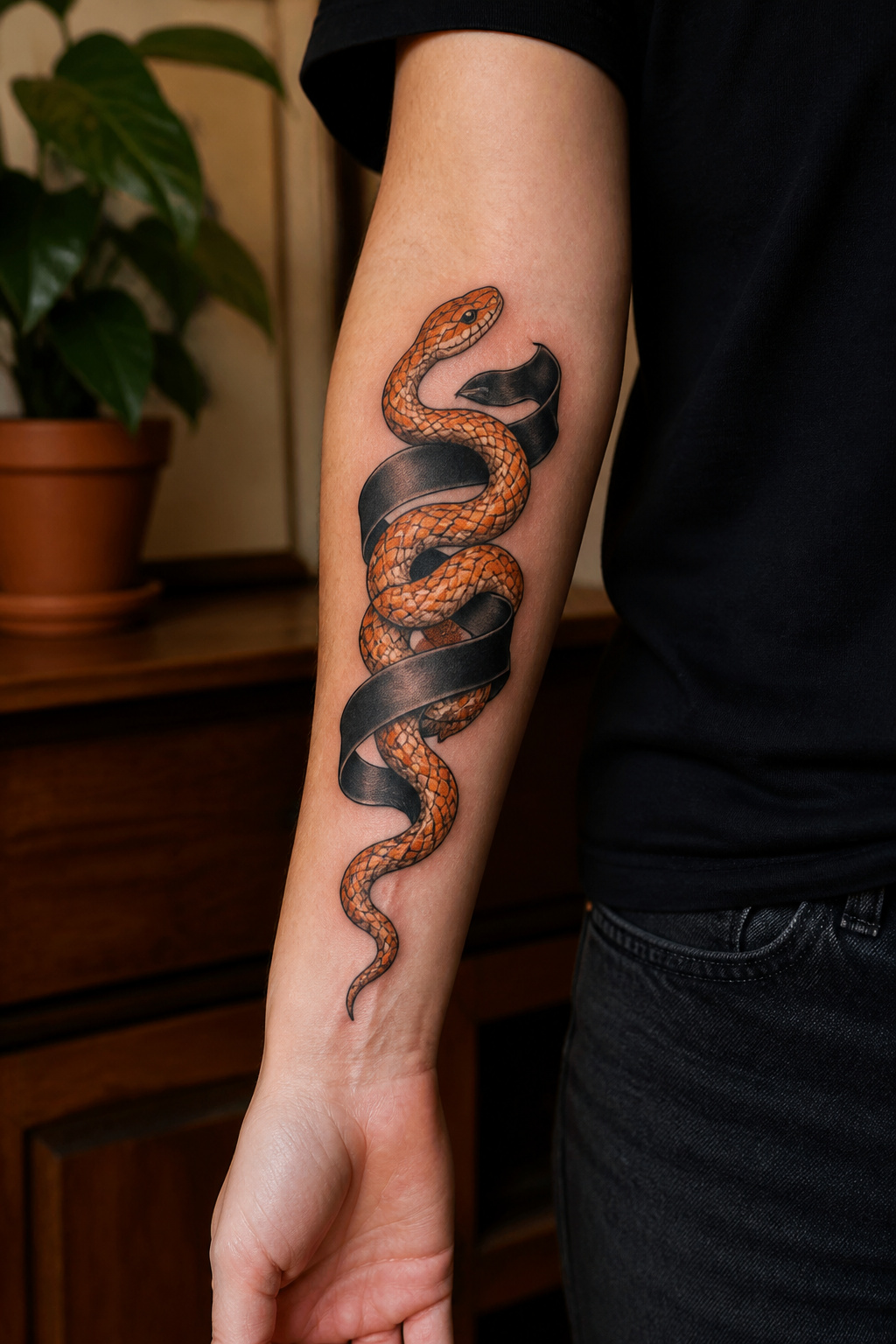
A banner threaded through or beneath a corn snake’s body turns the reptile into a frame for words that matter to you. The ribbon’s curves can echo the snake’s natural S-shape so the two elements read as one flowing piece rather than a snake plopped on top of a sign.
Text on the banner needs breathing room. Small lettering under four or five characters works best for names or dates; longer words force the ribbon wider and can make the snake look pinched or stretched to fit. Most artists sketch the snake first, then weave the banner through the coils where the body already creates negative space.
Placement changes how the banner reads. A snake above the banner with text hanging below draws the eye downward to the words; a snake coiled behind the ribbon pushes the text forward as the clear focal point. Color choice matters too. A naturalistic corn snake in orange and red against a black banner creates contrast, while matching the banner’s edges to the snake’s belly scales softens the boundary between them.
The risk here is datedness. Banner tattoos with names peaked in the early 2000s, so the snake’s detail quality needs to feel current. A badly rendered ribbon can drag an otherwise beautiful corn snake into flash-art territory.
34. With a Mandala
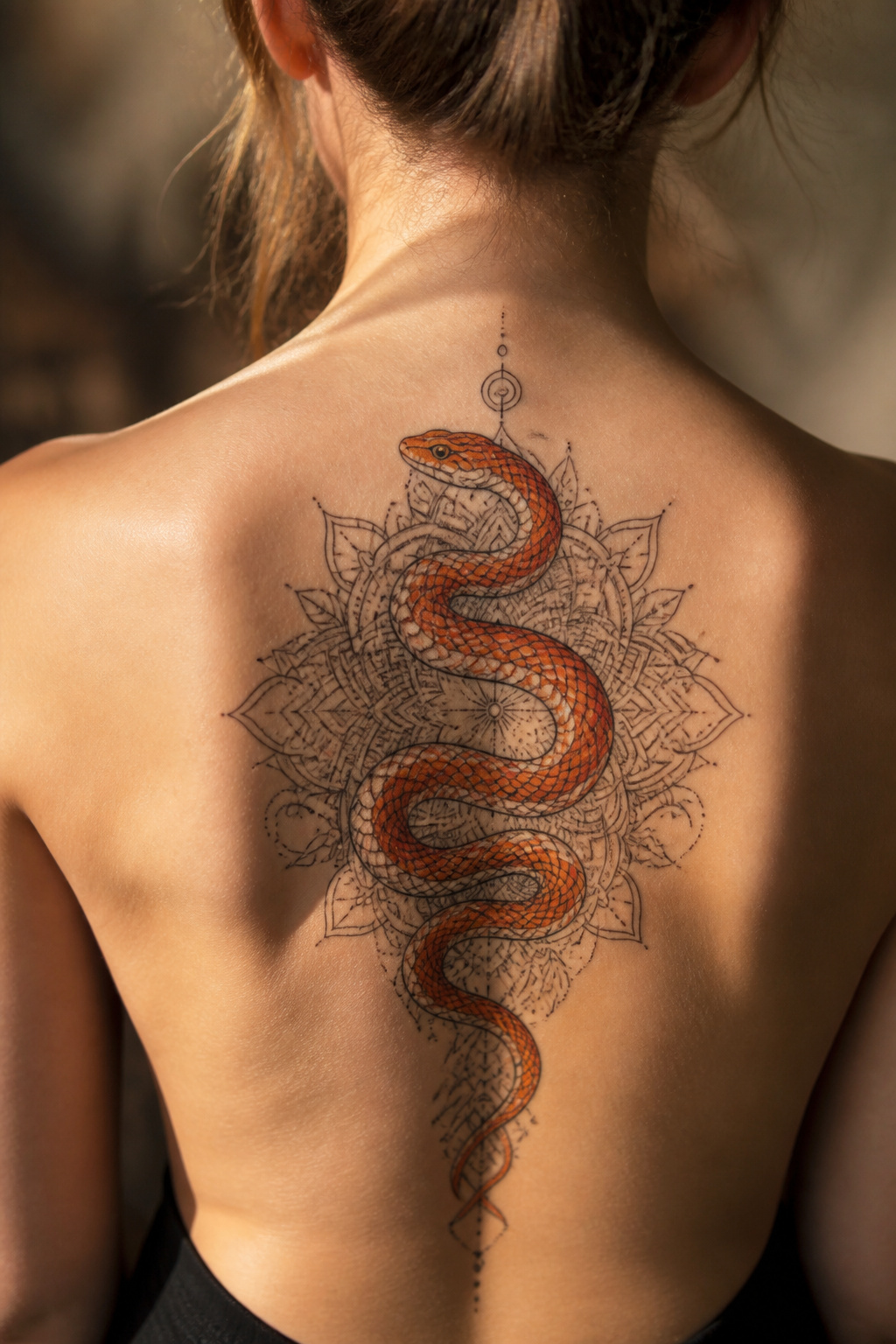
The mandala draws the eye inward, and a corn snake threaded through its geometry turns that stillness into movement. The snake’s body can follow one ring of the pattern, scale by scale, or break outward to frame the whole design like a living border. What works is the tension between the two: the mandala’s perfect symmetry against the slight irregularity of muscle and curve. Color matters more here than in most snake tattoos. The corn snake’s natural oranges and ambers read as warm against the cooler linework of a black mandala, or you can reverse it, keeping the snake pale so the pattern carries the saturation. Placement on the shoulder blade or upper back gives the mandala room to breathe at a size where the detail doesn’t blur. The one mistake to avoid is letting the snake compete for center; the mandala stays the anchor, the snake the interruption that makes you look twice.
35. Rose and Thorns
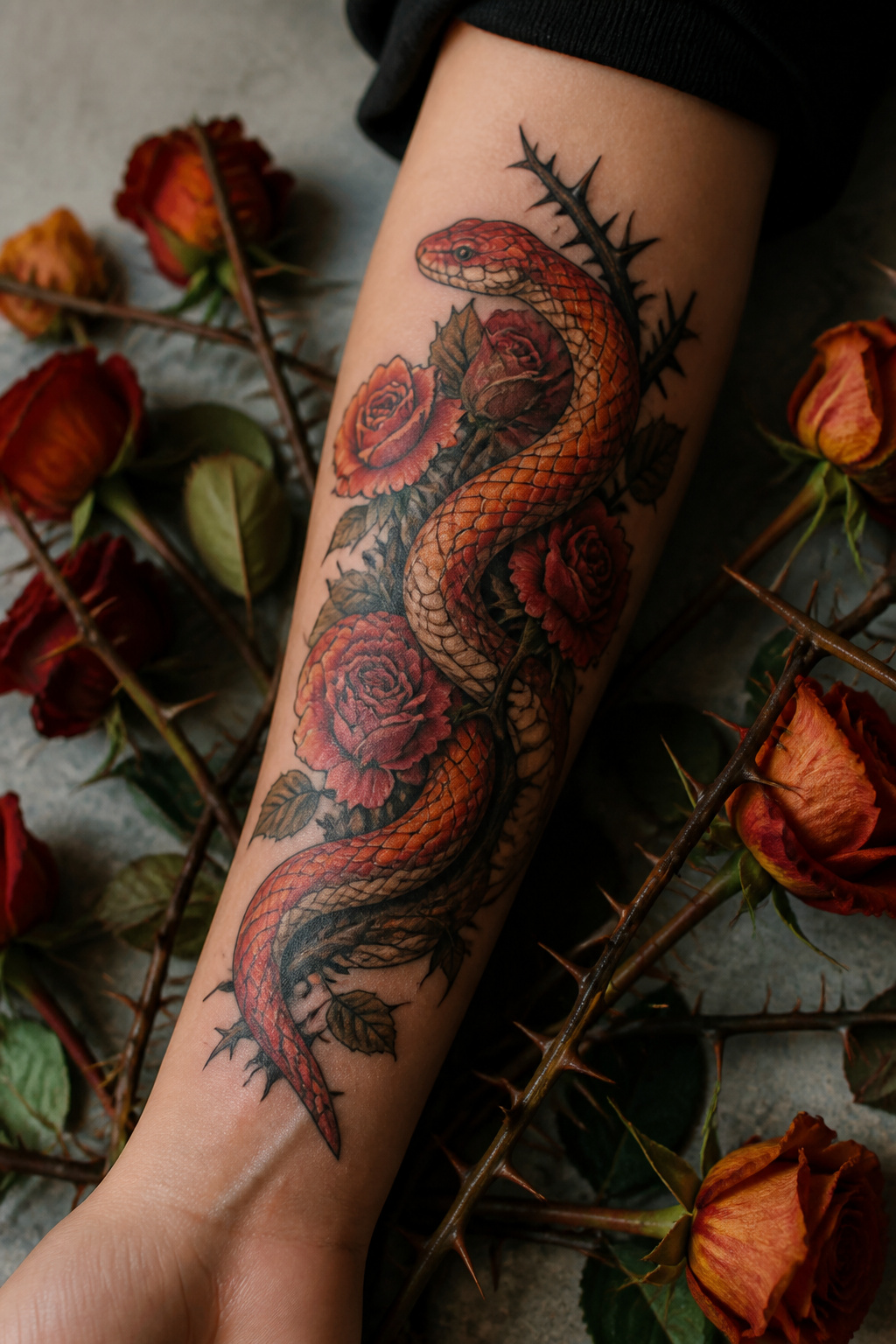
The thorn structure changes everything about how the corn snake reads on skin. Where a simple snake-and-rose design keeps the stem smooth and decorative, this version forces the eye to follow sharp angles against the snake’s rounded saddles. That friction is the whole point.
A corn snake’s pattern, those repeating orange and red blotches with black borders, already carries enough visual weight to compete with thorn detail. The artist has to decide which wins: crisp thorn outlines that risk flattening the snake into background color, or softer spikes that let the scales keep their depth. Most pieces that work choose one layer to dominate and let the other support it, usually thorns in hard black line with the snake rendered in softer gray-wash so the pattern still reads but doesn’t fight.
Placement matters more here than in friendlier floral designs. Thorns wrapping a forearm or calf read as defensive, almost warning, which suits the corn snake’s harmless reputation turned slightly darker. The snake’s body threading through the stem at a diagonal, not straight vertical, breaks up the rose’s natural symmetry and keeps the composition from looking like clip art.
Color tends toward muted: burgundy instead of bright red, olive or near-black greens, the snake’s natural orange dialed down to rust. Brightness would undercut the tension the thorns are there to build.
36. Butterfly and Flowers
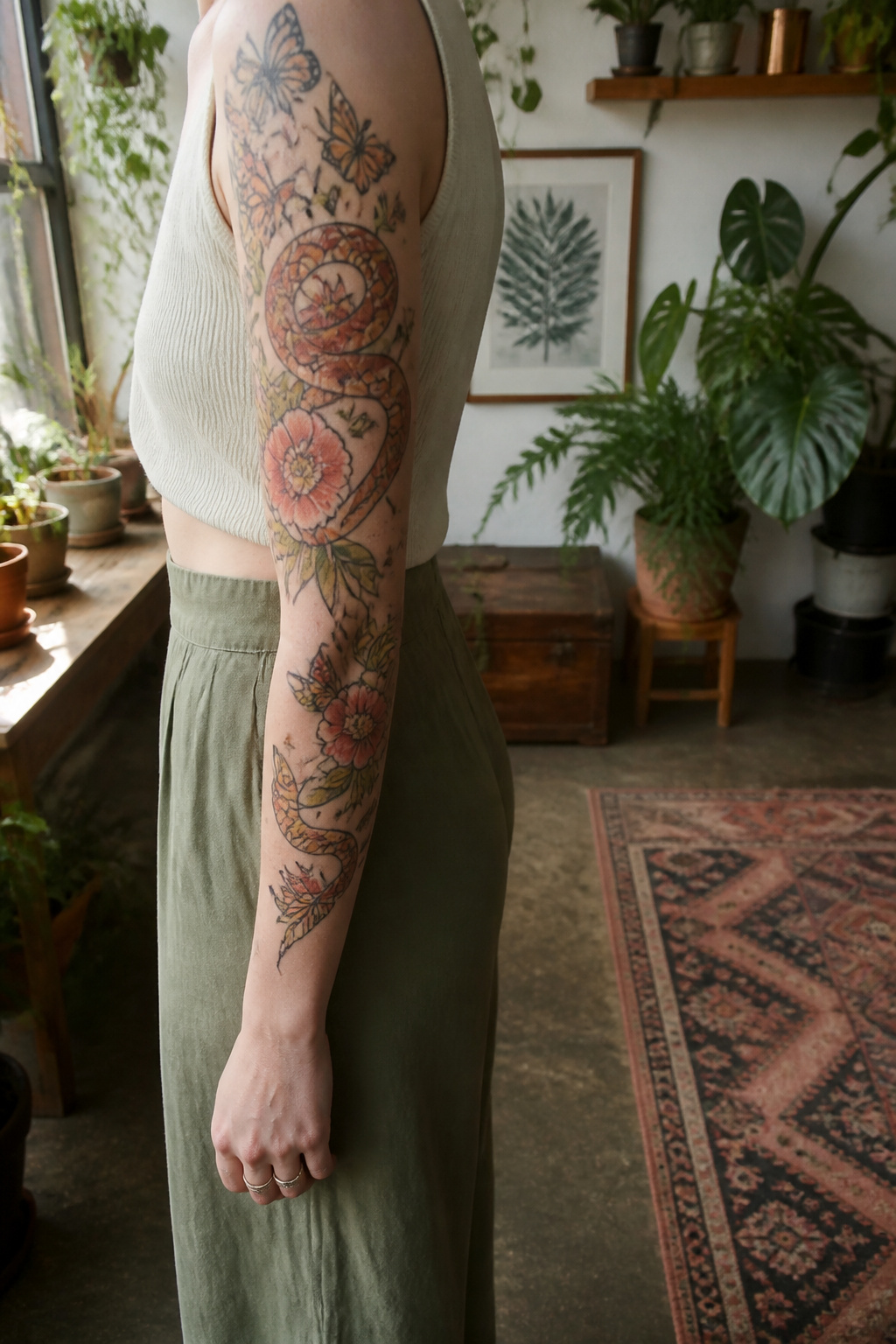
A corn snake threaded through a full garden scene with butterfly and multiple floral species demands the larger canvas of a back piece, thigh, or full sleeve. The extra space lets the snake move through layers rather than sit beside a single accent. Three or four flower varieties, maybe wildflowers with a monarch or swallowtail, keep the eye traveling so the composition never flattens into a sticker arrangement.
In my own research, the designs that hold up are the ones where the snake’s body creates the path through the chaos. One artist I followed placed the corn snake’s orange and red saddles against pale butterfly weed and deep purple asters; the cool tones pushed the warm snake forward without competing. Smaller placements compress this into clutter. A busy garden needs room for negative space between elements, otherwise the tattoo muddies within a few years as ink settles.
Color saturation matters more here than in simpler pairings. The snake’s natural palette already carries warmth, so adding a butterfly with competing iridescence can tip into garish unless the artist limits the insect to one or two accent hues. What convinced me, looking through healed photos from three to five years out, was the difference between pieces that planned for fade and those that maxed pigment from day one. The restrained ones aged like relief carvings; the saturated ones became soup.
37. With a Peacock Feather
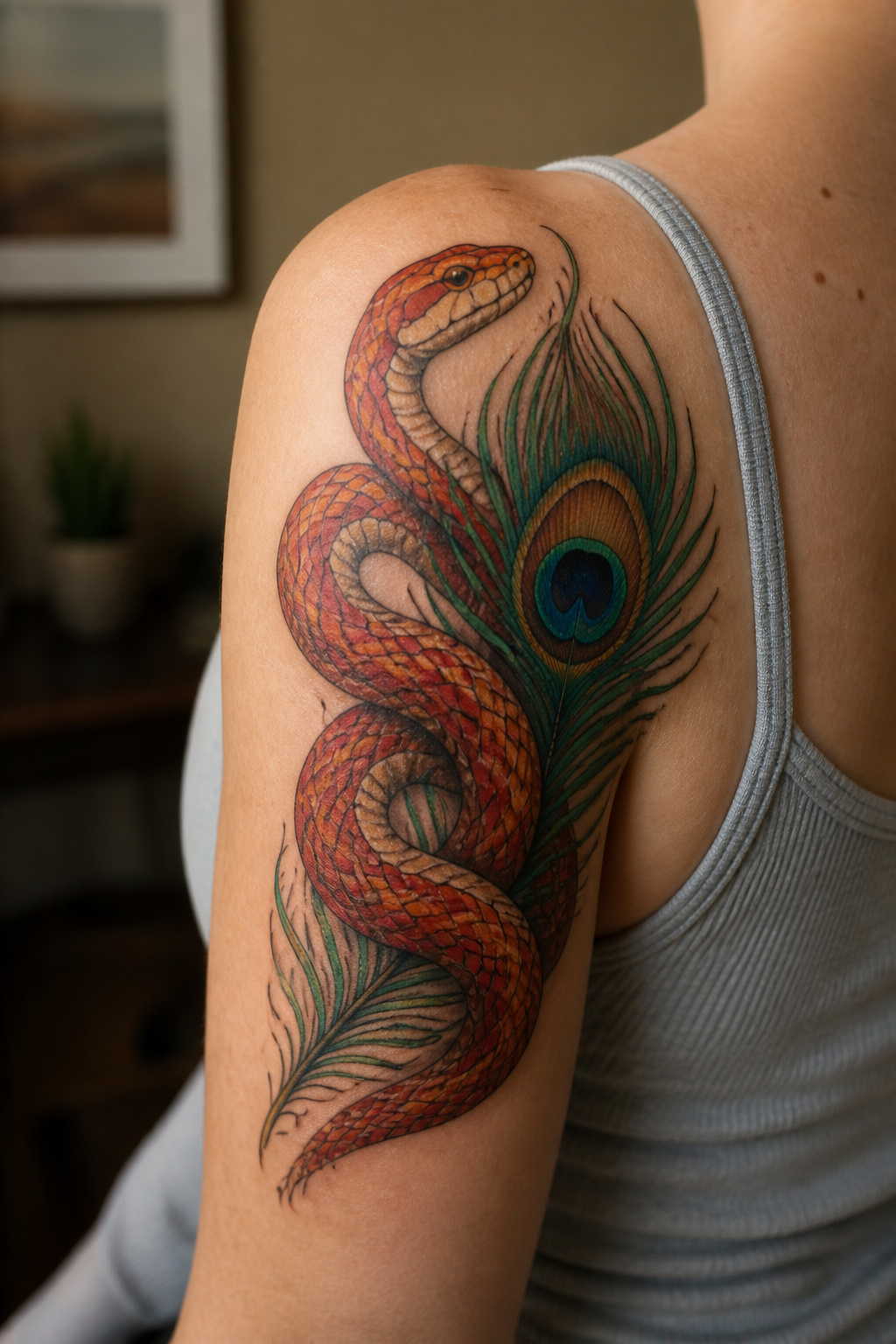
Pairing a corn snake tattoo with a peacock feather works because both carry eye-shaped markings that talk to each other across the design. The snake’s belly scales and the feather’s ocelli create a visual rhyme, two different species solving the same pattern problem. Where corn snakes run warm, oranges and ambers and soft reds, peacock feathers hit cool notes, iridescent blues and greens that shift in light. That temperature gap is the point. The contrast keeps either one from flattening into decoration. A skilled artist will stagger them so the snake’s body crosses the feather’s shaft at an angle, letting both read as separate forms rather than one shape swallowing the other. The eye patterns should not line up too neatly; overlap them slightly off-register and the design gains depth. Placement matters for the iridescence. On a shoulder or outer thigh, where light catches differently as you move, the peacock blues stay alive. Flatten that onto an inner forearm and the same colors can read as static, almost printed. The snake’s warmer tones hold up better in shadow, which makes it the anchor. Someone who wants this pairing should ask to see healed photos of similar color work, not fresh ink, since those greens and blues are notorious for settling into something duller six months out.
38. Starry Background
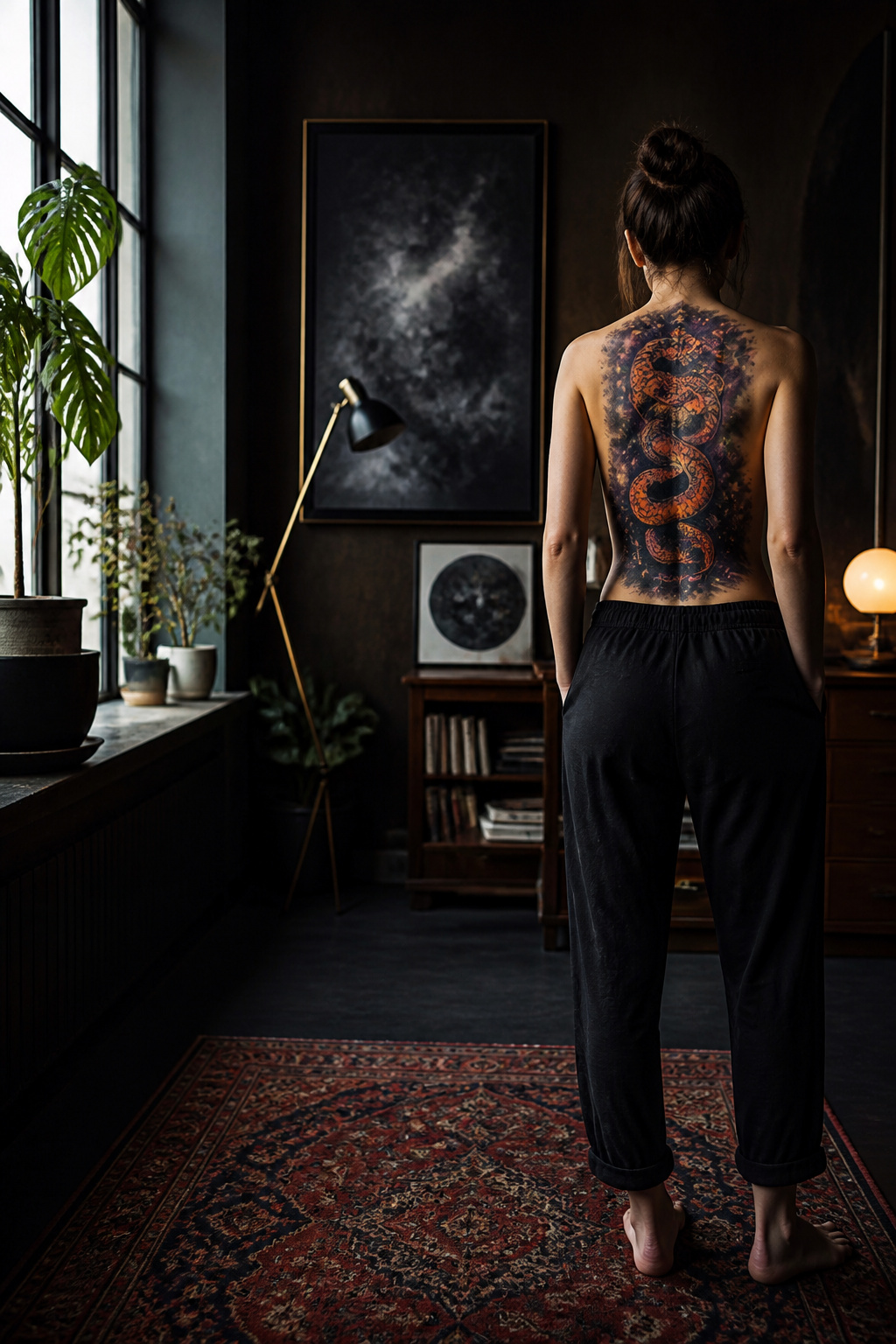
A full cosmic backdrop turns a corn snake tattoo into something else entirely. The snake stops reading as a pet portrait and starts looking like it is actually moving through deep space, scales catching nebula light instead of moon glow. That shift matters on larger pieces where the background has room to breathe across a shoulder blade, thigh, or ribs.
The nebula itself needs to stay softer than the snake for the animal to stay the clear subject. Saturated purples and teals behind clean orange and red corn snake markings create that depth without turning the reptile into decoration. I have seen pieces where the artist rendered the snake in near-photographic detail against a hazy, almost watercolor galaxy, and the contrast gave the whole thing motion the way a coiled snake alone rarely achieves.
Placement shapes what works here. A back piece lets the snake traverse real distance, head emerging from one color field and tail dissolving into another. Smaller areas like a forearm force compression that loses the sense of scale this concept needs. If the canvas is tight, the moon-and-stars approach from the previous section reads cleaner; the full cosmic treatment wants room to imply actual space, not just suggest it.
39. Floral Wreath Frame
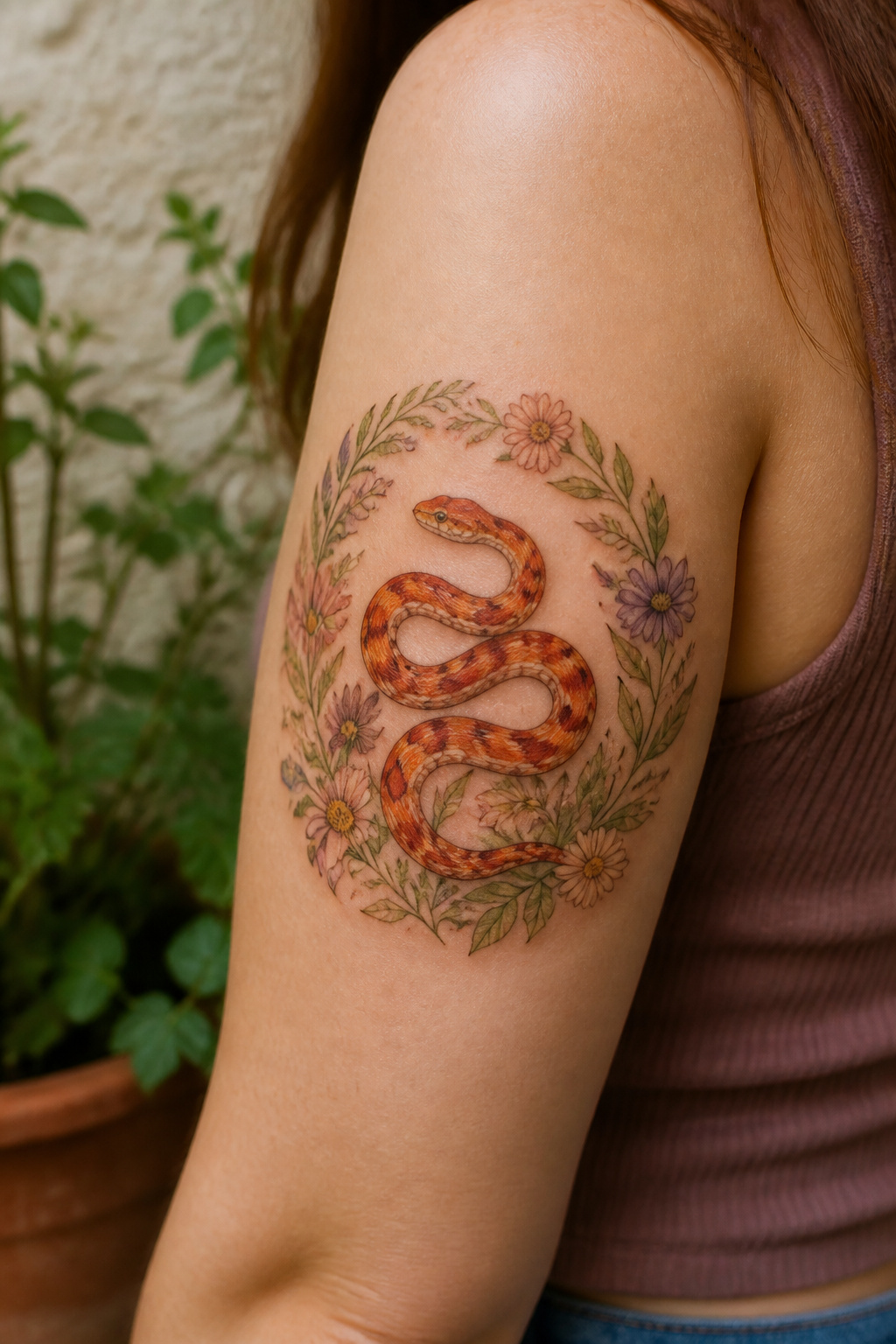
A floral wreath frame gives the corn snake a circle to move through rather than a straight line to follow, which changes the whole rhythm of the piece. The snake can thread between sage and wild carrot blooms, its orange and red scales catching against soft greens, or it can form the wreath itself, tail meeting head in a loose ouroboros that leaves gaps for leaves to fill. This shape sits naturally on the upper arm, where the band follows muscle, or across the chest as a frame for a child’s name, a date, or a second animal at the center. Chest pieces need breathing room; the wreath keeps the snake from sprawling too wide while still letting it move. What separates this from just adding flowers is the containment. The circle holds the eye, and the corn snake’s natural looping posture fits that geometry without looking forced into it. For anyone who wants the reptile present but not dominant, the wreath softens the statement without weakening it.
What Corn Snake Tattoos Mean
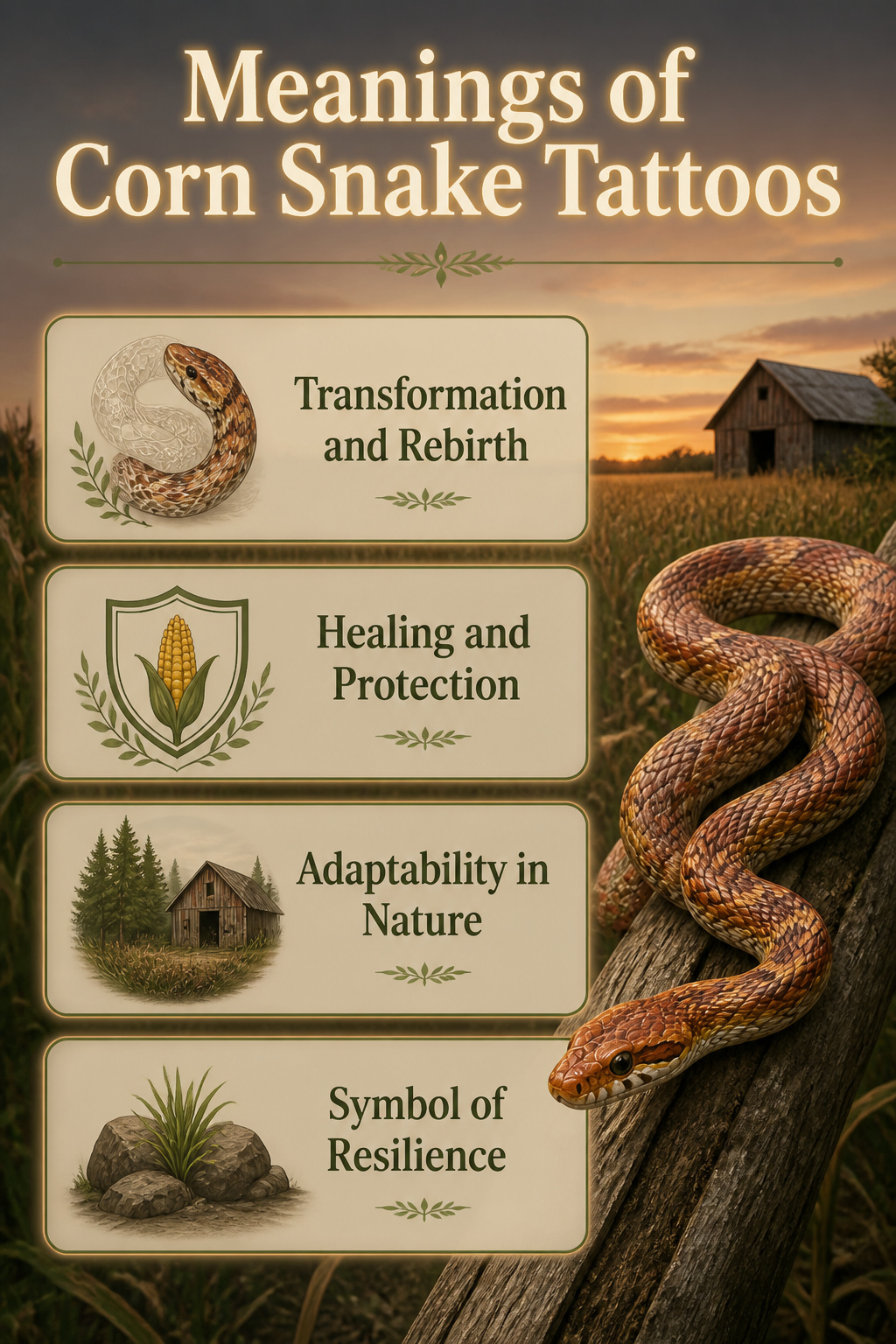
A corn snake tattoo carries transformation and rebirth as its strongest pull, drawn straight from the way these snakes shed their skin whole. That image of leaving behind a complete, transparent shell resonates with anyone who has walked through a major change and come out recognizably themselves.
The healing thread runs quieter but just as deep. Corn snakes in the wild keep rodent populations low around grain stores, so the same animal that signals personal renewal also guarded the food that kept a community fed. Southeastern Native American traditions tied corn itself to sustenance and continuation, and the snake that patrolled those fields absorbed some of that protective, fertile charge by association.
Adaptability and resilience round out the meaning. Corn snakes thrive across variable conditions, from pine forests to abandoned barns, without demanding much. A tattoo of one can mark survival through instability without dramatizing it, the snake simply doing what it has always done.
Frequently Asked Questions
What do corn snake tattoos symbolize?
Corn snake tattoos symbolize transformation, healing, and rebirth through the snake’s ability to shed its skin. The article also pairs this meaning with other symbols that shift the reading: a skull adds the tension of time running out, a butterfly highlights metamorphosis, and a compass suggests deliberate direction paired with ground-level patience.
Where should I place a corn snake tattoo?
The forearm and upper arm work well for most designs, letting the snake’s curve follow natural muscle lines. Geometric styles need the upper arm or back for eight to ten inches of repeat space. Tribal designs reward flat surfaces like the outer forearm, calf, or shoulder blade, while ribs and joints distort the curves. Watercolor pieces hold cleaner on the outer forearm or calf than on fingers or ribs where color breaks down faster.
What colors are popular for corn snake tattoos?
Orange, red, and yellow dominate, drawn from the snake’s natural palette of bold orange ground color, red saddle blotches, and yellow belly markings with black borders. Specific morphs offer variation: the Okeetee morph deepens blacks and intensifies reds, while the Miami phase cools orange toward gray-tan. Geometric and tribal styles often stick to flat orange and red against black line work, and watercolor pieces let these tones bleed together without outlines.