Spider tattoos on this list run from a palm-sized party-hat illustration to a full forearm of black and grey smoke dissolving in midair, and the right one depends on whether you want the creature itself or what it stands for.
A black widow near the knee carries patience and danger in one vessel; rainbow legs with sparkles trade that solemnity for something closer to celebration.
The one detail that separates wishes from mistakes here is healed photos: tribal lines blur, neon yellows in a colorful piece disappear into skin, and every style ages differently than it looks fresh.
1. Tribal Spider Tattoo
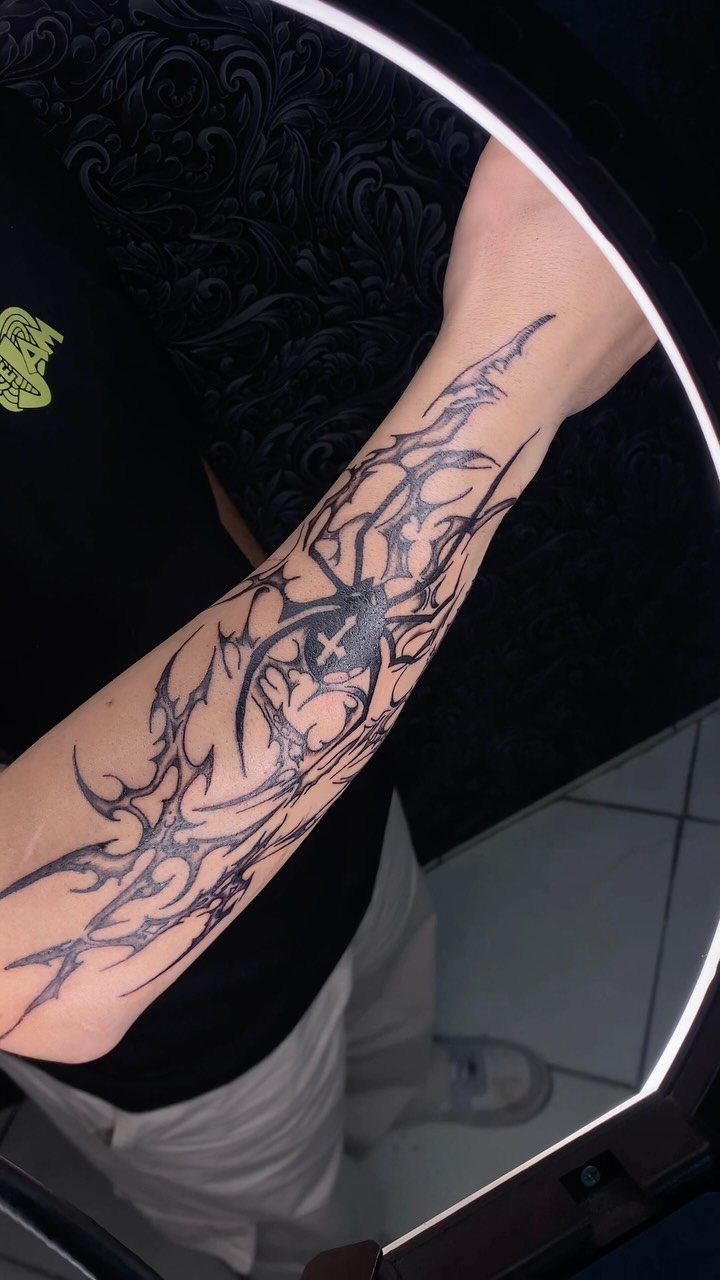
Tribal spider tattoos borrow from the thick black linework and geometric patterns that dominated 90s tattoo flash, but the current run pairs those bold shapes with cybersigilism’s sharp, technical edges.
The style works best at magazine size or larger on a forearm or calf, where the clean negative space keeps the spider readable from across a room.
Black ink only, heavy saturation, and a steady hand on the long curves. A good artist will map the flow to your muscle so the legs seem to move when you flex.
Tribal fading turns muddy fast, so plan on touch-ups to keep the lines clean.
2. Abstract Spider Tattoo
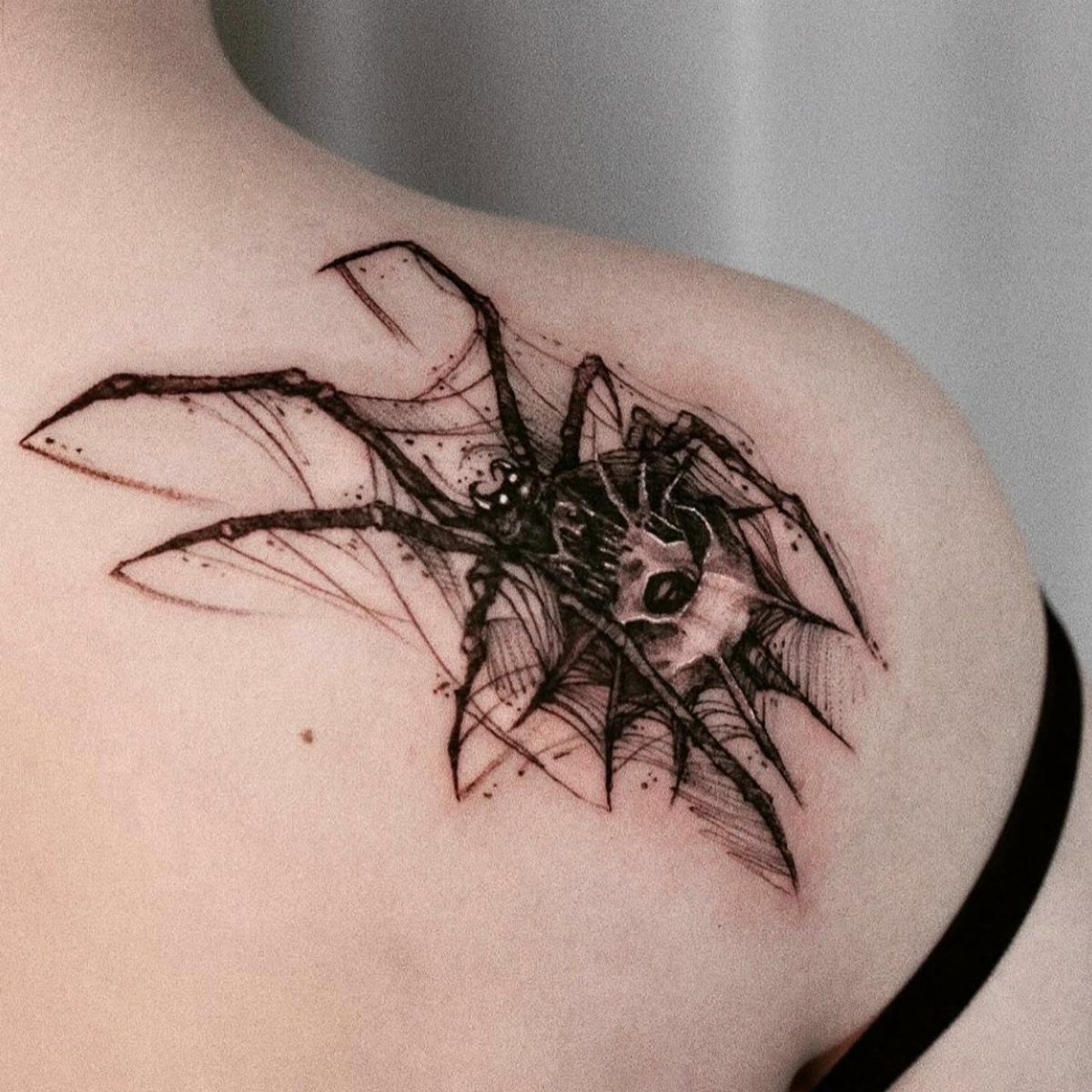
Abstract spiders strip the creature down to angles and suggestion, more Rorschach than arachnid.
The shoulder blade gives the webbed lines room to stretch and fragment, and the geometric treatment reads as personal symbol rather than specimen drawer. Black ink dominates, though some artists add a single tone for depth.
This style suits someone who wants the spider’s meaning without its literal silhouette.
The catch: abstract work ages best when the lines stay bold; too fine and the geometry collapses into gray wash. Ask to see healed photos, not just fresh work, before you book.
3. Standard Spider Tattoo
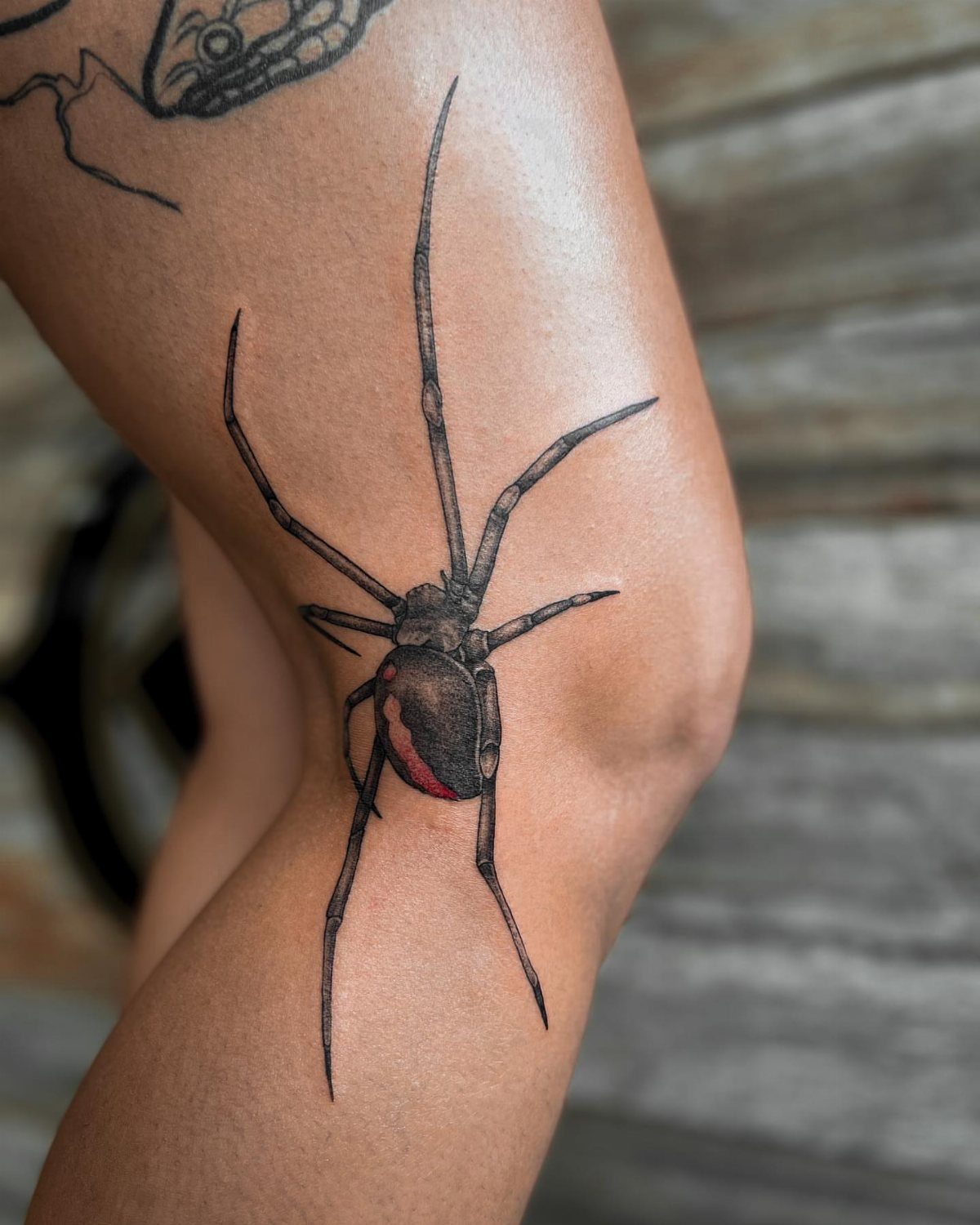
A standard spider tattoo is the version you picture before you start looking: 8 legs, a body, no extra conceptual baggage.
The black widow shape on the leg near the knee carries every traditional meaning, patience and danger wrapped in one vessel, or it carries none at all if you just like how they look.
Placement near a joint adds movement; the spider seems to adjust its stance when you bend the knee.
Budget shapes run smaller and simpler. The real cost variable is whether you want scientific accuracy or cartoon boldness, and that conversation happens in the consult, not the chair.
4. Spider and Web Tattoo
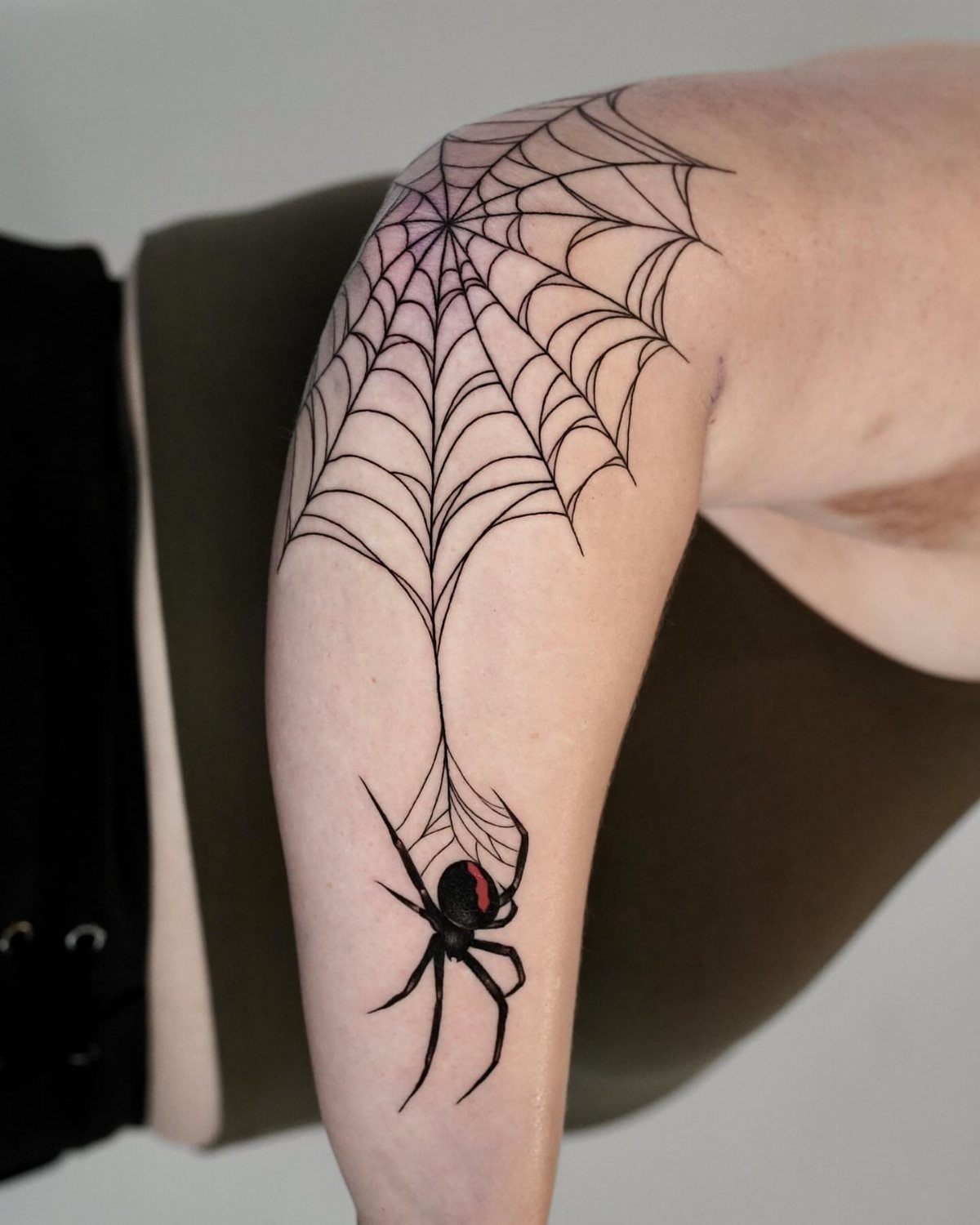
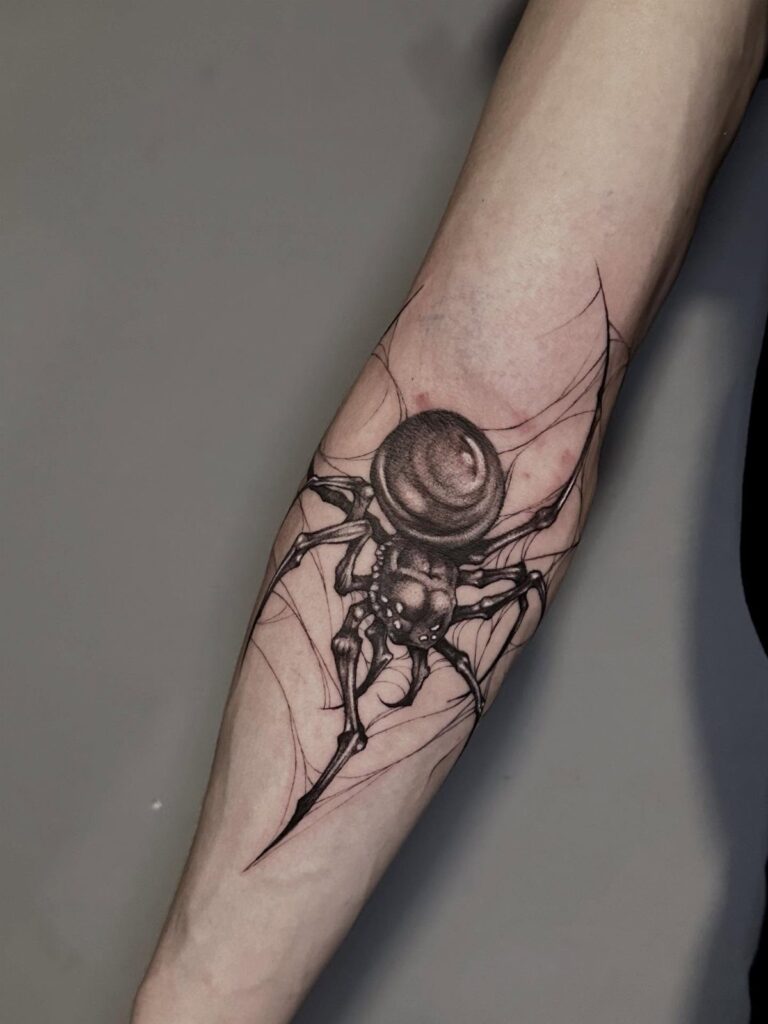
Spider and web pairings put the architecture front and center, not just the tenant.
A spider and web tattoo demands mechanical precision in the radial and spiral threading, which takes time and a specialist in line consistency; rushing it shows in wobbles that break the illusion.
Web work draws a specific crowd: the elbow is traditional prison territory, so placement elsewhere, the shoulder, the ribs, the thigh, lets you keep the symbolism without the signal.
Interconnectedness and destiny sound lofty, but the image works because it is tense, pulled tight, a thing still in use.
5. Realistic Spider Tattoo
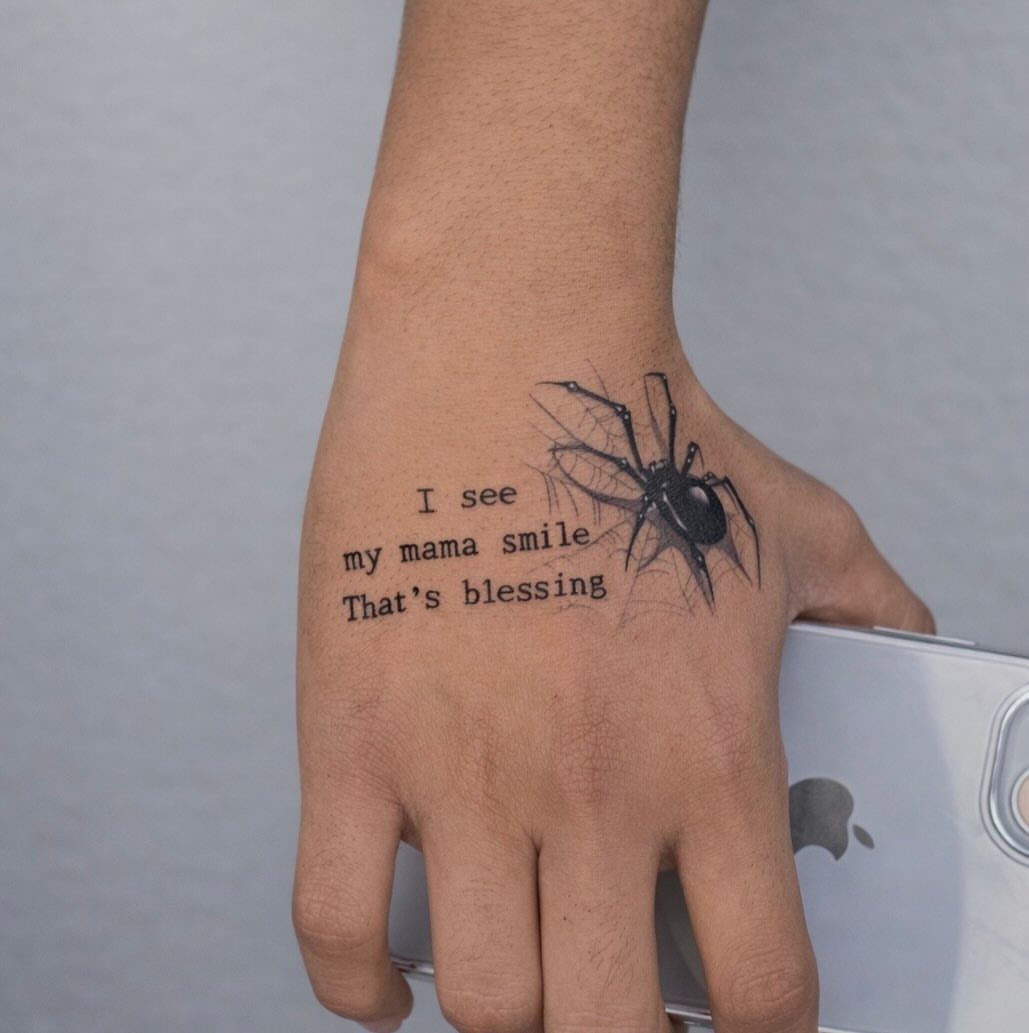
Realistic spider tattoos aim for the moment of doubt, the did-something-move reflex when you glance down.
Hand placement raises the stakes: the skin there turns over fast, the fingers flex and distort, and a 3D black spider with full shadow depth will soften faster than a flatter design.
The effect is immediate presence: legs carry apparent shadows, the body seems to press real weight onto the knuckle.
Trap muscles or hand anatomy, the principle holds: the artist studies reference photos, builds layers of gray wash, and places the light source so the shadows agree.
Bold realism needs long sessions and a healed review; the ink settles differently than it first looks, so adjustment is part of the process.
6. Spider with a Decayed Face Tattoo
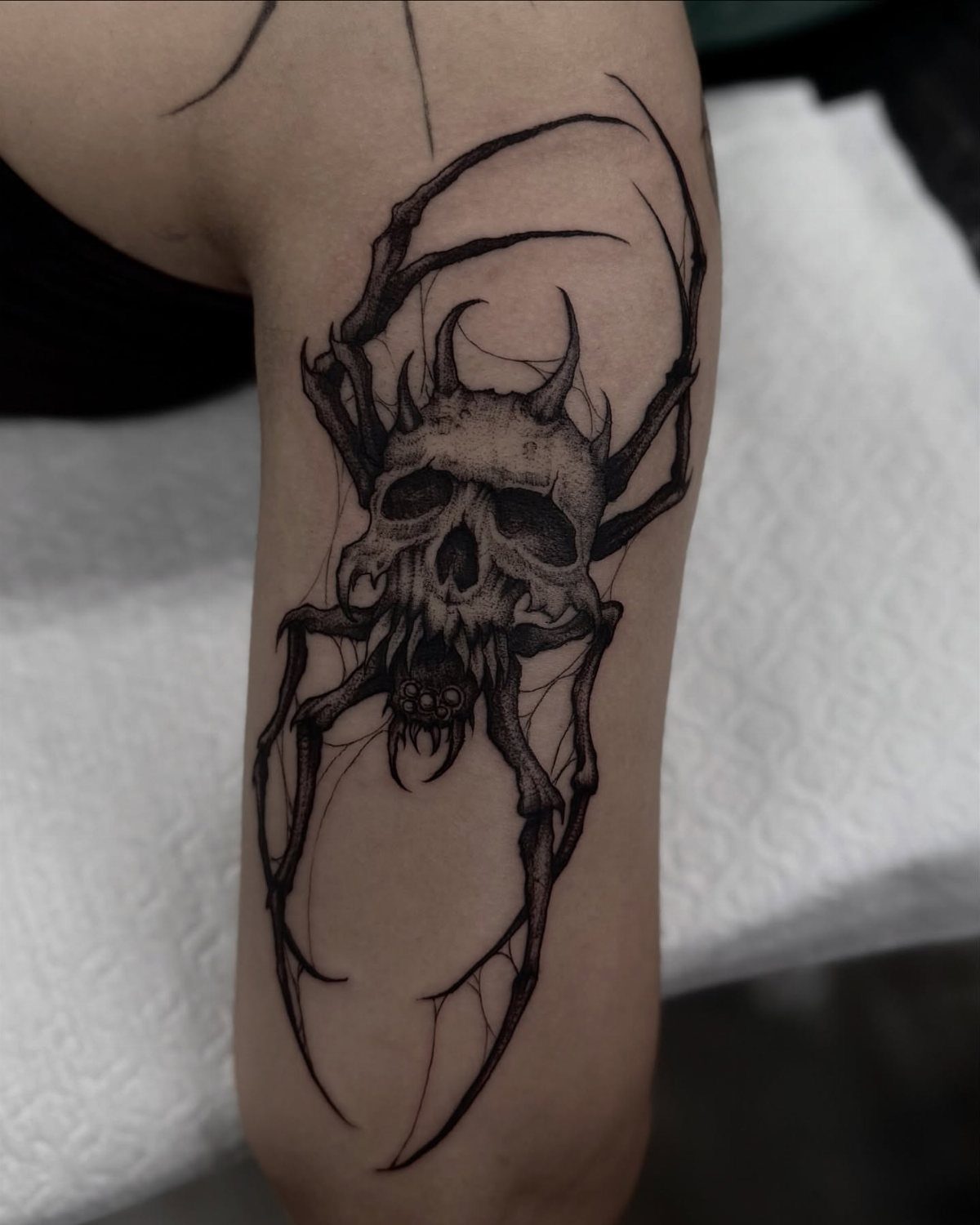
A spider with a decayed face, skull features rotting through on one side, horned and hollow, pushes past biology into something older.
The black and grey treatment keeps the horror legible rather than cartoonish, and the arm placement lets the abdomen carry the face at a natural viewing distance.
Blackwork technique, solid fills and thick outlines with deliberate skin breaks, keeps the dark areas from becoming one muddy pool.
The decay detail demands an artist who builds texture through stipple and whip shading, not just smooth gradients. This version trades the spider’s patience-symbol for something more blunt: time, death, the thing underneath the carapace.
It is not a first tattoo choice for most people, and the healing on heavy black saturation runs longer and itchier than linework pieces.
7. Whimsical Illustrative Spider Tattoo
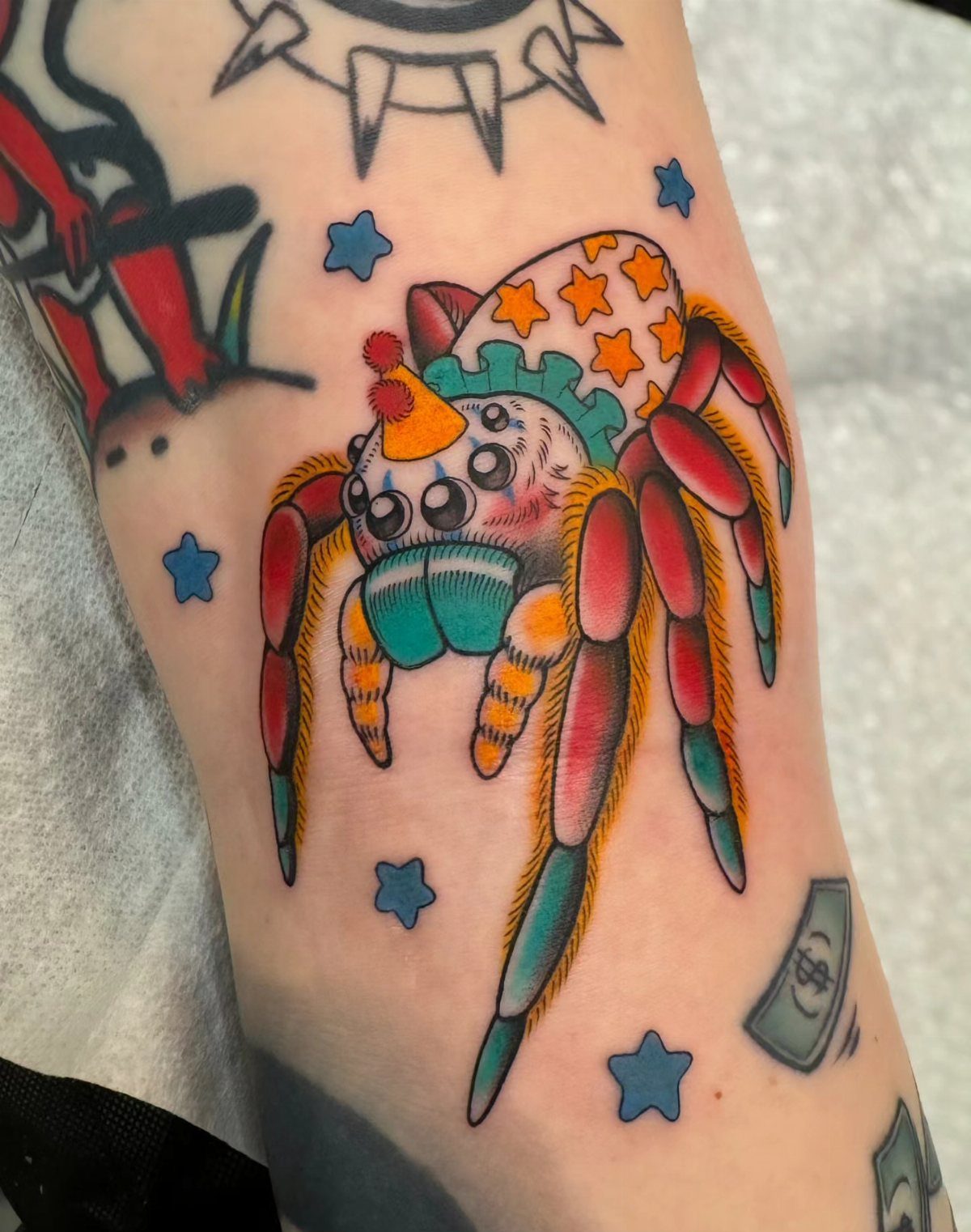
Bright rainbow legs and a tiny party hat turn the spider into something closer to mascot than menace.
The illustrative style, with its clean outlines and flat color fields, reads best at palm size or a little larger, where the details stay legible.
This version suits someone who wants the form without the freighted symbolism.
Neons and pastels fade faster than black, so the hat and stars will need a refresh sooner than a black-ink piece would. Ask your artist for healed photos of similar palettes; some yellows and pinks disappear into skin tones entirely.
8. Spider Tattoo with Sparkles
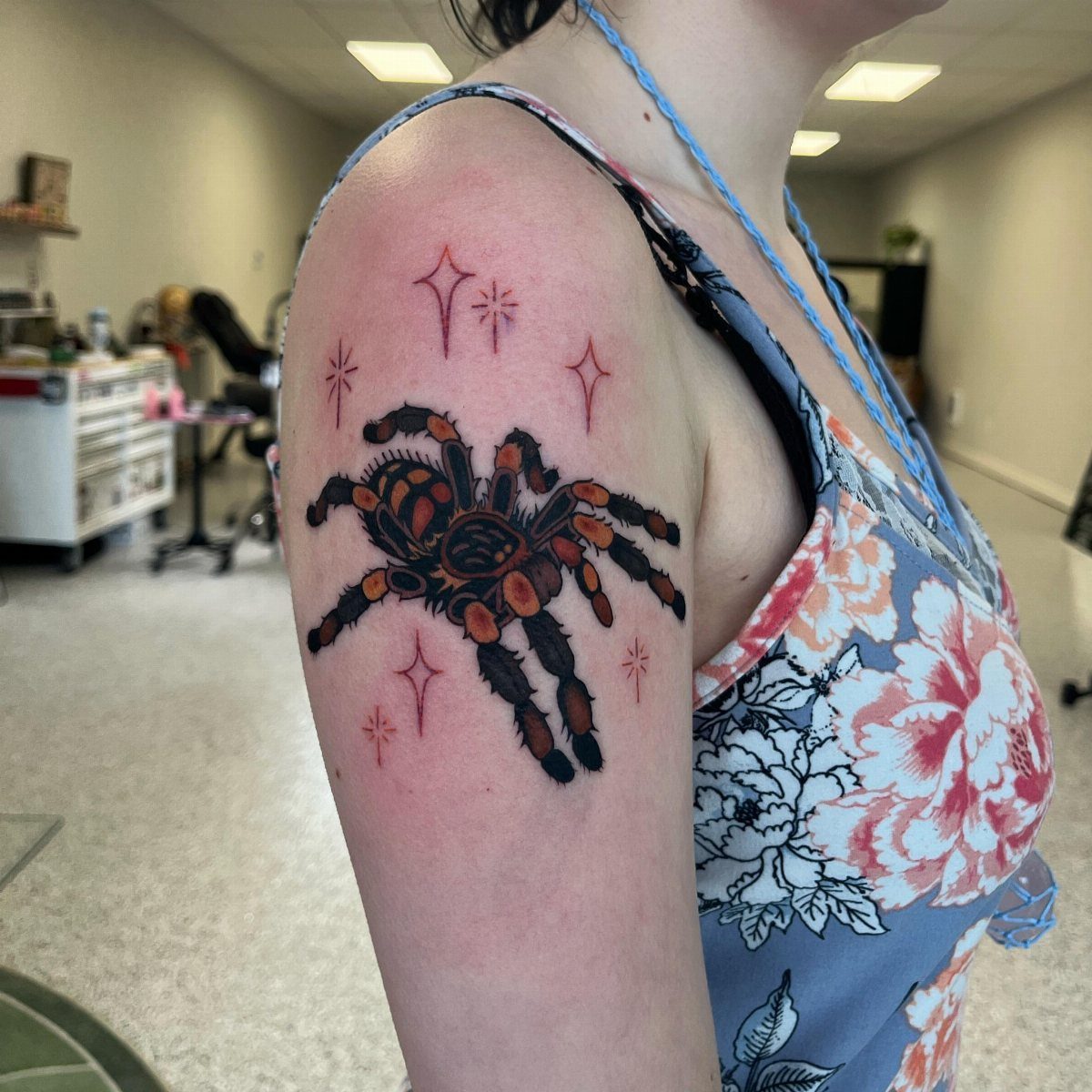
Red starbursts clustered around a black and orange tarantula borrow from sticker sheets and airbrush booths, a deliberate pop-art move.
The orange on the spider’s joints and the red bursts against black skin create high contrast that reads from a distance.
Upper arm placement gives the sparkles room to orbit without crowding the body.
The effect relies on saturation: muted reds read as bruises once healed, so push for bold in the chair. This one trades the spider’s usual solemnity for something more playful, closer to celebration than warning.
9. Spider and Floral Tattoo
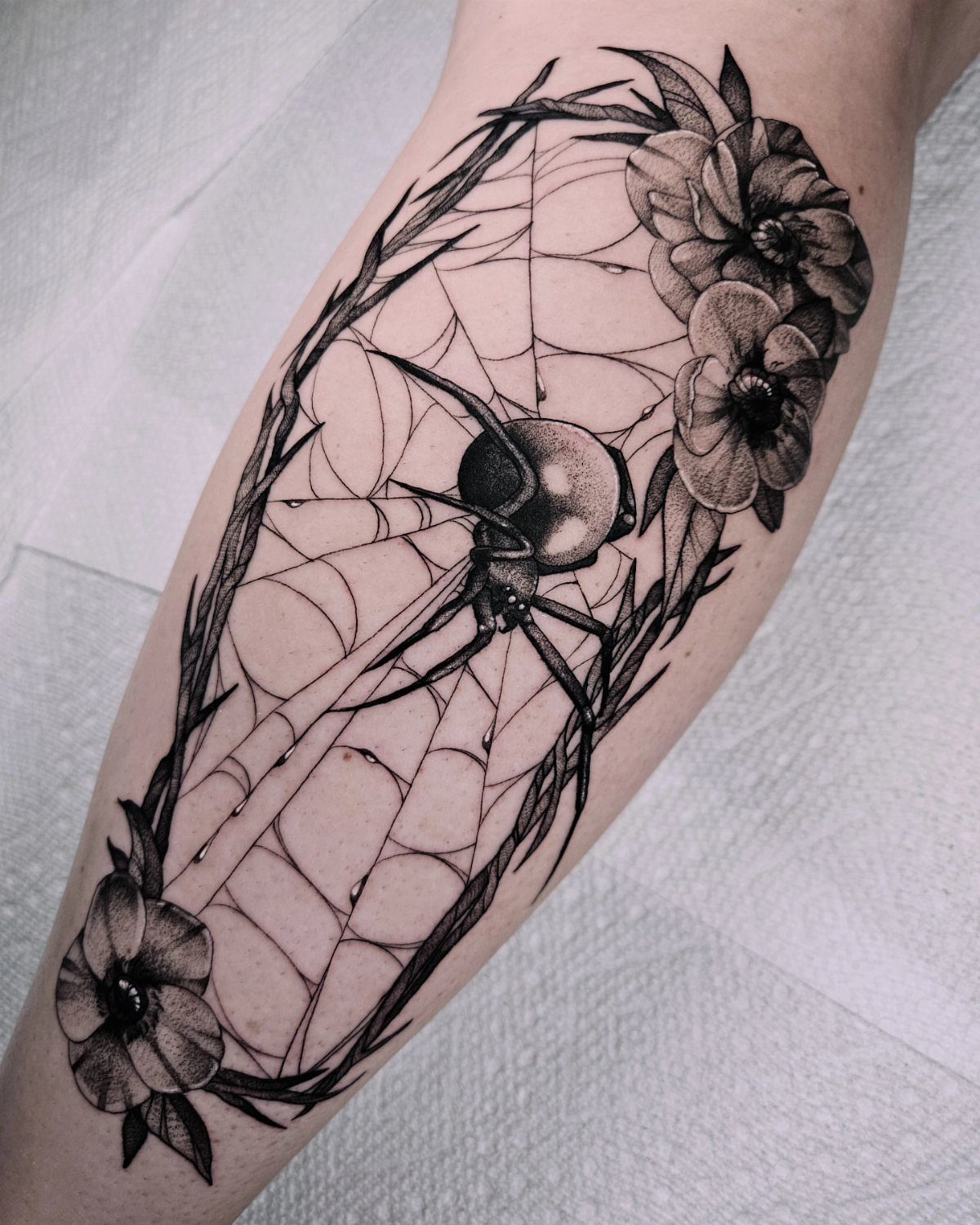
A black widow framed in leafy stems and blooms softens the threat without erasing it.
The black and grey palette keeps the botanical details from competing with the spider’s silhouette, and leg or arm placement lets the web threads extend naturally along the limb’s length.
Flower choice changes the read: roses carry their own symbolism, baby’s breath suggests delicacy, wildflowers something less cultivated.
The web in this version is structural, not decorative, holding the composition together. Check that your artist builds botanical line weight to match the spider’s; too fine and the flowers fade to texture around a dark center.
10. Smoke Leg Spider Tattoo
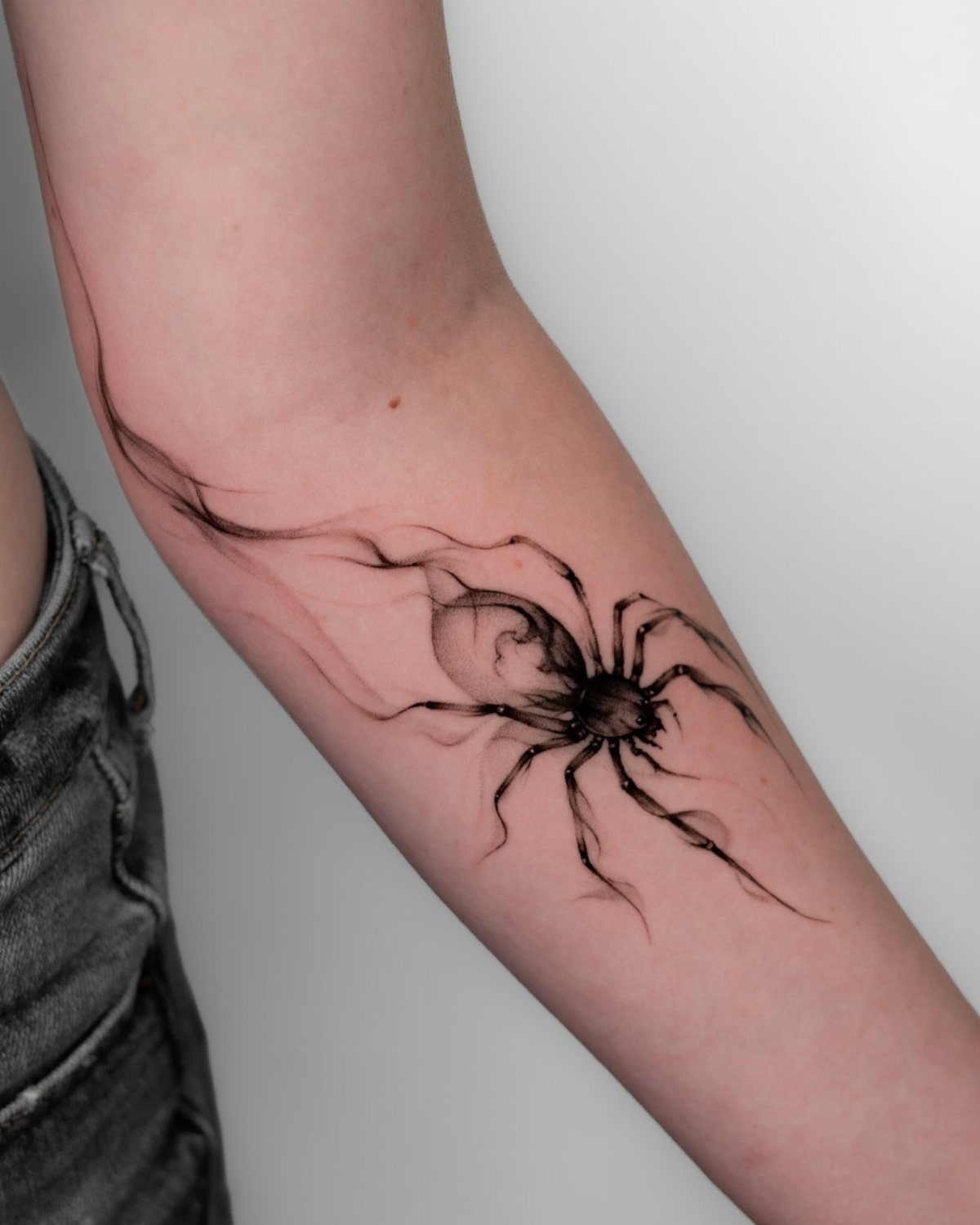
Wispy legs dissolving into trailing smoke turn solid anatomy into something passing through.
The black and grey treatment, built from soft whip shading and deliberate edge loss, needs an artist who understands how smoke reads in ink: not gray blobs but graded disappearance.
Forearm placement works because the viewer sees it at the angle smoke naturally rises. Hair and skin oil will soften the gray wash faster than the black core, so the spider body stays while the legs blur further.
This version sacrifices some legibility for atmosphere; over time the smoke may read as shadow, which is its own effect.
11. Spider with Cross Tattoo
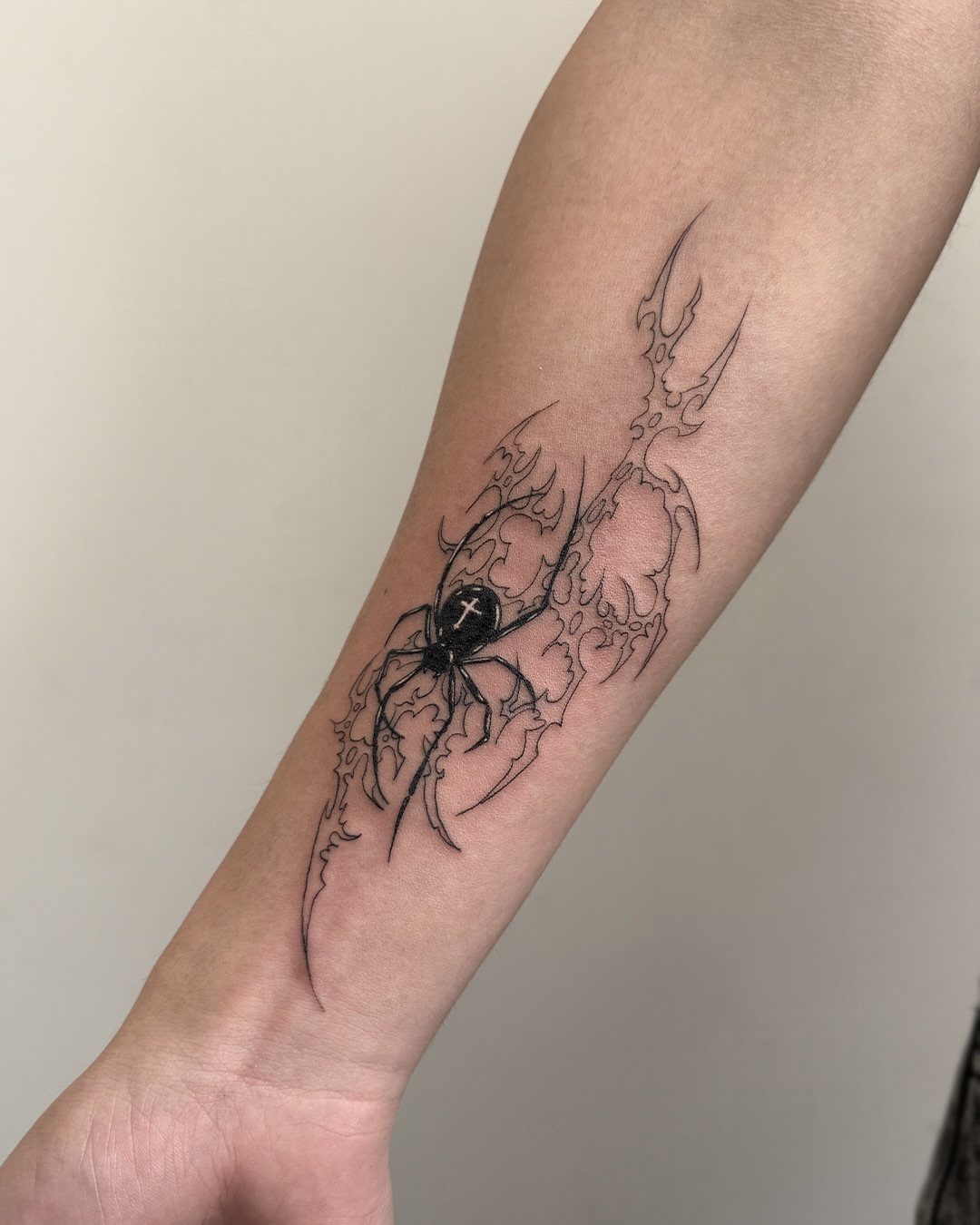
A white cross on the spider’s back, set in black ink with flowing neo-tribal lines around it, layers 2 loaded symbols without explaining either.
The cross reads as marking, protection, or provocation depending on who looks, and the abstract linework keeps the composition from becoming too literal.
Forearm placement puts it at handshake distance, impossible to miss.
The white ink will yellow or fall out faster than the black; some artists plan for this and set the cross slightly raised, others accept that it becomes a scar-like texture over time.
The surrounding lines age like standard blackwork, steady and dark. This one demands you know what the pairing means to you, because others will ask.
12. Colorful Spider Tattoo
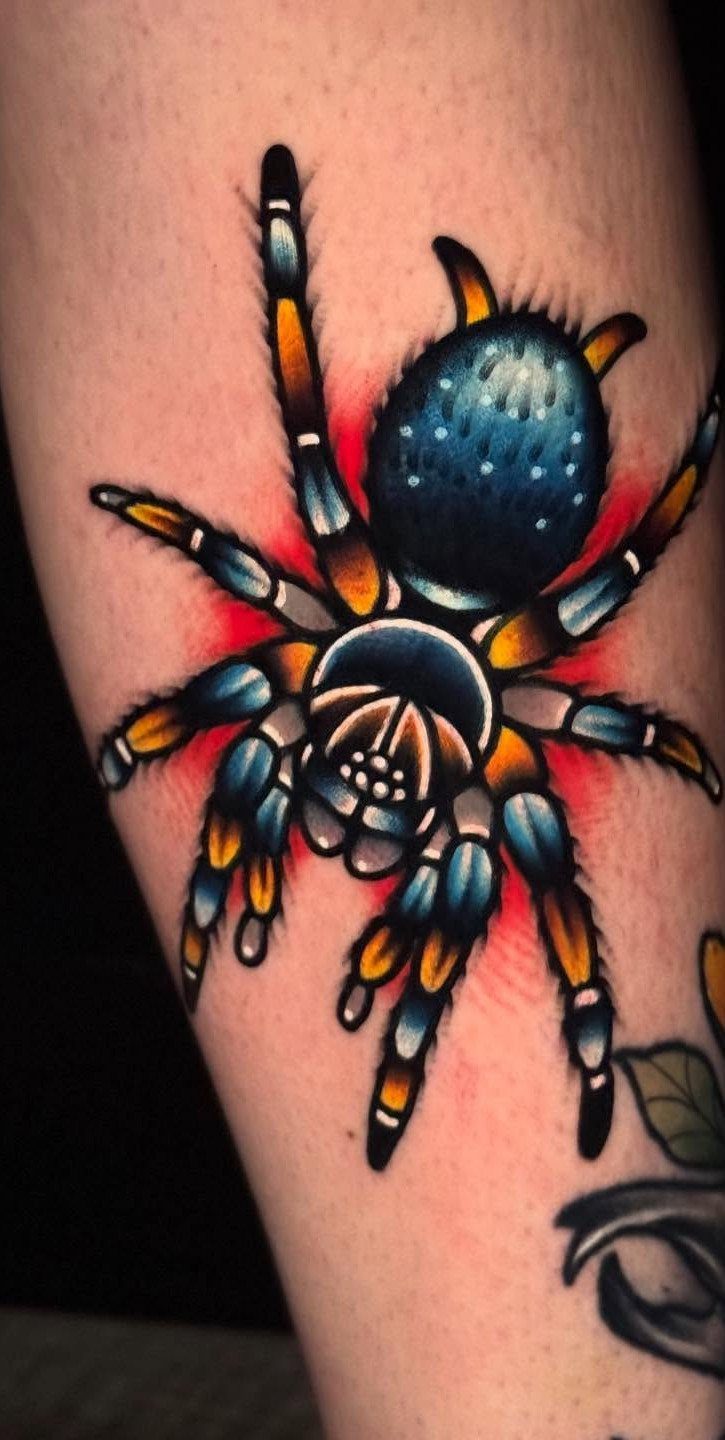
Saturated blues and oranges against a red glow background reject the spider’s usual gloom entirely. The tarantula form, heavy-bodied and visibly hairy, carries the color like tropical plumage rather than warning signal.
This much color needs space: palm-size minimum, and the red background field must extend far enough that the spider does not float.
The blues here lean turquoise, a shade that holds better than navy in skin; the orange carries warmth that keeps the cool from turning clinical.
Background glows require maintenance, the red muddies first where it meets the blue, so plan touch-ups to keep the halo effect alive. Bright spider work pulls a different audience than black and grey; expect conversation rather than avoidance.
Symbolism of Spiders
In African stories, Anansi spins tales the same way he spins thread: clever, surviving by wit. That trickster energy pairs oddly with protection, but the same stories do both.
Arachne’s Greek myth turns on skill punished until it becomes form.
The transformation angle matters for anyone choosing the shed-skin reading: spiders molt, leave the old shell intact, walk away larger. That literal biology backs up every tattoo claiming personal change.
Buddhist sources treat the web differently, as something to cross rather than build. The spider moves over its own architecture without getting stuck; the mind’s own tangles work the same way if you learn the gait.
Indian texts go further, calling the creature the act of weaving itself. A spider tattoo that carries personal meaning shifts the design from mere decoration to a statement about who controls the pattern of your life.
Not every spider tattoo needs all this. But knowing which layer you are invoking helps when someone asks what it means.
Frequently Asked Questions
What does a spider tattoo mean?
A spider tattoo pulls meaning from several directions at once.
Anansi’s trickster wit shows up in African stories, Arachne turned into form after her skill earned punishment, and Buddhist readings treat the web as something the mind crosses without getting stuck.
Some wearers want the patience and danger bundled in a black widow’s silhouette; others want no symbolic luggage at all and just like how the creature looks.
Which layer you invoke matters when someone asks, because the tattoo will prompt the question.
How big is a $500 tattoo?
A $500 tattoo has no fixed size; the artist’s rate, detail level, and location on the body all shift the math.
Budget spider tattoos run smaller and simpler, while realistic work with gray wash layers, long sessions, and healed reviews costs more.
The real variable is the conversation in the consult: scientific accuracy or cartoon boldness, single color or full background glow. Size follows from those choices rather than fixed rates.
Is spider web elbow tattoo racist?
The elbow web sits in traditional prison territory, though the design itself carries no racial meaning. The shoulder, ribs, or thigh keep the interconnectedness and destiny reading without the prison signal.
The web itself is tense architecture, a thing still in use, but the elbow location lands in a specific cultural context that many wearers now deliberately avoid.