These cat tattoos with pattern range from fine line work that stays small enough for a wrist to large-scale tribal pieces that need their own real estate on the chest or back.
The deciding factor is not how much cat you want but how much pattern: whether the geometry, stippling, floral, or mandala element is there to frame the animal or to become it.
1. Floral Pattern Cat Tattoo
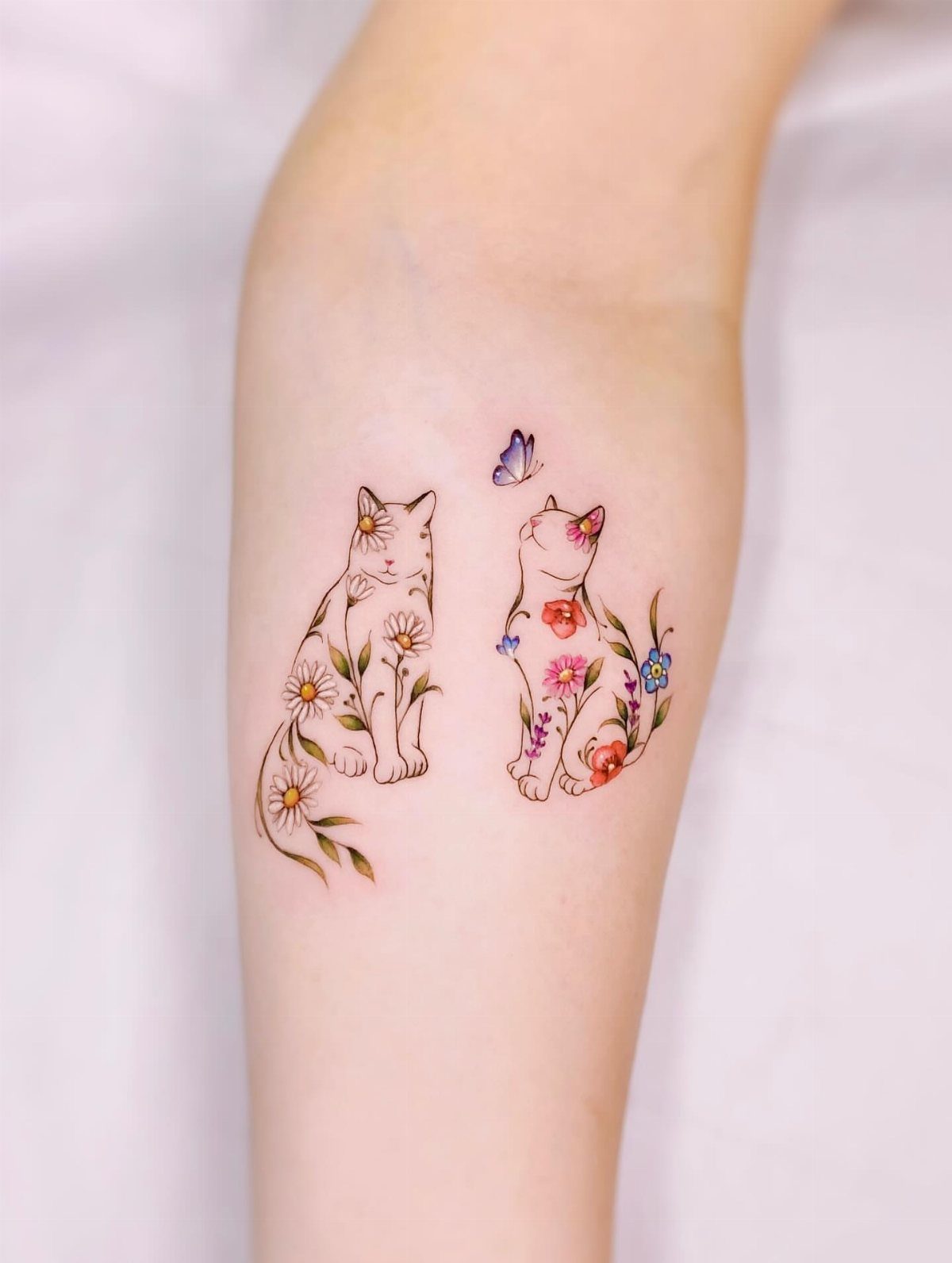
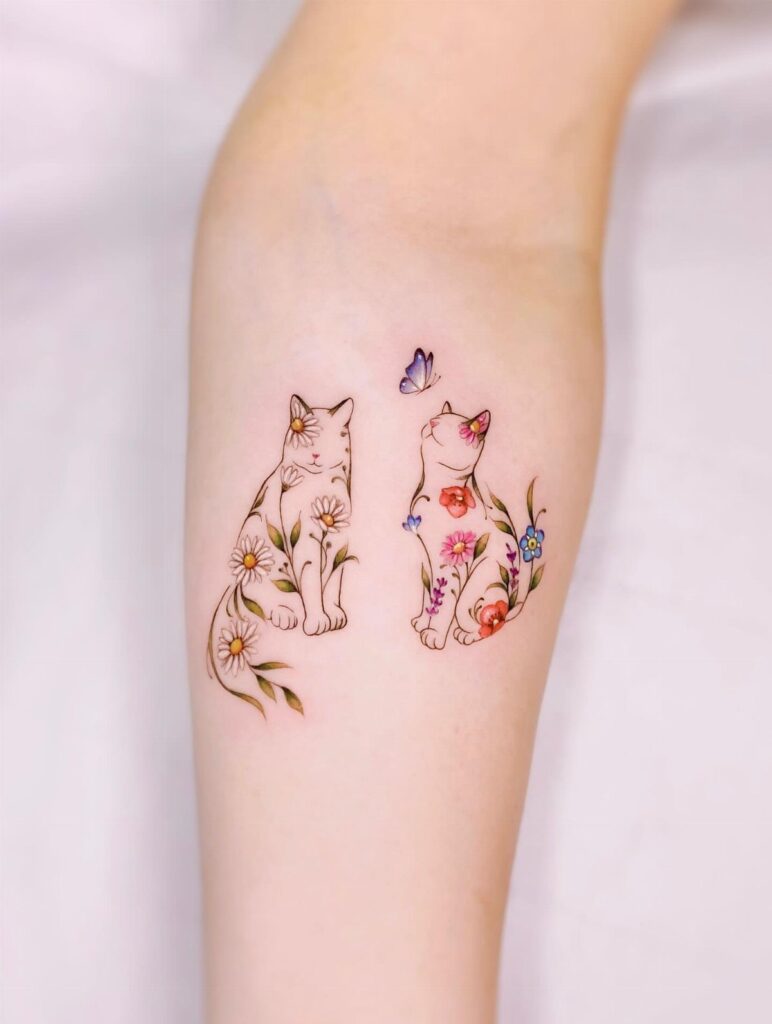
Floral cat tattoos borrow a trick from early botanical illustration: the plant and the creature share one body.
The leaf or petal follows the spine of the cat, the stem curves along a tail, and the eye becomes a flower center or stays a cat eye depending on which artist you sit with.
A purple butterfly above the pair reads as the cat’s own thought or as a separate visitor; either way it breaks the symmetry and makes the arm feel like a garden scene rather than a stamp.
The fine linework on white skin keeps it from reading as a nursery pattern; on darker tones, ask for heavier petal shading or jewel-toned ink that holds against melanin.
These pair well with existing botanical pieces and age slowly if the flowers stay inside the cat’s outline rather than floating around it.
2. Geometric Cat Tattoo
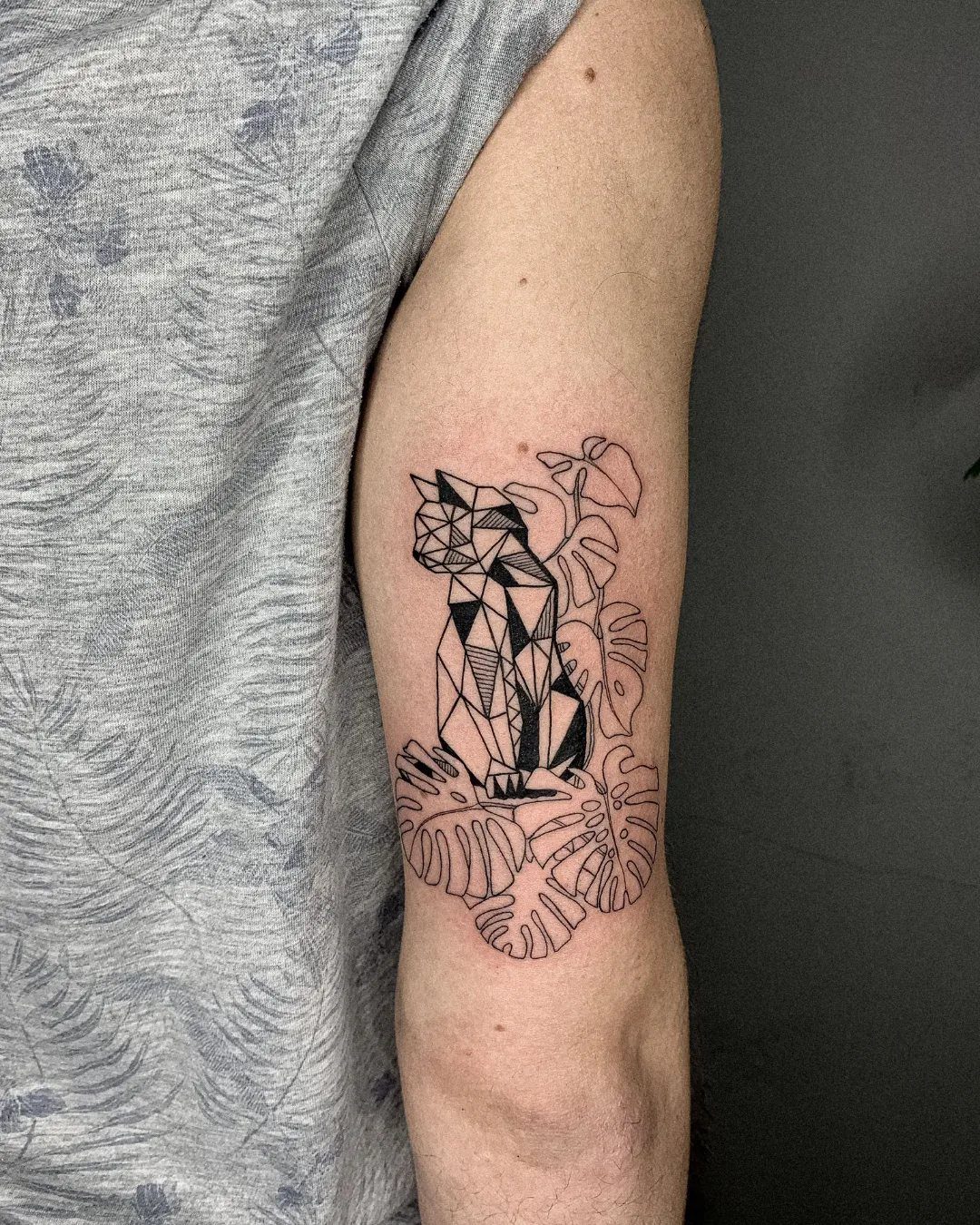
Geometric cat tattoos reward the client who knows exactly where the piece will live.
Straight lines and measured angles sit flat on the upper arm because the muscle curve there is gentle; the same pattern on a shoulder blade or calf will bend and break the symmetry that makes the style work.
Monstera leaf outlines around the cat’s edge soften the math with something organic; without them, the design can read as pure logo.
A good artist maps the geometry first, then lets the cat emerge from it, not the reverse. The result holds up for years if the black ink is dense enough, since grey wash fades faster in tight angles.
The setup takes as long as the tattoo itself, so plan for a longer session than the size alone would suggest.
3. Tribal Pattern Cat Tattoo
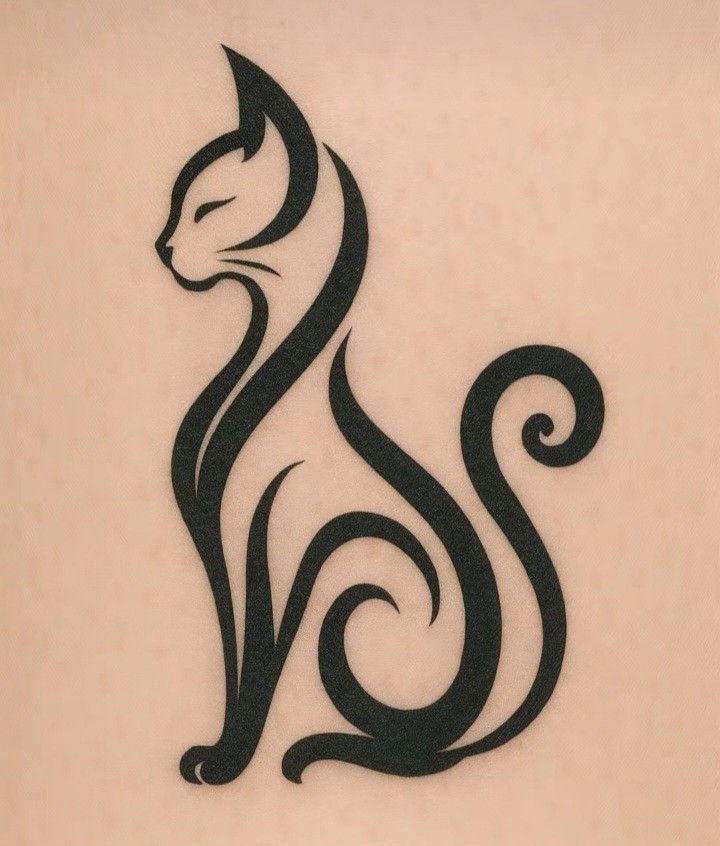
Tribal pattern cat tattoos carry the same risk as any tribal revival: the curves and points can flatten into decoration if the artist does not know the source vocabulary.
The forehead and eye patterns visible in some reference studies work better on actual cats than on human skin, where those placements read as literal masks.
On a person, the belly and chest of the cat figure carry the pattern more naturally. This style scales large; at small sizes, the curves tangle and the eye loses the boldness that makes tribal read from across a room.
4. Mandala Cat Tattoo
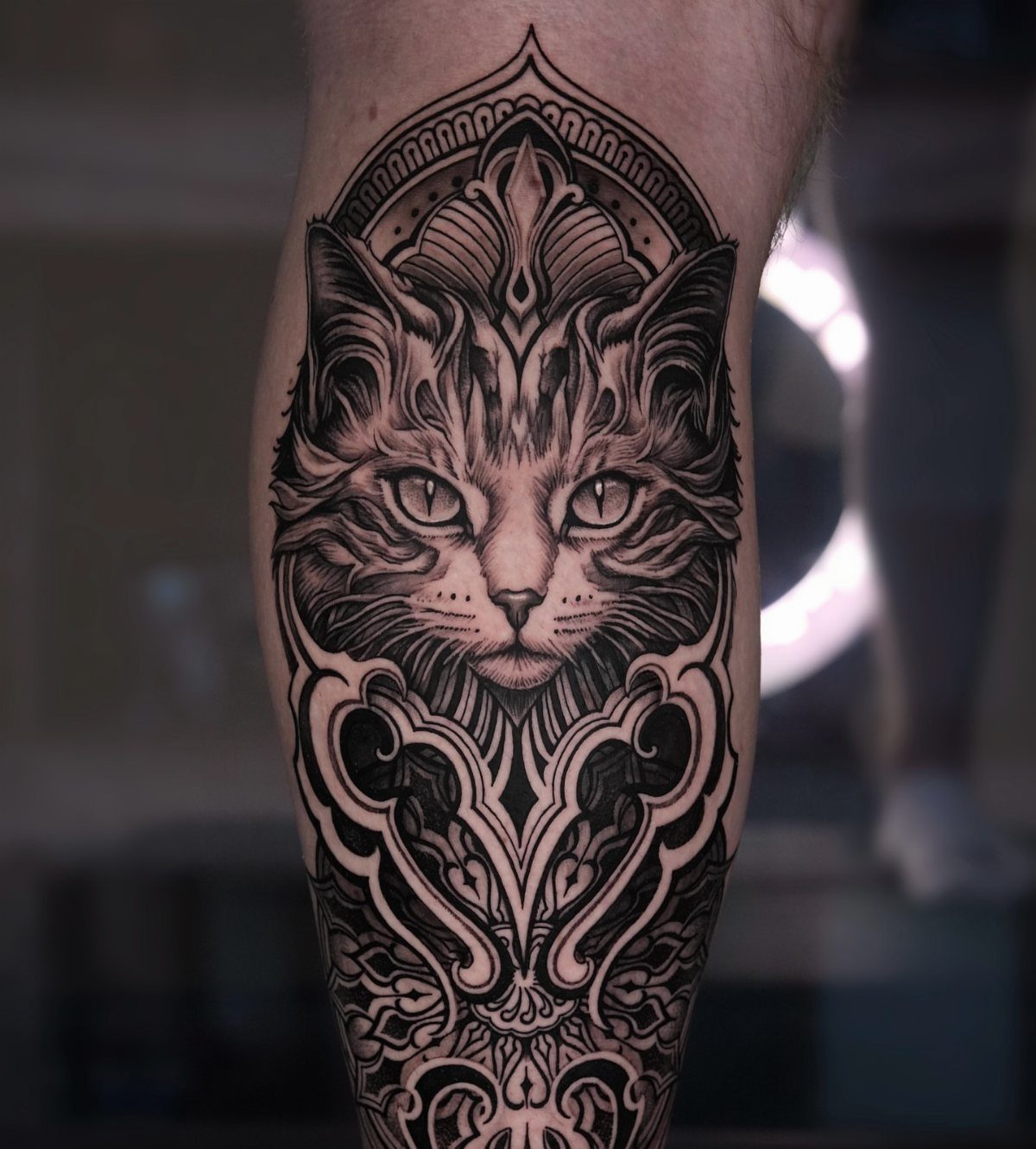
Mandala cat tattoos ask more patience than most cat pieces.
Radial symmetry extends well beyond the cat’s actual head, which means the stencil must align to a center point on the limb; on a rounded surface like a calf or forearm, the artist is effectively drawing on a cylinder and the eye judges every mismatch.
The filigree holds hair-fine detail that blurs without regular touch-ups.
The mandala wraps around the cat’s face in strict black and grey, with no color added; the decision then becomes whether to keep it that way or introduce ink that matches an actual eye color, which reads one way, or a standard emerald, which reads another.
Either works; mixing both in one piece rarely does. This style suits someone who already wears detailed work and can place this where existing tattoos frame it rather than compete.
5. Minimalist Cat Tattoo Using Fine Lines
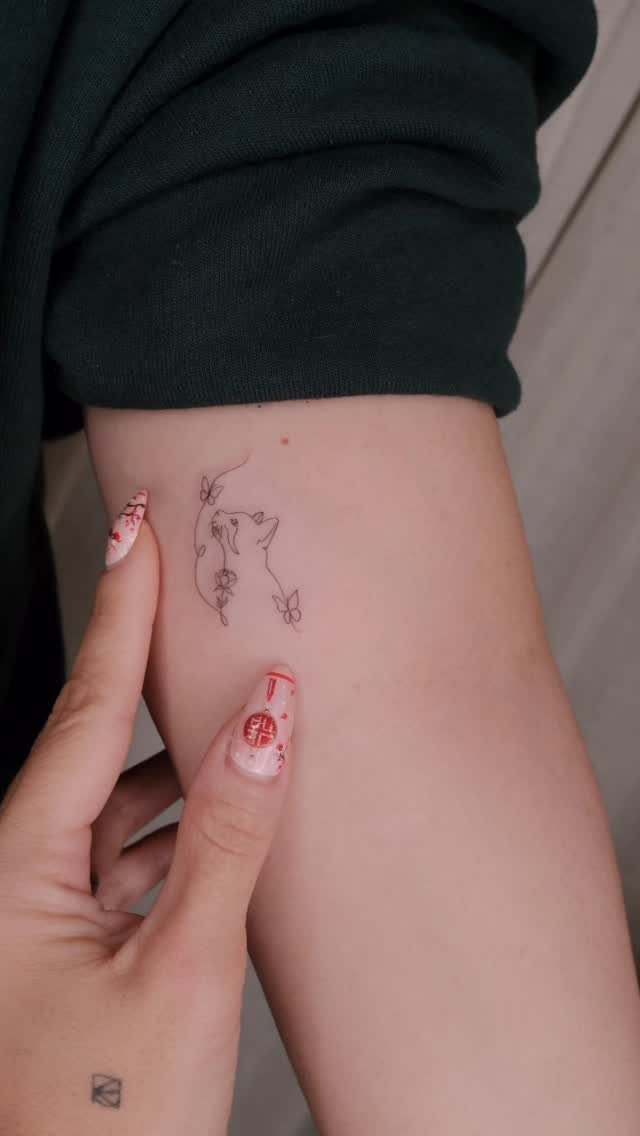
Fine-line cat tattoos live or die by the needle diameter.
Single-needle work runs hair-thin, where a breath of the artist’s hand becomes visible in the final line. The butterflies above the cat are simple enough to balance the figure; too many elements and the eye loses the cat entirely.
On fair skin that tans, sun exposure yellows black ink to brown-grey faster than you’d expect; on darker skin, the line itself must carry enough weight to read against the tone rather than relying on contrast alone.
This is the entry point style for someone new to ink. It costs less, heals faster, and commits the wearer to a lifetime of sunscreen or to a gradual fade that some prefer.
6. Cat with Stars and Dots
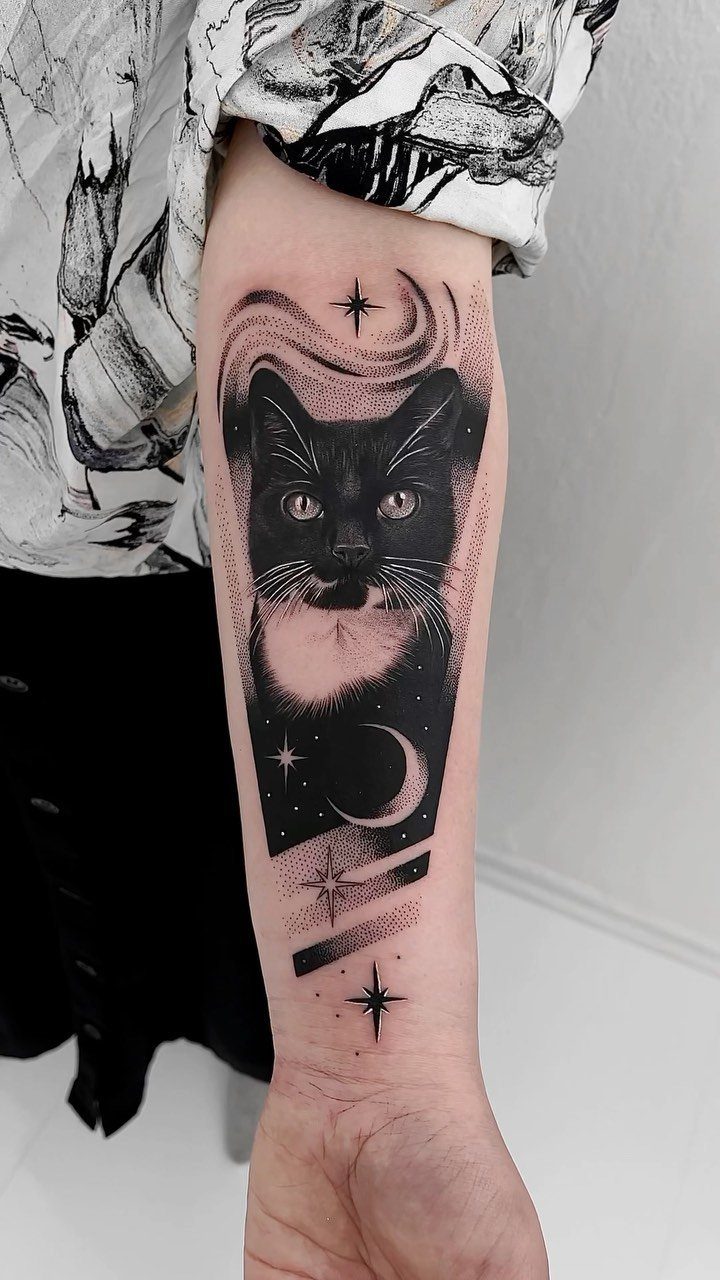
Dotwork and stippling turn the cat tattoo into a night-sky piece by building tone from density rather than shading. A crescent moon and four-pointed stars give the cat a setting; without them, the dots read as texture alone.
The technique takes longer than solid black fill because the artist is effectively drawing half the image and letting negative space complete it.
Stippled fur on a moving animal is harder than it looks: the dot spacing must tighten where light would hit and open where shadow falls, which means the reference photo matters enormously.
A static pose forgives more than a leaping or stretching cat, whose limbs must read clearly at a glance. After healing, the dots settle slightly and the image softens; plan for that, not for the fresh crispness.
7. Cat with Fur Patterns
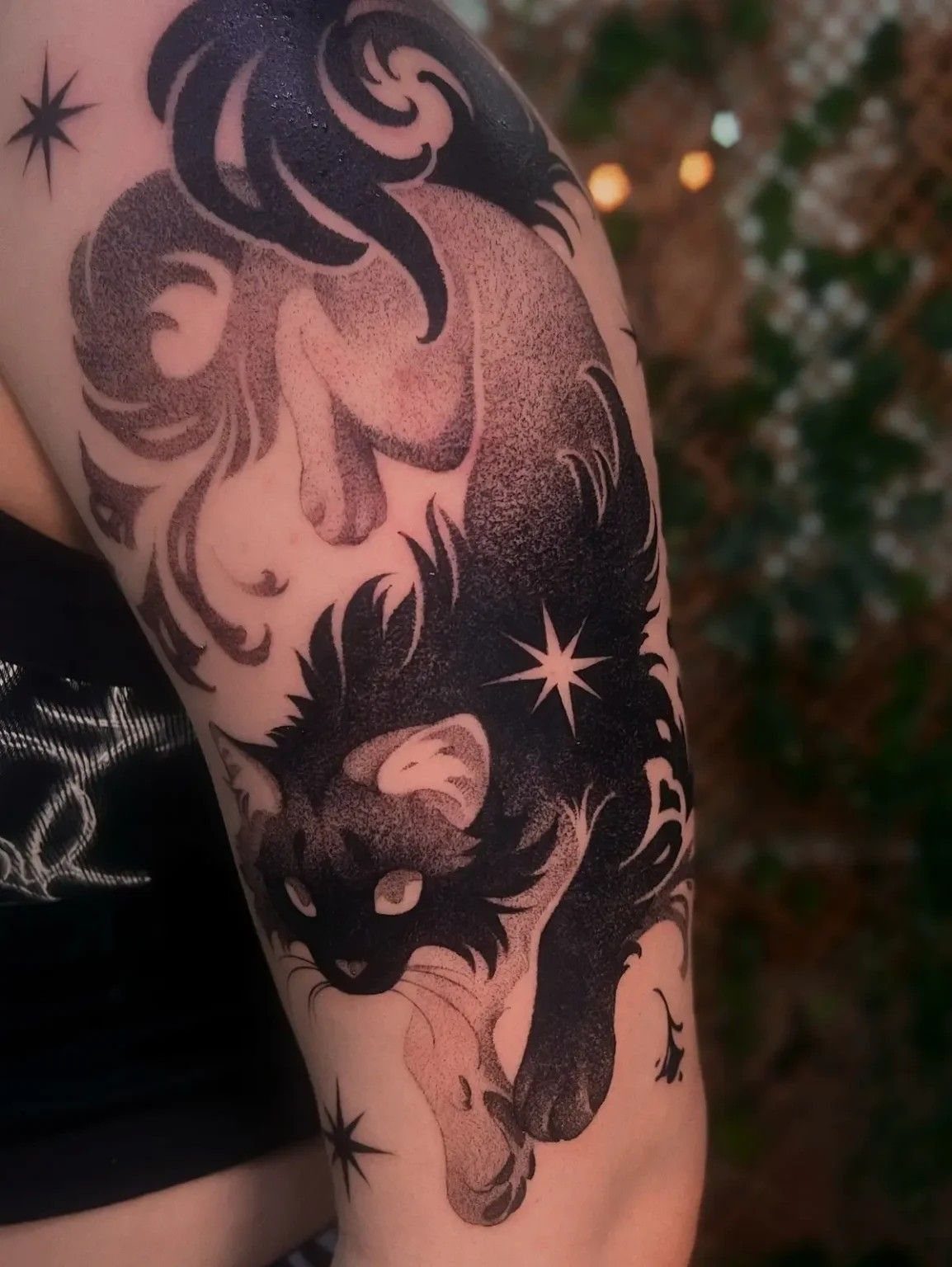
Copying a cat’s actual coat stripes or spots onto skin is harder than drawing a generic tabby from memory. Swirling decorative fur, done in dotwork, solves this by inventing a pattern that suggests texture without committing to biological accuracy.
Vertical flame-shaped stripes read upward and lengthen a limb; horizontal spots widen it. On a fluffy breed, the pattern sits inside a soft edge; on a sleek one, the outline is crisp and the pattern fills it like wallpaper.
Black ink holds, but grey wash in the stripe valleys adds depth at the cost of faster fade.
8. Cat Head with Patterns
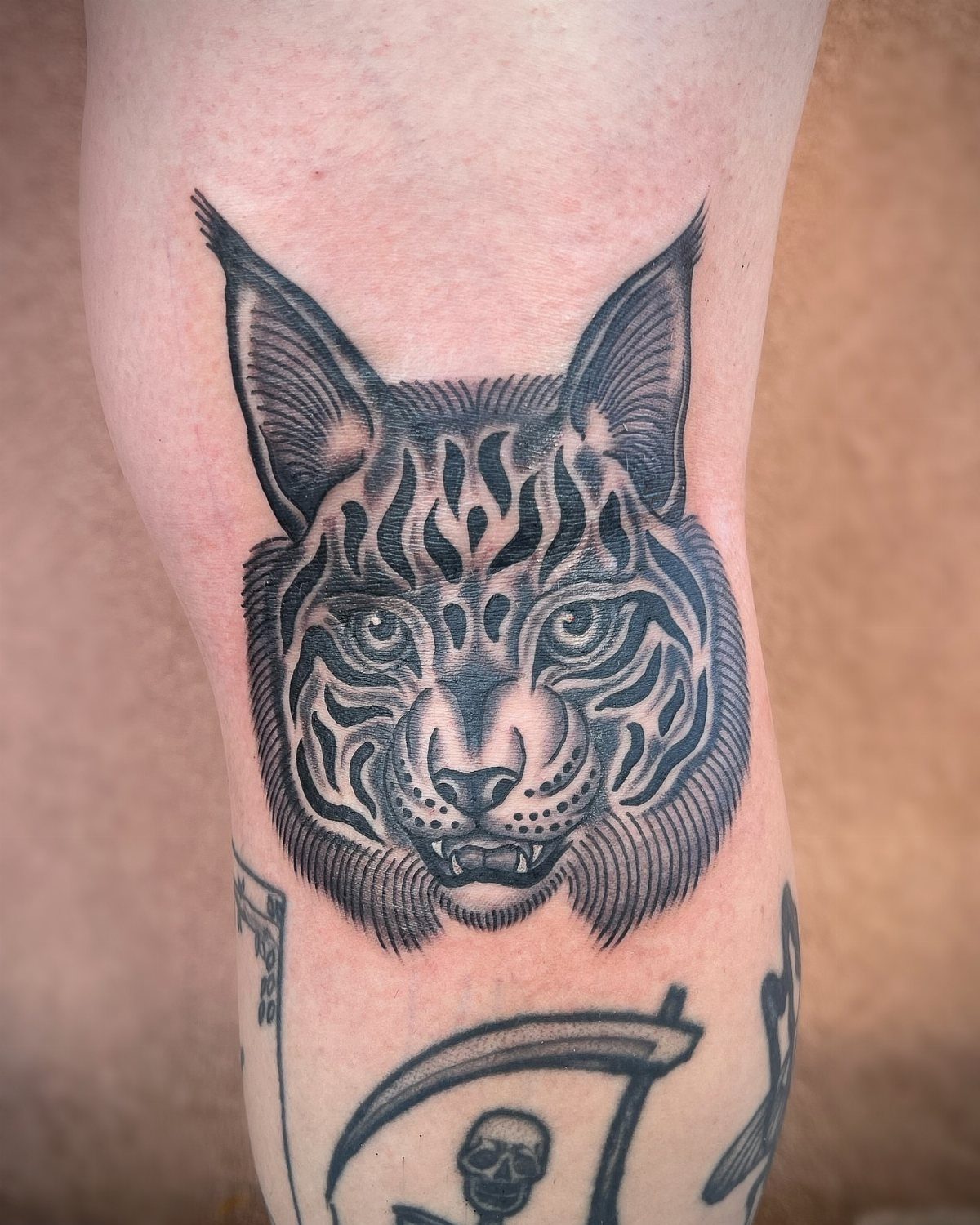
A cat head isolates the one part everyone reads instantly: the eyes, the ears, the whisker pads. Patterned markings on the face do what jewelry does, drawing attention to those features rather than scattering it across a body.
Bold ink and sharp angles in a lynx head suit a leg or a rib panel where the shape fills space without wrapping around a curve.
The eye expression is set by the pattern, not the line alone. Stripes that pull downward from the inner eye make the cat read as wary; upward curves read alert.
Since the head carries the whole tattoo, any asymmetry in the face is the first thing a viewer notices; check the stencil mirror-image before the needle starts.
Small white dots for eyes turn the face iconic but sacrifice the living glance.