Centipede tattoos on this site range from a single fine line on an inner forearm to a full sleeve built across multiple sessions, paired with spider lilies or human eyes, left as bare bone or done in traditional bold color, and the deciding factor is whether you want the creature to read as a specimen or as part of a larger scene.
The back placement uses the spine as a natural channel where the body tapers, the thigh wrap turns the leg itself into an environment the creature moves through, and the inner forearm keeps a fine line version visible without committing to a larger piece.
1. Centipede with Spider Lilies
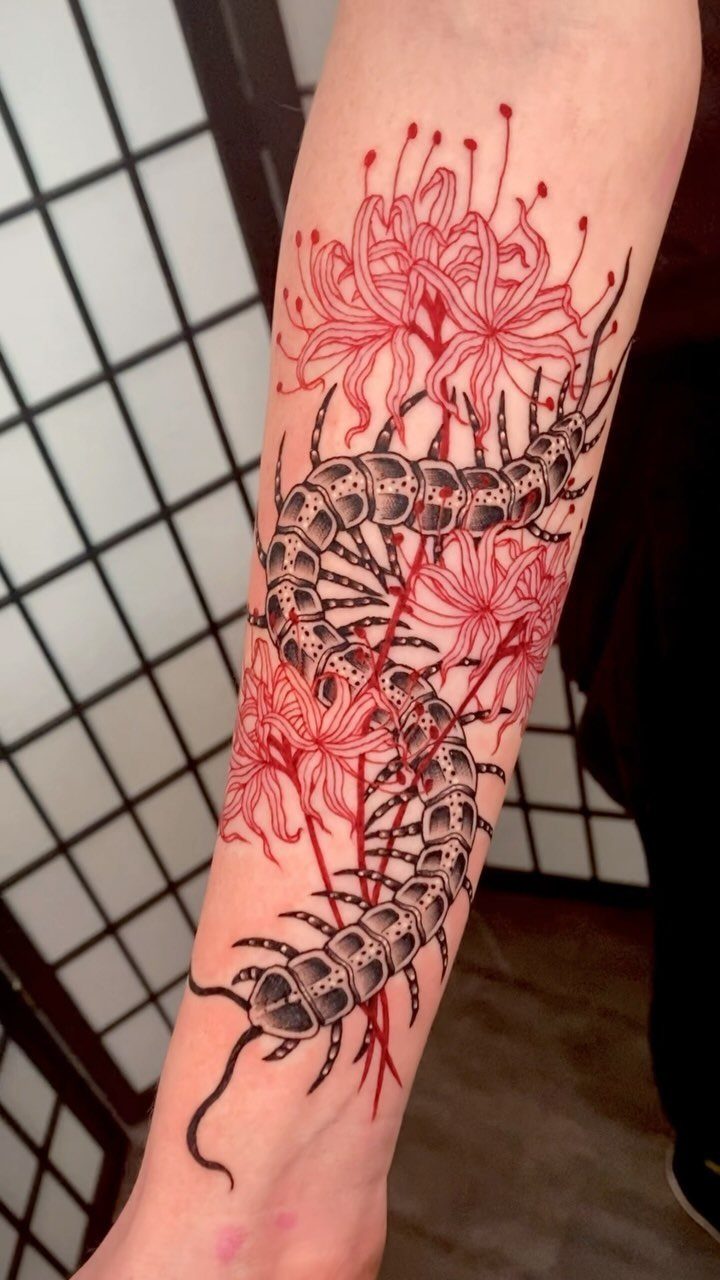
Spider lilies carry death and farewell in Japanese symbolism, which pairs naturally with the centipede’s reputation as a creature of the underworld.
The red against black ink makes the flowers read first from a distance, the insect second; the centipede becomes a dark vine holding them together.
Fine line work on the flowers keeps them from turning cartoonish against the heavier shading the centipede needs for its segments to read. Ask the artist to vary line weight so the lilies float lighter than the body.
A forearm placement gives the composition enough length for both motifs to breathe without crowding. I would keep background elements minimal; the 2 subjects already carry enough weight.
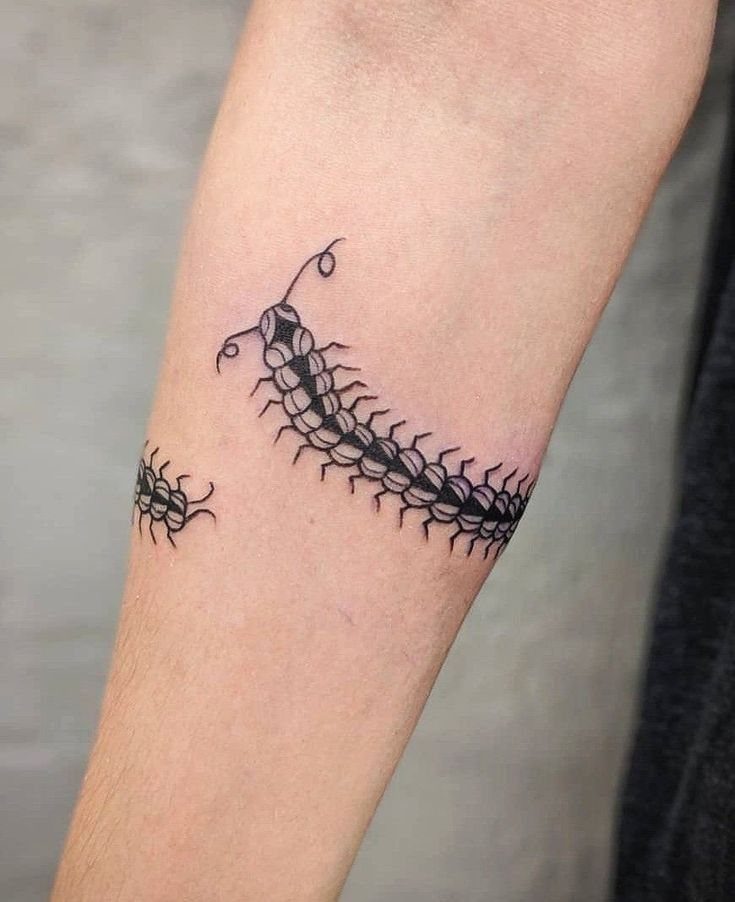
2. Fine Line Centipede Tattoo
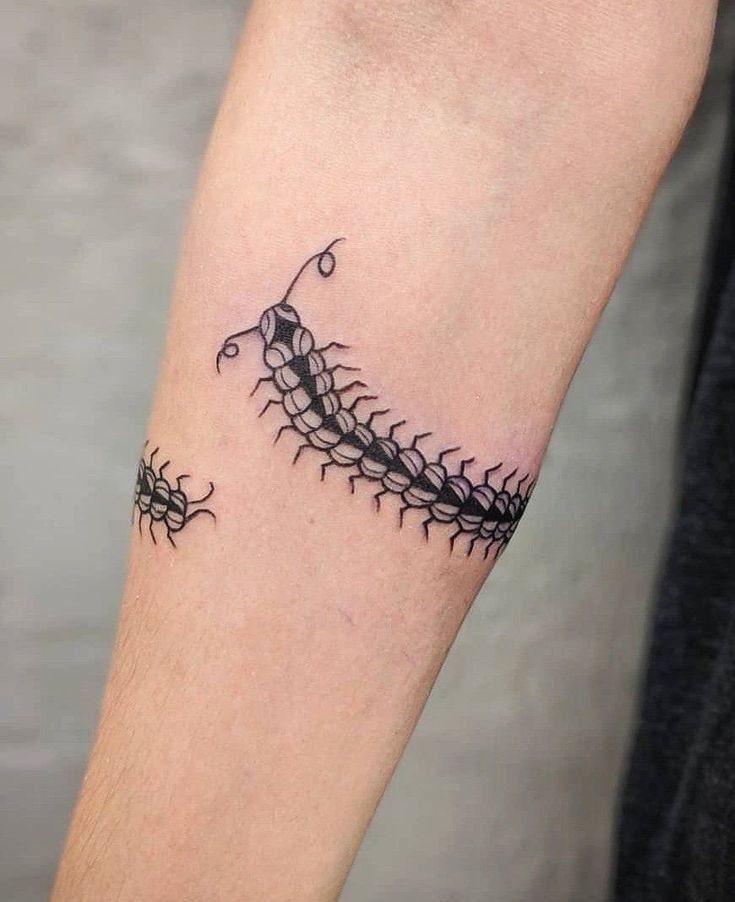
Fine line technique suits the centipede better than I expected.
The dozens of legs become readable rather than muddy when each stays a single hairline stroke, and the antennae taper to near-invisibility in a way that feels biological rather than underdrawn.
The risk is blowout on the smallest segments.
Older fine line work sometimes ages into a grey blur where the needle traveled too fast. A practitioner who builds tone through spacing rather than crosshatching gives the tattoo its best chance at aging cleanly.
I prefer this style on a narrow placement, the inner forearm or a vertical rib line, where the centipede’s length becomes the composition’s entire logic.
3. Centipede Tattoo Sleeve
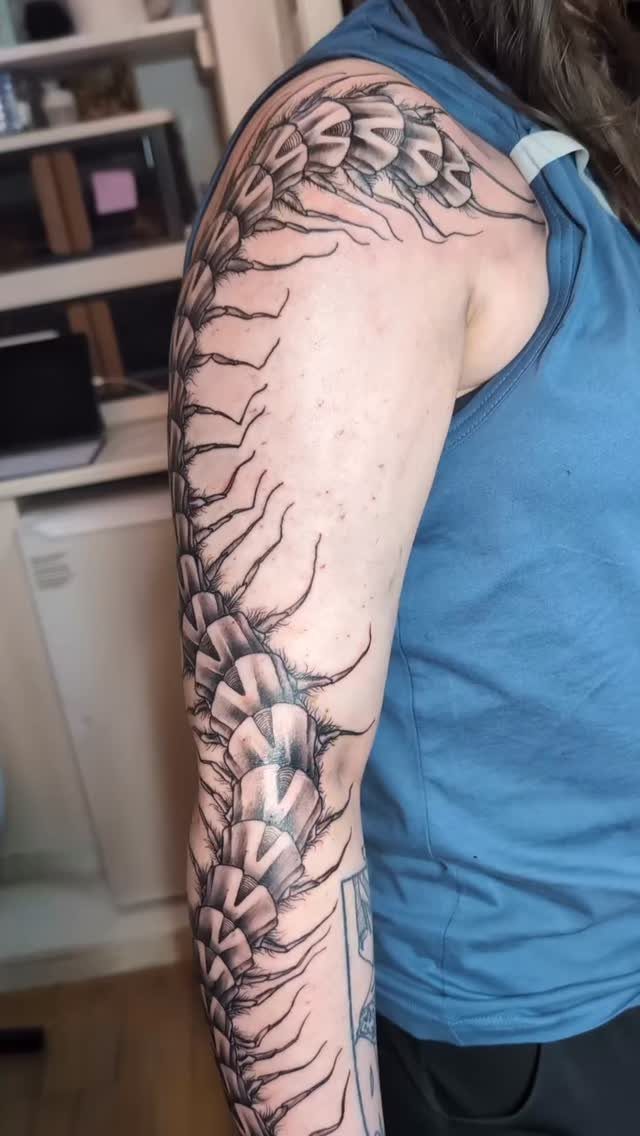
A sleeve asks the centipede to compete with whatever else sits on the arm. The versions that work let the insect’s segments replace background filler, dark negative space between other pieces, rather than floating it as a standalone figure.
Layered segments build dimension through stacked ellipses, each one slightly offset from the last. The curved legs catch light differently than flat blackwork, which matters at the shoulder where the body rounds.
Shading follows the arm’s musculature or fights it; I would follow, letting the elbow’s point become a natural joint in the centipede’s body.
This scale takes multiple sessions. The 3D effect arrives in the second or third sitting when the darkest tones go in.
4. Centipede Back Tattoo
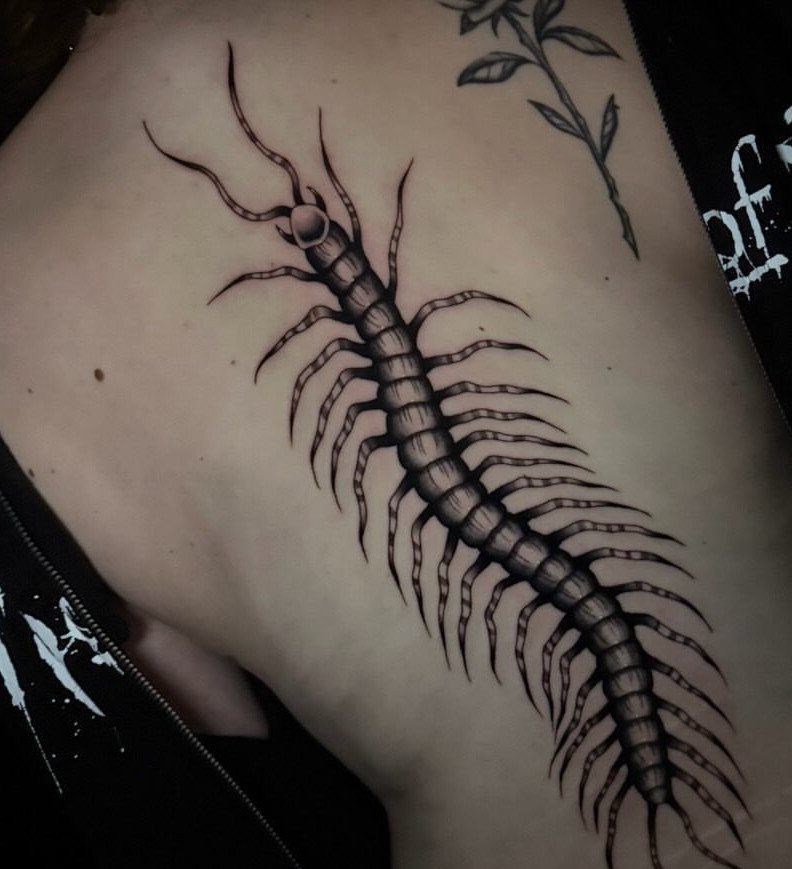
The spine’s natural channel gives the centipede a habitat. It reads as crawling between the shoulder blades rather than stamped on top of them, especially when the body tapers slightly at the lumbar hinge where a real insect would bend.
Black ink stays the reliable choice here. Color on the back faces sun and fabric friction in equal measure, and the centipede’s many legs create edges that fade fastest.
A long body with sketchy, spindly legs keeps the composition from turning military; the irregular ink weight suggests movement rather than diagram.
I would check the mirror image carefully at stencil stage. A spine tattoo faces away from you permanently; any asymmetry in the segments becomes a daily surprise.
5. Centipede Tattoo Wrapping Around the Thigh
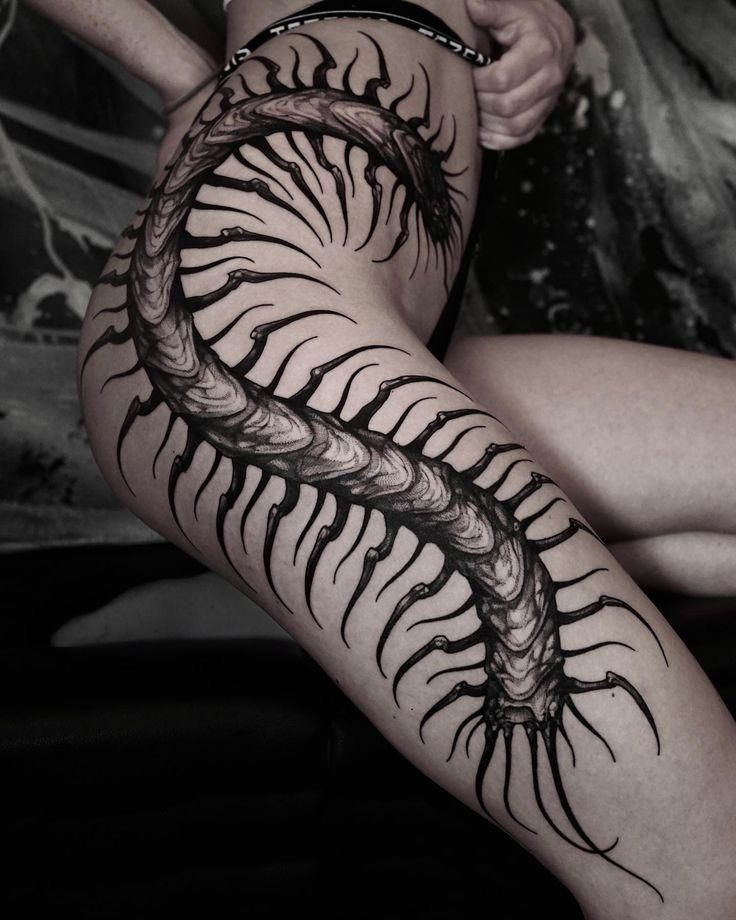
The thigh’s cylinder shape lets the centipede wrap rather than flatten, legs projecting around the curve like they would over a branch. From the front the body disappears, reappears; the viewer’s eye has to travel.
Large scale matters here. A small centipede wrapping a thigh reads as a bracelet, loses the species-specific menace.
The versions that extend toward the ankle commit fully, turning the leg into an environment. Curved legs at the hip flare outward, at the knee compress; the anatomy of the insect responds to the anatomy of the body.
Clothing choices narrow. The tattoo shows at shorts length or gets fully hidden; there is no casual partial reveal.
6. Traditional Centipede Tattoo
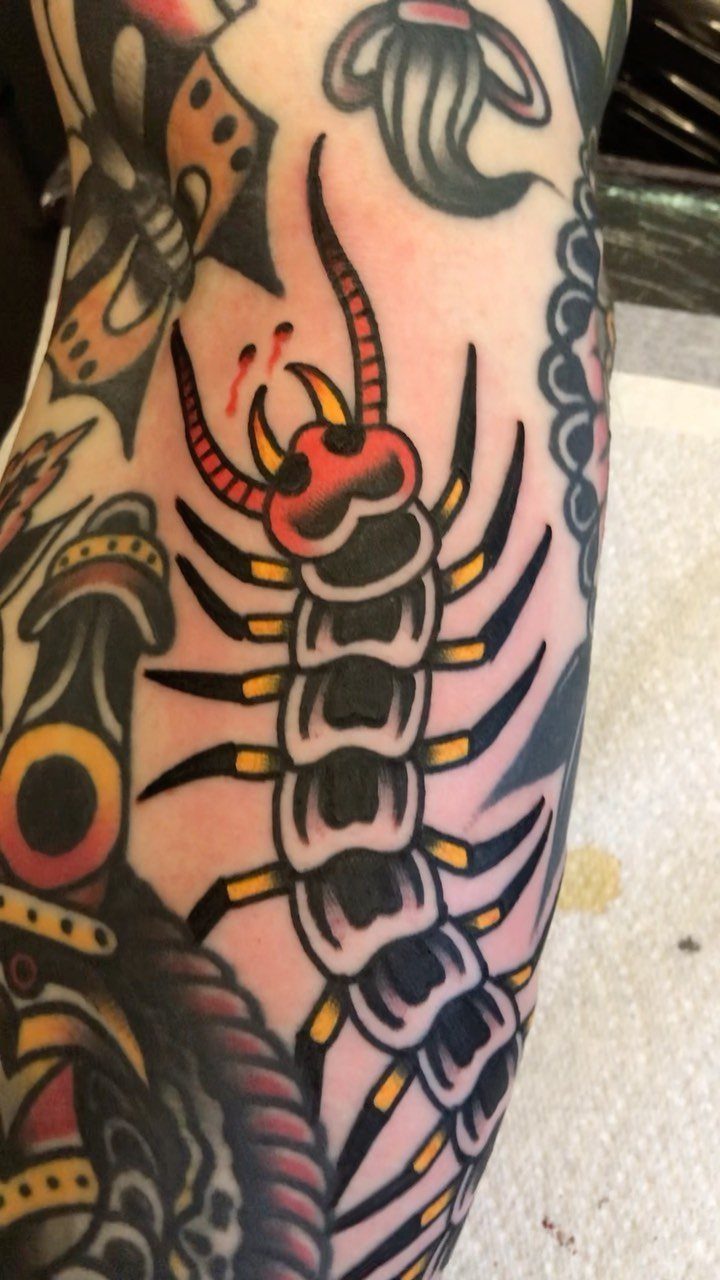
The traditional style forces a choice: historical accuracy or personal palette.
American traditional centipedes in source books run green-black or brown, but the red head with yellow accents visible here carries its own logic, warning coloration borrowed from actual venomous species.
Bold outlines age better than fine work in this placement, which matters when the forearm takes daily sun and abrasion.
The surrounding elements, flowers or decorative patterns, need the same heavy line weight or they drop out visually within a few years.
I would ask for the black to stay genuinely black, not washed grey for "vintage" effect. Traditional work earns its longevity through contrast, not through pretending to be older than it is.
7. Skeletal Centipede Tattoo
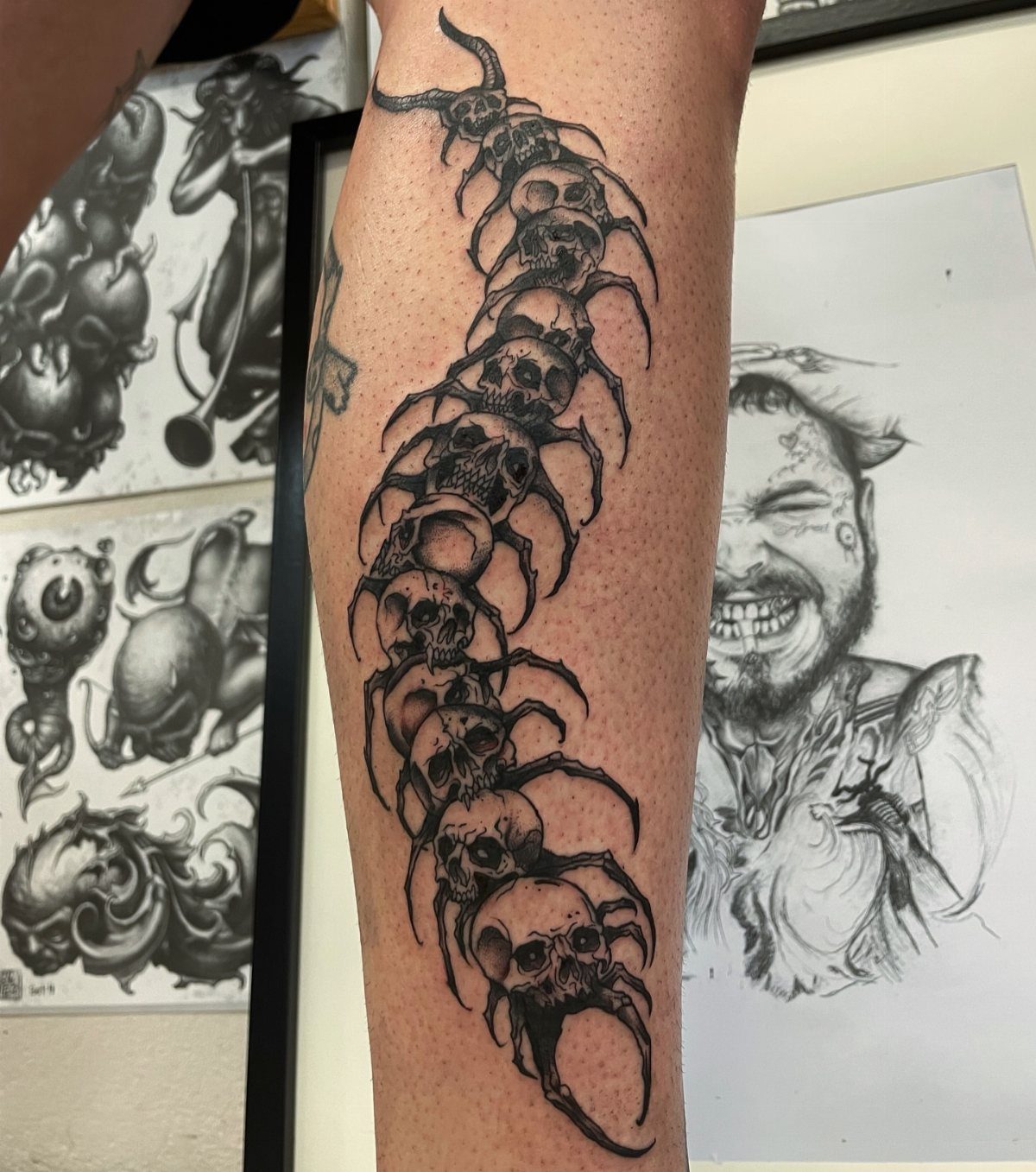
A centipede built from stacked skulls turns the insect’s segmented body into something explicitly memento mori. Each skull becomes a joint, the mandibles become feet, and the whole thing moves like an exoskeleton built from what’s left after decay.
Black ink is the only color that holds this concept together. Any bright tone would tip the piece toward Halloween decoration; the monochrome keeps it in the territory of serious anatomical drawing.
The skulls need individual personality, slight variations in socket depth and cheekbone width, or the repetition flattens into pattern rather than reads as collected remains.
The shoulder-to-chest wrap visible in reference drawings asks for a body that fills out the frame.
On a narrower build the skulls compress and lose their individual impact. A single limb, forearm or calf, keeps the segments at scales where the bone detail stays legible.
8. Centipede with Human Eyes
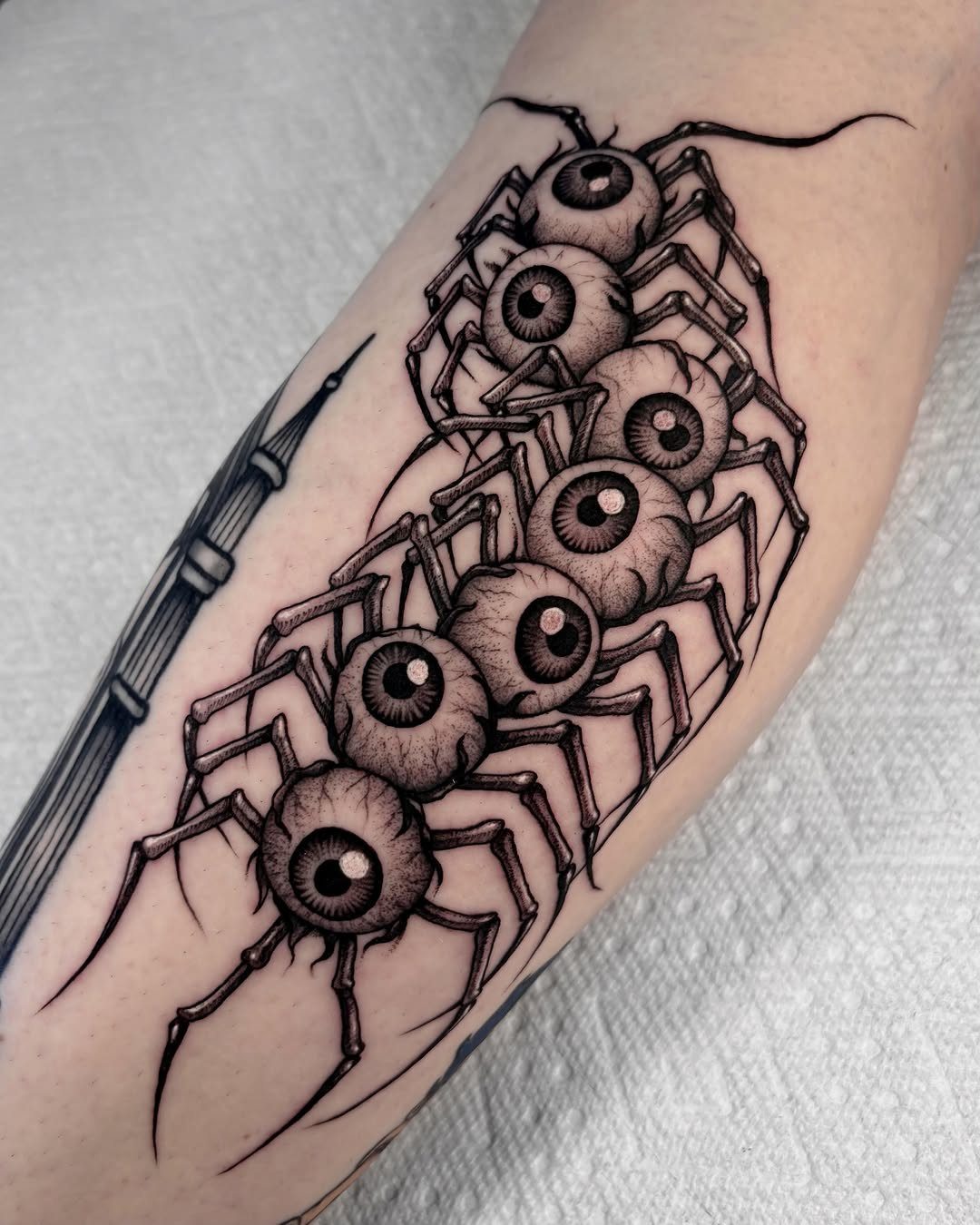
Human eyes at every segment replace the centipede’s natural armor with something that watches back. The effect is surveillance as organism, a creature that does not crawl past you but tracks you continuously through its own length.
Realistic irises demand an artist with portrait experience.
The curvature of each eyeball must match the body’s cylinder or the segments read as flat stickers; catchlights in identical positions would break the illusion, so each eye needs its own light source response.
Black and grey ink carries more danger here than color, since grey wash can muddy the distinction between sclera and shadow.
The limb placement suits this design unusually well. The spine becomes a central nervous system the eyes gather around, and the viewer’s position behind the wearer mirrors the uncanny feeling of being watched by something that faces away.
Placement on a limb risks the eyes reading as decorative dots when the body twists; the back holds a stable field for the image to accumulate its intended effect.
Curved legs need sharper points than organic versions; the eyes provide enough soft material that the limbs must balance with graphic precision or the whole creature collapses into mush.
Design Styles for Centipede Tattoos
Black ink centers most centipede work for good reason.
The segmented body reads through contrast, each division catching light differently when the artist weights solid fills against open skin. Traditional builds keep this contrast bold and immediate, heavy outlines locking in the shape against decades of sun.
Illustrative work loosens the structure without losing it. Crosshatched segments, stippled antennae, leaves or stones worked into the negative space around the legs: the centipede becomes one element in a larger scene rather than a specimen pinned to the body.
The style asks more of the artist’s planning, since a centipede’s length leaves little room to hide a compositional mistake.
Fine line centipedes trade longevity for delicacy. Where blackwork relies on the eye reading shape through outline, fine line asks it to read through accumulated strokes, dozens of nearly parallel marks that suggest volume by density.
Tattoo Placement Ideas
The back skin stretches and compresses across the shoulder blades in ways the forearm does not; a design that reads straight at rest may bow when the wearer reaches overhead.
I would stencil it standing, arms raised, then check the same pose after holding it long enough to feel the strain.
Forearm and calf placements split the difference between visibility and concealment. The centipede’s length follows these bones naturally, though the calf’s muscle bellies can make the body’s straight line appear to kink where none exists.
A slight curve built into the design anticipates this, letting the leg’s form complete the geometry rather than fight it.
Hand and foot placements I would avoid. The centipede’s many fine legs blur fastest where the skin turns over fastest, and the detail that makes the species recognizable disappears into a generic slash of black within a few years.
Symbolism of Centipede Tattoos
The centipede’s symbolism starts in what it actually does.
It navigates dark, compressed spaces, regenerates lost segments, survives contact with predators many times its size through venom and speed both. These are literal facts, not poetic readings, and they precede any meaning the wearer assigns.
In Japanese sources the centipede carries specific protective force, one of the gardener’s allies against agricultural pests, elevated to the status of mythic opponent in the story of the giant centipede at Ryuto.
That history gives the tattoo a cultural weight the Western wearer may not intend; the image alone does not communicate the specific context, and I would not assume it shows on the body without some research into whether the reference lands.
Resilience reads most honestly through the creature’s form rather than through explicit symbol.
The segmented body continues after damage, the legs push forward in waves of motion, the antennae probe ahead blindly and find passage. These are observable qualities that need no translation into language to function as meaning on the skin.
Frequently Asked Questions
What does the centipede symbolize?
The creature lives in places where light does not reach, grows back what it loses, and defends itself with poison and sudden speed; those 3 habits are where its meaning begins.
Japanese texts give it a particular protective weight, starting as a helper in rice fields and growing into the dragon-sized enemy at Ryuto that even Susanoo had to kill.
The body in segments that still crawl after injury, the legs that move forward in rolling waves: these visible traits carry resilience without needing any cultural footnote to read as skin meaning.
Which tattoo should I avoid?
A centipede on hand or foot loses its identifying detail fast, since those spots shed skin quickest and the fine leg work that tells one species from another dissolves into an unmarked black shape inside five years.
The back, forearm, and calf all hold the design better over time.
What do insect tattoos symbolize?
Tattoos of small creatures like these often carry meanings of resilience, adaptability, and change drawn from literal behavior rather than poetic reading.
For centipedes specifically, these qualities show in the segmented body continuing after damage, the antennae probing ahead blindly to find passage, and the creature’s survival against larger predators through speed and venom.