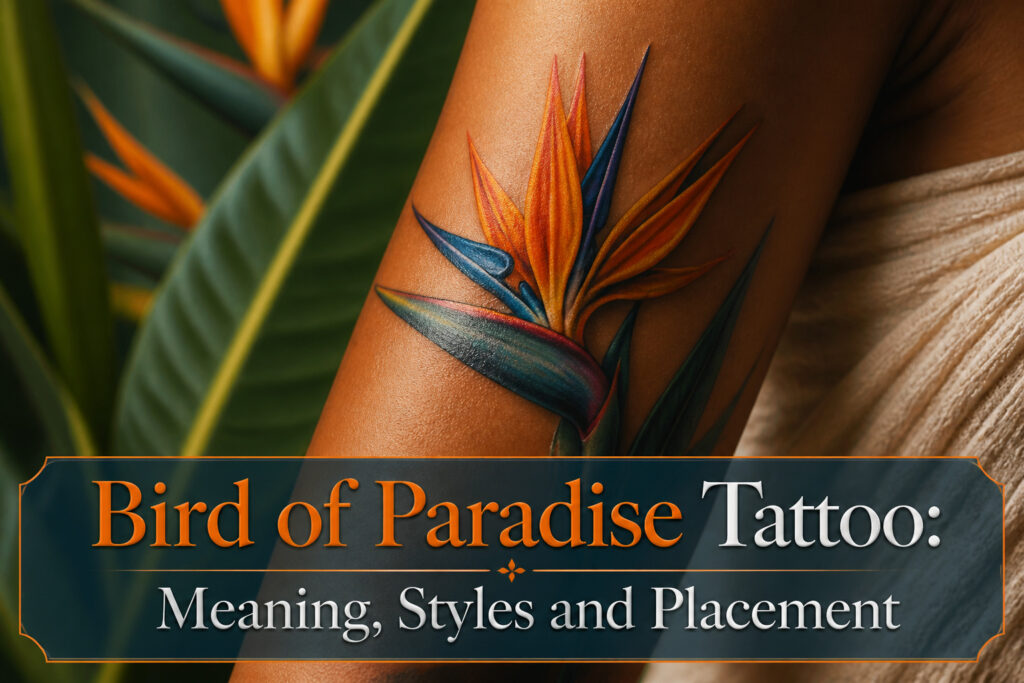
A bird of paradise tattoo is a permanent design of the Strelitzia flower, shaped so precisely like a bird mid-flight that its symbolism of freedom and joy is immediate.
The catch is choosing between that meaning and the style that carries it: a minimalist line drawing at three inches reads as private daily reminder, while a color-realist piece needs ten to twenty inches and multiple sessions to hold the orange and cobalt gradients that make the flower unmistakable.
The Victorians assigned it magnificence; Hawaiian tradition tied its feather-like form to divine power.
What the Bird of Paradise Means
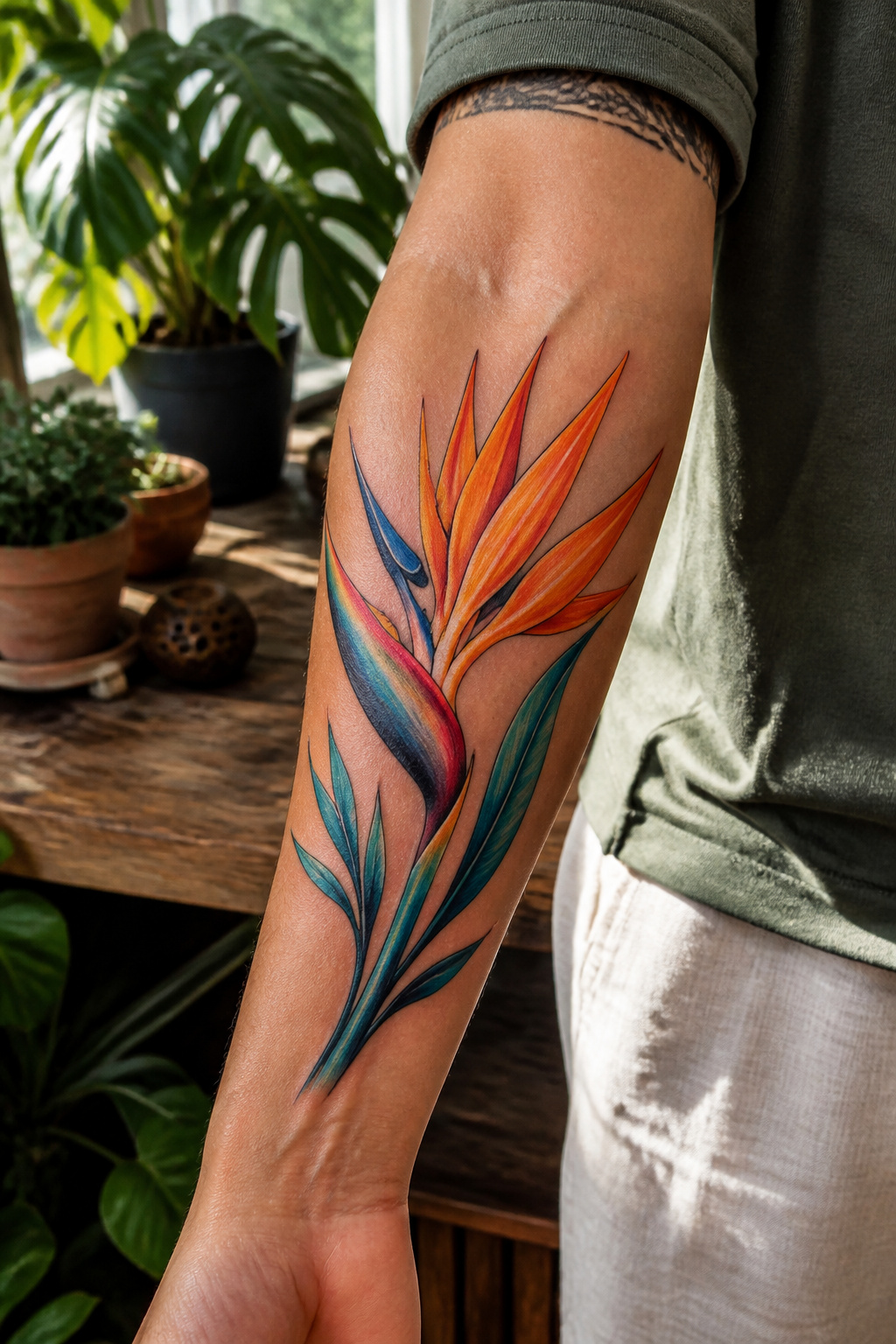
Strelitzia reginae, the scientific name most people skip right past, carries the whole story in its shape. The petals flare like wings mid-beat, and that silhouette is why the flower stands for freedom and the pull toward exploration.
A bird of paradise tattoo draws on that exact reading: the urge to move, to see what is over the next ridge, to refuse the ground.
Joy runs through the symbolism just as strongly. Victorian-era use tied the flower to magnificence, to moments that call for awe rather than restraint.
The celebration angle is not decorative; it is the core reason people choose this image after a hard-won change, a survival, a finally. The flower marks the occasion instead of describing it.
Uniqueness is the third thread, and the trickiest. The bird of paradise is not a quiet bloom.
It demands space, reads as unconventional, and the tattoo borrows that refusal to blend. Individuality here is not the generic kind sold by the dozen.
It is the specific claim that your path, your timing, your version of beauty, is valid without matching anyone else’s.
Two ways to weight this: lean into the joy and celebration if the tattoo marks a moment, or let the flight shape dominate if the meaning is forward motion.
The first reads warmer, the second more restless, and either choice holds up because the flower itself carries both.

🎁【Colorful Flower Bird Themed Tattoos for Kids】Flower Bird tattoos for kids, Use them as party favors and your kids will love. Perfect for flower bird themed party, birthday activities, school reward and other class events. They will be your kids' favorite small gifts.

🐤【15 Sheets in One Package】Distinctive Design Brand FANRUI Temporary Tattoos For Women Kids Girls Adults Teens Lovers Boys Baby Teens Child Daughter Son Children Tattoo Paper 3D DIY Custom Tatoos Cover Body Art Drawings Painting Sets.

Vibrant Watercolor Tattoo Stickers: Bring your skin to life with our stunning collection of 20 watercolor-style tattoo stickers, featuring beautifully designed flowers and birds. Each 57x97mm sticker showcases vibrant colors and artistic details, perfect for adding a touch of nature-inspired elegance to your look.
Where the Symbol Comes From
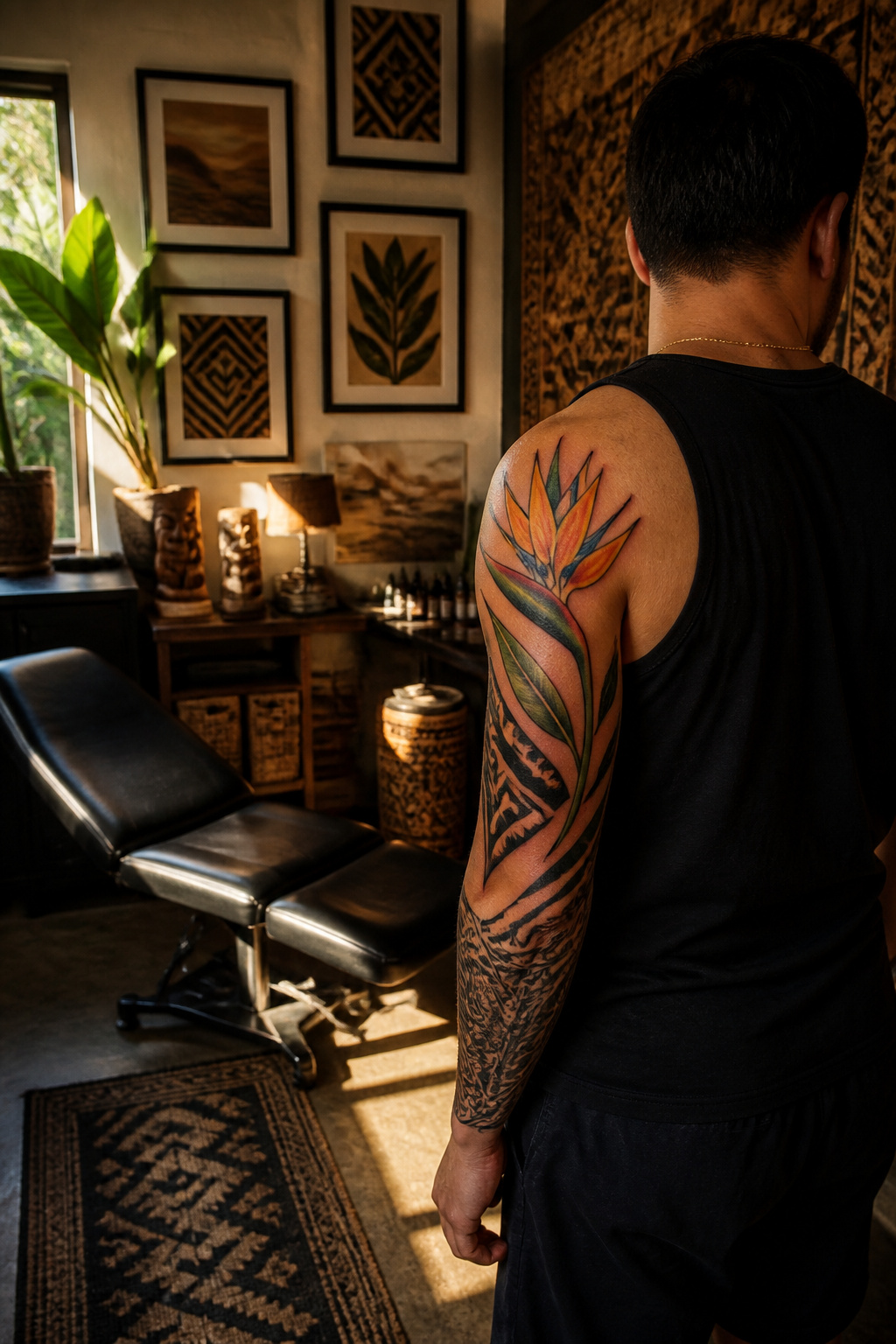
The bird of paradise carries weight from three separate traditions, and each one steers what people ask for at the needle.
In Hawaiian culture, the flower’s shape mirrors the feathers worn by Polynesian royalty.
That resemblance made it a mark of divine power and high status, so a tattoo drawn from this lineage reads as inherited authority rather than borrowed decoration.
The Victorians folded it into their language of flowers, where it stood for magnificence and awe. A client leaning that way usually wants the image to signal admiration for someone else, or a standard they hold themselves to.
Then there is the bird itself. The Raggiana Bird-of-Paradise, Paradisaea raggiana, carries the full weight of national emblem for Papua New Guinea.
Its yellow-orange body and sweeping side plumes appear on the flag. For anyone with a real tie to that country, the Raggiana is the right species to name.
Without that connection, choosing it anyway risks flattening a loaded symbol into mere ornament.

▶ Henna Tattoo Kit: 16 sheets tattoo stencils. airbrush tattoo stencils suitable for tattoo lovers. Experience the effects of tattooing without the pain of tattooing.

Easy Application: Made of durable 3-layer PVC material, these henna tattoo stencils are flexible, waterproof and easy to apply. The self-adhesive design helps keep patterns in place for clean and precise temporary tattoo designs. Does not includ ink

Package Includes: You will receive 20 sheets reusable tattoo stencils, enough quantity to meet your daily requirements. The mehndi stencils are suitable for airbrush painting, glitter tattoo, and so on.
Minimalist Bird of Paradise Tattoo
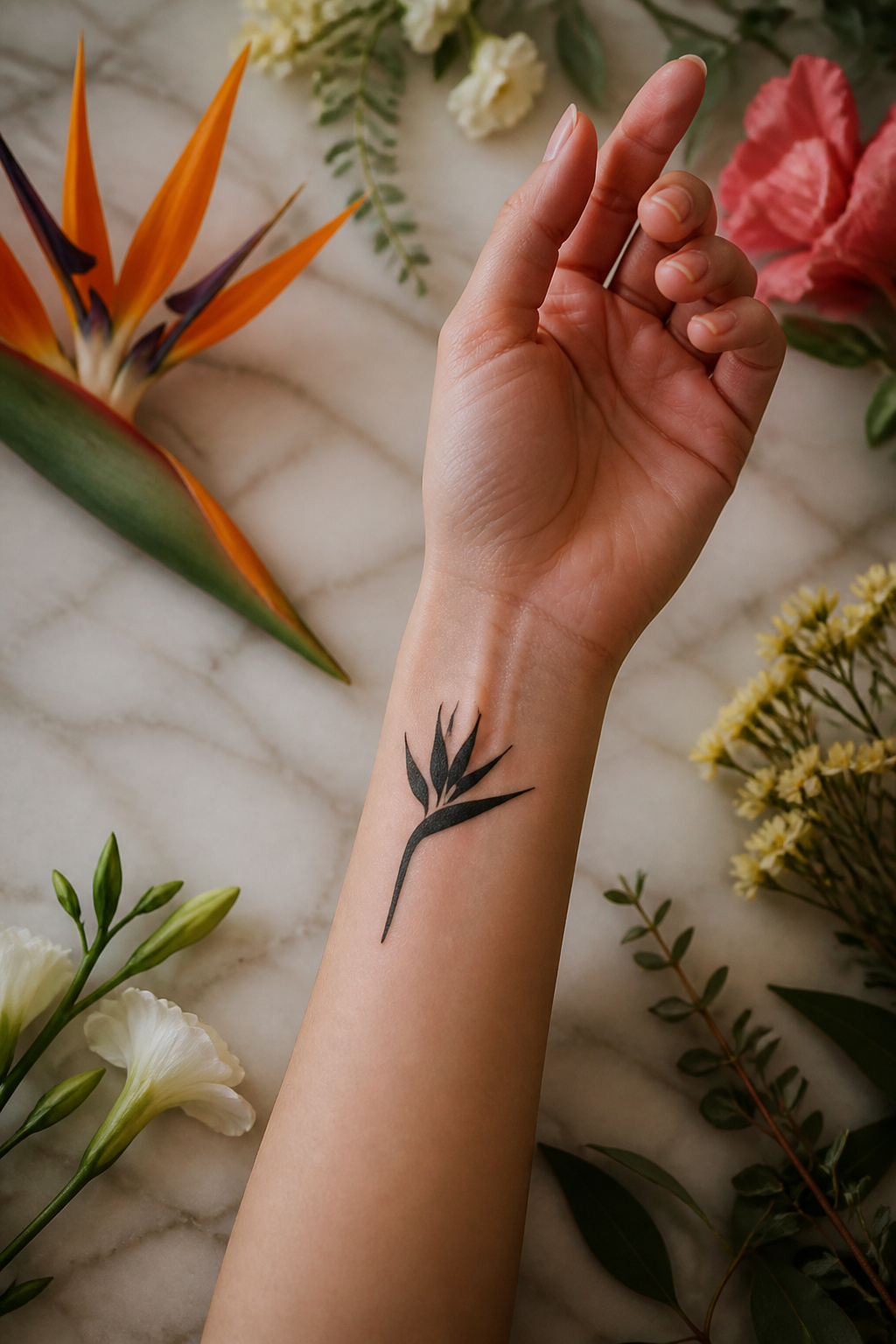
Clean lines and deliberate emptiness do the work in a minimalist bird of paradise tattoo.
The design strips away color gradients, background foliage, and feathered detail until only the essential silhouette remains: a single curved stem, the beak-like bract, and the fan of petals reduced to their geometry.
Negative space becomes part of the drawing itself, letting the un-inked skin stand in for the flower’s more complex layers.
Scale matters more here than in busier styles. The 3–6 inch range is where this approach lives; anything smaller and the flower collapses into an unrecognizable smudge.
Under three inches, only a simplified silhouette survives, and even then the bird form itself does not hold. At 3–6 inches, a fine-line botanical rendering keeps its legibility without demanding the room that neo-traditional or watercolor work requires.
Someone chooses this over fuller versions for practical reasons that hold up over years. A small, discreet piece on an ankle or wrist ages cleanly; there is no packed pigment to blur, no dense black to soften at the edges.
The tattoo reads as a private symbol rather than a statement, a daily glimpse of joy or freedom visible mainly to the wearer.
For women who already curate their routines with care, who read ingredient lists and judge results over claims, the appeal is the same: less that does more, with nothing to hide.

Unframed Prints for your home decor or gifts choice. It comes unframed. We use good archival art paper and great design to ensure highest resolution, clarity and overall quality.
【Natural & Skin-Friendly】Made with plant-based extracts and free from harsh chemicals, UBICA semi permanent tattoos are gentle on all skin types—even sensitive skin. Express yourself without irritation!

Traditional Bird of Paradise Tattoo
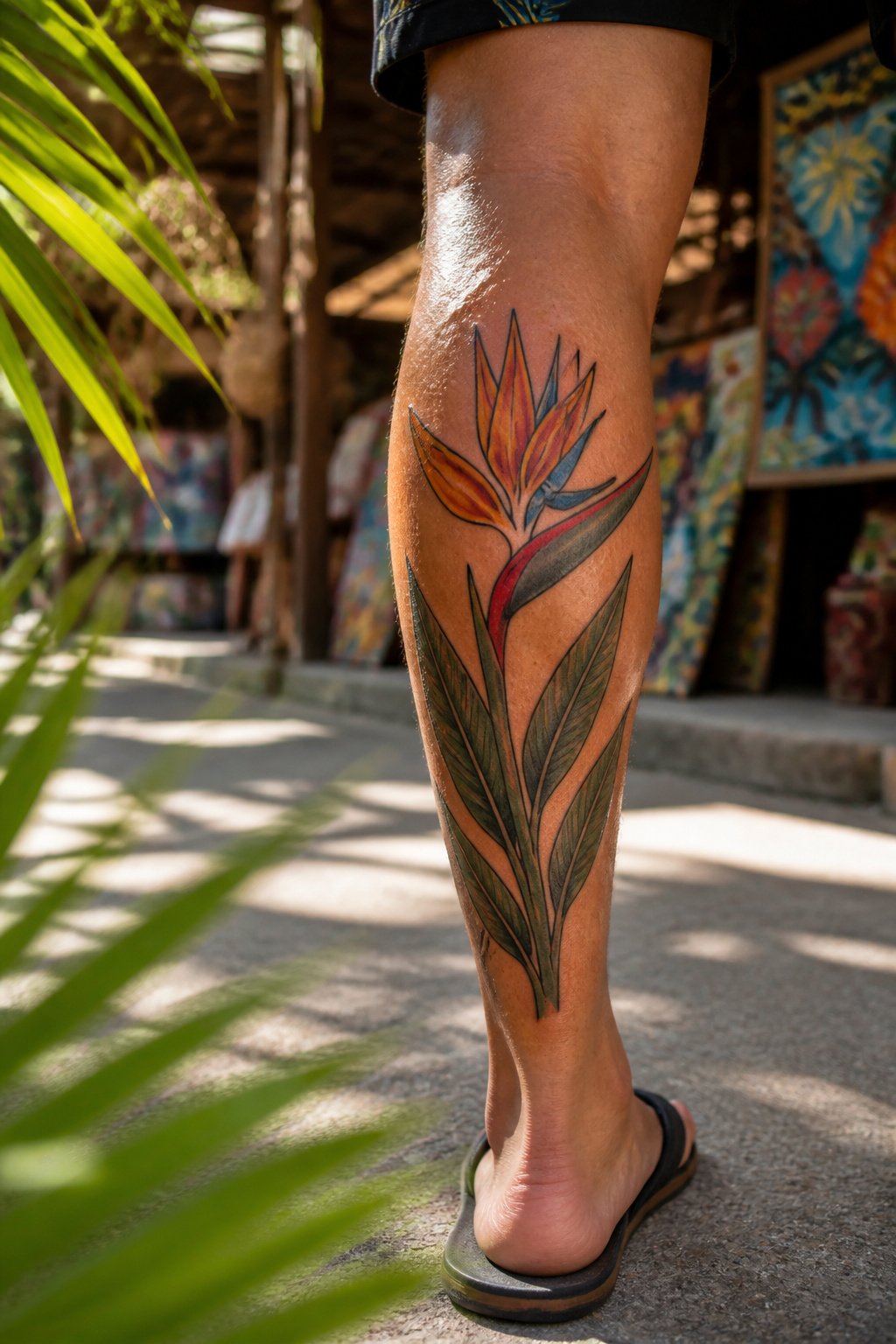
Bold outlines and saturated color are what hold the bird of paradise together in traditional American work.
The style was built for flowers that read from across a room: thick black borders lock the shape in place while orange-to-red gradients and cobalt-to-violet blues do the heavy lifting without muddying. A traditional piece leans on that contrast.
The orange stays hot and declarative, the blue goes deep rather than pastel, and neither color is asked to blend quietly into skin tone.
The emotional weight comes from lineage more than from the flower itself.
Sailor Jerry and the generations after him established this grammar of color and line, so choosing traditional placement, an upper arm or outer calf at five to ten inches, signals participation in that continuity.
Some artists push the green and yellow harder than the old guard would have, letting the bird of paradise read almost as tropical parrot.
The classic move keeps the orange dominant and the blue structural, trusting the black outline to carry the nostalgia.

Bird of Paradise Flower Stencil: Designed for adult crafters and artists, this creative hollow-out plant theme template includes 1PC plastic paint brush. This reusable stencil features a sophisticated bird of paradise flower leaves pattern, a unique design that will inspire your creativity. Please note: This product is intended for ages 14 and above.

Warm Tips: The tattoo transfer paper need to work with transfer medias.You will need to purchase the stencil ointment separately. Apply the design made on the master paper. Please pay attention to press the back side of the pattern to the skin for at least 3 seconds
ADVANCED MATERIAL: Tattoo transfer paper is made with the high quality dyes and stencil paper. Transfer marks are very clear, clean and smooth. Tattoo transfer paper kit come with 35 sheets. Great for tattooing, trace and transfer images onto the body.<br>
Geometric Bird of Paradise Tattoo
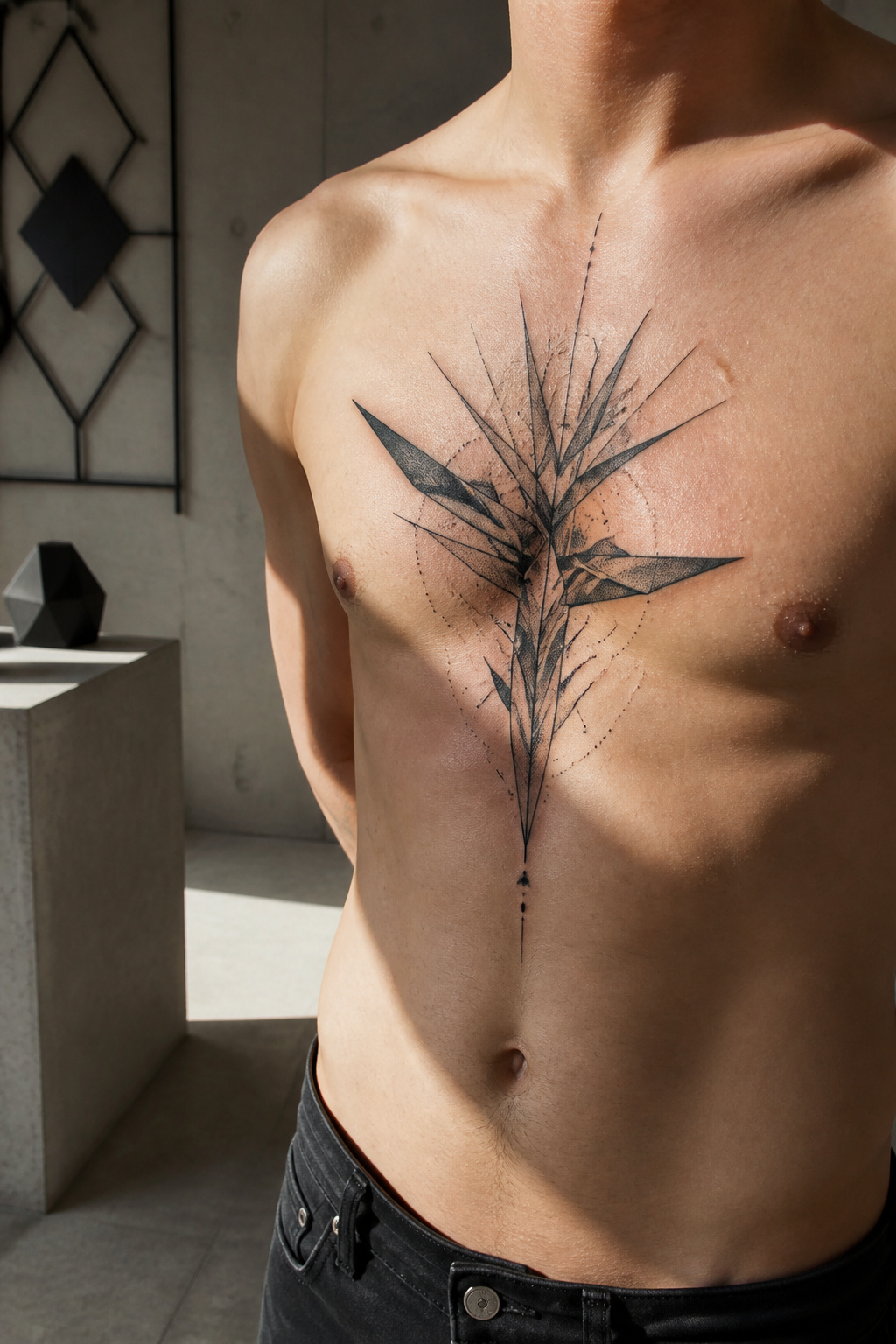
A geometric bird of paradise tattoo breaks the flower into angular planes and measured lines, treating the bloom like an architectural drawing rather than a botanical study.
The style works against the plant’s natural softness: the spiky orange sepals become triangles, the broad leaves turn to tessellated shapes, and the whole thing locks into a grid or radial pattern drawn from sacred geometry.
That tension between organic subject and rigid structure is exactly why the design holds the eye. Your brain expects curves and finds edges; the surprise keeps you looking.
Hairline precision matters here. Black-and-gray or single-tone execution keeps the focus on form rather than color, and the piece reads as engineering rather than nature documentary.
Scale runs small, roughly 3 to 6 inches, with the inner forearm, sternum, or ribcage offering flat planes where the geometry can sit cleanly without wrapping or distorting.
The flower’s natural architecture almost asks for this treatment; the sharp points already suggest triangles waiting to be found.

Innovative Skin-Sync Technology: We don't just sit on the skin; we interact with it. By reacting organically with naturally occurring proteins in your skin's outermost layer (stratum corneum), our plant-based formula magically transforms from a transparent guide into a rich, ultra-realistic navy-black. It looks exactly like a healed, permanent tattoo—without the needles or depth.
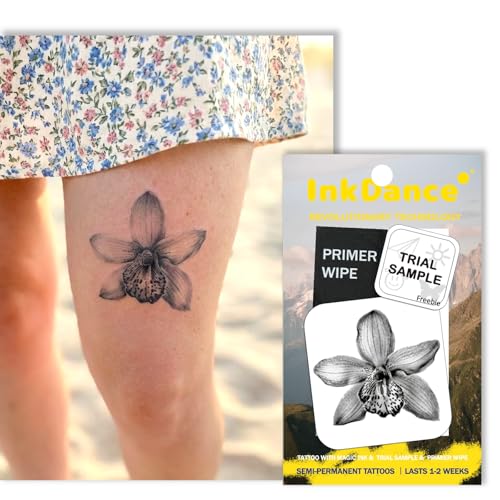
Innovative Skin-Sync Technology: We don't just sit on the skin; we interact with it. By reacting organically with naturally occurring proteins in your skin's outermost layer (stratum corneum), our plant-based formula magically transforms from a transparent guide into a rich, ultra-realistic navy-black. It looks exactly like a healed, permanent tattoo—without the needles or depth.

Amazing Product: Different from you know ordinary temporary tattoo stickers or fake tattoos. It is so real and comparable to the real tattoo. It is a semi-permanent technology, waterproof, friction-resistant, and can last for a long time, staying on your skin for 1-2 weeks.
Tribal Bird of Paradise Tattoo
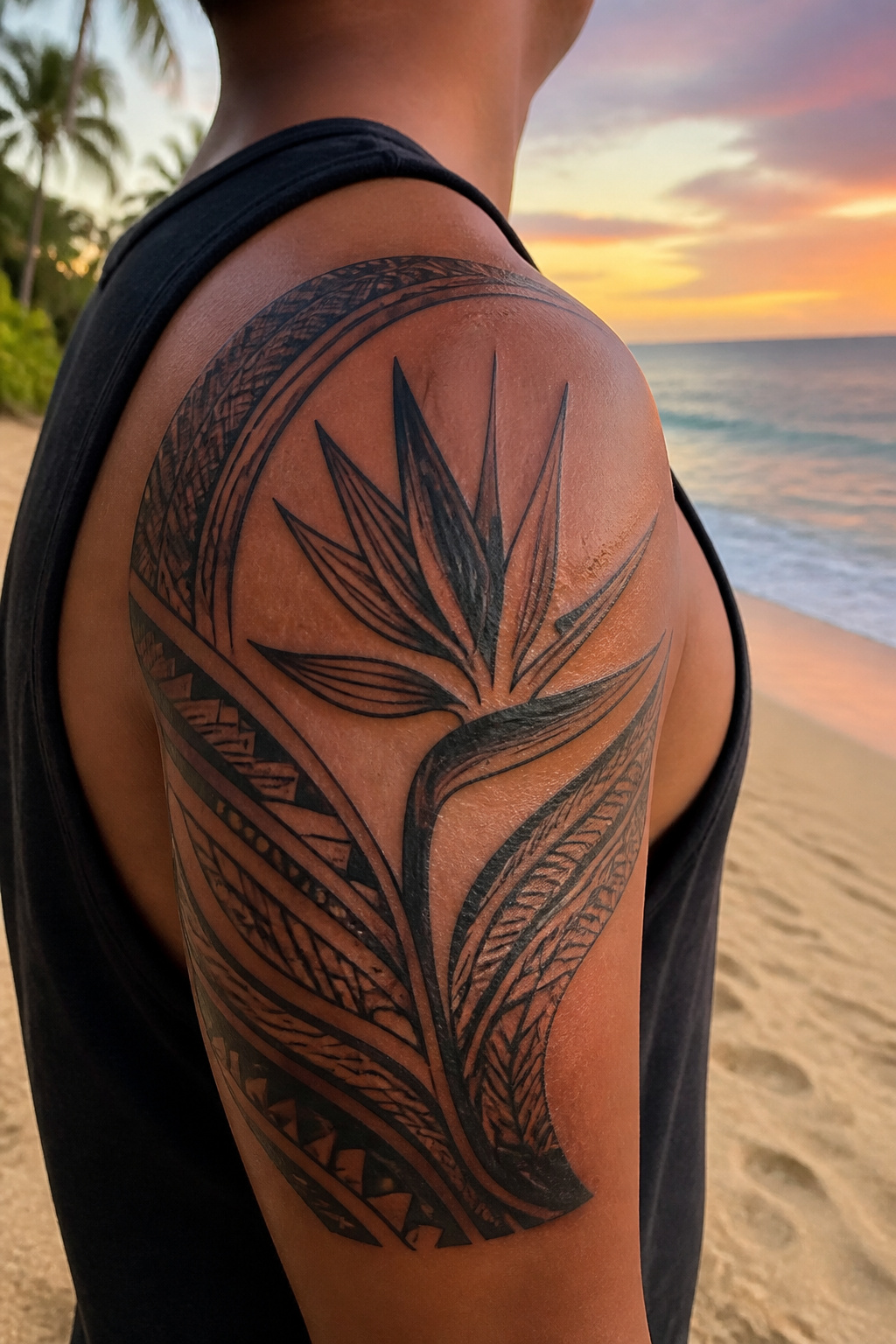
Polynesian and Pacific Islander patterns give the bird of paradise a different lineage than the botanical styles most people book.
The flower’s shape already echoes the feathered regalia of Hawaiian royalty, and tattoo artists working in this tradition lean into that overlap rather than fight it.
The silhouette matters more than the color. Blackwork builds the form, with negative space doing the work that orange and blue would handle in a realistic piece.
Thick bands and repeating triangles frame the bloom; the eye reads the flower because the skin left open shapes its edges. What reads as background is actually the subject breathing through the pattern.
Hawaiian royal symbolism connects here through that feather resemblance. The flower stood for divine status and power in that context, so a tribal piece carries weight a decorative sleeve does not.
The person wearing it should know that history, because the style invites questions the watercolor version does not.
Negative space also solves a practical problem. Solid black Polynesian work ages better than fine-line color, and the bird of paradise form stays readable at smaller sizes when the design is built from absence rather than packed pigment.
The trade is the same as any tribal choice: this reads as cultural reference, not casual ornament, and the commitment runs deeper than the sitting.
[LARGE SIZE & LARGE QUANTITY] Large size flowers collection tattoo stickers can cover your body parts larger, size is 9.45 * 5.35 inch (24 * 13.6cm) 10 sheets, 3.9 * 2.3 inch (9.8 * 5.8cm) 30 sheets .You can share it with your family and friends

🌲 Beautiful Hand-drawn Nature Tattoos - Black and White Illustrative and Fine Line Style of Flowers, Branches, Trees, Birds, Butterflies, Bees, and More.

Colorful Flower Bird Tattoo Stickers : 10 sheets bird fake tattoos contain 35 pcs unique styles, showing both cute and energetic styles. The delicate patterns are popular with many people
Realistic Bird of Paradise Tattoo
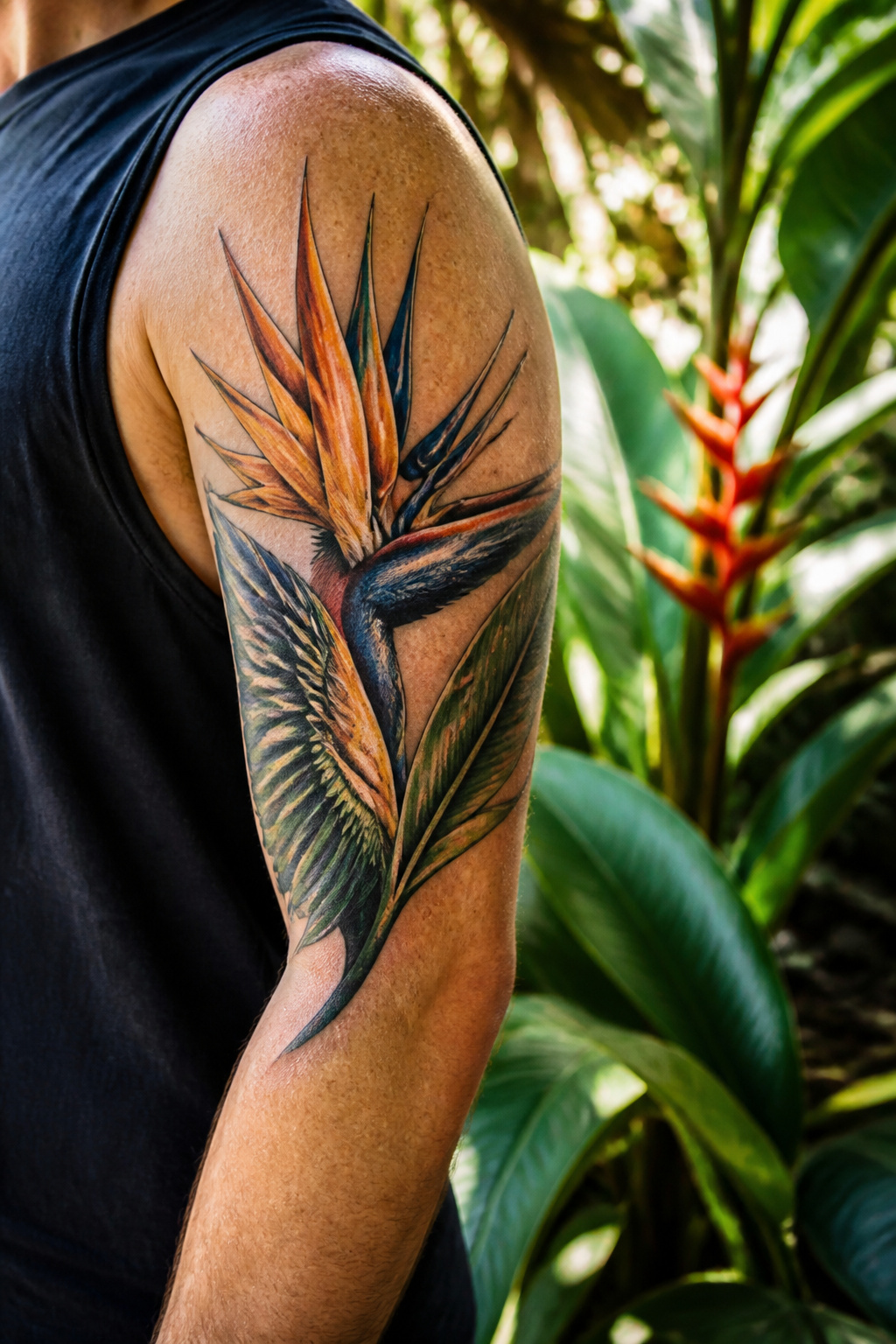
Photorealistic rendering of a bird of paradise tattoo means the plumage carries color gradation so smooth the feathers look lit from within, not stamped on.
Botanical accuracy matters here because the bird’s structure is unmistakable even at a glance, and a misread wing or flattened crown ruins the recognition. This style needs 10 to 20 inches to hold that detail.
Anything smaller and the fine barbs collapse into muddy patches; the sources mark the 10-inch threshold as where full-color bird realism actually begins.
The sitting commitment is serious. Multiple sessions, heavy saturation, skin that stays irritated longer than a black-and-gray piece.
Not every color-realist artist handles this subject well, even if their portraits are strong. What convinced me, reading through the portfolios, is to look specifically for healed photos of birds or comparable plumage, not just fresh work under studio lights.
Ask to see how the oranges and cobalt held up at six months. If the artist deflects or has none, that is the answer.

[Tattoos Stencils Kit]: 24 sheets, each sheet including 4 patterns total 96pcs tattoo stencil. Which featuring Playing card patterns, flowers, lizards, scorpions, rabbits, spiders, butterflies, geckos, small birds, insects, hearts, stars, abstract and tribal motifs and more tattoo designs, enough quantity and different pattern for you create your style.

142+ Nature-Inspired Tattoos Stencil Designs in 12 Sheets: This temporay tattoo template set features over 142 unique, delicate designs centered on enchanting botanical and natural elements. Discover a vast collection of flowers (daisies, roses, sunflowers, lavender), intricate leaves, winding stems, complete bouquets, elegant wreaths, crowns, bees, and butterflies. Perfect for creating floral temporary tattoos, henna-inspired patterns, and nature-themed body art.

【 575+ Fun Assorted Tattoo Stencils 】-The ChurlChurl tattoo stencils collection includes 575 high quality stencils with multiple themes. enjoy cute trendy tattoo stencil designs like butterflies, words, flowers, symbols, totem, Egypt style patterns and more.
Bird of Paradise Plant Tattoo
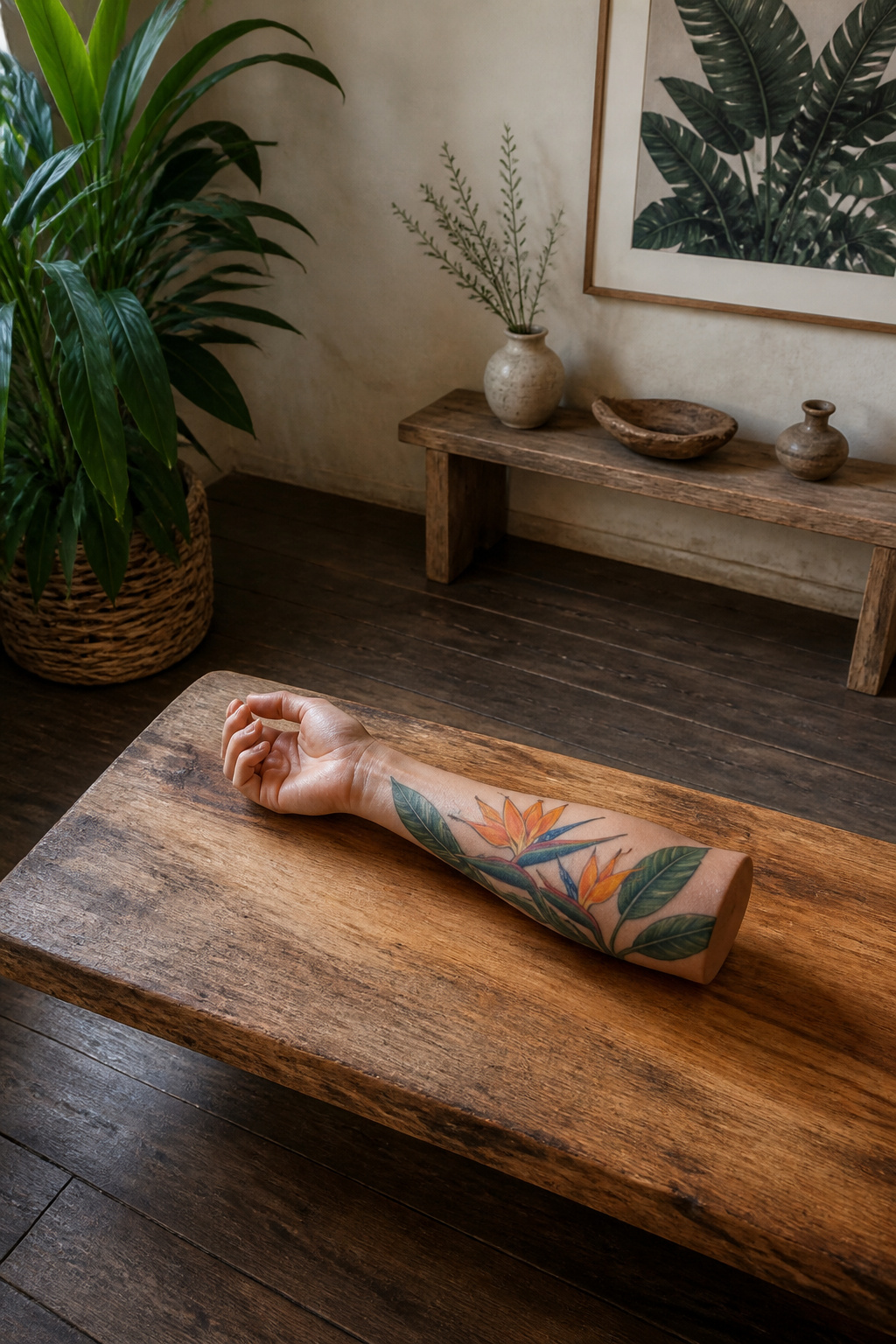
A full bird of paradise plant carries weight that the flower alone never manages. The broad, paddle-shaped leaves and thick stem create an architectural silhouette that reads from across a room, not just arm’s length.
Where a single bloom can feel like an accent, the whole plant becomes a statement piece that justifies the real estate of a thigh, a rib panel, or the full length of a forearm.
Color work here runs deeper than the flower head. Sources describe gradients of green across those leaves, the blue and orange tucked among the bracts, the whole thing building what amounts to a small slice of tropical landscape.
That depth is what draws people to the plant over the bloom: the flower is the exclamation point, but the leaves are the sentence that gives it meaning.
Larger placements suit this design almost by necessity. The stem needs room to show its structure, the leaves their fan and droop.
Compress it too small and you lose the very presence that makes the choice interesting. Someone committed to the bird of paradise tattoo as a plant rather than a motif is usually committed to scale as well.

HOW TO SET THE TONE of your room? How about from the walls out with this unframed france country vintage art set. This 5 pieces print set consists of 3 8x10" and 2 5x7" art prints. Its eclectic themes range from nature landscape, meadow, botanical study to plant drawing. The art set will add a personal flair to your rustic farmhouse or bohemian home. This sage green wall art will be the focal point of your space, inspire conversation when friends visit your home!


Includes:168 packs of parrot theme tattoos temporary, the number is enough to meet your needs and they can let you get an impressive happy party.
Bird of Paradise Flower Tattoo
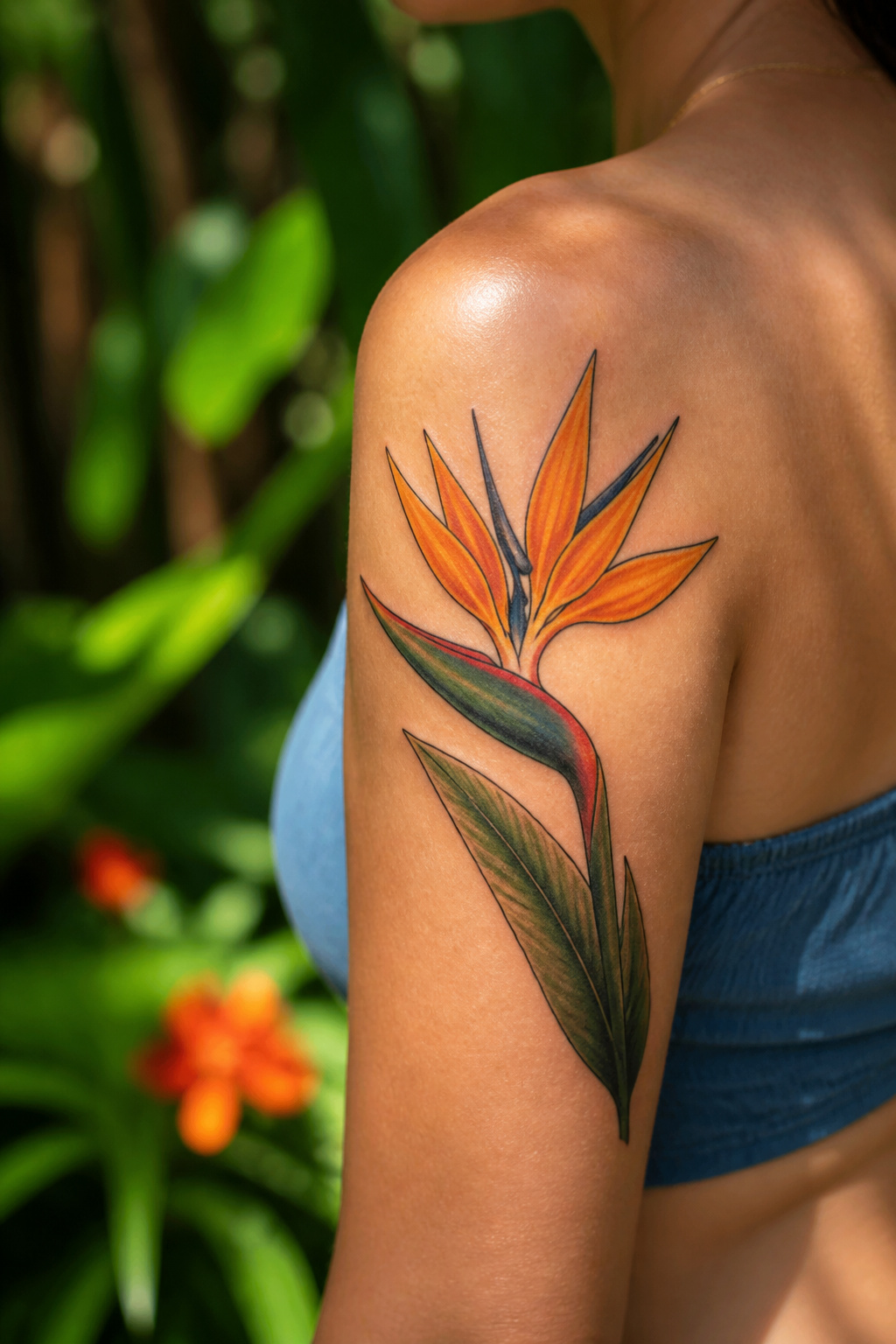
The bird of paradise flower tattoo strips the plant down to its most recognizable moment: the spathe and petals forming that sharp, crested profile everyone reads as a bird mid-takeoff.
This is the version most people choose, and the reason is practical.
The full plant crowds the design with stems and leaves that do not add meaning; the bloom alone keeps the shape bold at any scale, from a two-inch wrist piece to something sprawling across a shoulder.
Color does the heavy lifting here. The orange and blue of a Strelitzia reginae, or the softer white and blue of Strelitzia nicolai, give the petals depth that black line alone cannot fake.
A clean black outline contains those shades and keeps the silhouette readable from across a room. Without it, the colors can bleed together into a shapeless bright spot in five years.
Black-and-white works too, but the tradeoff is real. You lose the tropical punch and rely entirely on the geometry of the spathe.
That unique bird-like angle still carries the design, though, which is why the flower tattoo survives as a standalone choice where a full plant might feel like botanical illustration instead of body art.

Spirit Tattoo Classic Thermal Transfer Paper, 8.5” X11” (100 Sheets): Established since 1946, the original and trusted choice of tattoo artists globally, offering reliability and consistency in tattoo stencil creation.

🔍 Precision Industry-Standard Transfer - Engineered 4-ply stencil paper (8.25"x11.75") with high-density dyes delivers defined lines for intricate tattoo stencils. Compatible with major thermal printers for reliable tattoo transfer paper workflows.

【 761+ Fun Assorted Tattoo Stencils 】-The ChurlChurl tattoo stencils collection includes 761 high quality stencils with multiple themes. enjoy cute trendy tattoo stencil designs like butterflies, words, flowers, symbols, totem, Egypt style patterns and more.
Black and White Bird of Paradise Tattoo
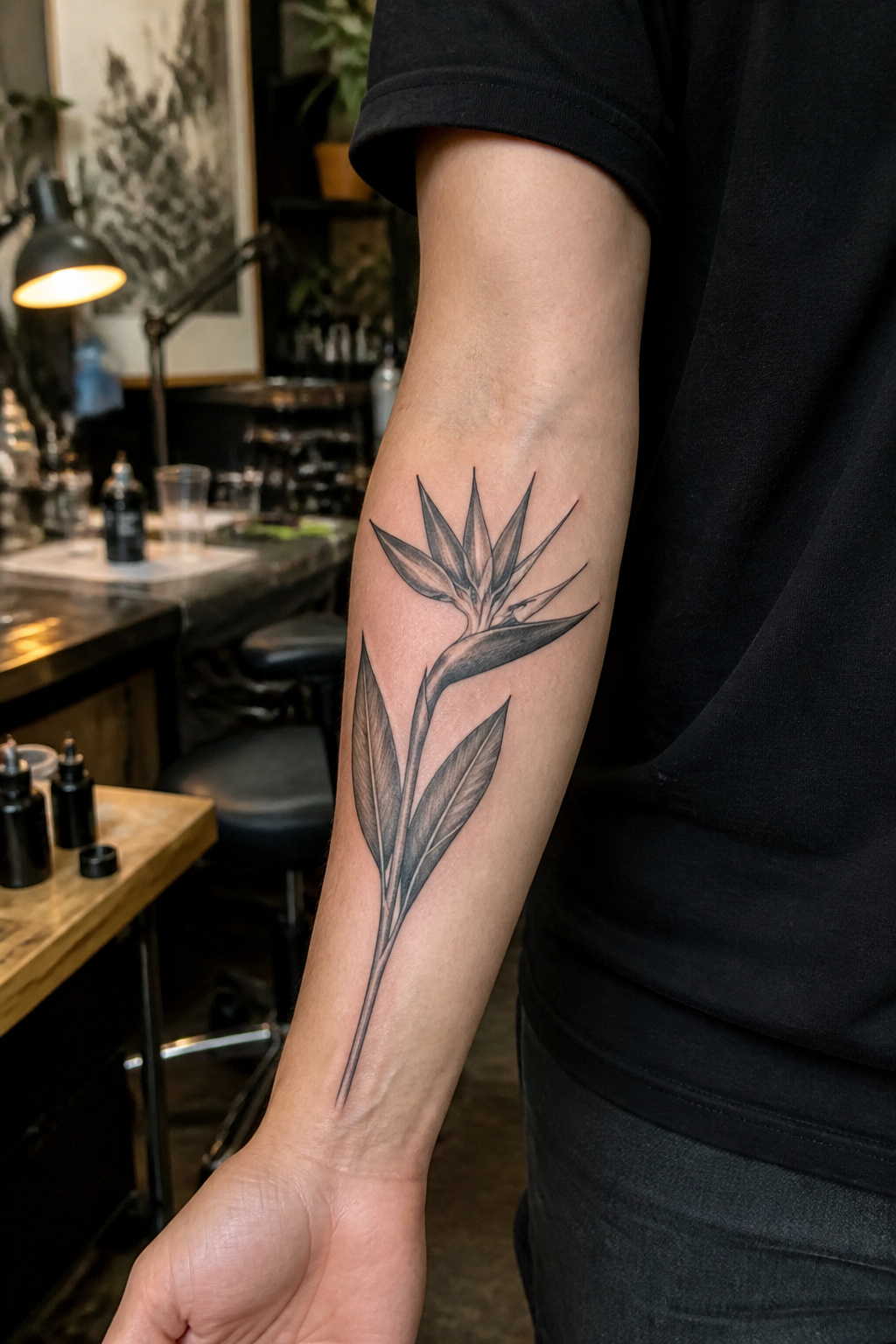
Stripping the orange and blue from a bird of paradise tattoo leaves the artist with only shading and contrast to carry the whole design.
The gradient in ink dispersal has to do the work that color usually handles, building depth through black fill and careful gradation rather than relying on the flower’s natural tropical palette.
What shifts is the mood: the design moves from exuberant and vacation-bright to something more subdued, almost architectural.
A black and grey palette also carries a practical advantage in longevity. Color saturation fades faster under sun exposure, and the touch-ups that keep orange vivid are more frequent than most people budget for.
Greyscale holds its value over years of daily UV exposure, especially on spots like the wrist where the tattoo stays visible and unprotected by clothing.
The tradeoff is the loss of that immediate tropical reading; someone seeing it from across a room might read it as abstract foliage before they recognize the specific flower.
For wearers who want the symbolism without the resort-wear brightness, that subdued register is the point.
Watercolor Bird of Paradise Tattoo
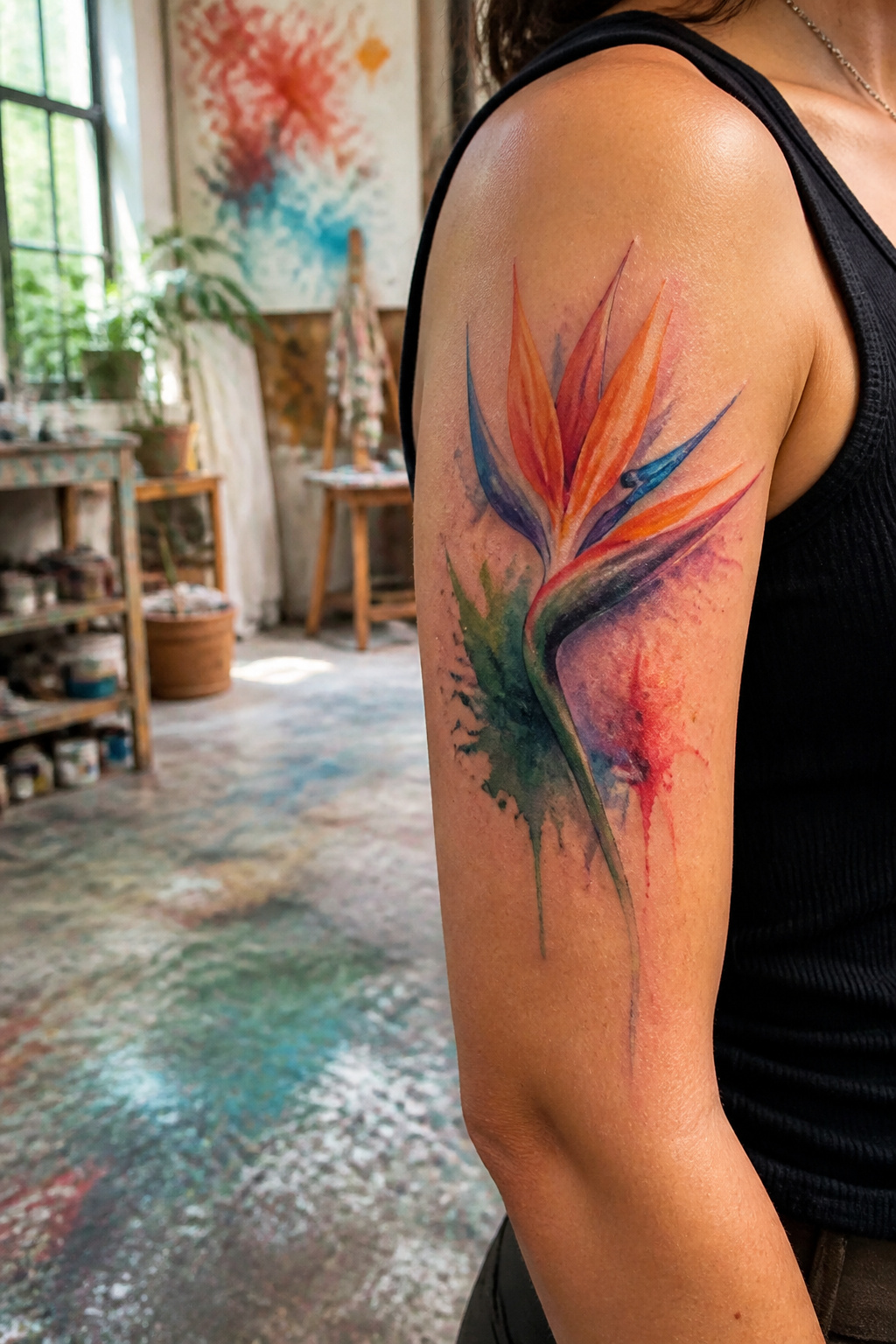
A watercolor bird of paradise tattoo drops the black outline entirely and builds the flower from splatter and bleed techniques instead.
The orange and blue already sit at the saturation levels of actual watercolor pigment, so the style and the subject share the same visual logic: one mimics the other without either one working very hard to get there.
The painterly effect comes from letting the color pool and fade at the edges, the way a wash does on cold-press paper.
The fade risk is real. Without a dark anchor line to hold the shape, the softer pigments drift and soften faster than line-anchored work.
Most of this style needs maintenance within five years. The typical scale runs 5–8 inches, large enough for the color to breathe but small enough to control the bleed.
Upper arm, thigh, or outer forearm give the flat surface the technique needs.
Bird of Paradise with Other Elements
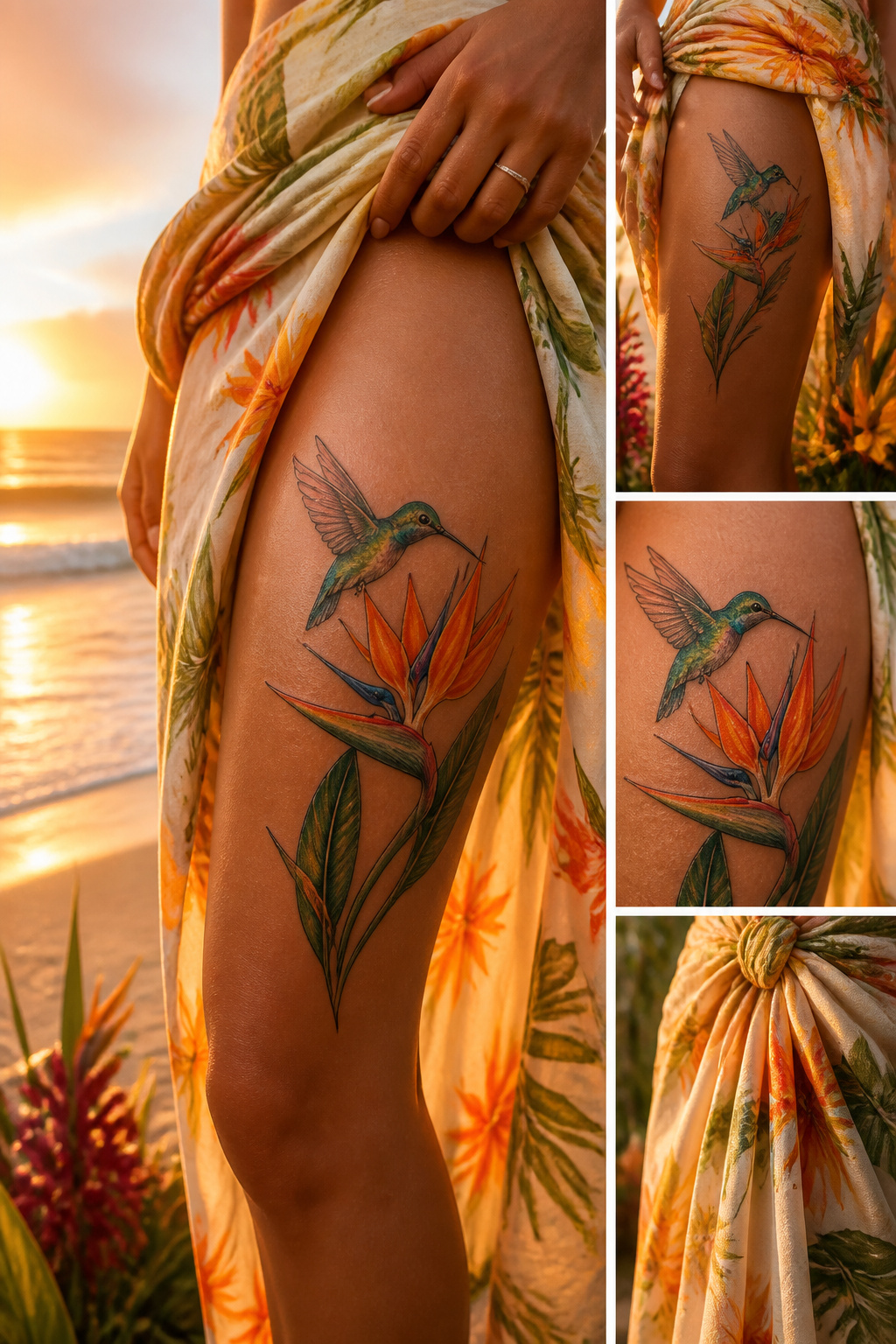
A bird of paradise tattoo paired with a hummingbird tightens the focus on motion and appetite for life, the two shapes competing for nectar in a way that reads as restless energy rather than stillness.
The same flower beside a butterfly softens that urgency into transformation, the insect’s brief lifespan against the bloom’s longer season.
Calla lilies shift the tone toward something more private. Where the bird of paradise broadcasts joy openly, the lily’s association with purity and rebirth turns the design inward, making personal transformation the readable message rather than public celebration.
An elephant anchors it further, the flower’s tropical flightiness weighted by memory and endurance.
Wildflowers keep things loose and informal, a scattered composition that refuses the formality of a single focal point.
Hibiscus doubles down on the tropical identity, the dense reds and oranges building what one LA shop builds into larger civic pieces: palm, monstera, and the bird of paradise flower as a regional signature worn on skin.
The phoenix raises the stakes to full myth, the flower’s natural beauty overtaken by fire and return, a pairing that risks melodrama unless the linework restrains it.
Where to Place It
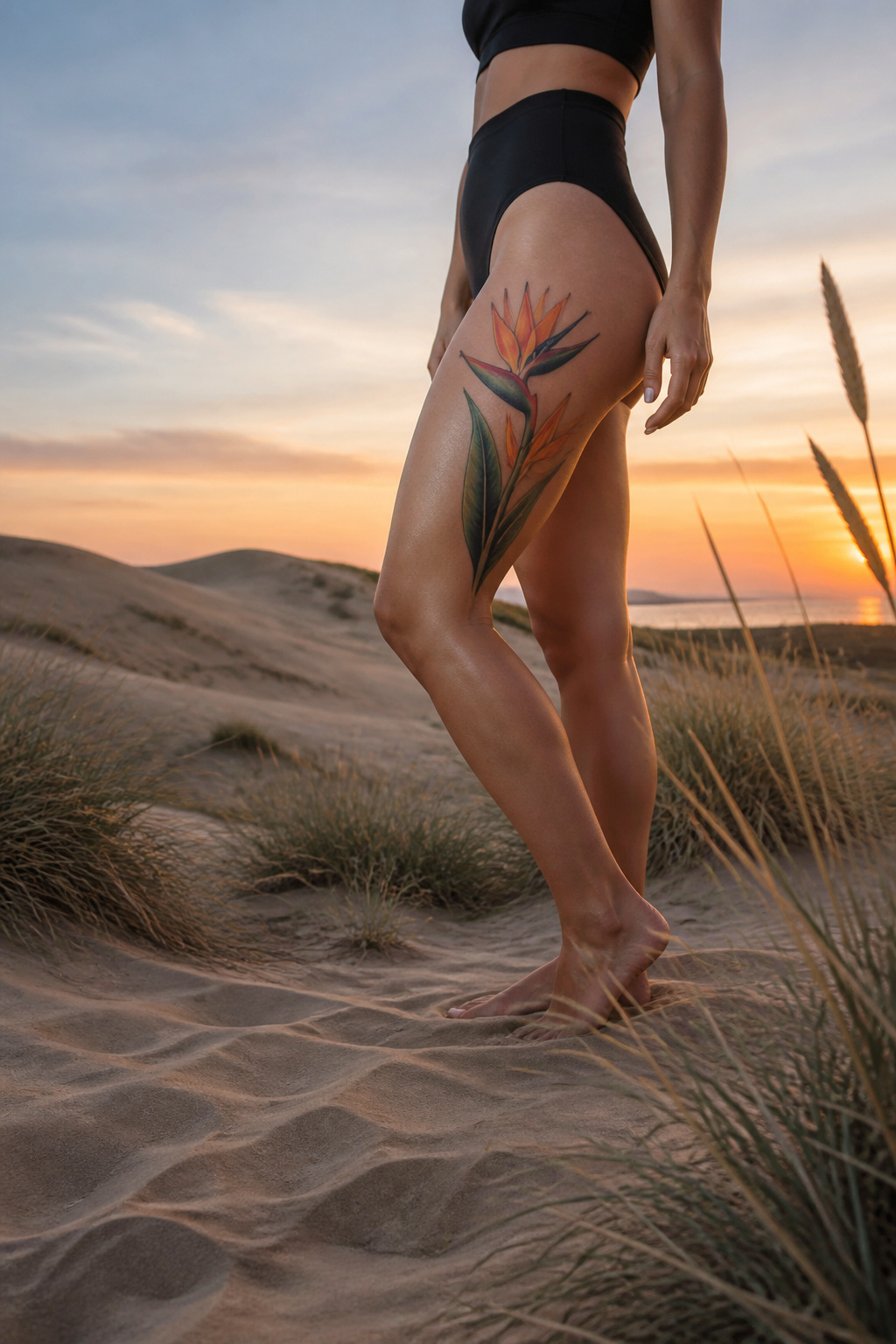
The forearm keeps a bird of paradise design in constant view, which makes it a natural fit for anyone who wants the piece to read as a deliberate statement. Thigh and ankle sit at opposite ends of that same choice.
The thigh stays hidden under most daily clothing but opens up for beach weekends or gym sessions; a piece there can run 10–20 inches without fighting the body’s curves.
An ankle placement forces the design small and turns it into a private detail, visible mainly to the wearer and only occasionally to anyone else.
Size dictates placement more than most people expect at first. A 3–6 inch design flattens on a large canvas; the lines crowd together and the flower’s distinctive shape loses its impact.
At that scale, ankle or inner forearm keeps the proportions honest. Stretch to 10–20 inches and the thigh or outer forearm gives the petals room to open fully.
The bird of paradise’s natural silhouette also points the way. Its elongated stem and jutting petals read vertically; rotating the same design ninety degrees to wrap a wrist or collarbone fights the form.
Horizontal placements work only when the artist restructures the composition entirely, building sideways from a central bloom rather than hanging it from a stem. That redesign is possible, but it is not the same tattoo.
Picking the Right Artist
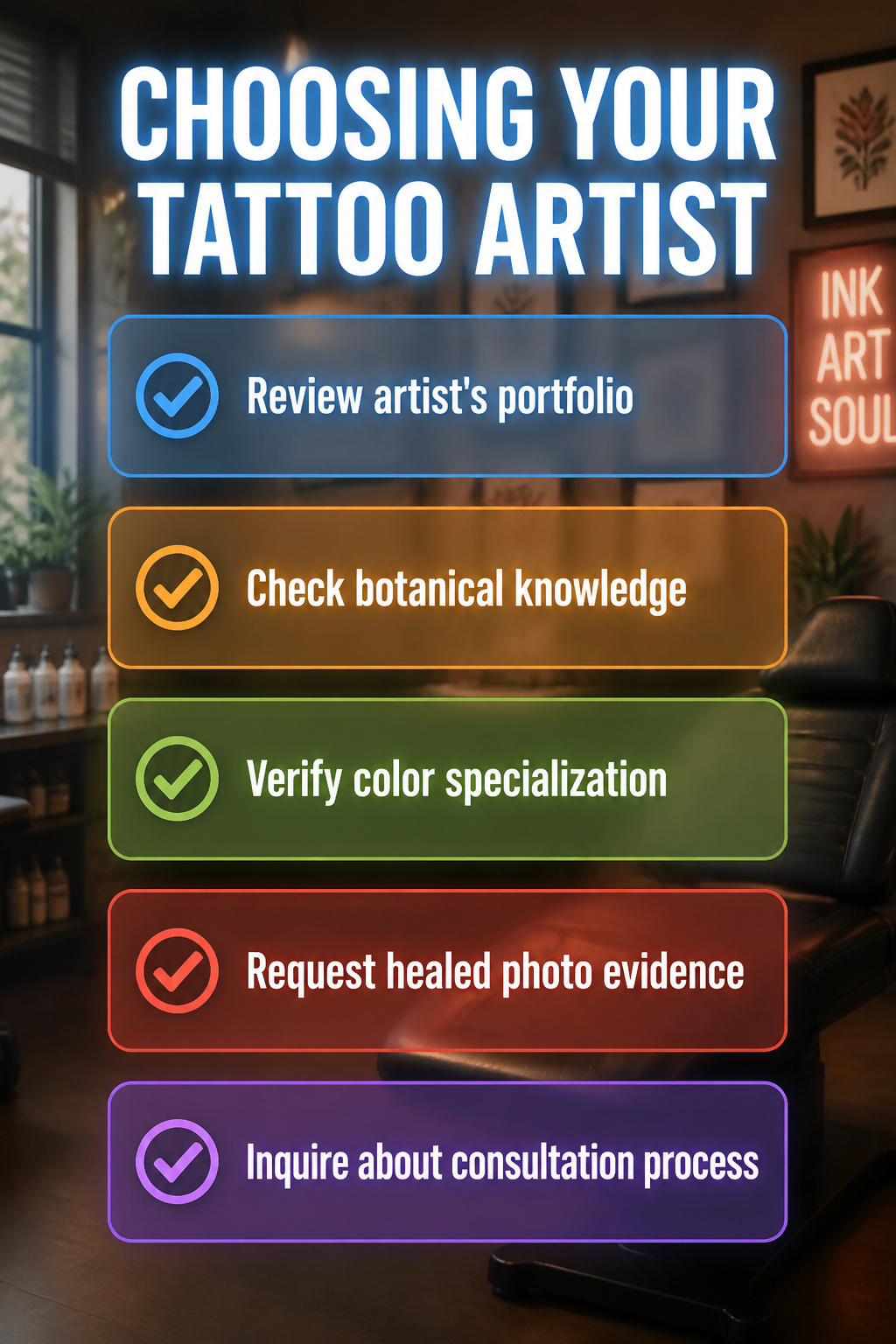
A portfolio tells you more than a price list ever will.
When I flipped through artists for my own piece, the ones who got the flower right had one thing in common: pages of living plants, not just flash sheets of roses and skulls.
The bird of paradise has a specific architecture, those pointed bracts fanning out like a crane’s wing, and an artist who has studied botanical illustration knows the veins run parallel, not netted like a maple leaf.
Generalists can copy a photograph. Someone with color specialization understands how orange shifts to vermillion where the light hits, and how much pigment density that particular saturation demands.
I learned the hard way that bright tropical colors fade fast on skin that sees sun; a color specialist will plan for that in the saturation mix, not just match the reference photo and hope.
The consultation matters more than most people treat it. Ask how they handle the transition from the flower’s hard orange to the softer yellow.
Ask to see a healed photo of a similar piece, not just the fresh one. If they only have fresh work to show, or if they change the subject when you ask about color longevity, that is your answer.
A healed photo from six months out is the only proof that matters.
Keeping the Color Alive
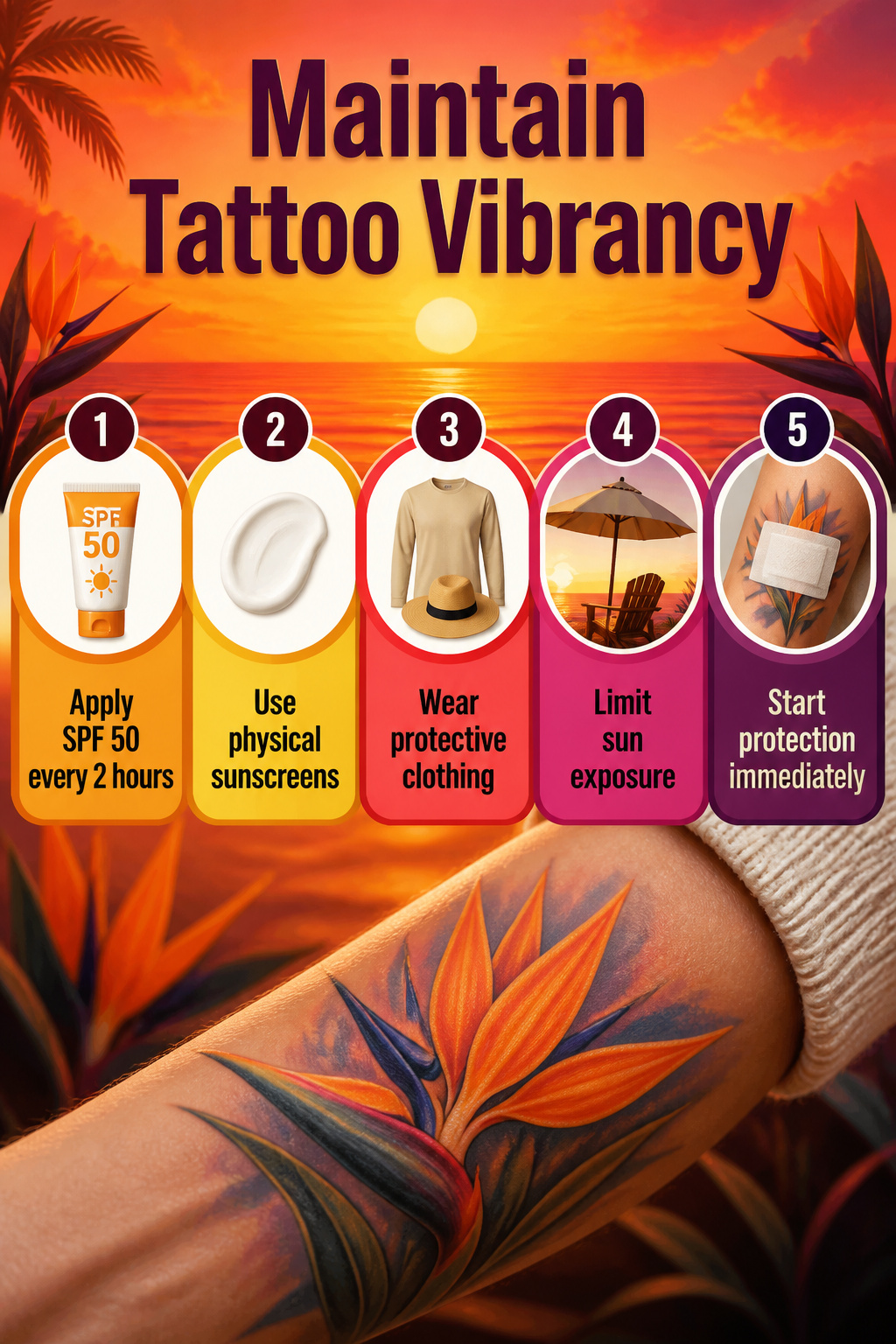
Vivid orange and deep blue are the first colors to fade under sun exposure, and a bird of paradise tattoo leans on both.
No aftercare product brings pigment back once it is gone; the best any balm or moisturizer does is slow the loss. Sunscreen matters more than anything in your cabinet.
I reapply SPF 50 to mine every two hours when I am outside, the same cadence I use for my face.
The neck and forearm, common placements for this design, catch incidental light during driving and walking that adds up faster than a beach afternoon.
A physical block with zinc oxide sits on top of the skin rather than sinking in, which means less interaction with the ink itself. Hats and long sleeves do what lotion cannot when the UV index climbs past six.
The fading is not failure; it is chemistry, and managing it starts the day the bandage comes off.
Frequently Asked Questions
What does a bird of paradise tattoo symbolize?
The tattoo stands for freedom and the pull toward exploration, joy and celebration after hard-won change, and a specific claim to individuality rather than generic uniqueness.
The flower’s wing-like petals carry all three meanings at once, so you can lean warmer by emphasizing the celebration or more restless by letting the flight shape dominate.
What are the different styles of bird of paradise tattoos?
The article covers minimalist, traditional American, geometric, tribal, realistic, watercolor, black and white, and full plant or flower-only versions.
Each style changes what the image says: clean lines read private and discreet, bold outlines with saturated color read nostalgic and declarative, and watercolor drops the black anchor entirely for a painterly effect that needs more maintenance.
How should I choose the placement for my bird of paradise tattoo?
Match size to body area and respect the flower’s natural vertical silhouette. A 3–6 inch piece fits ankle or inner forearm; 10–20 inches needs thigh or outer forearm to keep proportions honest.
The elongated stem and jutting petals read vertically, so horizontal placements only work if the artist restructures the entire composition.
What does a bird of paradise tattoo mean in Hawaiian culture?
The flower’s shape mirrors feathers worn by Polynesian royalty, making it a mark of divine power and high status rather than borrowed decoration.
A tribal piece built in this lineage carries that weight and invites questions a decorative watercolor version does not.
How big should a realistic bird of paradise tattoo be?
Plan for 10 to 20 inches. Anything smaller and the fine barbs of photorealistic plumage collapse into muddy patches; full-color bird realism needs that threshold to hold detail.
The sitting commitment runs multiple sessions with heavy saturation and longer healing than black-and-gray work.
How do I keep the colors in a bird of paradise tattoo from fading?
Sunscreen matters more than any aftercare product, since no balm brings pigment back once it is gone. Reapply SPF 50 every two hours outside, especially on neck and forearm placements that catch incidental light during driving and walking.
A physical block with zinc oxide sits on top of skin rather than sinking in, meaning less interaction with the ink itself.
What should I look for when picking an artist for a bird of paradise tattoo?
Ask to see healed photos of similar pieces from six months out, not just fresh work under studio lights. A color specialist will plan saturation mix for longevity rather than matching a reference photo and hoping.
If the artist deflects when you ask about color longevity or has no healed bird or plumage work to show, that is your answer.
Can a bird of paradise tattoo work without color?
Yes, but the mood shifts from exuberant and tropical to something more subdued and architectural.
Black and grey relies on gradient in ink dispersal to build depth, and the tradeoff is that someone across a room might read abstract foliage before recognizing the specific flower.
The practical advantage is longevity, since greyscale holds up better under years of UV exposure than vivid orange and deep blue.
What elements pair well with a bird of paradise tattoo?
A hummingbird tightens the focus on restless motion, a butterfly softens it into transformation, calla lilies turn the message inward toward personal rebirth, and an elephant adds weight through memory and endurance.
Hibiscus doubles the tropical identity, while a phoenix risks melodrama unless restrained linework keeps the mythic pairing in check.