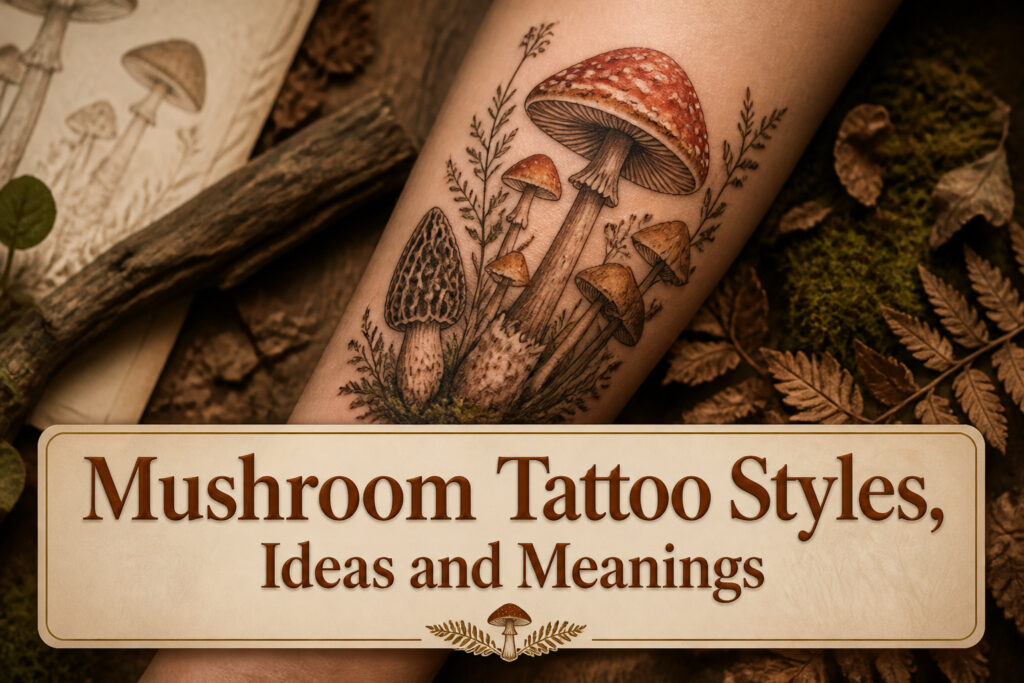
The right mushroom tattoo depends on where you want the detail to hold and how much daily fading you will tolerate. A tiny Amanita muscaria behind the ear reads differently than a six-inch morel on the calf, and the choice between them usually comes down to whether you need the image to pass as botanical truth or as fairy-tale signal.
What few first-timers expect is how fast fine lines blur on fingers and ribs compared to the shoulder blade’s flat plane, where a small cap-and-stem silhouette stays legible for years. Over 50,000 mushroom species exist, and the foragers among your future viewers will notice if an artist gets the gill structure wrong.
1. Small Mushroom Tattoo
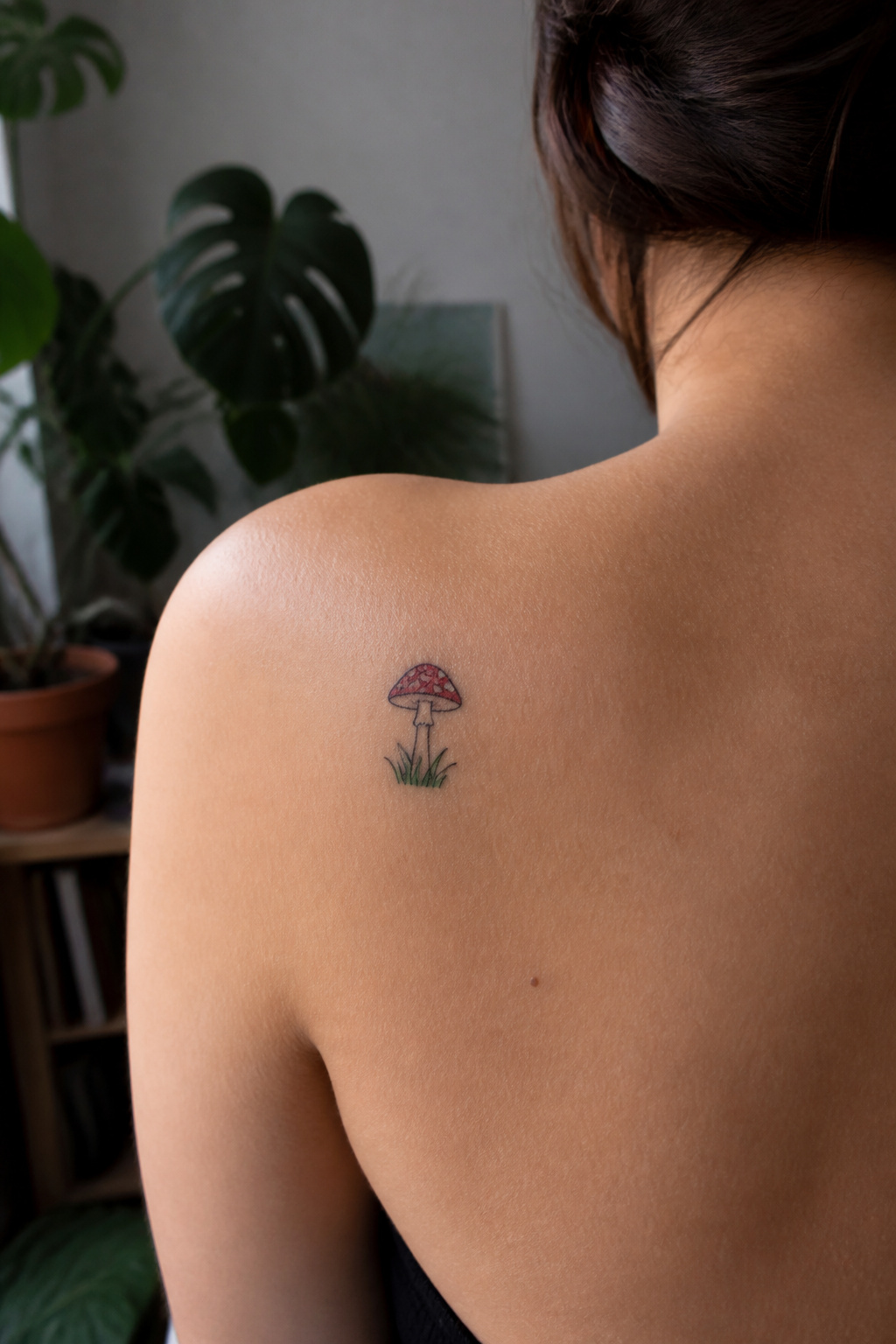
A small mushroom tattoo sits naturally at the back of the shoulder, where the flat plane of the blade gives the design room to breathe without distortion. The cap-and-stem silhouette reads cleanly there, and the placement lets you show it or cover it with a strap width of difference.
For small-scale work, the shoulder blade has two practical advantages over spots like the ankle or behind the ear. Skin there sees less daily flexing than a wrist or finger, so fine lines hold their definition longer. And the natural curve of the muscle creates a gentle frame rather than forcing the artist to distort the shape to fit.
Color behaves differently at this scale. A faded red cap with dark black outline and white spots, stem rising from green grass, all of that fits within a few inches because the shoulder offers uninterrupted surface. Behind the ear, the same detail would crowd; on a finger, the grass would blur within a year.
The tradeoff is visibility. You will not see this piece without a mirror, which suits some temperaments and frustrates others. If daily sight of your tattoo matters to you, the forearm or calf reads as clearly and takes stackable cluster work for a later sleeve.

【What You Will Get】 There are 20 pieces unique mushroom stencils in the package. Each stencil measures 5.8 x 5.8 inch. The 20 styles mushroom stencils meet your different demands to create any DIY art projects

Package Includes: You will receive 20 sheets reusable tattoo stencils, enough quantity to meet your daily requirements. The mehndi stencils are suitable for airbrush painting, glitter tattoo, and so on.

Mushroom Stencils: Intricately crafted Mushroom Stencils with precise detailing. Expert cutting techniques create unique, nature-inspired templates for artistic projects.
2. Cute Mushroom Tattoo
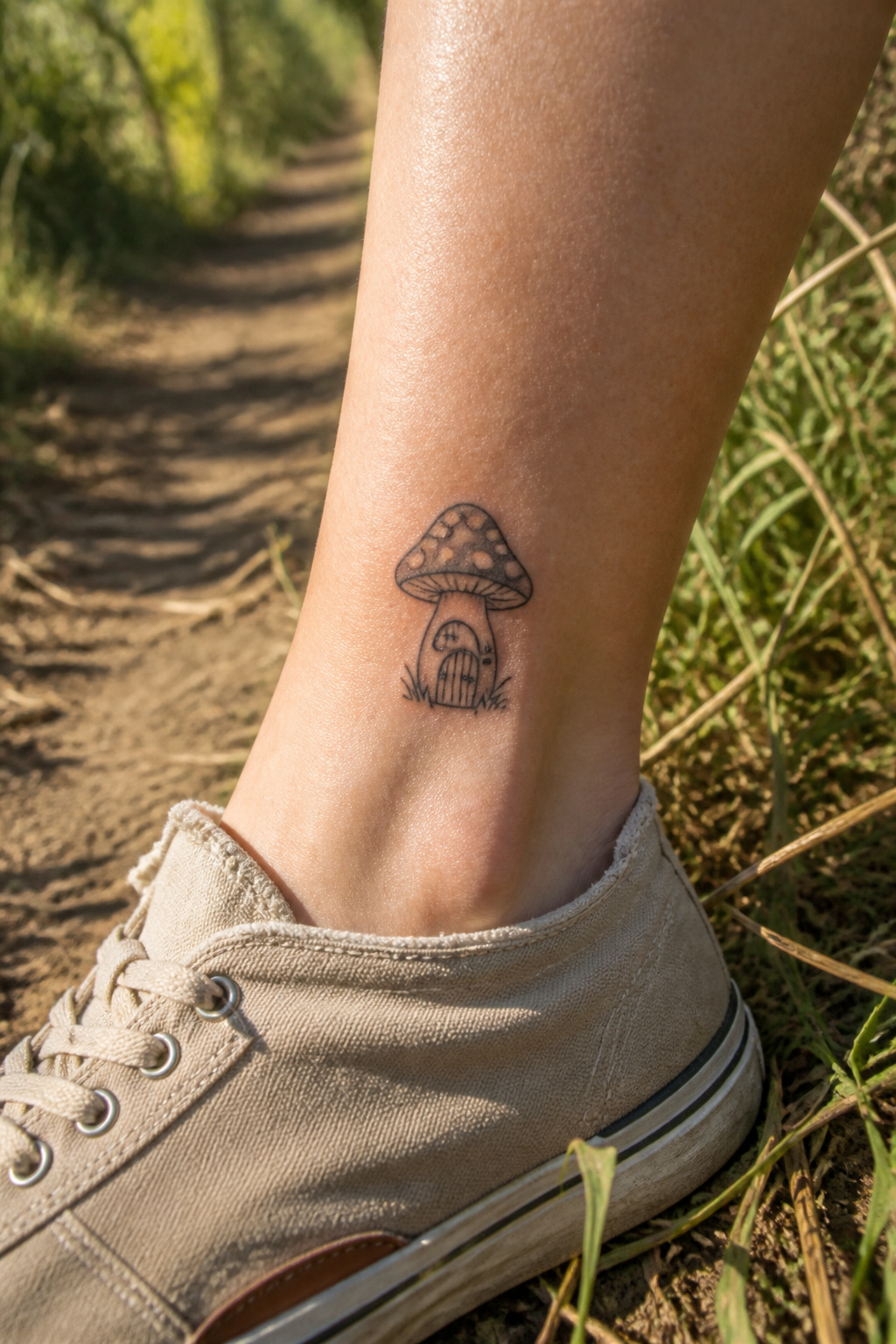
A small mushroom with a door and window sketched into its stem reads as a tiny fairy house rather than a piece of botanical art. The black outline keeps it graphic, and the hollow where cap meets stem gives the design a shallow 3D effect that flat flash rarely achieves. This is the style younger clients gravitate toward when they want something cottagecore without the full pastoral scene.
The appeal is mostly in the scale. A thumb-sized tattoo near the ankle or behind the ear carries the whimsy without demanding much real estate or sitting time. The fairy-house detail is what separates it from the cleaner minimalist mushroom trending elsewhere; it asks the viewer to lean in and notice the joke.
Placement matters more here than with bolder styles. The fine lines in the window and door blur faster on fingers or palms, so the upper arm or calf holds the detail longer. Color is optional, but the black-outline version ages more predictably if your artist tends to pack red too lightly.

Mushroom Window Stickers: Window stickers are printed with colorful mushrooms, butterflies, and green plants, etc. When pasted on the window, it seems to bring a miniature forest secret realm right before your eyes, full of natural beauty (Note: The window stickers are translucent)

Large Fairy Mushroom Privacy Film: This rainbow decorative window cling has leaves, snail and mushroom pattern on it, bringing nature's beauty indoors. The decorative privacy window film are with special 3D design, will create a rainbow visual effect when sunlight shines in, bringing a unique spring film decoration

DAILY MOTIVATION AT EYE-LEVEL - Start every journey with a boost of confidence! Our "Mushroom" and uplifting affirmation decals transform your rearview mirror into a personal inspiration hub, reminding you of your strength and purpose every time you drive.
3. Mario Mushroom Tattoo
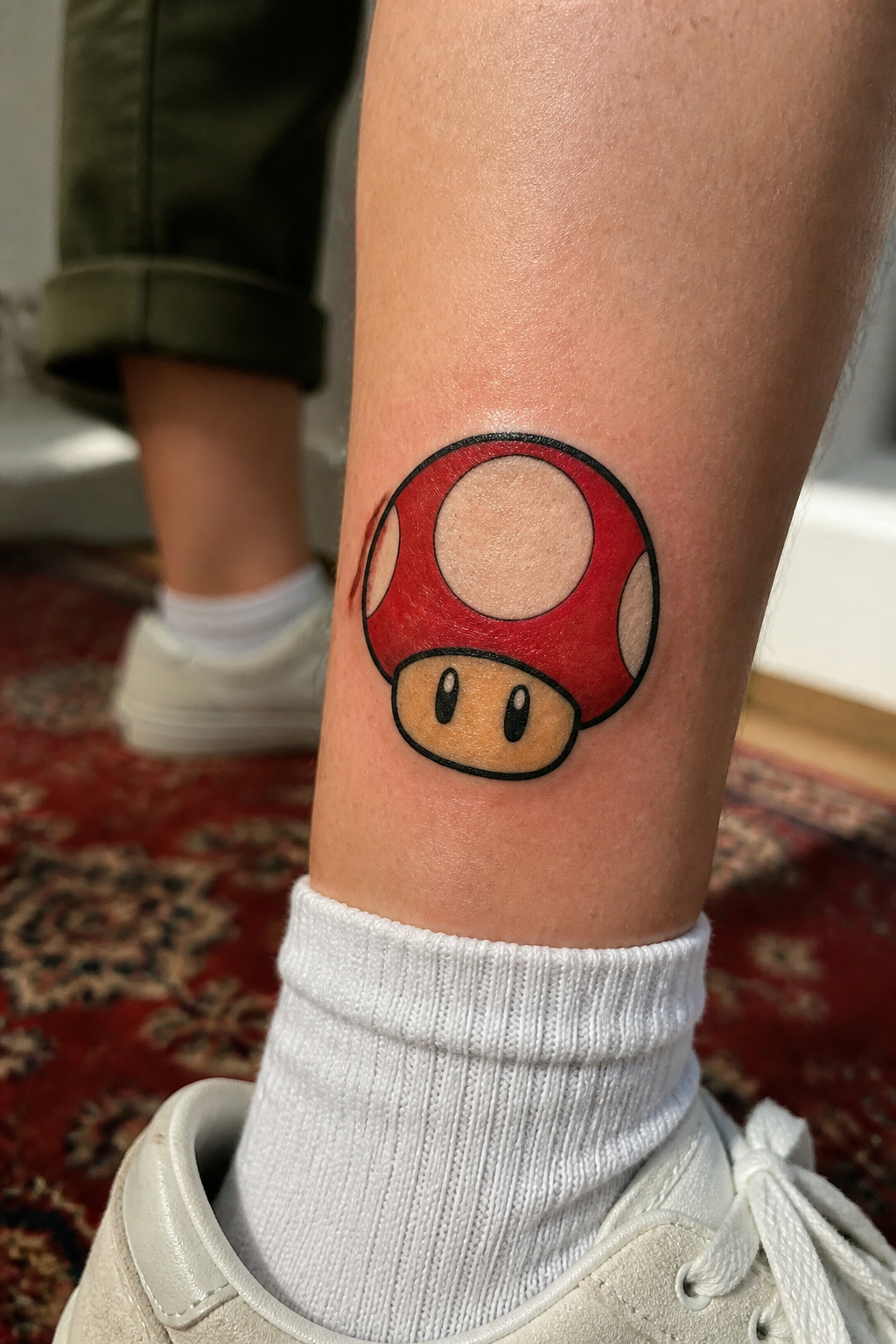
A Mario mushroom tattoo trades the soft browns and muted reds of a forest floor for a bold red cap, two white polka dots, and a thick black outline that reads from across a room. The glistening eyes and rounded shape come straight from the power-up that lets Mario smash through blocks, and that specific nostalgia is the whole point.
Nature-inspired mushroom designs usually chase realism or botanical accuracy. This one does the opposite: it announces itself as game art, flattened and graphic, saturated to the point of vibrating against skin. The yellow accents and cartoon proportions are instantly readable to anyone who held a controller in the nineties, which makes the tattoo work as both personal memory and public signal.
Some artists push the piece toward 3D rendering, adding shading under the cap to make the mushroom look like it could bounce. Others keep it strictly two-dimensional, the way it appeared on a CRT screen. The flat version ages cleaner; heavy black lines hold their weight where soft gradients might blur. Either way, the color palette is non-negotiable. Mute the red or shrink the dots and the reference collapses into a generic toadstool, losing the recognition that justifies the choice.

🌊【210+ Patterns 20 SHEETS Small Temporary Tattoos For Women Men Adults】GOROMON Unique Design Waterproof Realistic Small Tattoos Including 20 Sheets Tiny Cute Mushroom Clover Crescent Moon Geometric Arrow Gem Jewelry Pendant Rose Crown Spider Flower Plant Leaf Snake Butterfly Tattoos For Hand And Tattoos For Fingers.

【Rich Fake Tattoos Kit】- Contains 136 stencils, tattoo ink in 3 colors (Black, Maroon, Cherry Red),3 disposable gloves, 1 pack of cotton swab for smearing. Easily achieve the personalized temporary tattoos

[Tattoo Supplies with Complete Accessories] This complete tattoo machine kit includes 1 wireless pen machine, 20 needles, 1 black ink, 3 practice skins and essential accessories—ideal for beginners and artists seeking a maquina para tatuar
4. Morel Mushroom Tattoo
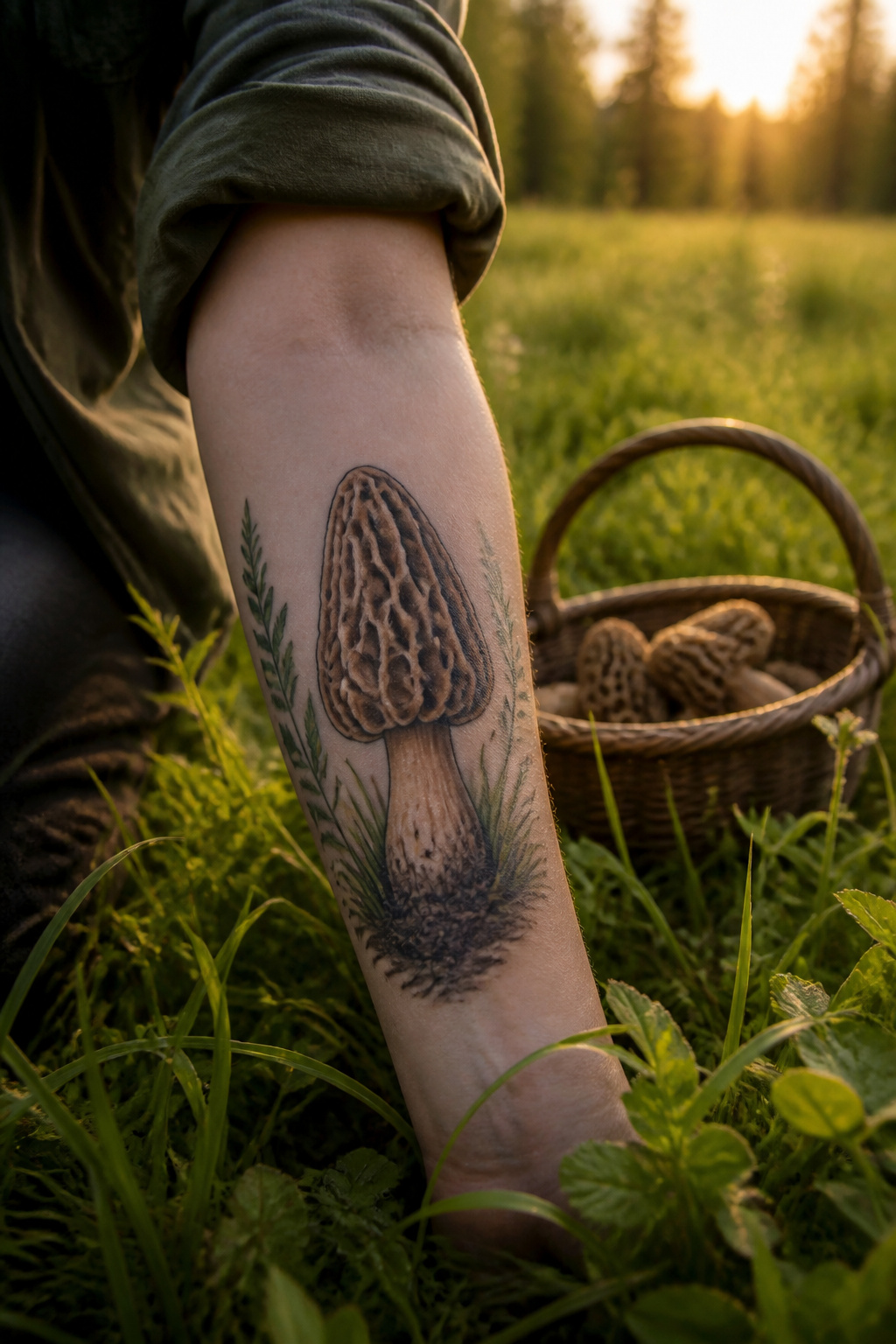
Morel mushrooms carry a particular gravity among people who actually go looking for them. The honeycombed cap and hollow stem are difficult to render in ink, which is exactly why the best morel tattoos look almost photographic. Over 50,000 mushroom species exist, and the foragers who can distinguish the edible few from the rest tend to notice when an artist gets the pore depth wrong or shades the ridges too uniformly.
There are over 50,000 different species of mushrooms, of these mushrooms 50% of them are inedible and indigestible.
That precision matters because the morel audience judges by accuracy first, beauty second. A good design sets the mushroom low in spring grass with the stem slightly buried, the way you actually find them. The color range stays narrow: warm browns, a touch of ochre where light hits the ridges, nothing garish. The tattoo works best at a scale large enough for those pits to read as shadowed rather than merely dark, which usually means the forearm, calf, or a shoulder piece where the vertical stem follows the body’s line.


5. Minimalist Mushroom Tattoo
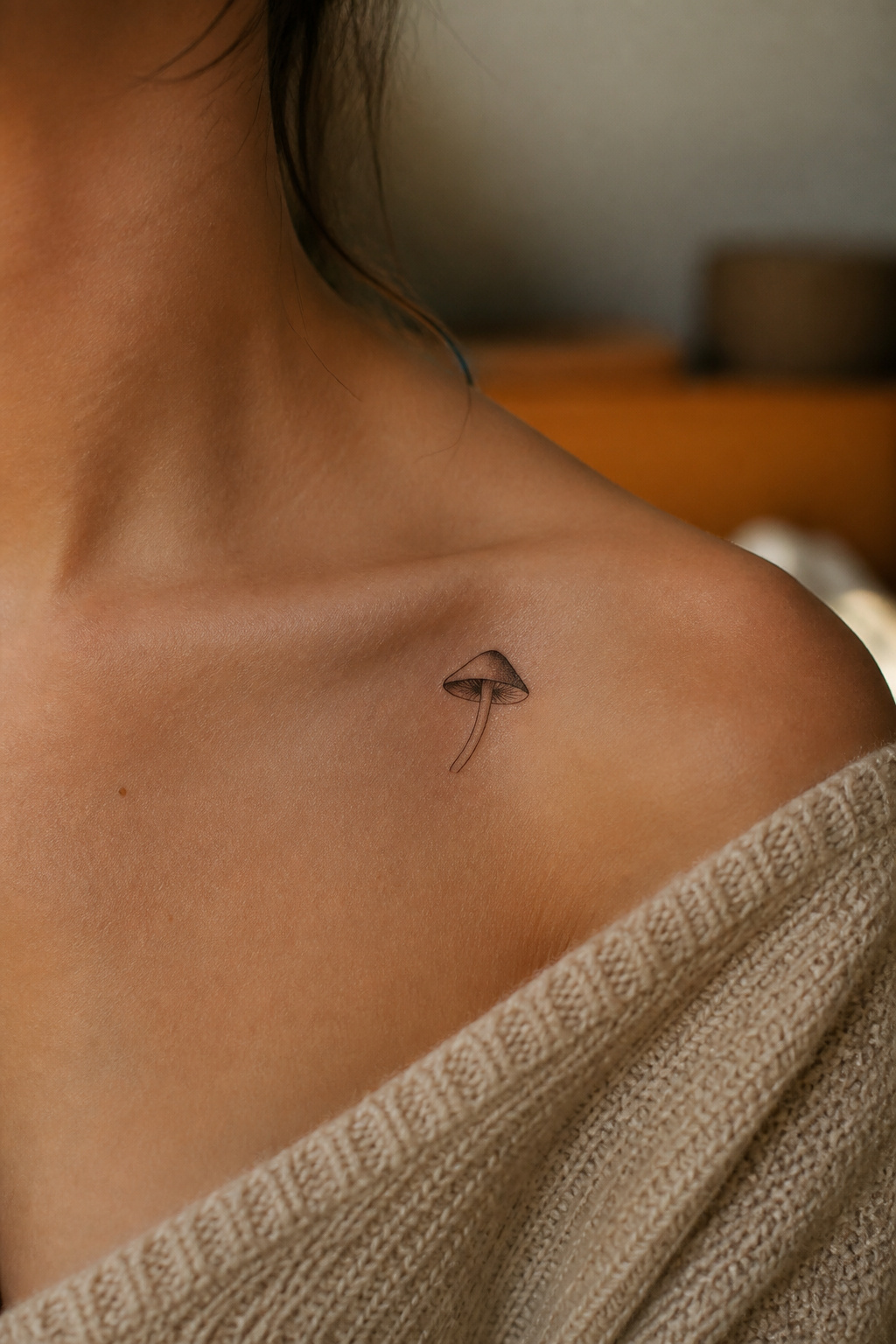
A shaded cap on an outline mushroom keeps the quiet feel of minimalism while adding just enough depth to read as illustration rather than icon. The stem stays clean, the cap carries its tone in a single gradient or crosshatch, and the whole thing stops before it becomes botanical study. This is the version for someone who wants the simplicity but not the flatness of a pure line piece.
Placement follows the same logic as the more stripped-down styles: wrist, behind the ear, collarbone, anywhere the design can stay small and still hold its detail. The shading gives the eye a place to rest, so the tattoo does not disappear into the skin the way an unbroken single line sometimes can. What you lose is the absolute longevity of a line-only piece; tone can soften or spread over years where a contour stays crisp. Two ways to play this: accept the tradeoff for the visual interest now, or keep the outline unshaded and let aging do its own softening. The shaded cap wins if you want the mushroom to look like a drawing rather than a symbol.


6. Traditional Mushroom Tattoo
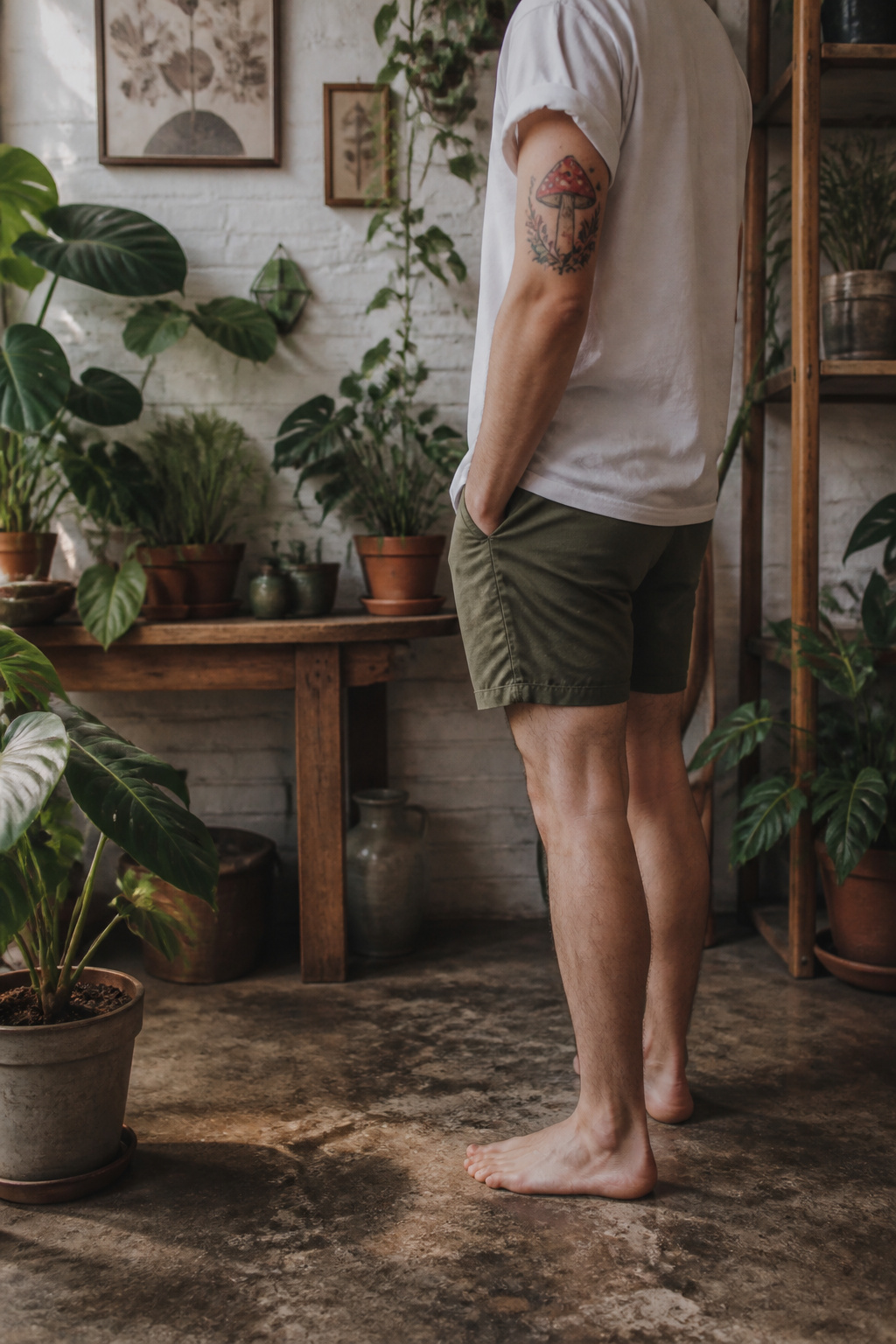
A traditional mushroom tattoo borrows its visual punch from American tattoo conventions that took shape in the mid-20th century: thick black outlines, limited but saturated color, and imagery that reads instantly from across a room. The classic pairing is a red-capped mushroom with a pale stem, often set against a sun or nestled among leaves and flowers that frame the design rather than compete with it.
Natural elements in these pieces typically include curling ferns, small blossoms, or a few simple leaves tucked behind the cap to ground the mushroom in a scene. The color stays bold and flat, no soft shading, with the red cap and brown stem doing most of the work against green foliage. What separates this from a botanical study is the stylization: the mushroom grows larger than life, the sun behind it might have a face, and every line is built to hold its shape for decades. The wearer is usually someone who wants the idea of nature without the fragility, the resilience of fungi rendered in ink that is meant to outlast the skin it sits on.

INCREDIBLE VALUE – 524 Unique Designs: This henna tattoo kit includes 20 stencil sheets with 524 patterns, featuring butterflies, florals, symbols, lettering, totems, and Egyptian-inspired designs. These henna stencils let you mix, match, and layer for custom henna temporary tattoos on hands, arms, and body. A refillable pen with a soft nylon tip is included for precise lines and varied strokes (pen does not include ink)

High quality fashionable temporary tattoo, which looks like real

Tall Skinny Mushrooms Pattern: You will receive a delicate painting stencil which has beautiful patterns in plant theme. There are a few tall skinny mushrooms in grass land patterns on the stencil. Our template is suitable for you to make handmade projects at home.
7. Psychedelic Mushroom Tattoo
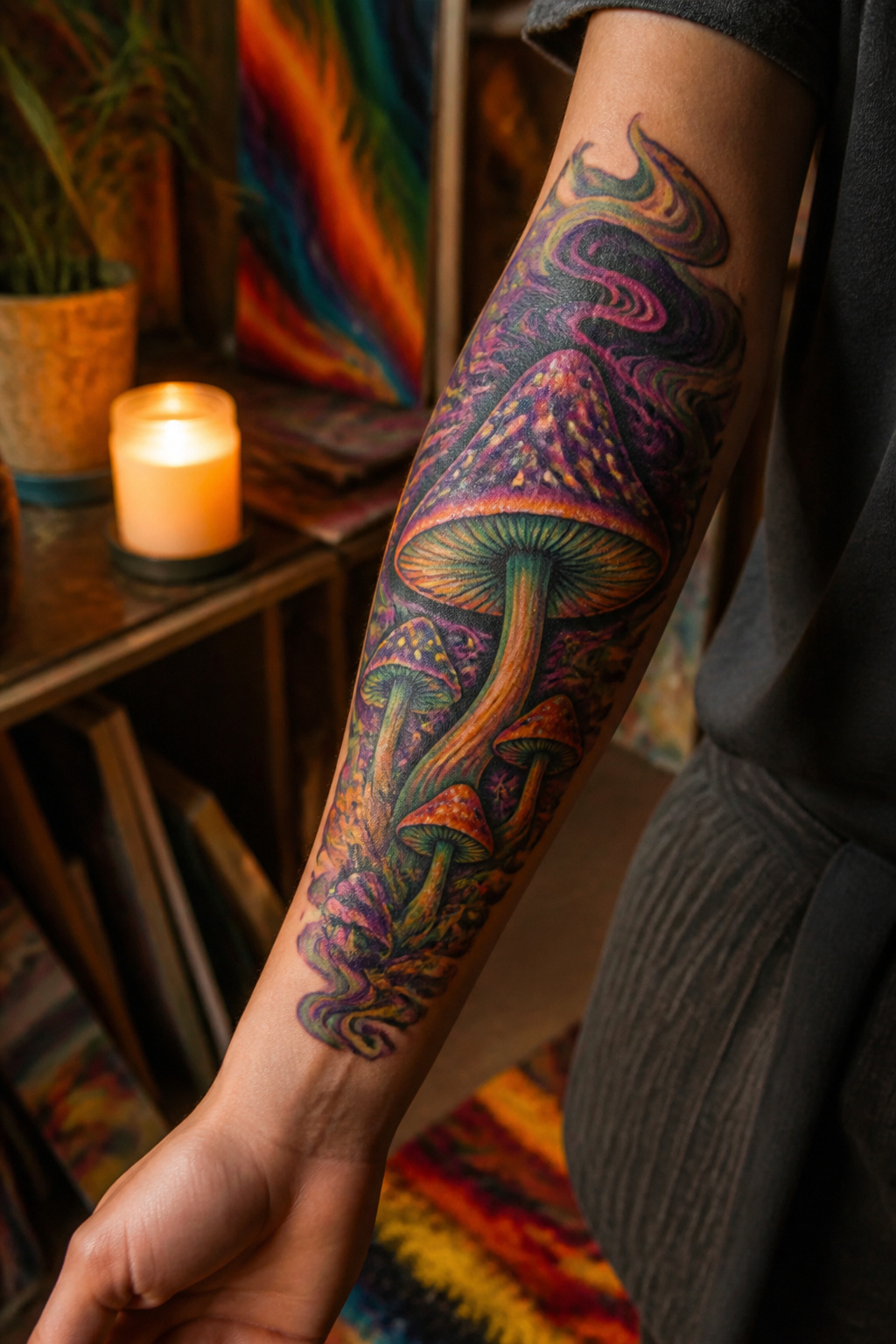
Psychedelic mushroom tattoos lean hard into color and distortion, the kind of piece that makes someone pause and look twice. The palette runs electric: purples bleeding into greens, skies that don’t behave like skies, rays of light that seem to pulse off the skin. About 180 species of hallucinogenic mushrooms exist worldwide, and the names that come up most often in this style’s reference material are Psilocybe cubensis, Psilocybe semilanceata, and Psilocybe azurescens. Artists working this territory borrow from rave culture and 1960s poster art alike, sometimes keeping the mushroom recognizable, sometimes letting it dissolve into pure pattern. The risk is the same as with any highly saturated tattoo: color that reads loud on day one can muddy over time if the saturation was pushed too hard or the skin was overworked. A lighter hand with the trippy elements, letting negative space do some of the hallucinatory work, usually ages cleaner than density everywhere you look.

Mushroom Theme Party Supplies: These cute mushroom tattoos stickers can add more fun to your mushroom themed decor, let you interact more with others, and create unforgettable memories. 12 Sheets mushroom temp tattoos stickers, enough for you to share with your friends or family; The size of each sheet is 6.1 x 4.2 inches.

Stained Glass Window Film Mushroom Design: Bring vibrant color and a touch of nature into your space with this mushroom-themed stained glass window film. The rich hues and whimsical design add personality to any room, all while enhancing privacy and creating an inviting atmosphere.

【Size】: 15.7x118in/40x300cm. Thickness: 0.1mm. The faux stained glass window film provides both privacy and a soft glow to your entryway that fits seamlessly with all types of spaces.
8. Magic Mushroom Tattoo
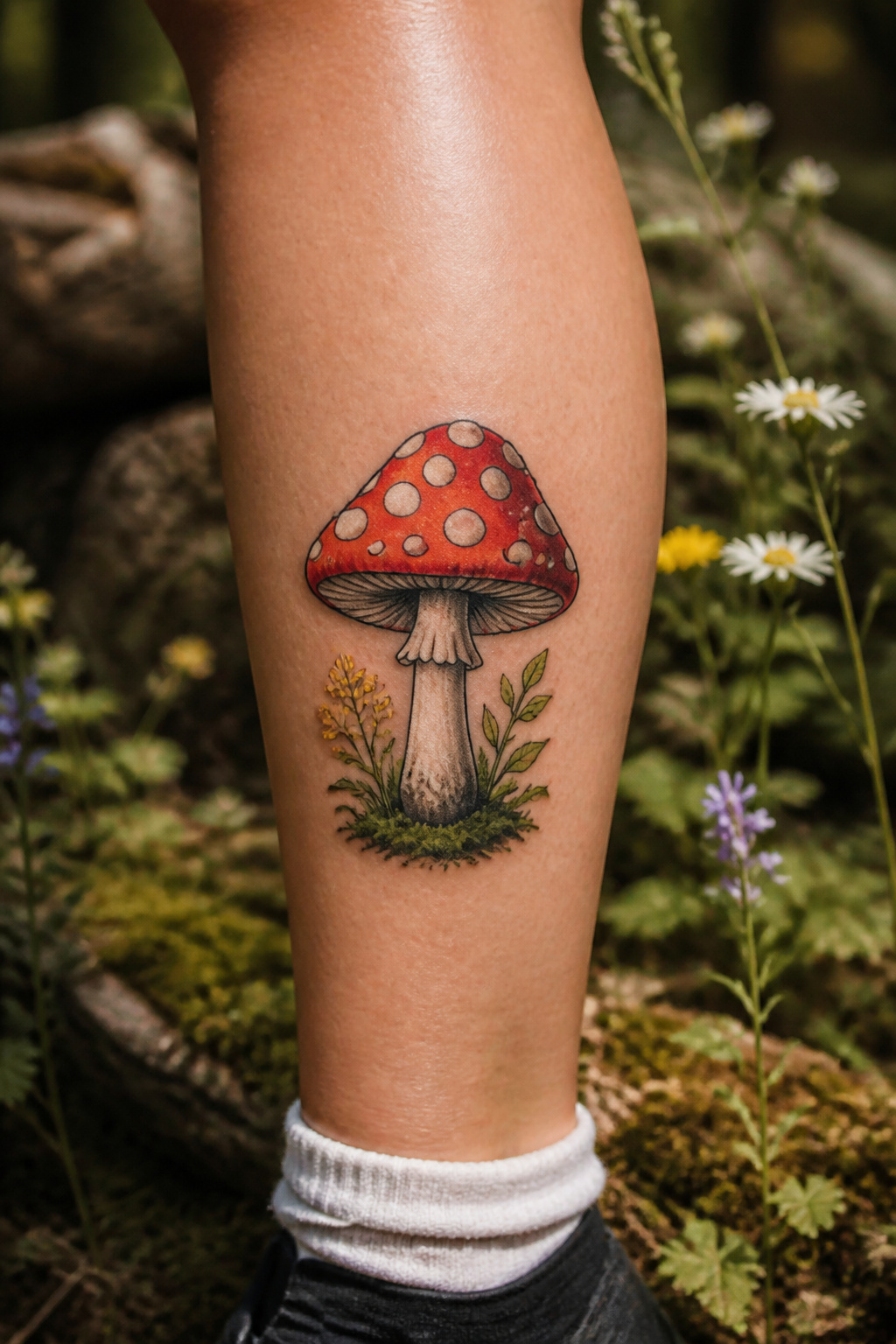
The red cap with white polka dots is the fairy-tale archetype, not the video-game power-up and not the trippy, fractal-laced psychedelic piece. That distinction matters when you sit down with an artist, because three very different moods share similar starting shapes.
Amanita muscaria, the fly agaric, is what every storybook illustrator reaches for: Snow White, Alice, the gnome gardens. The stem bends slightly, thick enough to look hand-drawn rather than digitally perfect, and the black dots around the base in some versions add a little menace without tipping into horror. The wearer who chooses this usually wants the boldness visible from across a room; placement on a forearm or calf keeps that readable scale.
Botanical purists sometimes flinch at the cartoon red, but that is the point. This is not a field guide tattoo. It is the mushroom that signaled "magic" before you could read the word, and the design leans into that recognition rather than fighting it. Add flowers or grass if you want to ground it, though the cap alone already carries the full weight of the reference.

What's Kit Included: Complete tattoo machine kit comes with everything you need to get started and then some, from the stencil printer to tattoo cartridges and practice skin. 1 tattoo stencil printer, 1 adjustable stroke tattoo machine, 10 tattoo needles, 10 transfer papers, 2 practice skins, 40 ink cups, 2*15 ml black tattoo ink, 2 dental bibs, 3 tattoo stickers, a pair of gloves and a easy to carry case.

Light medium and dark greywash shades cover the full range needed for smooth shading transitions and layered depth in black and grey work

【All-in-One Pro Kit, Ready to Use】:This complete set comes equipped with a tattoo kit includes a wireless tattoo pen, 2PCS 1500mAh battery, 20 tattoo needles, tattoo ink, practice skin and other core accessories. Everything you need to start practicing or creating right out of the box—no extra purchases required. Perfect for beginners, apprentices, and professional artists.
9. Watercolor Mushroom Tattoo
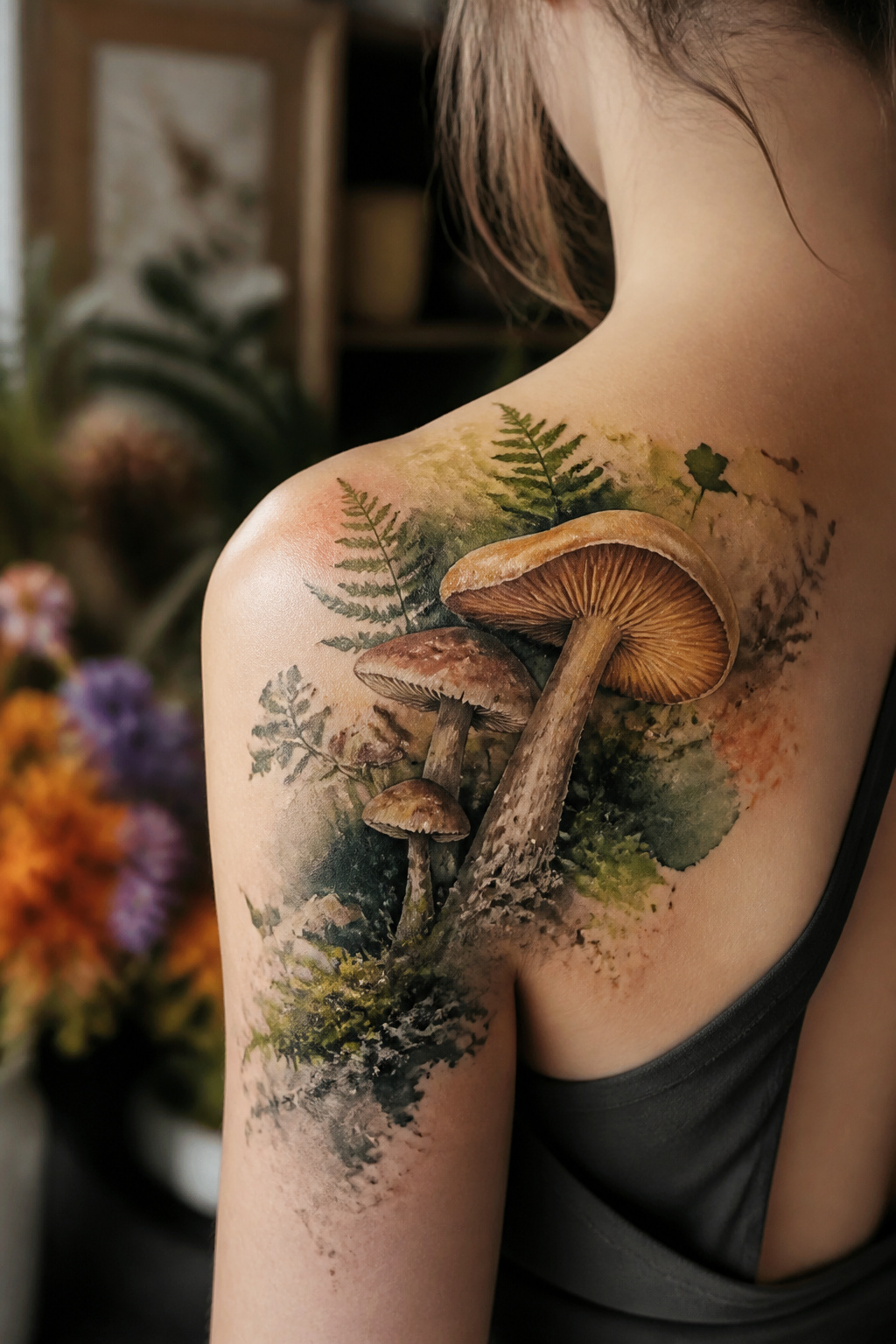
Watercolor mushroom tattoos lean into softness the way a field guide illustration never would. Pigments bloom and layer across the cap, warm ochres bleeding into mossy greens, washes of pink or indigo catching where the light would hit a damp forest floor. The edges stay loose, almost dissolving, so the whole piece reads like pigment on paper rather than ink locked behind a hard border.
That looseny is exactly why the style suits mushrooms so well. Their organic forms, the way a cap curves over gills or a stem narrows to nothing, flow naturally into watercolor’s refusal to hold a line. Healing asks more patience than a traditional outline, since the blurred edges can muddy slightly during recovery and the final wash settles only after the skin fully calms. Where a bold neo-traditional mushroom keeps its shape through scabbing, watercolor needs the full three to four weeks before you know whether the atmospheric effect held or faded into a bruised suggestion of what was planned.
Artists who work this style often build in moss, drifting spores, or leaf litter around the main form, letting the storybook quality carry the composition. The result sits closer to a small painting than to tattooing’s usual graphic punch, which makes it a particular fit for someone who wants the subject to feel found in nature rather than stamped on top of it.
10. Tribal Mushroom Tattoo
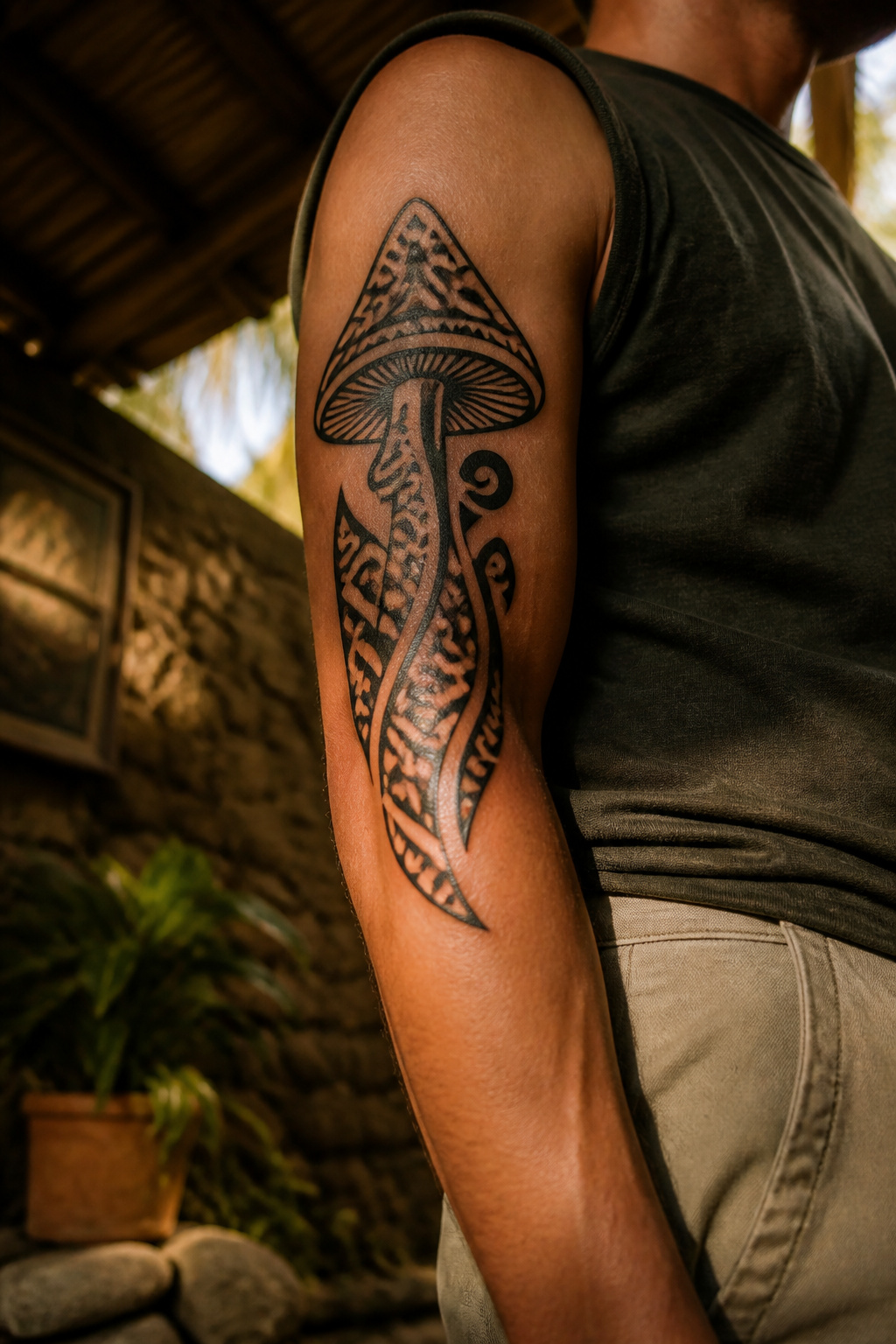
Bold black lines and repeating geometric patterns turn the mushroom into something that reads from across a room. Thick tribal silhouettes hold up for decades, which matters more than fine detail when you are choosing a placement with scale, like the upper arm, chest, or down the spine.
Celtic knotwork and Norse runic patterns both pair naturally with the shape. In those traditions, mushrooms carried associations with fairies and the hidden world, the kind of folklore that makes the design feel less like a nature illustration and more like a protective emblem. Dots and spirals can suggest spores or the mycelial network beneath the forest floor without breaking the rhythmic symmetry that makes tribal work feel balanced.
The Maori koru spiral and Haida-style forms are specific directions to ask about if you want something tied to actual Indigenous visual language rather than a generic geometric look. Not every artist works in those traditions, and the ones who do will tell you whether your reference holds up or drifts into watered-down imitation.


11. Clean Line Minimalist Mushroom Tattoo
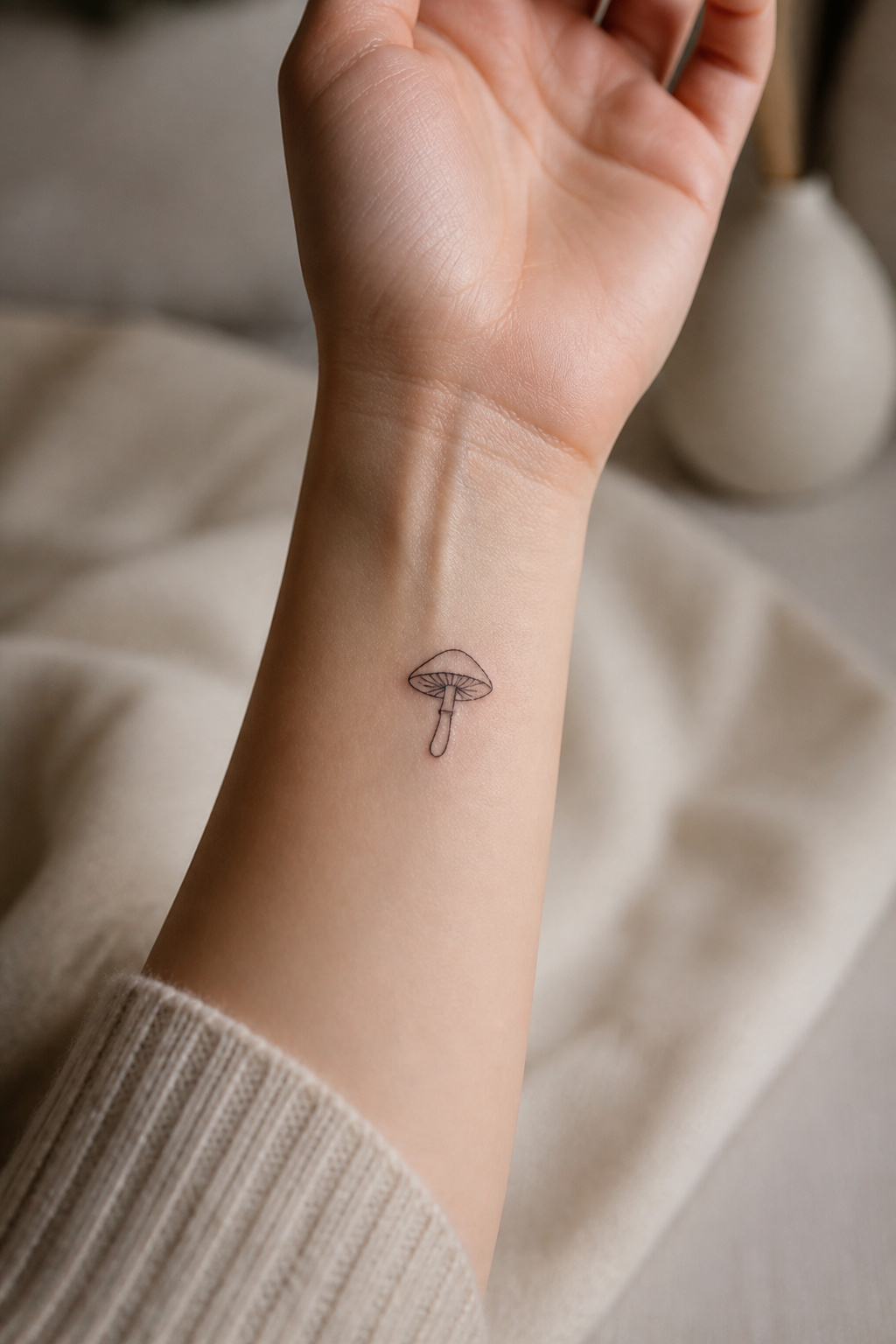
Clean line minimalist mushroom tattoos rely on skin tone as the only color and un-inked space as deliberate shape rather than leftover background. The mushroom cap might be outlined in a single continuous stroke, with the gill pattern formed by nothing more than the skin showing through between two curved lines. This differs from standard minimalism, which often reduces detail but still fills silhouettes or adds a wash of flat pigment. Here, the absence of ink does the descriptive work.
The technique asks more of the artist’s needle control. A wobble in a one-weight line has nowhere to hide, and the decision to stop a stroke before it closes a shape, to let the viewer’s eye finish the form, is a judgment call that separates spare from unfinished. Placement matters more too. On denser melanin, the contrast between black line and skin reads differently; what looks airy on pale forearms can disappear or read as accidental gaps elsewhere. The style suits someone who wants the idea of a mushroom, its recognizability, without carrying the weight of a rendered object.
12. Geometric Mushroom Tattoo
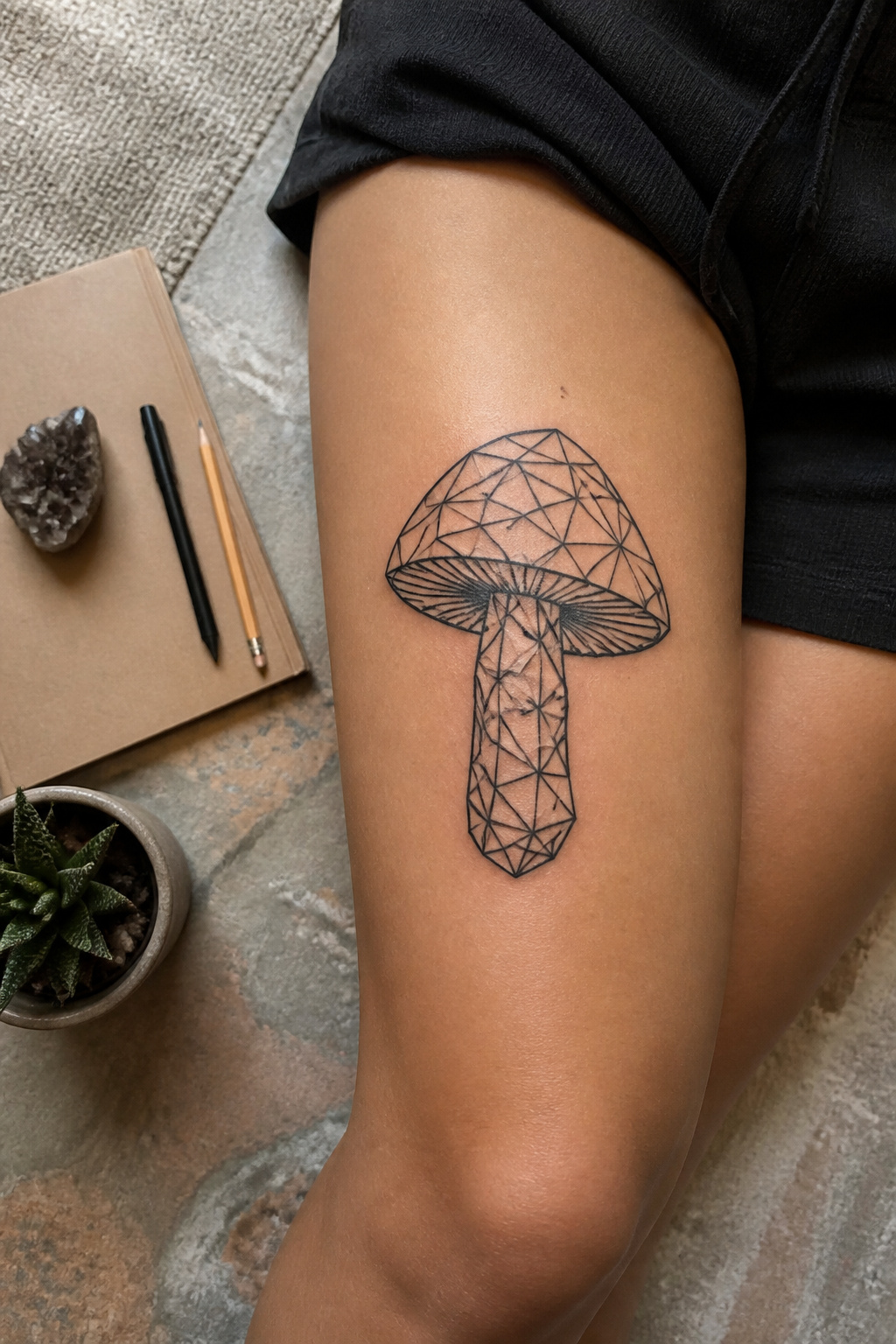
A geometric mushroom tattoo takes the soft, irregular curves of a real fungus and locks them into angular, mathematical structures. Interlocking triangles can form the whole silhouette, or crystalline facets might replace the gills beneath the cap. The appeal sits in that tension: something that grows wild and rotting rendered as clean, permanent geometry.
The style draws two kinds of collectors. Younger clients often arrive wanting the fractal-patterned or cubist versions, something that reads as visionary or psychedelic without the literalness of a magic mushroom piece. Older collectors tend toward the sacred geometry mandala format, where the mushroom becomes a meditation object, symmetrical and contained.
Placement matters more here than with softer styles. A geometric mushroom needs flat skin and enough scale for the lines to stay crisp. The forearm, upper chest, or a flat section of thigh work; fingers and the side of the neck usually fight the precision this style demands.
The risk is overcomplication. A design packed with too many overlapping planes will blur inside five years, especially on areas that see sun or movement. The versions that last keep the geometry bold and the negative space generous, letting the mushroom shape breathe inside the math.
What Mushroom Tattoos Mean
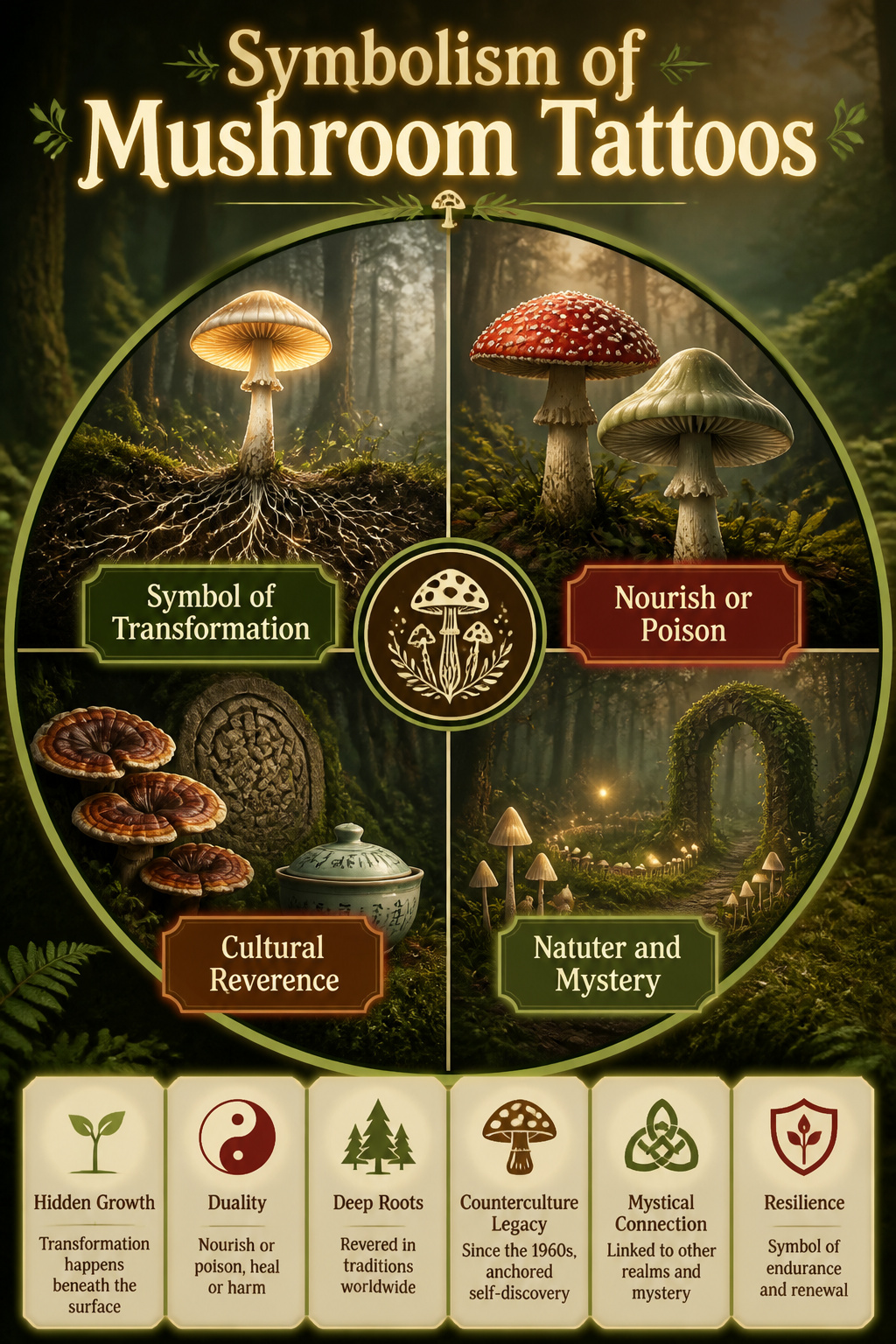
A mushroom tattoo carries weight because the word itself means to develop rapidly, and that growth is rarely visible until the fruiting body pushes through. The mycelium beneath has already done the quiet work. That hidden network is why the image works for marking personal transformation or recovery; the wearer knows the struggle came before anyone could see it.
The duality matters too. Mushrooms nourish or poison, heal or harm, and that tension makes the symbol richer than a simple positive emblem. A design can lean either way, or hold both.
Culturally, the associations layer deep. Forest-dwelling cultures and shamanic traditions have long revered fungi. Celtic and Norse folklore placed mushrooms at fairy rings, thresholds to other realms. Chinese medicine treated them as emblems of longevity. Since the 1960s, the psychedelic variety anchored counterculture and self-discovery. What draws someone in 2026 is usually one thread pulled from that whole weave: nature, mystery, resilience, or the refusal to be only one thing.
Where to Put One
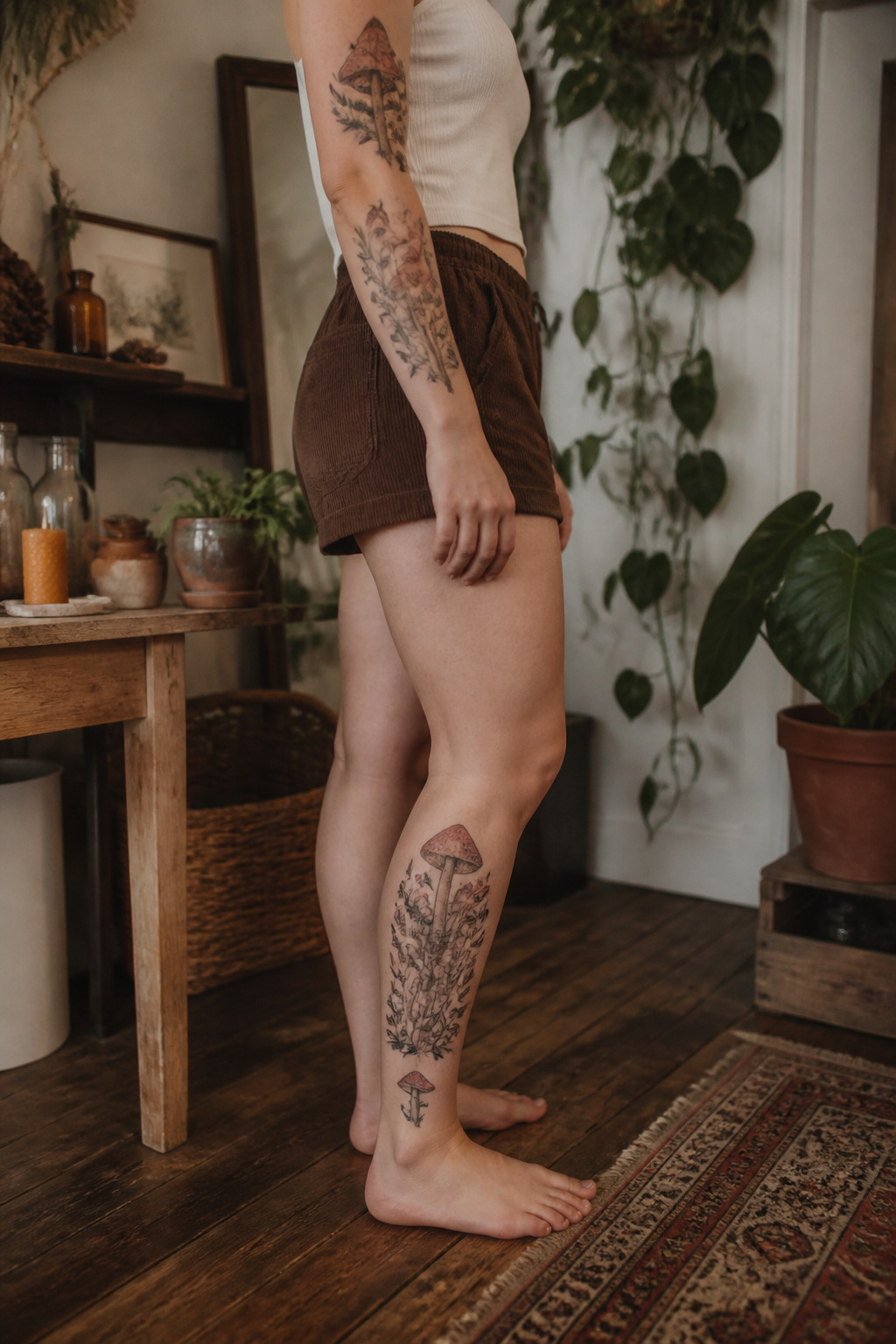
Compact, vertical shapes and a clear cap-and-stem silhouette mean mushrooms read well on the forearm or calf, where a single piece stays legible or a small cluster can grow into an organic sleeve or band. The thigh and ribcage open up room for larger illustrative work, roots and moss included, if the goal is a storytelling piece rather than a standalone icon. Size decides this more than subject: anything under two inches loses detail fast on a ribcage, while a six-inch composition with surrounding flora cramps on a wrist. Small mushroom tattoos work best behind the ear, on the ankle, or along the finger, where delicate line work and negative space keep the design refined rather than muddied. I have seen the same morel design stretched to cover a shoulder and shrunk to sit on a collarbone; the smaller version held up because the artist stripped it to outline and shadow, not because the subject itself saved it.
Who Gets Them and Why
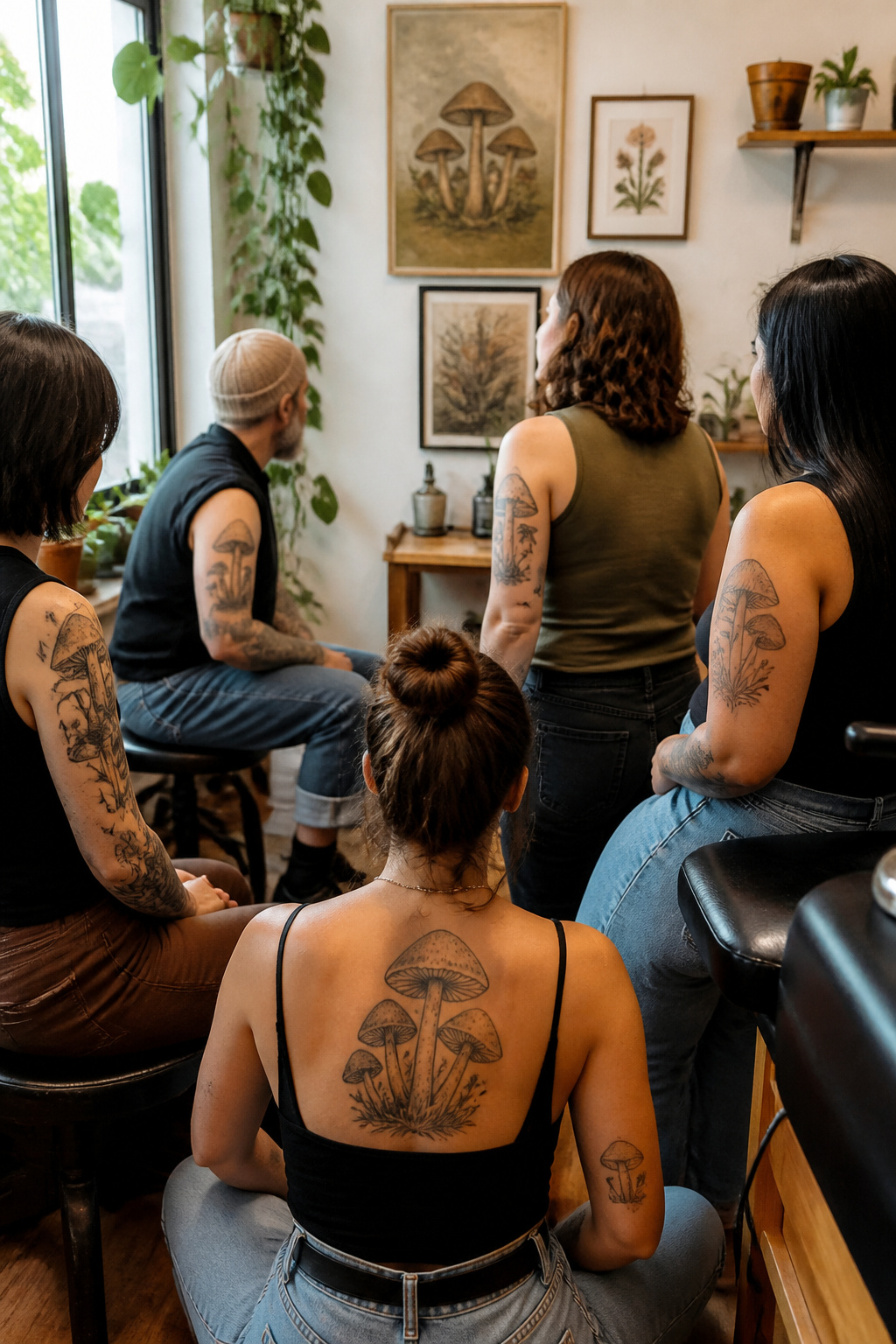
Nature enthusiasts and science-minded clients were the first wave I noticed, drawn to mycelium’s hidden networks and the botanical precision a good artist can render in ink. A mycologist friend of mine spent three sessions on a morel that tracks the actual gill structure of the species she studies; the tattoo functions as both credential and inside joke with her field crew.
Counterculture communities have carried mushroom imagery since the 1960s, though today’s psychedelic references tend toward subtler geometry than the day-glo clichés. What surprised me was how often people mark recovery or major life change with the same motif, treating the mushroom’s overnight emergence after rain as a private metaphor for regrowth.
The demographic spread is wider than most subjects I have watched in shops. Younger clients lean cottagecore or whimsical, wanting fairy-ring compositions and Amanita muscaria caps in soft color. Older collectors often commission botanical studies, sometimes building entire sleeves of native forest species with Latin labels tucked into the design. The symbol’s flexibility carries it across age groups: a single small piece reads as playful, while a technically accurate cluster signals serious intent. First-timers and experienced collectors both find footing here, which is rarer than shop talk suggests.
Frequently Asked Questions
What do mushroom tattoos symbolize?
Mushroom tattoos symbolize personal growth, transformation, and resilience. The hidden mycelium network doing its work before the fruiting body appears mirrors recovery or change that happens out of sight. The duality also matters: mushrooms nourish or poison, heal or harm, so the symbol can hold both tensions at once.
Are mushroom tattoos popular among certain groups?
Nature enthusiasts, science-minded clients, and counterculture communities gravitate toward mushroom tattoos most strongly. Mycologists sometimes commission species-accurate pieces, while people marking recovery or major life change use the overnight emergence of mushrooms as a private metaphor. The demographic spread is unusually wide, spanning cottagecore younger clients to older collectors building botanical sleeves.
Can I customize my mushroom tattoo design?
Yes, mushroom tattoos adapt to almost any style or personal reference you want to include. The article covers twelve distinct directions, from Mario power-ups and watercolor washes to tribal geometry and fairy-tale Amanita muscaria caps, each carrying a different mood. You can also add surrounding elements like ferns, moss, spores, or Latin species labels depending on whether you want whimsy, scientific accuracy, or spiritual weight.